Manesh Samuel John
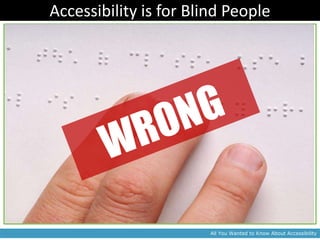
Accessibility is for Blind People


                        All You Wanted to Know About Accessibility
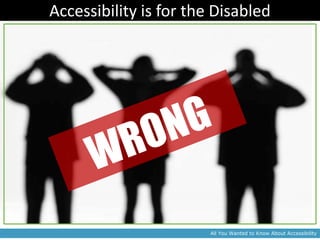
Accessibility is for the Disabled


                        All You Wanted to Know About Accessibility
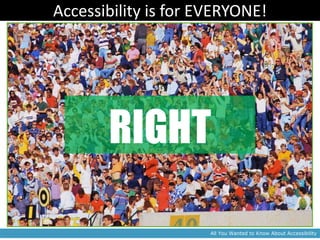
Accessibility is for EVERYONE!


       RIGHT

                      All You Wanted to Know About Accessibility
So what’s Accessibility?
As per the dictionary, Accessibility means:
• Convenience
• Easy of access
• User-friendliness
• Easy of understanding
• Easy of use

   Persons with disabilities are the most hit with
                 accessibility issues!

                                    All You Wanted to Know About Accessibility
Disabled = Everyone!
Its about time we do some reality check on the term
disabled!
  HEARING                                       MOBILITY
  Deaf: can’t hear                              Physical disability: unable to move one or
  Hard-of-hearing or hearing impaired:          more limbs, fingers, or toes
  can hear only with amplification or can       Motor skills impairment:
  hear in one ear only                          unable to press one key at a time, unable
                                                to press a key without duplicate
                                                keystrokes, unable to use a mouse


  VISION                                        LEARNING
  Blind: can’t see                              Dyslexia: difficulty with reading
  Visually-impaired: can’t read small type or
  distinguish certain colors
  Color-blind: can’t distinguish certain
  colors


                                                                All You Wanted to Know About Accessibility
Let’s look at some real life examples
•     People using a wheel chair
•     Those using a white cane
•     Those wearing hearing aids
•     Those using crutches

    These are the first instances that come to our mind! But what about..

•     Forgetting glasses at home - finding it complicated to work on the computer
•     With age, each one of us acquires some sort of disabilities including;
     •    memory loss,
     •    hard-of-hearing,
     •    deteriorating vision ,
     •    adversity in climbing stairs, etc


     In our every day life we all face impairments, activity limitations, and
                                   participations!

                                                          All You Wanted to Know About Accessibility
So the point is ...


“Disability is a socially created problem and not an
              attribute of an individual”


                                   All You Wanted to Know About Accessibility
Did You Know


1 out of every 5 people in the United States has a
                learning disability


                                 All You Wanted to Know About Accessibility
All You Wanted to Know About Accessibility
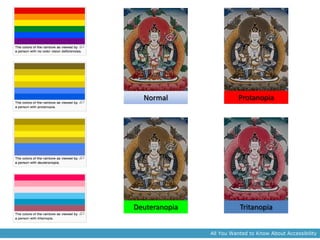
Normal                  Protanopia


Deuteranopia              Tritanopia


               All You Wanted to Know About Accessibility
Did You Know…
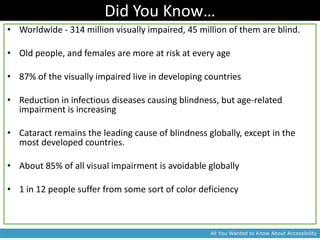
• Worldwide - 314 million visually impaired, 45 million of them are blind.

• Old people, and females are more at risk at every age

• 87% of the visually impaired live in developing countries

• Reduction in infectious diseases causing blindness, but age-related
  impairment is increasing

• Cataract remains the leading cause of blindness globally, except in the
  most developed countries.

• About 85% of all visual impairment is avoidable globally

• 1 in 12 people suffer from some sort of color deficiency


                                                   All You Wanted to Know About Accessibility
Did You Know


 One in five have a hearing difficulty or impairment.


Source: MS Forrester Report 2004
                                            All You Wanted to Know About Accessibility
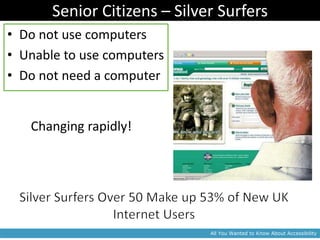
Senior Citizens – Silver Surfers
• Do not use computers
• Unable to use computers
• Do not need a computer


   Changing rapidly!


                              All You Wanted to Know About Accessibility
Who is your target audience?


                      All You Wanted to Know About Accessibility
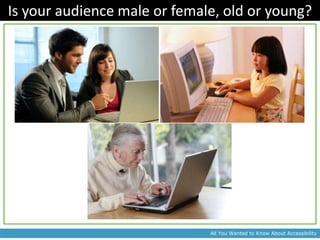
Is your audience male or female, old or young?


                              All You Wanted to Know About Accessibility
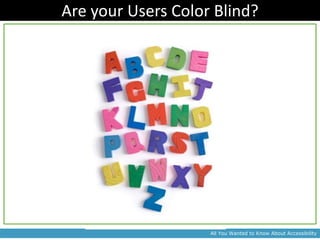
Are your Users Color Blind?


                    All You Wanted to Know About Accessibility
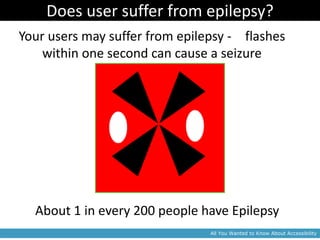
Does user suffer from epilepsy?
Your users may suffer from epilepsy - 3 flashes
    within one second can cause a seizure


  About 1 in every 200 people have Epilepsy
                                 All You Wanted to Know About Accessibility
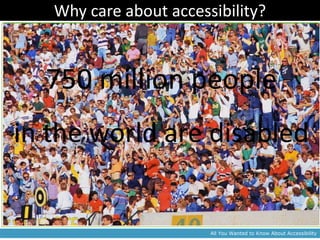
Why care about accessibility?


  750 million people
in the world are disabled


                        All You Wanted to Know About Accessibility
How do people use the web?


                    All You Wanted to Know About Accessibility
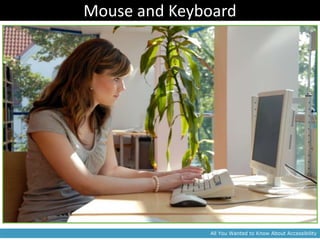
Mouse and Keyboard


              All You Wanted to Know About Accessibility
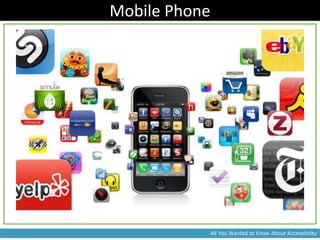
Mobile Phone


               All You Wanted to Know About Accessibility
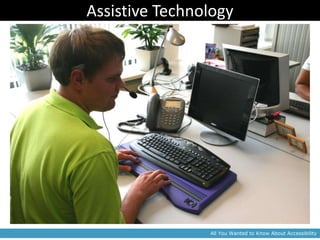
Assistive Technology


                All You Wanted to Know About Accessibility
What is Assistive Technology (AT)?

   AT refers to any "product, device, or equipment,
       whether acquired commercially, modified or
 customized, that is used to maintain, increase, or
  improve the functional capabilities of individuals
                                   with disabilities."


Source: http://www.section508.gov/docs/AT1998.html


                                                         All You Wanted to Know About Accessibility
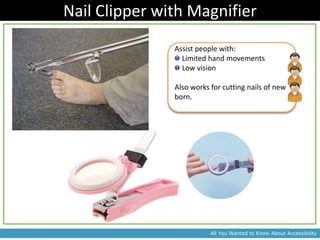
Nail Clipper with Magnifier
               Assist people with:
                 Limited hand movements
                 Low vision

               Also works for cutting nails of new
               born.


                          All You Wanted to Know About Accessibility
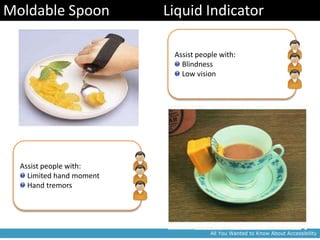
Moldable Spoon            Liquid Indicator

                           Assist people with:
                             Blindness
                             Low vision


  Assist people with:
    Limited hand moment
    Hand tremors


                                      All You Wanted to Know About Accessibility
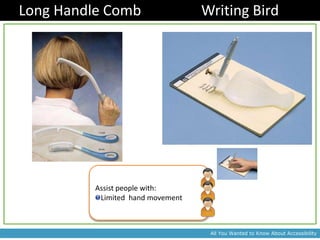
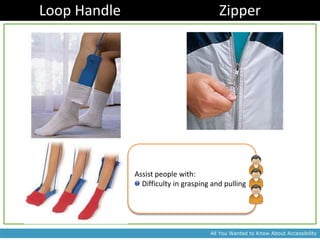
Long Handle Comb                  Writing Bird


         Assist people with:
          Limited hand movement


                                   All You Wanted to Know About Accessibility
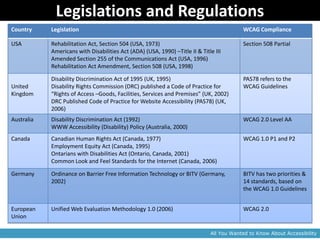
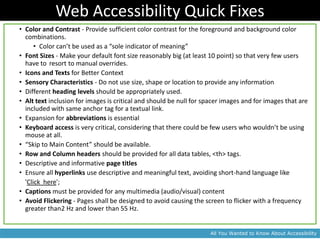
Loop Handle                              Zipper


              Assist people with:
                Difficulty in grasping and pulling


                                      All You Wanted to Know About Accessibility
Legislations and Regulations
Country     Legislation                                                                   WCAG Compliance

USA         Rehabilitation Act, Section 504 (USA, 1973)                                   Section 508 Partial
            Americans with Disabilities Act (ADA) (USA, 1990) –Title II & Title III
            Amended Section 255 of the Communications Act (USA, 1996)
            Rehabilitation Act Amendment, Section 508 (USA, 1998)

            Disability Discrimination Act of 1995 (UK, 1995)                              PAS78 refers to the
United      Disability Rights Commission (DRC) published a Code of Practice for           WCAG Guidelines
Kingdom     “Rights of Access –Goods, Facilities, Services and Premises” (UK, 2002)
            DRC Published Code of Practice for Website Accessibility (PAS78) (UK,
            2006)
Australia   Disability Discrimination Act (1992)                                          WCAG 2.0 Level AA
            WWW Accessibility (Disability) Policy (Australia, 2000)
Canada      Canadian Human Rights Act (Canada, 1977)                                      WCAG 1.0 P1 and P2
            Employment Equity Act (Canada, 1995)
            Ontarians with Disabilities Act (Ontario, Canada, 2001)
            Common Look and Feel Standards for the Internet (Canada, 2006)

Germany     Ordinance on Barrier Free Information Technology or BITV (Germany,            BITV has two priorities &
            2002)                                                                         14 standards, based on
                                                                                          the WCAG 1.0 Guidelines


European    Unified Web Evaluation Methodology 1.0 (2006)                                 WCAG 2.0
Union

                                                                              All You Wanted to Know About Accessibility
Web Accessibility Quick Fixes
• Color and Contrast - Provide sufficient color contrast for the foreground and background color
  combinations.
      • Color can’t be used as a “sole indicator of meaning”
• Font Sizes - Make your default font size reasonably big (at least 10 point) so that very few users
  have to resort to manual overrides.
• Icons and Texts for Better Context
• Sensory Characteristics - Do not use size, shape or location to provide any information
• Different heading levels should be appropriately used.
• Alt text inclusion for images is critical and should be null for spacer images and for images that are
  included with same anchor tag for a textual link.
• Expansion for abbreviations is essential
• Keyboard access is very critical, considering that there could be few users who wouldn’t be using
  mouse at all.
• “Skip to Main Content” should be available.
• Row and Column headers should be provided for all data tables, <th> tags.
• Descriptive and informative page titles
• Ensure all hyperlinks use descriptive and meaningful text, avoiding short-hand language like
  'Click here';
• Captions must be provided for any multimedia (audio/visual) content
• Avoid Flickering - Pages shall be designed to avoid causing the screen to flicker with a frequency
  greater than2 Hz and lower than 55 Hz.


                                                                    All You Wanted to Know About Accessibility

All you wanted to Know about Accessibility

  • 1.
  • 2.
    Accessibility is forBlind People All You Wanted to Know About Accessibility
  • 3.
    Accessibility is forthe Disabled All You Wanted to Know About Accessibility
  • 4.
    Accessibility is forEVERYONE! RIGHT All You Wanted to Know About Accessibility
  • 5.
    So what’s Accessibility? Asper the dictionary, Accessibility means: • Convenience • Easy of access • User-friendliness • Easy of understanding • Easy of use Persons with disabilities are the most hit with accessibility issues! All You Wanted to Know About Accessibility
  • 6.
    Disabled = Everyone! Itsabout time we do some reality check on the term disabled! HEARING MOBILITY Deaf: can’t hear Physical disability: unable to move one or Hard-of-hearing or hearing impaired: more limbs, fingers, or toes can hear only with amplification or can Motor skills impairment: hear in one ear only unable to press one key at a time, unable to press a key without duplicate keystrokes, unable to use a mouse VISION LEARNING Blind: can’t see Dyslexia: difficulty with reading Visually-impaired: can’t read small type or distinguish certain colors Color-blind: can’t distinguish certain colors All You Wanted to Know About Accessibility
  • 7.
    Let’s look atsome real life examples • People using a wheel chair • Those using a white cane • Those wearing hearing aids • Those using crutches These are the first instances that come to our mind! But what about.. • Forgetting glasses at home - finding it complicated to work on the computer • With age, each one of us acquires some sort of disabilities including; • memory loss, • hard-of-hearing, • deteriorating vision , • adversity in climbing stairs, etc In our every day life we all face impairments, activity limitations, and participations! All You Wanted to Know About Accessibility
  • 8.
    So the pointis ... “Disability is a socially created problem and not an attribute of an individual” All You Wanted to Know About Accessibility
  • 9.
    Did You Know 1out of every 5 people in the United States has a learning disability All You Wanted to Know About Accessibility
  • 10.
    All You Wantedto Know About Accessibility
  • 11.
    All You Wantedto Know About Accessibility
  • 12.
    All You Wantedto Know About Accessibility
  • 13.
    Normal Protanopia Deuteranopia Tritanopia All You Wanted to Know About Accessibility
  • 14.
    Did You Know… •Worldwide - 314 million visually impaired, 45 million of them are blind. • Old people, and females are more at risk at every age • 87% of the visually impaired live in developing countries • Reduction in infectious diseases causing blindness, but age-related impairment is increasing • Cataract remains the leading cause of blindness globally, except in the most developed countries. • About 85% of all visual impairment is avoidable globally • 1 in 12 people suffer from some sort of color deficiency All You Wanted to Know About Accessibility
  • 15.
    Did You Know One in five have a hearing difficulty or impairment. Source: MS Forrester Report 2004 All You Wanted to Know About Accessibility
  • 16.
    Senior Citizens –Silver Surfers • Do not use computers • Unable to use computers • Do not need a computer Changing rapidly! All You Wanted to Know About Accessibility
  • 17.
    Who is yourtarget audience? All You Wanted to Know About Accessibility
  • 18.
    Is your audiencemale or female, old or young? All You Wanted to Know About Accessibility
  • 19.
    Are your UsersColor Blind? All You Wanted to Know About Accessibility
  • 20.
    Does user sufferfrom epilepsy? Your users may suffer from epilepsy - 3 flashes within one second can cause a seizure About 1 in every 200 people have Epilepsy All You Wanted to Know About Accessibility
  • 21.
    Why care aboutaccessibility? 750 million people in the world are disabled All You Wanted to Know About Accessibility
  • 22.
    How do peopleuse the web? All You Wanted to Know About Accessibility
  • 23.
    Mouse and Keyboard All You Wanted to Know About Accessibility
  • 24.
    Mobile Phone All You Wanted to Know About Accessibility
  • 25.
    Assistive Technology All You Wanted to Know About Accessibility
  • 26.
    What is AssistiveTechnology (AT)? AT refers to any "product, device, or equipment, whether acquired commercially, modified or customized, that is used to maintain, increase, or improve the functional capabilities of individuals with disabilities." Source: http://www.section508.gov/docs/AT1998.html All You Wanted to Know About Accessibility
  • 27.
    Nail Clipper withMagnifier Assist people with: Limited hand movements Low vision Also works for cutting nails of new born. All You Wanted to Know About Accessibility
  • 28.
    Moldable Spoon Liquid Indicator Assist people with: Blindness Low vision Assist people with: Limited hand moment Hand tremors All You Wanted to Know About Accessibility
  • 29.
    Long Handle Comb Writing Bird Assist people with: Limited hand movement All You Wanted to Know About Accessibility
  • 30.
    Loop Handle Zipper Assist people with: Difficulty in grasping and pulling All You Wanted to Know About Accessibility
  • 31.
    Legislations and Regulations Country Legislation WCAG Compliance USA Rehabilitation Act, Section 504 (USA, 1973) Section 508 Partial Americans with Disabilities Act (ADA) (USA, 1990) –Title II & Title III Amended Section 255 of the Communications Act (USA, 1996) Rehabilitation Act Amendment, Section 508 (USA, 1998) Disability Discrimination Act of 1995 (UK, 1995) PAS78 refers to the United Disability Rights Commission (DRC) published a Code of Practice for WCAG Guidelines Kingdom “Rights of Access –Goods, Facilities, Services and Premises” (UK, 2002) DRC Published Code of Practice for Website Accessibility (PAS78) (UK, 2006) Australia Disability Discrimination Act (1992) WCAG 2.0 Level AA WWW Accessibility (Disability) Policy (Australia, 2000) Canada Canadian Human Rights Act (Canada, 1977) WCAG 1.0 P1 and P2 Employment Equity Act (Canada, 1995) Ontarians with Disabilities Act (Ontario, Canada, 2001) Common Look and Feel Standards for the Internet (Canada, 2006) Germany Ordinance on Barrier Free Information Technology or BITV (Germany, BITV has two priorities & 2002) 14 standards, based on the WCAG 1.0 Guidelines European Unified Web Evaluation Methodology 1.0 (2006) WCAG 2.0 Union All You Wanted to Know About Accessibility
  • 32.
    Web Accessibility QuickFixes • Color and Contrast - Provide sufficient color contrast for the foreground and background color combinations. • Color can’t be used as a “sole indicator of meaning” • Font Sizes - Make your default font size reasonably big (at least 10 point) so that very few users have to resort to manual overrides. • Icons and Texts for Better Context • Sensory Characteristics - Do not use size, shape or location to provide any information • Different heading levels should be appropriately used. • Alt text inclusion for images is critical and should be null for spacer images and for images that are included with same anchor tag for a textual link. • Expansion for abbreviations is essential • Keyboard access is very critical, considering that there could be few users who wouldn’t be using mouse at all. • “Skip to Main Content” should be available. • Row and Column headers should be provided for all data tables, <th> tags. • Descriptive and informative page titles • Ensure all hyperlinks use descriptive and meaningful text, avoiding short-hand language like 'Click here'; • Captions must be provided for any multimedia (audio/visual) content • Avoid Flickering - Pages shall be designed to avoid causing the screen to flicker with a frequency greater than2 Hz and lower than 55 Hz. All You Wanted to Know About Accessibility

Editor's Notes

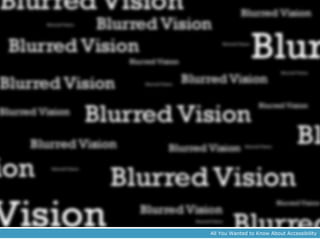
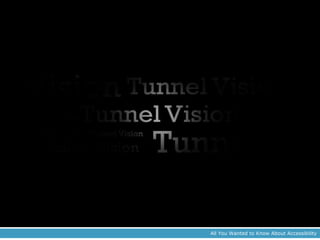
  • #11 Simulation for blindness
  • #12 Simulation for blindness
  • #15 Reference: WHOColor blindness is most commonly a lack of distinction between the colors red and green. It is not generally a lack of seeing all colors (this is extremely rare). It is usually inherited.
  • #16 Reference: WHO
  • #17 http://www.smh.com.au/news/technology/web/rise-of-the-silver-surfer/2008/12/16/1229189620630.htmlhttp://news.suite101.com/article.cfm/silver-surfers-over-50-make-up-53-of-new-uk-internet-users-a256562
  • #22 Need some more information80% of disabled people live in developing countries 10% of the population in poor countries is disabled 1 in every 10 children around the world copes with a disability Only 2–3% of disabled children in poor countries go to school
  • #26 A blind user using refereshablebraille display
  • #30 http://www.disabilityproducts.com/cgi-bin/disabilityproducts.cgi/scan/fi=products/st=db/co=1/sf=additional_categories/se=Dressing%20%26%20Grooming%20Aids/op=rm/nu=0/ml=50/tf=description/to=x.html?mv_session_id=LidHpc2L&amp;mv_pc=84&amp;header=Dressing%20%26%20Grooming%20Aids