All India Institute of Medical
Sciences - AIIMS
Presented by:
Rabeendra Basnet
Ansarinagar, New Delhi
Introduction
• AIIMS New Delhi is governed by the All India
Institute of Medical Sciences Act, 1956.
• The institute has a hospital with 1766
beds, 1323 doctors including.
• The hospital facilities cater to about 1.5
million outpatients and 80,000
inpatients , 100,000 surgeries every
year.
Objectives of AIIMS
• To develop a pattern of teaching in
undergraduate and postgraduate medical
education in all its branches so as to demonstrate
high standard of medical education to all medical
colleges and other allied institutions in India.
• To bring together in one place educational
facilities of the highest order for the training of
the personnel in all important branches of the
health activity.
• To attain self sufficiency in postgraduate in
medical education.
Functions of AIIMS
• Undergraduate and postgraduate teaching in
medical and related physical biological sciences.
• Nursing and dental education
• Innovations in education.
• Producing medical teachers for the country.
• Research in medical and related sciences.
• Health care : preventive, promotive and curative;
primary, secondary & tertiary.
• Community based teaching and research
Departments
• Anaesthesiology
• Anatomy
• Biochemistry
• Biomedical Engineering
• Biophysics
• Biostatistics
• Biotechnology
• Cardiology
• Centre for Community Medicine
• College of Nursing
• Dermatology & Venereology
• Dietetics
• Emergency Medicine
• Endocrinology, Metabolism &
Diabetes
• Forensic Medicine and Toxicology
• Geriatric Medicine
• Gastroenterology and Human
Nutrition
• Gastrointestinal Surgery
• Haematology
• Hospital Administration
• Laboratory Medicine
• Medicine
• Microbiology
• Nephrology
• Nuclear Medicine
• Nuclear Magnetic Resonance
Imaging
• Obstetrics and Gynaecology
• Orthopaedics
• Otorhinolaryngology
• Finance Division
Departments
• Paediatrics
• Paediatric Surgery
• Pathology
• Pharmacology
• Physiology
• Physical Medicine &
Rehabilitation
• Psychiatry
• Pulmonary Medicine and Sleep
Disorders
• Radio Diagnosis
• Reproductive Biology
• Research Section
• Surgical Disciplines
• Transplant Immunology &
Immunogenetics
• Transfusion Medicine (Blood Bank)
• Urology
• Academic Section
Specialty Centers
Cardio-Thoracic Sciences Centre
• Cardiothoracic Sciences Centre began functioning in the
new building in 1982 after 4 years In 1986 the Centre
became fully independent and functioned entirely from the
new 7 floor building.
The Cardiothoracic Centre has the following departments.
• Cardiology
• Cardiac Anaesthesiology
• Cardiac Pathology
• Cardiac Radiology
• Cardiothoracic & Vascular Surgery
• Cardiac Biochemistry
• ORBO & Stem Cell Facility
• Hospital Administration (CNC)
• Nuclear Medicine
• The department has 102 beds exclusively for
cardiovascular Surgery.
• There are two Intensive Care Units of 16 & 18
beds. There are seven operating rooms fully
equipped for any cardiovascular surgical
procedure.
• The general wards contain 34 beds each on
two floors. In addition there are 14 private
rooms (paying wards) both for Cardiology and
Cardiovascular Surgery.
• The office of the faculty are on the 7thfloor.
Centre for Dental Education and Research
• Department of Conservative Dentistry and Endodontics
• Department of Orthodontics and Dentofacial Deformities
• Department of Pediatric and Preventive Dentistry
Neurosciences Centre
The Neurosciences Centre consists of the Departments of :-
• Neurology
• Neuro-Surgery
• Neuro Anaesthesiology
• Neuro Biochemistry
• Neuro Pathology
• Neuro Psychology
• Neuro Radiology
Major Centres of AIIMS
Dr. R.P Centre for Ophthalmic Sciences
• Dr. Rajendra Prasad Centre for Ophthalmic
Sciences is an integral part of AIIMS and was
created in 1967 as a National Institute of
Ophthalmology to ensure maximized
interdisciplinary benefits and holistic patient care.
• As the Apex Institution under the National
Programme for Control of Blindness ( NPCB ), it
was the first Centre of its kind started at the
AIIMS more than 38 years ago, followed by the
other super-speciality Centres later at the
Institute.
Dr. B.R.A Institute-Rotary Cancer
Hospital
• Institute Rotary Cancer Hospital (DR. B.R.A. Institute Rotary
Cancer Hospital) started functioning in 1983-84 on 35 beds
with infrastructure of 2 floors.
• Recently it has been converted into a 200 bedded, 7th floor
building. Prime Minister of India Sh. Atal Bihari Vajpayee,
inaugurated this centre on October 5, 2003.
• Best of radiodiagnostic and radiotherapy machines including
state of art linear accelerator, brachytherapy, stereotactic
radiotherapy and intensity modulated radiotherapy are
available at this centre.
• Vaccum assisted advanced mammography unit, first of its
kind in India, has made stereotactic breast biopsy possible.
Prostate cancer can be diagnosed at an early stage with help
of transrectal sextant biopsy. Radio frequency ablation of liver
cancer has also been initiated.
National Drug Dependence Treatment
Center
The Drug Dependence Treatment Centre, AIIMS was established in the year
1988 and was functional from the premises of the Deen Dayal Upadhyay
Hospital, New Delhi. In 2003 it was upgraded as the National Centre (National
Drug Dependence Treatment Centre) and is fully operational from its new
premises in Ghaziabad since April 2003.
The centre has been involved in:
• Assessing magnitude of drug abuse in the country.
• Providing clinical care to patients - hospital and community based -
through daily OPD, special clinics, ward and community clinics in urban-
slums of Delhi.
• Health education
• Manpower development – training of several categories of staff
• Establishment of laboratory to detect drugs of abuse in body fluids and
health damage.
• Documentation, publication of resource material and creation of
database.
• Research.
Jai Prakash Narayan Apex Trauma
Center
• The centre became fully functional on 26 November, 2007 when the
casualty (emergency department) was thrown open to general
public.
• The total cost of constructing the centre was Rs 132 crores, and it is
spread over an area of 20,600 sq metres and seven storeys that
consist of five operation theatres, 152 inpatient and 30 casualty
beds, including 26 ICU beds to provide both pre-hospital and
emergency care.
• The centre also acts as a referral hospital, where patients sent by
zonal public hospitals and satellite trauma centers will be observed
and treated.
• 957 staff, including doctors, resident doctors, nurses and technical
staff from specialties like neurosurgery, orthopedics, cardio-thoracic
and vascular surgery, general surgery and plastic surgery were
initially recruited to make the trauma centre functional.
• A helipad is also planned on top of the building for transporting
critically ill patients.
DEPARTMENTS
• Anesthesia & CC
• Emergency Medicine
• Forensic Medicine
• Laboratory Medicine
• Neuroanaesthesia
• Neurosurgery
• Orthopedics
• Radiology
• Trauma Surgery
• Information Technology
Central Facilities
B.B. Dikshit Library
Central Animal Facility
Computer Facility
Central Workshop
EHS
Electron Microscope Facility
K.L. Wig CMET
Medical Social & Welfare Services
National Poisons Information Centre
Organ Retrieval Banking Organisation
Patent Cell
Stem Cell Facility
Telemedicine Facility
Transport Facility
Other facilities
 Facilities provided in private ward - Each room has - attached
toilets & bath room, T.V. with cable connection, Refrigerator, A.C.,
sofas, bed for attendant, chairs and table, geyser, emergency light,
phone with incoming facility etc.
 Day care facility is available for certain types of operations. e.g.
laproscopic surgery; day care chemotherapy; blood transfusion,
dialysis, endoscopies and similar interventions.
 ICUs The hospital has fully equipped Main ICU at 8th Floor, AB wing
to provide expert ICU care. There are ICUs/HDUs in few wards of
main hospital and CTVS ICU & NS ICU in CN Centre. Patients
requiring urgent ICU care are admitted to ICUs at the discretion of
treating Doctors.
 Blood Bank:- AIIMS has a licensed modern, state of the art Blood
Bank that functions 24 hours a day and provides facilities for blood
donation, storage, issue of blood and its components. Strict
precautions are taken and testing is done to prevent any borne
infection. If your patient requires blood transfusions, then you are
requested to arrange healthy blood donors for donating blood in
order to reduce shortage of blood.
Medical College
The AIIMS offers various courses at different levels. All in all 42 disciplines are taught
at AIIMS. The different categories include :
Undergraduate Courses (UG) Postgraduate Courses (PG)
MBBS MD,MS & MDS
B.Sc.(Hons.)Human Biology: DM & MCh
B.Sc.Courses in Nursing,
Audiometry,Ophthalmic, Techniques
and Radiography
Master's Degree in Science (M Sc)
Master's Degree in Biotechnology (M
Biotech)
Doctor of Philosophy (Ph D)
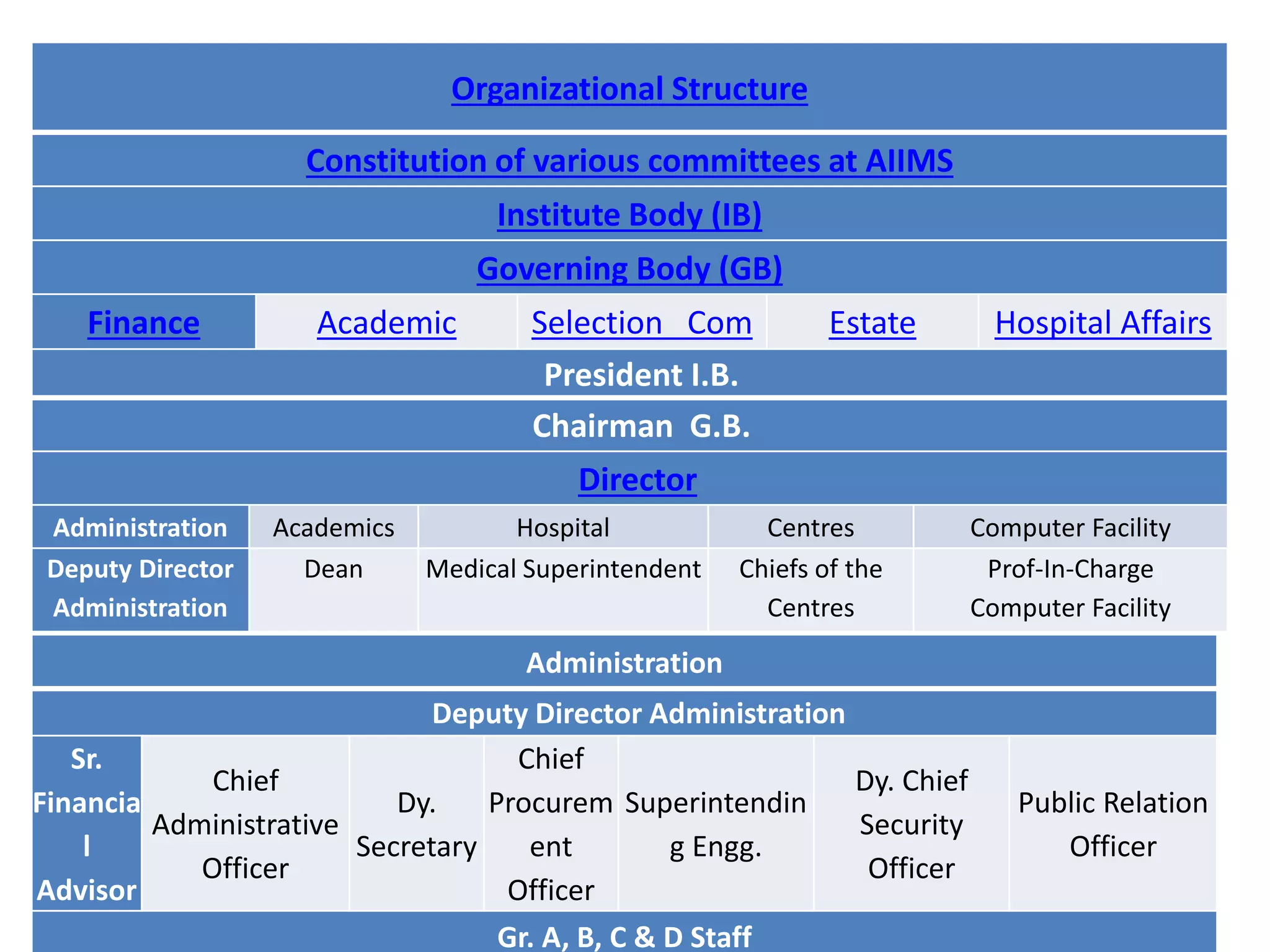
Organizational Structure
Constitution of various committees at AIIMS
Institute Body (IB)
Governing Body (GB)
Finance
Committee
Academic
Committee
Selection Com
mittee
Estate
Committee
Hospital Affairs
CommitteePresident I.B.
Chairman G.B.
Director
Administration Academics Hospital Centres Computer Facility
Deputy Director
Administration
Dean Medical Superintendent Chiefs of the
Centres
Prof-In-Charge
Computer Facility
Administration
Deputy Director Administration
Sr.
Financia
l
Advisor
Chief
Administrative
Officer
Dy.
Secretary
Chief
Procurem
ent
Officer
Superintendin
g Engg.
Dy. Chief
Security
Officer
Public Relation
Officer
Gr. A, B, C & D Staff
Academics
Dean
Sub Dean
Registrar
Examination
Section
Head of Departments
Academic Section
Faculty
Addl. Prof
P
r
o
f
e
s
s
o
r
Academic Section Asstt. Prof. Assoc. Prof. Assoc. Prof.
Computer Facility
Prof-In-Charge Computer Facility
System Analyst
Senior Programmer
Programmer
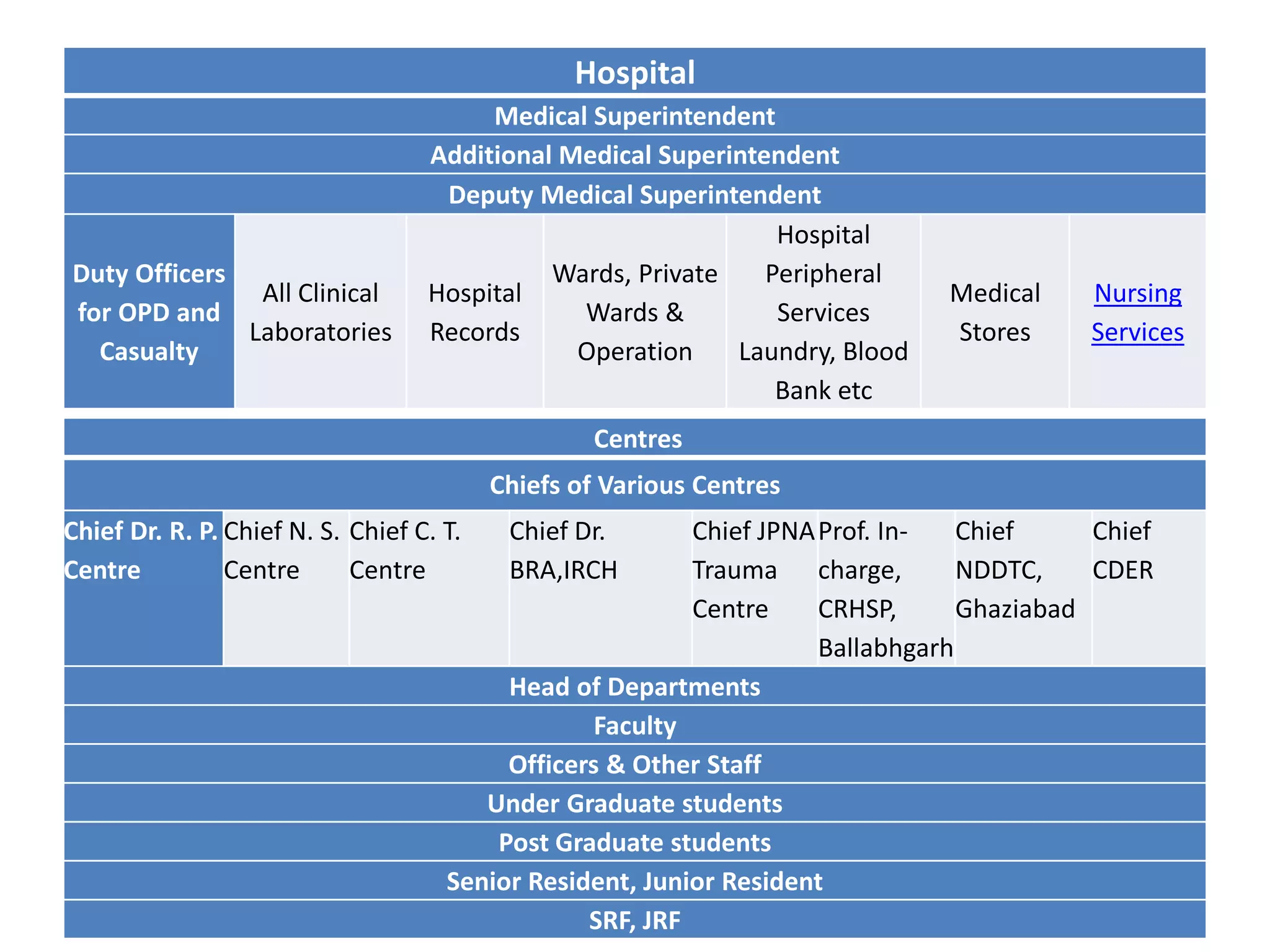
Hospital
Medical Superintendent
Additional Medical Superintendent
Deputy Medical Superintendent
Duty Officers
for OPD and
Casualty
All Clinical
Laboratories
Hospital
Records
Wards, Private
Wards &
Operation
Hospital
Peripheral
Services
Laundry, Blood
Bank etc
Medical
Stores
Nursing
Services
Centres
Chiefs of Various Centres
Chief Dr. R. P.
Centre
Chief N. S.
Centre
Chief C. T.
Centre
Chief Dr.
BRA,IRCH
Chief JPNA
Trauma
Centre
Prof. In-
charge,
CRHSP,
Ballabhgarh
Chief
NDDTC,
Ghaziabad
Chief
CDER
Head of Departments
Faculty
Officers & Other Staff
Under Graduate students
Post Graduate students
Senior Resident, Junior Resident
SRF, JRF
Patient Care :
• Sophisticated medical and surgical care among the best in
the world. The most satisfying aspect of this endeavour is
that these cutting-edge modalities are being actually used
for the poor.
• It has over 1500 spread over the main hospital, Dr.
Rajendra Prasad Centre for Ophthalmic sciences,
Cardiothoracic Centre, Neurosciences Centre, Institute
Rotary Centre Hospital and De-addiction Centre. This
complex of facilities caters to about 1.5 million outpatients
and 80,000 inpatients every year .The number of surgical
operations performed at AIIMS last year was over 100,000.
• The first heart transplant patient in India, operated on 3
August 1994 at AIIMS.
• Laser treatment at Dr.Rajendra Prasad Centre for
Ophthalmic Sciences
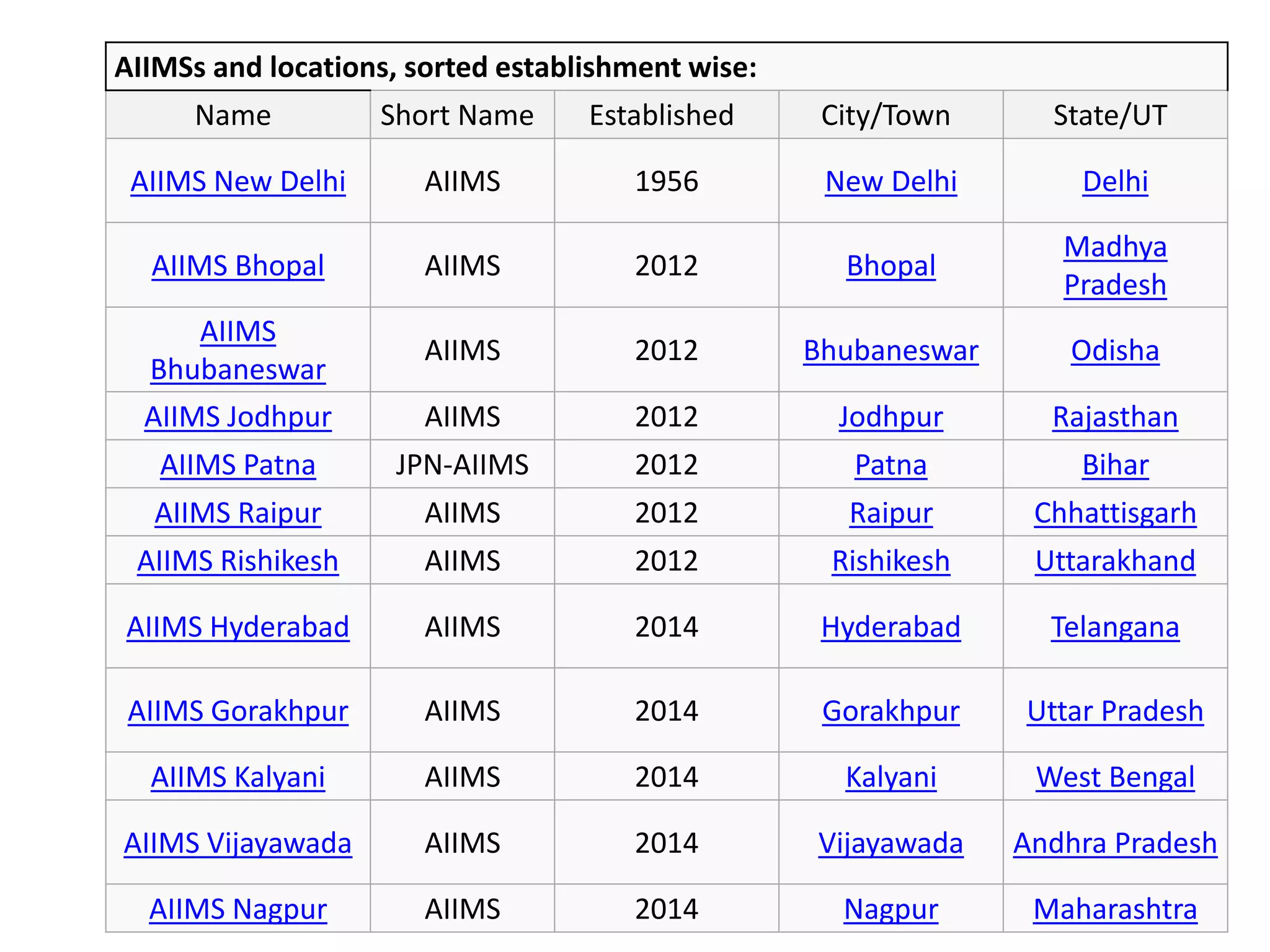
AIIMSs and locations, sorted establishment wise:
Name Short Name Established City/Town State/UT
AIIMS New Delhi AIIMS 1956 New Delhi Delhi
AIIMS Bhopal AIIMS 2012 Bhopal
Madhya
Pradesh
AIIMS
Bhubaneswar
AIIMS 2012 Bhubaneswar Odisha
AIIMS Jodhpur AIIMS 2012 Jodhpur Rajasthan
AIIMS Patna JPN-AIIMS 2012 Patna Bihar
AIIMS Raipur AIIMS 2012 Raipur Chhattisgarh
AIIMS Rishikesh AIIMS 2012 Rishikesh Uttarakhand
AIIMS Hyderabad AIIMS 2014 Hyderabad Telangana
AIIMS Gorakhpur AIIMS 2014 Gorakhpur Uttar Pradesh
AIIMS Kalyani AIIMS 2014 Kalyani West Bengal
AIIMS Vijayawada AIIMS 2014 Vijayawada Andhra Pradesh
AIIMS Nagpur AIIMS 2014 Nagpur Maharashtra
Future AIIMS
• In 2009, the government had further decided to set up two more
AIIMS-like institutes at Raiganj in West Bengal and Rae Bareli in
Uttar Pradesh.
• AIIMS Raebareli, Uttar Pradesh: Out of agreed 148 acres land, Uttar
Pradesh Government has handed over 97 acres for the
campus.[15] Construction work for AIIMS Raebareli has started.[16]
• AIIMS, Raiganj: The plan for setting up AIIMS in West Bengal at
Raiganj got stuck due to resistance from West Bengal Government
which wants the institute to come up at Kalyani which is 50
Kilometers away from Kolkaka instead of Raiganj which is 400
Kilometers away from Kolkata.
• In July 2014, the Government of India has given approval for setting
up five new AIIMS which are to come up
in Hyderabad(Telangana), Nagpur (Maharashtra), Gorakhpur (Uttar
Pradesh), Vijayawada (Andhra Pradesh)and Kalyani (West Bengal).
References:
• http://www.aiims.edu/en.html
• http://en.wikipedia.org/wiki/All_India_Institute_of_Medical_Sciences
• www.slideshare.net
Thank you !

All India Institute of Medical Sciences AIIMS - New Delhi

  • 1.
    All India Instituteof Medical Sciences - AIIMS Presented by: Rabeendra Basnet Ansarinagar, New Delhi
  • 2.
    Introduction • AIIMS NewDelhi is governed by the All India Institute of Medical Sciences Act, 1956. • The institute has a hospital with 1766 beds, 1323 doctors including. • The hospital facilities cater to about 1.5 million outpatients and 80,000 inpatients , 100,000 surgeries every year.
  • 3.
    Objectives of AIIMS •To develop a pattern of teaching in undergraduate and postgraduate medical education in all its branches so as to demonstrate high standard of medical education to all medical colleges and other allied institutions in India. • To bring together in one place educational facilities of the highest order for the training of the personnel in all important branches of the health activity. • To attain self sufficiency in postgraduate in medical education.
  • 4.
    Functions of AIIMS •Undergraduate and postgraduate teaching in medical and related physical biological sciences. • Nursing and dental education • Innovations in education. • Producing medical teachers for the country. • Research in medical and related sciences. • Health care : preventive, promotive and curative; primary, secondary & tertiary. • Community based teaching and research
  • 5.
    Departments • Anaesthesiology • Anatomy •Biochemistry • Biomedical Engineering • Biophysics • Biostatistics • Biotechnology • Cardiology • Centre for Community Medicine • College of Nursing • Dermatology & Venereology • Dietetics • Emergency Medicine • Endocrinology, Metabolism & Diabetes • Forensic Medicine and Toxicology • Geriatric Medicine • Gastroenterology and Human Nutrition • Gastrointestinal Surgery • Haematology • Hospital Administration • Laboratory Medicine • Medicine • Microbiology • Nephrology • Nuclear Medicine • Nuclear Magnetic Resonance Imaging • Obstetrics and Gynaecology • Orthopaedics • Otorhinolaryngology • Finance Division
  • 6.
    Departments • Paediatrics • PaediatricSurgery • Pathology • Pharmacology • Physiology • Physical Medicine & Rehabilitation • Psychiatry • Pulmonary Medicine and Sleep Disorders • Radio Diagnosis • Reproductive Biology • Research Section • Surgical Disciplines • Transplant Immunology & Immunogenetics • Transfusion Medicine (Blood Bank) • Urology • Academic Section
  • 7.
    Specialty Centers Cardio-Thoracic SciencesCentre • Cardiothoracic Sciences Centre began functioning in the new building in 1982 after 4 years In 1986 the Centre became fully independent and functioned entirely from the new 7 floor building. The Cardiothoracic Centre has the following departments. • Cardiology • Cardiac Anaesthesiology • Cardiac Pathology • Cardiac Radiology • Cardiothoracic & Vascular Surgery • Cardiac Biochemistry • ORBO & Stem Cell Facility • Hospital Administration (CNC) • Nuclear Medicine
  • 8.
    • The departmenthas 102 beds exclusively for cardiovascular Surgery. • There are two Intensive Care Units of 16 & 18 beds. There are seven operating rooms fully equipped for any cardiovascular surgical procedure. • The general wards contain 34 beds each on two floors. In addition there are 14 private rooms (paying wards) both for Cardiology and Cardiovascular Surgery. • The office of the faculty are on the 7thfloor.
  • 9.
    Centre for DentalEducation and Research • Department of Conservative Dentistry and Endodontics • Department of Orthodontics and Dentofacial Deformities • Department of Pediatric and Preventive Dentistry Neurosciences Centre The Neurosciences Centre consists of the Departments of :- • Neurology • Neuro-Surgery • Neuro Anaesthesiology • Neuro Biochemistry • Neuro Pathology • Neuro Psychology • Neuro Radiology
  • 10.
    Major Centres ofAIIMS Dr. R.P Centre for Ophthalmic Sciences • Dr. Rajendra Prasad Centre for Ophthalmic Sciences is an integral part of AIIMS and was created in 1967 as a National Institute of Ophthalmology to ensure maximized interdisciplinary benefits and holistic patient care. • As the Apex Institution under the National Programme for Control of Blindness ( NPCB ), it was the first Centre of its kind started at the AIIMS more than 38 years ago, followed by the other super-speciality Centres later at the Institute.
  • 11.
    Dr. B.R.A Institute-RotaryCancer Hospital • Institute Rotary Cancer Hospital (DR. B.R.A. Institute Rotary Cancer Hospital) started functioning in 1983-84 on 35 beds with infrastructure of 2 floors. • Recently it has been converted into a 200 bedded, 7th floor building. Prime Minister of India Sh. Atal Bihari Vajpayee, inaugurated this centre on October 5, 2003. • Best of radiodiagnostic and radiotherapy machines including state of art linear accelerator, brachytherapy, stereotactic radiotherapy and intensity modulated radiotherapy are available at this centre. • Vaccum assisted advanced mammography unit, first of its kind in India, has made stereotactic breast biopsy possible. Prostate cancer can be diagnosed at an early stage with help of transrectal sextant biopsy. Radio frequency ablation of liver cancer has also been initiated.
  • 12.
    National Drug DependenceTreatment Center The Drug Dependence Treatment Centre, AIIMS was established in the year 1988 and was functional from the premises of the Deen Dayal Upadhyay Hospital, New Delhi. In 2003 it was upgraded as the National Centre (National Drug Dependence Treatment Centre) and is fully operational from its new premises in Ghaziabad since April 2003. The centre has been involved in: • Assessing magnitude of drug abuse in the country. • Providing clinical care to patients - hospital and community based - through daily OPD, special clinics, ward and community clinics in urban- slums of Delhi. • Health education • Manpower development – training of several categories of staff • Establishment of laboratory to detect drugs of abuse in body fluids and health damage. • Documentation, publication of resource material and creation of database. • Research.
  • 13.
    Jai Prakash NarayanApex Trauma Center • The centre became fully functional on 26 November, 2007 when the casualty (emergency department) was thrown open to general public. • The total cost of constructing the centre was Rs 132 crores, and it is spread over an area of 20,600 sq metres and seven storeys that consist of five operation theatres, 152 inpatient and 30 casualty beds, including 26 ICU beds to provide both pre-hospital and emergency care. • The centre also acts as a referral hospital, where patients sent by zonal public hospitals and satellite trauma centers will be observed and treated. • 957 staff, including doctors, resident doctors, nurses and technical staff from specialties like neurosurgery, orthopedics, cardio-thoracic and vascular surgery, general surgery and plastic surgery were initially recruited to make the trauma centre functional. • A helipad is also planned on top of the building for transporting critically ill patients.
  • 14.
    DEPARTMENTS • Anesthesia &CC • Emergency Medicine • Forensic Medicine • Laboratory Medicine • Neuroanaesthesia • Neurosurgery • Orthopedics • Radiology • Trauma Surgery • Information Technology
  • 15.
    Central Facilities B.B. DikshitLibrary Central Animal Facility Computer Facility Central Workshop EHS Electron Microscope Facility K.L. Wig CMET Medical Social & Welfare Services National Poisons Information Centre Organ Retrieval Banking Organisation Patent Cell Stem Cell Facility Telemedicine Facility Transport Facility
  • 16.
    Other facilities  Facilitiesprovided in private ward - Each room has - attached toilets & bath room, T.V. with cable connection, Refrigerator, A.C., sofas, bed for attendant, chairs and table, geyser, emergency light, phone with incoming facility etc.  Day care facility is available for certain types of operations. e.g. laproscopic surgery; day care chemotherapy; blood transfusion, dialysis, endoscopies and similar interventions.  ICUs The hospital has fully equipped Main ICU at 8th Floor, AB wing to provide expert ICU care. There are ICUs/HDUs in few wards of main hospital and CTVS ICU & NS ICU in CN Centre. Patients requiring urgent ICU care are admitted to ICUs at the discretion of treating Doctors.  Blood Bank:- AIIMS has a licensed modern, state of the art Blood Bank that functions 24 hours a day and provides facilities for blood donation, storage, issue of blood and its components. Strict precautions are taken and testing is done to prevent any borne infection. If your patient requires blood transfusions, then you are requested to arrange healthy blood donors for donating blood in order to reduce shortage of blood.
  • 17.
    Medical College The AIIMSoffers various courses at different levels. All in all 42 disciplines are taught at AIIMS. The different categories include : Undergraduate Courses (UG) Postgraduate Courses (PG) MBBS MD,MS & MDS B.Sc.(Hons.)Human Biology: DM & MCh B.Sc.Courses in Nursing, Audiometry,Ophthalmic, Techniques and Radiography Master's Degree in Science (M Sc) Master's Degree in Biotechnology (M Biotech) Doctor of Philosophy (Ph D)
  • 18.
    Organizational Structure Constitution ofvarious committees at AIIMS Institute Body (IB) Governing Body (GB) Finance Committee Academic Committee Selection Com mittee Estate Committee Hospital Affairs CommitteePresident I.B. Chairman G.B. Director Administration Academics Hospital Centres Computer Facility Deputy Director Administration Dean Medical Superintendent Chiefs of the Centres Prof-In-Charge Computer Facility Administration Deputy Director Administration Sr. Financia l Advisor Chief Administrative Officer Dy. Secretary Chief Procurem ent Officer Superintendin g Engg. Dy. Chief Security Officer Public Relation Officer Gr. A, B, C & D Staff
  • 19.
    Academics Dean Sub Dean Registrar Examination Section Head ofDepartments Academic Section Faculty Addl. Prof P r o f e s s o r Academic Section Asstt. Prof. Assoc. Prof. Assoc. Prof. Computer Facility Prof-In-Charge Computer Facility System Analyst Senior Programmer Programmer
  • 20.
    Hospital Medical Superintendent Additional MedicalSuperintendent Deputy Medical Superintendent Duty Officers for OPD and Casualty All Clinical Laboratories Hospital Records Wards, Private Wards & Operation Hospital Peripheral Services Laundry, Blood Bank etc Medical Stores Nursing Services Centres Chiefs of Various Centres Chief Dr. R. P. Centre Chief N. S. Centre Chief C. T. Centre Chief Dr. BRA,IRCH Chief JPNA Trauma Centre Prof. In- charge, CRHSP, Ballabhgarh Chief NDDTC, Ghaziabad Chief CDER Head of Departments Faculty Officers & Other Staff Under Graduate students Post Graduate students Senior Resident, Junior Resident SRF, JRF
  • 21.
    Patient Care : •Sophisticated medical and surgical care among the best in the world. The most satisfying aspect of this endeavour is that these cutting-edge modalities are being actually used for the poor. • It has over 1500 spread over the main hospital, Dr. Rajendra Prasad Centre for Ophthalmic sciences, Cardiothoracic Centre, Neurosciences Centre, Institute Rotary Centre Hospital and De-addiction Centre. This complex of facilities caters to about 1.5 million outpatients and 80,000 inpatients every year .The number of surgical operations performed at AIIMS last year was over 100,000. • The first heart transplant patient in India, operated on 3 August 1994 at AIIMS. • Laser treatment at Dr.Rajendra Prasad Centre for Ophthalmic Sciences
  • 22.
    AIIMSs and locations,sorted establishment wise: Name Short Name Established City/Town State/UT AIIMS New Delhi AIIMS 1956 New Delhi Delhi AIIMS Bhopal AIIMS 2012 Bhopal Madhya Pradesh AIIMS Bhubaneswar AIIMS 2012 Bhubaneswar Odisha AIIMS Jodhpur AIIMS 2012 Jodhpur Rajasthan AIIMS Patna JPN-AIIMS 2012 Patna Bihar AIIMS Raipur AIIMS 2012 Raipur Chhattisgarh AIIMS Rishikesh AIIMS 2012 Rishikesh Uttarakhand AIIMS Hyderabad AIIMS 2014 Hyderabad Telangana AIIMS Gorakhpur AIIMS 2014 Gorakhpur Uttar Pradesh AIIMS Kalyani AIIMS 2014 Kalyani West Bengal AIIMS Vijayawada AIIMS 2014 Vijayawada Andhra Pradesh AIIMS Nagpur AIIMS 2014 Nagpur Maharashtra
  • 23.
    Future AIIMS • In2009, the government had further decided to set up two more AIIMS-like institutes at Raiganj in West Bengal and Rae Bareli in Uttar Pradesh. • AIIMS Raebareli, Uttar Pradesh: Out of agreed 148 acres land, Uttar Pradesh Government has handed over 97 acres for the campus.[15] Construction work for AIIMS Raebareli has started.[16] • AIIMS, Raiganj: The plan for setting up AIIMS in West Bengal at Raiganj got stuck due to resistance from West Bengal Government which wants the institute to come up at Kalyani which is 50 Kilometers away from Kolkaka instead of Raiganj which is 400 Kilometers away from Kolkata. • In July 2014, the Government of India has given approval for setting up five new AIIMS which are to come up in Hyderabad(Telangana), Nagpur (Maharashtra), Gorakhpur (Uttar Pradesh), Vijayawada (Andhra Pradesh)and Kalyani (West Bengal).
  • 24.
  • 26.