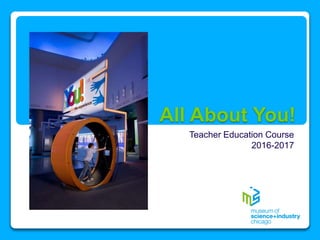
All About You!
Teacher Education Course
2016-2017
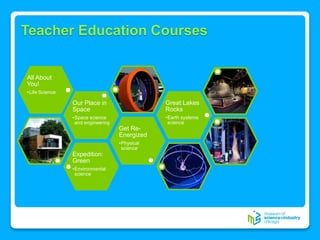
Teacher Education Courses
Expedition:
Green
•Environmental
science
Get Re-
Energized
•Physical
science
Our Place in
Space
•Space science
and engineering
Great Lakes
Rocks
•Earth systems
science
All About
You!
•Life Science
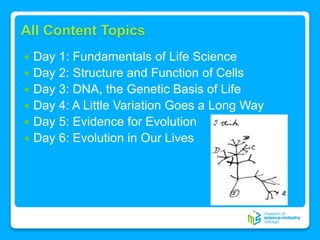
All Content Topics
 Day 1: Fundamentals of Life Science
 Day 2: Structure and Function of Cells
 Day 3: DNA, the Genetic Basis of Life
 Day 4: A Little Variation Goes a Long Way
 Day 5: Evidence for Evolution
 Day 6: Evolution in Our Lives
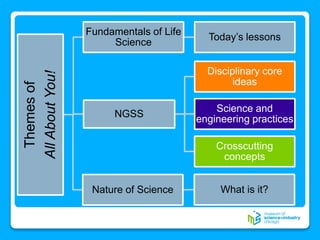
Themesof
AllAboutYou!
Fundamentals of Life
Science
Today’s lessons
NGSS
Disciplinary core
ideas
Science and
engineering practices
Crosscutting
concepts
Nature of Science What is it?
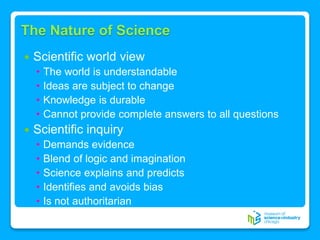
The Nature of Science
 Scientific world view
• The world is understandable
• Ideas are subject to change
• Knowledge is durable
• Cannot provide complete answers to all questions
 Scientific inquiry
• Demands evidence
• Blend of logic and imagination
• Science explains and predicts
• Identifies and avoids bias
• Is not authoritarian
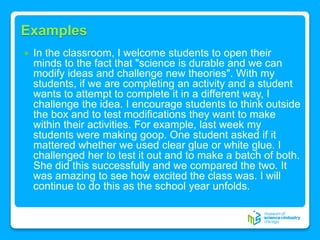
Examples
 In the classroom, I welcome students to open their
minds to the fact that "science is durable and we can
modify ideas and challenge new theories". With my
students, if we are completing an activity and a student
wants to attempt to complete it in a different way, I
challenge the idea. I encourage students to think outside
the box and to test modifications they want to make
within their activities. For example, last week my
students were making goop. One student asked if it
mattered whether we used clear glue or white glue. I
challenged her to test it out and to make a batch of both.
She did this successfully and we compared the two. It
was amazing to see how excited the class was. I will
continue to do this as the school year unfolds.
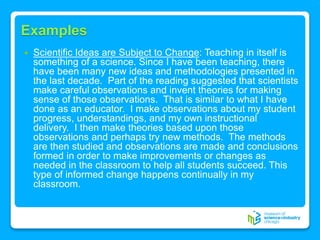
Examples
 Scientific Ideas are Subject to Change: Teaching in itself is
something of a science. Since I have been teaching, there
have been many new ideas and methodologies presented in
the last decade. Part of the reading suggested that scientists
make careful observations and invent theories for making
sense of those observations. That is similar to what I have
done as an educator. I make observations about my student
progress, understandings, and my own instructional
delivery. I then make theories based upon those
observations and perhaps try new methods. The methods
are then studied and observations are made and conclusions
formed in order to make improvements or changes as
needed in the classroom to help all students succeed. This
type of informed change happens continually in my
classroom.
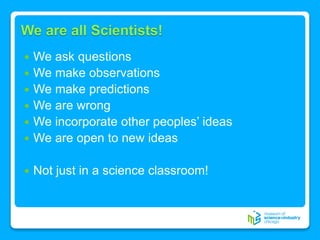
We are all Scientists!
 We ask questions
 We make observations
 We make predictions
 We are wrong
 We incorporate other peoples’ ideas
 We are open to new ideas
 Not just in a science classroom!
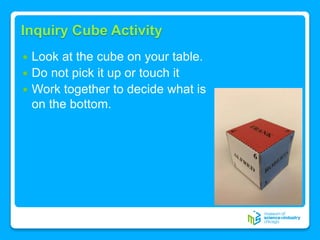
Inquiry Cube Activity
 Look at the cube on your table.
 Do not pick it up or touch it
 Work together to decide what is
on the bottom.
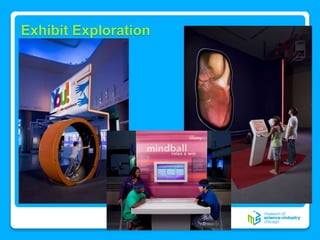
Exhibit Exploration

All about you! 16 17 intro

  • 1.
    All About You! TeacherEducation Course 2016-2017
  • 2.
    Teacher Education Courses Expedition: Green •Environmental science GetRe- Energized •Physical science Our Place in Space •Space science and engineering Great Lakes Rocks •Earth systems science All About You! •Life Science
  • 3.
    All Content Topics Day 1: Fundamentals of Life Science  Day 2: Structure and Function of Cells  Day 3: DNA, the Genetic Basis of Life  Day 4: A Little Variation Goes a Long Way  Day 5: Evidence for Evolution  Day 6: Evolution in Our Lives
  • 4.
    Themesof AllAboutYou! Fundamentals of Life Science Today’slessons NGSS Disciplinary core ideas Science and engineering practices Crosscutting concepts Nature of Science What is it?
  • 5.
    The Nature ofScience  Scientific world view • The world is understandable • Ideas are subject to change • Knowledge is durable • Cannot provide complete answers to all questions  Scientific inquiry • Demands evidence • Blend of logic and imagination • Science explains and predicts • Identifies and avoids bias • Is not authoritarian
  • 6.
    Examples  In theclassroom, I welcome students to open their minds to the fact that "science is durable and we can modify ideas and challenge new theories". With my students, if we are completing an activity and a student wants to attempt to complete it in a different way, I challenge the idea. I encourage students to think outside the box and to test modifications they want to make within their activities. For example, last week my students were making goop. One student asked if it mattered whether we used clear glue or white glue. I challenged her to test it out and to make a batch of both. She did this successfully and we compared the two. It was amazing to see how excited the class was. I will continue to do this as the school year unfolds.
  • 7.
    Examples  Scientific Ideasare Subject to Change: Teaching in itself is something of a science. Since I have been teaching, there have been many new ideas and methodologies presented in the last decade. Part of the reading suggested that scientists make careful observations and invent theories for making sense of those observations. That is similar to what I have done as an educator. I make observations about my student progress, understandings, and my own instructional delivery. I then make theories based upon those observations and perhaps try new methods. The methods are then studied and observations are made and conclusions formed in order to make improvements or changes as needed in the classroom to help all students succeed. This type of informed change happens continually in my classroom.
  • 8.
    We are allScientists!  We ask questions  We make observations  We make predictions  We are wrong  We incorporate other peoples’ ideas  We are open to new ideas  Not just in a science classroom!
  • 9.
    Inquiry Cube Activity Look at the cube on your table.  Do not pick it up or touch it  Work together to decide what is on the bottom.
  • 10.

Editor's Notes

  • #3 The Museum of Science Industry is dedicated to providing the highest level teacher professional development to middle and late elementary teachers. We currently have five courses on various science topics (listed above). Each course uses best practices to increase teacher content and pedagogical knowledge.
  • #5 There are three major themes that will tie All About You! together. The first is the content piece, the fundamentals of life science. These are the three lesson that will be presented on day one: Form Fits Function, I’m a Survivor and Characteristics of Life. These lessons will allow learners to have the necessary background information to have success in this course. Each of the lessons is aligned to the second theme of the course, the Next Generation Science Standards. These standards have three parts themselves: Disciplinary core ideas, Science and engineering practices, and Crosscutting concepts. All of these will be evident in the lessons. Throughout the entire course the NGSS three dimensions will be explained and explored to give a deeper understanding of how to incorporate them into lesson planning and how to assess if students are learning in the three dimensional way. The final theme is the Nature of Science. This is an important theme to have in any science class because it explains what science is, how and why it is important to teach it, and why it is important to understand it as a citizen.