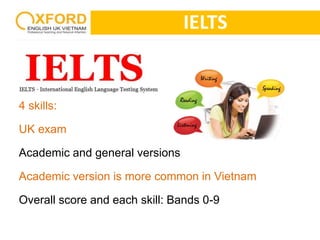
4 skills: 
UK exam 
Academic and general versions 
IELTS 
Academic version is more common in Vietnam 
Overall score and each skill: Bands 0-9
IELTS – Listening 
Same for academic and general versions 
About 30 minutes then 10 minutes to transfer answers 
4 sections / 40 questions 
Sections 1-2: General topics 
Sections 3-4: Academic topics 
Sections 1+3: Conversations 
Sections 2+4: Monologues 
Variety of question types (e.g. multiple choice, sentence 
and note completion, and labeling diagrams)
IELTS – Listening Tips 
1. Question order matches dialogue progression 
2. Variety of accents 
Be familiar with non-US pronunciation and vocabulary 
3. Sentence completion questions 
Answers must make sentences grammatically correct 
4. Non-sentence gap-fill questions (e.g. notes) 
Grammar does not matter 
(e.g. ‘car’ and ‘a car’ are both correct)
IELTS – Listening Tips 
5. Number answers as figures or words 
(e.g. 500, 5 hundred or five hundred) 
6. Read the instructions carefully 
(e.g. ‘Use no more than two words’ = 1-2 words 
so three-word answer is incorrect) 
7. Check spellings 
‘Correct’ answers spelled incorrectly are incorrect
IELTS – Reading 
Different texts for academic and general versions 
60 minutes / 3 texts / 40 questions 
Variety of question types (e.g. multiple choice, sentence 
and note completion, matching headings, ‘true-false-not 
given’, and labeling diagrams)
IELTS – Reading 
1. Time management 
40 questions in one hour = 1.5 minutes per question 
2. Not sure then eliminate answers before guessing 
Random guess with four choices = 25% chance 
Guess with two choices eliminated = 50% chance 
3. Look for words or phrases in the text with the same 
meaning as in the questions 
(e.g. 1985 = the mid-1980s)
4. Skim 
IELTS – Reading Tips 
Read quickly for main idea and paragraph topics 
5. Scan 
Look for key words or phrases 
(e.g. a person’s name or a date)
IELTS – Speaking 
Same for academic and general versions 
Face-to-face exam with an IELTS examiner 
11-14 minutes / 3 parts 
No choice of questions 
Part 1 
4-5 minutes 
Questions about familiar topics 
(e.g. your country or home town, family, jobs or hobbies) 
Can’t read the questions
Part 2 
3-4 minutes 
Can read the questions 
IELTS – Speaking 
1 minute to prepare by making notes 
1-2 minutes to speak about the topic 
Part 3 
4-5 minutes 
More difficult questions which are related to part 2 
Can’t read the questions
IELTS – Speaking Tips 
1. Give reasons, details and examples (think ‘why?’) 
2. Answer the question asked, not a similar question 
3. Don’t memorize answers 
Topics can’t be predicted 
Unnatural style 
Examiner may ask another question if a candidate 
gives an obviously prepared speech
IELTS – Speaking Tips 
4. Choose less common answers to interest the 
examiner 
(e.g. an unusual hobby rather than listening to music) 
5. Think before answering 
Use phrases such as: 
“That’s an interesting question.” 
“Let me think about that for a moment.” 
“I’ve never thought about that before, but…”
Different for academic and general versions 
60 minutes 
No choice of questions 
Handwritten essays 
2 tasks 
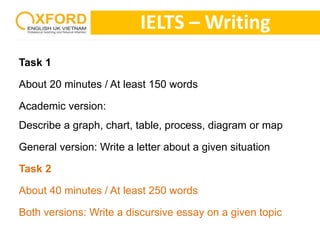
IELTS –Writing
Task 1 
IELTS –Writing 
About 20 minutes / At least 150 words 
Academic version: 
Describe a graph, chart, table, process, diagram or map 
General version: Write a letter about a given situation 
Task 2 
About 40 minutes / At least 250 words 
Both versions: Write a discursive essay on a given topic
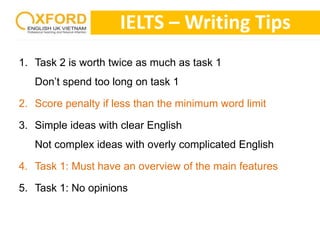
IELTS –Writing Tips 
1. Task 2 is worth twice as much as task 1 
Don’t spend too long on task 1 
2. Score penalty if less than the minimum word limit 
3. Simple ideas with clear English 
Not complex ideas with overly complicated English 
4. Task 1: Must have an overview of the main features 
5. Task 1: No opinions
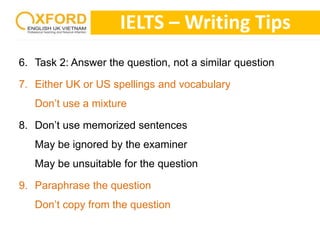
IELTS –Writing Tips 
6. Task 2: Answer the question, not a similar question 
7. Either UK or US spellings and vocabulary 
Don’t use a mixture 
8. Don’t use memorized sentences 
May be ignored by the examiner 
May be unsuitable for the question 
9. Paraphrase the question 
Don’t copy from the question
OXFORD ENGLISH UK VIETNAM 
FOR MORE INFORMATION PLEASE CONTACT US AT: 
http://oxford.edu.vn/
THANK YOU & 
GOOD LUCK!

All tips for IELTS- Oxford English UK Vietnam

  • 1.
    4 skills: UKexam Academic and general versions IELTS Academic version is more common in Vietnam Overall score and each skill: Bands 0-9
  • 2.
    IELTS – Listening Same for academic and general versions About 30 minutes then 10 minutes to transfer answers 4 sections / 40 questions Sections 1-2: General topics Sections 3-4: Academic topics Sections 1+3: Conversations Sections 2+4: Monologues Variety of question types (e.g. multiple choice, sentence and note completion, and labeling diagrams)
  • 3.
    IELTS – ListeningTips 1. Question order matches dialogue progression 2. Variety of accents Be familiar with non-US pronunciation and vocabulary 3. Sentence completion questions Answers must make sentences grammatically correct 4. Non-sentence gap-fill questions (e.g. notes) Grammar does not matter (e.g. ‘car’ and ‘a car’ are both correct)
  • 4.
    IELTS – ListeningTips 5. Number answers as figures or words (e.g. 500, 5 hundred or five hundred) 6. Read the instructions carefully (e.g. ‘Use no more than two words’ = 1-2 words so three-word answer is incorrect) 7. Check spellings ‘Correct’ answers spelled incorrectly are incorrect
  • 5.
    IELTS – Reading Different texts for academic and general versions 60 minutes / 3 texts / 40 questions Variety of question types (e.g. multiple choice, sentence and note completion, matching headings, ‘true-false-not given’, and labeling diagrams)
  • 6.
    IELTS – Reading 1. Time management 40 questions in one hour = 1.5 minutes per question 2. Not sure then eliminate answers before guessing Random guess with four choices = 25% chance Guess with two choices eliminated = 50% chance 3. Look for words or phrases in the text with the same meaning as in the questions (e.g. 1985 = the mid-1980s)
  • 7.
    4. Skim IELTS– Reading Tips Read quickly for main idea and paragraph topics 5. Scan Look for key words or phrases (e.g. a person’s name or a date)
  • 8.
    IELTS – Speaking Same for academic and general versions Face-to-face exam with an IELTS examiner 11-14 minutes / 3 parts No choice of questions Part 1 4-5 minutes Questions about familiar topics (e.g. your country or home town, family, jobs or hobbies) Can’t read the questions
  • 9.
    Part 2 3-4minutes Can read the questions IELTS – Speaking 1 minute to prepare by making notes 1-2 minutes to speak about the topic Part 3 4-5 minutes More difficult questions which are related to part 2 Can’t read the questions
  • 10.
    IELTS – SpeakingTips 1. Give reasons, details and examples (think ‘why?’) 2. Answer the question asked, not a similar question 3. Don’t memorize answers Topics can’t be predicted Unnatural style Examiner may ask another question if a candidate gives an obviously prepared speech
  • 11.
    IELTS – SpeakingTips 4. Choose less common answers to interest the examiner (e.g. an unusual hobby rather than listening to music) 5. Think before answering Use phrases such as: “That’s an interesting question.” “Let me think about that for a moment.” “I’ve never thought about that before, but…”
  • 12.
    Different for academicand general versions 60 minutes No choice of questions Handwritten essays 2 tasks IELTS –Writing
  • 13.
    Task 1 IELTS–Writing About 20 minutes / At least 150 words Academic version: Describe a graph, chart, table, process, diagram or map General version: Write a letter about a given situation Task 2 About 40 minutes / At least 250 words Both versions: Write a discursive essay on a given topic
  • 14.
    IELTS –Writing Tips 1. Task 2 is worth twice as much as task 1 Don’t spend too long on task 1 2. Score penalty if less than the minimum word limit 3. Simple ideas with clear English Not complex ideas with overly complicated English 4. Task 1: Must have an overview of the main features 5. Task 1: No opinions
  • 15.
    IELTS –Writing Tips 6. Task 2: Answer the question, not a similar question 7. Either UK or US spellings and vocabulary Don’t use a mixture 8. Don’t use memorized sentences May be ignored by the examiner May be unsuitable for the question 9. Paraphrase the question Don’t copy from the question
  • 16.
    OXFORD ENGLISH UKVIETNAM FOR MORE INFORMATION PLEASE CONTACT US AT: http://oxford.edu.vn/
  • 17.
    THANK YOU & GOOD LUCK!