PORTFOLIO
ALKA PANCHAL
Diploma 1st
Year
FASHION TECHNOLOGY
Project Report on
Women's Western Wear
Submitted to
Dezyne E’cole College
Towards the Partial Fulfillment for
Award of Diploma in Fashion Technology
As Technical Knowledge Development to
Women’s Wear
Included With Diploma Program Of
Fashion Technology
By
ALKA PANCHAL
Dezyne E’cole College Ajmer
Address, 106/10, civil lines, Ajmer
Tel. no.0145 2624679
www.dezyneecole.com
2014-2015
The Project of Ms. Alka Panchal has been Checked & has
been graded as
Dezyne E’cole College
Civil Lines, Ajmer
www.dezyneecole.com
Thank you
Principal
(Seal
&Signature)
ACKNOWLEDGEMENT
I am deeply grateful to all those whose guidance has been of
tremendous value and enabled me to complete this project
successfully.
I am thankful to all my mentors of Dezyne E’ cole who
gave me an opportunity to show my abilities by working on this
project on the esteem organization.
ALKA PANCHAL
1ST
Year diploma in Fashion Technology
1. Fashion as a Person’s Image
2. Fashion Industry
3. Learning Experience
4. Foundation Design
5. Corel Draw
6. Fashion illustration
7. Pattern Engineering
8. Measurement techniques
9. Draping
10.Fabric Manipulation
11.Element and Principle of Design
12.Trible Art
CONTENT
Fashion is a more then wearing good clothes it is about presenting a
person’s image in Society , we generally see people accepting fashion
due to pee pressure, Image in the society and when a person wants a
change to brighten his life. There are many reasons behind what we wear.
• Protection from cold ,rain and snow :- Mountain climbers wear high –
tech outwear to avoid frostbite and over – exposure.
• Physical attention :- Many styles are worn to inspire “chemistry”.
• Emotions :- we dress “up” when we’re happy and “down” when we’re
upset.
• Religious expression :- Orthodox Jewish men wear long part of their
body except their eyes.
• Identification and tradition :- Judges wear robes ,people in the military
wear uniform, brides wear long white dresses.
Fashion as a Person’s Image
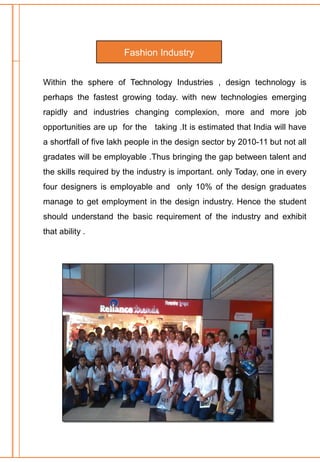
Within the sphere of Technology Industries , design technology is
perhaps the fastest growing today. with new technologies emerging
rapidly and industries changing complexion, more and more job
opportunities are up for the taking .It is estimated that India will have
a shortfall of five lakh people in the design sector by 2010-11 but not all
gradates will be employable .Thus bringing the gap between talent and
the skills required by the industry is important. only Today, one in every
four designers is employable and only 10% of the design graduates
manage to get employment in the design industry. Hence the student
should understand the basic requirement of the industry and exhibit
that ability .
Fashion Industry
Learning Experience
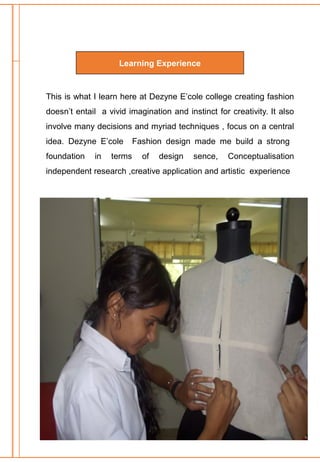
This is what I learn here at Dezyne E’cole college creating fashion
doesn’t entail a vivid imagination and instinct for creativity. It also
involve many decisions and myriad techniques , focus on a central
idea. Dezyne E’cole Fashion design made me build a strong
foundation in terms of design sence, Conceptualisation
independent research ,creative application and artistic experience
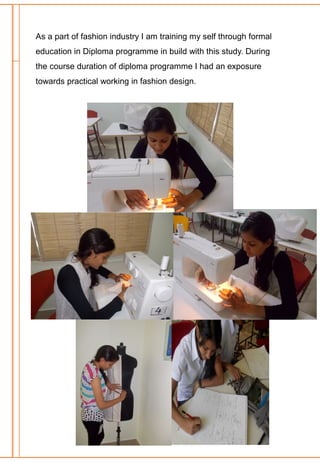
As a part of fashion industry I am training my self through formal
education in Diploma programme in build with this study. During
the course duration of diploma programme I had an exposure
towards practical working in fashion design.
FOUNDATION DESIGN
COLOR INPACT IN DESIGN
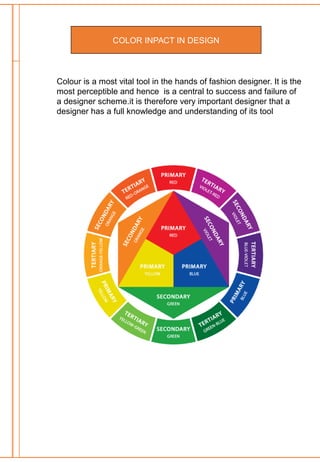
Colour is a most vital tool in the hands of fashion designer. It is the
most perceptible and hence is a central to success and failure of
a designer scheme.it is therefore very important designer that a
designer has a full knowledge and understanding of its tool
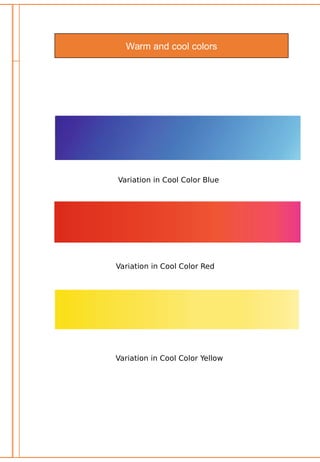
Warm and cool colors
Variation in Cool Color Blue
Variation in Cool Color Yellow
Variation in Cool Color Red
Comparing Value of Colors
The Yellow is lighter
value then Red
The Blue is Darker
value then Orange
The Green is
lighter value then
Brown
The Dark Green is
equal in the value to
the Brown
Compare the Blue and Red Rectangles to the Grey
Rectangles or either side of each color. Which Grey is equal
in value to the color ? It may be helpful to stand at a distance
and blur your eyes. If the edge between the two area
disappears, the values are equal.
Simultaneous Contrast
Corel Draw
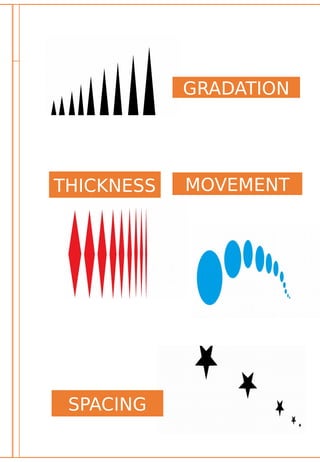
GRADATION
MOVEMENTTHICKNESS
SPACING
MOVEMENT
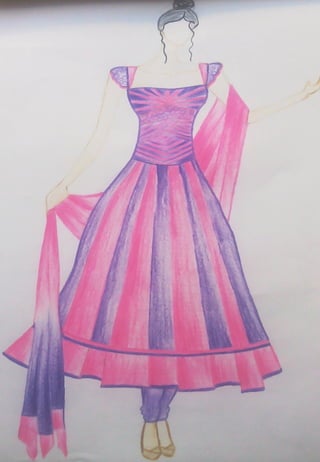
ILLUSTRATION
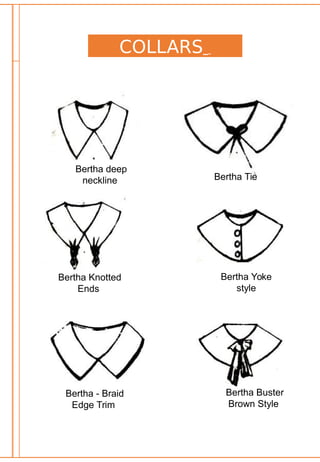
COLLARS
Bertha deep
neckline Bertha Tie
Bertha Buster
Brown Style
Bertha Knotted
Ends
Bertha Yoke
style
Bertha - Braid
Edge Trim
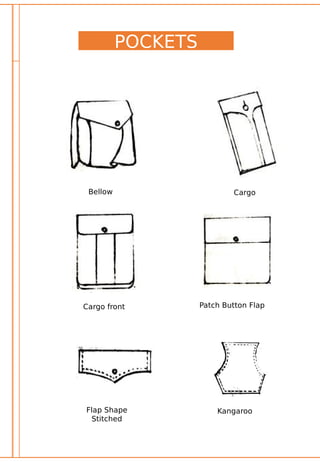
POCKETS
Bellow Cargo
Cargo front
KangarooFlap Shape
Stitched
Patch Button Flap
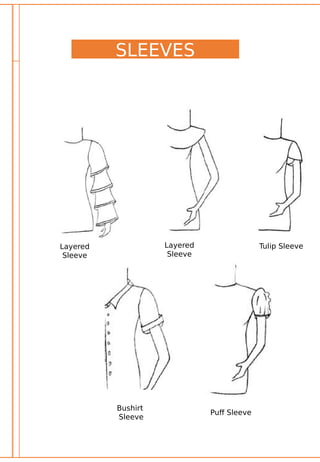
SLEEVES
Layered
Sleeve
Layered
Sleeve
Tulip Sleeve
Bushirt
Sleeve
Puff Sleeve
PATTERN ENGINEERING
Garment Construction
Fashion Designing runs the garment from eveningwear to sportswear,
Women’s wear to Men’s wear and Kids wear to knitwear. Garment
Construction is popularly called Pattern Engineering has a great
importance in fashion design industry. The Companies like van
heuson,dockers levis, adidas etc. are the providers of perfect fit and
this is what we learn at Dezyne E’cole through the art of pattern
making.
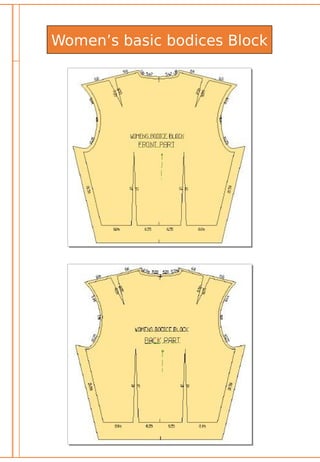
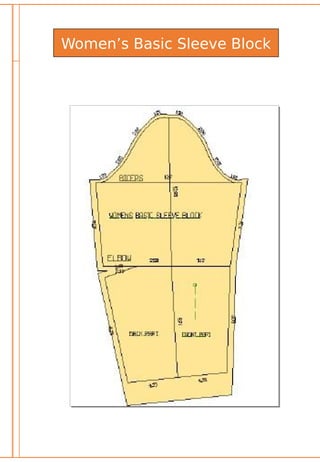
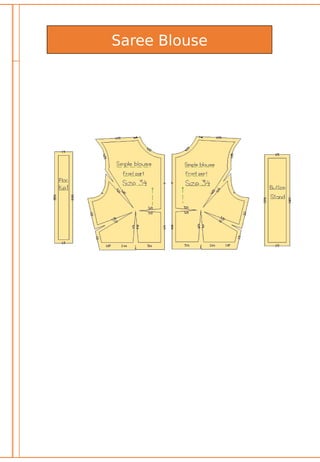
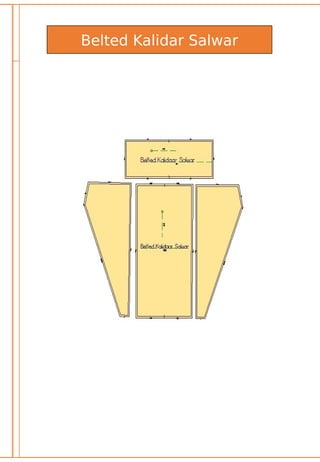
A slop pattern [ home sewing ] and block pattern [ industrial
production ] is custom – fitted basic pattern from which pattern for
many different styles can be developed.
The Draping method involves creating a Maslin mock up by pinning
fabric directly on a form then transferring the muslin outline and
makings onto a paper pattern or using the muslin as the pattern it self.
The flat pattern Draping method is the most commonly used method in
Menswear.
Women’s basic bodices Block
Women’s Basic Sleeve Block
Saree Blouse
Kurrta
Belted Kalidar Salwar
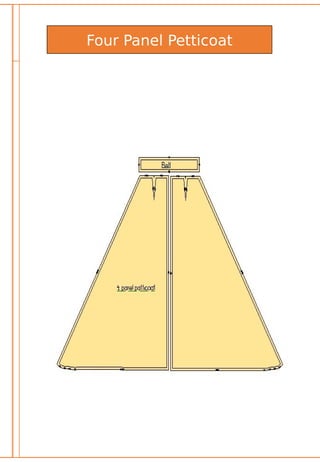
Four Panel Petticoat
Six Panel Petticoat
Women’s Basic Bodice Block
Saree Blouse
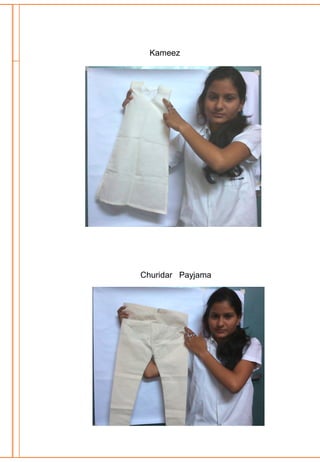
Kameez
Churidar Payjama
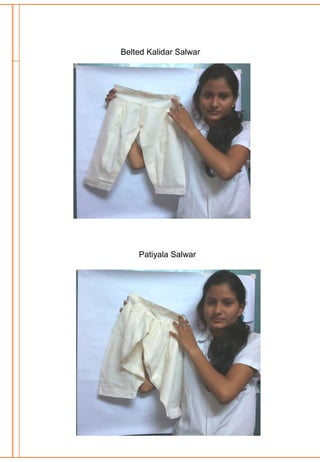
Belted Kalidar Salwar
Patiyala Salwar
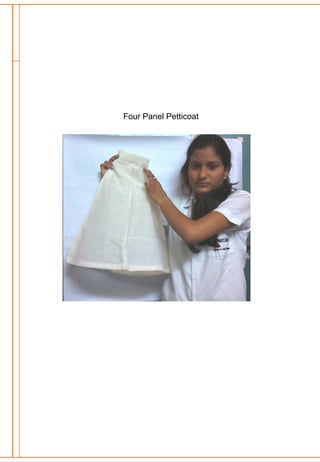
Four Panel Petticoat
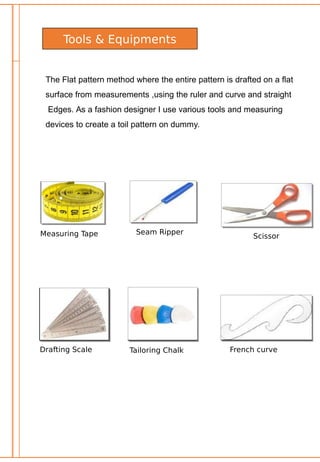
Tools & Equipments
The Flat pattern method where the entire pattern is drafted on a flat
surface from measurements ,using the ruler and curve and straight
Edges. As a fashion designer I use various tools and measuring
devices to create a toil pattern on dummy.
Measuring Tape Seam Ripper
Scissor
Drafting Scale Tailoring Chalk French curve
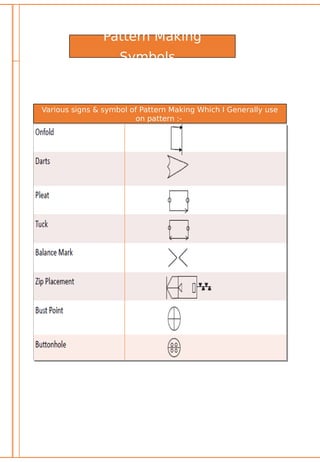
Pattern Making
Symbols
Various signs & symbol of Pattern Making Which I Generally use
on pattern :-
Various signs & symbol of Pattern Making Which I Generally use
on pattern :-
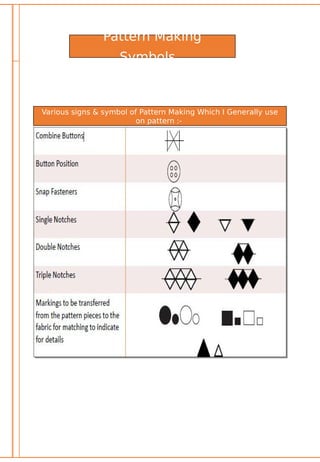
Pattern Making
Symbols
Pattern Making
Symbols
Various signs & symbol of Pattern Making Which I Generally use
on pattern :-
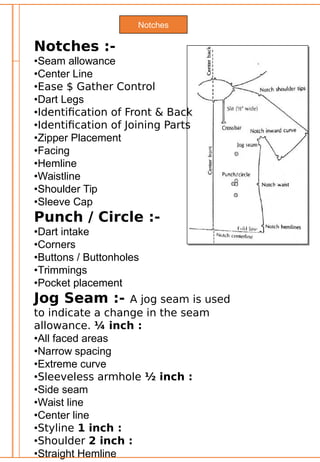
Notches
Notches :-
•Seam allowance
•Center Line
•Ease $ Gather Control
•Dart Legs
•Identification of Front & Back
•Identification of Joining Parts
•Zipper Placement
•Facing
•Hemline
•Waistline
•Shoulder Tip
•Sleeve Cap
Punch / Circle :-
•Dart intake
•Corners
•Buttons / Buttonholes
•Trimmings
•Pocket placement
Jog Seam :- A jog seam is used
to indicate a change in the seam
allowance. ¼ inch :
•All faced areas
•Narrow spacing
•Extreme curve
•Sleeveless armhole ½ inch :
•Side seam
•Waist line
•Center line
•Styline 1 inch :
•Shoulder 2 inch :
•Straight Hemline
LANDMARKS
Number refers to both front & back
wherever indicated :-
1. Center Front Neck
Center Back Neck
2. Center Front Waist
Center Back Waist
3. Bust Point
4. Center Bus Level
5. Center Front [Princess line]
Center Back [Princess line
6. Mid Armhole front
Mid Armhole Back
7. Shoulder Tip
8. Shoulder at Neck
9. Armhole Ridged or Roll Line
10.Plate Screw
11.Armhole Plate
Measurements
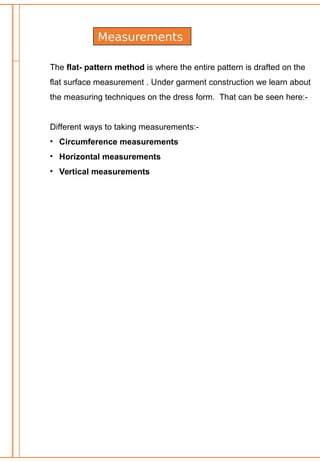
The flat- pattern method is where the entire pattern is drafted on the
flat surface measurement . Under garment construction we learn about
the measuring techniques on the dress form. That can be seen here:-
Different ways to taking measurements:-
• Circumference measurements
• Horizontal measurements
• Vertical measurements
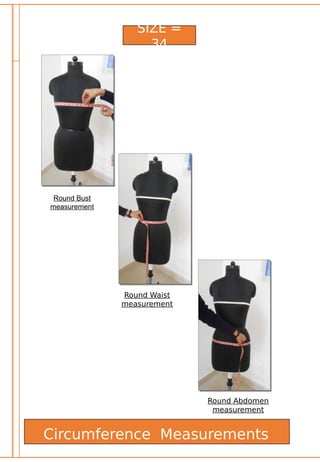
Circumference
measurements
Circumference Measurements
SIZE =
34
Round Bust
measurement
Round Waist
measurement
Round Abdomen
measurement
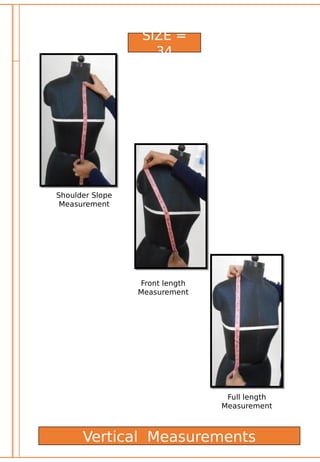
Vertical Measurements
SIZE =
34
Front length
Measurement
Shoulder Slope
Measurement
Full length
Measurement
Vertical Measurements
Horizontal Measurement
SIZE =
34
Across shoulder
Measurement
Across Chest
Measurement
Abdomen Arc
Measurement
Dart
Manipulation
Dart Manipulation is a slash spread and pivotal transfer making
technique to transfer dart excess to one location to another for
design variation .It is a beginning of pattern manipulation for
generating design patterns. It require both artistic and technical
skills to manage and control the pattern.
PRINCIPLE 1
 One Dart Series
 Two Dart Series
A Dart may be transfer to any
location around the pattern
outlines from the designated
pivotal point without affecting
the size or fit of the garment.
PRINCIPLE 2 Added fullness
To increase garment to an amount
greater then that provided by the
dart excess of working pattern.
The length and the width within
the pattern’s outline must be
increased.
PRINCIPLE 3 Contouring
To fit the contour of the upper torso closer then the basic garment
the pattern must be reduced within its frame to fit the dimension of
the body above, below and between the bust mounds and shoulder
blades.
SINGLE DART SERIES
French Dart
Front view
Side View
Back view
SINGLE DART SERIES
Mid Shoulder
Dart
Front view Back view
Side View
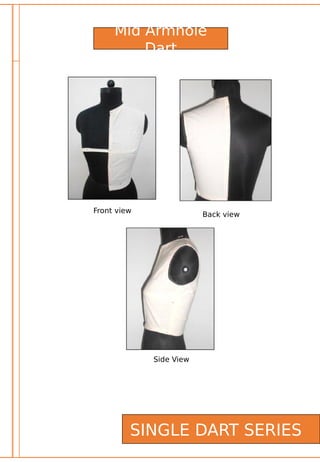
Mid Armhole
Dart
Front view
Back view
Side View
SINGLE DART SERIES
DOUBLE DART SERIES
Mid Shoulder and Waist
Dart
Front view Back view
Side View
DOUBLE DART SERIES
Mid Armhole and Waist
Dart
Front view Back view
Side View
DOUBLE DART SERIES
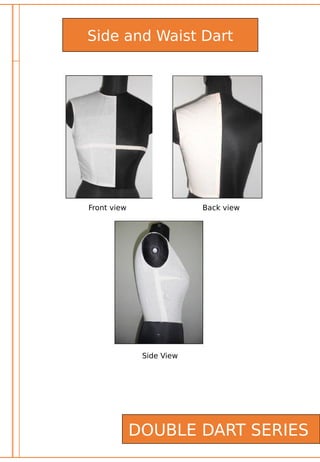
Side and Waist Dart
Front view Back view
Side View
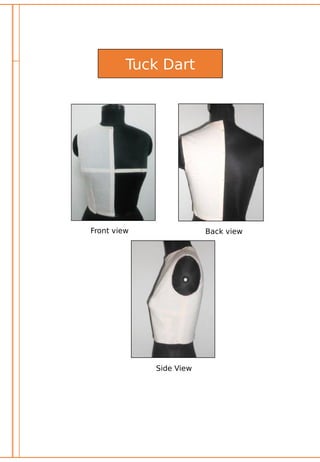
Tuck Dart
Front view Back view
Side View
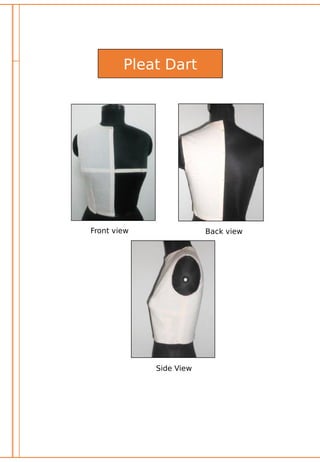
Pleat Dart
Front view Back view
Side View
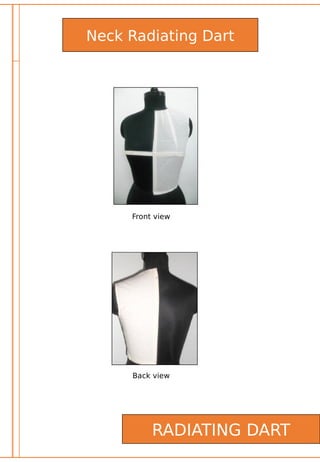
RADIATING DART
Neck Radiating Dart
Front view
Back view
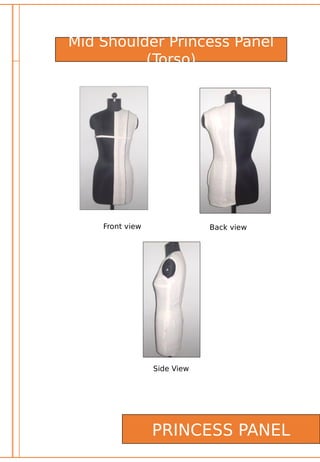
PRINCESS PANEL
Mid Shoulder Princess Panel
(Torso)
Front view Back view
Side View
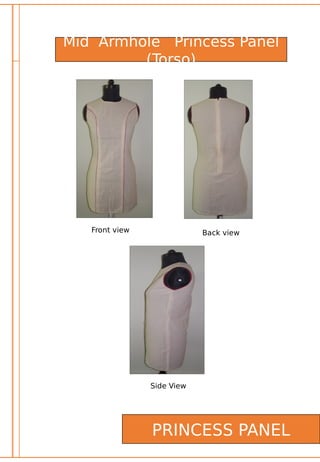
PRINCESS PANEL
Mid Armhole Princess Panel
(Torso)
Front view Back view
Side View
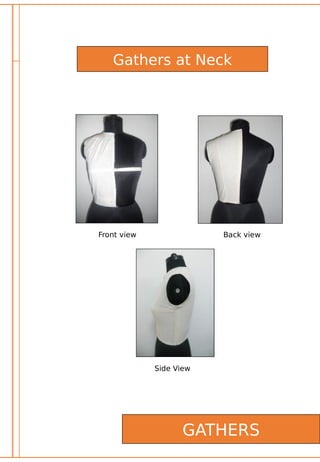
GATHERS
Gathers at Neck
Front view Back view
Side View
Front view Back view
Side View
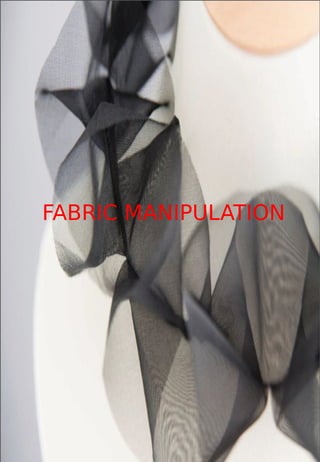
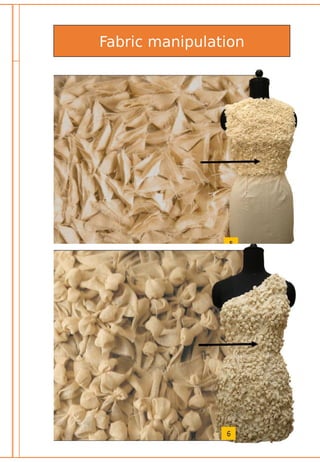
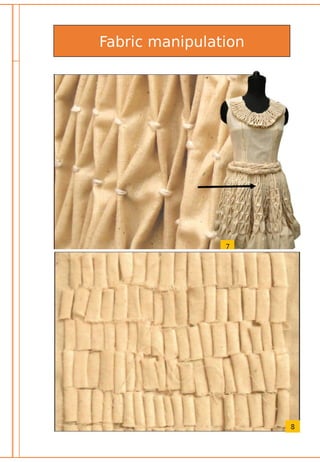
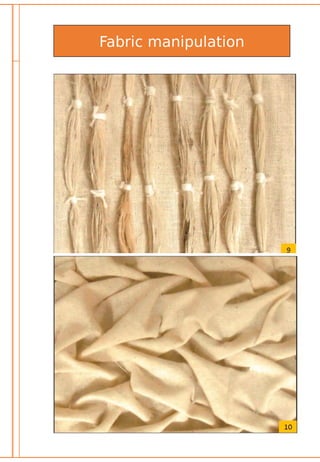
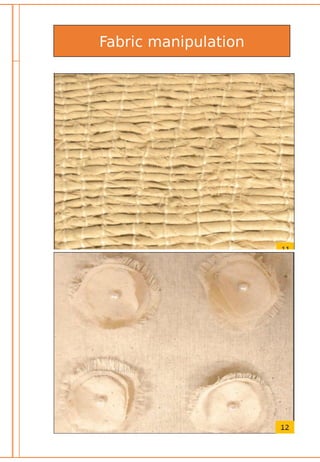
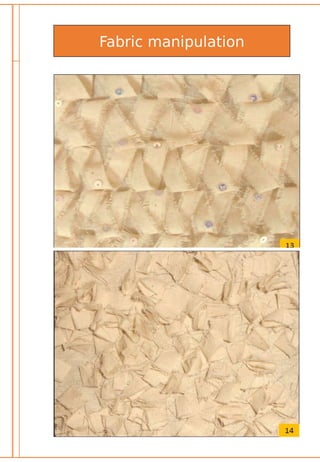
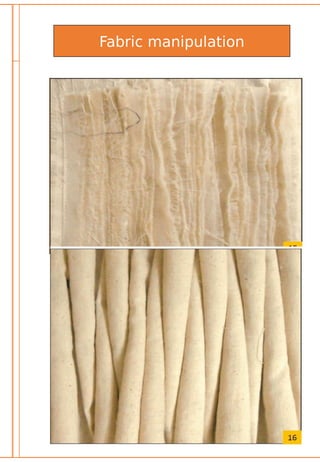
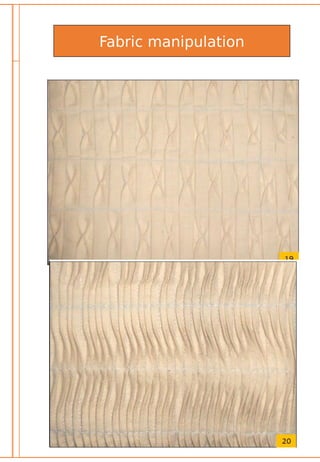
FABRIC MANIPULATION
The Art of
Manipulating
Fabric
For any Fashion Designer fabric first needs to be
prepared with textures and then used for style and
design development.
Style requires plain textures and sometimes textured
Fabric to be create better style.
Presenting few best ideas of textures which I learnt at
My study of Fashion Design at Dezyne E’cole College.
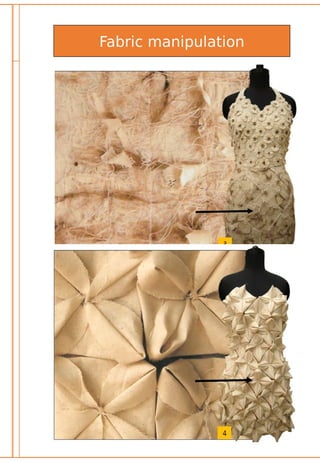
Fabric manipulation
Fabric manipulation
Fabric manipulation
Fabric manipulation
Fabric manipulation
Fabric manipulation
Fabric manipulation
Fabric manipulation
Fabric manipulation
Fabric manipulation
TRIBAL ART
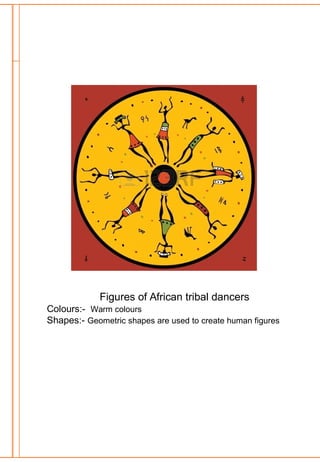
Figures of African tribal dancers
Colours:- Warm colours
Shapes:- Geometric shapes are used to create human figures
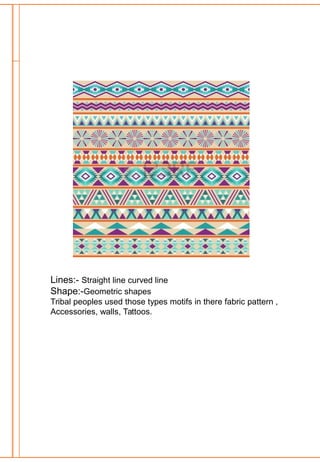
Lines:- Straight line curved line
Shape:-Geometric shapes
Tribal peoples used those types motifs in there fabric pattern ,
Accessories, walls, Tattoos.
Portrait of a African women
Tribal peoples wear heavy and colourful accessories for
looks attractive.
In there accessories mostly used straight lines and
geometric shapes.

Alka Panchal

  • 1.
  • 2.
    Project Report on Women'sWestern Wear Submitted to Dezyne E’cole College Towards the Partial Fulfillment for Award of Diploma in Fashion Technology As Technical Knowledge Development to Women’s Wear Included With Diploma Program Of Fashion Technology By ALKA PANCHAL Dezyne E’cole College Ajmer Address, 106/10, civil lines, Ajmer Tel. no.0145 2624679 www.dezyneecole.com 2014-2015
  • 3.
    The Project ofMs. Alka Panchal has been Checked & has been graded as Dezyne E’cole College Civil Lines, Ajmer www.dezyneecole.com Thank you Principal (Seal &Signature)
  • 4.
    ACKNOWLEDGEMENT I am deeplygrateful to all those whose guidance has been of tremendous value and enabled me to complete this project successfully. I am thankful to all my mentors of Dezyne E’ cole who gave me an opportunity to show my abilities by working on this project on the esteem organization. ALKA PANCHAL 1ST Year diploma in Fashion Technology
  • 5.
    1. Fashion asa Person’s Image 2. Fashion Industry 3. Learning Experience 4. Foundation Design 5. Corel Draw 6. Fashion illustration 7. Pattern Engineering 8. Measurement techniques 9. Draping 10.Fabric Manipulation 11.Element and Principle of Design 12.Trible Art CONTENT
  • 6.
    Fashion is amore then wearing good clothes it is about presenting a person’s image in Society , we generally see people accepting fashion due to pee pressure, Image in the society and when a person wants a change to brighten his life. There are many reasons behind what we wear. • Protection from cold ,rain and snow :- Mountain climbers wear high – tech outwear to avoid frostbite and over – exposure. • Physical attention :- Many styles are worn to inspire “chemistry”. • Emotions :- we dress “up” when we’re happy and “down” when we’re upset. • Religious expression :- Orthodox Jewish men wear long part of their body except their eyes. • Identification and tradition :- Judges wear robes ,people in the military wear uniform, brides wear long white dresses. Fashion as a Person’s Image
  • 7.
    Within the sphereof Technology Industries , design technology is perhaps the fastest growing today. with new technologies emerging rapidly and industries changing complexion, more and more job opportunities are up for the taking .It is estimated that India will have a shortfall of five lakh people in the design sector by 2010-11 but not all gradates will be employable .Thus bringing the gap between talent and the skills required by the industry is important. only Today, one in every four designers is employable and only 10% of the design graduates manage to get employment in the design industry. Hence the student should understand the basic requirement of the industry and exhibit that ability . Fashion Industry
  • 8.
    Learning Experience This iswhat I learn here at Dezyne E’cole college creating fashion doesn’t entail a vivid imagination and instinct for creativity. It also involve many decisions and myriad techniques , focus on a central idea. Dezyne E’cole Fashion design made me build a strong foundation in terms of design sence, Conceptualisation independent research ,creative application and artistic experience
  • 9.
    As a partof fashion industry I am training my self through formal education in Diploma programme in build with this study. During the course duration of diploma programme I had an exposure towards practical working in fashion design.
  • 10.
  • 11.
    COLOR INPACT INDESIGN Colour is a most vital tool in the hands of fashion designer. It is the most perceptible and hence is a central to success and failure of a designer scheme.it is therefore very important designer that a designer has a full knowledge and understanding of its tool
  • 12.
    Warm and coolcolors Variation in Cool Color Blue Variation in Cool Color Yellow Variation in Cool Color Red
  • 13.
    Comparing Value ofColors The Yellow is lighter value then Red The Blue is Darker value then Orange The Green is lighter value then Brown The Dark Green is equal in the value to the Brown Compare the Blue and Red Rectangles to the Grey Rectangles or either side of each color. Which Grey is equal in value to the color ? It may be helpful to stand at a distance and blur your eyes. If the edge between the two area disappears, the values are equal.
  • 14.
  • 15.
  • 16.
  • 17.
  • 18.
  • 19.
    COLLARS Bertha deep neckline BerthaTie Bertha Buster Brown Style Bertha Knotted Ends Bertha Yoke style Bertha - Braid Edge Trim
  • 20.
    POCKETS Bellow Cargo Cargo front KangarooFlapShape Stitched Patch Button Flap
  • 21.
  • 29.
  • 30.
    Garment Construction Fashion Designingruns the garment from eveningwear to sportswear, Women’s wear to Men’s wear and Kids wear to knitwear. Garment Construction is popularly called Pattern Engineering has a great importance in fashion design industry. The Companies like van heuson,dockers levis, adidas etc. are the providers of perfect fit and this is what we learn at Dezyne E’cole through the art of pattern making. A slop pattern [ home sewing ] and block pattern [ industrial production ] is custom – fitted basic pattern from which pattern for many different styles can be developed. The Draping method involves creating a Maslin mock up by pinning fabric directly on a form then transferring the muslin outline and makings onto a paper pattern or using the muslin as the pattern it self. The flat pattern Draping method is the most commonly used method in Menswear.
  • 31.
  • 32.
  • 33.
  • 34.
  • 35.
  • 36.
  • 37.
  • 38.
    Women’s Basic BodiceBlock Saree Blouse
  • 39.
  • 40.
  • 41.
  • 42.
    Tools & Equipments TheFlat pattern method where the entire pattern is drafted on a flat surface from measurements ,using the ruler and curve and straight Edges. As a fashion designer I use various tools and measuring devices to create a toil pattern on dummy. Measuring Tape Seam Ripper Scissor Drafting Scale Tailoring Chalk French curve
  • 43.
    Pattern Making Symbols Various signs& symbol of Pattern Making Which I Generally use on pattern :-
  • 44.
    Various signs &symbol of Pattern Making Which I Generally use on pattern :- Pattern Making Symbols
  • 45.
    Pattern Making Symbols Various signs& symbol of Pattern Making Which I Generally use on pattern :-
  • 46.
    Notches Notches :- •Seam allowance •CenterLine •Ease $ Gather Control •Dart Legs •Identification of Front & Back •Identification of Joining Parts •Zipper Placement •Facing •Hemline •Waistline •Shoulder Tip •Sleeve Cap Punch / Circle :- •Dart intake •Corners •Buttons / Buttonholes •Trimmings •Pocket placement Jog Seam :- A jog seam is used to indicate a change in the seam allowance. ¼ inch : •All faced areas •Narrow spacing •Extreme curve •Sleeveless armhole ½ inch : •Side seam •Waist line •Center line •Styline 1 inch : •Shoulder 2 inch : •Straight Hemline
  • 47.
    LANDMARKS Number refers toboth front & back wherever indicated :- 1. Center Front Neck Center Back Neck 2. Center Front Waist Center Back Waist 3. Bust Point 4. Center Bus Level 5. Center Front [Princess line] Center Back [Princess line 6. Mid Armhole front Mid Armhole Back 7. Shoulder Tip 8. Shoulder at Neck 9. Armhole Ridged or Roll Line 10.Plate Screw 11.Armhole Plate
  • 48.
    Measurements The flat- patternmethod is where the entire pattern is drafted on the flat surface measurement . Under garment construction we learn about the measuring techniques on the dress form. That can be seen here:- Different ways to taking measurements:- • Circumference measurements • Horizontal measurements • Vertical measurements
  • 49.
  • 50.
    Circumference Measurements SIZE = 34 RoundBust measurement Round Waist measurement Round Abdomen measurement
  • 51.
  • 52.
    SIZE = 34 Front length Measurement ShoulderSlope Measurement Full length Measurement Vertical Measurements
  • 53.
  • 54.
    Horizontal Measurement SIZE = 34 Acrossshoulder Measurement Across Chest Measurement Abdomen Arc Measurement
  • 55.
    Dart Manipulation Dart Manipulation isa slash spread and pivotal transfer making technique to transfer dart excess to one location to another for design variation .It is a beginning of pattern manipulation for generating design patterns. It require both artistic and technical skills to manage and control the pattern. PRINCIPLE 1  One Dart Series  Two Dart Series A Dart may be transfer to any location around the pattern outlines from the designated pivotal point without affecting the size or fit of the garment. PRINCIPLE 2 Added fullness To increase garment to an amount greater then that provided by the dart excess of working pattern. The length and the width within the pattern’s outline must be increased. PRINCIPLE 3 Contouring To fit the contour of the upper torso closer then the basic garment the pattern must be reduced within its frame to fit the dimension of the body above, below and between the bust mounds and shoulder blades.
  • 58.
    SINGLE DART SERIES FrenchDart Front view Side View Back view
  • 59.
    SINGLE DART SERIES MidShoulder Dart Front view Back view Side View
  • 60.
    Mid Armhole Dart Front view Backview Side View SINGLE DART SERIES
  • 61.
    DOUBLE DART SERIES MidShoulder and Waist Dart Front view Back view Side View
  • 62.
    DOUBLE DART SERIES MidArmhole and Waist Dart Front view Back view Side View
  • 63.
    DOUBLE DART SERIES Sideand Waist Dart Front view Back view Side View
  • 64.
    Tuck Dart Front viewBack view Side View
  • 65.
    Pleat Dart Front viewBack view Side View
  • 66.
    RADIATING DART Neck RadiatingDart Front view Back view
  • 67.
    PRINCESS PANEL Mid ShoulderPrincess Panel (Torso) Front view Back view Side View
  • 68.
    PRINCESS PANEL Mid ArmholePrincess Panel (Torso) Front view Back view Side View
  • 69.
    GATHERS Gathers at Neck Frontview Back view Side View
  • 70.
    Front view Backview Side View
  • 71.
  • 72.
    The Art of Manipulating Fabric Forany Fashion Designer fabric first needs to be prepared with textures and then used for style and design development. Style requires plain textures and sometimes textured Fabric to be create better style. Presenting few best ideas of textures which I learnt at My study of Fashion Design at Dezyne E’cole College.
  • 73.
  • 74.
  • 75.
  • 76.
  • 77.
  • 78.
  • 79.
  • 80.
  • 81.
  • 82.
  • 83.
  • 84.
    Figures of Africantribal dancers Colours:- Warm colours Shapes:- Geometric shapes are used to create human figures
  • 85.
    Lines:- Straight linecurved line Shape:-Geometric shapes Tribal peoples used those types motifs in there fabric pattern , Accessories, walls, Tattoos.
  • 86.
    Portrait of aAfrican women Tribal peoples wear heavy and colourful accessories for looks attractive. In there accessories mostly used straight lines and geometric shapes.