ALGERIA VS
KENYA
By: Kristie Cordeiro
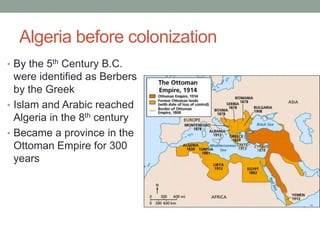
Algeria before colonization
• By the 5th Century B.C.
were identified as Berbers
by the Greek
• Islam and Arabic reached
Algeria in the 8th century
• Became a province in the
Ottoman Empire for 300
years
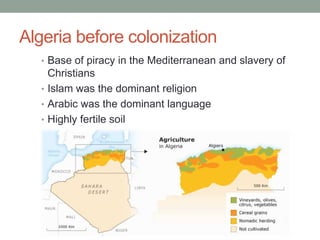
Algeria before colonization
• Base of piracy in the Mediterranean and slavery of
Christians
• Islam was the dominant religion
• Arabic was the dominant language
• Highly fertile soil
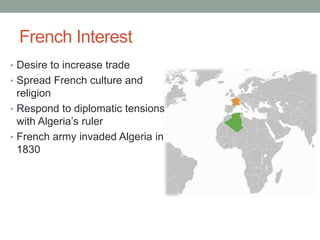
French Interest
• Desire to increase trade
• Spread French culture and
religion
• Respond to diplomatic tensions
with Algeria’s ruler
• French army invaded Algeria in
1830
Citizens and Subjects
• French citizens: small farmers who were able to ascend to a
status they could not reach in mainland France
• Colonial policies turned Muslims into second class citizens
• By the 19th century those who followed Islamic Laws were seen as
“subjects”
• By 1936: out of 4.5 million, only 2,500 Muslim Algerians chose
to become citizens
Citizens and Subjects
• Settlers bought the most fertile areas for a low price
• Most Algerians were farmers on small plots of land
• Many faced poverty and malnutrion
• Moved to Algerian cities to work for settler farms
“[W]e have not come to
Algeria to oppress and
exploit them, but to bring
them the benefits of
civilization…” – Emporer
Napoleon III
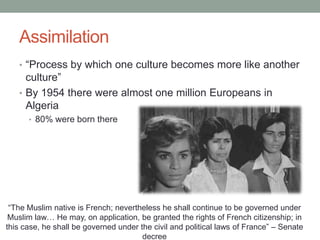
Assimilation
• “Process by which one culture becomes more like another
culture”
• By 1954 there were almost one million Europeans in
Algeria
• 80% were born there
“The Muslim native is French; nevertheless he shall continue to be governed under
Muslim law… He may, on application, be granted the rights of French citizenship; in
this case, he shall be governed under the civil and political laws of France” – Senate
decree
Assimilation
• French politicians supported Algerian assimilation,
but strongly opposed increase of Muslim rights
• Encouraged Algerians to speak French, limited the
influence of Islam and taught them French
curriculum
• Labeled Arabic as a foreign language
• Limited pilgrimages to Mecca
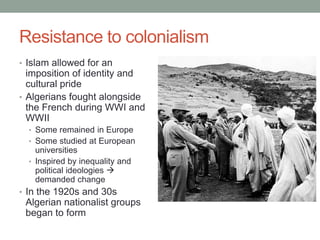
Resistance to colonialism
• Islam allowed for an
imposition of identity and
cultural pride
• Algerians fought alongside
the French during WWI and
WWII
• Some remained in Europe
• Some studied at European
universities
• Inspired by inequality and
political ideologies 
demanded change
• In the 1920s and 30s
Algerian nationalist groups
began to form
Nationalist leaders and groups
• May 8 1945: demonstrations to show the link between the
end of fascism and the desire to end colonialism
• Demonstration turned into a violent revolt
• Resulted in the deaths of thousands of settlers and Algerians
• Many Algerians joined the nationalist cause
“ [The Muslim Algerian Nation]… has its culture, its tradition and
its characteristics, good or bad like every other nation of the earth.
And… we state that this Algerian nation is not France, cannot be
France, and does not wish to be France.” – Sheikh Abdul-hamid
Ben Badis
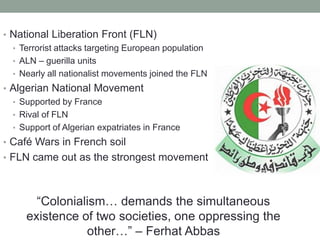
• National Liberation Front (FLN)
• Terrorist attacks targeting European population
• ALN – guerilla units
• Nearly all nationalist movements joined the FLN
• Algerian National Movement
• Supported by France
• Rival of FLN
• Support of Algerian expatriates in France
• Café Wars in French soil
• FLN came out as the strongest movement
“Colonialism… demands the simultaneous
existence of two societies, one oppressing the
other…” – Ferhat Abbas
Frantz Fanon
• Afro-french psychiatrist and revolutionary
• Joined the FLN in November of 1954
• Defended the right to use violence to fight
for independence
“human beings who are not
considered as such shall not be
bound by principles that apply to
humanity, in their attitude towards the
colonizer”
Algerian War
• 1954: France lost the war against Vietnam, and faced
uprisings in Tunisia and Morocco
• FLN led one of the most violent struggles for violence in
the 20th century
• Fought between Algerian militants and the French army,
white settlers and Algerians recruited by France
• Lasted 8 years: 1954-1962
• Focus on urban areas  Algiers
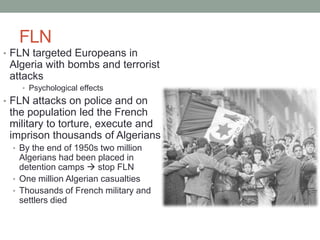
FLN
• FLN targeted Europeans in
Algeria with bombs and terrorist
attacks
• Psychological effects
• FLN attacks on police and on
the population led the French
military to torture, execute and
imprison thousands of Algerians
• By the end of 1950s two million
Algerians had been placed in
detention camps  stop FLN
• One million Algerian casualties
• Thousands of French military and
settlers died
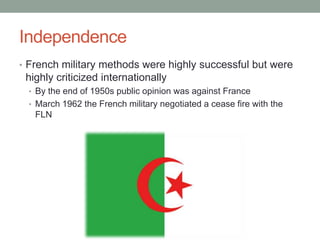
Independence
• French military methods were highly successful but were
highly criticized internationally
• By the end of 1950s public opinion was against France
• March 1962 the French military negotiated a cease fire with the
FLN
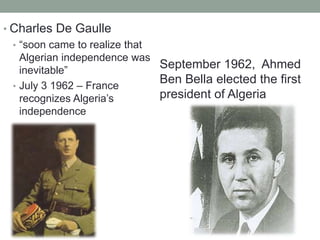
• Charles De Gaulle
• “soon came to realize that
Algerian independence was
inevitable”
• July 3 1962 – France
recognizes Algeria’s
independence
September 1962, Ahmed
Ben Bella elected the first
president of Algeria
Learn more!
Kenya before colonization
• Arabs who settled with the Bantu
people introduced Islam and Arabic
to the Swahili culture
• During 17th century, Swahili area
came under control of Omani Arabs
• Increased slave trade
• City of Mombasa  important port
city
• Diplomatic relations with Ming Dynasty 
Zheng He
• Welcomed Vasco da Gama
British interest
• Under British rule for 68 years
• Arrival of the Imperial British East Africa
Company
• Initial focus on Uganda
• Railroad through Kenya to connect Uganda with
the Indian Ocean
• Authorities encouraged Europeans to live in
Kenya  demand for railroad travel
• Some of the most fertile land in all East Africa
• Cash crops: tea and coffee
• WWI
• 400,000 mobilized in Carrier troops
• WWII
• Military base
• 98,000 men on military duty
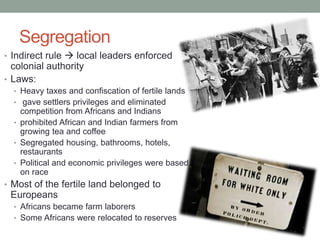
Segregation
• Indirect rule  local leaders enforced
colonial authority
• Laws:
• Heavy taxes and confiscation of fertile lands
• gave settlers privileges and eliminated
competition from Africans and Indians
• prohibited African and Indian farmers from
growing tea and coffee
• Segregated housing, bathrooms, hotels,
restaurants
• Political and economic privileges were based
on race
• Most of the fertile land belonged to
Europeans
• Africans became farm laborers
• Some Africans were relocated to reserves
Resistance to colonialism
• Violent resistance against:
• Levy taxes, draft African men for
the military, force communities off
their lands
• African political organizations
began to form in 1920s
• Groups were divided among ethnic
lines  few saw themselves as
Kenyan
• After WWII a revolt began
among the Kikuyu, Kenya’s
largest ethnic group
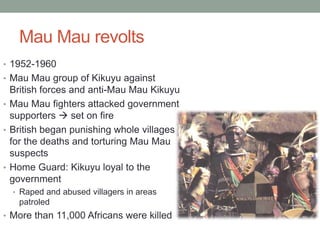
Mau Mau revolts
• 1952-1960
• Mau Mau group of Kikuyu against
British forces and anti-Mau Mau Kikuyu
• Mau Mau fighters attacked government
supporters  set on fire
• British began punishing whole villages
for the deaths and torturing Mau Mau
suspects
• Home Guard: Kikuyu loyal to the
government
• Raped and abused villagers in areas
patroled
• More than 11,000 Africans were killed
Mau Mau revolts
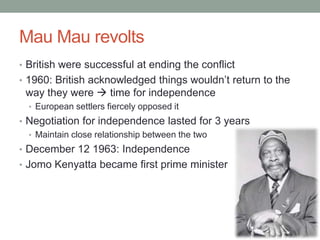
• British were successful at ending the conflict
• 1960: British acknowledged things wouldn’t return to the
way they were  time for independence
• European settlers fiercely opposed it
• Negotiation for independence lasted for 3 years
• Maintain close relationship between the two
• December 12 1963: Independence
• Jomo Kenyatta became first prime minister
• Internationalist
• Algeria:
• France had recently lost the war against Vietnam and face uprisings in Tunisia and Morocco
which led nationalists to believe that defeating the French was feasible
• After the defeat of fascist Germany, Algerians raised awareness to the comparison between
fascism and imperialism
• Kenya:
• After defeating the Axis alliance, who desired to expand their empires, Britain chose to maintain
economic ties to Kenya, but allow its independence
• Nationalist
• Algeria:
• Decolonization of Algeria was the result of efforts of resistance movements such as the FLN, who
battled against French oppression
Kenya:
• Decolonization of Kenya was the result of efforts of resistance movements such as the Mau Mau
Kikuyu, who battled against House Guard and British oppression
• Metropolitanist
• Kenya:
• After British containment of the Mau Mau, they could still maintain control over the region, but
instead they chose to construct diplomatic relations with an independent country where they would
keep close economic relationship
• Algeria:
• Failed attempts of French assimilation led to dissatisfaction and oppression, contributing to a
feeling of intense nationalism
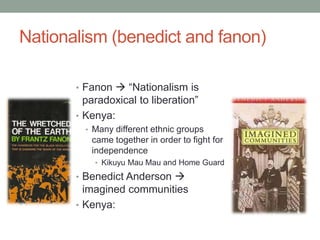
Nationalism (benedict and fanon)
• Fanon  “Nationalism is
paradoxical to liberation”
• Kenya:
• Many different ethnic groups
came together in order to fight for
independence
• Kikuyu Mau Mau and Home Guard
• Benedict Anderson 
imagined communities
• Kenya:
Kemper
• “nationalism is a local response
employing local cultural forms
to new circumstances”
• Algeria:
• With the increase of French
repression, the Muslim Algerians,
with the influence of the FLN,
experienced a sense of community
• Muslim Algerians developed a
sense of community with the
increase of French repression and
subsequent influence of the FLN
A. G. Hopkins
• Decolonization is a
process of globalization
• Algeria:
• After French defeat in
Vietnam and uprisings in
Tunisia and Morocco
convinced the nationalists
were convinced that
France could be
challenged and defeated
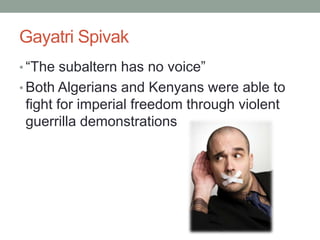
Gayatri Spivak
• “The subaltern has no voice”
• Both Algerians and Kenyans were able to
fight for imperial freedom through violent
guerrilla demonstrations
World System
World System
• Algeria:
• France  core
• Periphery during
colonialism
• Remained a periphery
• Kenya:
• Britain  core
• Periphery during
colonialism
• Export relations between
the two countries
continued after
independence
Relevance
• Similarities:
• both settler colonies
• Use of guerilla tactics
• Kenya in rural areas
• Algeria in
• Differences:
• France aimed at assimilating the
Algerians into the French culture
• Britain aimed at segregating the natives
and the settlers for economic interests
• Algerian resistance movements were
largely urban
• Kenya resistance movements were
largely rural

Algeria vs. kenya

  • 1.
  • 2.
    Algeria before colonization •By the 5th Century B.C. were identified as Berbers by the Greek • Islam and Arabic reached Algeria in the 8th century • Became a province in the Ottoman Empire for 300 years
  • 3.
    Algeria before colonization •Base of piracy in the Mediterranean and slavery of Christians • Islam was the dominant religion • Arabic was the dominant language • Highly fertile soil
  • 4.
    French Interest • Desireto increase trade • Spread French culture and religion • Respond to diplomatic tensions with Algeria’s ruler • French army invaded Algeria in 1830
  • 5.
    Citizens and Subjects •French citizens: small farmers who were able to ascend to a status they could not reach in mainland France • Colonial policies turned Muslims into second class citizens • By the 19th century those who followed Islamic Laws were seen as “subjects” • By 1936: out of 4.5 million, only 2,500 Muslim Algerians chose to become citizens
  • 6.
    Citizens and Subjects •Settlers bought the most fertile areas for a low price • Most Algerians were farmers on small plots of land • Many faced poverty and malnutrion • Moved to Algerian cities to work for settler farms “[W]e have not come to Algeria to oppress and exploit them, but to bring them the benefits of civilization…” – Emporer Napoleon III
  • 7.
    Assimilation • “Process bywhich one culture becomes more like another culture” • By 1954 there were almost one million Europeans in Algeria • 80% were born there “The Muslim native is French; nevertheless he shall continue to be governed under Muslim law… He may, on application, be granted the rights of French citizenship; in this case, he shall be governed under the civil and political laws of France” – Senate decree
  • 8.
    Assimilation • French politicianssupported Algerian assimilation, but strongly opposed increase of Muslim rights • Encouraged Algerians to speak French, limited the influence of Islam and taught them French curriculum • Labeled Arabic as a foreign language • Limited pilgrimages to Mecca
  • 9.
    Resistance to colonialism •Islam allowed for an imposition of identity and cultural pride • Algerians fought alongside the French during WWI and WWII • Some remained in Europe • Some studied at European universities • Inspired by inequality and political ideologies  demanded change • In the 1920s and 30s Algerian nationalist groups began to form
  • 10.
    Nationalist leaders andgroups • May 8 1945: demonstrations to show the link between the end of fascism and the desire to end colonialism • Demonstration turned into a violent revolt • Resulted in the deaths of thousands of settlers and Algerians • Many Algerians joined the nationalist cause “ [The Muslim Algerian Nation]… has its culture, its tradition and its characteristics, good or bad like every other nation of the earth. And… we state that this Algerian nation is not France, cannot be France, and does not wish to be France.” – Sheikh Abdul-hamid Ben Badis
  • 11.
    • National LiberationFront (FLN) • Terrorist attacks targeting European population • ALN – guerilla units • Nearly all nationalist movements joined the FLN • Algerian National Movement • Supported by France • Rival of FLN • Support of Algerian expatriates in France • Café Wars in French soil • FLN came out as the strongest movement “Colonialism… demands the simultaneous existence of two societies, one oppressing the other…” – Ferhat Abbas
  • 12.
    Frantz Fanon • Afro-frenchpsychiatrist and revolutionary • Joined the FLN in November of 1954 • Defended the right to use violence to fight for independence “human beings who are not considered as such shall not be bound by principles that apply to humanity, in their attitude towards the colonizer”
  • 13.
    Algerian War • 1954:France lost the war against Vietnam, and faced uprisings in Tunisia and Morocco • FLN led one of the most violent struggles for violence in the 20th century • Fought between Algerian militants and the French army, white settlers and Algerians recruited by France • Lasted 8 years: 1954-1962 • Focus on urban areas  Algiers
  • 14.
    FLN • FLN targetedEuropeans in Algeria with bombs and terrorist attacks • Psychological effects • FLN attacks on police and on the population led the French military to torture, execute and imprison thousands of Algerians • By the end of 1950s two million Algerians had been placed in detention camps  stop FLN • One million Algerian casualties • Thousands of French military and settlers died
  • 15.
    Independence • French militarymethods were highly successful but were highly criticized internationally • By the end of 1950s public opinion was against France • March 1962 the French military negotiated a cease fire with the FLN
  • 16.
    • Charles DeGaulle • “soon came to realize that Algerian independence was inevitable” • July 3 1962 – France recognizes Algeria’s independence September 1962, Ahmed Ben Bella elected the first president of Algeria
  • 17.
  • 18.
    Kenya before colonization •Arabs who settled with the Bantu people introduced Islam and Arabic to the Swahili culture • During 17th century, Swahili area came under control of Omani Arabs • Increased slave trade • City of Mombasa  important port city • Diplomatic relations with Ming Dynasty  Zheng He • Welcomed Vasco da Gama
  • 19.
    British interest • UnderBritish rule for 68 years • Arrival of the Imperial British East Africa Company • Initial focus on Uganda • Railroad through Kenya to connect Uganda with the Indian Ocean • Authorities encouraged Europeans to live in Kenya  demand for railroad travel • Some of the most fertile land in all East Africa • Cash crops: tea and coffee • WWI • 400,000 mobilized in Carrier troops • WWII • Military base • 98,000 men on military duty
  • 20.
    Segregation • Indirect rule local leaders enforced colonial authority • Laws: • Heavy taxes and confiscation of fertile lands • gave settlers privileges and eliminated competition from Africans and Indians • prohibited African and Indian farmers from growing tea and coffee • Segregated housing, bathrooms, hotels, restaurants • Political and economic privileges were based on race • Most of the fertile land belonged to Europeans • Africans became farm laborers • Some Africans were relocated to reserves
  • 21.
    Resistance to colonialism •Violent resistance against: • Levy taxes, draft African men for the military, force communities off their lands • African political organizations began to form in 1920s • Groups were divided among ethnic lines  few saw themselves as Kenyan • After WWII a revolt began among the Kikuyu, Kenya’s largest ethnic group
  • 22.
    Mau Mau revolts •1952-1960 • Mau Mau group of Kikuyu against British forces and anti-Mau Mau Kikuyu • Mau Mau fighters attacked government supporters  set on fire • British began punishing whole villages for the deaths and torturing Mau Mau suspects • Home Guard: Kikuyu loyal to the government • Raped and abused villagers in areas patroled • More than 11,000 Africans were killed
  • 23.
    Mau Mau revolts •British were successful at ending the conflict • 1960: British acknowledged things wouldn’t return to the way they were  time for independence • European settlers fiercely opposed it • Negotiation for independence lasted for 3 years • Maintain close relationship between the two • December 12 1963: Independence • Jomo Kenyatta became first prime minister
  • 24.
    • Internationalist • Algeria: •France had recently lost the war against Vietnam and face uprisings in Tunisia and Morocco which led nationalists to believe that defeating the French was feasible • After the defeat of fascist Germany, Algerians raised awareness to the comparison between fascism and imperialism • Kenya: • After defeating the Axis alliance, who desired to expand their empires, Britain chose to maintain economic ties to Kenya, but allow its independence • Nationalist • Algeria: • Decolonization of Algeria was the result of efforts of resistance movements such as the FLN, who battled against French oppression Kenya: • Decolonization of Kenya was the result of efforts of resistance movements such as the Mau Mau Kikuyu, who battled against House Guard and British oppression • Metropolitanist • Kenya: • After British containment of the Mau Mau, they could still maintain control over the region, but instead they chose to construct diplomatic relations with an independent country where they would keep close economic relationship • Algeria: • Failed attempts of French assimilation led to dissatisfaction and oppression, contributing to a feeling of intense nationalism
  • 25.
    Nationalism (benedict andfanon) • Fanon  “Nationalism is paradoxical to liberation” • Kenya: • Many different ethnic groups came together in order to fight for independence • Kikuyu Mau Mau and Home Guard • Benedict Anderson  imagined communities • Kenya:
  • 26.
    Kemper • “nationalism isa local response employing local cultural forms to new circumstances” • Algeria: • With the increase of French repression, the Muslim Algerians, with the influence of the FLN, experienced a sense of community • Muslim Algerians developed a sense of community with the increase of French repression and subsequent influence of the FLN
  • 27.
    A. G. Hopkins •Decolonization is a process of globalization • Algeria: • After French defeat in Vietnam and uprisings in Tunisia and Morocco convinced the nationalists were convinced that France could be challenged and defeated
  • 28.
    Gayatri Spivak • “Thesubaltern has no voice” • Both Algerians and Kenyans were able to fight for imperial freedom through violent guerrilla demonstrations
  • 29.
  • 30.
    World System • Algeria: •France  core • Periphery during colonialism • Remained a periphery • Kenya: • Britain  core • Periphery during colonialism • Export relations between the two countries continued after independence
  • 31.
    Relevance • Similarities: • bothsettler colonies • Use of guerilla tactics • Kenya in rural areas • Algeria in • Differences: • France aimed at assimilating the Algerians into the French culture • Britain aimed at segregating the natives and the settlers for economic interests • Algerian resistance movements were largely urban • Kenya resistance movements were largely rural

Editor's Notes

  • #3 Change in social and economic relationsConnection to a rich culture  the desire to return to true Islamic values had political and social impacts throughout historyAlgiers was the capitalThe pasha ruled, and Turkish was the official languageBerbers and Arabs were excluded from the governmentAround 1710 the Dey got control over AlgeriaAlgiers remained part of the Empire, but the Ottoman had little influence
  • #4 3- High production of vegetables, fruits, olive, tobaco, grains and cotton
  • #6 French citizens: thousands of French migrated to Algeriamostly small farmers who grew wheat and produced wine
  • #7 By the 1930s policies allowed settlers to buy thousands of square kilometers of the best land to grow crops for exportAlgerians were subsistence farmers who faced poverty, hunger and malnutrition Moved to Algerian town and cities to escape destitutionWorked in settlers’ farms for low wages
  • #8 The French believed their culture was superior and that the Algerian Muslim culture was “primitive” and “medieval”, which led to the idea of Assimilation80% of the settlers inhabiting Algeria were born there
  • #9 French politicians supported Algerian assimilation and to grant them citizenship, but strongly opposed increase of muslim rightsTaught Algerians French literature, history and political ideas
  • #10 Islam was a key factor in resisting colonial rule and French assimilationPost WWI and WWII, many Algerians remained in Europe to liveStudents also went to Europe to pursue university degreesCame in contact with new political ideologies and the disparity of living conditionsInspired groups to form to fight for independence
  • #11 Fascism and colonialismDemonstrations became violent revoltAlgerians murdered more than a hundred settlers and in return French murdered thousands of Algerians in returnThis led many Algerians to join the nationalist cuasue and to see violence as the only way to win independence
  • #12 Sporadic attacks to governmental buildings, public gatherings for the French, areas of high concentrationAlgerian national movement had the support of French movement and was rivals with the FLNWas supported by the majority of Algerian expatriates in FranceFLN and ANM engaged in attacks on one another led to Café War in French soil conflict that involved sporadic bombings and assassinations in cafes During the Algerian War these two groups fought each other and the ALN destroyed the ANM’s armed group and became the dominant group
  • #13 Fanon defends the right for a colonized people to use violence to struggle for independence, arguing that human beings who are not considered as such shall not be bound by principles that apply to humanity, in their attitude towards the colonizer
  • #14 Convinced the Algerian nationalists that France could finally be challenged and defeated
  • #15 Nationalists aimed to create a climate of fear and insecurityFLN attacks on police and settlers led the French military to respond with mass torture, executions and imprisonments of thousands of Algerians Two million Algerians had beed placed in detention camps as a French attempt to isolate the FLN
  • #19 Sincebritish abolitionists interrupted the transatlantic slave trade, the Portuguese seeked the Omani for slave purchaseWelcomed portuguese voyager vasco da gama in 1498