Algebraic
Structures
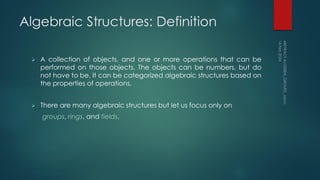
Algebraic Structures: Definition
 A collection of objects, and one or more operations that can be
performed on those objects. The objects can be numbers, but do
not have to be. It can be categorized algebraic structures based on
the properties of operations.
 There are many algebraic structures but let us focus only on
groups, rings, and fields.
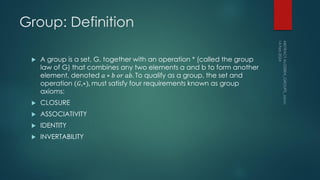
Group: Definition
 A group is a set, G, together with an operation * (called the group
law of G) that combines any two elements a and b to form another
element, denoted 𝑎 ∗ 𝑏 𝑜𝑟 𝑎𝑏. To qualify as a group, the set and
operation (𝐺,∗), must satisfy four requirements known as group
axioms:
 CLOSURE
 ASSOCIATIVITY
 IDENTITY
 INVERTABILITY
Group Axiom 1: Closure
 For all 𝑎, 𝑏 𝑖𝑛 𝐺, the result of the operation 𝑎 ∗ 𝑏, is also in 𝐺.
For example:
 The integers under addition (ℤ, +) is closed.
1 and 2 are elements of ℤ.
1 + 2 = 3 is also an element of ℤ. And so, with all the positive and
negative integers.
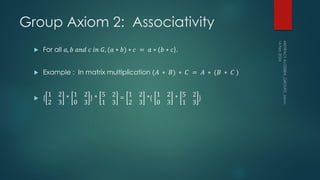
Group Axiom 2: Associativity
 For all 𝑎, 𝑏 𝑎𝑛𝑑 𝑐 𝑖𝑛 𝐺, (𝑎 ∗ 𝑏) ∗ 𝑐 = 𝑎 ∗ (𝑏 ∗ 𝑐).
 Example : In matrix multiplication (𝐴 ∗ 𝐵) ∗ 𝐶 = 𝐴 ∗ (𝐵 ∗ 𝐶 )
 (
1 2
2 3
*
1 2
0 3
) *
5 2
1 3
=
1 2
2 3
*(
1 2
0 3
*
5 2
1 3
)
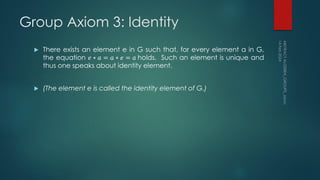
Group Axiom 3: Identity
 There exists an element e in G such that, for every element a in G,
the equation 𝑒 ∗ 𝑎 = 𝑎 ∗ 𝑒 = 𝑎 holds. Such an element is unique and
thus one speaks about identity element.
 (The element e is called the identity element of G.)
Group Axiom 4: Invertability
 For all a in G, there exists an element b in G, commonly denoted
𝑎−1(or −𝑎 , if the operation is denoted by “+”) such that
𝑎 ∗ 𝑏 = 𝑏 ∗ 𝑎 = 𝑒, where 𝑒, is the identity element.
(The element b is called the inverse of a.)
Examples
Any set of elements with an operation that satisfies these
properties forms a group.
 ℤ is the set of all integers, with addition
 ℤn is the set of integers mod n, with addition
 ℚ the set of all rational numbers, with addition
 ℝ the set of nonzero real numbers, with multiplication
 GL (n, R), the set of n x n invertible matrices, with matrix multiplication
(ℤ, +) Z is the set of all integers, with addition.
Let us verify:
 CLOSURE : (-1)+5 = 4
 ASSOCIATIVITY : (9 + 4) + 5 = 9 + (4 + 5)
 IDENTITY : 9 + e = e + 9 = 9
 INVERTABILITY : 9 + b = e = 0
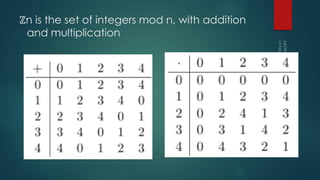
ℤn is the set of integers mod n, with addition
and multiplication
Is ℤ7
,∗ a group? Verify.
Task to do:
 Assignment: Answer Slide 11.

Algebraic-Structures_123456789101112.pdf

  • 1.
  • 2.
    Algebraic Structures: Definition A collection of objects, and one or more operations that can be performed on those objects. The objects can be numbers, but do not have to be. It can be categorized algebraic structures based on the properties of operations.  There are many algebraic structures but let us focus only on groups, rings, and fields.
  • 3.
    Group: Definition  Agroup is a set, G, together with an operation * (called the group law of G) that combines any two elements a and b to form another element, denoted 𝑎 ∗ 𝑏 𝑜𝑟 𝑎𝑏. To qualify as a group, the set and operation (𝐺,∗), must satisfy four requirements known as group axioms:  CLOSURE  ASSOCIATIVITY  IDENTITY  INVERTABILITY
  • 4.
    Group Axiom 1:Closure  For all 𝑎, 𝑏 𝑖𝑛 𝐺, the result of the operation 𝑎 ∗ 𝑏, is also in 𝐺. For example:  The integers under addition (ℤ, +) is closed. 1 and 2 are elements of ℤ. 1 + 2 = 3 is also an element of ℤ. And so, with all the positive and negative integers.
  • 5.
    Group Axiom 2:Associativity  For all 𝑎, 𝑏 𝑎𝑛𝑑 𝑐 𝑖𝑛 𝐺, (𝑎 ∗ 𝑏) ∗ 𝑐 = 𝑎 ∗ (𝑏 ∗ 𝑐).  Example : In matrix multiplication (𝐴 ∗ 𝐵) ∗ 𝐶 = 𝐴 ∗ (𝐵 ∗ 𝐶 )  ( 1 2 2 3 * 1 2 0 3 ) * 5 2 1 3 = 1 2 2 3 *( 1 2 0 3 * 5 2 1 3 )
  • 6.
    Group Axiom 3:Identity  There exists an element e in G such that, for every element a in G, the equation 𝑒 ∗ 𝑎 = 𝑎 ∗ 𝑒 = 𝑎 holds. Such an element is unique and thus one speaks about identity element.  (The element e is called the identity element of G.)
  • 7.
    Group Axiom 4:Invertability  For all a in G, there exists an element b in G, commonly denoted 𝑎−1(or −𝑎 , if the operation is denoted by “+”) such that 𝑎 ∗ 𝑏 = 𝑏 ∗ 𝑎 = 𝑒, where 𝑒, is the identity element. (The element b is called the inverse of a.)
  • 8.
    Examples Any set ofelements with an operation that satisfies these properties forms a group.  ℤ is the set of all integers, with addition  ℤn is the set of integers mod n, with addition  ℚ the set of all rational numbers, with addition  ℝ the set of nonzero real numbers, with multiplication  GL (n, R), the set of n x n invertible matrices, with matrix multiplication
  • 9.
    (ℤ, +) Zis the set of all integers, with addition. Let us verify:  CLOSURE : (-1)+5 = 4  ASSOCIATIVITY : (9 + 4) + 5 = 9 + (4 + 5)  IDENTITY : 9 + e = e + 9 = 9  INVERTABILITY : 9 + b = e = 0
  • 10.
    ℤn is theset of integers mod n, with addition and multiplication
  • 11.
    Is ℤ7 ,∗ agroup? Verify.
  • 12.
    Task to do: Assignment: Answer Slide 11.