Algebra L2 Lessons 1-5

       Wharekura
Algebra – Level 2
•   What I need to know.                     •   What I can do.
     – continue a simple pattern
     – generalise the pattern
     – use the mathematical symbols of =,
       <, >
     – partition numbers less than 10
     – know and use "teen" facts
     – solve addition problems by making
       a ten, or making a decade
     – solve addition problems involving
       measurements
     – continue a sequential pattern
     – develop bar charts to show
       relationships
     – draw the next shape in a pattern
       sequence
     – see how the pattern continues
       from one shape to the next
     – draw up a table of values
     – identify patterns in number
       sequences
     – systematically “count” to establish
       rules for sequential patterns
     – use rules to make predictions
Lesson 1
• We are learning to:        • How do I know when I
  – continue a simple          have learnt this?
    pattern                    – I am able to continue a
                                 simple pattern.
  – generalise the pattern
                               – I am able to make a
                                 generalisation about the
                                 pattern that is accurate.
Lesson 1
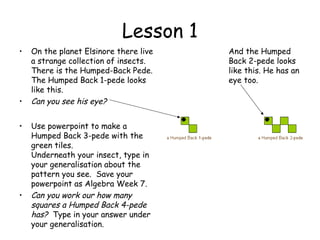
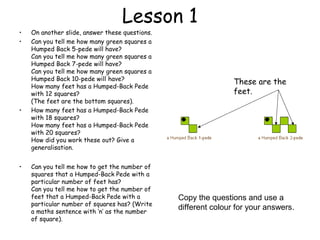
•   On the planet Elsinore there live   And the Humped
    a strange collection of insects.    Back 2-pede looks
    There is the Humped-Back Pede.      like this. He has an
    The Humped Back 1-pede looks        eye too.
    like this. 
•   Can you see his eye? 

•   Use powerpoint to make a
    Humped Back 3-pede with the
    green tiles.
    Underneath your insect, type in
    your generalisation about the
    pattern you see. Save your
    powerpoint as Algebra Week 7.
•   Can you work our how many
    squares a Humped Back 4-pede
    has? Type in your answer under
    your generalisation.
Lesson 1
•   On another slide, answer these questions.
•   Can you tell me how many green squares a
    Humped Back 5-pede will have?
    Can you tell me how many green squares a
    Humped Back 7-pede will have?
    Can you tell me how many green squares a
    Humped Back 10-pede will have?
                                                                These are the
    How many feet has a Humped-Back Pede
    with 12 squares?                                            feet.
    (The feet are the bottom squares).
•   How many feet has a Humped-Back Pede
    with 18 squares?
    How many feet has a Humped-Back Pede
    with 20 squares?
    How did you work these out? Give a
    generalisation.


•   Can you tell me how to get the number of
    squares that a Humped-Back Pede with a
    particular number of feet has?
    Can you tell me how to get the number of
    feet that a Humped-Back Pede with a         Copy the questions and use a
    particular number of squares has? (Write
    a maths sentence with ‘n’ as the number
                                                different colour for your answers.
    of square).
Lesson 2
• We are learning to:        • How do I know when I
  – continue a simple          have learnt this?
    pattern                    – I am able to continue a
                                 simple pattern.
  – generalise the pattern
                               – I am able to make a
                                 generalisation about the
                                 pattern that is accurate.
Lesson 2
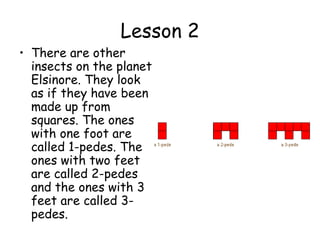
• There are other
  insects on the planet
  Elsinore. They look
  as if they have been
  made up from
  squares. The ones
  with one foot are
  called 1-pedes. The
  ones with two feet
  are called 2-pedes
  and the ones with 3
  feet are called 3-
  pedes.
Lesson 2
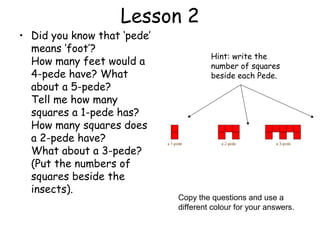
• Did you know that ‘pede’
  means ‘foot’?
                                      Hint: write the
  How many feet would a               number of squares
  4-pede have? What                   beside each Pede.
  about a 5-pede?
  Tell me how many
  squares a 1-pede has?
  How many squares does
  a 2-pede have?
  What about a 3-pede?
  (Put the numbers of
  squares beside the
  insects). 
                             Copy the questions and use a
                             different colour for your answers.
Lesson 2
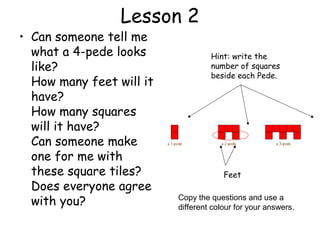
• Can someone tell me
  what a 4-pede looks              Hint: write the
  like?                            number of squares
                                   beside each Pede.
  How many feet will it
  have?
  How many squares
  will it have?
  Can someone make
  one for me with
  these square tiles?                  Feet
  Does everyone agree
  with you?               Copy the questions and use a
                          different colour for your answers.
Lesson 2
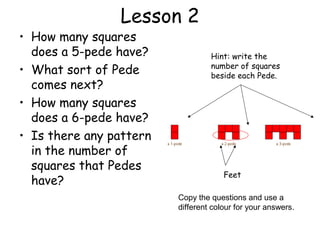
• How many squares
  does a 5-pede have?             Hint: write the
                                  number of squares
• What sort of Pede               beside each Pede.
  comes next?
• How many squares
  does a 6-pede have?
• Is there any pattern
  in the number of
  squares that Pedes
                                      Feet
  have?
                         Copy the questions and use a
                         different colour for your answers.
Lesson 3
• We are learning to:        • How do I know when I have
                               learnt this?
  – continue a simple           – I am able to continue a simple
    pattern                       pattern.
  – generalise the pattern      – I am able to make a
                                  generalisation about the
                                  pattern that is accurate.
Lesson 3
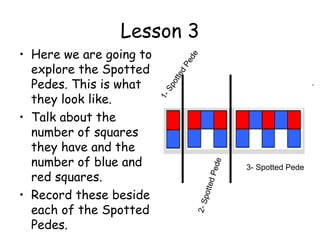
• Here we are going to


                                  e
                                ed
  explore the Spotted


                                dP
                             tte
  Pedes. This is what


                           po
                            S
  they look like.


                         1-
• Talk about the
  number of squares
  they have and the
  number of blue and


                                             de
                                                    3- Spotted Pede


                                             d Pe
  red squares. 

                                       ot t e
• Record these beside
                                         p
                                     2- S
  each of the Spotted
  Pedes.
Lesson 3
• Create the 4 – Spotted
  Pede.
• Answer these questions.
• How many red squares        4- Spotted Pede
  does a Spotted 4-pede
  have?
  How many blue squares
  does a Spotted 4-pede
  have?
  How many squares all
  together?
• How did you work that
  out?
  Why are there more
  blue squares than red
  squares?
• How many more?
Lesson 3
• Create the 5 and 6 – Spotted
  Pede.
• Answer these questions.
• How many red squares does a    4- Spotted Pede
  Spotted 5-pede have?
• 6-pede?
  How many blue squares does
  a Spotted 5-pede have?
  How many squares all
  together?
• How many blue squares does
  a Spotted 6-pede have?
  How many squares all
  together?
• How did you work that out?
Lesson 3
• Challenge –
• How many red
  squares does a          10 - Spotted Pede

  Spotted 10-pede
  have?

• How many blue
  squares does a
  Spotted 10-pede
  have?
Lesson 3
• What did you find
  out about the
  Spotted Pedes?

• What patterns did
  you find?


• Make sure your
  answers are in the
  same powerpoint.
Lesson 4
• We are learning to:        • How do I know when I have
                               learnt this?
  – continue a simple           – I am able to continue a simple
    pattern                       pattern.
  – generalise the pattern      – I am able to make a
                                  generalisation about the
                                  pattern that is accurate.
Lesson 4
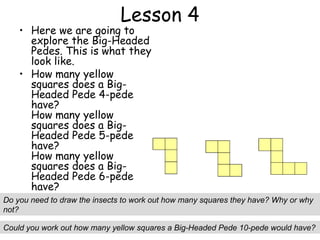
    • Here we are going to
      explore the Big-Headed
      Pedes. This is what they
      look like.
    • How many yellow
      squares does a Big-
      Headed Pede 4-pede
      have?
      How many yellow
      squares does a Big-
      Headed Pede 5-pede
      have?
      How many yellow
      squares does a Big-
      Headed Pede 6-pede
      have?
Do you need to draw the insects to work out how many squares they have? Why or why
not?

Could you work out how many yellow squares a Big-Headed Pede 10-pede would have?
Lesson 4
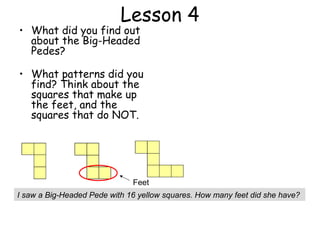
• What did you find out
  about the Big-Headed
  Pedes?

• What patterns did you
  find? Think about the
  squares that make up
  the feet, and the
  squares that do NOT.


                              Feet
I saw a Big-Headed Pede with 16 yellow squares. How many feet did she have?
Lesson 5
• We are learning to:        • How do I know when I have
                               learnt this?
  – continue a simple           – I am able to continue a simple
    pattern                       pattern.
  – generalise the pattern      – I am able to make a
                                  generalisation about the
                                  pattern that is accurate.
Lesson 5
• We are learning to:        • How do I know when I have
                               learnt this?
  – continue a simple           – I am able to continue a simple
    pattern                       pattern.
  – generalise the pattern      – I am able to make a
                                  generalisation about the
                                  pattern that is accurate.
Lesson 5
• Create a new powerpoint         • I will put these into the
  called [Name]’s Pede.             Maths folder on the
                                    resources drive, and you need
                                    to complete pedes 4,5 and 6.
• Create your own pede.             Re-save the ppt and call it
                                    “Finished pede by [Your
                                    name]”. You should have
• Create the first three pedes.
                                    saved 10 different pedes.
                                    Make sure these are in your
• Save your powerpoint, then        algebra folder.
  close it.

• COPY the file into your
  w_wharekura folder. Put it
  into a new folder called
  Algebra PPTs.

Algebra L2 lesson 1 to 5

  • 1.
    Algebra L2 Lessons1-5 Wharekura
  • 2.
    Algebra – Level2 • What I need to know. • What I can do. – continue a simple pattern – generalise the pattern – use the mathematical symbols of =, <, > – partition numbers less than 10 – know and use "teen" facts – solve addition problems by making a ten, or making a decade – solve addition problems involving measurements – continue a sequential pattern – develop bar charts to show relationships – draw the next shape in a pattern sequence – see how the pattern continues from one shape to the next – draw up a table of values – identify patterns in number sequences – systematically “count” to establish rules for sequential patterns – use rules to make predictions
  • 3.
    Lesson 1 • Weare learning to: • How do I know when I – continue a simple have learnt this? pattern – I am able to continue a simple pattern. – generalise the pattern – I am able to make a generalisation about the pattern that is accurate.
  • 4.
    Lesson 1 • On the planet Elsinore there live And the Humped a strange collection of insects. Back 2-pede looks There is the Humped-Back Pede. like this. He has an The Humped Back 1-pede looks eye too. like this.  • Can you see his eye?  • Use powerpoint to make a Humped Back 3-pede with the green tiles. Underneath your insect, type in your generalisation about the pattern you see. Save your powerpoint as Algebra Week 7. • Can you work our how many squares a Humped Back 4-pede has? Type in your answer under your generalisation.
  • 5.
    Lesson 1 • On another slide, answer these questions. • Can you tell me how many green squares a Humped Back 5-pede will have? Can you tell me how many green squares a Humped Back 7-pede will have? Can you tell me how many green squares a Humped Back 10-pede will have? These are the How many feet has a Humped-Back Pede with 12 squares? feet. (The feet are the bottom squares). • How many feet has a Humped-Back Pede with 18 squares? How many feet has a Humped-Back Pede with 20 squares? How did you work these out? Give a generalisation. • Can you tell me how to get the number of squares that a Humped-Back Pede with a particular number of feet has? Can you tell me how to get the number of feet that a Humped-Back Pede with a Copy the questions and use a particular number of squares has? (Write a maths sentence with ‘n’ as the number different colour for your answers. of square).
  • 6.
    Lesson 2 • Weare learning to: • How do I know when I – continue a simple have learnt this? pattern – I am able to continue a simple pattern. – generalise the pattern – I am able to make a generalisation about the pattern that is accurate.
  • 7.
    Lesson 2 • Thereare other insects on the planet Elsinore. They look as if they have been made up from squares. The ones with one foot are called 1-pedes. The ones with two feet are called 2-pedes and the ones with 3 feet are called 3- pedes.
  • 8.
    Lesson 2 • Didyou know that ‘pede’ means ‘foot’? Hint: write the How many feet would a number of squares 4-pede have? What beside each Pede. about a 5-pede? Tell me how many squares a 1-pede has? How many squares does a 2-pede have? What about a 3-pede? (Put the numbers of squares beside the insects).  Copy the questions and use a different colour for your answers.
  • 9.
    Lesson 2 • Cansomeone tell me what a 4-pede looks Hint: write the like? number of squares beside each Pede. How many feet will it have? How many squares will it have? Can someone make one for me with these square tiles? Feet Does everyone agree with you? Copy the questions and use a different colour for your answers.
  • 10.
    Lesson 2 • Howmany squares does a 5-pede have? Hint: write the number of squares • What sort of Pede beside each Pede. comes next? • How many squares does a 6-pede have? • Is there any pattern in the number of squares that Pedes Feet have? Copy the questions and use a different colour for your answers.
  • 11.
    Lesson 3 • Weare learning to: • How do I know when I have learnt this? – continue a simple – I am able to continue a simple pattern pattern. – generalise the pattern – I am able to make a generalisation about the pattern that is accurate.
  • 12.
    Lesson 3 • Herewe are going to e ed explore the Spotted dP tte Pedes. This is what po S they look like. 1- • Talk about the number of squares they have and the number of blue and de 3- Spotted Pede d Pe red squares.  ot t e • Record these beside p 2- S each of the Spotted Pedes.
  • 13.
    Lesson 3 • Createthe 4 – Spotted Pede. • Answer these questions. • How many red squares 4- Spotted Pede does a Spotted 4-pede have? How many blue squares does a Spotted 4-pede have? How many squares all together? • How did you work that out? Why are there more blue squares than red squares? • How many more?
  • 14.
    Lesson 3 • Createthe 5 and 6 – Spotted Pede. • Answer these questions. • How many red squares does a 4- Spotted Pede Spotted 5-pede have? • 6-pede? How many blue squares does a Spotted 5-pede have? How many squares all together? • How many blue squares does a Spotted 6-pede have? How many squares all together? • How did you work that out?
  • 15.
    Lesson 3 • Challenge– • How many red squares does a 10 - Spotted Pede Spotted 10-pede have? • How many blue squares does a Spotted 10-pede have?
  • 16.
    Lesson 3 • Whatdid you find out about the Spotted Pedes? • What patterns did you find? • Make sure your answers are in the same powerpoint.
  • 17.
    Lesson 4 • Weare learning to: • How do I know when I have learnt this? – continue a simple – I am able to continue a simple pattern pattern. – generalise the pattern – I am able to make a generalisation about the pattern that is accurate.
  • 18.
    Lesson 4 • Here we are going to explore the Big-Headed Pedes. This is what they look like. • How many yellow squares does a Big- Headed Pede 4-pede have? How many yellow squares does a Big- Headed Pede 5-pede have? How many yellow squares does a Big- Headed Pede 6-pede have? Do you need to draw the insects to work out how many squares they have? Why or why not? Could you work out how many yellow squares a Big-Headed Pede 10-pede would have?
  • 19.
    Lesson 4 • Whatdid you find out about the Big-Headed Pedes? • What patterns did you find? Think about the squares that make up the feet, and the squares that do NOT. Feet I saw a Big-Headed Pede with 16 yellow squares. How many feet did she have?
  • 20.
    Lesson 5 • Weare learning to: • How do I know when I have learnt this? – continue a simple – I am able to continue a simple pattern pattern. – generalise the pattern – I am able to make a generalisation about the pattern that is accurate.
  • 21.
    Lesson 5 • Weare learning to: • How do I know when I have learnt this? – continue a simple – I am able to continue a simple pattern pattern. – generalise the pattern – I am able to make a generalisation about the pattern that is accurate.
  • 22.
    Lesson 5 • Createa new powerpoint • I will put these into the called [Name]’s Pede. Maths folder on the resources drive, and you need to complete pedes 4,5 and 6. • Create your own pede. Re-save the ppt and call it “Finished pede by [Your name]”. You should have • Create the first three pedes. saved 10 different pedes. Make sure these are in your • Save your powerpoint, then algebra folder. close it. • COPY the file into your w_wharekura folder. Put it into a new folder called Algebra PPTs.