Sultan Qaboos University
College of Education
Early Childhood department


Assignment (3):


       Sharing of an Exemplary Learning Task


Submitted by: Thuraya Al-khalili.
ID: 83842
Submitted to: Dr. Flick Douglas.
Course: ECED4080 “Creating Materials for Use by Young
Children – Winter 2011”
Submission date: Sunday, 11 03 20
Learning Task:                                   improving their ability to build with blocks
                                                 and complete puzzles.
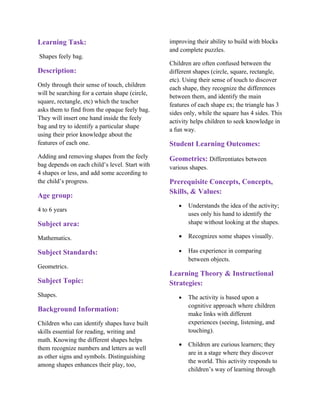
Shapes feely bag.
                                                 Children are often confused between the
Description:                                     different shapes (circle, square, rectangle,
                                                 etc). Using their sense of touch to discover
Only through their sense of touch, children
                                                 each shape, they recognize the differences
will be searching for a certain shape (circle,
                                                 between them, and identify the main
square, rectangle, etc) which the teacher
                                                 features of each shape ex; the triangle has 3
asks them to find from the opaque feely bag.
                                                 sides only, while the square has 4 sides. This
They will insert one hand inside the feely
                                                 activity helps children to seek knowledge in
bag and try to identify a particular shape
                                                 a fun way.
using their prior knowledge about the
features of each one.                            Student Learning Outcomes:
Adding and removing shapes from the feely        Geometrics: Differentiates between
bag depends on each child’s level. Start with    various shapes.
4 shapes or less, and add some according to
the child’s progress.                            Prerequisite Concepts, Concepts,
                                                 Skills, & Values:
Age group:
                                                    •   Understands the idea of the activity;
4 to 6 years
                                                        uses only his hand to identify the
Subject area:                                           shape without looking at the shapes.

Mathematics.                                        •   Recognizes some shapes visually.

Subject Standards:                                  •   Has experience in comparing
                                                        between objects.
Geometrics.
                                                 Learning Theory & Instructional
Subject Topic:                                   Strategies:
Shapes.                                             •   The activity is based upon a
                                                        cognitive approach where children
Background Information:
                                                        make links with different
Children who can identify shapes have built             experiences (seeing, listening, and
skills essential for reading, writing and               touching).
math. Knowing the different shapes helps
                                                    •   Children are curious learners; they
them recognize numbers and letters as well
                                                        are in a stage where they discover
as other signs and symbols. Distinguishing
                                                        the world. This activity responds to
among shapes enhances their play, too,
                                                        children’s way of learning through
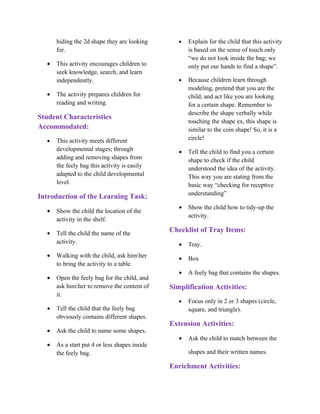
hiding the 2d shape they are looking        •   Explain for the child that this activity
      for.                                            is based on the sense of touch only
                                                      “we do not look inside the bag; we
  •   This activity encourages children to            only put our hands to find a shape”.
      seek knowledge, search, and learn
      independently.                              •   Because children learn through
                                                      modeling, pretend that you are the
  •   The activity prepares children for              child, and act like you are looking
      reading and writing.                            for a certain shape. Remember to
                                                      describe the shape verbally while
Student Characteristics
                                                      touching the shape ex, this shape is
Accommodated:                                         similar to the coin shape! So, it is a
  •   This activity meets different                   circle!
      developmental stages; through               •   Tell the child to find you a certain
      adding and removing shapes from                 shape to check if the child
      the feely bag this activity is easily           understood the idea of the activity.
      adapted to the child developmental              This way you are stating from the
      level.                                          basic way “checking for receptive
                                                      understanding”
Introduction of the Learning Task:
                                                  •   Show the child how to tidy-up the
  •   Show the child the location of the
                                                      activity.
      activity in the shelf.

  •   Tell the child the name of the
                                               Checklist of Tray Items:
      activity.                                   •   Tray.
  •   Walking with the child, ask himher         •   Box
      to bring the activity to a table.
                                                  •   A feely bag that contains the shapes.
  •   Open the feely bag for the child, and
      ask himher to remove the content of     Simplification Activities:
      it.
                                                  •   Focus only in 2 or 3 shapes (circle,
  •   Tell the child that the feely bag               square, and triangle).
      obviously contains different shapes.
                                               Extension Activities:
  •   Ask the child to name some shapes.
                                                  •   Ask the child to match between the
  •   As a start put 4 or less shapes inside
      the feely bag.                                  shapes and their written names.

                                               Enrichment Activities:
•   Create a feely bag that contains a 3d       •     Make sure to remove any sharp
       shapes (cube, cylinder, cone, etc).               edges in the shapes.

Assessment Techniques:                             •     Use the same color for all the shapes
                                                         in order to help the child focus on
       Informal assessment:                              one difference only to compare
                                                         between the shapes “number of
   •   Observe the child during the outdoor,
                                                         sides” rather than the color of the
       playing time, and snack time.
                                                         shape.
       Formal assessment:
                                                   •     Enlarge the font of the shapes cards
   •   The child identifies the shapes                   names.
       receptively “gives the teacher a
       circle, when she asks for a circle”.     Key Words:

   •   The child identifies the shapes          Feely bag, inside, outside, same, different,
       expressively “says this is a square”.    sides.

Evaluation Rubric:                              Materials needed:

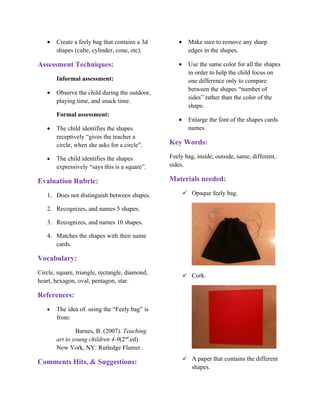
   1. Does not distinguish between shapes.              Opaque feely bag.

   2. Recognizes, and names 5 shapes.

   3. Recognizes, and names 10 shapes.

   4. Matches the shapes with their name
      cards.

Vocabulary:
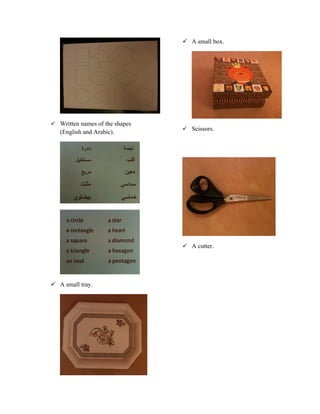
Circle, square, triangle, rectangle, diamond,           Cork.
heart, hexagon, oval, pentagon, star.

References:
   •   The idea of using the “Feely bag” is
       from:

               Barnes, B. (2007). Teaching
       art to young children 4-9(2nd.ed).
       New York, NY: Rutledge Flamer.
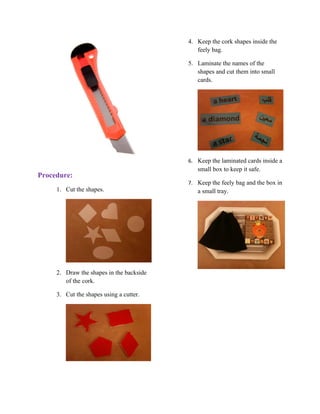
                                                        A paper that contains the different
Comments Hits, & Suggestions:
                                                          shapes.
 A small box.


 Written names of the shapes
                                 Scissors.
   (English and Arabic).


                                 A cutter.


 A small tray.
4. Keep the cork shapes inside the
                                             feely bag.

                                          5. Laminate the names of the
                                             shapes and cut them into small
                                             cards.


                                          6. Keep the laminated cards inside a
                                             small box to keep it safe.
Procedure:
                                          7. Keep the feely bag and the box in
     1. Cut the shapes.                      a small tray.


     2. Draw the shapes in the backside
        of the cork.

     3. Cut the shapes using a cutter.
Thuraya learning task

Thuraya learning task

  • 1.
    Sultan Qaboos University Collegeof Education Early Childhood department Assignment (3): Sharing of an Exemplary Learning Task Submitted by: Thuraya Al-khalili. ID: 83842 Submitted to: Dr. Flick Douglas. Course: ECED4080 “Creating Materials for Use by Young Children – Winter 2011” Submission date: Sunday, 11 03 20
  • 2.
    Learning Task: improving their ability to build with blocks and complete puzzles. Shapes feely bag. Children are often confused between the Description: different shapes (circle, square, rectangle, etc). Using their sense of touch to discover Only through their sense of touch, children each shape, they recognize the differences will be searching for a certain shape (circle, between them, and identify the main square, rectangle, etc) which the teacher features of each shape ex; the triangle has 3 asks them to find from the opaque feely bag. sides only, while the square has 4 sides. This They will insert one hand inside the feely activity helps children to seek knowledge in bag and try to identify a particular shape a fun way. using their prior knowledge about the features of each one. Student Learning Outcomes: Adding and removing shapes from the feely Geometrics: Differentiates between bag depends on each child’s level. Start with various shapes. 4 shapes or less, and add some according to the child’s progress. Prerequisite Concepts, Concepts, Skills, & Values: Age group: • Understands the idea of the activity; 4 to 6 years uses only his hand to identify the Subject area: shape without looking at the shapes. Mathematics. • Recognizes some shapes visually. Subject Standards: • Has experience in comparing between objects. Geometrics. Learning Theory & Instructional Subject Topic: Strategies: Shapes. • The activity is based upon a cognitive approach where children Background Information: make links with different Children who can identify shapes have built experiences (seeing, listening, and skills essential for reading, writing and touching). math. Knowing the different shapes helps • Children are curious learners; they them recognize numbers and letters as well are in a stage where they discover as other signs and symbols. Distinguishing the world. This activity responds to among shapes enhances their play, too, children’s way of learning through
  • 3.
    hiding the 2dshape they are looking • Explain for the child that this activity for. is based on the sense of touch only “we do not look inside the bag; we • This activity encourages children to only put our hands to find a shape”. seek knowledge, search, and learn independently. • Because children learn through modeling, pretend that you are the • The activity prepares children for child, and act like you are looking reading and writing. for a certain shape. Remember to describe the shape verbally while Student Characteristics touching the shape ex, this shape is Accommodated: similar to the coin shape! So, it is a • This activity meets different circle! developmental stages; through • Tell the child to find you a certain adding and removing shapes from shape to check if the child the feely bag this activity is easily understood the idea of the activity. adapted to the child developmental This way you are stating from the level. basic way “checking for receptive understanding” Introduction of the Learning Task: • Show the child how to tidy-up the • Show the child the location of the activity. activity in the shelf. • Tell the child the name of the Checklist of Tray Items: activity. • Tray. • Walking with the child, ask himher • Box to bring the activity to a table. • A feely bag that contains the shapes. • Open the feely bag for the child, and ask himher to remove the content of Simplification Activities: it. • Focus only in 2 or 3 shapes (circle, • Tell the child that the feely bag square, and triangle). obviously contains different shapes. Extension Activities: • Ask the child to name some shapes. • Ask the child to match between the • As a start put 4 or less shapes inside the feely bag. shapes and their written names. Enrichment Activities:
  • 4.
    Create a feely bag that contains a 3d • Make sure to remove any sharp shapes (cube, cylinder, cone, etc). edges in the shapes. Assessment Techniques: • Use the same color for all the shapes in order to help the child focus on Informal assessment: one difference only to compare between the shapes “number of • Observe the child during the outdoor, sides” rather than the color of the playing time, and snack time. shape. Formal assessment: • Enlarge the font of the shapes cards • The child identifies the shapes names. receptively “gives the teacher a circle, when she asks for a circle”. Key Words: • The child identifies the shapes Feely bag, inside, outside, same, different, expressively “says this is a square”. sides. Evaluation Rubric: Materials needed: 1. Does not distinguish between shapes.  Opaque feely bag. 2. Recognizes, and names 5 shapes. 3. Recognizes, and names 10 shapes. 4. Matches the shapes with their name cards. Vocabulary: Circle, square, triangle, rectangle, diamond,  Cork. heart, hexagon, oval, pentagon, star. References: • The idea of using the “Feely bag” is from: Barnes, B. (2007). Teaching art to young children 4-9(2nd.ed). New York, NY: Rutledge Flamer.  A paper that contains the different Comments Hits, & Suggestions: shapes.
  • 5.
     A smallbox.  Written names of the shapes  Scissors. (English and Arabic).  A cutter.  A small tray.
  • 6.
    4. Keep thecork shapes inside the feely bag. 5. Laminate the names of the shapes and cut them into small cards. 6. Keep the laminated cards inside a small box to keep it safe. Procedure: 7. Keep the feely bag and the box in 1. Cut the shapes. a small tray. 2. Draw the shapes in the backside of the cork. 3. Cut the shapes using a cutter.