• Objectives
• ABrief History about Algebra
• Introduction
• Algebraic Expressions
• Activity 1
• Terms - Like and Unlike Terms
• Variables and Constants
• Coefficients
• Rules of Operations of
Algebraic Expressions
• Addition of Algebraic
Expressions
• Subtraction of Algebraic
Expressions
• Evaluation of Algebraic
Expressions
• Activity 2
• Summary
CONTENT
3.
To enable studentsto:
• Understand the language of algebra (use of
letters of the alphabets to represent numbers).
• Understand Variables.
• Differentiate between Variables & Constants.
• Form an algebraic expression.
• Identify the like and unlike terms.
OBJECTIVES
4.
To enable studentsto:
• Know the number of terms in an algebraic expressions.
• Substitute numbers for letters of the alphabet in expressions and
formula.
• Find out the addition of algebraic expressions by horizontal and
column method.
• Find out the subtraction of algebraic expressions by horizontal
and column method.
• Evaluate the algebraic expressions by substituting the given value.
OBJECTIVES
5.
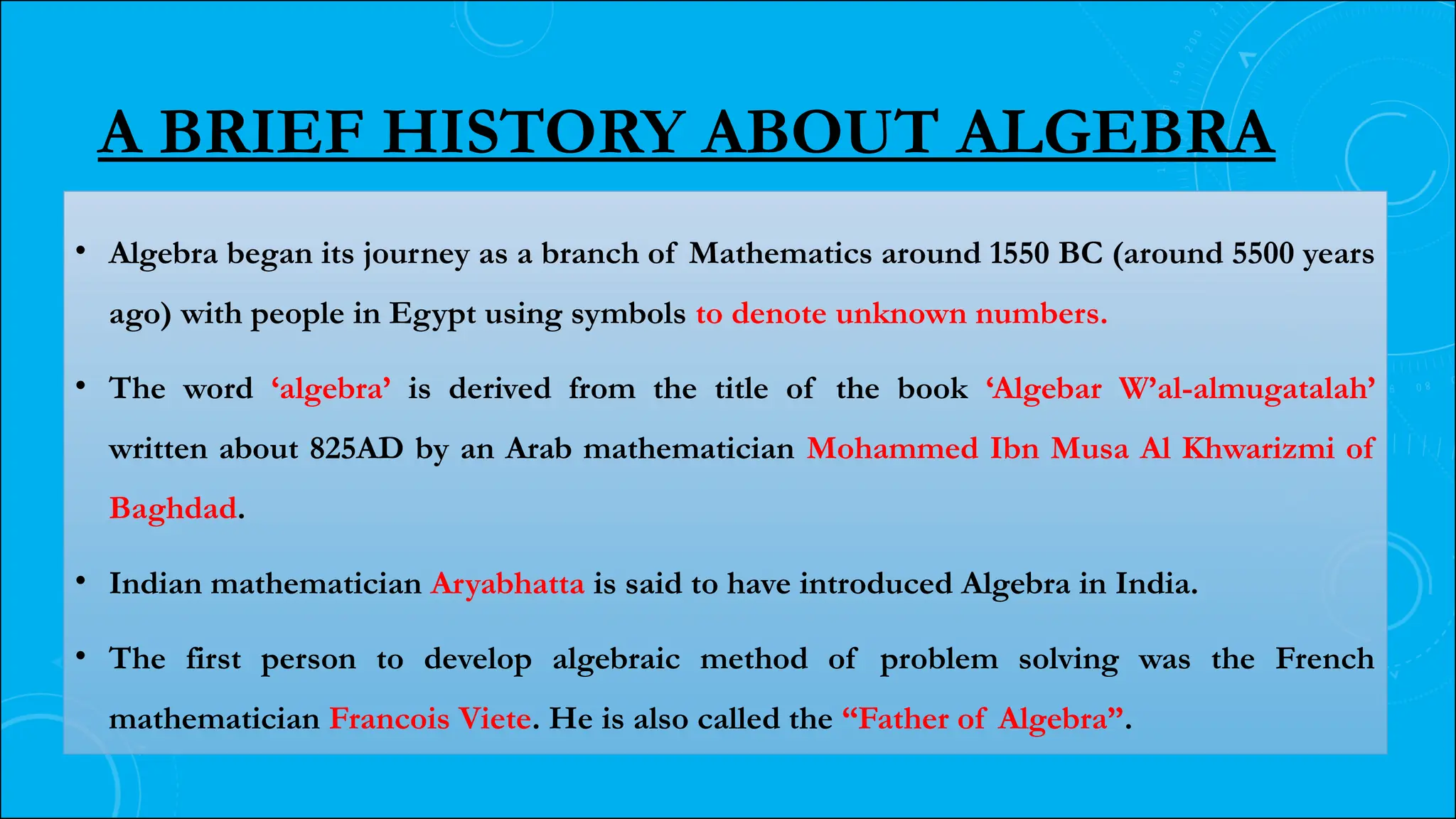
A BRIEF HISTORYABOUT ALGEBRA
• Algebra began its journey as a branch of Mathematics around 1550 BC (around 5500 years
ago) with people in Egypt using symbols to denote unknown numbers.
• The word ‘algebra’ is derived from the title of the book ‘Algebar W’al-almugatalah’
written about 825AD by an Arab mathematician Mohammed Ibn Musa Al Khwarizmi of
Baghdad.
• Indian mathematician Aryabhatta is said to have introduced Algebra in India.
• The first person to develop algebraic method of problem solving was the French
mathematician Francois Viete. He is also called the “Father of Algebra”.
6.
WHAT IS ALGEBRA?
•The part of the mathematics in which letters
and other general symbols are used to represent
numbers and quantities in formulae and
equations.
7.
6 + q= 10
q = 4
Can you solve?
2 + x = 10
x = 8
So letters in Maths are just missing numbers.
When letters of alphabet represent numbers, they are
called Literal Numbers.
8.
Use algebra towrite:
1) 2 less than x
2) 4 more than d
3) 6 together with a
4) y more than g
5) z less than q
6) m less than 5
x – 2
d + 4
a + 6
y + g
q - z
5 - m
Try this yourself!
9.
WHAT IS ALGEBRAICEXPRESSION?
• A combination of numbers, literal numbers and the
fundamental operations is called an Algebraic
Expression.
Example:
5x + 3y – 4 5x, 3y and 4 are the parts separated by the
symbols (+) and (-) signs.
3 𝑥−2 𝑦+7
Term
Whatis a Term?
Parts of an algebraic expression separated by the symbols (+) and (-) are
called the Terms of an algebraic expression.
16.
TERMS
LIKE TERMS
Terms havingthe same variables.
Examples
4x, 7x , -2x
They have the same variable ‘x’ and therefore are
like terms.
UNLIKE TERMS
Terms having different variables.
Examples
7x , -5y , 5x2
They have different variables (such as x,y,x2
) and
therefore are unlike terms.
17.
3 𝑥−2 𝑦+7
Variables
Whatis a Variable?
A variable is a symbol which represents a quantity that can change.
18.
3 𝑥−2 𝑦+7
Constant
Whatis a Constant?
A quantity which does not change its value is called Constant.
19.
3 𝑥−2 𝑦+7
Coefficients
Whatis a Coefficient?
The number that is multiplied by the variable is called Coefficient.
20.
• For theexpression: 7x + 3y – 9
Name:
1. a term
2. the constant
3. a coefficient
4. a variable
21.
• For theexpression: 7x + 3y – 9
Name:
1. a term 7x or 3y or
-9
2. the constant -9
3. a coefficient 7 or 3
4. a variable x or y
OPERATIONS ON ALGEBRAIC
EXPRESSIONS
•Two or more terms can only
be added or subtracted if
they are like terms.
• Unlike terms cannot be
added or subtracted.
24.
ADDITION OF ALGEBRAICEXPRESSIONS
Jack has some toys, we do not know how many toys he has….
so we can say ‘Jack has x toys’
If Jack buys 6 more toys, how many toys has he now got?
x + 6
25.
ADDITION OF MONOMIALS
LikeTerms
Example:
Add 5x, 4x and 3x
5x + 4x + 3x = (5+4+3)x
=
12x
(Adding numerical coefficient
of each monomial)
26.
ADDITION OF MONOMIALS
UnlikeTerms
Example:
Add 4x, 2y, -y and 3x
4x + 2y + (-y) + 3x
= (4x + 3x) + (2y – y)
= 7x + y
We have unlike terms
Regrouping like terms
27.
ADDITION OF BINOMIALS
•Two ways to solve addition of algebraic expressions:-
1. Horizontal Method:
2. Column Method:
28.
1. HORIZONTAL METHOD
Inthis method, all expressions are written in a horizontal line and then the
terms are arranged to collect all the groups of like terms and then added.
Example:
(3x2
+ 5x – 3) + (x2
– 5x + 1)
= 3x2
+ 5x – 3 + x2
– 5x + 1 (remove the brackets, identify the
like
terms)
= 3x2
+ x2
+ 5x – 5x – 3 + 1 (group the like terms together)
= 4x2
+ 0 - 2
= 4x2
– 2 (Ans.)
29.
2. COLUMN METHOD
Inthis method each expression is written in a separate row such
that there like terms are arranged one below the other in a column.
Then the addition of terms is done column wise.
Example :-
30.
SUBTRACTION OF ALGEBRAICEXPRESSIONS
Ram catches x fish.
Bharat takes 3 away from him.
How many fish does Ram now have?
x – 3
31.
SUBTRACTION OF ALGEBRAICEXPRESSIONS
The steps for subtraction of algebraic expressions are:
1. Arrange the terms of the given expression in the same order.
2. Write the given expressions in such a way that the like terms occur
one below the other, keeping the subtracted in the second row.
3. Change the sign of each term in the lower row from + to – and –
to +.
4. With new signs of the terms of lower row, add column wise.
EVALUATION OF ALGEBRAICEXPRESSIONS
• Evaluate means to find
the value of an
algebraic expression by
substituting numbers in
for variables.
Example:
What is the value of x + 4
when x = 2?
x = 2
x + 4
= 2 + 4
= 6
35.
If Radha wasborn in 2002. You can find out what year Radha will
turn 18 by adding the year she was born to her age.
In this case, if we add 18 to add to 2002,
2002 + 18 = 2020
Similarly, x can be Radha’s age. Therefore, Radha turns x year old
and the expression is given by,
2002 + x.
36.
Evaluate the expressionfor the given value of the variable:
4x – 3 for x = 2.
4x – 3 for x = 2.
4(2) – 3 Substitute for x
= 8 – 3 Multiply
= 5 Subtract
37.
Try It Yourself!
1.Evaluate x + 4 for each value of x.
A. x = 14
B. x = 83.
2. The expression 7d gives the number of days in d weeks.
Calculate the number of days in 52 weeks.
38.
1. Evaluate x+ 4 for each
value of x.
A. x = 14
x = 14
x + 4
= 14 + 4
= 18
1. Evaluate x + 4 for each
value of x.
B. x = 83.
x = 83
x + 4
= 83 + 4
= 87
39.
2. The expression7d gives the number of days in d weeks.
Calculate the number of days in 52 weeks?
The expression is given by 7d.
In this case, d = 52
7d
= 7(52)
= 364
40.
ACTIVITY - 2
1.Think of a number
2. Multiply it by 2
3. Add 10 to the number
4. Divide total by 2
5. Subtract number you picked from total
41.
The Answer willbe 5 !!!!
Step 1 Let the number be x.
Step 2 If it is multiplied by 2 => 2x
Step 3 Add 10 to the number => 2x + 10
Step 4 Divide total by 2 => = x + 5
Step 5 Subtract number you picked (i.e. x) from
total => x + 5 – x = 5
42.
1. The letterswhich are used to represent numbers
are called Literal Numbers or Literals.
2. Literal numbers obey all the properties
regarding the operation of addition, subtraction,
multiplication or division.
3. Constant is a quantity which does not change its
value.
4. Variable is a quantity which changes its value.
SUMMARY
43.
5. Algebraic Expressionis a combination of numbers,
literal numbers and fundamental questions.
6. Parts of an algebraic expression separated by the
symbols (+) and (-) are called the terms.
7. Terms having same variables are called Like Terms and
terms having different variables are called Unlike Terms.
8. For addition and subtraction of algebraic expression
only like terms are to be added or subtracted in both
horizontal and column method.
SUMMARY