A STUDY OF AVIAN FAUNA IN A
SMALL LOCALITY IN ANICADU
VILLAGE IN MALLAPALLY TALUK
AKHILA KRISHNA
Reg. No. : 140021097901
INTRODUCTION
 Birds are a group of endothermic vertebrates characterized by
feathers and are included under class Aves.
 Ornithology is a branch of zoology that concerns the study of
birds.
 Birds play vital role in pollination, dispersal of seeds, predatory
on insects, as scavenger, food chain balancing, and as bio-
indicators.
 A worldwide total of 10425 species of birds are recognized
by Bird Life International.
 Indian subcontinent supports 1340 species (13% of World’s
birds) and include 141 endemic species.
 Kerala has about 497 bird species within its boundary.
 The highest number of birds was recorded during the
months of winter.
OBJECTIVES OF THE STUDY
 To make a checklist of the birds found in this area.
 To determine the distribution of birds in the region.
 To assess the population fluctuation across the months.
 To find out the unique species in each ecosystems.
METHODOLOGY
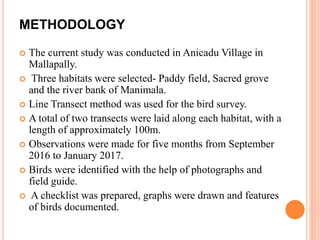
 The current study was conducted in Anicadu Village in
Mallapally.
 Three habitats were selected- Paddy field, Sacred grove
and the river bank of Manimala.
 Line Transect method was used for the bird survey.
 A total of two transects were laid along each habitat, with a
length of approximately 100m.
 Observations were made for five months from September
2016 to January 2017.
 Birds were identified with the help of photographs and
field guide.
 A checklist was prepared, graphs were drawn and features
of birds documented.
OBSERVATIONS
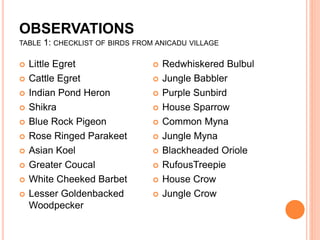
TABLE 1: CHECKLIST OF BIRDS FROM ANICADU VILLAGE
 Little Egret
 Cattle Egret
 Indian Pond Heron
 Shikra
 Blue Rock Pigeon
 Rose Ringed Parakeet
 Asian Koel
 Greater Coucal
 White Cheeked Barbet
 Lesser Goldenbacked
Woodpecker
 Redwhiskered Bulbul
 Jungle Babbler
 Purple Sunbird
 House Sparrow
 Common Myna
 Jungle Myna
 Blackheaded Oriole
 RufousTreepie
 House Crow
 Jungle Crow
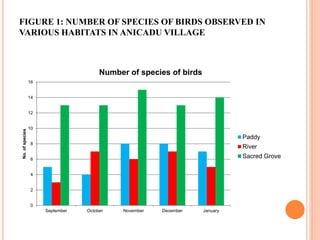
FIGURE 1: NUMBER OF SPECIES OF BIRDS OBSERVED IN
VARIOUS HABITATS IN ANICADU VILLAGE
0
2
4
6
8
10
12
14
16
September October November December January
No.ofspecies
Number of species of birds
Paddy
River
Sacred Grove
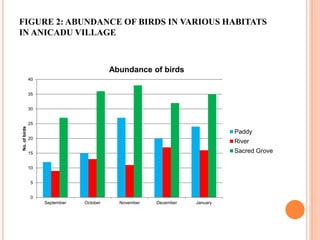
FIGURE 2: ABUNDANCE OF BIRDS IN VARIOUS HABITATS
IN ANICADU VILLAGE
0
5
10
15
20
25
30
35
40
September October November December January
No.ofbirds
Abundance of birds
Paddy
River
Sacred Grove
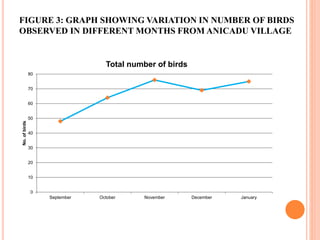
FIGURE 3: GRAPH SHOWING VARIATION IN NUMBER OF BIRDS
OBSERVED IN DIFFERENT MONTHS FROM ANICADU VILLAGE
0
10
20
30
40
50
60
70
80
September October November December January
No.ofbirds
Total number of birds
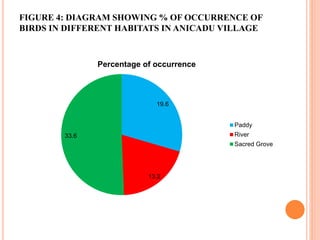
FIGURE 4: DIAGRAM SHOWING % OF OCCURRENCE OF
BIRDS IN DIFFERENT HABITATS IN ANICADU VILLAGE
19.6
13.2
33.6
Percentage of occurrence
Paddy
River
Sacred Grove
DISCUSSION
 From the study, 20 species of birds belonging to 18 genera and
14 families were observed.
 Most number of bird species was observed in sacred grove (17
species) followed by river (13) and paddy field (11).
 Most abundant family was Ardiedae and Corvidae, represented
by 3 species each.
 Cattle egret was the most common bird and Shikra and Lesser
golden backed woodpecker were the rarest birds observed in the
field.
 Cattle egret was observed only in the paddy field. 6 species
of birds were present only in Sacred grove.
 Richness and abundance was highest in sacred grove,
followed by paddy field and then river.
 Highest richness and abundance was observed in sacred
grove in November (15 species, 38 number).
 Total abundance was also high (75 numbers) in November.
 Maximum number of birds (51%) were present in sacred
grove followed by paddy field (29%) and river (20%).
CONCLUSION
 A total of 20 species of birds belonging to 18 genera from 14
families were observed.
 The study area was not very rich in bird diversity due to
degraded condition of habitats in the study area.
 It was sacred grove that shows highest richness, abundance
and in overall diversity than paddy field and river.
 Richness and abundance of birds shows the maximum in the
month of November.
 Birds are economically useful for humans in many ways. So,
the conservation of birds is important for maintaining a
healthy environment.
 Absence of fish in rivers and non-cultivated condition of
paddy field affect their food chain.
 Conservation of rivers, paddy fields and sacred groves can
protect a large number of birds and thereby conserve the
environment.
THANK YOU

Akhila ppt

  • 1.
    A STUDY OFAVIAN FAUNA IN A SMALL LOCALITY IN ANICADU VILLAGE IN MALLAPALLY TALUK AKHILA KRISHNA Reg. No. : 140021097901
  • 2.
    INTRODUCTION  Birds area group of endothermic vertebrates characterized by feathers and are included under class Aves.  Ornithology is a branch of zoology that concerns the study of birds.  Birds play vital role in pollination, dispersal of seeds, predatory on insects, as scavenger, food chain balancing, and as bio- indicators.
  • 3.
     A worldwidetotal of 10425 species of birds are recognized by Bird Life International.  Indian subcontinent supports 1340 species (13% of World’s birds) and include 141 endemic species.  Kerala has about 497 bird species within its boundary.  The highest number of birds was recorded during the months of winter.
  • 4.
    OBJECTIVES OF THESTUDY  To make a checklist of the birds found in this area.  To determine the distribution of birds in the region.  To assess the population fluctuation across the months.  To find out the unique species in each ecosystems.
  • 5.
    METHODOLOGY  The currentstudy was conducted in Anicadu Village in Mallapally.  Three habitats were selected- Paddy field, Sacred grove and the river bank of Manimala.  Line Transect method was used for the bird survey.  A total of two transects were laid along each habitat, with a length of approximately 100m.  Observations were made for five months from September 2016 to January 2017.  Birds were identified with the help of photographs and field guide.  A checklist was prepared, graphs were drawn and features of birds documented.
  • 6.
    OBSERVATIONS TABLE 1: CHECKLISTOF BIRDS FROM ANICADU VILLAGE  Little Egret  Cattle Egret  Indian Pond Heron  Shikra  Blue Rock Pigeon  Rose Ringed Parakeet  Asian Koel  Greater Coucal  White Cheeked Barbet  Lesser Goldenbacked Woodpecker  Redwhiskered Bulbul  Jungle Babbler  Purple Sunbird  House Sparrow  Common Myna  Jungle Myna  Blackheaded Oriole  RufousTreepie  House Crow  Jungle Crow
  • 7.
    FIGURE 1: NUMBEROF SPECIES OF BIRDS OBSERVED IN VARIOUS HABITATS IN ANICADU VILLAGE 0 2 4 6 8 10 12 14 16 September October November December January No.ofspecies Number of species of birds Paddy River Sacred Grove
  • 8.
    FIGURE 2: ABUNDANCEOF BIRDS IN VARIOUS HABITATS IN ANICADU VILLAGE 0 5 10 15 20 25 30 35 40 September October November December January No.ofbirds Abundance of birds Paddy River Sacred Grove
  • 9.
    FIGURE 3: GRAPHSHOWING VARIATION IN NUMBER OF BIRDS OBSERVED IN DIFFERENT MONTHS FROM ANICADU VILLAGE 0 10 20 30 40 50 60 70 80 September October November December January No.ofbirds Total number of birds
  • 10.
    FIGURE 4: DIAGRAMSHOWING % OF OCCURRENCE OF BIRDS IN DIFFERENT HABITATS IN ANICADU VILLAGE 19.6 13.2 33.6 Percentage of occurrence Paddy River Sacred Grove
  • 11.
    DISCUSSION  From thestudy, 20 species of birds belonging to 18 genera and 14 families were observed.  Most number of bird species was observed in sacred grove (17 species) followed by river (13) and paddy field (11).  Most abundant family was Ardiedae and Corvidae, represented by 3 species each.  Cattle egret was the most common bird and Shikra and Lesser golden backed woodpecker were the rarest birds observed in the field.
  • 12.
     Cattle egretwas observed only in the paddy field. 6 species of birds were present only in Sacred grove.  Richness and abundance was highest in sacred grove, followed by paddy field and then river.  Highest richness and abundance was observed in sacred grove in November (15 species, 38 number).  Total abundance was also high (75 numbers) in November.  Maximum number of birds (51%) were present in sacred grove followed by paddy field (29%) and river (20%).
  • 13.
    CONCLUSION  A totalof 20 species of birds belonging to 18 genera from 14 families were observed.  The study area was not very rich in bird diversity due to degraded condition of habitats in the study area.  It was sacred grove that shows highest richness, abundance and in overall diversity than paddy field and river.  Richness and abundance of birds shows the maximum in the month of November.
  • 14.
     Birds areeconomically useful for humans in many ways. So, the conservation of birds is important for maintaining a healthy environment.  Absence of fish in rivers and non-cultivated condition of paddy field affect their food chain.  Conservation of rivers, paddy fields and sacred groves can protect a large number of birds and thereby conserve the environment.
  • 15.