ProjectOn Common Birds Environment
Study
DEPT OF ZOOLOGY , VAC1 ENVS
-Sumita Mondal
INTRODUCTION
 Welcome to "The Marvels of Bird Diversity"
presentation. In this exploration, we delve into
the rich tapestry of avian life, spanning
continents and habitats. From the smallest
songbird to the mighty raptor, birds captivate us
with their beauty, behavior, and evolutionary
adaptations. Join us as we uncover the wonders
of bird diversity and appreciate the intricate
roles these feathered creatures play in our
ecosystems.
2
3
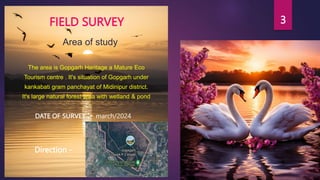
FIELD SURVEY
The area is Gopgarh Heritage a Mature Eco
Tourism centre . It's situation of Gopgarh under
kankabati gram panchayat of Midinipur district.
It's large natural forest area with wetland & pond
Area of study
DATE OF SURVEY :- march/2024
Direction -
METHODOLOGY
>Field observation
We conduct regular field of Gopgarh
Ecopark, to observe of document the diff .
Species of birds insects of plants present.
 Data collection
Record observation of each species physical
characteristics, behaviour of habital
performance. Utilise digital cameras, binoculars
& field guider to facilitate accurate data
collection
>Photographic documents
capture high quality photography of bird, insect &
plant to supplement the identification guide & create
an engaging visual representation.
4
DATA ANALYSIS(COMMON BIRDS)
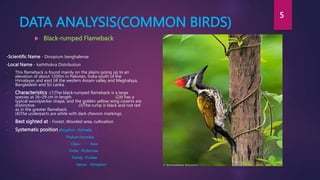
 Black-rumped Flameback
-Scientific Name - Dinopium benghalense
-Local Name - kaththokra Distribution
- This flameback is found mainly on the plains going up to an
elevation of about 1200m in Pakistan, India south of the
Himalayas and east till the western Assam valley and Meghalaya,
Bangladesh and Sri Lanka.
- Characteristics -(1)The black-rumped flameback is a large
species at 26–29 cm in length. (2)It has a
typical woodpecker shape, and the golden yellow wing coverts are
distinctive. (3)The rump is black and not red
as in the greater flameback.
(4)The underparts are white with dark chevron markings.
- Best sighted at - Forest, Wooded area, cultivation
- Systematic position :Kingdom : Animalia
Phylum chordata
Class : Aves
Order : Piciformes
Family : Picidae
Genus : Dinopium
5
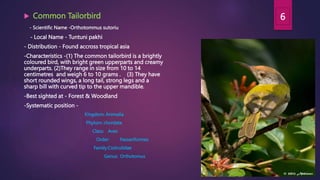
 Common Tailorbird
- Scientific Name -Orthotommus sutoriu
- Local Name - Tuntuni pakhi
- Distribution - Found accross tropical asia
-Characteristics -(1) The common tailorbird is a brightly
coloured bird, with bright green upperparts and creamy
underparts. (2)They range in size from 10 to 14
centimetres and weigh 6 to 10 grams . (3) They have
short rounded wings, a long tail, strong legs and a
sharp bill with curved tip to the upper mandible.
-Best sighted at - Forest & Woodland
-Systematic position -
Kingdom: Animalia
Phylum: chordata
Class: Aves
Order: Passeriformes
Family:Cisticolidae
Genus: Orthotomus
6
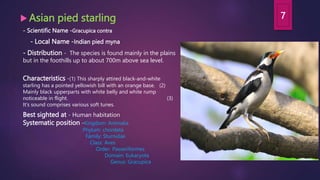
 Asian pied starling
- Scientific Name -Gracupica contra
- Local Name -Indian pied myna
- Distribution - The species is found mainly in the plains
but in the foothills up to about 700m above sea level.
Characteristics -(1) This sharply attired black-and-white
starling has a pointed yellowish bill with an orange base. (2)
Mainly black upperparts with white belly and white rump
noticeable in flight. (3)
It's sound comprises various soft tunes.
Best sighted at - Human habitation
Systematic position -Kingdom: Animalia
Phylum: chordata
Family: Sturnidae
Class: Aves
Order: Passeriformes
Domain: Eukaryota
Genus: Gracupica
7
CONCLUSION
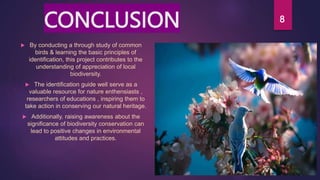
 By conducting a through study of common
birds & learning the basic principles of
identification, this project contributes to the
understanding of appreciation of local
biodiversity.
 The identification guide well serve as a
valuable resource for nature enthensiasts ,
researchers of educations , inspiring them to
take action in conserving our natural heritage.
 Additionally, raising awareness about the
significance of biodiversity conservation can
lead to positive changes in environmental
attitudes and practices.
8
THANK YOU
9
The reason birds can fly and we can't is simply because
they have perfect faith, for to have faith is to have wings.
Save Birds. Save the
Earth.

bird ppt Presentation.survey about the bird.pptx.

  • 1.
    ProjectOn Common BirdsEnvironment Study DEPT OF ZOOLOGY , VAC1 ENVS -Sumita Mondal
  • 2.
    INTRODUCTION  Welcome to"The Marvels of Bird Diversity" presentation. In this exploration, we delve into the rich tapestry of avian life, spanning continents and habitats. From the smallest songbird to the mighty raptor, birds captivate us with their beauty, behavior, and evolutionary adaptations. Join us as we uncover the wonders of bird diversity and appreciate the intricate roles these feathered creatures play in our ecosystems. 2
  • 3.
    3 FIELD SURVEY The areais Gopgarh Heritage a Mature Eco Tourism centre . It's situation of Gopgarh under kankabati gram panchayat of Midinipur district. It's large natural forest area with wetland & pond Area of study DATE OF SURVEY :- march/2024 Direction -
  • 4.
    METHODOLOGY >Field observation We conductregular field of Gopgarh Ecopark, to observe of document the diff . Species of birds insects of plants present.  Data collection Record observation of each species physical characteristics, behaviour of habital performance. Utilise digital cameras, binoculars & field guider to facilitate accurate data collection >Photographic documents capture high quality photography of bird, insect & plant to supplement the identification guide & create an engaging visual representation. 4
  • 5.
    DATA ANALYSIS(COMMON BIRDS) Black-rumped Flameback -Scientific Name - Dinopium benghalense -Local Name - kaththokra Distribution - This flameback is found mainly on the plains going up to an elevation of about 1200m in Pakistan, India south of the Himalayas and east till the western Assam valley and Meghalaya, Bangladesh and Sri Lanka. - Characteristics -(1)The black-rumped flameback is a large species at 26–29 cm in length. (2)It has a typical woodpecker shape, and the golden yellow wing coverts are distinctive. (3)The rump is black and not red as in the greater flameback. (4)The underparts are white with dark chevron markings. - Best sighted at - Forest, Wooded area, cultivation - Systematic position :Kingdom : Animalia Phylum chordata Class : Aves Order : Piciformes Family : Picidae Genus : Dinopium 5
  • 6.
     Common Tailorbird -Scientific Name -Orthotommus sutoriu - Local Name - Tuntuni pakhi - Distribution - Found accross tropical asia -Characteristics -(1) The common tailorbird is a brightly coloured bird, with bright green upperparts and creamy underparts. (2)They range in size from 10 to 14 centimetres and weigh 6 to 10 grams . (3) They have short rounded wings, a long tail, strong legs and a sharp bill with curved tip to the upper mandible. -Best sighted at - Forest & Woodland -Systematic position - Kingdom: Animalia Phylum: chordata Class: Aves Order: Passeriformes Family:Cisticolidae Genus: Orthotomus 6
  • 7.
     Asian piedstarling - Scientific Name -Gracupica contra - Local Name -Indian pied myna - Distribution - The species is found mainly in the plains but in the foothills up to about 700m above sea level. Characteristics -(1) This sharply attired black-and-white starling has a pointed yellowish bill with an orange base. (2) Mainly black upperparts with white belly and white rump noticeable in flight. (3) It's sound comprises various soft tunes. Best sighted at - Human habitation Systematic position -Kingdom: Animalia Phylum: chordata Family: Sturnidae Class: Aves Order: Passeriformes Domain: Eukaryota Genus: Gracupica 7
  • 8.
    CONCLUSION  By conductinga through study of common birds & learning the basic principles of identification, this project contributes to the understanding of appreciation of local biodiversity.  The identification guide well serve as a valuable resource for nature enthensiasts , researchers of educations , inspiring them to take action in conserving our natural heritage.  Additionally, raising awareness about the significance of biodiversity conservation can lead to positive changes in environmental attitudes and practices. 8
  • 9.
    THANK YOU 9 The reasonbirds can fly and we can't is simply because they have perfect faith, for to have faith is to have wings. Save Birds. Save the Earth.