MODULE-5
TOPIC: Financial management
SUBMITTED BY:
AKBARKHAN PATHAN(03)
AMISHA BRAHMBHATT(04)
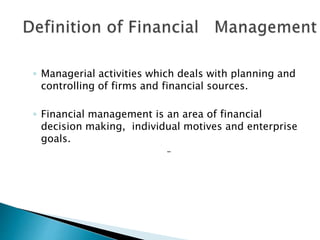
◦ Managerial activities which deals with planning and
controlling of firms and financial sources.
◦ Financial management is an area of financial
decision making, individual motives and enterprise
goals.
-
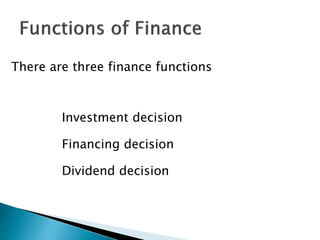
There are three finance functions
Investment decision
Financing decision
Dividend decision
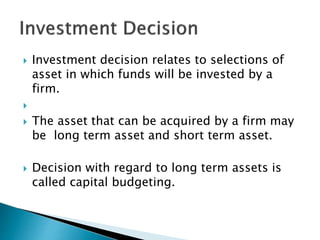
 Investment decision relates to selections of
asset in which funds will be invested by a
firm.

 The asset that can be acquired by a firm may
be long term asset and short term asset.
 Decision with regard to long term assets is
called capital budgeting.
 Decision with regard to long term assets is
called capital budgeting.
 Decision with regard to short term or current
assets is called working capital management.
 Decision with regard to short term or current
assets is called working capital management
 Capital budgeting relates to selection of an
asset or investment proposal which would
yield benefit in future. It involves three
elements.
 The measurement of the worth of the
proposal
 Evaluation of the investment proposal in
terms of risk associated with it and
 Evaluation of the worth of the investment
proposal against certain norms or standard.
The standard is broadly known as cost of
capital
 Determination of the proportion of equity and
dept is the main issue in financing decision.
 Once the best combination of debt and equity
is determined, the next step is raising
appropriate amount through available
sources.
 Working capital management or current asset
management is an important part of
investment decision.
 Proper management of working capital
ensures firm’s liquidity and solvency.
 A conflict exists between profitability and
liquidity while managing current asset.
 If a firm does not invest sufficient funds in
current assets it may become illiquid and may
not meet its current obligations.

 If the current asset are large, the firm would
lose its profitability and liquidity.
 The financial manager should develop proper
techniques of managing current assets so that
neither insufficient nor unnecessary funds are
invested in current assets.
 Dividend decision has a strong influence on
the market prize of the share.
 So the dividend policy is to be determined in
terms of its impact on shareholder’s value.
 The optimum dividend policy is one which
maximizes the value of shares and wealth of
the shareholders
 Long term funds are required to create
production facilities through purchase of
fixed assets such as
- plant,
- machinery,
- land,
- building,
- furniture, etc.
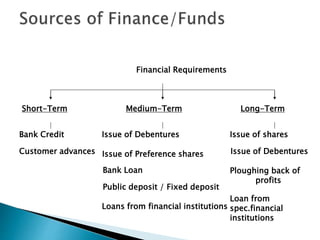
Financial Requirements
Short-Term Medium-Term Long-Term
Bank Credit
Customer advances
Issue of Debentures
Issue of Preference shares
Bank Loan
Public deposit / Fixed deposit
Loans from financial institutions
Issue of shares
Issue of Debentures
Ploughing back of
profits
Loan from
spec.financial
institutions
Ak finaacial

Ak finaacial

  • 1.
    MODULE-5 TOPIC: Financial management SUBMITTEDBY: AKBARKHAN PATHAN(03) AMISHA BRAHMBHATT(04)
  • 2.
    ◦ Managerial activitieswhich deals with planning and controlling of firms and financial sources. ◦ Financial management is an area of financial decision making, individual motives and enterprise goals. -
  • 3.
    There are threefinance functions Investment decision Financing decision Dividend decision
  • 4.
     Investment decisionrelates to selections of asset in which funds will be invested by a firm.   The asset that can be acquired by a firm may be long term asset and short term asset.  Decision with regard to long term assets is called capital budgeting.
  • 5.
     Decision withregard to long term assets is called capital budgeting.  Decision with regard to short term or current assets is called working capital management.  Decision with regard to short term or current assets is called working capital management
  • 6.
     Capital budgetingrelates to selection of an asset or investment proposal which would yield benefit in future. It involves three elements.  The measurement of the worth of the proposal
  • 7.
     Evaluation ofthe investment proposal in terms of risk associated with it and  Evaluation of the worth of the investment proposal against certain norms or standard. The standard is broadly known as cost of capital
  • 8.
     Determination ofthe proportion of equity and dept is the main issue in financing decision.  Once the best combination of debt and equity is determined, the next step is raising appropriate amount through available sources.
  • 9.
     Working capitalmanagement or current asset management is an important part of investment decision.  Proper management of working capital ensures firm’s liquidity and solvency.  A conflict exists between profitability and liquidity while managing current asset.
  • 10.
     If afirm does not invest sufficient funds in current assets it may become illiquid and may not meet its current obligations.   If the current asset are large, the firm would lose its profitability and liquidity.  The financial manager should develop proper techniques of managing current assets so that neither insufficient nor unnecessary funds are invested in current assets.
  • 11.
     Dividend decisionhas a strong influence on the market prize of the share.  So the dividend policy is to be determined in terms of its impact on shareholder’s value.  The optimum dividend policy is one which maximizes the value of shares and wealth of the shareholders
  • 12.
     Long termfunds are required to create production facilities through purchase of fixed assets such as - plant, - machinery, - land, - building, - furniture, etc.
  • 13.
    Financial Requirements Short-Term Medium-TermLong-Term Bank Credit Customer advances Issue of Debentures Issue of Preference shares Bank Loan Public deposit / Fixed deposit Loans from financial institutions Issue of shares Issue of Debentures Ploughing back of profits Loan from spec.financial institutions