Air Foil Project 
By: Tony Tufano and Drew Bard
Understand 
 We are designing an air foil to try to get the highest amount 
of lift while getting the least amount of drag 
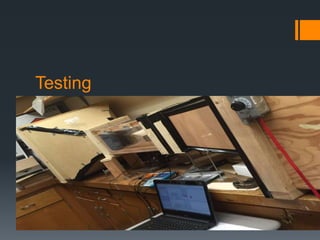
 We will test the air foil using online programs as well as 
actually making the air foil and testing it in a wind tunnel
Explore 
 My partner and I did three worksheets to further out 
understanding of the topic. 
 One worksheet was the calculus for lift to find out how to 
maximize lift. 
 Another was making graphs for velocity vs lift, lift vs area, 
and other ones to find out how they related to each other. 
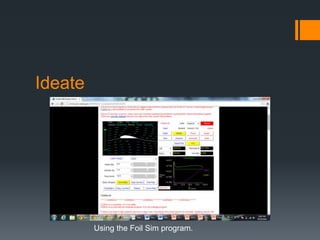
 We also did an intro to Foil Sim a program that simulated the 
air foil.
Define 
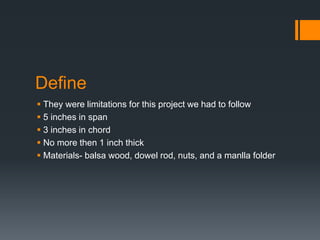
 They were limitations for this project we had to follow 
 5 inches in span 
 3 inches in chord 
 No more then 1 inch thick 
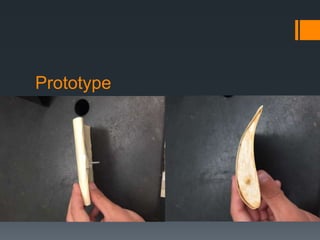
 Materials- balsa wood, dowel rod, nuts, and a manlla folder
Ideate 
Using the Foil Sim program.
Prototype
Testing
Results 
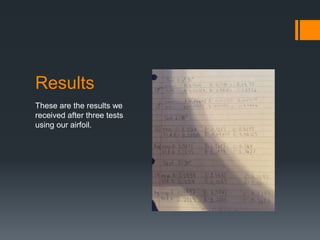
These are the results we 
received after three tests 
using our airfoil.
Conclusion 
 After reviewing our data we determined that as we increased 
the degree at which the wing was placed, lift and drag both 
resultantly increased. Though our data showed this trend we 
were unable to test frequently enough to completely trust this 
output. Throughout the project we also had many extraneous 
variables such as when we accidentally removed the airfoil 
from the sensors early, skewing our data.

Air foil powerpoint

  • 1.
    Air Foil Project By: Tony Tufano and Drew Bard
  • 2.
    Understand  Weare designing an air foil to try to get the highest amount of lift while getting the least amount of drag  We will test the air foil using online programs as well as actually making the air foil and testing it in a wind tunnel
  • 3.
    Explore  Mypartner and I did three worksheets to further out understanding of the topic.  One worksheet was the calculus for lift to find out how to maximize lift.  Another was making graphs for velocity vs lift, lift vs area, and other ones to find out how they related to each other.  We also did an intro to Foil Sim a program that simulated the air foil.
  • 4.
    Define  Theywere limitations for this project we had to follow  5 inches in span  3 inches in chord  No more then 1 inch thick  Materials- balsa wood, dowel rod, nuts, and a manlla folder
  • 5.
    Ideate Using theFoil Sim program.
  • 6.
  • 7.
  • 8.
    Results These arethe results we received after three tests using our airfoil.
  • 9.
    Conclusion  Afterreviewing our data we determined that as we increased the degree at which the wing was placed, lift and drag both resultantly increased. Though our data showed this trend we were unable to test frequently enough to completely trust this output. Throughout the project we also had many extraneous variables such as when we accidentally removed the airfoil from the sensors early, skewing our data.