Innovations in GreekTheater
Origins of Greek Drama
Greek drama originated in the
6th century BCE, rooted in
ancient rituals honoring
Dionysus, the god of wine
and fertility. The earliest form
used choruses that recited
stories, evolving into more
structured performances that
included dialogue and
Key Playwrights: Aeschylus,
Sophocles, Euripides
Aeschylus introduced more structured
narratives and complex characters, often
dealing with fate an divine intervention.
Sophocles refined drama with his
development of character and dramatic
irony, while Euripides challenged societal
norms with naturalistic dialogue, exploring
psychological depth and moral ambiguity.
Influence of Dionysian Festivals
The City Dionysia festival in Athens played a
pivotal role in the birth of theater,
showcasing dramatic contests. This annual
event celebrated both the agricultural cycles
and religious ceremonies, further
galvanizing the community's appreciation
5.
Theater Architecture and
Design
Greektheaters were open-air
structures built into hillsides,
featuring a circular orchestra for the
chorus and a raised stage for actors.
The design facilitated natural
acoustics and provided dramatic
backdrops against the surrounding
landscape, enhancing the audience's
experience.
Stagecraft and Performance
Techniques
Advanced techniques such as the use
of masks allowed actors to portray
different characters with distinct
emotions. Mechanical devices, like
the eccyclema and deus ex machina,
were employed to create elaborate
effects and resolve complex plots,
showcasing the ingenuity of Greek
stagecraft.
Structural Elements of Greek
Theater
Grandeur and Spectaclein Roman
Theater
Characteristics of Roman
Performance
Roman theater integrated diverse
entertainment forms, including tragedy,
comedy, and farce. Elaborate sets,
costumes, and the inclusion of music and
dance from various cultures enhanced the
spectacle, appealing to broad audiences
across the empire.
Contribution of Plautus and Seneca
Plautus significantly influenced comedy
with his witty plays that showcased
everyday life and mistaken identities.
Seneca, on the other hand, focused on
tragedy, emphasizing psychological conflict
and moral dilemmas, impacting later
European dramatic traditions.
8.
The Shift inTheatrical Tradition
Decline of Greek Influence
As Rome expanded, the original Greek
influences waned, leading to a distinctive
Roman style characterized by greater
spectacle and an emphasis on
entertainment. Roman adaptations of Greek
plays diverged in themes and presentation,
reflecting their own societal values.
Roman Innovations: Use of Scenery
Romans pioneered elaborate stage designs
with backdrops and movable scenery,
utilizing perspective to create immersive
environments. This innovation redefined
audience engagement, making
performances more visually captivating and
dynamic compared to earlier simpler
settings.
Miracle and MoralityPlays' Impact
Miracle and morality plays became popular,
presenting moral lessons through
allegorical characters. These works not only
entertained but also educated the public on
ethical dilemmas, shaping societal norms
and values during the Middle Ages.
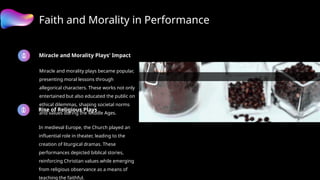
Faith and Morality in Performance
Rise of Religious Plays
In medieval Europe, the Church played an
influential role in theater, leading to the
creation of liturgical dramas. These
performances depicted biblical stories,
reinforcing Christian values while emerging
from religious observance as a means of
teaching the faithful.
11.
Spectacle and Community
Engagement
Festivalsand Public Performances
Public festivals often featured performances in town
squares, accessible to all social classes. These events
created a sense of unity and identity within
communities, allowing the populace to engage with
narratives that reflected their lives and struggles.
Guilds and Their Role in Theater
Guilds organized and funded many medieval plays,
transforming them into community events. Each
guild would contribute their craft to stage elements,
fostering collaboration and solidifying the role of
theater as a communal activity that reinforced local
identities.
The Rebirth ofArt in the
Renaissance
01. 02.
Shakespeare’s Contribution to
Theater Themes of Love and Power
William Shakespeare emerged as a
defining figure, blending tragic and
comedic elements to explore human
emotions and social constructs. His
masterful use of language and complex
characters revolutionized theater, leaving
a profound legacy that influenced
countless playwrights.
Shakespeare's works often delve into
themes of love, power, and the human
condition, encapsulating the
Renaissance's spirit of inquiry. His
exploration of these themes reflected
contemporary societal changes,
resonating with audiences both in his
time and today.
14.
The Baroque andNeoclassical Eras
Ornamentation and Emotion in
Baroque Theater
Baroque theater pushed
boundaries with elaborate
staging, opulent costumes,
and heightened emotional
expressions. This era sought
to evoke awe and intensity,
often employing dramatic
contrasts and grand narratives
Neoclassical Theater's Emphasis on
Order
Neoclassical theater embraced
reason and structure,
adhering to classical principles
derived from Greek and
Roman traditions. It
emphasized unity of time,
place, and action, reflecting
Enlightenment ideals and
shaping European theatrical
15.
The Romantic Revolutionin Theater
Exploration of Passion and
Individuality
The Romantic movement in theater
emphasized emotion, individualism, and
the sublime. Playwrights like Goethe and
Byron focused on personal experiences
and the inner struggles of characters,
challenging rationality and societal
constraints.
Influence of Romanticism on
Modern Drama
Romanticism laid the foundation for
modern drama by exploring themes
of existentialism and identity. Its
legacy is evident in contemporary
theater that prioritizes complex
characters and emotional depth,
shaping the landscape of