AIDS & Dentistry
HARSH PARIKH
IV BDS
R.NO.36
Contents:
 Introduction
 HIV Virology
 Transmission
 Oral pathophysiology of HIV infection
 Oral conditions associated with HIV infection
 Infection Control
 Ethical Considerations
AIDS & Dentistry
INTRODUCTION:
• AIDS is Acquired Immune Deficiency Syndrome.
• It commonly occurs due to the infection of the Human Immune
Defficiency Virus.
HIV Virology
– HIV belongs to retrovirus family.
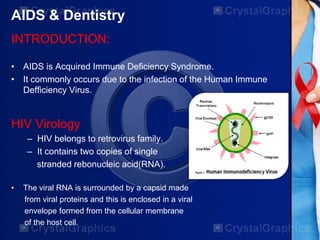
– It contains two copies of single
stranded rebonucleic acid(RNA).
• The viral RNA is surrounded by a capsid made
from viral proteins and this is enclosed in a viral
envelope formed from the cellular membrane
of the host cell.
• Following infection of a cell, viral RNA is converted to
deoxyribonucleic acid (DNA).
• The main targets for HIV infection are cells in the
immune system, particularly CD4 cells.
• CD4 cells are regulators and effectors of the normal
• immune response.
• Over time, CD4 cell counts decline, which results in a
poorly functioning immune system
(immunodeficiency).
• This eventually leads to AIDS, which is indicated by
the opportunistic infections.
Transmission
HIV can be transmitted through the following body fluids:
• Blood
• Semen
• Vaginal fluid
• Breast milk
HIV can’t be transmitted through the following :
• Saliva
• Tears
• Urine
• Mosquitoes
• Toilet Seats
• Kissing
• Hugging
• HIV is present in saliva, however it is not considered a risk factor for
transmission.
• It contains low levels of HIV that can be detected, and the endogenous
antiviral factors present in saliva.
Oral pathophysiology of HIV infection
• Oral lesions may be present at all stages of HIV infection.
• As the immunodeficient state gradually impairs humoral and cell-
mediated immunity it allows other diseases to affect the patient.
• Oral conditions associated with HIV infection are divided into
five major groups:
-Microbiological infections (fungal, bacterial, viral)
-Oral neoplasias
-Neurological conditions
-Lesions of uncertain aetiology
-Oral conditions associated with HIV treatment.
• Other co-infections and conditions associated with HIV infection,
which are significant to dentists are:
-Syphilis
-Tuberculosis
-Persistent generalised lymphadenopathy
-Gastro-oesophageal reflux disease (GORD).
Oral conditions associated with HIV treatment
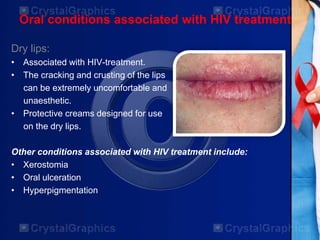
Dry lips:
• Associated with HIV-treatment.
• The cracking and crusting of the lips
can be extremely uncomfortable and
unaesthetic.
• Protective creams designed for use
on the dry lips.
Other conditions associated with HIV treatment include:
• Xerostomia
• Oral ulceration
• Hyperpigmentation
HIV and tooth decay
• Dental caries is common in people with HIV infection,due to
Xerostomia which occurs due to the HIV infection or its
treatment.
• Treatment includes “scoop and fill”.
• Decayed material is scooped out using
hand instruments and replaced with
temporary filling usually with
glass ionomer.
Microbiological infections
Fungal Infections
• Mycoses or fungal infections are often the first and most prevalent
conditions affecting the oral mucosal surfaces of patients with HIV
infection.
• The main fungal pathogen involved in oral disease is Candida
albicans.
• Lesions occurring by candida albicans,
-Pseudomembranous candidiasis
-Erythematous candidiasis
-Chronic hyperplastic candidiasis
Pseudomembranous candidiasis
• Description: creamy white or yellow plaques which, when scraped,
reveal an erythematous or bleeding mucosal surface.
• Location: may be found on any of the
intra-oral surfaces.
• Symptoms: none or mild-to-moderate
pain or burning.
• Duration: usually intermittent, however may be chronic.
• Diagnosis: clinical, with a swab for microscopy and culture
when the diagnosis is uncertain.
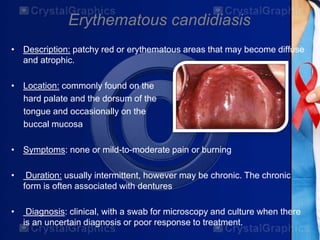
Erythematous candidiasis
• Description: patchy red or erythematous areas that may become diffuse
and atrophic.
• Location: commonly found on the
hard palate and the dorsum of the
tongue and occasionally on the
buccal mucosa
• Symptoms: none or mild-to-moderate pain or burning
• Duration: usually intermittent, however may be chronic. The chronic
form is often associated with dentures
• Diagnosis: clinical, with a swab for microscopy and culture when there
is an uncertain diagnosis or poor response to treatment.
Chronic hyperplastic candidiasis
• This condition has an association with smoking.
• It is generally considered premalignant and may demonstrate
dysplasia.
• Description: Homogenous white patches that are rough and
irregular and cannot be wiped off.
• Location: Buccal mucosa near the
labial commissures less frequently
palate or tongue
• Symptoms: usually symptomless.
• Duration: chronic
• Diagnosis: clinical, with a swab for microscopy and culture.
Bacterial Infections
• There is a wide range of bacterial pathogens that cause oral disease in
patients with HIV infection.
• Common bacterial infection occurs in HIV are,
-Necrotising ulcerative gingivitis
-Necrotising ulcerative periodontitis
-Necrotising ulcerative stomatitis
Necrotising ulcerative gingivitis
• It presents with pain, ulceration and gingival bleeding.
• The lesion does not involve the alveolar bone.
• Description: the characteristic lesion is a punched out, ulcerated and
erythematous interdental papilla covered by a greyish necrotic slough.
• Location: gingival tissues particularly
the interdental papillae.
• Symptoms: moderate-to-severe pain,
bleeding.Systemic features such as
fever, malaise and lymphadenopathy.
• Duration: sudden onset and rapidly deteriorating
• Diagnosis: clinical.
Necrotising ulcerative periodontitis
• The lesion involves the alveolar bone.
• Description: There may be exposed bone
gingival recession and tooth mobility.
• Location: the interdental papilla extending
into deeper periodontal tissues.
• Symptoms: moderate-to-severe pain, bleeding.Systemic features
such as fever, malaise and lymphadenopathy may be present.
• Duration: sudden onset and rapidly worsening
• Diagnosis: clinical
Syphilis and tuberculosis are also common
opportunistic Bacterial infections in AIDS.
Viral Infections
Herpes simplex virus (HSV)
• Description:Small, round vesicles that rupture, leaving shallow ulcers
which can coalesce.
• Location : Hard palate, gingiva and
dorsum of the tongue
• symptoms: Mild-to-severe pain.
Fever, lymphadenopathy and
other symptoms may occur.
• Duration: rapid onset with a duration of 7–14 days.
• Diagnosis: swab for PCR analysis.
Epstein-Barr virus (EBV)
• EBV has been linked to oral ulceration in patients with advanced HIV
infection.
• The chief manifestation of EBV in people with HIV infection is
Oral hairy leukoplakia.
Oral neoplasias
• Two common malignancies associated with HIV infection that are -- -
-Kaposi’s sarcoma
-non-Hodgkin’s lymphoma (NHL).
Kaposi’s sarcoma(KS)
• KS starts red macule which enlarges to form a red-blue plaque and
these plaques may grow into lobulated nodules that may ulcerate
sometimes cause pain.
• Description: Pigmented lesions ranges from flat macules to ulcerated
nodular masses. The lesions can be red, purple, blue or brown in
colour.
• Location: Hard palate,gingiva and
buccal mucosa.
• Symptoms: lesions are usually painless
• Duration: chronic
• Diagnosis: clinical followed by biopsy.
Non-Hodgkin’s lymphoma (NHL)
• HIV infection is association with EBV can induce NHL.
• Description: Diffuse, rapidly proliferating, slightly purplish mass
• Location: In the palatal-retromolar complex.
• Symptoms: Generalised symptoms fever, night sweats and weight
loss.
• Duration: chronic.
• Diagnosis: clinical followed by biopsy.
Infection Control
Hand Hygiene
• The purpose of hand hygiene is to reduce the quantity of micro
organisms of hands.
Protective Equipment
• Protective equipment would include gloves, masks, protective
eye-wear and protective clothing.
• It protects from the splashing or spraying of blood, saliva or other
body fluids.
Gloves
• Double-gloving may be utilized for some specific procedures and
in the infected patient’s treatment.
Masks ,Eye wear, Protective Clothing
• They are weared to protect from splashes, sprays or spatter of
blood, saliva, other body fluids, or contaminated water.
Ethical Considerations
• A Common Form of Human Rights Violation is a Dentist
refusing to take on a new patient due to their HIV
status.
• Courts have recognized that privacy concerns are of paramount
importance for people with HIV.
• HIV status of a patient should be protected and not revealed without the
patient’s written informed consent.
• The form must be signed and dated and a witness signature may be
prudent.
Title of the study
with author and
journal
information
Research design
and Level Of
Evidence(Accordin
g to CEBM criteria)
Problem/
population
Methods (
including
Intervention and
comparison)
Outcome/Resul
ts
Conclusion
Is human
immunodeficie
ncy virus (HIV)
stage
an independent
risk factor for
altering the
periodontal
status of HIV-
positive
patients?
A South African
study
A Cohort study. 120 HIV-
infected
patients
attending
an
infectious
diseases
clinic in the
Western
Cape,
South
Africa
were
included in
the study
The periodontal
clinical indices such as
plaque index, gingival
index, pocket
probing depth and
clinical attachment
levels were measured
on the mesial aspect
of the six Ramfjord
teeth. The
CD4 + T cell counts
were taken from the
patients’ medical
records and patients’
HIV stage determined
and grouped
according to their
CD4+ T cell counts
into A (<200 cells
/mm3), B (200–500
cells /mm3) and C
(>500 cells /mm3).
The mean age
of 120 HIV-
positive patients
was 33.25 years
and the mean
CD4 + T cell
count was
293.43
cells/mm3.
-No correlation
was found
between age
and HIV stage of
the
patients.
HIV stage,
ART and
age are not
independent
risk factors
for
changes in
the
periodontal
status of
HIV-positive
subjects but
rather that
smoking
and oral
hygiene
habits
determine
their
susceptibilit
y to
disease.
Aids & dentistry

Aids & dentistry

  • 1.
    AIDS & Dentistry HARSHPARIKH IV BDS R.NO.36
  • 2.
    Contents:  Introduction  HIVVirology  Transmission  Oral pathophysiology of HIV infection  Oral conditions associated with HIV infection  Infection Control  Ethical Considerations
  • 3.
    AIDS & Dentistry INTRODUCTION: •AIDS is Acquired Immune Deficiency Syndrome. • It commonly occurs due to the infection of the Human Immune Defficiency Virus. HIV Virology – HIV belongs to retrovirus family. – It contains two copies of single stranded rebonucleic acid(RNA). • The viral RNA is surrounded by a capsid made from viral proteins and this is enclosed in a viral envelope formed from the cellular membrane of the host cell.
  • 4.
    • Following infectionof a cell, viral RNA is converted to deoxyribonucleic acid (DNA). • The main targets for HIV infection are cells in the immune system, particularly CD4 cells. • CD4 cells are regulators and effectors of the normal • immune response. • Over time, CD4 cell counts decline, which results in a poorly functioning immune system (immunodeficiency). • This eventually leads to AIDS, which is indicated by the opportunistic infections.
  • 5.
    Transmission HIV can betransmitted through the following body fluids: • Blood • Semen • Vaginal fluid • Breast milk HIV can’t be transmitted through the following : • Saliva • Tears • Urine • Mosquitoes • Toilet Seats • Kissing • Hugging
  • 6.
    • HIV ispresent in saliva, however it is not considered a risk factor for transmission. • It contains low levels of HIV that can be detected, and the endogenous antiviral factors present in saliva. Oral pathophysiology of HIV infection • Oral lesions may be present at all stages of HIV infection. • As the immunodeficient state gradually impairs humoral and cell- mediated immunity it allows other diseases to affect the patient.
  • 7.
    • Oral conditionsassociated with HIV infection are divided into five major groups: -Microbiological infections (fungal, bacterial, viral) -Oral neoplasias -Neurological conditions -Lesions of uncertain aetiology -Oral conditions associated with HIV treatment. • Other co-infections and conditions associated with HIV infection, which are significant to dentists are: -Syphilis -Tuberculosis -Persistent generalised lymphadenopathy -Gastro-oesophageal reflux disease (GORD).
  • 8.
    Oral conditions associatedwith HIV treatment Dry lips: • Associated with HIV-treatment. • The cracking and crusting of the lips can be extremely uncomfortable and unaesthetic. • Protective creams designed for use on the dry lips. Other conditions associated with HIV treatment include: • Xerostomia • Oral ulceration • Hyperpigmentation
  • 9.
    HIV and toothdecay • Dental caries is common in people with HIV infection,due to Xerostomia which occurs due to the HIV infection or its treatment. • Treatment includes “scoop and fill”. • Decayed material is scooped out using hand instruments and replaced with temporary filling usually with glass ionomer.
  • 10.
    Microbiological infections Fungal Infections •Mycoses or fungal infections are often the first and most prevalent conditions affecting the oral mucosal surfaces of patients with HIV infection. • The main fungal pathogen involved in oral disease is Candida albicans. • Lesions occurring by candida albicans, -Pseudomembranous candidiasis -Erythematous candidiasis -Chronic hyperplastic candidiasis
  • 11.
    Pseudomembranous candidiasis • Description:creamy white or yellow plaques which, when scraped, reveal an erythematous or bleeding mucosal surface. • Location: may be found on any of the intra-oral surfaces. • Symptoms: none or mild-to-moderate pain or burning. • Duration: usually intermittent, however may be chronic. • Diagnosis: clinical, with a swab for microscopy and culture when the diagnosis is uncertain.
  • 12.
    Erythematous candidiasis • Description:patchy red or erythematous areas that may become diffuse and atrophic. • Location: commonly found on the hard palate and the dorsum of the tongue and occasionally on the buccal mucosa • Symptoms: none or mild-to-moderate pain or burning • Duration: usually intermittent, however may be chronic. The chronic form is often associated with dentures • Diagnosis: clinical, with a swab for microscopy and culture when there is an uncertain diagnosis or poor response to treatment.
  • 13.
    Chronic hyperplastic candidiasis •This condition has an association with smoking. • It is generally considered premalignant and may demonstrate dysplasia. • Description: Homogenous white patches that are rough and irregular and cannot be wiped off. • Location: Buccal mucosa near the labial commissures less frequently palate or tongue • Symptoms: usually symptomless. • Duration: chronic • Diagnosis: clinical, with a swab for microscopy and culture.
  • 14.
    Bacterial Infections • Thereis a wide range of bacterial pathogens that cause oral disease in patients with HIV infection. • Common bacterial infection occurs in HIV are, -Necrotising ulcerative gingivitis -Necrotising ulcerative periodontitis -Necrotising ulcerative stomatitis
  • 15.
    Necrotising ulcerative gingivitis •It presents with pain, ulceration and gingival bleeding. • The lesion does not involve the alveolar bone. • Description: the characteristic lesion is a punched out, ulcerated and erythematous interdental papilla covered by a greyish necrotic slough. • Location: gingival tissues particularly the interdental papillae. • Symptoms: moderate-to-severe pain, bleeding.Systemic features such as fever, malaise and lymphadenopathy. • Duration: sudden onset and rapidly deteriorating • Diagnosis: clinical.
  • 16.
    Necrotising ulcerative periodontitis •The lesion involves the alveolar bone. • Description: There may be exposed bone gingival recession and tooth mobility. • Location: the interdental papilla extending into deeper periodontal tissues. • Symptoms: moderate-to-severe pain, bleeding.Systemic features such as fever, malaise and lymphadenopathy may be present. • Duration: sudden onset and rapidly worsening • Diagnosis: clinical
  • 17.
    Syphilis and tuberculosisare also common opportunistic Bacterial infections in AIDS.
  • 18.
    Viral Infections Herpes simplexvirus (HSV) • Description:Small, round vesicles that rupture, leaving shallow ulcers which can coalesce. • Location : Hard palate, gingiva and dorsum of the tongue • symptoms: Mild-to-severe pain. Fever, lymphadenopathy and other symptoms may occur. • Duration: rapid onset with a duration of 7–14 days. • Diagnosis: swab for PCR analysis.
  • 19.
    Epstein-Barr virus (EBV) •EBV has been linked to oral ulceration in patients with advanced HIV infection. • The chief manifestation of EBV in people with HIV infection is Oral hairy leukoplakia.
  • 20.
    Oral neoplasias • Twocommon malignancies associated with HIV infection that are -- - -Kaposi’s sarcoma -non-Hodgkin’s lymphoma (NHL). Kaposi’s sarcoma(KS) • KS starts red macule which enlarges to form a red-blue plaque and these plaques may grow into lobulated nodules that may ulcerate sometimes cause pain. • Description: Pigmented lesions ranges from flat macules to ulcerated nodular masses. The lesions can be red, purple, blue or brown in colour. • Location: Hard palate,gingiva and buccal mucosa. • Symptoms: lesions are usually painless • Duration: chronic • Diagnosis: clinical followed by biopsy.
  • 21.
    Non-Hodgkin’s lymphoma (NHL) •HIV infection is association with EBV can induce NHL. • Description: Diffuse, rapidly proliferating, slightly purplish mass • Location: In the palatal-retromolar complex. • Symptoms: Generalised symptoms fever, night sweats and weight loss. • Duration: chronic. • Diagnosis: clinical followed by biopsy.
  • 22.
    Infection Control Hand Hygiene •The purpose of hand hygiene is to reduce the quantity of micro organisms of hands. Protective Equipment • Protective equipment would include gloves, masks, protective eye-wear and protective clothing. • It protects from the splashing or spraying of blood, saliva or other body fluids. Gloves • Double-gloving may be utilized for some specific procedures and in the infected patient’s treatment. Masks ,Eye wear, Protective Clothing • They are weared to protect from splashes, sprays or spatter of blood, saliva, other body fluids, or contaminated water.
  • 23.
    Ethical Considerations • ACommon Form of Human Rights Violation is a Dentist refusing to take on a new patient due to their HIV status. • Courts have recognized that privacy concerns are of paramount importance for people with HIV. • HIV status of a patient should be protected and not revealed without the patient’s written informed consent. • The form must be signed and dated and a witness signature may be prudent.
  • 24.
    Title of thestudy with author and journal information Research design and Level Of Evidence(Accordin g to CEBM criteria) Problem/ population Methods ( including Intervention and comparison) Outcome/Resul ts Conclusion Is human immunodeficie ncy virus (HIV) stage an independent risk factor for altering the periodontal status of HIV- positive patients? A South African study A Cohort study. 120 HIV- infected patients attending an infectious diseases clinic in the Western Cape, South Africa were included in the study The periodontal clinical indices such as plaque index, gingival index, pocket probing depth and clinical attachment levels were measured on the mesial aspect of the six Ramfjord teeth. The CD4 + T cell counts were taken from the patients’ medical records and patients’ HIV stage determined and grouped according to their CD4+ T cell counts into A (<200 cells /mm3), B (200–500 cells /mm3) and C (>500 cells /mm3). The mean age of 120 HIV- positive patients was 33.25 years and the mean CD4 + T cell count was 293.43 cells/mm3. -No correlation was found between age and HIV stage of the patients. HIV stage, ART and age are not independent risk factors for changes in the periodontal status of HIV-positive subjects but rather that smoking and oral hygiene habits determine their susceptibilit y to disease.