AIDS & MENTAL HEALTH
DR.VIGNESHVAR CHANDRASEKARAN
ASSISTANT PROFESSOR, PSYCHIATRY, MGMCRI, SBV
AIDS & MENTAL HEALTH 1
OUTLINE
AIDS & MENTAL HEALTH 2
Introduction
How is Psychiatry and HIV related?
HIV and Psychiatry – Interplay among Psychiatric disorders
Special areas of interest
Conclusion
INTRODUCTION
 HIV is considered an epidemic and has
donned the mantle of a chronic illness
 The highly effective HAART therapy
inhibits viral replication and has
prolonged the longevity of treated
individuals
AIDS & MENTAL HEALTH 3
INTRODUCTION
Population at highest risk:
 Homosexual men
 IV drug abuser and their partners
 Commercial sex workers
AIDS & MENTAL HEALTH 4
HOW IS PSYCHIATRY AND HIV RELATED?
Psychiatric conditions are associated with
 Increased high risk behaviors for infection
 Decreased access to care
 Decreased adherence to HIV therapies
 Increased medical comorbidity
AIDS & MENTAL HEALTH 5
HOW IS PSYCHIATRY AND HIV RELATED?
High risk behaviors:
 Majority of individuals contract HIV due to engaging in high risk
behaviors
 Most of the high risk behaviors are associated with reward seeking
behaviors such as unprotected sex and substance use
 Individuals with untreated psychiatric illness have increased propensity
for above mentioned behaviors
AIDS & MENTAL HEALTH 6
HOW IS PSYCHIATRY AND HIV RELATED?
Decreased access to care:
 Vulnerable population tend to lag in access to healthcare
Impaired adherence to antiviral regimen:
 Mentally ill individuals are prone for non adherence to antiviral regimen
leading to increased viral load – increased infectivity
 More viral load leading to more immunosuppression and further to more
morbidity and mortality
AIDS & MENTAL HEALTH 7
PSYCHIATRY NEEDS TO BE
A PART OF INTEGRATED
CARE IN HIV
DELIRIUM
9 AIDS & MENTAL HEALTH
State of global derangement of
cerebral function
Prevalence – 43-65%
• Altered sensorium
• Reversal of sleep wake cycle
• Behavioral disturbances
• Emotional and cognitive disturbances
Characterized by
DELIRIUM
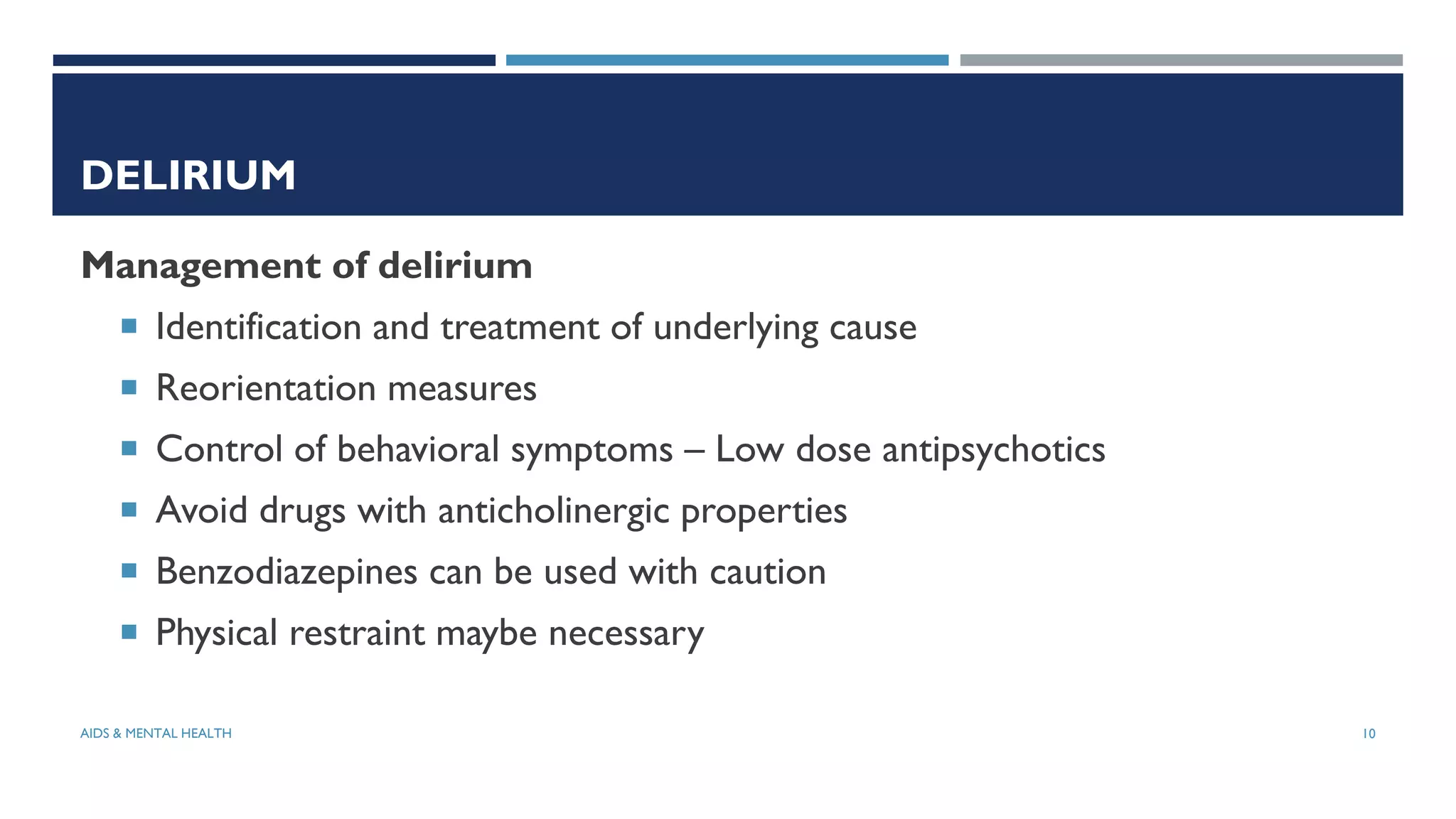
Management of delirium
 Identification and treatment of underlying cause
 Reorientation measures
 Control of behavioral symptoms – Low dose antipsychotics
 Avoid drugs with anticholinergic properties
 Benzodiazepines can be used with caution
 Physical restraint maybe necessary
AIDS & MENTAL HEALTH 10
HIV
ASSOCIATED
DEMENTIA
11 AIDS & MENTAL HEALTH
Rapidly progressing neurocognitive disturbances finally
leading to death
A sub cortical dementia with HIV as a causative factor
Characterized by
• Loss of attention and concentration
• Motor slowing
• Behavioral symptoms
Decreased incidence with onset of HAART therapy
MAJOR
DEPRESSION
12 AIDS & MENTAL HEALTH
Most common complication of any chronic
illness
Often underrecognized, underdiagnosed, and
undertreated
Role of the immune axis in major depression
is highly relevant in HIV infected individuals
By comorbidities such as toxoplasmosis,
cryptococcal meningitis, lymphoma, syphilis
MAJOR DEPRESSION
High rates of major depression have been found in homosexual men and
patients with substance use disorders
Major depression is a risk factor for HIV infection by virtue of its impact on
• On behavior
• Intensification of substance abuse
• Exacerbation of self harm behaviors
• Promotion of poor partner choice in relationships.
AIDS & MENTAL HEALTH 13
MAJOR DEPRESSION
 Depression has a negative impact on adherence with medical treatments, quality of
life, and treatment outcome
 Patients with HIV suffering from major depression frequently present with multiple
somatic symptoms such as
 Headache, gastrointestinal (GI) disturbances, musculoskeletal or visceral pain,
cardiac symptoms, dizziness, tinnitus, weakness, and anesthesia
AIDS & MENTAL HEALTH 14
MAJOR DEPRESSION
Treatment
 Pharmacotherapy – SSRIs
 Psychotherapy : Cognitive behavioral therapy – Individual or group
 Supportive psychotherapy
AIDS & MENTAL HEALTH 15
BIPOLAR
DISORDER
 Manic episodes - associated with increased
rates of substance abuse and impulsive
behavior
 Associated with late stage HIV infection
 Quite severe in its presentation and
malignant in its course
 Rx – Mood stabilizers/ Antipsychotics
 Drug specific adverse effects and interaction
with HAART medications needs to be taken
into consideration
AIDS & MENTAL HEALTH 16
SCHIZOPHRENIA
 Prevalence around 4-19%
 High rates of unprotected sex, multiple sex
partners, trading sex for money or other
goods, and sex while intoxicated.
 Patients with more positive symptoms
(Delusions and Hallucinations) and impulse
control problems are at increased risk of
high-risk sexual behavior
 Rx
 Antipsychotics
 Rehabilitation with psychosocial support
AIDS & MENTAL HEALTH 17
PERSONALITY
FACTORS
18 AIDS & MENTAL HEALTH
Extraversion is associated with sexual
promiscuity, desire for sexual novelty, multiple
sex partners
Neuroticism is related to unprotected anal
sex.
Psychoticism is associated with number of
sexual partners and unprotected sex in
several studies
PERSONALITY FACTORS
 Sensation seeking - positive expectancies about the effect of
alcohol on sexual pleasure or sexual behavior increases the
likelihood that alcohol will be used in sexual situations
 Having sex when under the influence of alcohol is associated with
an increased likelihood of having unprotected sex.
AIDS & MENTAL HEALTH 19
PERSONALITY
DISORDERS
20 AIDS & MENTAL HEALTH
Antisocial personality disorder (ASPD) is
the most common risk factor for HIV
infection.
Individuals with personality disorder,
particularly ASPD, have
• Higher rates of Substance abuse
• More likely to inject drugs and share needles
• Higher numbers of lifetime sexual partners,
• Engage in unprotected anal sex, and contract STDs
PERSONALITY DISORDERS
Therapy Focus on thoughts, not feelings.
Use a behavioral contract
Emphasize constructive rewards
Use relapse prevention techniques
AIDS & MENTAL HEALTH 21
SUBSTANCE USE
AND HIV
 Substance use is a primary vector for
the spread of HIV.
 This impact is directed not only at
injection drug users and their sexual
partners but also at those who are
disinhibited or cognitively impaired by
intoxication, causing them to act
impulsively and engage in unsafe sexual
practices
AIDS & MENTAL HEALTH 22
SUBSTANCE USE AND HIV
 Injection drug use is obviously a primary risk factor for contracting HIV
by needle sharing
 Alcohol use can lead to risky sexual behaviors during intoxication by way
of cognitive impairment and disinhibition.
 The rewarding properties of drugs and alcohol to “self-medicate”
dysphoria and anhedonia can be a perpetuating factor
AIDS & MENTAL HEALTH 23
SUBSTANCE USE AND HIV
 Patients infected by HIV are often demoralized, become hopeless, and
are more likely to use drugs and engage in high-risk behaviors.
 Patients with substance use disorders may not seek health care or may
be excluded from health care because of stigmatization.
 Intoxication and the behaviors necessary to obtain drugs interfere with
adherence to medication regimens and medical appointments.
AIDS & MENTAL HEALTH 24
SUBSTANCE
USE AND HIV
Substance use and HIV –
How deadly is it?
 The accumulation of
medical sequelae from
chronic substance abuse can
accelerate the process of
immunocompromise and
amplify the progressive
burden of the HIV infection
itself.
AIDS & MENTAL HEALTH 25
SUBSTANCE USE AND HIV
 Injection drug users are at higher risk of developing bacterial infections
such as pneumonia, sepsis, soft tissue infections, and endocarditis.
 Tuberculosis, STDs, viral hepatitis infection, and coinfection with human CD4
cell lymphotropic virus occur more commonly in IV drug users infected with
HIV.
 Certain malignancies, lymphomas in particular, occur more frequently in HIV-
infected drug users.
AIDS & MENTAL HEALTH 26
SUBSTANCE USE AND HIV
 Alcohol users experience faster progression of HIV and poorer response to
antiretroviral therapy due to the immunosuppressive effects of alcohol.
 Active substance use is highly associated with nonadherence and reduced
access to antiretroviral medication
 Interaction between substances of abuse and HIV medications
AIDS & MENTAL HEALTH 27
AIDS & MENTAL HEALTH
SUBSTANCE USE
AND HIV -
MANAGEMENT
PRINCIPLES
28
1. Induction of patient role
2. Detoxification
3.Treatment of comorbid conditions
4. Rehabilitation
5. Relapse prevention
PSYCHOLOGICAL
TRAUMA IN HIV
Patients with HIV
 Have more incidences of severe trauma
 High rates of PTSD and anxiety
PTSD increases the likelihood of engaging in
destructive behaviors such as:
 Substance abuse,
 Sexual promiscuity
 Prostitution
AIDS & MENTAL HEALTH 29
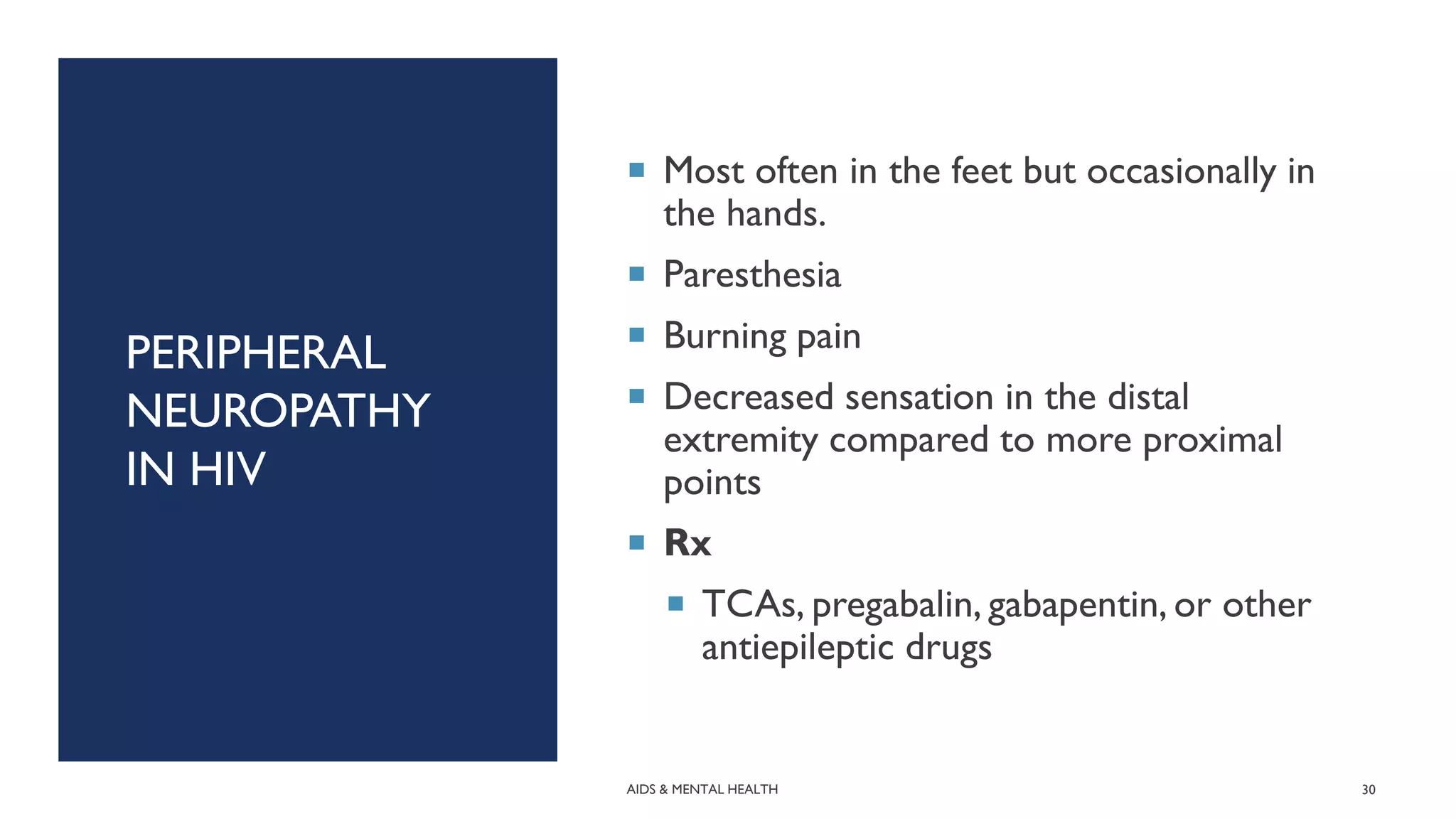
PERIPHERAL
NEUROPATHY
IN HIV
 Most often in the feet but occasionally in
the hands.
 Paresthesia
 Burning pain
 Decreased sensation in the distal
extremity compared to more proximal
points
 Rx
 TCAs, pregabalin, gabapentin, or other
antiepileptic drugs
AIDS & MENTAL HEALTH 30
FATIGUE IN HIV
 Fatigue is a common symptom in HIV-
infected patients
 Often overlooked, improperly assessed
or inadequately investigated
 Fatigue is a nonspecific symptom and
may have varied etiology
AIDS & MENTAL HEALTH 31
FATIGUE IN HIV - ETIOLOGY
 Medical causes include pneumonia, bronchitis, hypothyroidism, hepatitis,
heart failure, renal failure, malignancies, and myopathy.
 Fatigue can also be caused by major depression
 As a side effect of medications such as antihypertensives, anticonvulsants,
benzodiazepines, antidepressants, narcotic analgesics, antipsychotics,
antiemetics, antihistamines, and most importantly HAART
 Rx - Identification and treatment of the cause/ Activating antidepressants can
be used
AIDS & MENTAL HEALTH 32
HIV / HCV CO-
INFECTION
 Special monitoring should be performed
during the period of treatment with
interferon-alpha
 Early recognition and treatment of
affective symptoms.
 Alcohol hastens the progression of HCV
disease and should be strongly
discouraged in any amount.
 Drug use may exacerbate
neuropsychiatric side effects of
interferon-alpha
AIDS & MENTAL HEALTH 33
PRE TEST
COUNSELING
 Individuals at risk are often reluctant to get
tested
 Psychoeducation directed at encouraging
patients to get tested, provides good results
 Prior to testing, informed consent regarding
the meaning of a positive and a negative test.
 It should be stressed that a negative test
does not mean that a patient is immune and
cannot become infected later, and that a
positive result does not mean that a person
has AIDS, is going to die, or will suffer from
opportunistic infections.
 Also include information on safe sex, safe
needle, and other risk-reduction
interventions.
AIDS & MENTAL HEALTH 34
POSTTEST
COUNSELING
 Post test interventions in both negative and
positive patients.
 Psychoeducation regarding the meaning of test
results, recommendations for treatment, risk
reduction interventions to control spread of
infection.
 At the time of test results being given to patients,
a variety of intense psychological reactions
including suicidal feelings, anger, homicidal
thoughts directed at potentially infecting
partners, overwhelming grief, and complete
psychological breakdown.
 Patients with poor coping skills, poor impulse
control, history of suicidal feelings and behaviors,
substance abuse disorders, and lack of social
supports are at increased risk of impulsive
behaviors and self-destructive behaviors.
AIDS & MENTAL HEALTH 35
PARTNER
NOTIFICATION
 Highly debated topic
 Tarasoff case
 Patients who are sexually active and
infected with HIV must be counseled
about potential risk to their sexual
partners.
AIDS & MENTAL HEALTH 36
ADHERENCE
COUNSELLING
 The single most important factor in outcome
of HIV treatment is the patient’s ability to
adhere to prescribed regimen
Factors improving adherence include
 Psychosocial support networks
 Individual coping skills
 Cognitive behavioral psychotherapy,
structured psychoeducational
psychotherapy, supportive psychotherapy,
and group interventions
 Pill box and timer reminders, less complex
pharmacological interventions, decreased
pill burdens
AIDS & MENTAL HEALTH 37
CONCLUSION
38 AIDS & MENTAL HEALTH
HIV and AIDS are conditions intimately linked to psychiatry.
Psychiatric disorders can be seen as vectors of HIV
transmission and complicate the treatment of HIV.
HIV in turn produces a number of psychiatric conditions and
exacerbates many others.
This interplay needs to be considered when a comprehensive
and integrated care is provided to HIV infected individuals
AIDS & MENTAL HEALTH 39

AIDS and Mental health

  • 1.
    AIDS & MENTALHEALTH DR.VIGNESHVAR CHANDRASEKARAN ASSISTANT PROFESSOR, PSYCHIATRY, MGMCRI, SBV AIDS & MENTAL HEALTH 1
  • 2.
    OUTLINE AIDS & MENTALHEALTH 2 Introduction How is Psychiatry and HIV related? HIV and Psychiatry – Interplay among Psychiatric disorders Special areas of interest Conclusion
  • 3.
    INTRODUCTION  HIV isconsidered an epidemic and has donned the mantle of a chronic illness  The highly effective HAART therapy inhibits viral replication and has prolonged the longevity of treated individuals AIDS & MENTAL HEALTH 3
  • 4.
    INTRODUCTION Population at highestrisk:  Homosexual men  IV drug abuser and their partners  Commercial sex workers AIDS & MENTAL HEALTH 4
  • 5.
    HOW IS PSYCHIATRYAND HIV RELATED? Psychiatric conditions are associated with  Increased high risk behaviors for infection  Decreased access to care  Decreased adherence to HIV therapies  Increased medical comorbidity AIDS & MENTAL HEALTH 5
  • 6.
    HOW IS PSYCHIATRYAND HIV RELATED? High risk behaviors:  Majority of individuals contract HIV due to engaging in high risk behaviors  Most of the high risk behaviors are associated with reward seeking behaviors such as unprotected sex and substance use  Individuals with untreated psychiatric illness have increased propensity for above mentioned behaviors AIDS & MENTAL HEALTH 6
  • 7.
    HOW IS PSYCHIATRYAND HIV RELATED? Decreased access to care:  Vulnerable population tend to lag in access to healthcare Impaired adherence to antiviral regimen:  Mentally ill individuals are prone for non adherence to antiviral regimen leading to increased viral load – increased infectivity  More viral load leading to more immunosuppression and further to more morbidity and mortality AIDS & MENTAL HEALTH 7
  • 8.
    PSYCHIATRY NEEDS TOBE A PART OF INTEGRATED CARE IN HIV
  • 9.
    DELIRIUM 9 AIDS &MENTAL HEALTH State of global derangement of cerebral function Prevalence – 43-65% • Altered sensorium • Reversal of sleep wake cycle • Behavioral disturbances • Emotional and cognitive disturbances Characterized by
  • 10.
    DELIRIUM Management of delirium Identification and treatment of underlying cause  Reorientation measures  Control of behavioral symptoms – Low dose antipsychotics  Avoid drugs with anticholinergic properties  Benzodiazepines can be used with caution  Physical restraint maybe necessary AIDS & MENTAL HEALTH 10
  • 11.
    HIV ASSOCIATED DEMENTIA 11 AIDS &MENTAL HEALTH Rapidly progressing neurocognitive disturbances finally leading to death A sub cortical dementia with HIV as a causative factor Characterized by • Loss of attention and concentration • Motor slowing • Behavioral symptoms Decreased incidence with onset of HAART therapy
  • 12.
    MAJOR DEPRESSION 12 AIDS &MENTAL HEALTH Most common complication of any chronic illness Often underrecognized, underdiagnosed, and undertreated Role of the immune axis in major depression is highly relevant in HIV infected individuals By comorbidities such as toxoplasmosis, cryptococcal meningitis, lymphoma, syphilis
  • 13.
    MAJOR DEPRESSION High ratesof major depression have been found in homosexual men and patients with substance use disorders Major depression is a risk factor for HIV infection by virtue of its impact on • On behavior • Intensification of substance abuse • Exacerbation of self harm behaviors • Promotion of poor partner choice in relationships. AIDS & MENTAL HEALTH 13
  • 14.
    MAJOR DEPRESSION  Depressionhas a negative impact on adherence with medical treatments, quality of life, and treatment outcome  Patients with HIV suffering from major depression frequently present with multiple somatic symptoms such as  Headache, gastrointestinal (GI) disturbances, musculoskeletal or visceral pain, cardiac symptoms, dizziness, tinnitus, weakness, and anesthesia AIDS & MENTAL HEALTH 14
  • 15.
    MAJOR DEPRESSION Treatment  Pharmacotherapy– SSRIs  Psychotherapy : Cognitive behavioral therapy – Individual or group  Supportive psychotherapy AIDS & MENTAL HEALTH 15
  • 16.
    BIPOLAR DISORDER  Manic episodes- associated with increased rates of substance abuse and impulsive behavior  Associated with late stage HIV infection  Quite severe in its presentation and malignant in its course  Rx – Mood stabilizers/ Antipsychotics  Drug specific adverse effects and interaction with HAART medications needs to be taken into consideration AIDS & MENTAL HEALTH 16
  • 17.
    SCHIZOPHRENIA  Prevalence around4-19%  High rates of unprotected sex, multiple sex partners, trading sex for money or other goods, and sex while intoxicated.  Patients with more positive symptoms (Delusions and Hallucinations) and impulse control problems are at increased risk of high-risk sexual behavior  Rx  Antipsychotics  Rehabilitation with psychosocial support AIDS & MENTAL HEALTH 17
  • 18.
    PERSONALITY FACTORS 18 AIDS &MENTAL HEALTH Extraversion is associated with sexual promiscuity, desire for sexual novelty, multiple sex partners Neuroticism is related to unprotected anal sex. Psychoticism is associated with number of sexual partners and unprotected sex in several studies
  • 19.
    PERSONALITY FACTORS  Sensationseeking - positive expectancies about the effect of alcohol on sexual pleasure or sexual behavior increases the likelihood that alcohol will be used in sexual situations  Having sex when under the influence of alcohol is associated with an increased likelihood of having unprotected sex. AIDS & MENTAL HEALTH 19
  • 20.
    PERSONALITY DISORDERS 20 AIDS &MENTAL HEALTH Antisocial personality disorder (ASPD) is the most common risk factor for HIV infection. Individuals with personality disorder, particularly ASPD, have • Higher rates of Substance abuse • More likely to inject drugs and share needles • Higher numbers of lifetime sexual partners, • Engage in unprotected anal sex, and contract STDs
  • 21.
    PERSONALITY DISORDERS Therapy Focuson thoughts, not feelings. Use a behavioral contract Emphasize constructive rewards Use relapse prevention techniques AIDS & MENTAL HEALTH 21
  • 22.
    SUBSTANCE USE AND HIV Substance use is a primary vector for the spread of HIV.  This impact is directed not only at injection drug users and their sexual partners but also at those who are disinhibited or cognitively impaired by intoxication, causing them to act impulsively and engage in unsafe sexual practices AIDS & MENTAL HEALTH 22
  • 23.
    SUBSTANCE USE ANDHIV  Injection drug use is obviously a primary risk factor for contracting HIV by needle sharing  Alcohol use can lead to risky sexual behaviors during intoxication by way of cognitive impairment and disinhibition.  The rewarding properties of drugs and alcohol to “self-medicate” dysphoria and anhedonia can be a perpetuating factor AIDS & MENTAL HEALTH 23
  • 24.
    SUBSTANCE USE ANDHIV  Patients infected by HIV are often demoralized, become hopeless, and are more likely to use drugs and engage in high-risk behaviors.  Patients with substance use disorders may not seek health care or may be excluded from health care because of stigmatization.  Intoxication and the behaviors necessary to obtain drugs interfere with adherence to medication regimens and medical appointments. AIDS & MENTAL HEALTH 24
  • 25.
    SUBSTANCE USE AND HIV Substanceuse and HIV – How deadly is it?  The accumulation of medical sequelae from chronic substance abuse can accelerate the process of immunocompromise and amplify the progressive burden of the HIV infection itself. AIDS & MENTAL HEALTH 25
  • 26.
    SUBSTANCE USE ANDHIV  Injection drug users are at higher risk of developing bacterial infections such as pneumonia, sepsis, soft tissue infections, and endocarditis.  Tuberculosis, STDs, viral hepatitis infection, and coinfection with human CD4 cell lymphotropic virus occur more commonly in IV drug users infected with HIV.  Certain malignancies, lymphomas in particular, occur more frequently in HIV- infected drug users. AIDS & MENTAL HEALTH 26
  • 27.
    SUBSTANCE USE ANDHIV  Alcohol users experience faster progression of HIV and poorer response to antiretroviral therapy due to the immunosuppressive effects of alcohol.  Active substance use is highly associated with nonadherence and reduced access to antiretroviral medication  Interaction between substances of abuse and HIV medications AIDS & MENTAL HEALTH 27
  • 28.
    AIDS & MENTALHEALTH SUBSTANCE USE AND HIV - MANAGEMENT PRINCIPLES 28 1. Induction of patient role 2. Detoxification 3.Treatment of comorbid conditions 4. Rehabilitation 5. Relapse prevention
  • 29.
    PSYCHOLOGICAL TRAUMA IN HIV Patientswith HIV  Have more incidences of severe trauma  High rates of PTSD and anxiety PTSD increases the likelihood of engaging in destructive behaviors such as:  Substance abuse,  Sexual promiscuity  Prostitution AIDS & MENTAL HEALTH 29
  • 30.
    PERIPHERAL NEUROPATHY IN HIV  Mostoften in the feet but occasionally in the hands.  Paresthesia  Burning pain  Decreased sensation in the distal extremity compared to more proximal points  Rx  TCAs, pregabalin, gabapentin, or other antiepileptic drugs AIDS & MENTAL HEALTH 30
  • 31.
    FATIGUE IN HIV Fatigue is a common symptom in HIV- infected patients  Often overlooked, improperly assessed or inadequately investigated  Fatigue is a nonspecific symptom and may have varied etiology AIDS & MENTAL HEALTH 31
  • 32.
    FATIGUE IN HIV- ETIOLOGY  Medical causes include pneumonia, bronchitis, hypothyroidism, hepatitis, heart failure, renal failure, malignancies, and myopathy.  Fatigue can also be caused by major depression  As a side effect of medications such as antihypertensives, anticonvulsants, benzodiazepines, antidepressants, narcotic analgesics, antipsychotics, antiemetics, antihistamines, and most importantly HAART  Rx - Identification and treatment of the cause/ Activating antidepressants can be used AIDS & MENTAL HEALTH 32
  • 33.
    HIV / HCVCO- INFECTION  Special monitoring should be performed during the period of treatment with interferon-alpha  Early recognition and treatment of affective symptoms.  Alcohol hastens the progression of HCV disease and should be strongly discouraged in any amount.  Drug use may exacerbate neuropsychiatric side effects of interferon-alpha AIDS & MENTAL HEALTH 33
  • 34.
    PRE TEST COUNSELING  Individualsat risk are often reluctant to get tested  Psychoeducation directed at encouraging patients to get tested, provides good results  Prior to testing, informed consent regarding the meaning of a positive and a negative test.  It should be stressed that a negative test does not mean that a patient is immune and cannot become infected later, and that a positive result does not mean that a person has AIDS, is going to die, or will suffer from opportunistic infections.  Also include information on safe sex, safe needle, and other risk-reduction interventions. AIDS & MENTAL HEALTH 34
  • 35.
    POSTTEST COUNSELING  Post testinterventions in both negative and positive patients.  Psychoeducation regarding the meaning of test results, recommendations for treatment, risk reduction interventions to control spread of infection.  At the time of test results being given to patients, a variety of intense psychological reactions including suicidal feelings, anger, homicidal thoughts directed at potentially infecting partners, overwhelming grief, and complete psychological breakdown.  Patients with poor coping skills, poor impulse control, history of suicidal feelings and behaviors, substance abuse disorders, and lack of social supports are at increased risk of impulsive behaviors and self-destructive behaviors. AIDS & MENTAL HEALTH 35
  • 36.
    PARTNER NOTIFICATION  Highly debatedtopic  Tarasoff case  Patients who are sexually active and infected with HIV must be counseled about potential risk to their sexual partners. AIDS & MENTAL HEALTH 36
  • 37.
    ADHERENCE COUNSELLING  The singlemost important factor in outcome of HIV treatment is the patient’s ability to adhere to prescribed regimen Factors improving adherence include  Psychosocial support networks  Individual coping skills  Cognitive behavioral psychotherapy, structured psychoeducational psychotherapy, supportive psychotherapy, and group interventions  Pill box and timer reminders, less complex pharmacological interventions, decreased pill burdens AIDS & MENTAL HEALTH 37
  • 38.
    CONCLUSION 38 AIDS &MENTAL HEALTH HIV and AIDS are conditions intimately linked to psychiatry. Psychiatric disorders can be seen as vectors of HIV transmission and complicate the treatment of HIV. HIV in turn produces a number of psychiatric conditions and exacerbates many others. This interplay needs to be considered when a comprehensive and integrated care is provided to HIV infected individuals
  • 39.
    AIDS & MENTALHEALTH 39