Download as PDF, PPTX
![15num_coeffs = 6
16trY_coeffs = [1, 2, 3, 4, 5, 6]
17trY = 0
18for i in range(num_coeffs):
19 #print(i)
20 trY += trY_coeffs[i] * np.power(trX, i)
21 #print(trX)
22 #print(trY)
23
24trY += np.random.randn(*trX.shape) * 1.5
25
26#print(trX)
27#print(trY)
28plt.scatter(trX, trY)
29plt.show()
F(x) = Wn*X^n + … + W1*x + W0
https://github.com/RuoAndo/seminar/blob/master/jt/7-nonlinear.py](https://image.slidesharecdn.com/nonlinear-reg-201029113213/75/AI-4-TensorFlow-2-2-2048.jpg)
![41w = tf.Variable([0.] * num_coeffs, name="parameters")
42y_model = model(X, w)
43
44cost = tf.reduce_sum(tf.square(Y-y_model))
45train_op = tf.train.GradientDescentOptimizer(learning_rate).minimize(cost)
46
47sess = tf.Session()
48init = tf.global_variables_initializer()
49sess.run(init)
50
51for epoch in range(training_epochs):
52 for (x, y) in zip(trX, trY):
53 sess.run(train_op, feed_dict={X: x, Y: y})
54
55w_val = sess.run(w)
56print(w_val)
[1.0518903 1.7557341 4.2570124 5.756541 3.2840345 5.1628995]
session.runの引数
train_opを探す。](https://image.slidesharecdn.com/nonlinear-reg-201029113213/75/AI-4-TensorFlow-2-3-2048.jpg)
![41w = tf.Variable([0.] * num_coeffs, name="parameters")
42y_model = model(X, w)
43
44cost = tf.reduce_sum(tf.square(Y-y_model))
45train_op = tf.train.GradientDescentOptimizer(learning_rate).minimize(cost)
46
47sess = tf.Session()
48init = tf.global_variables_initializer()
49sess.run(init)
50
51for epoch in range(training_epochs):
52 for (x, y) in zip(trX, trY):
53 sess.run(train_op, feed_dict={X: x, Y: y})
54
55w_val = sess.run(w)
56print(w_val)
[1.0518903 1.7557341 4.2570124 5.756541 3.2840345 5.1628995]
損失関数は
何か?](https://image.slidesharecdn.com/nonlinear-reg-201029113213/75/AI-4-TensorFlow-2-4-2048.jpg)
![41w = tf.Variable([0.] * num_coeffs, name="parameters")
42y_model = model(X, w)
43
44cost = tf.reduce_sum(tf.square(Y-y_model))
45train_op = tf.train.GradientDescentOptimizer(learning_rate).minimize(cost)
46
47sess = tf.Session()
48init = tf.global_variables_initializer()
49sess.run(init)
50
51for epoch in range(training_epochs):
52 for (x, y) in zip(trX, trY):
53 sess.run(train_op, feed_dict={X: x, Y: y})
54
55w_val = sess.run(w)
56print(w_val)
[1.0518903 1.7557341 4.2570124 5.756541 3.2840345 5.1628995]
モデルを探す。](https://image.slidesharecdn.com/nonlinear-reg-201029113213/75/AI-4-TensorFlow-2-5-2048.jpg)
![41w = tf.Variable([0.] * num_coeffs, name="parameters")
42y_model = model(X, w)
43
44cost = tf.reduce_sum(tf.square(Y-y_model))
45train_op = tf.train.GradientDescentOptimizer(learning_rate).minimize(cost)
46
47sess = tf.Session()
48init = tf.global_variables_initializer()
49sess.run(init)
50
51for epoch in range(training_epochs):
52 for (x, y) in zip(trX, trY):
53 sess.run(train_op, feed_dict={X: x, Y: y})
54
55w_val = sess.run(w)
56print(w_val)
[1.0518903 1.7557341 4.2570124 5.756541 3.2840345 5.1628995]
34def model(X, w):
35 terms = []
36 for i in range(num_coeffs):
37 term = tf.multiply(w[i], tf.pow(X, i))
38 terms.append(term)
39 return tf.add_n(terms)
モデル](https://image.slidesharecdn.com/nonlinear-reg-201029113213/75/AI-4-TensorFlow-2-6-2048.jpg)
![34def model(X, w):
35 terms = []
36 for i in range(num_coeffs):
37 term = tf.multiply(w[i], tf.pow(X, i))
38 terms.append(term)
39 return tf.add_n(terms)
モデル
15num_coeffs = 6
16trY_coeffs = [1, 2, 3, 4, 5, 6]
17trY = 0
18for i in range(num_coeffs):
19 #print(i)
20 trY += trY_coeffs[i] * np.power(trX, i)
生成器](https://image.slidesharecdn.com/nonlinear-reg-201029113213/75/AI-4-TensorFlow-2-7-2048.jpg)
![60plt.scatter(trX, trY)
61trY2 = 0
62for i in range(num_coeffs):
63 trY2 += w_val[i] * np.power(trX, i)
64plt.plot(trX, trY2, 'r')
65plt.show()
15num_coeffs = 6
16trY_coeffs = [1, 2, 3, 4, 5, 6]
17trY = 0
18for i in range(num_coeffs):
19 #print(i)
20 trY += trY_coeffs[i] * np.power(trX, i)
生成器](https://image.slidesharecdn.com/nonlinear-reg-201029113213/75/AI-4-TensorFlow-2-8-2048.jpg)

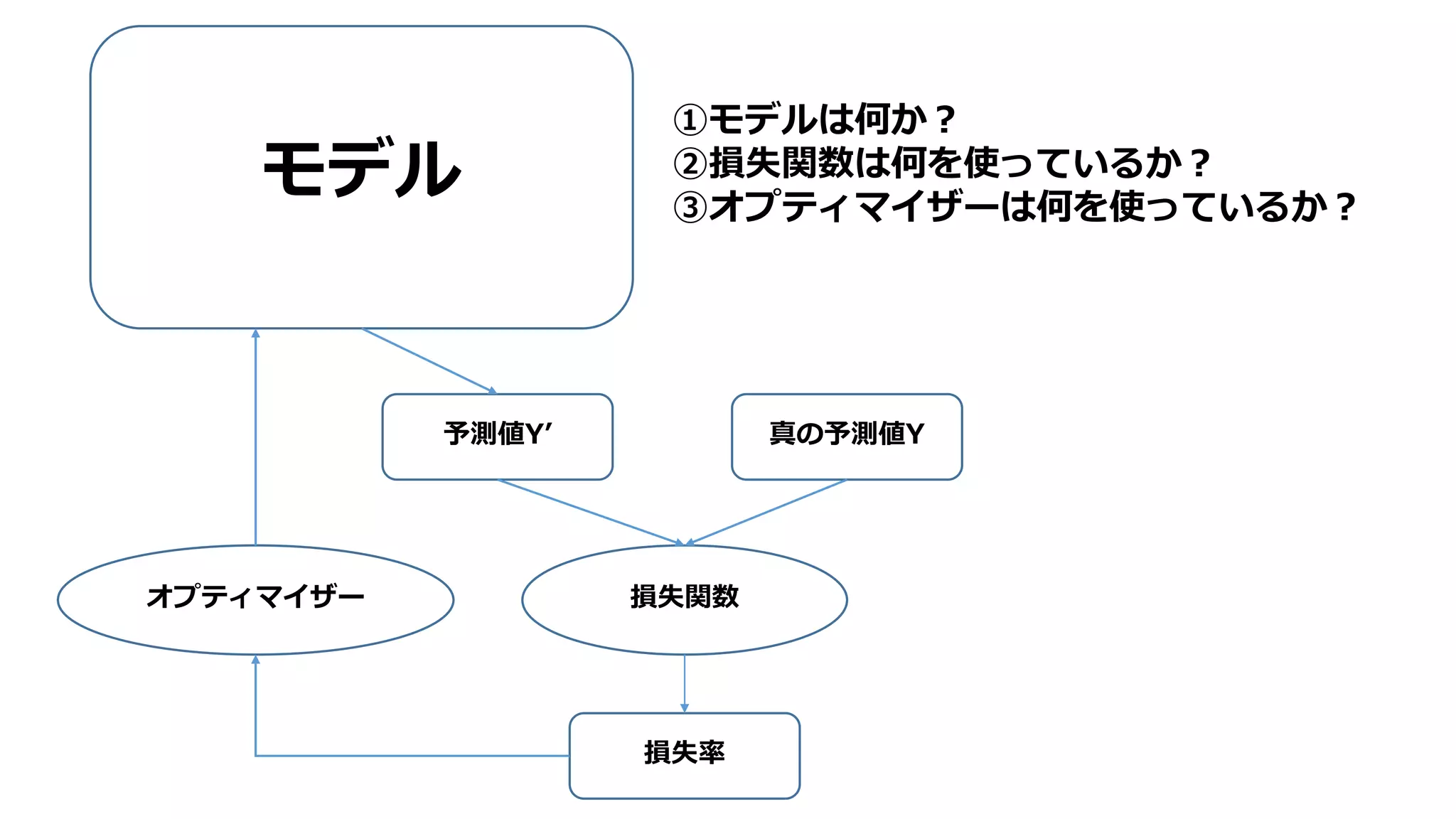
1. The model is a polynomial regression model that fits a polynomial function to the training data. 2. The loss function used is the sum of squares of the differences between the predicted and actual target values. 3. The optimizer used is GradientDescentOptimizer which minimizes the loss function to fit the model parameters.


