AI-Powered Drowsiness
Detection System
This presentation details the development of an AI-powered
drowsiness detection system. We explore the dataset used,
algorithm selection, project workflow, and results. The system
aims to improve road safety by detecting driver drowsiness in
real-time.
by Minal Fatyma
Dataset Composition
Public Data
YawDD (Yawning Detection
Dataset) provides a foundational
dataset.
Private Data
Self-collected video samples
augment the dataset with diverse
scenarios.
Dataset Size
107 videos (61 drowsy, 57 non-
drowsy), 4,202 frames (~300
frames per video).
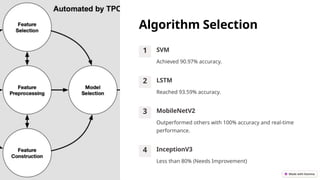
Algorithm Selection
1 SVM
Achieved 90.97% accuracy.
2 LSTM
Reached 93.59% accuracy.
3 MobileNetV2
Outperformed others with 100% accuracy and real-time
performance.
4 InceptionV3
Less than 80% (Needs Improvement)
Project Workflow
Data Collection
Gather public and private video samples.
Preprocessing
Extract frames and detect facial landmarks.
Feature Extraction
Identify signs of drowsiness.
Model Training
Train CNN/LSTM models for classification.
Real-Time Detection
Process live video and generate alerts.
Alert Mechanism
Timer-based alert system.
System Architecture
Laptop camera
captures video
input.
Face detection,
feature extraction,
model prediction.
Alert triggers if
drowsiness is
detected.
Monthly Timeline
1
Month 1
Literature review and data collection.
2 Month 2
Data preprocessing and model selection.
3
Month 3
Model training and testing.
4 Month 4
Real-time integration and evaluation.
5
Month 5
System optimization and report writing.
Results & Evaluation
Model Performance
Analyzed with accuracy, confusion matrix, and metrics.
Real-World Testing
System tested in diverse lighting and driving conditions.
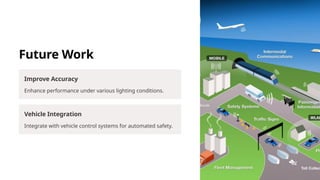
Future Work
Improve Accuracy
Enhance performance under various lighting conditions.
Vehicle Integration
Integrate with vehicle control systems for automated safety.
Conclusion
1 Summary
Drowsiness detection
reduces accidents.
2 Effectiveness
AI approach for real-
time monitoring is
effective.
3 Impact
Potential to save lives and improve road safety.
References & Q&A
Research papers, articles, and dataset sources used.
Any Questions?

AI-Powered-Drowsiness-Detection-System.pptx

  • 1.
    AI-Powered Drowsiness Detection System Thispresentation details the development of an AI-powered drowsiness detection system. We explore the dataset used, algorithm selection, project workflow, and results. The system aims to improve road safety by detecting driver drowsiness in real-time. by Minal Fatyma
  • 2.
    Dataset Composition Public Data YawDD(Yawning Detection Dataset) provides a foundational dataset. Private Data Self-collected video samples augment the dataset with diverse scenarios. Dataset Size 107 videos (61 drowsy, 57 non- drowsy), 4,202 frames (~300 frames per video).
  • 3.
    Algorithm Selection 1 SVM Achieved90.97% accuracy. 2 LSTM Reached 93.59% accuracy. 3 MobileNetV2 Outperformed others with 100% accuracy and real-time performance. 4 InceptionV3 Less than 80% (Needs Improvement)
  • 4.
    Project Workflow Data Collection Gatherpublic and private video samples. Preprocessing Extract frames and detect facial landmarks. Feature Extraction Identify signs of drowsiness. Model Training Train CNN/LSTM models for classification. Real-Time Detection Process live video and generate alerts. Alert Mechanism Timer-based alert system.
  • 5.
    System Architecture Laptop camera capturesvideo input. Face detection, feature extraction, model prediction. Alert triggers if drowsiness is detected.
  • 6.
    Monthly Timeline 1 Month 1 Literaturereview and data collection. 2 Month 2 Data preprocessing and model selection. 3 Month 3 Model training and testing. 4 Month 4 Real-time integration and evaluation. 5 Month 5 System optimization and report writing.
  • 7.
    Results & Evaluation ModelPerformance Analyzed with accuracy, confusion matrix, and metrics. Real-World Testing System tested in diverse lighting and driving conditions.
  • 8.
    Future Work Improve Accuracy Enhanceperformance under various lighting conditions. Vehicle Integration Integrate with vehicle control systems for automated safety.
  • 9.
    Conclusion 1 Summary Drowsiness detection reducesaccidents. 2 Effectiveness AI approach for real- time monitoring is effective. 3 Impact Potential to save lives and improve road safety.
  • 10.
    References & Q&A Researchpapers, articles, and dataset sources used. Any Questions?