


1
©	Copyright	Project10x	|	Confidential 2
• Lawrence	Mills	Davis	is	founder	and	managing	director	of	
Project10X,	a	research	consultancy	known	for	forward-looking	
industry	studies;	multi-company	innovation	and	market	
development	programs;	and	business	solution	strategy	
consulting.	Mills	brings	30	years	experience	as	an	industry	
analyst,	business	consultant,	computer	scientist,	and	
entrepreneur.	He	is	the	author	of	more	than	50	reports,	
whitepapers,	articles,	and	industry	studies.	
• Mills	researches	artificial	intelligence	technologies	and	their	
applications	across	industries,	including	cognitive	computing,	
machine	learning	(ML),	deep	learning	(DL),	predictive	analytics,	
symbolic	AI	reasoning,	expert	systems	(ES),	natural	language	
processing	(NLP),	conversational	UI,	intelligent	assistance	(IA),	
and	robotic	process	automation	(RPA),	and	autonomous	multi-
agent	systems.	
• For	clients	seeking	to	exploit	transformative	opportunities	
presented	by	the	rapidly	evolving	capabilities	of	artificial	
intelligence,	Mills	brings	a	depth	and	breadth	of	expertise	to	help	
leaders	realize	their	goals.	More	than	narrow	specialization,	he	
brings	perspective	that	combines	understanding	of	business,	
technology,	and	creativity.	Mills	fills	roles	that	include	industry	
research,	venture	development,	and	solution	envisioning.
Lawrence	Mills	Davis	
Managing	Director		
Project10X		
mdavis@project10x.com	
202-667-6400
©	Copyright	Project10x	|	Confidential
Direct competitors for Publicis.Sapient include digital agencies, consultants, IT services, which are providing AI
and cognitive platforms as a basis for custom solutions, products/services, and XaaS offerings to markets
addressed by Publicis.Sapient
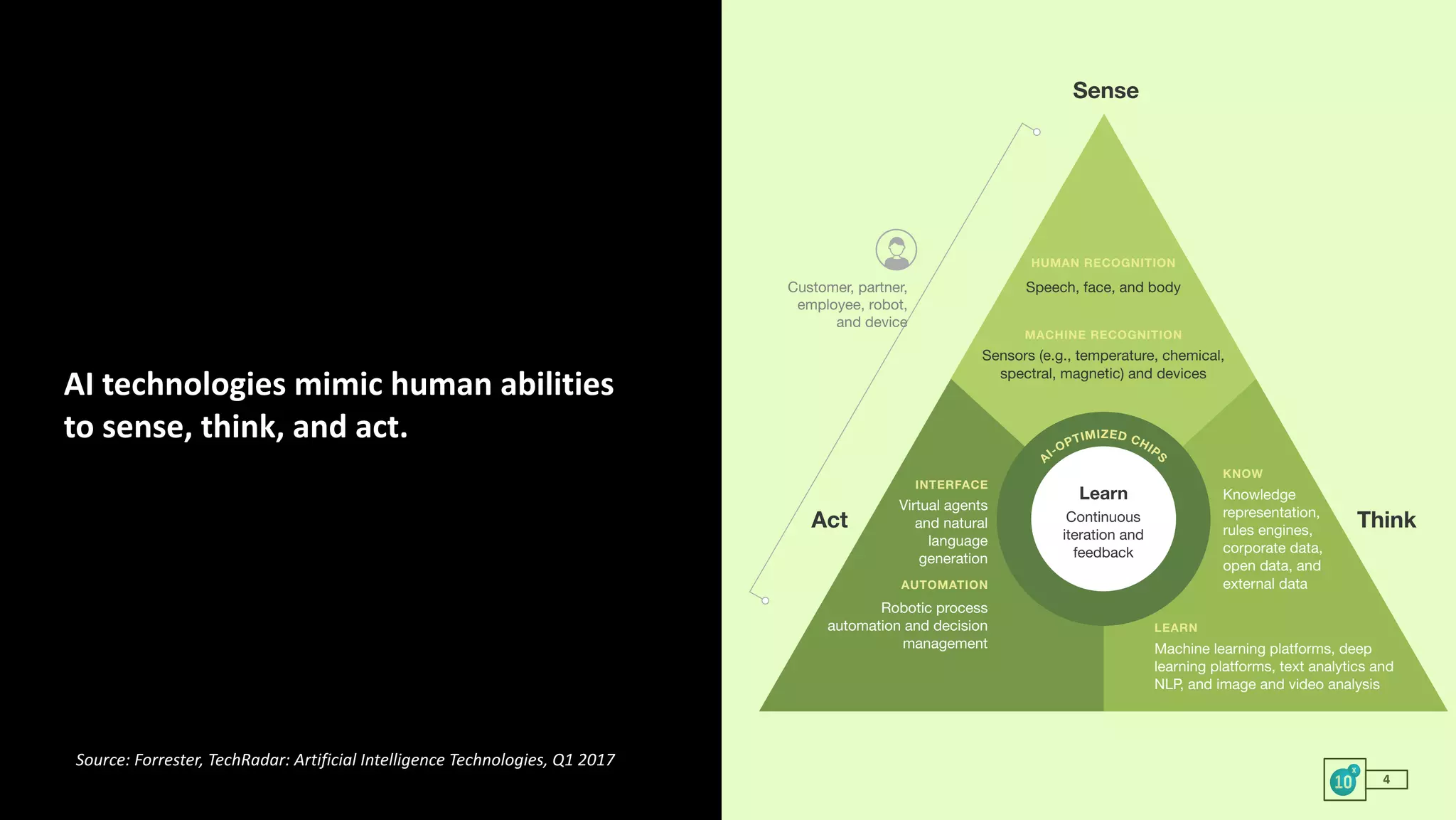
AI	encompasses	multiple	technologies	that	can	be	combined	to	
sense,	think,	and	act	as	well	as	to	learn	from	experience	and	
adapt	over	time.
SENSE	
Computer	vision,	audio	and	
affective	processing	aim	to	
actively	perceive	the	world	
around	them	by	acquiring	and	
processing	images,	sounds,	
speech,	biometrics,	and	other	
sensory	inputs.	One	example	is	
identity	analytics	for	facial	
recognition.	Lie	detection	is	
another.
THINK	
Natural	language	processing	
and	inference	engines	enable	
AI	systems	to	analyze,	
interpret,	and	understand	
information.	One	example	is	
speech	analytics	and	language	
translation	of	search	engine	
results.	Another	is	
interpretation	of	user	intent	by	
virtual	assistants..
ACT	
AI	systems	take	action	in	digital	
or	physical	worlds	using	
machine	learning,	expert	
systems	and	inference	engines.	
Recommendation	systems	are	
one	example.	Another	is	auto-
pilot	and	assisted-braking	
capabilities	in	cars.	Cognitive	
robotics	is	another.
©	Copyright	Project10x	|	Confidential
3
©	Copyright	Project10x	|	Confidential 4
AI	technologies	mimic	human	abilities	
to	sense,	think,	and	act.
Source:	Forrester,	TechRadar:	Artificial	Intelligence	Technologies,	Q1	2017
A
I-OPTIMIZED CHIPS
Think
Learn
Sense
Act Continuous
iteration and
feedback
HUMAN RECOGNITION
Speech, face, and body
Sensors (e.g., temperature, chemical,
spectral, magnetic) and devices
MACHINE RECOGNITION
Knowledge
representation,
rules engines,
corporate data,
open data, and
external data
KNOW
Virtual agents
and natural
language
generation
INTERFACE
Machine learning platforms, deep
learning platforms, text analytics and
NLP, and image and video analysis
LEARN
Robotic process
automation and decision
management
AUTOMATION
Customer, partner,
employee, robot,
and device
©	Copyright	Project10x	|	Confidential 5
Standard	Automation Intelligent	Automation
Systems	
that	do
Systems	
that	think
Systems	
that	learn
Robotic Process
Automation
Data Collection/
Data Preparation
Speech, Video &
Image Recognition
Predictive
APIs
Natural
Language
Processing
IT Process
Automation
Deep
Learning
Artificial
Intelligence
IoT & Smart
Devices
Emotional
Recognition
Cognitive
Computing
Machine
Learning
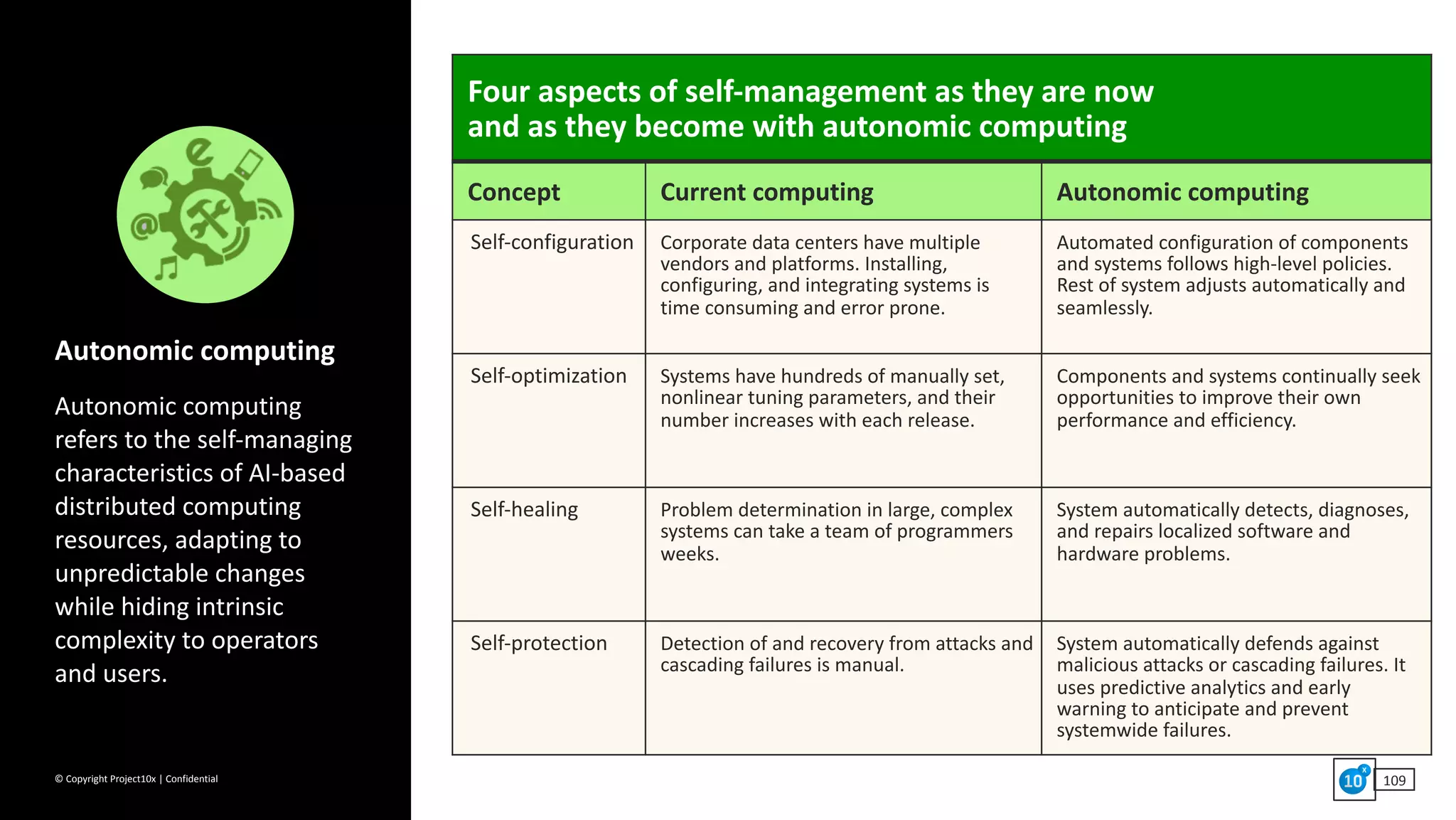
Autonomic
Computing
AI	systems	learn,	think,	
and	automate	doing
AI: SENSE
©	Copyright	Project10x	|	Confidential
• Pattern	recognition	
• Machine	perception	
• Speech	recognition	
• Computer	vision	
• Affective	computing
Overview	of

AI:	Sense
7
©	Copyright	Project10x	|	Confidential
Pattern recognition
8
PaGern	recogniHon	involves	techniques	to	dis`nguish	
signal	from	noise	through	sta`s`cal	analyses,	Bayesian	
analysis,	classifica`on,	cluster	analysis,	and	analysis	of	
texture	and	edges.	Pacern	recogni`on	techniques	
apply	to	sensors,	data,	imagery,	sound,	speech,	
language.	
Automated	classificaHon	tools	dis`nguish,	
characterize	and	categorize	data	based	on	a	set	of	
observed	features.		For	example,	one	might	determine	
whether	a	par`cular	mushroom	is	“poisonous”	or	
“edible”	based	on	its	color,	size,	and	gill	size.		
Classifiers	can	be	trained	automa`cally	from	a	set	of	
examples	through	supervised	learning.	Classifica`on	
rules	discriminate	between	different	contents	of	a	
document	or	par``ons	of	a	database	based	on	various	
acributes	within	the	repository.		
StaHsHcal	learning	techniques	construct	quan`ta`ve	
models	of	an	en`ty	based	on	surface	features	drawn	
from	a	large	corpus	of	examples.	In	the	domain	of	
natural	language,	for	example,	sta`s`cs	of	language	
usage	(e.g.,	word	trigram	frequencies)	are	compiled	
from	large	collec`ons	of	input	documents	and	are	
used	to	categorize	or	make	predic`ons	about	new	
text.		
Sta`s`cal	techniques	can	have	high	precision	within	a	
domain	at	the	cost	of	generality	across	domains.	
Systems	trained	through	sta`s`cal	learning	do	not	
require	human-engineered	domain	modeling.	
However,	they	require	access	to	large	corpora	of	
examples	and	a	retraining	step	for	each	new	domain	
of	interest.				
Source: Gary Larson
Source: Barbara Catania and Anna Maddalena
©	Copyright	Project10x	|	Confidential 9
Machine	perception		
Enterprises	are	adopting	biometrics	based	

AI	solutions	to	determine:		
• Identity	and	authentication	—	Sensor	processing	
and	biometrics	for	retinal	scanning,	fingerprint	
scanning,	facial	recognition,	voice	recognition,	
signature	verification.	
• Sentiment	and	emotion	—	sonic	analytics,	facial	
expressions,	text	analytics,	gesture	analytics	and	
body	language	
• Veracity	—	biometric	sensors	(temperature,	
moisture,	heart	rate,	etc.),	sonic	analytics,	facial	
expressions,	text	analytics,	gesture	analytics	and	
body	language.
©	Copyright	Project10x	|	Confidential
©	Copyright	Project10x	|	Confidential 10
• Cybersecurity	is	the	body	of	technologies,	processes	and	practices	designed	
to	protect	networks,	computers,	programs	and	data	from	attack,	damage	
or	unauthorized	access.	
• User	security	is	shifting	from	reliance	on	usernames,	passwords	and	
security	questions	to	incorporate	biometric	factors	including	voice	
recognition,	facial	recognition,	iris	recognition,	fingerprints	and	other	
biometric	data.		
• Biometric	security	incorporates	AI	techniques	for	pattern	recognition	and	
anomaly	detection.	
• Facial	recognition	technology	is	already	a	big	business;	it’s	being	used	to	
measure	the	effectiveness	of	store	displays,	spot	cheaters	in	casinos,	and	
tailor	digital	ads	to	those	passing	by.	
• Cognitive	security	analytics	provide	capabilities	for	predicting	and	assessing	
threats,	recommending	best	practices	for	system	configuration,	automating	
defenses,	and	orchestrating	resilient	response.
AI	machine	perception	
for	user	security	is	
incorporating	biometric	
factors.
©	Copyright	Project10x	|	Confidential
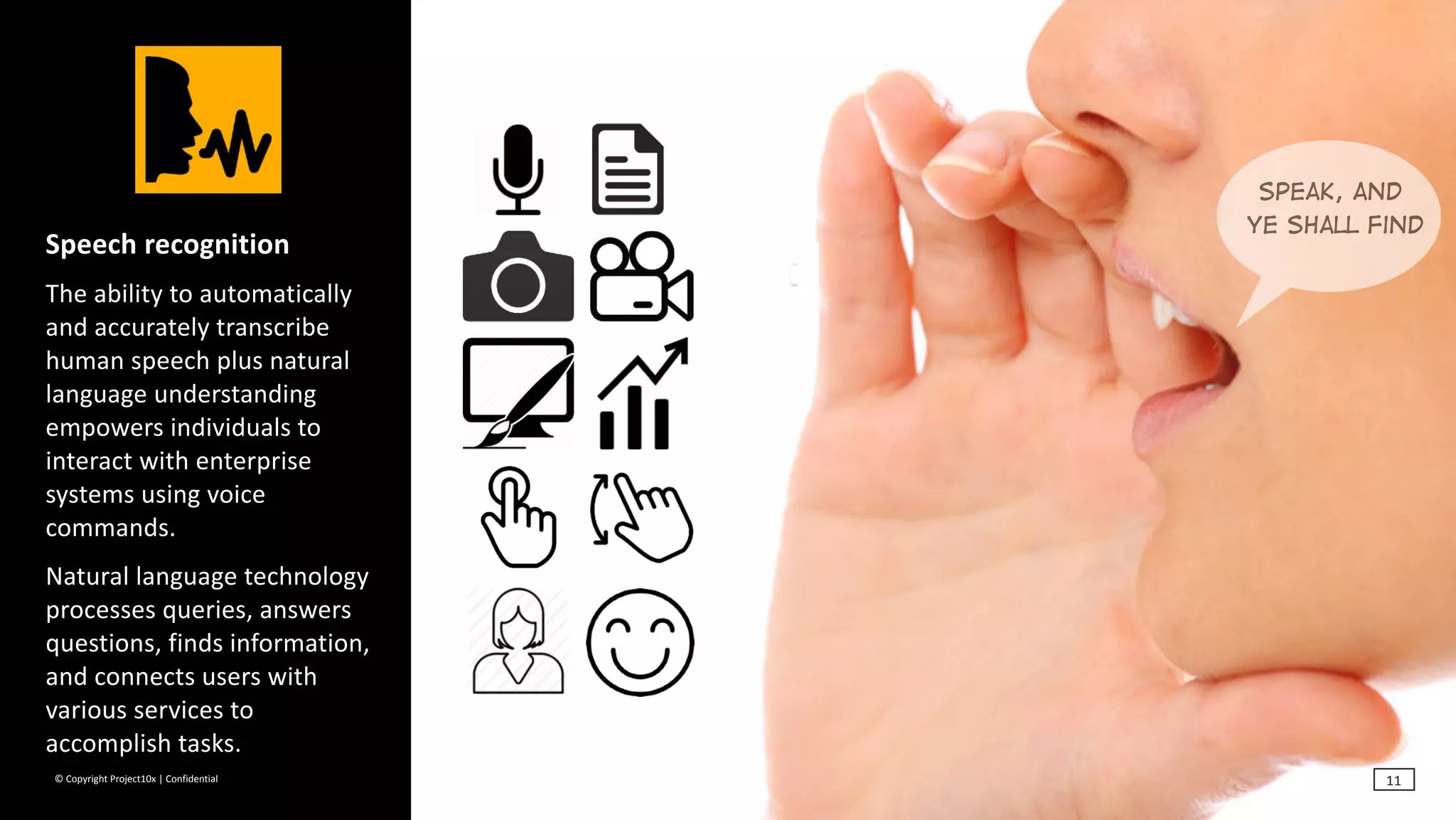
Speech	recognition	
The	ability	to	automatically	
and	accurately	transcribe	
human	speech	plus	natural	
language	understanding	
empowers	individuals	to	
interact	with	enterprise	
systems	using	voice	
commands.		
Natural	language	technology	
processes	queries,	answers	
questions,	finds	information,	
and	connects	users	with	
various	services	to	
accomplish	tasks.
Speak, and
ye shall find
11
©	Copyright	Project10x	|	Confidential
Evolution	of	speech	technologies
12
Speaker
dependent
Automatic Speech Recognition
Natural Language Understanding
Text-to-Speech
ASR
NLU
TTS
Speaker
independent
Rules based
grammars
Statistical
grammars
Cloud
ASR
Deep neural
networks
Deep neural networksCloud NLUStatistical NLU
Format based
TTS
Concatenated
TTS
Rules based
TTS
Cloud
TTS
Statistical
TTS models
Deep neural
networks
Source: Nuance
©	Copyright	Project10x	|	Confidential 13
Voice	application	
development
Text NL
Semantics
ASR
Language
Understanding
Context
Interpretation
Grammar and semantic tags
Voice application
developer
©	Copyright	Project10x	|	Confidential 14
Computer	vision	
• 	The	ability	of	computers	to	iden`fy	objects,	scenes,	
and	ac`vi`es	in	unconstrained	(that	is,	naturalis`c)	
visual	environments.	
• Computer	vision	has	been	transformed	by	the	rise	of	
deep	learning.		
• The	confluence	of	large-scale	computing,	especially	
on	GPUs,	the	availability	of	large	datasets,	especially	
via	the	internet,	and	refinements	of	neural	network	
algorithms	has	led	to	dramatic	improvements.		
• Computers	are	able	to	perform	some	(narrowly	
defined)	visual	classification	tasks	better	than	
people.	A	current	research	focus	is	automatic	image	
and	video	captioning.
©	Copyright	Project10x	|	Confidential
Image	annotation	

and	captioning	using

deep	learning
a man riding a motorcycle 

on a city street
a plate of food with

meat and vegetables
15
©	Copyright	Project10x	|	Confidential
Does My ai really
understand what
he feels and 

what he is 

saying to 

me?
Affective	computing	
• Detecting	emotions	from	videos,	audio,	text,	
facial	expressions	and	gestures	is	a	growth	
market	and	important	part	of	future	cognitive	
systems.	
• Audio	and	video	analytics	for	interpreting	
sentiment,	emotion	and	veracity
©	Copyright	Project10x	|	Confidential 16
©	Copyright	Project10x	|	Confidential
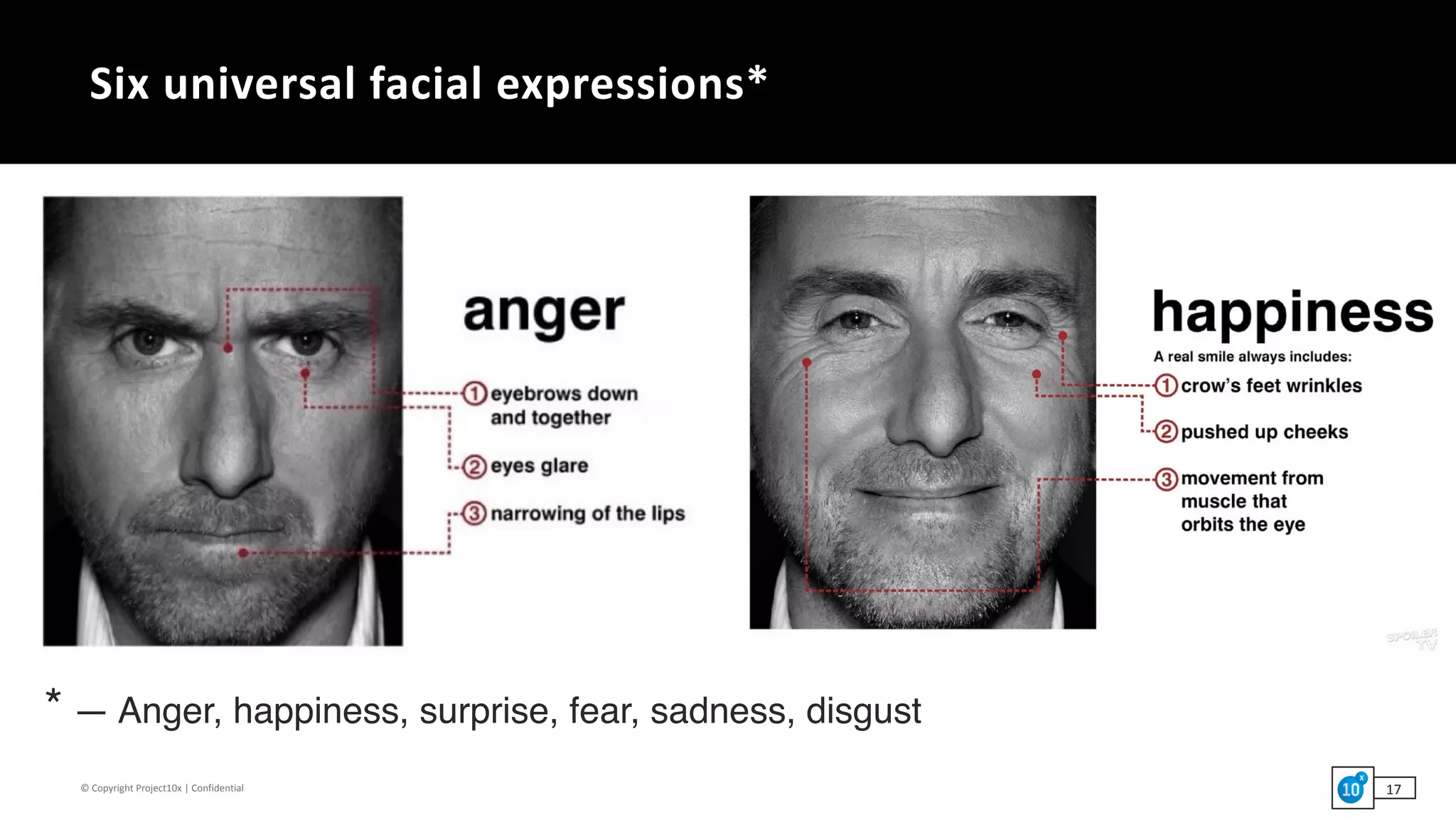
Six	universal	facial	expressions*
* — Anger, happiness, surprise, fear, sadness, disgust
17
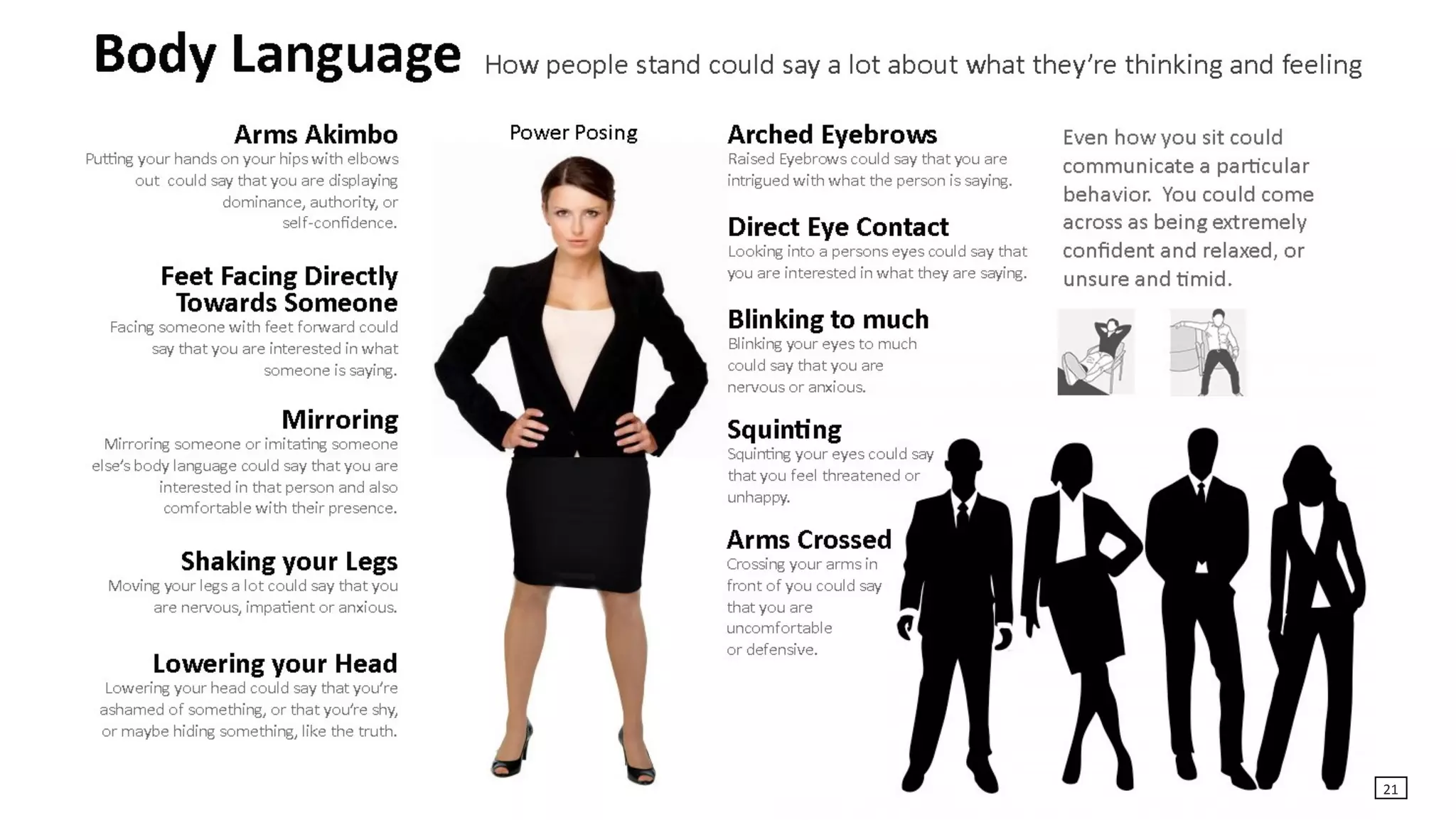
To	analyze	someone’s	facial	expressions,	body	temperature,	etc.	to	determine	
what	that	person	is	feeling,	whether	they	are	lying	or	not,	what	their	gestures	
and	body	language	are,	etc…	
Who	are	some	of	the	players	and	what	are	their	top	offerings?
18
©	Copyright	Project10x	|	Confidential
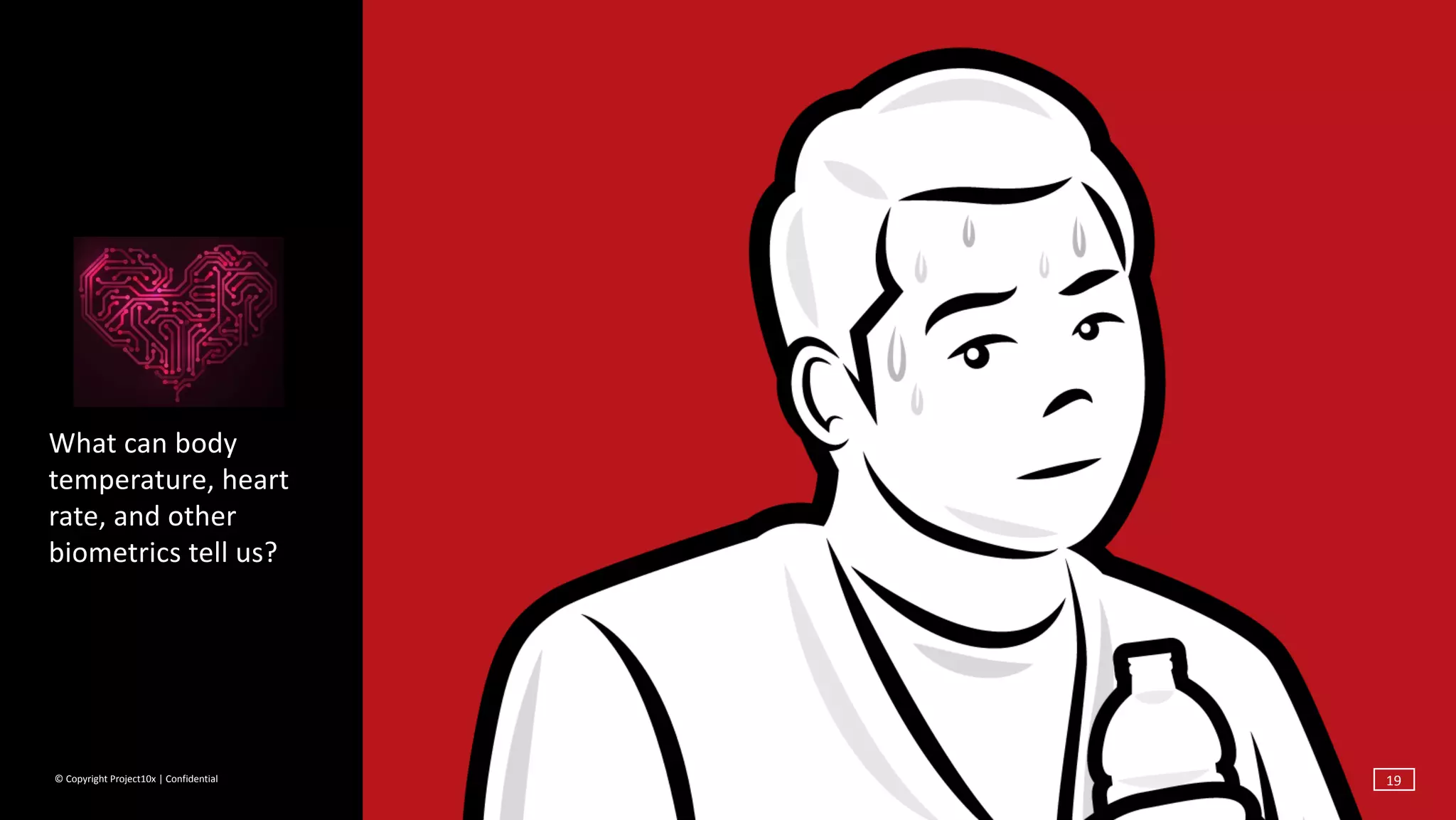
What	can	body	
temperature,	heart	
rate,	and	other	
biometrics	tell	us?
19
©	Copyright	Project10x	|	Confidential
Can	you	tell	when	
someone	is	lying	
by	reading	their	
facial	expressions?
20
To	analyze	someone’s	facial	expressions,	body	temperature,	etc.	to	determine	
what	that	person	is	feeling,	whether	they	are	lying	or	not,	what	their	gestures	
and	body	language	are,	etc…	
Who	are	some	of	the	players	and	what	are	their	top	offerings?
©	Copyright	Project10x	|	Confidential 21
©	Copyright	Project10x	|	Confidential
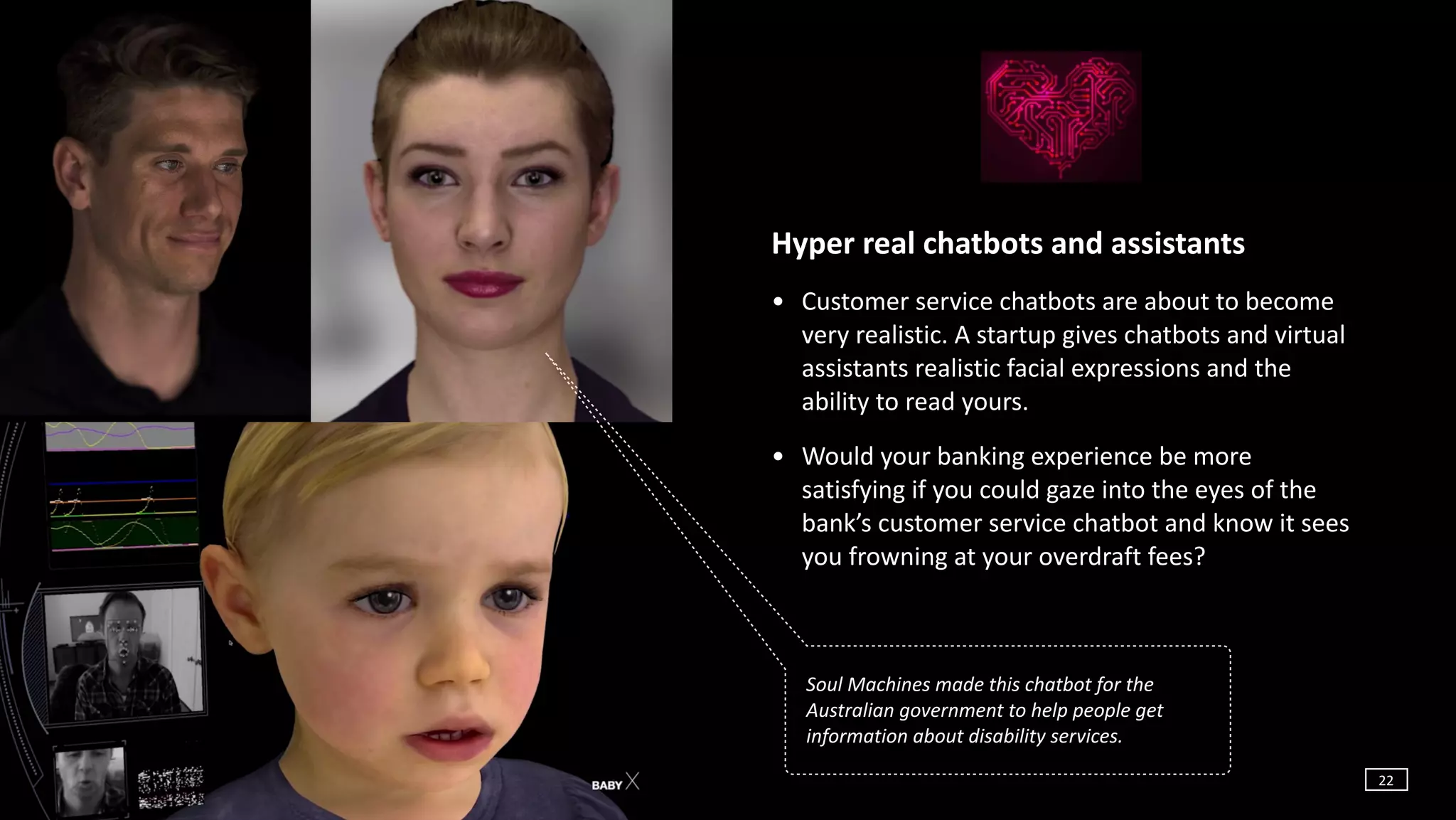
Hyper	real	chatbots	and	assistants	
• Customer	service	chatbots	are	about	to	become	
very	realistic.	A	startup	gives	chatbots	and	virtual	
assistants	realistic	facial	expressions	and	the	
ability	to	read	yours.		
• Would	your	banking	experience	be	more	
satisfying	if	you	could	gaze	into	the	eyes	of	the	
bank’s	customer	service	chatbot	and	know	it	sees	
you	frowning	at	your	overdraft	fees?	
Soul	Machines	made	this	chatbot	for	the	
Australian	government	to	help	people	get	
information	about	disability	services.
22
©	Copyright	Project10x	|	Confidential
Selected	vendors*	by	category	of	machine	perception	analytics
AI Platforms
with APIs for 

Image & Text
• Apple (Emotient)
• Facebook
• Google
• IBM
• Microsoft
Facial
Analytics
• Affectiva
• Clarifai
• CrowdEmotion
• Eyeris/EmoVu
• Faciometrics
• Imotions
• Kairos
• Noldus
• nViso
• RealEyes
• Sightcorp/
Sonic
Analytics
• BeyondVerbal
• EMO Speech
• Nemesysco
• NICE
• Verint
• Vokaturi
Gesture
Analytics
• GRT—Gesture
Recognition
Toolkit
Text 

Analytics
• Clarabridge
• Crimson
Hexagon
• IBM Alchemy API
• Indico
• Receptiviti
Document

Image Analytics
• Cvision
• Parascript
• Signotec
• Topaz Systems
23
* See sections 06 and 07 of this research deck.
AI: THINK
©	Copyright	Project10x	|	Confidential 25
• Machine	learning	
• Deep	learning	
• Natural	language	processing	
• Knowledge	representation		
• Reasoning	
• Cognitive	computing	
• What	today’s	AI	technology	can	and	cannot	do
Overview	of

AI:	Think
©	Copyright	Project10x	|	Confidential
Machine	learning	
• Machine	learning	is	a	type	of	AI	that	involves	using	
computerized	mathema`cal	algorithms	that	can	
learn	from	data	and	can	depart	from	strictly	
following	rule-based,	pre-programmed	logic.		
• Machine	learning	algorithms	build	a	probabilis`c	
model	and	then	use	it	to	make	assump`ons	and	
predic`ons	about	similar	data	sets	
• Machine	Learning	runs	at	machine	scale:	it	is	data	
driven	and	suited	to	the	complexity	of	dealing	with	
disparate	data	sources	and	the	huge	variety	of	
variables	and	amounts	of	data	involved.		
• Unlike	for	tradi`onal	analysis,	the	more	data	fed	to	a	
machine	learning	system,	the	more	it	can	learn,	
resul`ng	in	higher	quality	insights.
26©	Copyright	Project10x	|	Confidential
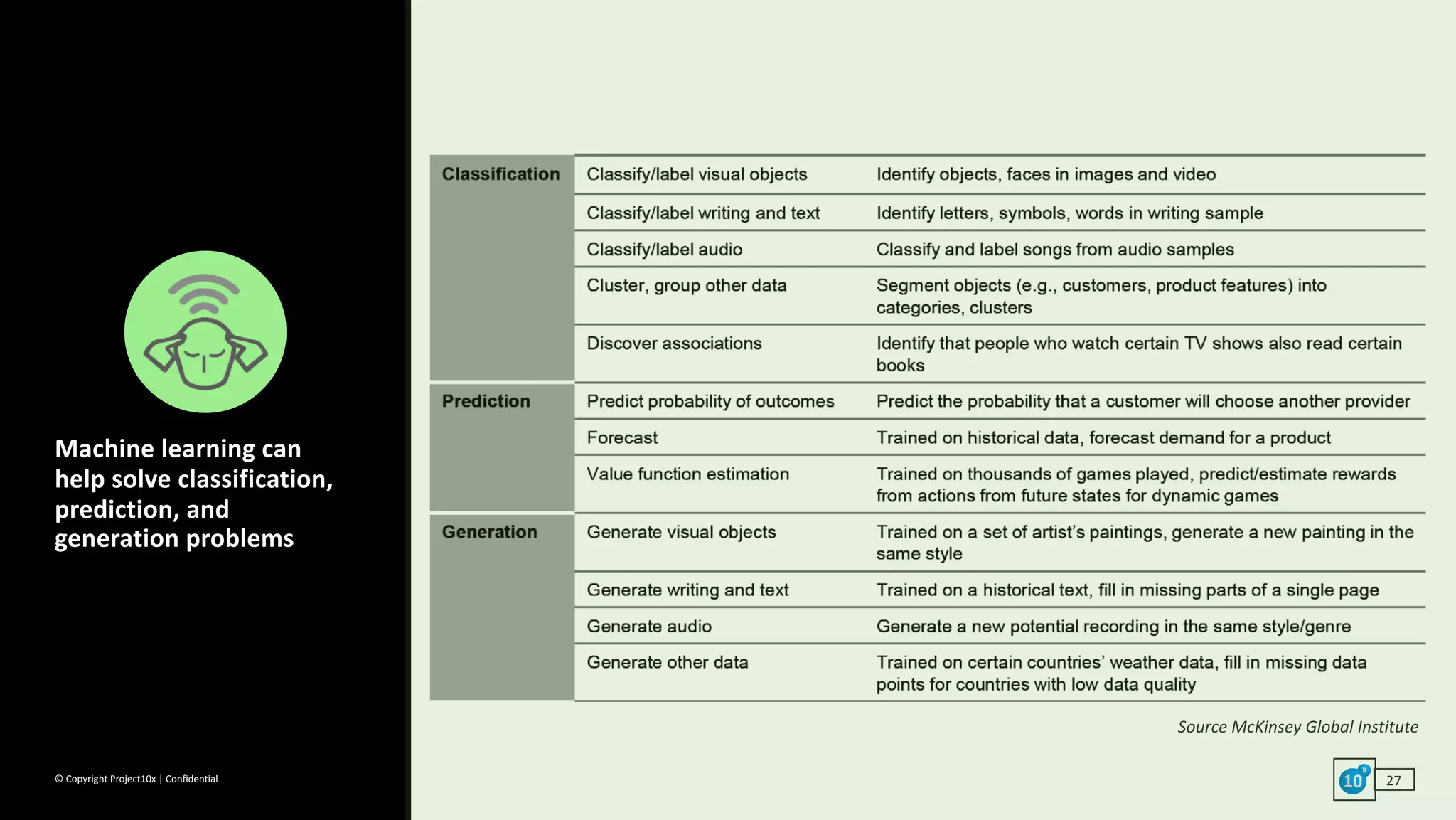
©	Copyright	Project10x	|	Confidential 27
Machine	learning	can	
help	solve	classification,	
prediction,	and	
generation	problems
Source	McKinsey	Global	Institute
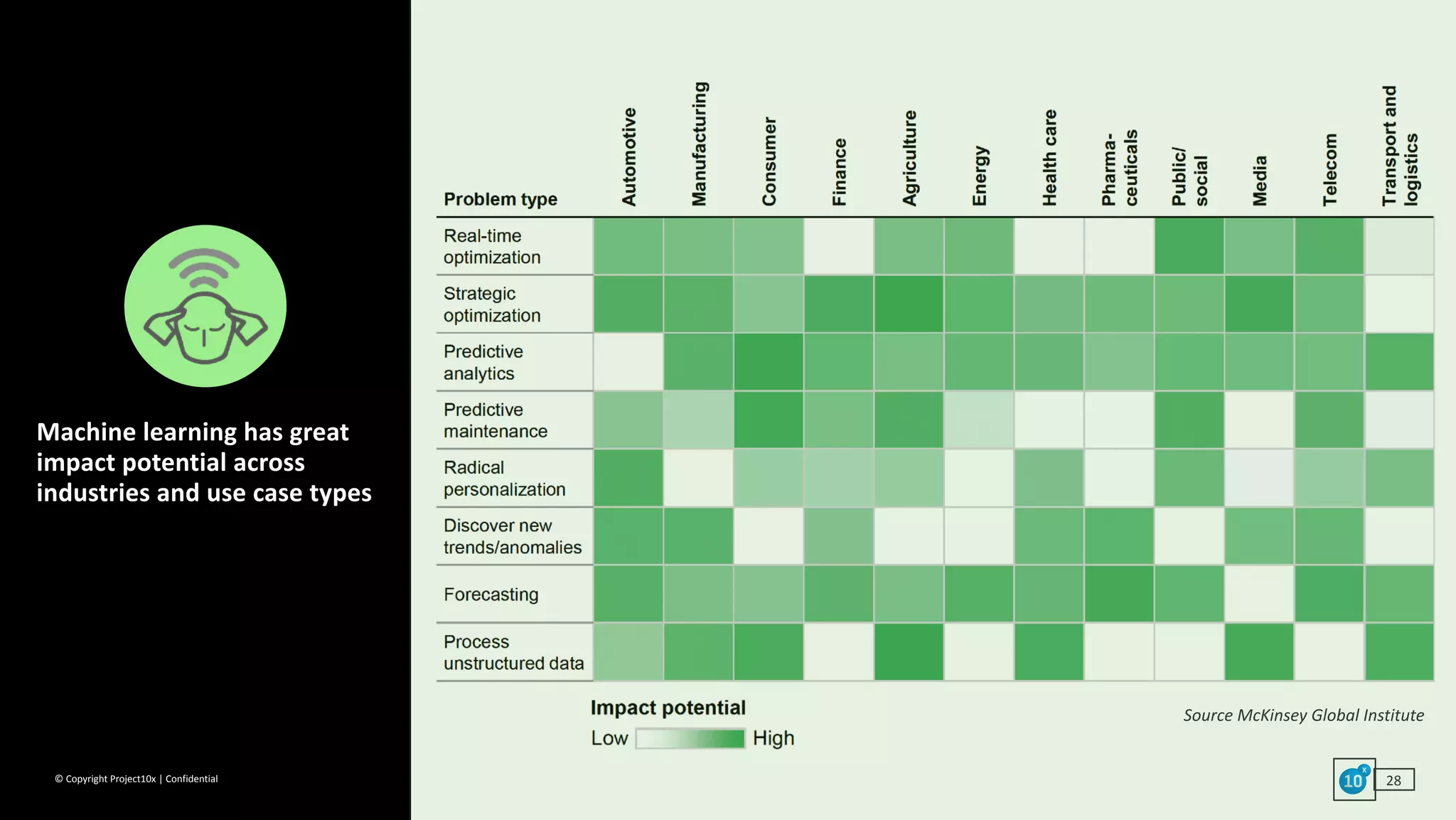
©	Copyright	Project10x	|	Confidential 28
Machine	learning	has	great	
impact	potential	across	
industries	and	use	case	types
Source	McKinsey	Global	Institute
©	Copyright	Project10x	|	Confidential 29
Types	of	machine	learning
©	Copyright	Project10x	|	Confidential
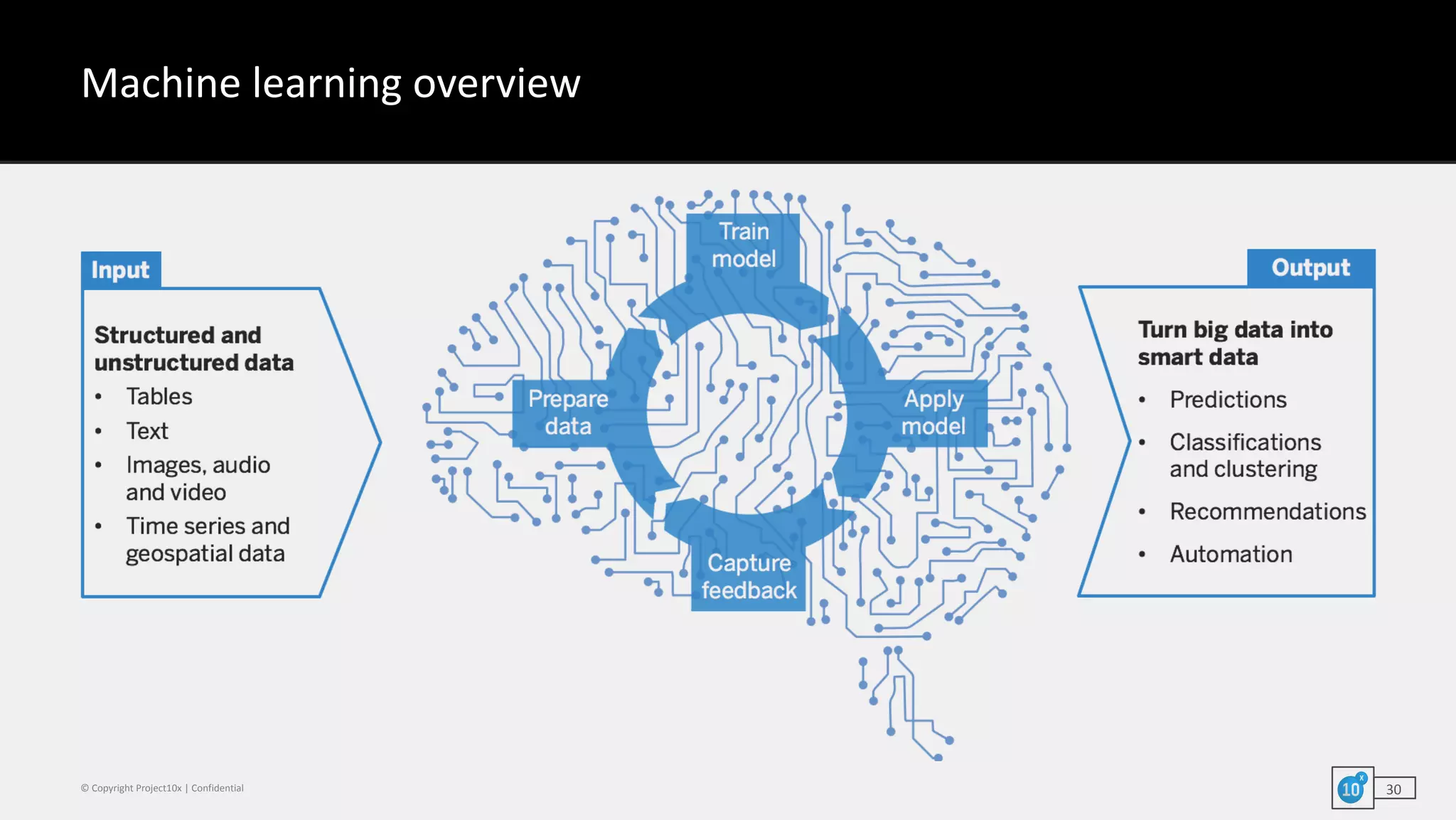
Machine	learning	overview
30
©	Copyright	Project10x	|	Confidential
Types	of	machine	learning	and	categories	of	algorithms
31
Type	of	machine	learning
Target	variable
Type	of	algorithm
Sample	application
©	Copyright	Project10x	|	Confidential
Clustering
32
Clustering	is	the	process	of	organizing	objects	into	groups	whose	
members	are	similar	in	some	way.	
Clustering	is	an	approach	to	learning	that	seeks	to	place	objects	into	
meaningful	groups	automa`cally	based	on	their	similarity.		Document	
clustering	techniques	iden`fy	topics	and	group	documents	into	
meaningful	classes.		
Clustering,	unlike	classifica`on	does	not	require	the	categories	to	be	
predefined	with	the	hope	that	the	algorithm	will	determine	useful	but	
hidden	groupings	of	data	points.		The	hope	in	applying	clustering	
algorithms	is	that	they	will	discover	useful	but	unknown	classes	of	items.
©	Copyright	Project10x	|	Confidential
Outlier	Detection
• Iden`fying	excep`ons	or	rare	events	can	osen	
lead	to	the	discovery	of	unexpected	knowledge.	

Outlier	detec`on	is	used	to	iden`fy	anomalous	
situa`ons.	
• Anomalies	may	be	hard-to-find	needles	in	a	
haystack,	but	may	nonetheless	represent	high	
value	when	they	are	found	(or	costs	if	they	are	
not	found).	Typical	applica`ons	include	fraud	
detec`on,	iden`fying	network	intrusion,	faults	in	
a	manufacturing	processes,	clinical	trials,	vo`ng	
ac`vi`es	and	criminal	ac`vi`es	in	E-commerce.	
• Applying	machine	learning	to	outlier	detec`on	
problems	brings	new	insight	and	becer	
detec`on	of	outlier	events.	Machine	learning	
can	take	into	account	many	disparate	sources	of	
data	and	find	correla`ons	that	are	too	obscure	
for	human	analysis	to	iden`fy.	
• Take	the	example	of	credit	card	fraud:	with	
machine	learning	online	behavior	(web	site	
browsing	history)	of	the	purchaser	becomes	a	
part	of	the	fraud	detec`on	algorithm	–	rather	
than	simply	considering	the	history	of	purchases	
made	by	the	card	holder.	This	involves	analyzing	
huge	amounts	of	data,	but	it	also	is	a	far	more	
robust	approach	to	E-commerce	fraud	detec`on.
©	Copyright	Project10x	|	Confidential 33
©	Copyright	Project10x	|	Confidential
Machine	learning	flow	—	training	and	prediction
34
©	Copyright	Project10x	|	Confidential
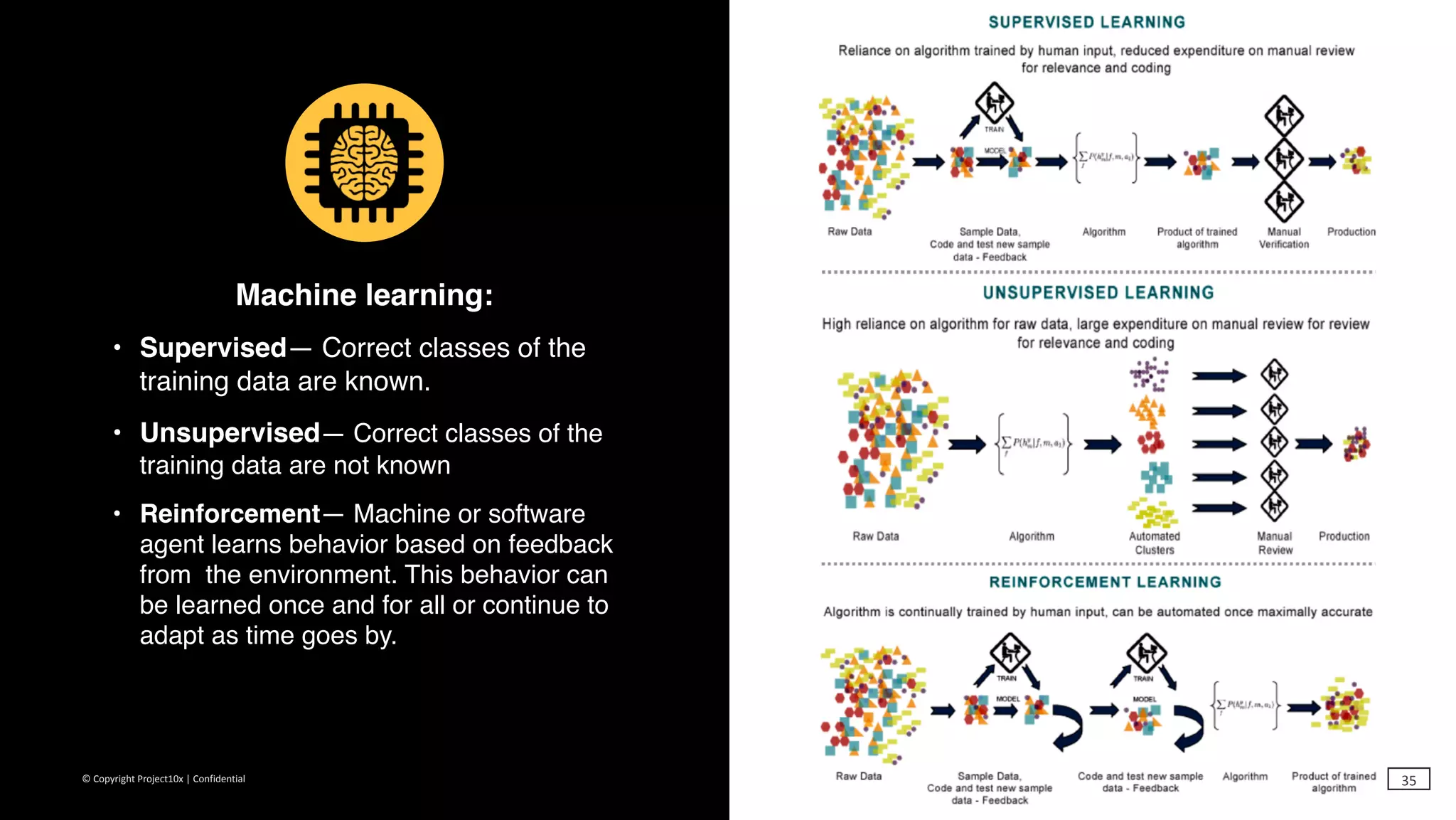
Machine learning:
• Supervised— Correct classes of the
training data are known.
• Unsupervised— Correct classes of the
training data are not known
• Reinforcement— Machine or software
agent learns behavior based on feedback
from the environment. This behavior can
be learned once and for all or continue to
adapt as time goes by.
35
©	Copyright	Project10x	|	Confidential
Deep	learning	
A	class	of	machine	learning	algorithms	that:	
• Use	a	cascade	of	many	layers	of	nonlinear	processing	
units	for	feature	extrac`on	and	transforma`on.	
Successive	layer	use	the	output	from	the	previous	
layer	as	input.	Algorithms	may	be	supervised	or	
unsupervised.	Applica`ons	include	pacern	analysis	
(unsupervised)	and	classifica`on	(supervised).	
• Are	based	on	(unsupervised)	learning	of	mul`ple	
levels	of	features	or	representa`ons	of	the	data.	
Higher	level	features	are	derived	from	lower	level	
features	to	form	a	hierarchical	representa`on.	
• Learn	mul`ple	levels	of	representa`ons	that	
correspond	to	different	levels	of	abstrac`on;	the	
levels	form	a	hierarchy	of	concepts.
36©	Copyright	Project10x	|	Confidential
©	Copyright	Project10x	|	Confidential
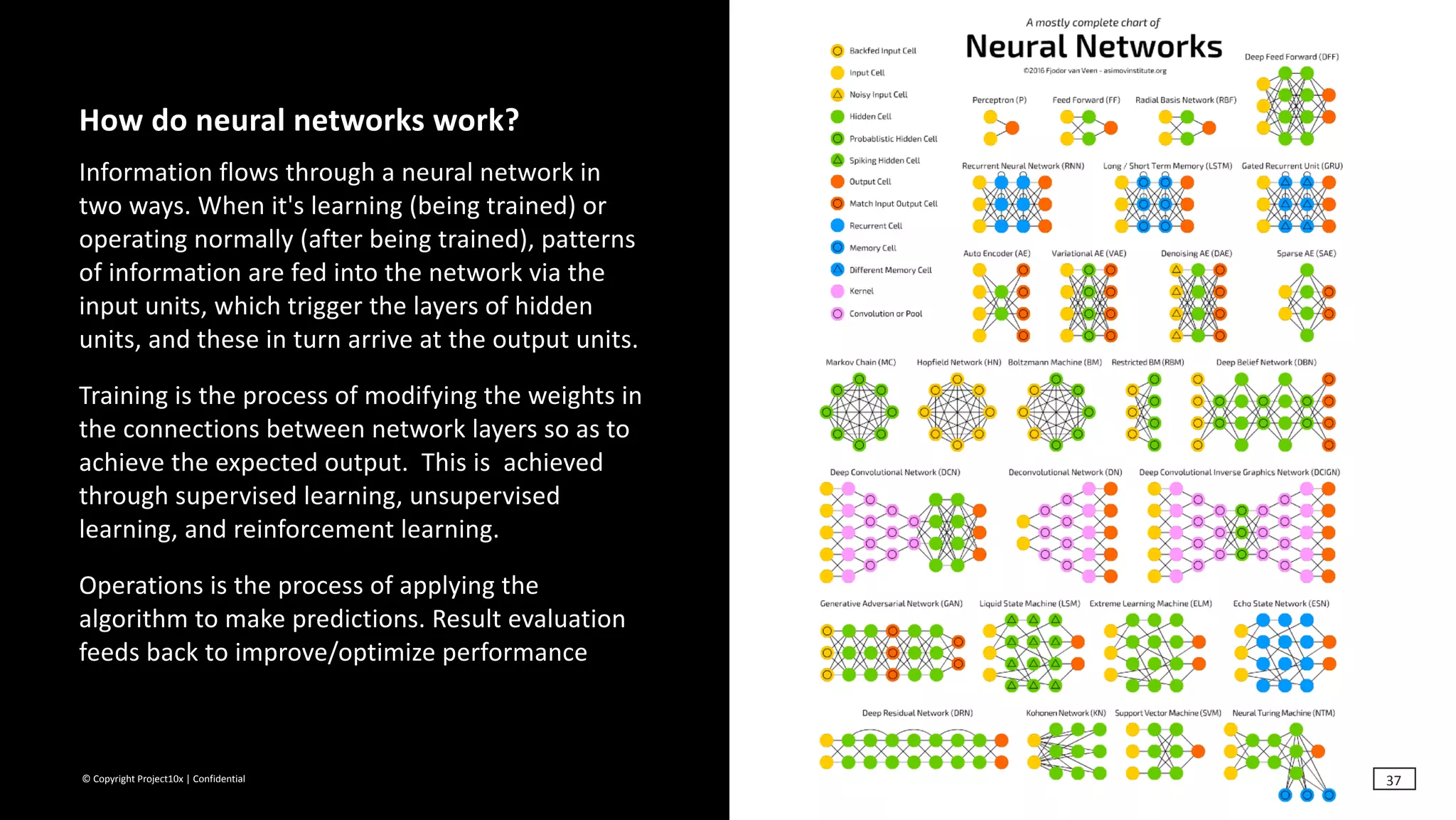
Types	of	Neural	Networks
How	do	neural	networks	work?	
Information	flows	through	a	neural	network	in	
two	ways.	When	it's	learning	(being	trained)	or	
operating	normally	(after	being	trained),	patterns	
of	information	are	fed	into	the	network	via	the	
input	units,	which	trigger	the	layers	of	hidden	
units,	and	these	in	turn	arrive	at	the	output	units.	
Training	is	the	process	of	modifying	the	weights	in	
the	connections	between	network	layers	so	as	to	
achieve	the	expected	output.		This	is		achieved	
through	supervised	learning,	unsupervised	
learning,	and	reinforcement	learning.	
Operations	is	the	process	of	applying	the	
algorithm	to	make	predictions.	Result	evaluation	
feeds	back	to	improve/optimize	performance
37
©	Copyright	Project10x	|	Confidential
Master	algorithm	—	towards	a	synthesis	of	five	approaches	to	machine	learning
TRIBE ORIGINS PROBLEM REPRESENTATION EVALUATION OPTIMIZATION
MASTER	
ALGORITHM
Symbolists
Logic,	
philosophy
Knowledge	
composition
Logic Accuracy
Inverse	
deduction
Inductive	logic	
programming
Connectionists Neuroscience
Credit	
assignment
Neural	networks Squared	error
Gradient	
descent
Back	
propagation
Evolutionaries
Evolutionary	
biology
Structure	
discovery
Genetic	programs Fitness Genetic	search
Genetic	
programming
Bayesians Statistics Uncertainty Graphical	models
Posterior	
probability
Bayesian	
optimization
Probabilistic	
inference
Analogizers Psychology Similarity Support	vectors Margin
Constrained	
optimization
Kernel	machines
Source:	Pedro	Domingos
38
©	Copyright	Project10x	|	Confidential
Natural	language	processing
39©	Copyright	Project10x	|	Confidential
©	Copyright	Project10x	|	Confidential
This	research	deck	précis	information	
from	the	Forrester	Digital	
Transformation	Conference	in	May	
2017.	It	compiles	selected	copy	and	
visuals	from	conference	presentations	
and	recent	Forrester	research	reports.	
Contents	are	organized	into	the	
following	sections:	
• Digital	transfor
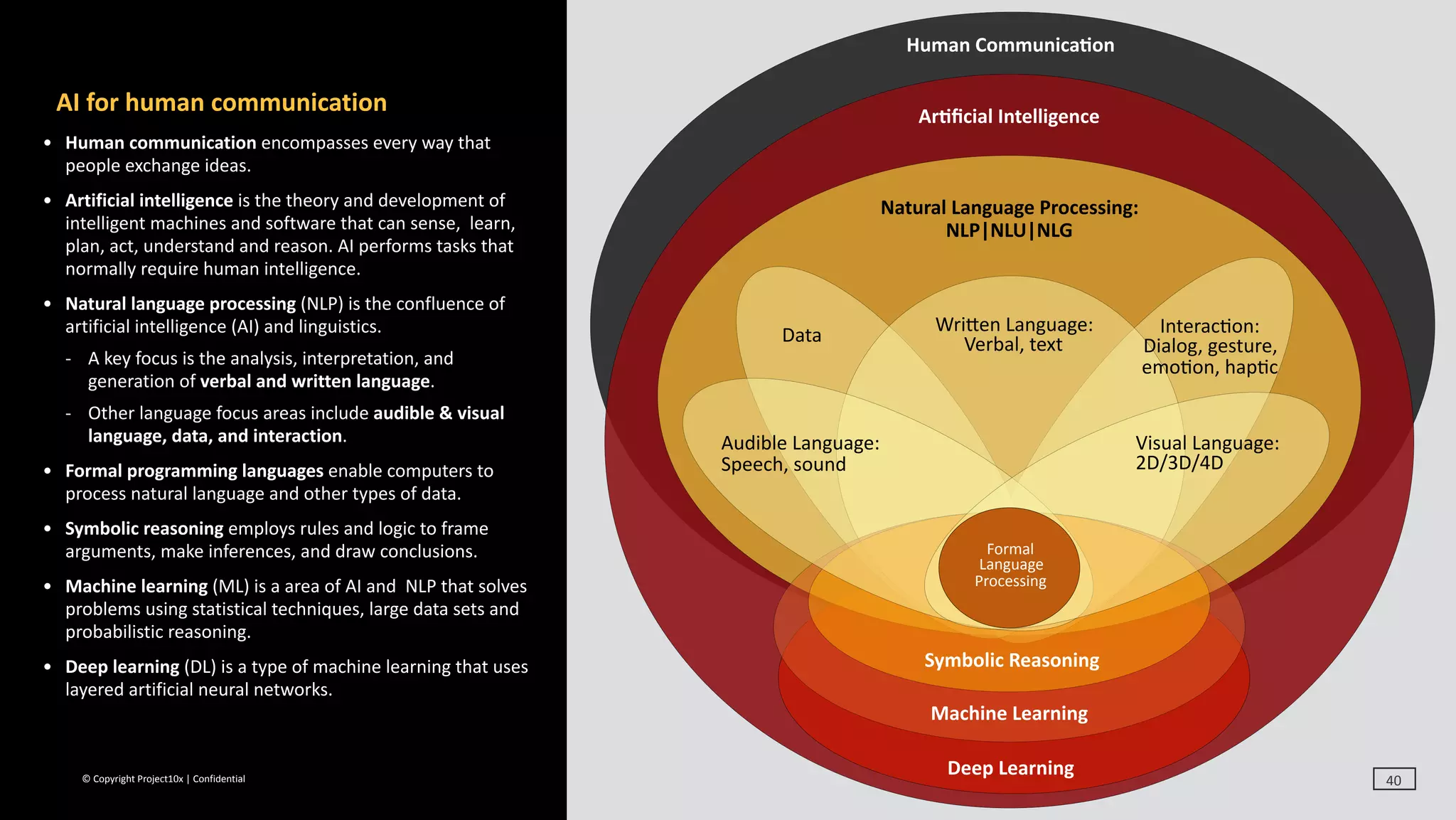
Machine	Learning
Human	CommunicaHon
ArHficial	Intelligence
Natural	Language	Processing:	
NLP|NLU|NLG
Interac`on:	
Dialog,	gesture,

emo`on,	hap`c
Audible	Language:

Speech,	sound
Visual	Language:

2D/3D/4D
Wricen	Language:

Verbal,	text
Formal

Language

Processing
Symbolic	Reasoning
Data
Deep	Learning
40
AI	for	human	communication	
• Human	communication	encompasses	every	way	that	
people	exchange	ideas.	
• Artificial	intelligence	is	the	theory	and	development	of	
intelligent	machines	and	software	that	can	sense,		learn,	
plan,	act,	understand	and	reason.	AI	performs	tasks	that	
normally	require	human	intelligence.	
• Natural	language	processing	(NLP)	is	the	confluence	of		
artificial	intelligence	(AI)	and	linguistics.		
- A	key	focus	is	the	analysis,	interpretation,	and	
generation	of	verbal	and	written	language.		
- Other	language	focus	areas	include	audible	&	visual	
language,	data,	and	interaction.		
• Formal	programming	languages	enable	computers	to	
process	natural	language	and	other	types	of	data.		
• Symbolic	reasoning	employs	rules	and	logic	to	frame	
arguments,	make	inferences,	and	draw	conclusions.	
• Machine	learning	(ML)	is	a	area	of	AI	and		NLP	that	solves	
problems	using	statistical	techniques,	large	data	sets	and	
probabilistic	reasoning.		
• Deep	learning	(DL)	is	a	type	of	machine	learning	that	uses	
layered	artificial	neural	networks.
©	Copyright	Project10x	|	Confidential 41
nat·u·ral	lan·guage	proc·ess·ing	
/ˈnaCH(ə)rəl//ˈlaNGɡwij//ˈpräˌsesˌiNG/	
Natural	language	is	spoken	or	wricen	speech.	English,	Chinese,	Spanish,	and	
Arabic	are	examples	of	natural	language.	A	formal	language	such	as	
mathema`cs,	symbolic	logic,	or	a	computer	language	isn't.		
Natural	language	processing	recognizes	the	sequence	of	words	spoken	by	a	
person	or	another	computer,	understands	the	syntax	or	grammar	of	the	words	
(i.e.,	does	a	syntac`cal	analysis),	and	then	extracts	the	meaning	of	the	words.		
Some	meaning	can	be	derived	from	a	sequence	of	words	taken	out	of	context	
(i.e.,	by	seman`c	analysis).	Much	more	of	the	meaning	depends	on	the	context	
in	which	the	words	are	spoken	(e.g.,	who	spoke	them,	under	what	
circumstances,	with	what	tone,	and	what	else	was	said,	par`cularly	before	the	
words),	which	requires	a	pragma`c	analysis	to	extract	meaning	in	context.	
Natural	language	technology	processes	queries,	answers	questions,	finds	
information,	and	connects	users	with	various	services	to	accomplish	tasks.
What	is	natural	
language	processing?
NLP
Aoccdrnig	to	a	rseearch	taem	at	Cmabrigde	
Uinervtisy,	it	deosn't	mttaer	in	waht	oredr	the	
ltteers	in	a	wrod	are,	the	olny	iprmoatnt	tihng	is	
taht	the	frist	and	lsat	ltteer	be	in	the	rghit	pclae.	
The	rset	can	be	a	taotl	mses	and	you	can	sitll	
raed	it	wouthit	a	porbelm.	Tihs	is	bcuseae	the	
huamn	mnid	deos	not	raed	ervey	lteter	by	istlef,	
but	the	wrod	as	a	wlohe.
42
©	Copyright	Project10x	|	Confidential
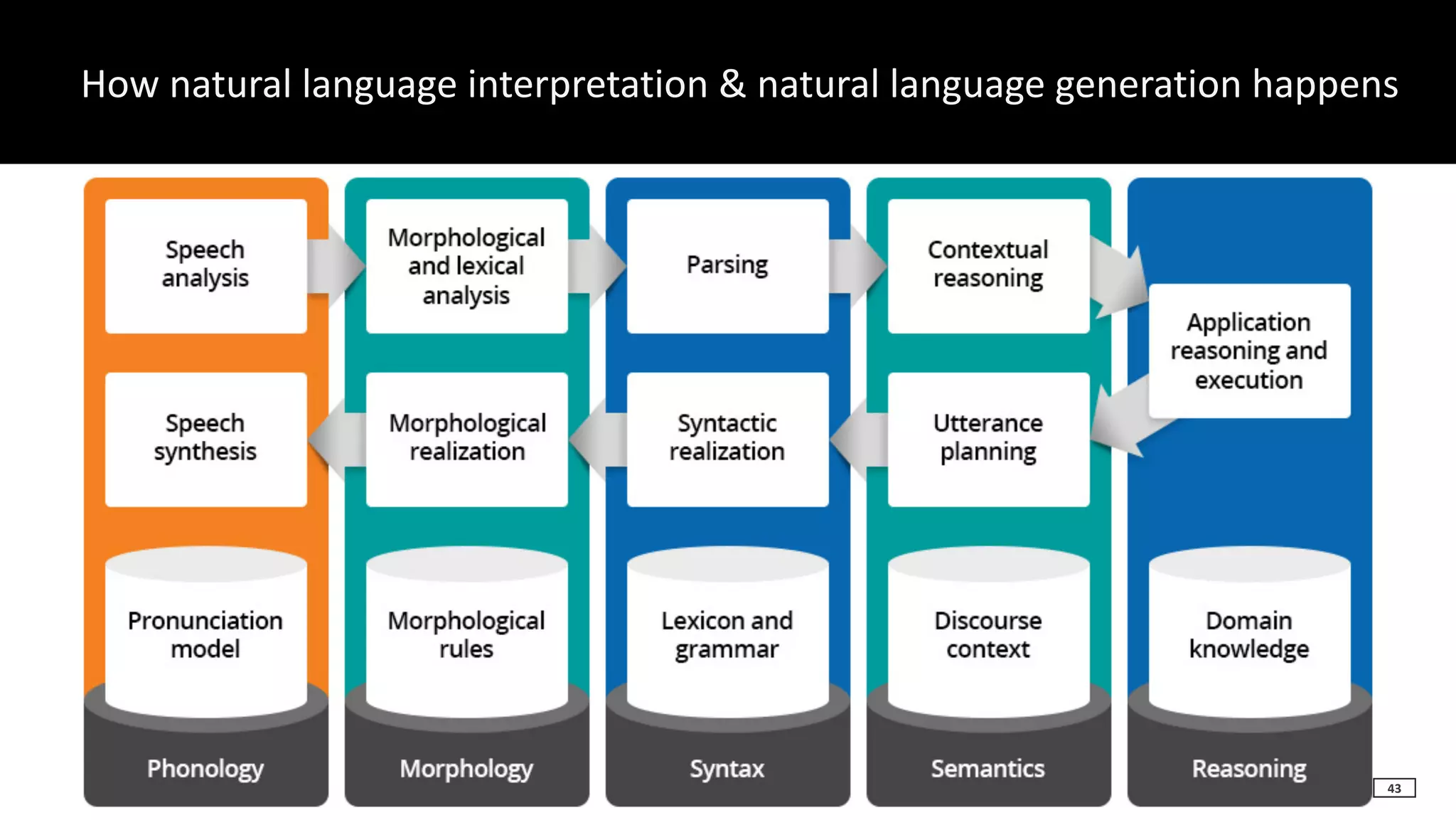
How	natural	language	interpretation	&	natural	language	generation	happens
43
©	Copyright	Project10x	|	Confidential
Text	analytics
44
Text mining is the discovery by computer of new, previously
unknown information, by automatically extracting it from
different written resources. A key element is the linking
together of the extracted information together to form new
facts or new hypotheses to be explored further by more
conventional means of experimentation.
Text analytics is the investigation of concepts, connections,
patterns, correlations, and trends discovered in written
sources. Text analytics examine linguistic structure and apply
statistical, semantic, and machine-learning techniques to
discern entities (names, dates, places, terms) and their
attributes as well as relationships, concepts, and even
sentiments. They extract these 'features' to databases or
semantic stores for further analysis, automate classification
and processing of source documents, and exploit visualization
for exploratory analysis.
IM messages, email, call center logs, customer service survey
results, claims forms, corporate documents, blogs, message
boards, and websites are providing companies with enormous
quantities of unstructured data — data that is information-rich
but typically difficult to get at in a usable way.
Text analytics goes beyond search to turn documents and
messages into data. It extends Business Intelligence (BI) and
data mining and brings analytical power to content
management. Together, these complementary technologies
have the potential to turn knowledge management into
knowledge analytics.
©	Copyright	Project10x	|	Confidential
Speech	I/O	vs	NLP	vs	NLU
NLP
NLU
syntactic
parsing
machine
translation
named entity
recognition (NER)
part-of-speech
tagging (POS)
semantic
parsing
relation
extraction
sentiment
analysis
coreference
resolution
dialogue
agents
paraphrase &
natural language
inference
text-to-
speech (TTS) summarization
automatic
speech
recognition (ASR)
text
categorization
question
answering (QA)
Speech I/O
45©	Copyright	Project10x	|	Confidential
©	Copyright	Project10x	|	Confidential
Natural	language	understanding	(NLU)
Natural	language	understanding	(NLU)	involves	mapping	a	given	
natural	language	input	into	useful	representations,	and	analyzing	
different	aspects	of	the	language.	
NLU	is	critical	to	making	making	AI	happen.	But	language	is	more	
than	words,	and	NLU	involves	more	than	lots	of	math	to	facilitate	
search	for	matching	words.	Language	understanding	requires	
dealing	with	ideas,	allusions,	inferences,	with	implicit	but	critical	
connections	to	the	ongoing	goals	and	plans.		
To	develop	models	of	NLU	effectively,	we	must	begin	with	limited	
domains	in	which	the	range	of	knowledge	needed	is	well	enough	
understood	that	natural	language	can	be	interpreted	within	the	
right	context.		
One	example	is	in	mentoring	in	massively	delivered	educational	
systems.	If	we	want	to	have	better	educated	students	we	need	to	
offer	them	hundreds	of	different	experiences	to	choose	from	
instead	of	a	mandated	curriculum.	A	main	obstacle	to	doing	that	
now	is	the	lack	of	expert	teachers.		
We	can	build	experiential	learning	based	on	simulations	and	
virtual	reality	enabling	student	to	pursue	their	own	interests	and	
eliminate	the	“one	size	fits	all	curriculum.”		
To	make	this	happen	expertise	must	be	captured	and	brought	in	to	
guide	from	people	at	their	time	of	need.	A	good	teacher	(and	a	
good	parent)	can	do	that,	but	they	cannot	always	be	available.		
A	kid	in	Kansas	who	wants	to	be	an	aerospace	engineer	should	get	
to	try	out	designing	airplanes.	But	a	mentor	would	be	needed.	We	
can	build	AI	mentors	in	limited	domains	so	it	would	be	possible	for	
a	student	anywhere	to	learn	to	do	anything	because	the	AI	mentor	
would	understand	what	a	user	was	trying	to	accomplish	within	the	
domain	and	perhaps	is	struggling	with.		
The	student	could	ask	questions	and	expect	good	answers	tailored	
to	the	student’s	needs	because	the	AI/NLU	mentor	would	know	
exactly	what	the	students	was	trying	to	do	because	it	has	a	perfect	
model	of	the	world	in	which	the	student	was	working,	the	relevant	
expertise	needed,	and	the	mistakes	students	often	make.	NLU	gets	
much	easier	when	there	is	deep	domain	knowledge	available.
Source: Roger C Shank
46
©	Copyright	Project10x	|	Confidential
Machine	reading	
&	comprehension	
AI	machine	learning	is	
being	developed	to	
understand	social	
media,	news	trends,	
stock	prices	and	
trades,	and	other	data	
sources	that	might	
impact	enterprise	
decisions.
47
©	Copyright	Project10x	|	Confidential
Natural	Language	GeneraHon		
Natural	language	generation	(NLG)	is	the	process	of	producing	meaningful	
phrases	and	sentences	in	the	form	of	natural	language	from	some	internal	
representation,	and	involves:	
• Text	planning	−	It	includes	retrieving	the	relevant	content	from	knowledge	
base.	
• Sentence	planning	−	It	includes	choosing	required	words,	forming	
meaningful	phrases,	setting	tone	of	the	sentence.	
• Text	realization	−	It	is	mapping	sentence	plan	into	sentence	(or	visualization)	
structure,	followed	by	text-to-speech	processing	and/or	visualization	
rendering.	
• The	output	may	be	provided	in	any	natural	language,	such	as	English,	French,	
Chinese	or	Tagalog,	and	may	be	combined	with	graphical	elements	to	provide	
a	mul`modal	presenta`on.		
• For	example,	the	log	files	of	technical	monitoring	devices	can	be	analyzed	for	
unexpected	events	and	transformed	into	alert-driven	messages;	or	numerical	
`me-series	data	from	hospital	pa`ent	monitors	can	be	rendered	as	hand-over	
reports	describing	trends	and	events	for	medical	staff	star`ng	a	new	shis.
48
©	Copyright	Project10x	|	Confidential
Knowledge	representation	

(KR)	
• Knowledge	=	theory	+	information	
• Knowledge	encoding	via	patterns	
and	language	
• Spectrum	of	knowledge	
representation	and	reasoning	
49©	Copyright	Project10x	|	Confidential
©	Copyright	Project10x	|	Confidential
This	diagram	reflects	a	philosopher's	tradi`onal	picture	and	our	acquired	
defini`ons	of	knowledge.	The	scope	of	knowledge	is	everything	that	has	
ever	been	thought	or	ever	can	be.	
On	the	right	(in	blue)	are	all	observa`ons	and	measurements	of	the	
physical	universe,	the	facts	that	characterize	reality	--	past,	present,	and	
future.	Within	its	bounds	you	find	every	object,	every	quantum	of	energy,	
every	`me	and	event	perceived	or	perceivable	by	our	senses	and	
instrumenta`on.	This	situa`onal	knowledge	of	physical	reality	is	
“informa`on”	in	the	sense	of	Shannon.	It	is	a	world	of	singular	and	most	
“par`cular”	things	and	facts	upon	which	we	might	figura`vely	scratch	
some	serial	number	or	other	iden`fying	mark.	
On	the	other	side	(in	red)	are	all	the	“concepts”	or	ideas	ever	imagined	--	
by	human's,	by	animals	and	plants,	by	Mickey	Mouse,	or	a	can	of	peas.	
We	can	“imagine”	a	can	of	peas	thinking.	It	embraces	every	mode	of	
visualizing	and	organizing	and	compelling	the	direc`on	of	our	thoughts	
from	logic	to	religion	to	economics	to	poli`cs	to	every	reason	or	ra`onale	
for	making	dis`nc`ons	or	for	pu‚ng	one	thing	before	another.	
What	is	knowledge?
“Knowledge is anything that resolves uncertainty. Knowledge is measured
mathematically by the amount of uncertainty removed. Knowledge bases
are defined by the questions they must answer.
Source: R.L. Ballard
50
©	Copyright	Project10x	|	Confidential
As	the	next	internet	gains	momentum,	expect	rapid	progress	towards	a	universal	knowledge	
technology	that	provides	a	full	spectrum	of	informa`on,	metadata,	seman`c	modeling,	and	
advanced	reasoning	capabili`es	for	any	who	want	it.		
Large	knowledgebases,	complex	forms	of	situa`on	assessment,	sophis`cated	reasoning	with	
uncertainty	and	values,	and	autonomic	and	autonomous	system	behavior	exceed	the	capabili`es	
and	performance	capacity	of	current	descrip`on	logic-based	approaches.		
Universal	knowledge	technology	will	be	based	on	a	physical	theory	of	knowledge	that	holds	that	
knowledge	is	anything	that	decreases	uncertainty.	The	formula	is:		
Knowledge	=	Theory	+	InformaMon	that	reduces	uncertainty.	
Theories	are	the	condi`onal	constraints	that	give	meaning	to	concepts,	ideas	and	thought	
pacerns.	Theory	asserts	answers	to	“how”,	“why”	and	“what	if”	ques`ons.	For	humans,	theory	is	
learned	through	encultura`on,	educa`on,	and	life	experience.		
InformaHon,	or	data,	provides	situa`on	awareness	—	who,	what,	when,	where	and	how-much	
facts	of	situa`ons	and	circumstances.	Informa`on	requires	theory	to	define	its	meaning	and	
purpose.		
Theory	persists	and	always	represents	the	lion’s	share	of	knowledge	content	—	say	85%.	
Informa`on	represents	a	much	smaller	por`on	of	knowledge	—	perhaps	only	15%	
What	will	dis`nguish	universal	knowledge	technology	is	enabling	both	machines	and	humans	to	
understand,	combine,	and	reason	with	any	form	of	knowledge,	of	any	degree	of	complexity,	at	any	
scale.
Knowledge	=	theory	+	informa`on
Knowledge = theory + information that reduces uncertainty
51
©	Copyright	Project10x	|	Confidential
• Knowledge	representation	is	the	application	of	
theory,	values,	logic,	and	ontology	to	the	task	of	
constructing	computable	patterns	in	some	domain.	
• Knowledge	is	“captured	and	preserved”,	when	it	is	
transformed	into	a	perceptible	and	manipulable	
system	of	representation.	Systems	of	knowledge	
representation	differ	in	their	fidelity,	intuitiveness,	
complexity,	and	rigor.		
• The	computational	theory	of	knowledge	predicts	
that	ultimate	economies	and	efficiencies	can	be	
achieved	through	variable-length,	n-ary	concept	
coding	and	pattern	reasoning	resulting	in	designs	
that	are	linear	and	proportional	to	knowledge	
measure.
What	is	knowledge	
representation?
52
©	Copyright	Project10x	|	Confidential
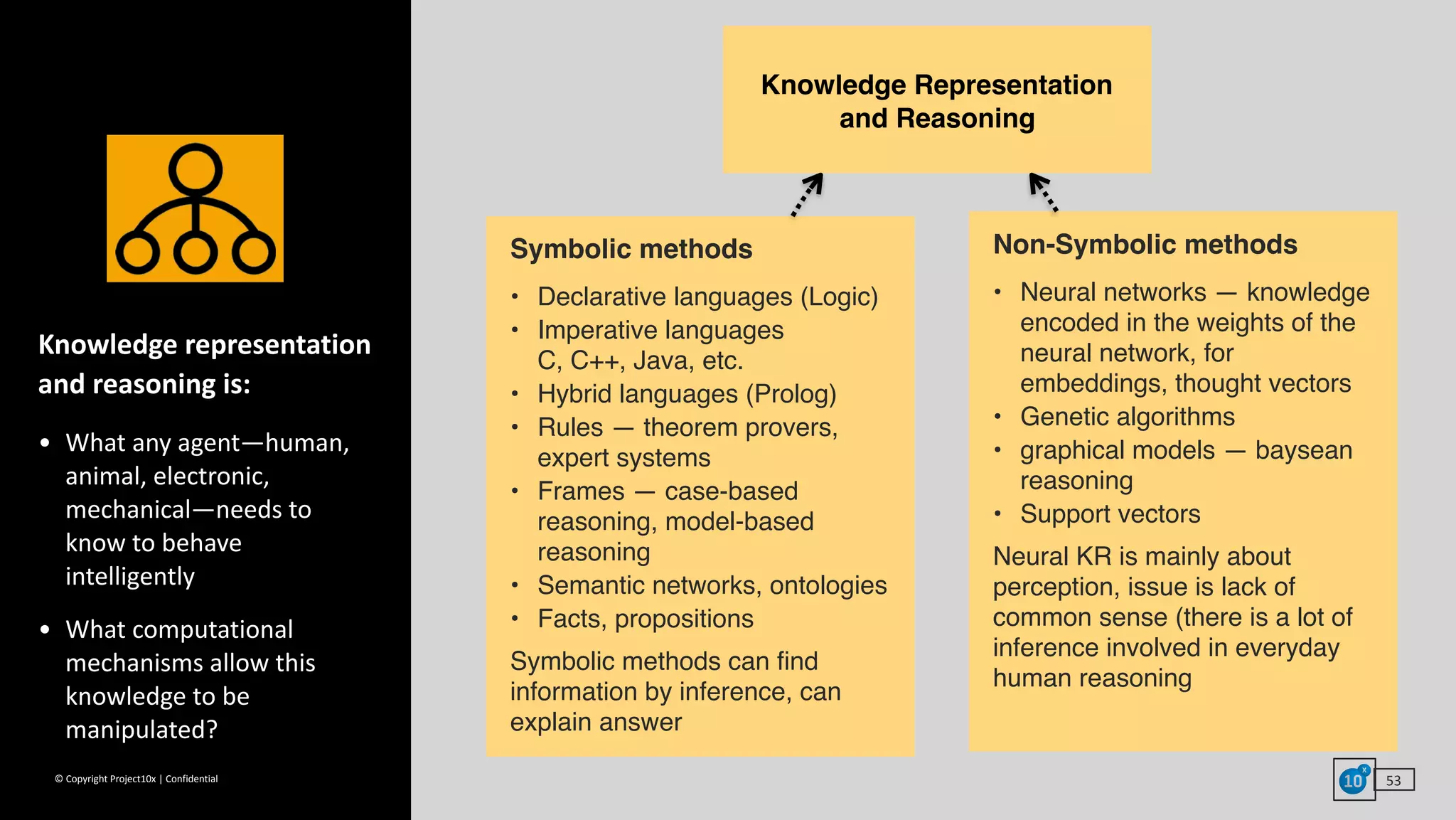
Symbolic methods
• Declarative languages (Logic)
• Imperative languages 

C, C++, Java, etc.
• Hybrid languages (Prolog)
• Rules — theorem provers,
expert systems
• Frames — case-based
reasoning, model-based
reasoning
• Semantic networks, ontologies
• Facts, propositions
Symbolic methods can find
information by inference, can
explain answer
Non-Symbolic methods
• Neural networks — knowledge
encoded in the weights of the
neural network, for
embeddings, thought vectors
• Genetic algorithms
• graphical models — baysean
reasoning
• Support vectors
Neural KR is mainly about
perception, issue is lack of
common sense (there is a lot of
inference involved in everyday
human reasoning
Knowledge Representation

and Reasoning
Knowledge	representation	
and	reasoning	is:	
• What	any	agent—human,	
animal,	electronic,	
mechanical—needs	to	
know	to	behave	
intelligently	
• What	computational	
mechanisms	allow	this	
knowledge	to	be	
manipulated?
53
©	Copyright	Project10x	|	Confidential
Knowledge	encoding
Natural language Documents, speech, stories
Visual language Tables, graphics, charts, maps,
illustrations, images
Formal language Models, schema, logic,
mathematics, professional and
scientific notations
Behavior language Software code, declarative
specifications, functions,
algorithms
Sensory language User experience, human-computer
interface, haptic, gestic.
Humans	encode	thoughts,	represent	knowledge,	and	share	meanings	using	
pacerns	and	language.	
PaNerns	are	knowledge	units.	A	pacern	is	a	compact	and	rich	in	seman`cs	
representa`on	of	raw	data.	Seman`c	richness	is	the	knowledge	a	pacern	
reveals	that	is	hidden	in	the	huge	quan`ty	of	data	it	represents.	Compactness	
is	the	correla`ons	among	data	and	the	synthe`c,	high	level	descrip`on	of	data	
characteris`cs.	For	example,	an	image.	
Language	is	a	system	of	signs,	symbols,	gestures,	and	rules	used	in	
communica`ng.	Meaning	is	something	that	is	conveyed	or	signified.		
Humans	have	plenty	of	experience	encoding	thoughts	and	meanings	using	
language	in	one	form	or	another…	Our	proficiency	varies.	We	tend	to	be	
becer	at	some	kinds	of	language,	and	not	so	good	at	others.		
Project	teams	osen	combine	different	skills	and	exper`se,	e.g.	to	make	a	
movie;	design	and	construct	a	building;	or	coordinate	response	to	an	
emergency.	
The	table	to	the	right	gives	examples	of	five	forms	of	human	language:	
natural,	visual,	formal,	behavioral,	and	sensory	language.
54
©	Copyright	Project10x	|	Confidential
Knowledge	encoding:	a	key	limitation	of	natural	language	is	

the	inherent	ambiguity	resulting	from	overloaded	symbol	use.
"A	noun	is	a	sound	that	has	meaning	
only	by	conven`on.	There	is	no	natural	
rela`onship	between	any	idea	or	
observa`on	and	the	sound	that	you	
ucer	to	describe	it."		
Aristotle	—	On	InterpretaMon
55
Source: Gary Larson, The Far Side.
©	Copyright	Project10x	|	Confidential
Knowledge	encoding:		visual	language	consists	of	words,	images	and	
shapes,	tightly	integrated	into	communication	units
56
Source: Robert Horn
Visual	language	is	the	`ght	integra`on	of	words,	images,	and	shapes	to	
produce	a	unified	communica`on.	It	is	a	tool	for	crea`ve	problems	
solving,	problem	analysis,	and	a	way	of	conveying	ideas	and	
communica`ng	about	the	complexi`es	of	our	technology	and	social	
ins`tu`ons.	Visual	language	can	be	displayed	on	different	media	and	
different	size	communica`on	units.	Visual	language	is	being	created	by	
the	merger	of	vocabularies	from	many	different	fields	as	shown	in	the	
diagram	to	the	lower	right.		
As	the	world	increases	in	complexity,	as	the	speed	at	which	we	need	to	
solve	business	and	social	problems	increases,	as	it	becomes	increasingly	
cri`cal	to	have	the	“big	picture”	as	well	as	mul`ple	levels	of	detail	
immediately	accessible,	visual	language	will	become	more	prevalent	in	
our	lives.	
The	internet	of	subjects,	services	and	things	will	evolve	seman`cally	
enabled	tools	for	visual	language.	Computers	will	cease	being	mere	
electronic	pencils,	and	be	used	to	author,	manage,	and	generate	visual	
language	as	a	form	of	shared	executable	knowledge.
©	Copyright	Project10x	|	Confidential
Theory	is	any	condi`onal	or	uncondi`onal	asser`on,	axiom	or	constraint	

used	for	reasoning	about	the	world.	It	may	be	any	conjecture,	opinion,	or	
specula`on.	In	this	usage,	a	theory	is	not	necessarily	based	on	facts	and	
may	or	may	not	be	consistent	with	verifiable	descrip`ons	of	reality.		
We	use	theories	to	reason	about	the	world.	In	this	sense,	theory	is	a	set	of	
interrelated	constructs	—	formulas	and	inference	rules	and	a	rela`onal	
model	(a	set	of	constants	and	a	set	of	rela`ons	defined	on	the	set	of	
constants).	
"The	ontology	of	a	theory	consists	in	the	objects	theory	assumes	

there	to	be."	

--	Quine	--	Word	and	Object,	1960	
Theories	are	accepted	or	rejected	as	a	whole.	If	we	choose	to	accept	and	
use	a	theory	for	reasoning,	then	we	must	commit	to	all	the	ideas	and	
rela`onships	the	theory	needs	to	establish	its	existence.		
In	science,	theory	is	a	proposed	ra`onal	descrip`on,	explana`on,	or	model	
of	the	manner	of	interac`on	of	a	set	of	natural	phenomena.		
Scien`fic	theory	should	be	capable	of	predic`ng	future	occurrences	or	
observa`ons	of	the	same	kind,	and	capable	of	being	tested	through	
experiment	or	otherwise	falsified	through	empirical	observa`on.		
Values	for	theory	construc`on	include	that	theory	should:	add	to	our	
understanding	of	observed	phenomena	by	explaining	them	in	the	simplest	
form	possible	(parsimony);	fit	cleanly	with	observed	facts	and	with	
established	principles;	be	inherently	testable	and	verifiable;	and	imply	
further	inves`ga`ons	and	predict	new	discoveries.
Theory
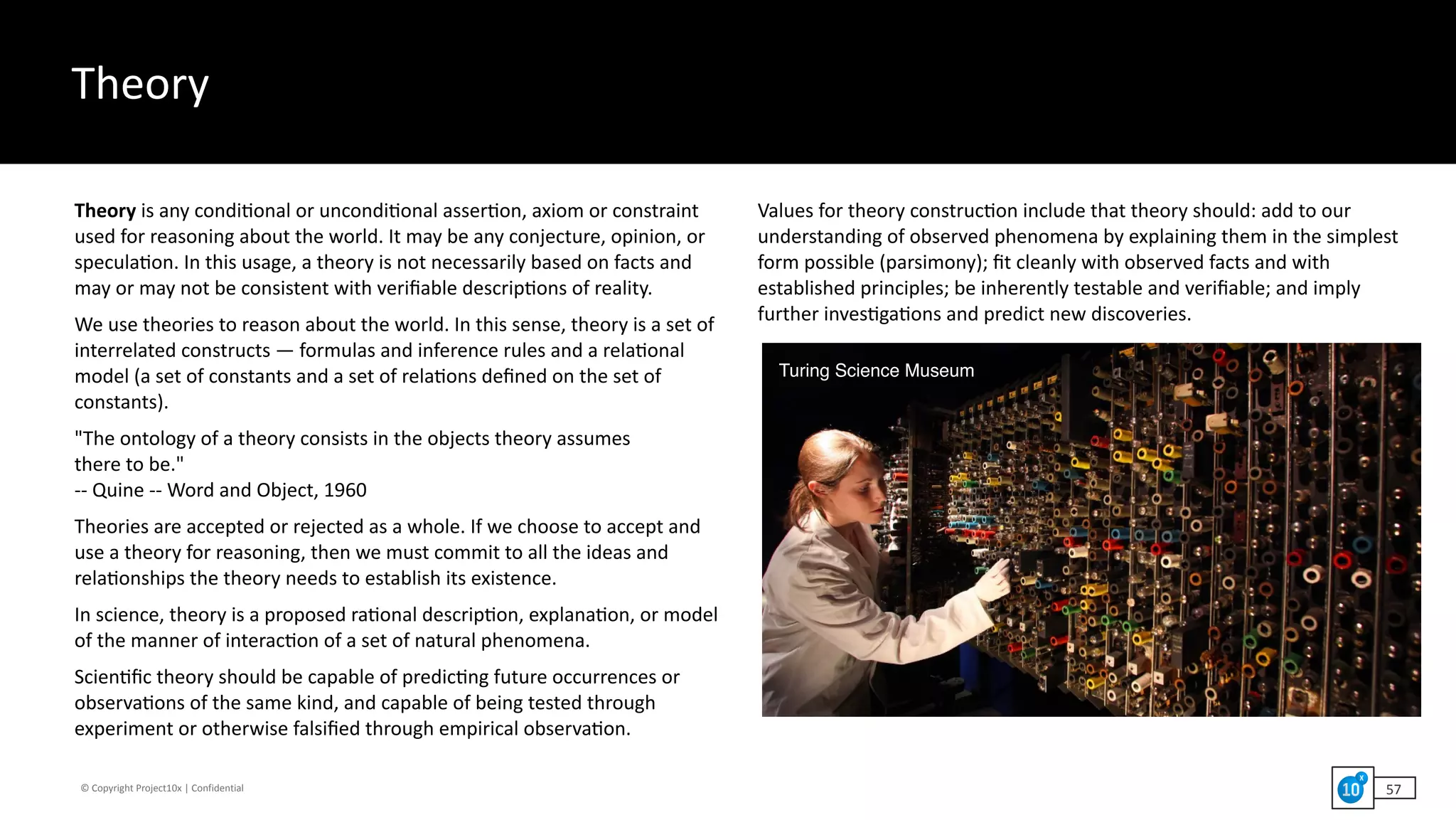
Claude Shannon
57
Turing Science Museum
©	Copyright	Project10x	|	Confidential
Structured,	semi-structured,	and	unstructured	are	types	of	data	representa`ons	
that	seman`c	technologies	unify.	
Structured	informaHon	is	informa`on	that	is	understandable	by	computers.	Data	
structures	(or	data	models)	include:	relaMonal	—	tabular	formats	for	data	are	
most	prevalent	in	database	systems,	and	operate	best	for	storage	and	
persistence;	hierarchical	—	tree-like	formats	(including	XML)	are	most	prevalent	
in	document	models,	and	operate	best	in	messaging	systems	(including	SOA);	
and	object	—	frame	systems	like	Java	and	C#	combine	behavior	with	data	
encapsula`on,	and	operate	best	for	compiled	sosware	programs.	
Semi-structured	informaHon	is	data	that	may	be	irregular	or	incomplete	and	
have	a	structure	that	changes	rapidly	or	unpredictably.	The	schema	(or	plan	of	
informa`on	contents)	is	discovered	by	parsing	the	data,	rather	than	imposed	by	
the	data	model,	e.g.	XML	markup	of	a	document.		
Unstructured	informaHon	is	not	readily	understandable	by	machines.	Its	sense	
must	be	discovered	and	inferred	from	the	implicit	structure	imposed	by	rules	and	
conven`ons	in	language	use,	e.g.	e-mails,	lecers,	news	ar`cles.
Data	representa`ons
Examples of data models.
58
©	Copyright	Project10x	|	Confidential
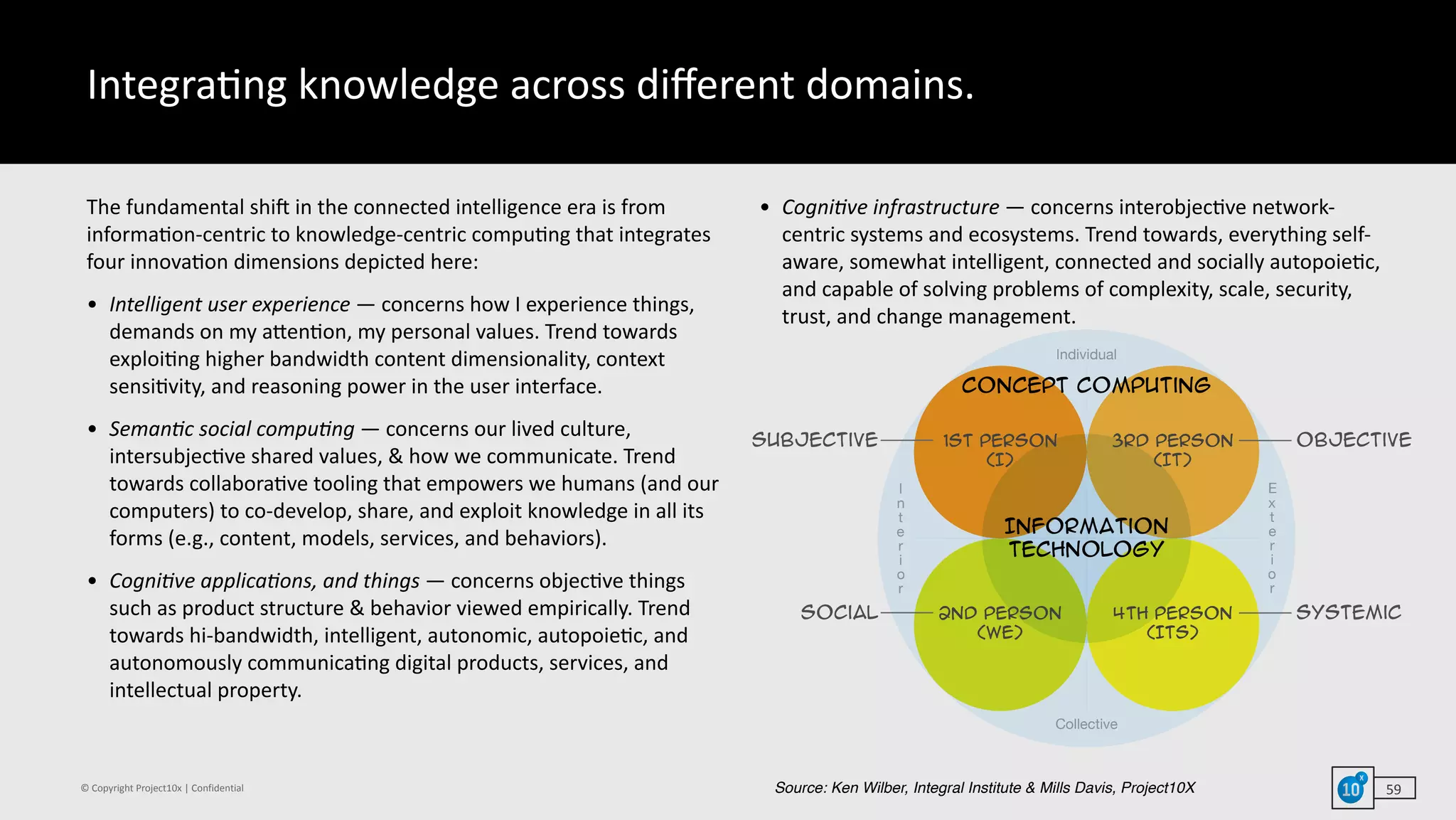
The	fundamental	shis	in	the	connected	intelligence	era	is	from	
informa`on-centric	to	knowledge-centric	compu`ng	that	integrates		
four	innova`on	dimensions	depicted	here:	
• Intelligent	user	experience	—	concerns	how	I	experience	things,	
demands	on	my	acen`on,	my	personal	values.	Trend	towards	
exploi`ng	higher	bandwidth	content	dimensionality,	context	
sensi`vity,	and	reasoning	power	in	the	user	interface.	
• SemanMc	social	compuMng	—	concerns	our	lived	culture,	
intersubjec`ve	shared	values,	&	how	we	communicate.	Trend	
towards	collabora`ve	tooling	that	empowers	we	humans	(and	our	
computers)	to	co-develop,	share,	and	exploit	knowledge	in	all	its	
forms	(e.g.,	content,	models,	services,	and	behaviors).	
• CogniMve	applicaMons,	and	things	—	concerns	objec`ve	things	
such	as	product	structure	&	behavior	viewed	empirically.	Trend	
towards	hi-bandwidth,	intelligent,	autonomic,	autopoie`c,	and	
autonomously	communica`ng	digital	products,	services,	and	
intellectual	property.	
• CogniMve	infrastructure	—	concerns	interobjec`ve	network-
centric	systems	and	ecosystems.	Trend	towards,	everything	self-
aware,	somewhat	intelligent,	connected	and	socially	autopoie`c,	
and	capable	of	solving	problems	of	complexity,	scale,	security,	
trust,	and	change	management.	
Integra`ng	knowledge	across	different	domains.
Source: Ken Wilber, Integral Institute & Mills Davis, Project10X
Concept Computing
Information
Technology
1st Person
(I)
Subjective
2nd Person
(WE)
Social 4th Person
(ITS)
Systemic
3rd Person
(IT)
Objective
Individual
I
n
t
e
r
i
o
r
E
x
t
e
r
i
o
r
Collective
59
©	Copyright	Project10x	|	Confidential 60
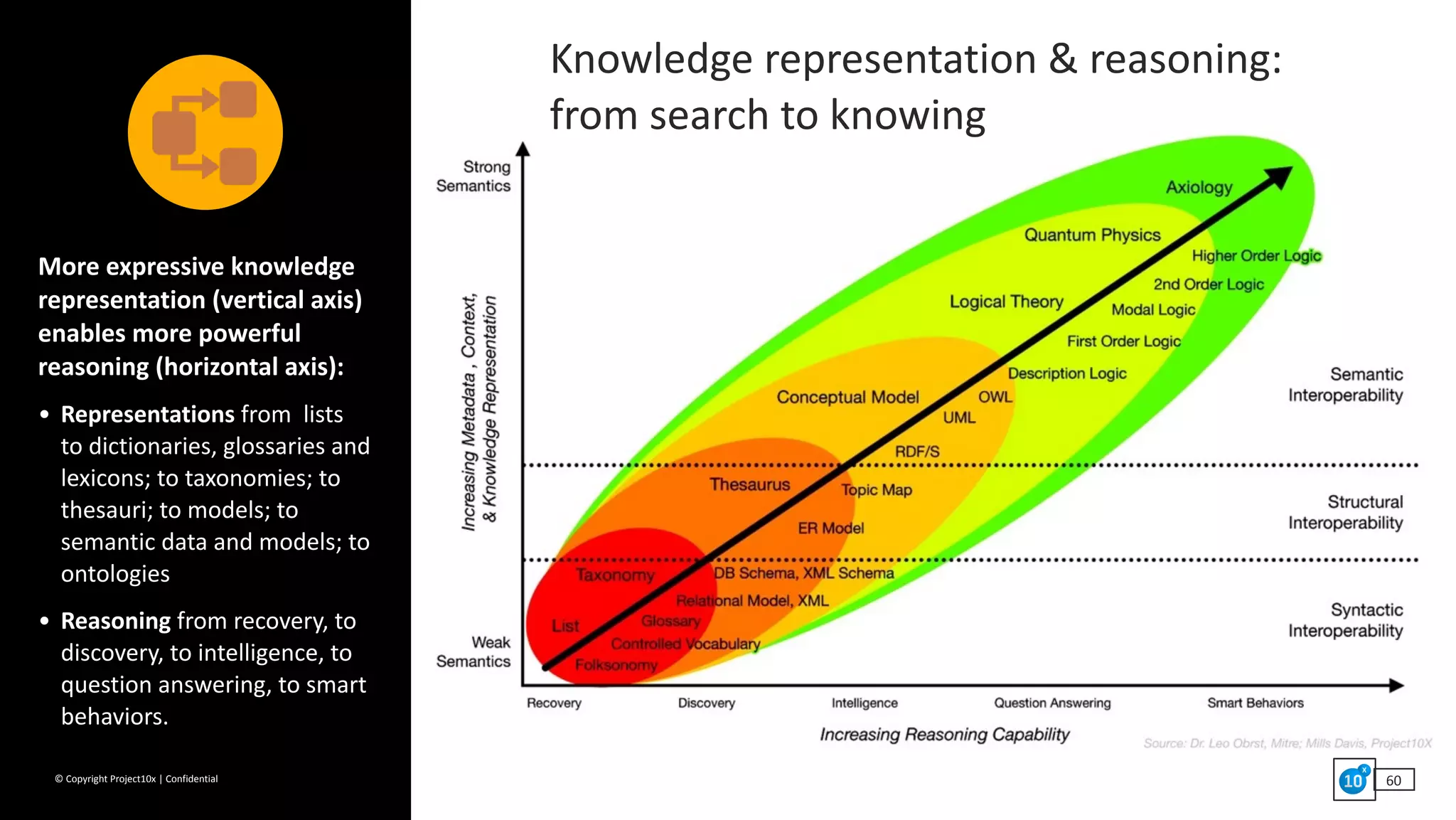
Knowledge	representation	&	reasoning:

from	search	to	knowing
More	expressive	knowledge	
representation	(vertical	axis)	
enables	more	powerful	
reasoning	(horizontal	axis):		
• Representations	from		lists	
to	dictionaries,	glossaries	and	
lexicons;	to	taxonomies;	to	
thesauri;	to	models;	to	
semantic	data	and	models;	to	
ontologies	
• Reasoning	from	recovery,	to	
discovery,	to	intelligence,	to	
question	answering,	to	smart	
behaviors.
©	Copyright	Project10x	|	Confidential
Dic`onaries,	glossaries	and	lexicons
61
DicHonaries	are	alphabe`cal	lists	of	terms	and	their	defini`ons	that	
provide	variant	senses	for	each	term,	where	applicable.	They	are	more	
general	in	scope	than	a	glossary.	They	may	also	provide	informa`on	about	
the	origin	of	the	term,	variants	(both	by	spelling	and	morphology),	and	
mul`ple	meanings	across	disciplines.	While	a	dic`onary	may	also	provide	
synonyms	and	through	the	defini`ons,	related	terms,	there	is	no	explicit	
hierarchical	structure	or	acempt	to	group	terms	by	concept.	
A	gazeNeer	is	a	dic`onary	of	place	names.	Tradi`onal	gazeceers	have	been	
published	as	books	or	they	appear	as	indexes	to	atlases.	Each	entry	may	
also	be	iden`fied	by	feature	type,	such	as	river,	city,	or	school.	Geospa`ally	
referenced	gazeceers	provide	coordinates	for	loca`ng	the	place	on	the	
earth’s	surface.		
A	glossary	is	a	list	of	terms,	usually	with	defini`ons.	The	terms	may	be	from	
a	specific	subject	field	or	those	used	in	a	par`cular	work.	The	terms	are	
defined	within	that	specific	environment	and	rarely	have	variant	meanings	
provided.	
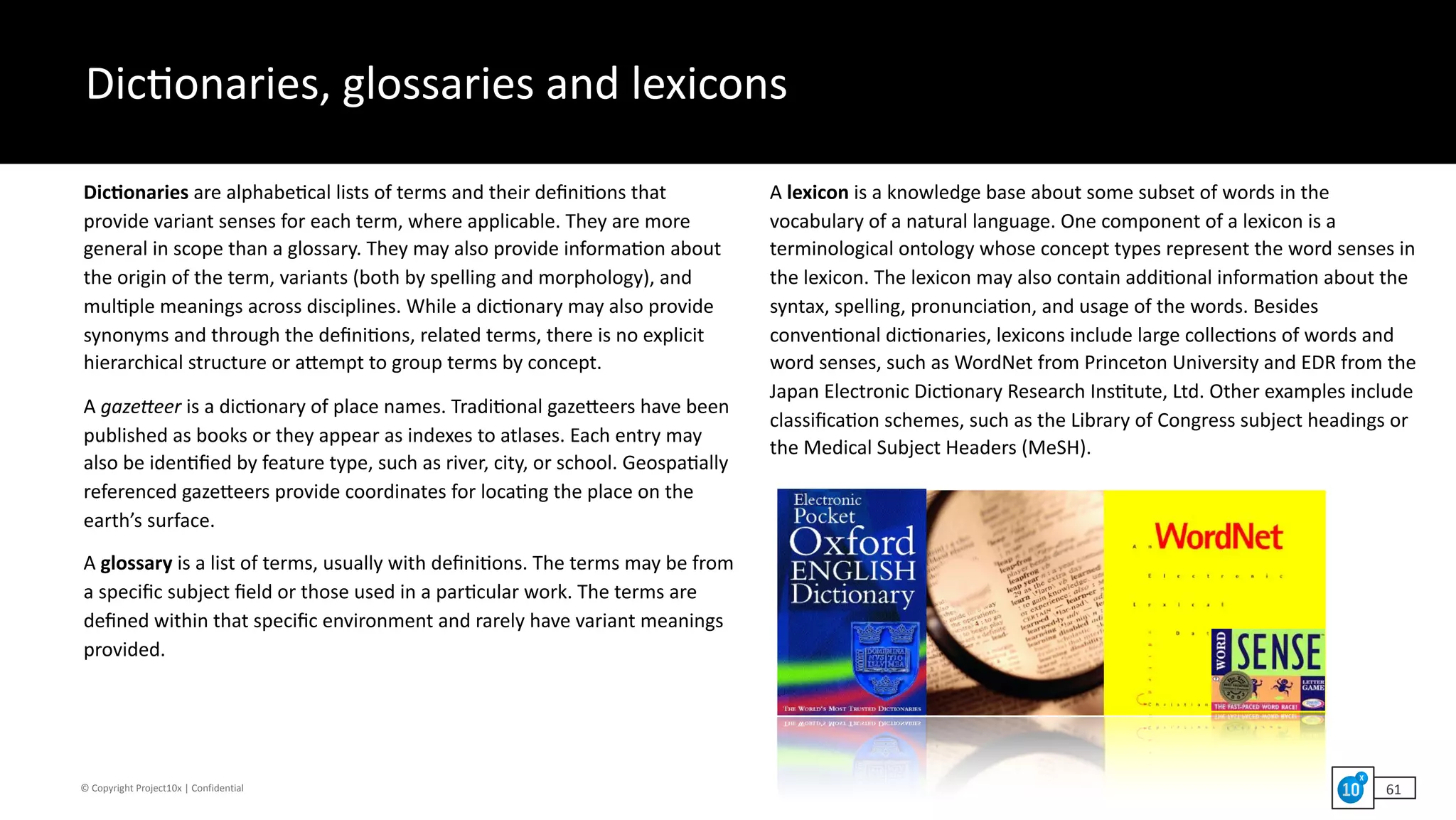
A	lexicon	is	a	knowledge	base	about	some	subset	of	words	in	the	
vocabulary	of	a	natural	language.	One	component	of	a	lexicon	is	a	
terminological	ontology	whose	concept	types	represent	the	word	senses	in	
the	lexicon.	The	lexicon	may	also	contain	addi`onal	informa`on	about	the	
syntax,	spelling,	pronuncia`on,	and	usage	of	the	words.	Besides	
conven`onal	dic`onaries,	lexicons	include	large	collec`ons	of	words	and	
word	senses,	such	as	WordNet	from	Princeton	University	and	EDR	from	the	
Japan	Electronic	Dic`onary	Research	Ins`tute,	Ltd.	Other	examples	include	
classifica`on	schemes,	such	as	the	Library	of	Congress	subject	headings	or	
the	Medical	Subject	Headers	(MeSH).
©	Copyright	Project10x	|	Confidential
Taxonomy
62
A	taxonomy	is	a	hierarchical	or	associa`ve	
ordering	of	terms	represen`ng	categories.	
A	taxonomy	takes	the	form	of	a	tree	or	a	
graph	in	the	mathema`cal	sense.		
A	taxonomy	typically	has	minimal	nodes,	
represen`ng	lowest	or	most	specific	
categories	in	which	no	sub-categories	are	
included	as	well	as	a	top-most	or	maximal	
node	or	la‚ce,	represen`ng	the	maximum	
or	general	category.	
Source: Denise Bedford, World Bank
Examples of taxonomy.
©	Copyright	Project10x	|	Confidential
Folk	taxonomy
63
A	folk	taxonomy	is	a	category	hierarchy	with	5-6	levels	
that	has	its	most	cogni`vely	basic	categories	in	the	
middle.	
In	folk	taxonomies,	categories	are	not	merely	organized	
in	a	hierarchy	from	the	most	general	to	the	most	specific,	
but	are	also	organized	so	that	the	categories	that	are	
most	cogni`vely	basic	are	“in	the	middle”	of	a	general-
to-specific	hierarchy.	Generaliza`on	proceeds	upward	
from	the	basic	level	and	specializa`on	proceeds	down.		
A	basic	level	category	is	somewhere	in	the	middle	of	a	
hierarchy	and	is	cogni`vely	basic.	It	is	the	level	that	is	
learned	earliest.	Usually	has	a	short	name	and	is	used	
frequently.	It	is	the	highest	level	at	which	a	single	mental	
image	can	reflect	the	category.	Also,	there	is	no	defini`ve	
basic	level	for	a	hierarchy	–	it	is	dependent	on	the	
audience.	Most	of	our	knowledge	is	organized	around	
basic	level	categories.	
Source: George Lakoff
©	Copyright	Project10x	|	Confidential
Thesaurus
64
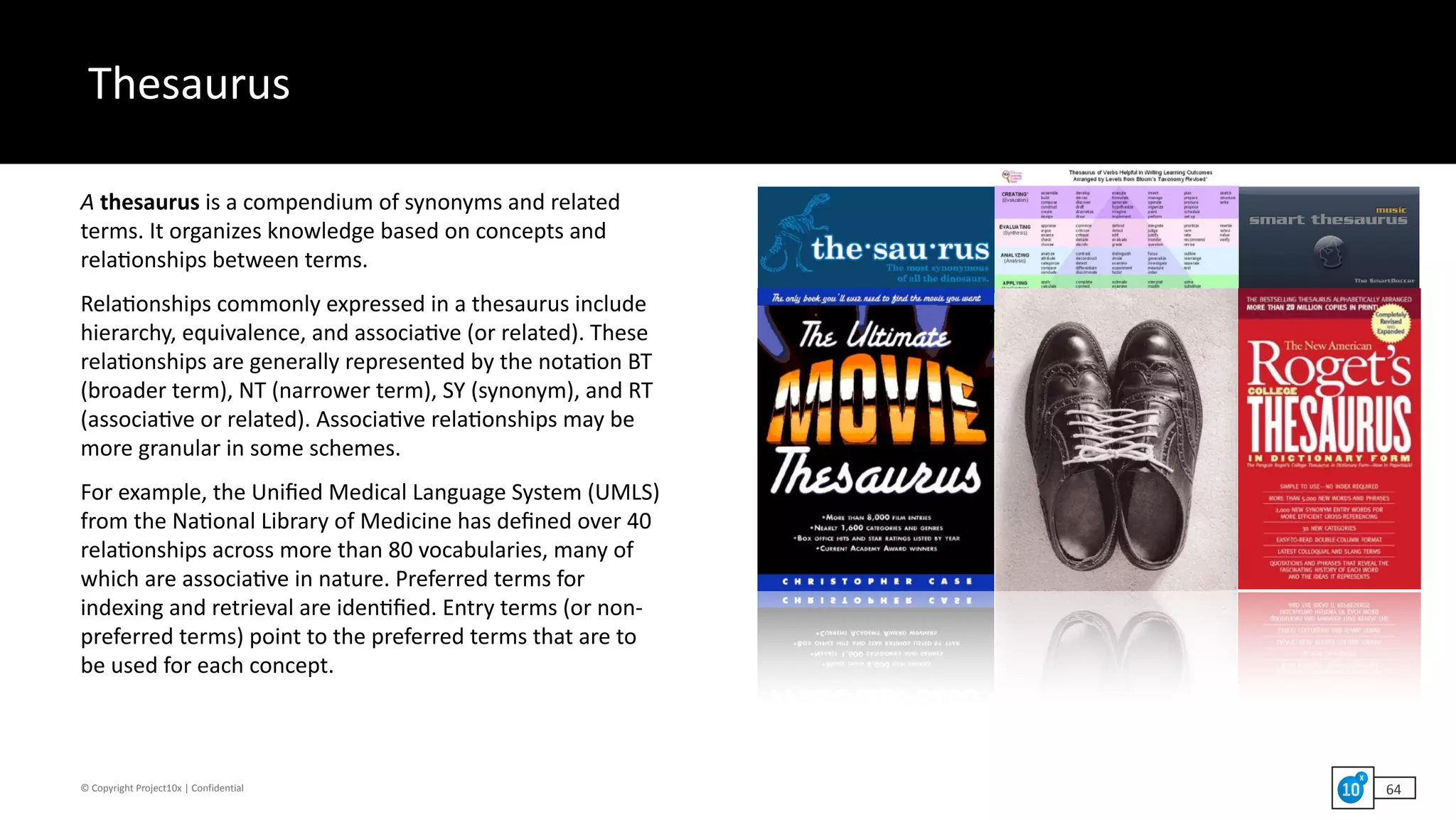
A	thesaurus	is	a	compendium	of	synonyms	and	related	
terms.	It	organizes	knowledge	based	on	concepts	and	
rela`onships	between	terms.		
Rela`onships	commonly	expressed	in	a	thesaurus	include	
hierarchy,	equivalence,	and	associa`ve	(or	related).	These	
rela`onships	are	generally	represented	by	the	nota`on	BT	
(broader	term),	NT	(narrower	term),	SY	(synonym),	and	RT	
(associa`ve	or	related).	Associa`ve	rela`onships	may	be	
more	granular	in	some	schemes.		
For	example,	the	Unified	Medical	Language	System	(UMLS)	
from	the	Na`onal	Library	of	Medicine	has	defined	over	40	
rela`onships	across	more	than	80	vocabularies,	many	of	
which	are	associa`ve	in	nature.	Preferred	terms	for	
indexing	and	retrieval	are	iden`fied.	Entry	terms	(or	non-
preferred	terms)	point	to	the	preferred	terms	that	are	to	
be	used	for	each	concept.
©	Copyright	Project10x	|	Confidential
Model
65
A	model	is	a	representa`on	of	an	actual	or	
conceptual	system.	It	involves	mathema`cs,	logical	
expressions,	or	computer	simula`ons	that	can	be	
used	to	predict	how	the	system	might	perform	or	
survive	under	various	condi`ons	or	in	a	range	of	
hos`le	environments.		
A	simulaHon	is	a	method	for	implemen`ng	a	
model.	It	is	the	process	of	conduc`ng	experiments	
with	a	model	for	the	purpose	of	understanding	the	
behavior	of	the	system	modeled	under	selected	
condi`ons	or	of	evalua`ng	various	strategies	for	
the	opera`on	of	the	system	within	the	limits	
imposed	by	developmental	or	opera`onal	criteria.	
Simula`on	may	include	the	use	of	analog	or	digital	
devices,	laboratory	models,	or	“testbed”	sites.	
Examples of models.
66
©	Copyright	Project10x	|	Confidential
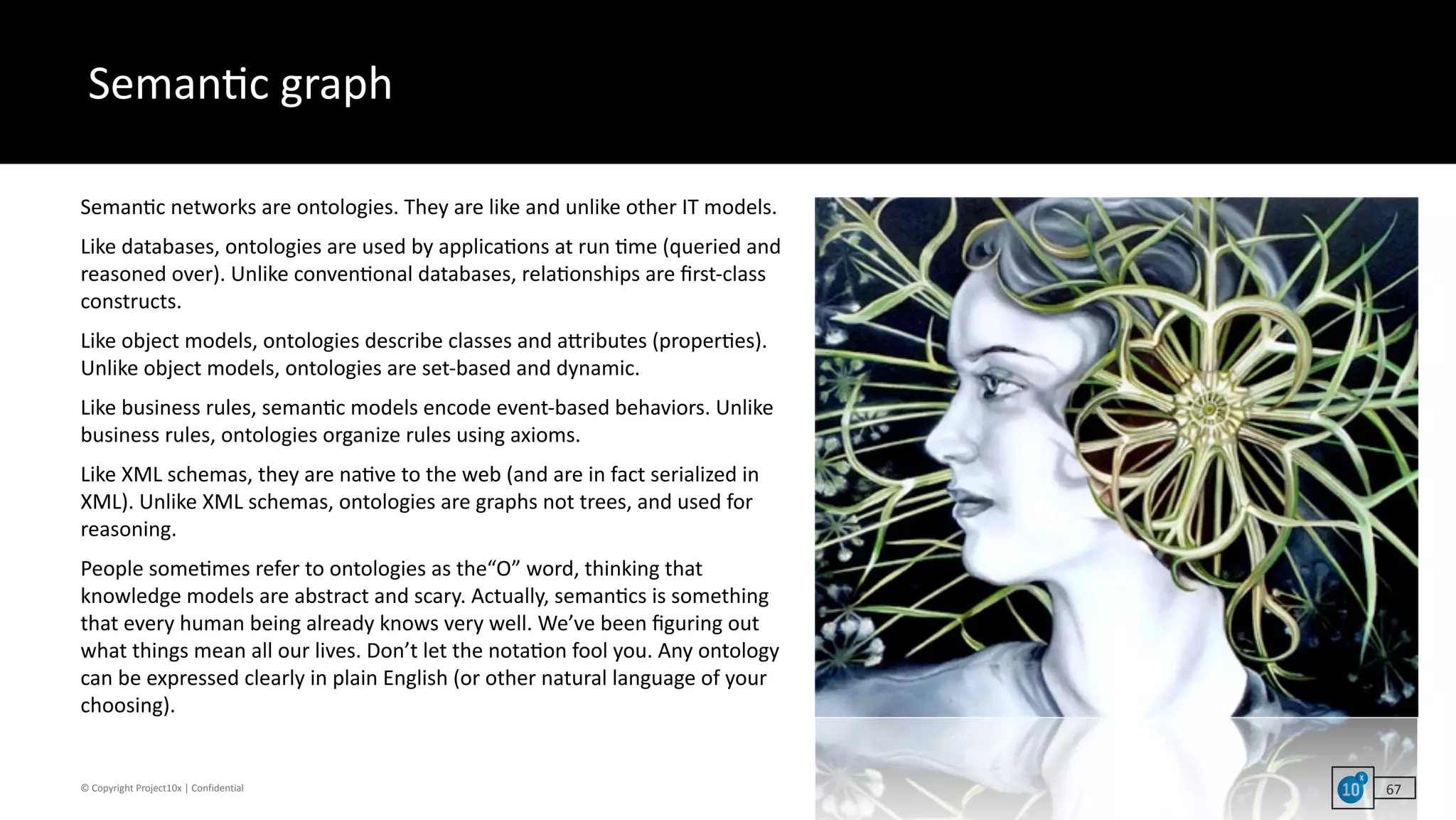
Seman`c	graph
67
Seman`c	networks	are	ontologies.	They	are	like	and	unlike	other	IT	models.		
Like	databases,	ontologies	are	used	by	applica`ons	at	run	`me	(queried	and	
reasoned	over).	Unlike	conven`onal	databases,	rela`onships	are	first-class	
constructs.		
Like	object	models,	ontologies	describe	classes	and	acributes	(proper`es).	
Unlike	object	models,	ontologies	are	set-based	and	dynamic.	
Like	business	rules,	seman`c	models	encode	event-based	behaviors.	Unlike	
business	rules,	ontologies	organize	rules	using	axioms.	
Like	XML	schemas,	they	are	na`ve	to	the	web	(and	are	in	fact	serialized	in	
XML).	Unlike	XML	schemas,	ontologies	are	graphs	not	trees,	and	used	for	
reasoning.	
People	some`mes	refer	to	ontologies	as	the“O”	word,	thinking	that	
knowledge	models	are	abstract	and	scary.	Actually,	seman`cs	is	something	
that	every	human	being	already	knows	very	well.	We’ve	been	figuring	out	
what	things	mean	all	our	lives.	Don’t	let	the	nota`on	fool	you.	Any	ontology	
can	be	expressed	clearly	in	plain	English	(or	other	natural	language	of	your	
choosing).
©	Copyright	Project10x	|	Confidential
Ontology
68
An ontology is a formal explicit specification of a shared conceptualization.
An ontology defines the terms and axioms used to describe, represent, and
reason about an area of knowledge (subject matter). It is the model (set of
concepts) for the meaning of those terms. It defines the vocabulary and the
meaning of that vocabulary as well as the assertions, rules, and constraints
used in reasoning about this subject matter. An ontology is used by people,
databases, and applications that need to share domain information.
A domain is a specific subject area or area of knowledge, like medicine, tool
manufacturing, real estate, automobile repair, financial management, etc.
Ontologies include computer-usable definitions of basic concepts in the domain
and the relationships among them. They encode domain knowledge (modular).
Knowledge that spans domains (composable). They make knowledge available
(reusable).
Ontologies are usually expressed in a logic-based language that enables
detailed, sound, meaningful distinctions to be made among the classes,
properties, & relations as well as inferencing across the knowledge model.
Source: Leo Obrst
Source: Tom Gruber
Source: Andreas Schmidt
The diagram above shows that shared ideas and knowledge can
be expressed with different degrees of formality.
REASONING
©	Copyright	Project10x	|	Confidential 69
©	Copyright	Project10x	|	Confidential
• Reasoning	is	the	derivation	of	inferences	and	
the	warranting	of	conclusions	through	
application	of	heuristics,	rules,	analogies,	
mathematics,	logic,	and	values.		
• Reasoning	requires	knowledge	representation.	
We	choose	more	powerful	forms	of	
representation	to	enable	more	powerful	kinds	
of	reasoning	and	problem	solving.		
• A	broad	range	of	reasoning	capabilities	exist	
including	pattern	detection	and	machine	
learning;	deep	linguistics;	ontology	and	model	
based	inferencing;	and	reasoning	with	
uncertainties,	conflicts,	causality,	analogies,	
and	values.
What	is	reasoning?
70
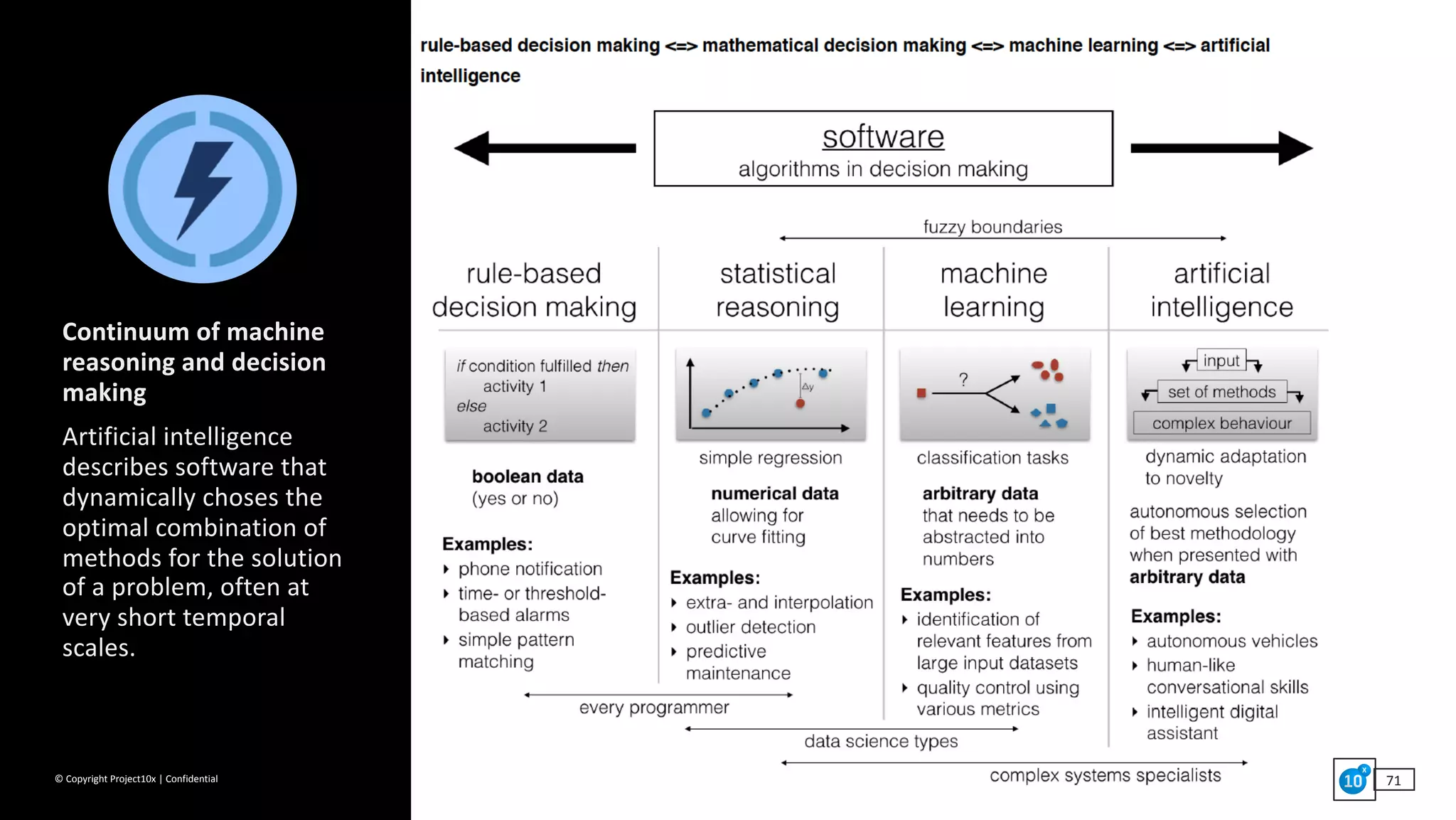
©	Copyright	Project10x	|	Confidential 71
Continuum	of	machine	
reasoning	and	decision	
making	
Artificial	intelligence	
describes	software	that	
dynamically	choses	the	
optimal	combination	of	
methods	for	the	solution	
of	a	problem,	often	at	
very	short	temporal	
scales.
©	Copyright	Project10x	|	Confidential
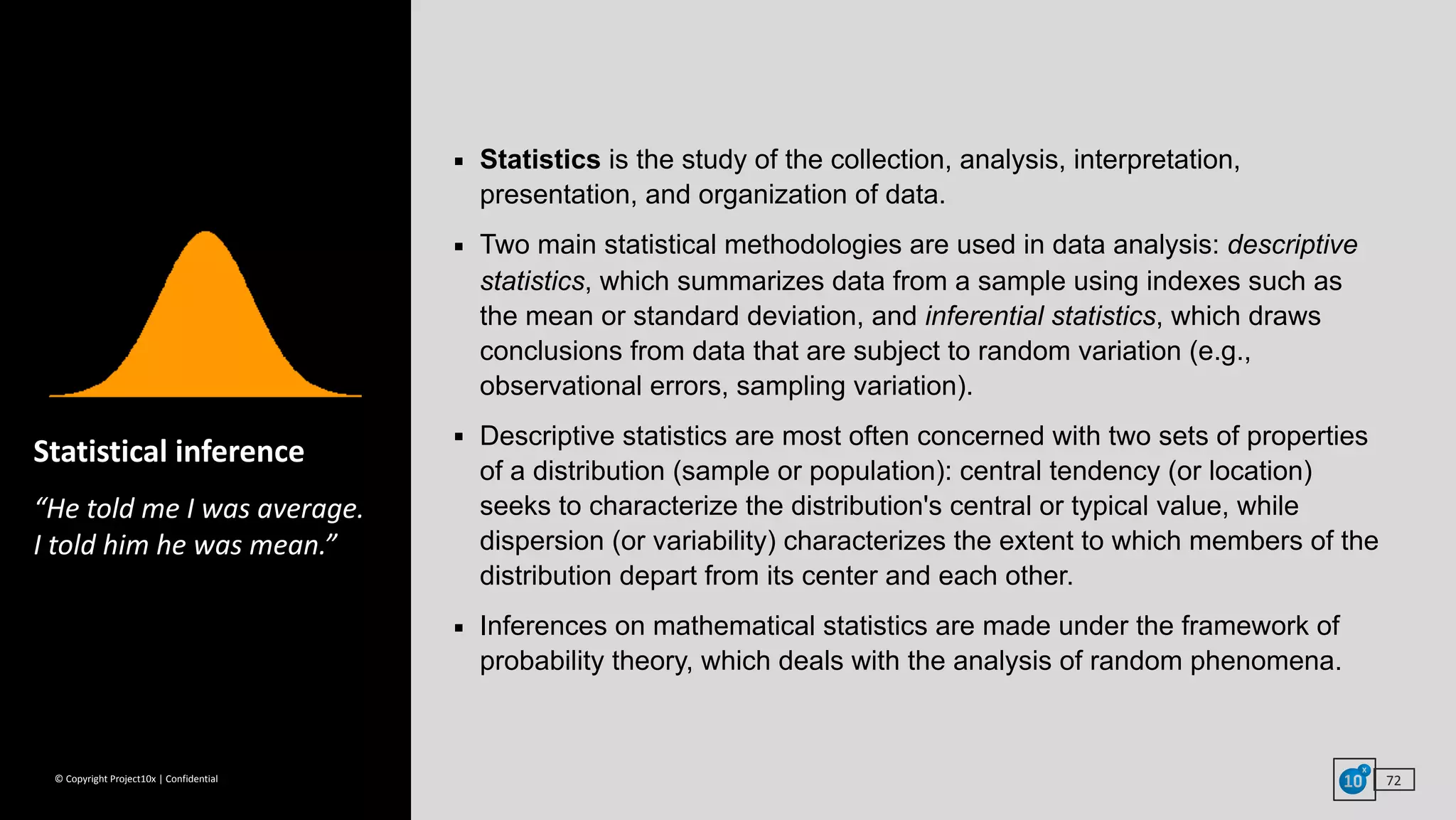
▪ Statistics is the study of the collection, analysis, interpretation,
presentation, and organization of data.
▪ Two main statistical methodologies are used in data analysis: descriptive
statistics, which summarizes data from a sample using indexes such as
the mean or standard deviation, and inferential statistics, which draws
conclusions from data that are subject to random variation (e.g.,
observational errors, sampling variation).
▪ Descriptive statistics are most often concerned with two sets of properties
of a distribution (sample or population): central tendency (or location)
seeks to characterize the distribution's central or typical value, while
dispersion (or variability) characterizes the extent to which members of the
distribution depart from its center and each other.
▪ Inferences on mathematical statistics are made under the framework of
probability theory, which deals with the analysis of random phenomena.
72
Statistical	inference	
“He	told	me	I	was	average.

I	told	him	he	was	mean.”
©	Copyright	Project10x	|	Confidential
Similarity	Search
• Similarity	search	provides	a	way	to	find	the	objects	that	are	the	
most	similar,	in	an	overall	sense,	to	the	object(s)	of	interest.	
• A	typical	example	is	that	of	a	doctor	finding	the	top	10	past	pa`ents	
who	are	most	similar	to	the	current	pa`ent	of	interest.	This	could	
be	used	for	diagnosis,	but	also	adds	the	human	judgement	that	
some	other	machine	learning	methods	do	not	necessarily	offer.	
Another	example	of	approximate	similarity	search	is	for	finding	the	
song	in	a	database	corresponding	to	a	given	sound	sample,	or	
finding	the	person	in	a	database	corresponding	to	a	face	photo.	
• Similarity	searches	can	be	thought	of	as	mul`dimensional	analogs	
to	SQL	queries.	SQL	queries	are	composed	of	condi`ons	on	
individual	variables,	for	example	“Find	all	customers	whose	age	is	
within	a	certain	range	and	whose	income	is	greater	than	a	certain	
amount”,	whereas	similarity	searches	are	more	like	“Find	all	the	
customers	most	like	this	one”.
73
©	Copyright	Project10x	|	Confidential
Analy`cs
74
AnalyHcs	studies	the	cons`tuent	parts	of	something	and	their	rela`on	to	the	
whole.		
Analy`cs	seeks	to	iden`fy	and	interpret	pacerns	in	informa`on	derived	from	
mul`ple	sources.	Seman`c	technologies	provide	the	capability	to	dynamically	
map	together	heterogeneous	data	sets,	bridging	silos	and	making	
interrela`onships	explicit	and	computable.		
The	chart	to	the	right	maps	different	types	of	analy`cs	by	purpose	and	`me	
horizon.	The	purpose	axis	(ver`cal)	dis`nguishes	"explora`on	vs.	control"	and	
highlights	the	difference	between	analysis	and	repor`ng.	Analysis	is	about	
digging	deep	into	data	to	discover	rela`onships,	find	causa`on,	and	describe	
phenomena.	Repor`ng,	in	contrast,	is	used	to	track	performance	and	iden`fy	
varia`on	from	goals.	The	temporal	axis	(horizontal)	dis`nguishes	“backward	
looking	vs.	forward	looking	vs.	real-`me).	Most	analy`cs	is	backward	looking	
—	in	an	acempt	to	understand	what	has	happened,	and	therefore	be	
equipped	to	make	becer	decisions	in	the	future.	Alterna`vely,	analy`cs	can	
focus	explicitly	on	predic`ng	future	performance.	Increasingly,	however,	the	
requirement	is	to	provide	informa`on	and	insight	to	support	opera`onal	
decisions	in	real-`me.
Source: Zach Gemignani
©	Copyright	Project10x	|	Confidential
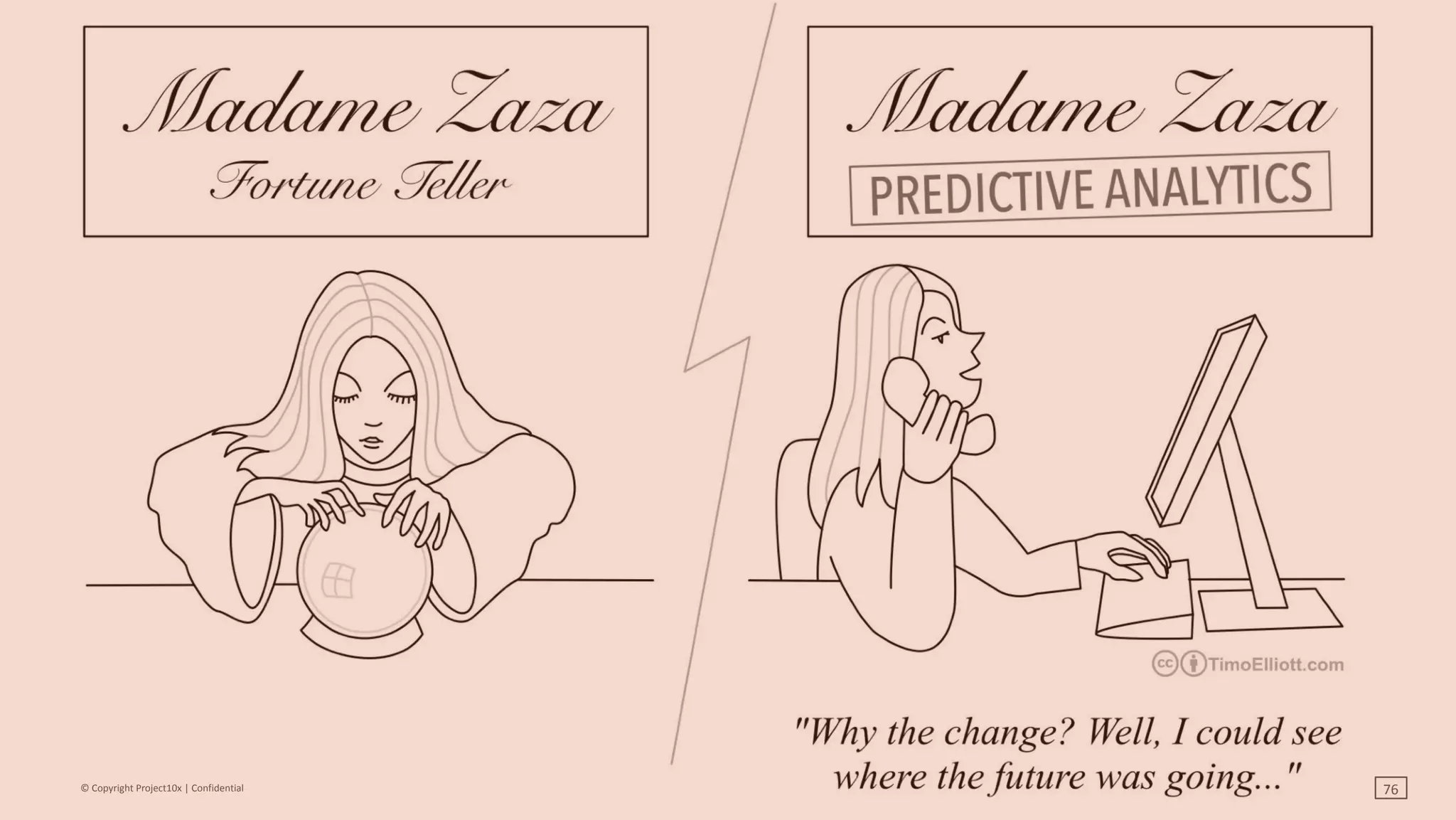
Predictive	Analytics
• PredicHve	analyHcs	is	the	science	of	analyzing	current	
and	historical	facts/data	to	make	predic`ons	about	future	
events.	
• Unlike	tradi`onal	business	intelligence	prac`ces,	which	
are	more	backward-looking	in	nature,	predic`ve	analy`cs	
is	focused	on	helping	companies	derive	ac`onable	
intelligence	based	on	past	experience.	
• A	typical	applica`on	is	in	insurance:	predic`ng	which	
policy	holders	(or	poten`al	policy	holders)	will	make	a	
claim	and	how	long	it	will	be	un`l	they	make	the	claim.	
The	more	data	available	on	the	history	of	claims	and	
‘extraneous’	informa`on	about	the	policy	holder	the	
more	variables	a	predic`ve	analy`cs	algorithm	can	take	
in	to	account.		
• For	example,	a	machine	learning	algorithm	could	easily	
take	into	account	the	impact	of	when	a	parent	has	
children	on	claim	rates.	Iden`fying	if	such	a	rela`onship	
exists	(amongst	ALL	the	other	possibili`es)	is	too	complex	
for	human	analysts.	
• Another	example	is	a	health	insurance	company	using	
predic`ve	analy`cs	to	iden`fy	when	pa`ents	are	likely	to	
have	a	hospital	stay	–	and	to	direct	health	care	providers	
to	take	preventa`ve	ac`ons	to	avoid	the	hospital	stay.	
With	a	growing	base	of	health	care	data,	this	sort	of	data	
science	is	set	to	improve	the	nature	of	health	care	
delivery.		
• Other	examples	include	predic`on	of	product	demand,	
op`ons	prices,	or	turnover	likelihood	of	sales	leads.
75
• Predic`ve	analy`cs	is	the	science	of	analyzing	current	and	historical	facts/data	to	make	predic`ons	about	future	events.	
• Unlike	tradi`onal	business	intelligence	prac`ces,	which	are	more	backward-looking	in	nature,	predic`ve	analy`cs	is	focused	on	helping	companies	
derive	ac`onable	intelligence	based	on	past	experience.	
• A	typical	applica`on	is	in	insurance:	predic`ng	which	policy	holders	(or	poten`al	policy	holders)	will	make	a	claim	and	how	long	it	will	be	un`l	they	
make	the	claim.	The	more	data	available	on	the	history	of	claims	and	‘extraneous’	informa`on	about	the	policy	holder	the	more	variables	a	
predic`ve	analy`cs	algorithm	can	take	in	to	account.		
• For	example,	a	machine	learning	algorithm	could	easily	take	into	account	the	impact	of	when	a	parent	has	children	on	claim	rates.	Iden`fying	if	such	
a	rela`onship	exists	(amongst	ALL	the	other	possibili`es)	is	too	complex	for	human	analysts.	
• Another	example	is	a	health	insurance	company	using	predic`ve	analy`cs	to	iden`fy	when	pa`ents	are	likely	to	have	a	hospital	stay	–	and	to	direct	
health	care	providers	to	take	preventa`ve	ac`ons	to	avoid	the	hospital	stay.	With	a	growing	base	of	health	care	data,	this	sort	of	data	science	is	set	
to	improve	the	nature	of	health	care	delivery.		
• Other	examples	include	predic`on	of	product	demand,	op`ons	prices,	or	turnover	likelihood	of	sales	leads.
©	Copyright	Project10x	|	Confidential 76
©	Copyright	Project10x	|	Confidential
Four	kinds	of	reasoning
77
The	four	methods	of	reasoning	include:		
(1)	DeducHon:	deriving	implica`ons	from	premises.		
(2)	InducHon:	deriving	general	principles	from	examples.		
(3)	AbducHon:	Forming	a	hypothesis	that	must	be	tested	by	induc`on	and	deduc`on.	
It	involves	inferring	the	best	or	most	plausible	explana`on	from	a	given	set	of	facts	or	
data.		
(4)	Analogy:	Besides	these	three	types	of	reasoning	there	is	a	fourth,	analogy,	which	
combines	the	characters	of	the	three,	yet	cannot	be	adequately	represented	as	
composite.	Analogy	is	more	primi`ve,	but	more	flexible	than	logic.	The	methods	of	
logic	are	disciplined	ways	of	using	analogy.	
Although	deduc`on	is	important,	it	is	only	one	of	the	four	methods	of	reasoning.	
Induc`on,	abduc`on,	and	analogy	are	at	least	as	important,	and	they	are	necessary	
for	learning	or	acquiring	new	knowledge.	Current	computer	systems	come	close	to	
human	ability	in	deduc`on.	But	they	are	far	inferior	in	learning,	which	depends	
heavily	on	the	other	three	methods	of	reasoning.	
Source:	John	Sowa
©	Copyright	Project10x	|	Confidential
Evidence-based	reasoning
• This	evidence-based	reasoning	framework	shows	how	a	premise	and	data	are	
processed	through	three	distinct	steps	(analysis,	interpretation,	and	application)	
to	produce	a	claim	as	the	output.		
• A	claim	is	a	statement	about	a	specific	outcome	or	state	phrased	as	either	a	
prediction	of	what	something	will	do	in	the	future	(e.g.,	“This	box	will	sink”),	an	
observation	of	what	something	has	done	in	the	past	(e.g.,	“This	box	sank”),	or	a	
conclusion	about	what	something	is	in	the	present	(e.g.,	“This	box	sinks”).	
• The	premise	consists	of	one	or	more	statements	describing	the	specific	
circumstances	acting	as	an	input	that	will	result	in	the	outcome	described	by	the	
claim.	
• Rules	link	the	premise	and	the	claim,	asserting	a	general	relationship	that	
justifies	how	the	latter	follows	from	the	former.	Application	is	the	process	by	
which	the	rule	are	brought	to	bear	in	the	specific	circumstances	described	by	the	
premise.	
• Evidence	consist	of	statements	describing	observed	relationships.	Interpretation	
of	evidence	is	a	process	of	generalization,	grounded	in	a	specific	context.	
• Data	are	discrete	reports	of	past	or	present	observations,	and	are	collected	and	
related	by	analysis	to	produce	a	statement	of	evidence.
78
Source:	EBR	Framework:	Assessing	Scientific	Reasoning,

Taylor	&	Francis	Group
Axiology,	logic	&	probability	
• Value	is	the	founda`on	of	meaning.	It	is	the	measure	of	the	
worth	or	desirability	(posi`ve	or	nega`ve)	of	something,	and	of	
how	well	something	conforms	to	its	concept	or	intension.	
• Value	forma`on	and	value-based	reasoning	are	fundamental	to	
all	areas	of	human	endeavor.	Theories	embody	values.	The	
axiom	of	value	is	based	on	“concept	fulfillment.”		
• Most	areas	of	human	reasoning	require	applica`on	of	mul`ple	
theories;	resolu`on	of	conflicts,	uncertain`es,	compe`ng	
values;	and	analysis	of	trade-offs.	For	example,	ques`ons	of	guilt	
or	innocence	require	judgment	of	far	more	than	logical	truth	or	
falsity.	
• Axiology	is	integral	to	the	evolu`on	of	AI.	Axiology	is	the	branch	
of	philosophy	that	studies	value	and	value	theory.	Things	like	
honesty,	truthfulness,	objec`veness,	novelty,	originality,	
“progress,”	people	sa`sfac`on,	etc.	The	word	‘axiology’,	derived	
from	two	Greek	roots	'axios’	(worth	or	value)	and	‘logos’	(logic	
or	theory),	means	the	theory	of	value,	and	concerns	the	process	
of	understanding	values	and	valua`on.	
©	Copyright	Project10x	|	Confidential
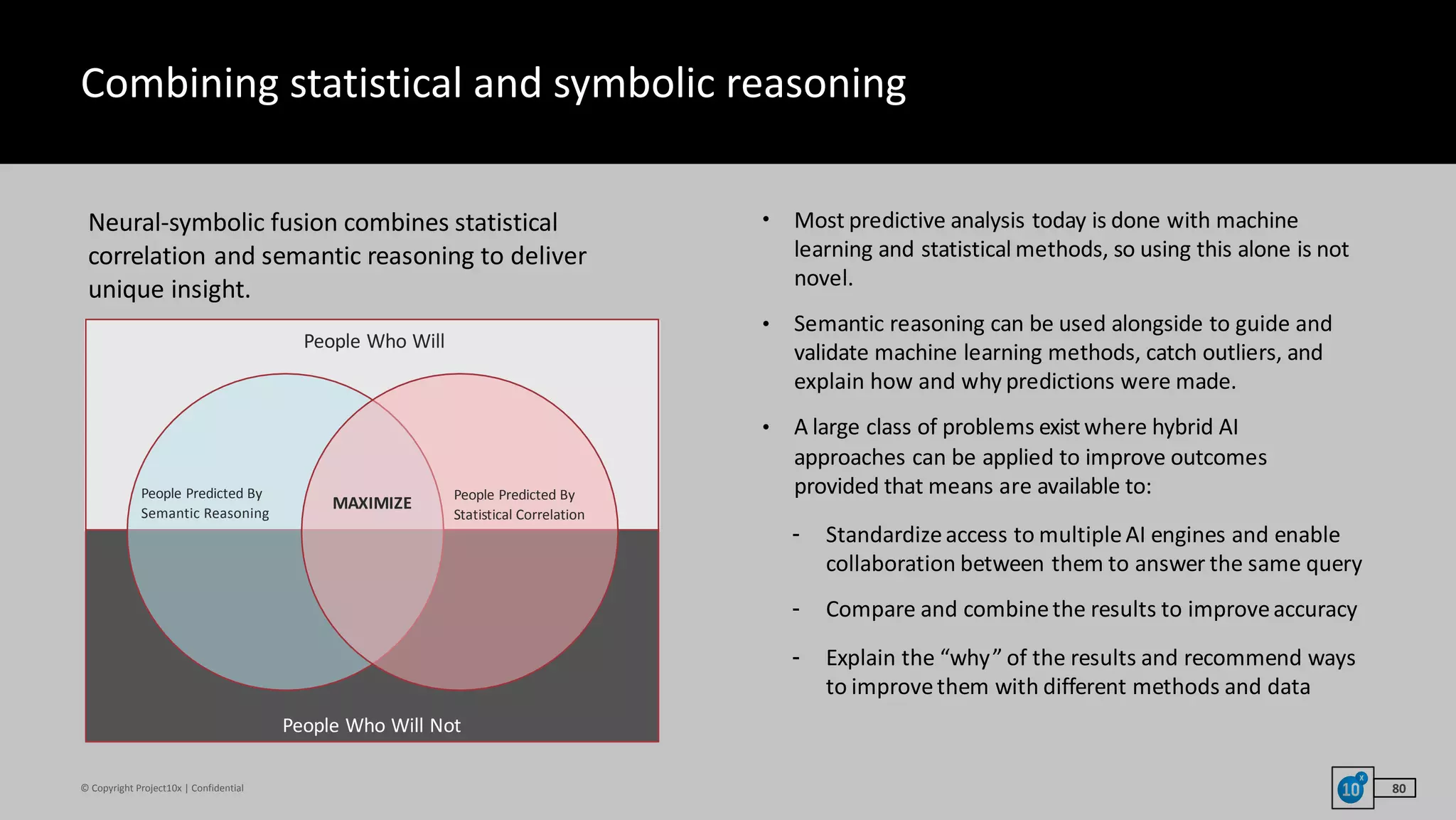
• Most	predictive	analysis	today	is	done	with	machine	
learning	and	statistical	methods,	so	using	this	alone	is	not	
novel.	
• Semantic	reasoning	can	be	used	alongside	to	guide	and	
validate	machine	learning	methods,	catch	outliers,	and	
explain	how	and	why	predictions	were	made.	
• A	large	class	of	problems	exist	where	hybrid	AI	
approaches	can	be	applied	to	improve	outcomes	
provided	that	means	are	available	to:	
- Standardize	access	to	multiple	AI	engines	and	enable	
collaboration	between	them	to	answer	the	same	query	
- Compare	and	combine	the	results	to	improve	accuracy	
- Explain	the	“why”	of	the	results	and	recommend	ways	
to	improve	them	with	different	methods	and	data
Neural-symbolic	fusion	combines	statistical	
correlation	and	semantic	reasoning	to	deliver	
unique	insight.
People	Who	Will
People	Who	Will	Not
People	Predicted	By	
Semantic	Reasoning
People	Predicted	By	
Statistical	Correlation
MAXIMIZE
Combining	statistical	and	symbolic	reasoning
80
©	Copyright	Project10x	|	Confidential 81
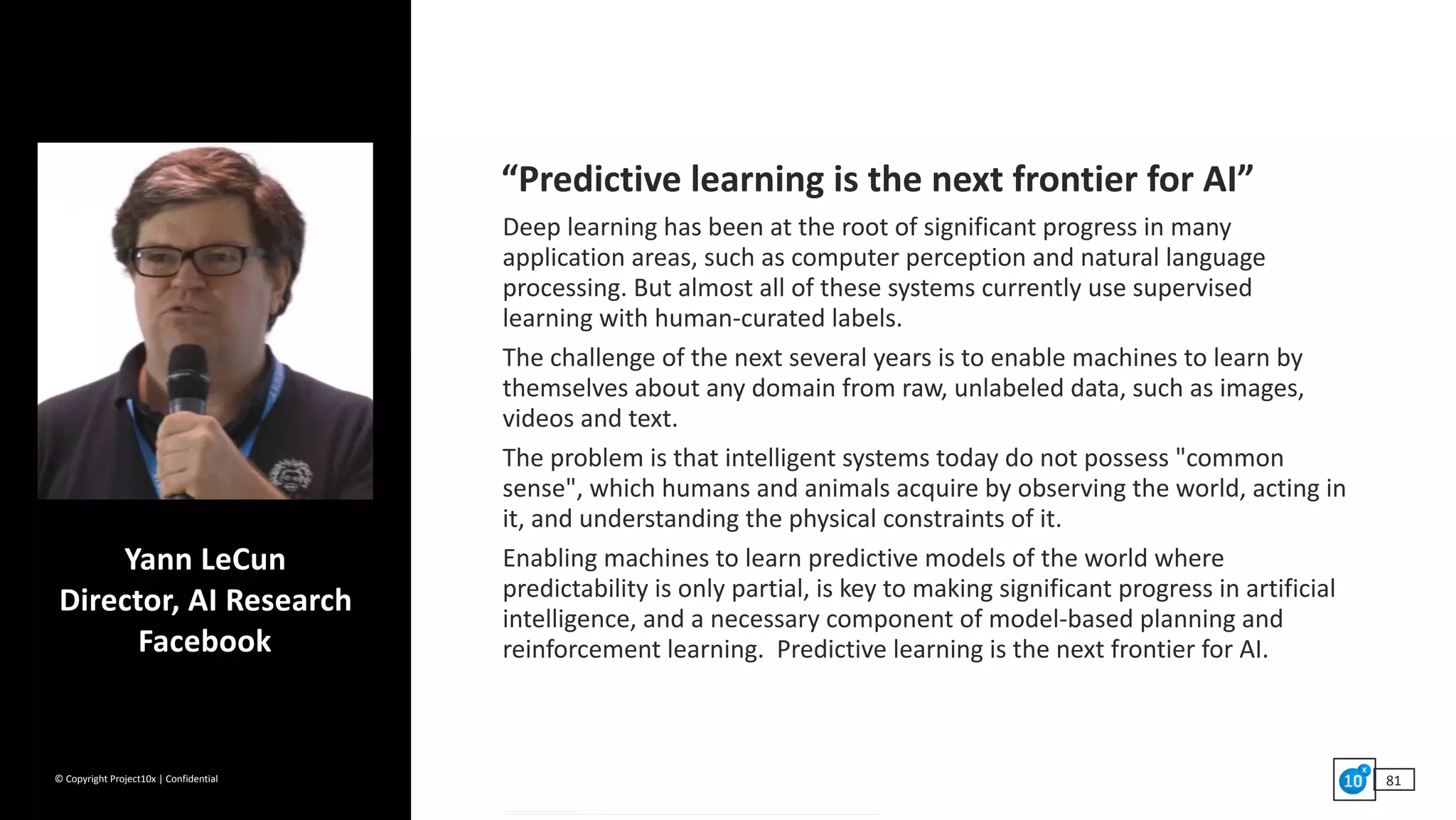
Yann	LeCun

Director,	AI	Research

Facebook
“Predictive	learning	is	the	next	frontier	for	AI”	
Deep	learning	has	been	at	the	root	of	significant	progress	in	many	
application	areas,	such	as	computer	perception	and	natural	language	
processing.	But	almost	all	of	these	systems	currently	use	supervised	
learning	with	human-curated	labels.		
The	challenge	of	the	next	several	years	is	to	enable	machines	to	learn	by	
themselves	about	any	domain	from	raw,	unlabeled	data,	such	as	images,	
videos	and	text.		
The	problem	is	that	intelligent	systems	today	do	not	possess	"common	
sense",	which	humans	and	animals	acquire	by	observing	the	world,	acting	in	
it,	and	understanding	the	physical	constraints	of	it.		
Enabling	machines	to	learn	predictive	models	of	the	world	where	
predictability	is	only	partial,	is	key	to	making	significant	progress	in	artificial	
intelligence,	and	a	necessary	component	of	model-based	planning	and	
reinforcement	learning.		Predictive	learning	is	the	next	frontier	for	AI.
©	Copyright	Project10x	|	Confidential 82
/ˈk.ɡnədiv//kəmˈpyo͞odiNG/	
noun	
Cognition	is	the	mental	action	or	process	of	acquiring		knowledge	and	
understanding	through	thought,		experience,	and	the	senses.	
Cognitive	computing	is	the	simulation	of	human	thought	processes	in	a	
computerized	model.	It	involves	self-learning	systems	that	use	data	
mining,	pattern	recognition,	natural	language	processing,	and	statistical	
and	symbolic	reasoning	to	mimic	the	way	that	humans	think	and	learn.
cog.ni.tive	com.put.ing
What	is	

cognitive	computing?
©	Copyright	Project10x	|	Confidential
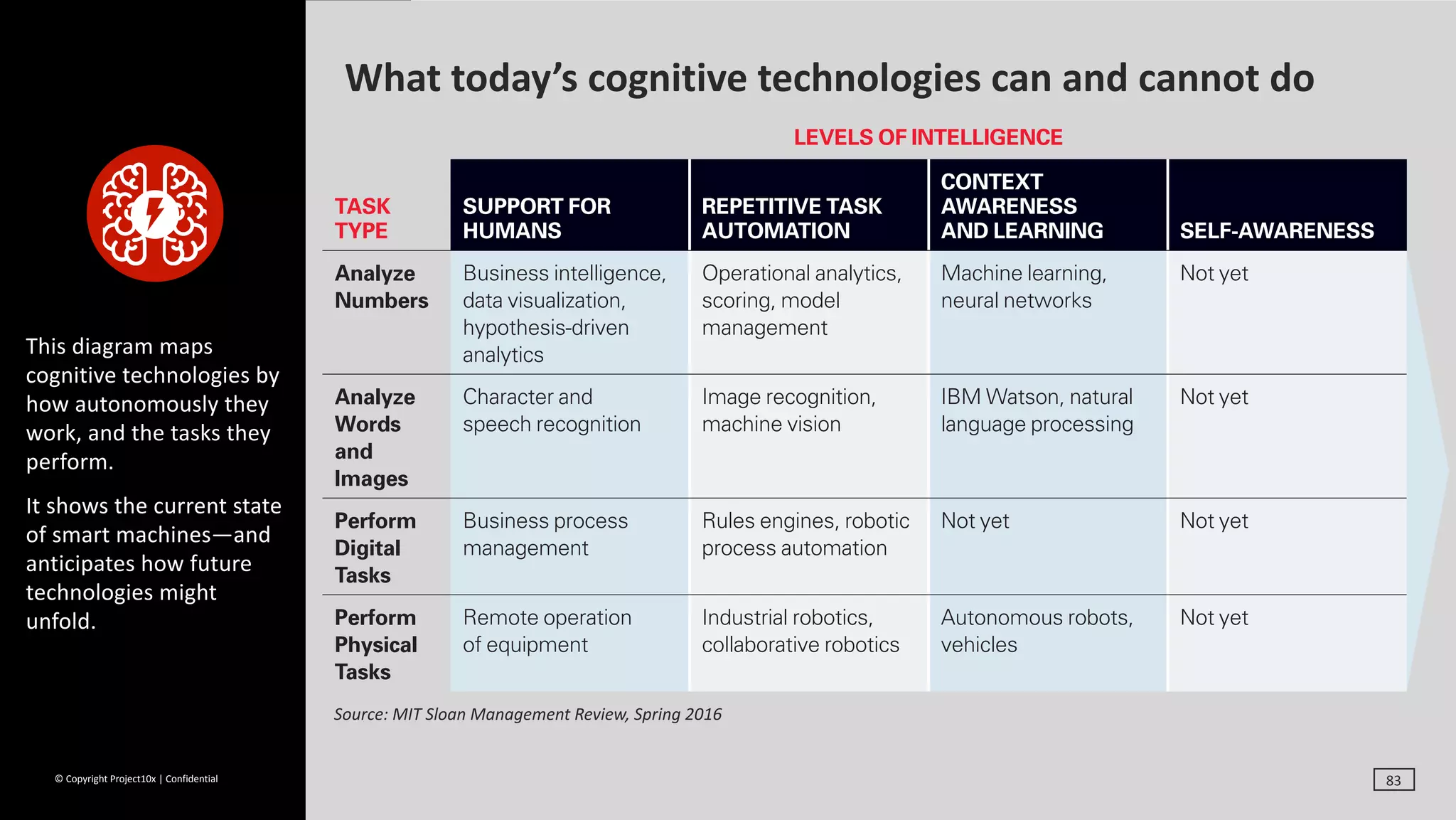
This	diagram	maps	
cognitive	technologies	by		
how	autonomously	they	
work,	and	the	tasks	they	
perform.		
It	shows	the	current	state	
of	smart	machines—and	
anticipates	how	future	
technologies	might	
unfold.
SPRING 2016 MIT SLOAN MANAGEMENT REVIEW
WHAT TODAY’S COGNITIVE TECHNOLOGIES CAN — AND CAN’T — DO
Mapping cognitive technologies by how autonomously they work and the tasks they perform shows the current
state of smart machines — and anticipates how future technologies might unfold.
LEVELS OF INTELLIGENCE
TASK
TYPE
SUPPORT FOR
HUMANS
REPETITIVE TASK
AUTOMATION
CONTEXT
AWARENESS
AND LEARNING SELF-AWARENESS
T
G
C
Analyze
Numbers
Business intelligence,
data visualization,
hypothesis-driven
analytics
Operational analytics,
scoring, model
management
Machine learning,
neural networks
Not yet
Analyze
Words
and
Images
Character and
speech recognition
Image recognition,
machine vision
IBM Watson, natural
language processing
Not yet
Perform
Digital
Tasks
Business process
management
Rules engines, robotic
process automation
Not yet Not yet
Perform
Physical
Tasks
Remote operation
of equipment
Industrial robotics,
collaborative robotics
Autonomous robots,
vehicles
Not yet
Source:	MIT	Sloan	Management	Review,	Spring	2016
What	today’s	cognitive	technologies	can	and	cannot	do
83
AI: ACT
©	Copyright	Project10x	|	Confidential 85
• Building	blocks	and	levels	of	intelligent	action	
• Levels	of	intelligent	action		
• Search	and	question	answering	
• Rules	engines	
• Expert	systems	
• Recommender	systems	
• Automated	planning	and	scheduling	systems	
• Robotic	process	automation	
• Autonomic	computing	
• Autonomous	systems
Overview	of

AI:	Act
©	Copyright	Project10x	|	Confidential
Four	building	blocks	for	intelligent	action
Source: HfS
Software	development	toolkit	
allows	non-engineers	quickly	
to	create	software	robots	to	
automate	rules-driven	
business	processes.		
E.g.	digitize	process	of	
collecting	of	unpaid	invoices,	
mimicking	manual	activities	in	
the	RPA	software,	the	
integration	of	electronic	
documents	and	generation	of	
automated	emails	to	ensure	
the	whole	collections,	process	
is	run	digitally	and	can	be	
repeated	in	a	hi-throughput,	
high	intensity	model.
Simulating	human	thought	
in	a	set	of	processes.	It	
involves	self-learning	
systems,	data	mining,	
pattern	recognition,	and	
natural	language	processing	
to	mimic	the	way	the	
human	brain	works.		
E.g.	an	insurance	
adjudication	system	that	
assesses	claims,	based	on	
scanned	documents	and	
available	data	from	similar	
claims	and	evaluates	
payment	awards.
Self-learning	and	self-
remediating	engines.	
System	makes	autonomous	
decisions,	using	hi-level	
policies.	Constantly	
monitors,	adapts	and	
optimizes	its	performance	
as	conditions	change	and	
business	rules	evolve.		
E.g.	a	virtual	support	agent	
continuously	learning	to	
handle	queries	and	creating	
new	rules/exceptions	as	
products	evolves	and	
queries	change.
Intelligent	automation	systems	
go	beyond	routine	business	
and	IT	process	activity		to	
make	decisions	and	
orchestrate	processes.		
E.g.	an	AI	system	managing	a	
fleet	of	self-driving	cars	or	
drones	to	deliver	goods	to	
clients,	manage	aftermarket	
warranties	and	continuously	
improve	the	supply	chain.
Artificial	IntelligenceRobotic	Process	Automation AutonomicsCognitive	Computing
86
©	Copyright	Project10x	|	Confidential
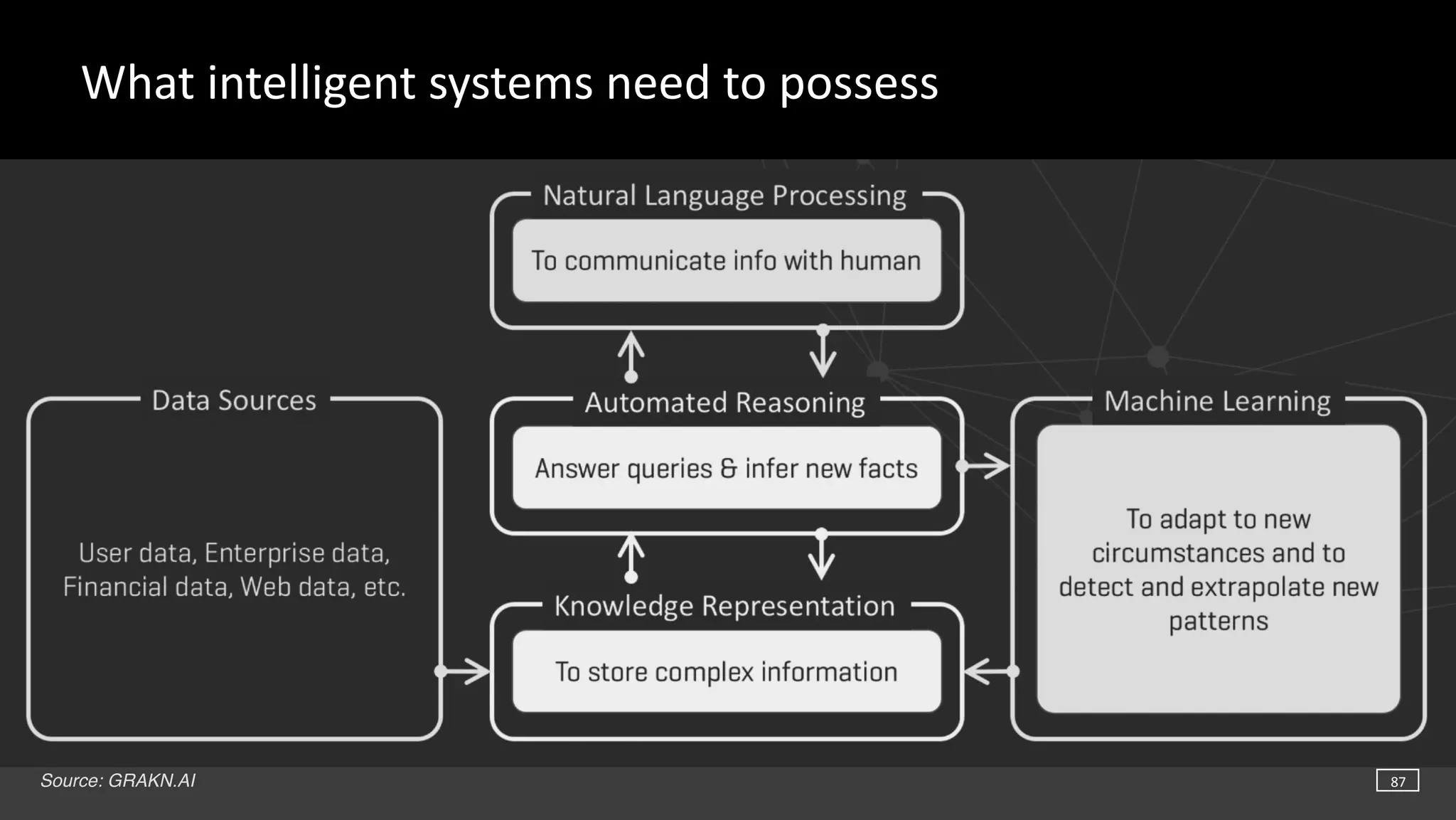
What	intelligent	systems	need	to	possess
Source: GRAKN.AI 87
©	Copyright	Project10x	|	Confidential
Four	levels	of	intelligent	action
88
FIXED
SEMANTIC
AUTONOMIC
AUTONOMOUS
•	Fixed	interfaces	
•	Hard-wired	design	`me	stack	
•	Black	boxes	
•	H2M	interoperability
VALUE
KNOWLEDGE	INTENSIVITYLow Hi
LowHi
•Model-based,	seman`c	APIs,	dynamic	
interfaces	
•Self-declaring,	self-defining	components	
•Glass	boxes	
•M2M	integra`on	and	interoperability
•Self*	(awareness,	provisioning,	configuring,	diagnosing)		
•Pervasive	adap`vity	(sense,	interpret,	respond)	
•Mobile	dynamics,	granular	security,	
•M2M	performance	op`miza`on
•	Goal-oriented,	

•	Mul`-domain	knowledge	
•	Cogni`ve	automa`on	
•	Mul`-agent	
•	M2M	&	predic`ve	learning
©	Copyright	Project10x	|	Confidential
What	makes	intelligent	systems	different?
Goal-orienta`on
Constraint-based	

models
Event-driven

inferencing
Context

awareness
Adap`vity
Self-op`miza`on
89
©	Copyright	Project10x	|	Confidential
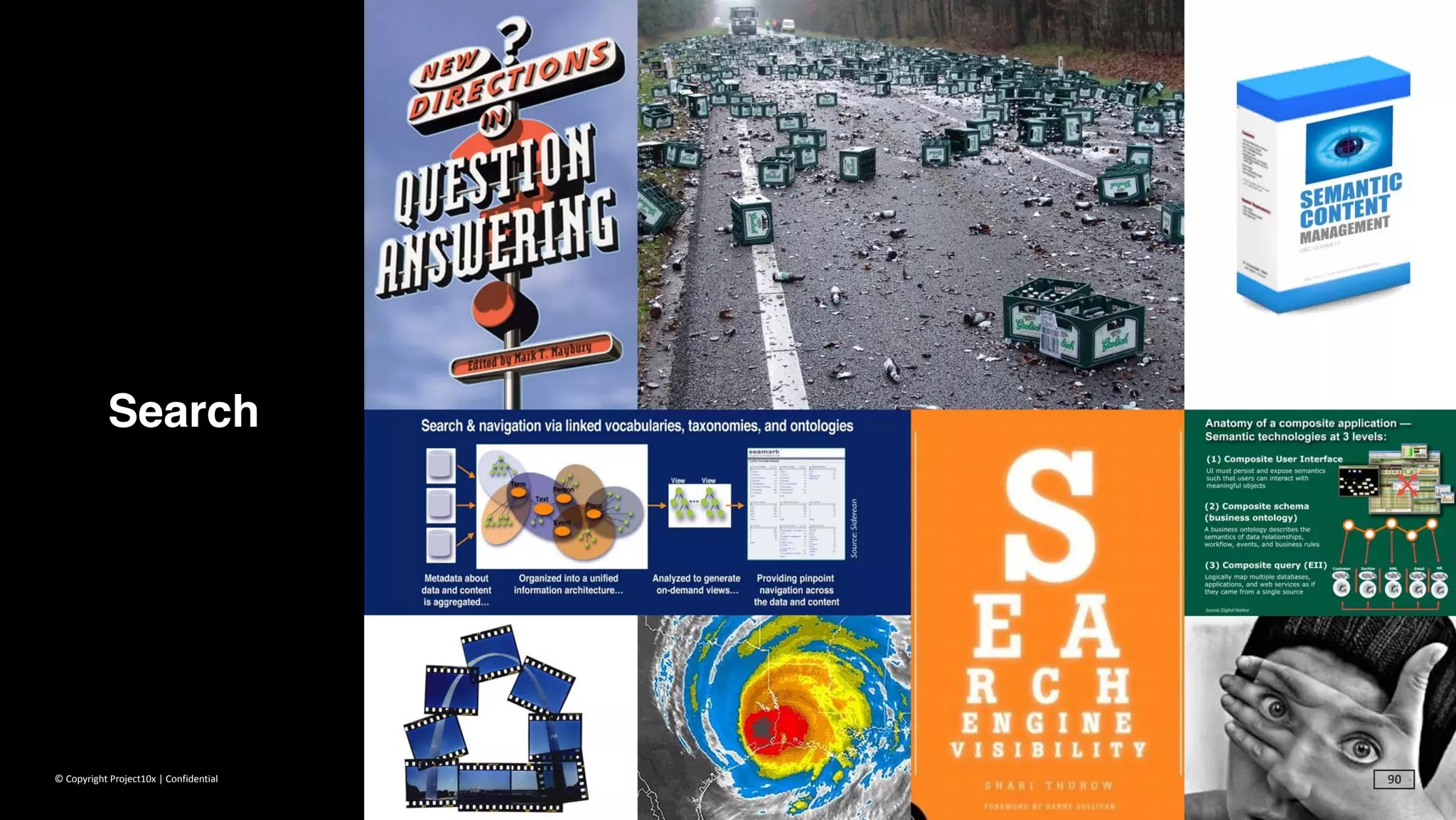
Search
90
©	Copyright	Project10x	|	Confidential
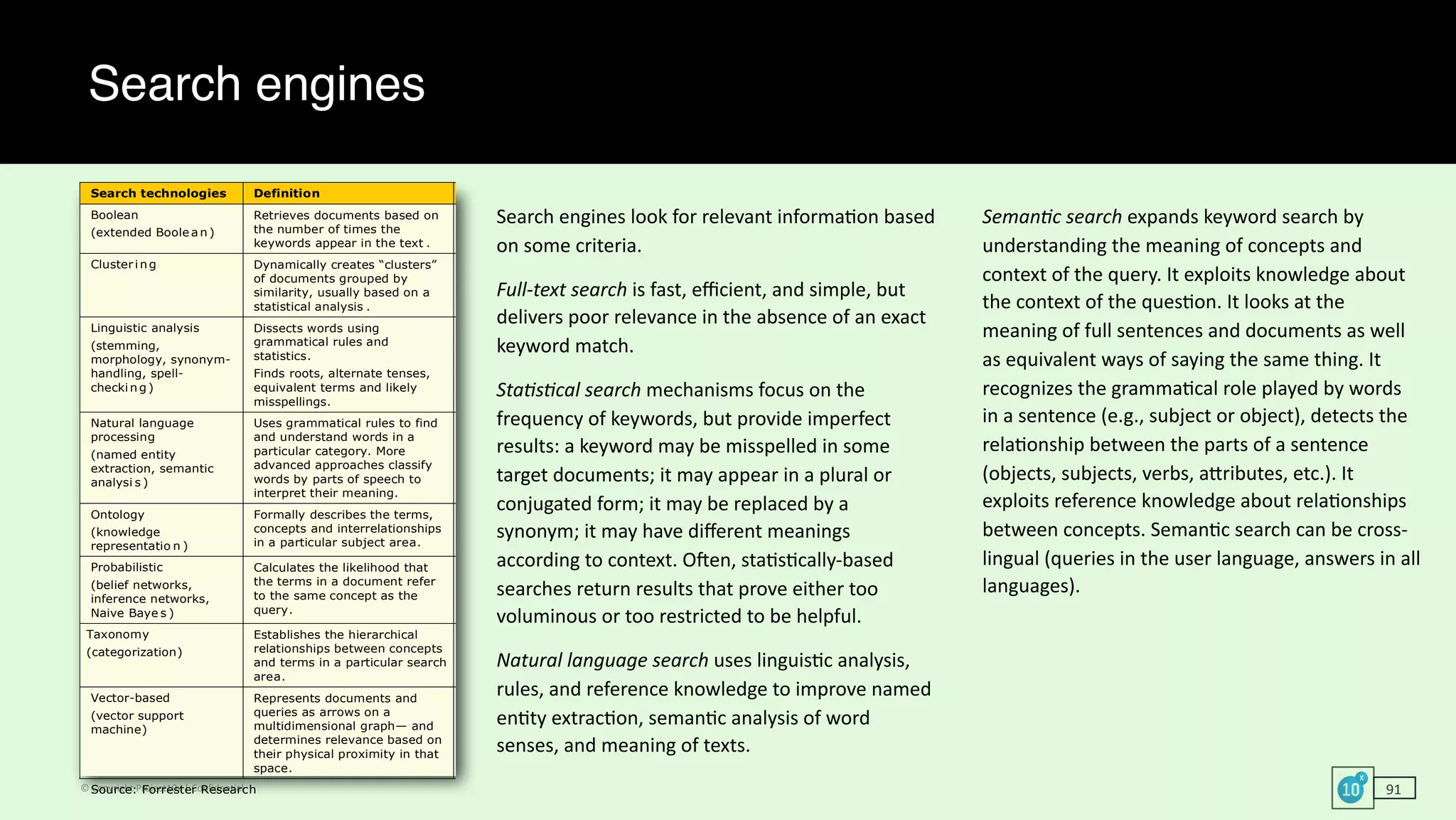
Search engines
91
Search	engines	look	for	relevant	informa`on	based	
on	some	criteria.		
Full-text	search	is	fast,	efficient,	and	simple,	but	
delivers	poor	relevance	in	the	absence	of	an	exact	
keyword	match.		
StaMsMcal	search	mechanisms	focus	on	the	
frequency	of	keywords,	but	provide	imperfect	
results:	a	keyword	may	be	misspelled	in	some	
target	documents;	it	may	appear	in	a	plural	or	
conjugated	form;	it	may	be	replaced	by	a	
synonym;	it	may	have	different	meanings	
according	to	context.	Osen,	sta`s`cally-based	
searches	return	results	that	prove	either	too	
voluminous	or	too	restricted	to	be	helpful.		
Natural	language	search	uses	linguis`c	analysis,	
rules,	and	reference	knowledge	to	improve	named	
en`ty	extrac`on,	seman`c	analysis	of	word	
senses,	and	meaning	of	texts.	
SemanMc	search	expands	keyword	search	by	
understanding	the	meaning	of	concepts	and	
context	of	the	query.	It	exploits	knowledge	about	
the	context	of	the	ques`on.	It	looks	at	the	
meaning	of	full	sentences	and	documents	as	well	
as	equivalent	ways	of	saying	the	same	thing.	It	
recognizes	the	gramma`cal	role	played	by	words	
in	a	sentence	(e.g.,	subject	or	object),	detects	the	
rela`onship	between	the	parts	of	a	sentence	
(objects,	subjects,	verbs,	acributes,	etc.).	It	
exploits	reference	knowledge	about	rela`onships	
between	concepts.	Seman`c	search	can	be	cross-
lingual	(queries	in	the	user	language,	answers	in	all	
languages).	
Search technologies Definition Sample vendors
Boolean
(extended Boole a n )
Retrieves documents based on
the number of times the
keywords appear in the text .
Virtually all search
engine s
Clusteri ng Dynamically creates “clusters”
of documents grouped by
similarity, usually based on a
statistical analysis .
Autonomy,
GammaSite,
Vivisim o
Linguistic analysis
(stemming,
morphology, synonym-
handling, spell-
checki n g )
Dissects words using
grammatical rules and
statistics.
Finds roots, alternate tenses,
equivalent terms and likely
misspellings.
Virtually all search
engines
Natural language
processing
(named entity
extraction, semantic
analysi s )
Uses grammatical rules to find
and understand words in a
particular category. More
advanced approaches classify
words by parts of speech to
interpret their meaning.
Albert, Inxight,
InQuira
Ontology
(knowledge
representatio n )
Formally describes the terms,
concepts and interrelationships
in a particular subject area.
Endeca, InQuira,
iPhrase, Verity
Probabilistic
(belief networks,
inference networks,
Naive Baye s )
Calculates the likelihood that
the terms in a document refer
to the same concept as the
query.
Autonomy,
Recommind,
Microsoft
Taxonomy
(categorization)
Establishes the hierarchical
relationships between concepts
and terms in a particular search
area.
GammaSite, H5
Technologies,
YellowBrix
Vector-based
(vector support
machine)
Represents documents and
queries as arrows on a
multidimensional graph— and
determines relevance based on
their physical proximity in that
space.
Convera, Google,
Verity
Source: Forrester Research
©	Copyright	Project10x	|	Confidential 92
Search engine parts
This	diagram	looks	under	the	hood	of	a	
search	engine	to	iden`fy	the	component	
parts:	search	inputs,	query	matching	
algorithms,	and	types	of	search	outputs	
that	the	user	sees.
©	Copyright	Project10x	|	Confidential 93
Question answering
Ques`on	answering	(QA)	is	more	than	search,	more	than	
discovery,	and	more	than	document	retrieval.		
The	first	step	is	to	analyze	the	natural	language	ques`on	to	
determine	the	informa`on	needed	and	the	form	that	the	
answer	should	take,	e.g.	a	factoid	for	“who	discovered	
oxygen?”,	a	list	for	“what	countries	export	oil?”,	a	
defini`on	for	“what	is	a	quasar?”.		
Ques`on	analysis	involves	both	linguis`c	and	seman`c	
processing,	and	results	in	targeted	informa`on	retrieval	
queries	to	search	engines	to	return	documents	that	are	
likely	to	contain	elements	of	the	answer	sought.		
The	next	step	is	to	extract	and	aggregate	informa`on	
passages	from	these	sources,	then	to	reason	about	the	
content	in	order	to	extract	or	synthesize	the	answer,	and	to	
present	it	to	user.
Machine
Learning
Question
Analysis
Feature
Engineering
Ontology
Analysis
Question
& Answer
Natural
Language
Processing
Question	answering	involves	analyzing	questions,		
retrieving	documents,	retrieving	passages,	and		
extracting	answers.
©	Copyright	Project10x	|	Confidential
Rules engine
• A	rules	engine	is	a	sosware	
system	that	executes	one	or	
more	business	rules	in	a	run`me	
produc`on	environment.		
• A	business	rule	system	enables	
company	policies	and	other	
opera`onal	decisions	to	be	
defined,	tested,	executed	and	
maintained	separately	from	
applica`on	code.	
• Rules-based	systems	use	
databases	of	knowledge	and	if-
then	rules	to	automate	the	
process	of	making	inferences	
about	informa`on.
94
©	Copyright	Project10x	|	Confidential
Expert	systems
KNOWLEDGE	BASE
Knowledge	Models
Smart	DataRules	&	Theory
Machine	Learning	
&	Data	Analytics
Knowledge	
Authoring	
&	Curation
Question	AnsweringKnowledge	Management Virtual	Assistance
INFERENCE

ENGINE
Decisions
Actions
Explanations
Reporting
Self-Documentation
SMART	USER	INTERFACE • An	expert	system	(ES)	employs	knowledge	about	its	
application	domain	and	uses	inferencing	(reasoning)	
procedures	to	solve	problems	that	require	human	
competence	or	expertise.		
• An	expert	system	contains	three	subsystems:	an	inference	
engine,	a	knowledge	base,	and	a	user	interface.	
• The	expert	system	reasons	with	the	knowledge	base.	Its	
reasoning	engine	interprets	directions,	answers	
questions,	and	executes	commands	that	result	in	decisions,	
actions,	reporting,	explanations,	and	self-documentation.		
• Expert	systems	assist	and	augment	human	decision	
makers.	Application	areas	include	classification,	diagnosis,	
monitoring,	process	control,	design,	scheduling	and	
planning,	and	generation	of	options.
95
©	Copyright	Project10x	|	Confidential
Recommender	system
• Recommend	—	to	put	forward	(someone	or	
something)	with	approval	as	being	suitable	for	a	
par`cular	purpose	or	role.	
• RecommendaHon	engines	automate	the	process	of	
making	real-`me	recommenda`ons	to	customers.	
• A	simple	example:	an	online	customer	who	is	browsing	
a	store	for	one	item	(e.g.	a	power	drill),	places	the	
item	in	their	shopping	cart,	and	is	then	recommended	
to	buy	a	complementary	item	(e.g.,	a	set	of	drill	bits).	
This	example	is	trivial.	Machine	learning	can	go	
further,	osen	uncovering	unexpected	buying	pacerns,	
based	on	unforeseen	rela`onships	between	different	
customers	and	between	different	products.	
• Recommender	systems	take	into	account	where	on	
the	site	the	customer	had	visited,	their	history	of	
purchases	at	the	site	and	even	their	social	network	
history.	It	may	be	that	the	customer	browsed	for	
mortar	on	the	last	visit	to	the	site.	Perhaps	the	user	
also	asked	friends	about	selec`ng	bathroom	`les	on	
Facebook.	In	this	case	it	might	make	sense	to	
recommend	a	mortar	mixing	acachment	–	since	it	is	
clear	the	customer	is	doing	a	`ling	project.	For	a	
machine	learning	algorithm,	iden`fying	non-explicit	
rela`onships	like	this	is	typical.	
• A	machine	learning	recommender	system	improves	
with	`me.	It	learns	from	successful,	and	unsuccessful	
recommenda`ons.	The	same	underlying	technology	
can	be	used	to	provide	customers	with	many	other	
kinds	of	personalized	experiences,	based	on	data	of	
many	kinds.
96
©	Copyright	Project10x	|	Confidential
Automated	planning	

and	scheduling	system	
AI	systems	that	devise		
strategies	and	sequences	of	
actions	to	meet	goals	and	
observe	constraints,	typically	
for	execution	by	intelligent	
agents,	autonomous	robots	
and	unmanned	vehicles.
97
©	Copyright	Project10x	|	Confidential
Robotic	process	
automation	(RPA)	
Captures	and	interprets	
existing	means	for	
conducting	a	task,	
processing	a	transaction,	
manipulating	data,	
triggering	responses,	and	
communicating	with	other	
systems.	This	may	include	
manual,	repetitive	tasks,	
intelligent	automation	of	
processes,	and	
augmentation	of	resources.
98
©	Copyright	Project10x	|	Confidential
Robotics	
• A	robot	is	a	programmable	mechanical	or	software	
device	that	can	perform	tasks	and	interact	with	its	
environment,	without	the	aid	of	human	interaction.		
• Robotics	is	embracing	cognitive	technologies	to	create	
robots	that	can	work	alongside,	interact	with,	assist,	or	
entertain	people.	Such	robots	can	perform	many	
different	tasks	in	unpredictable	environments,	
integrating	cognitive	technologies	such	as	computer	
vision	and	automated	planning	with	tiny,	high-
performance	sensors,	actuators,	and	hardware.	Current	
development	efforts	focus	how	to	train	robots	to	interact	
with	the	world	in	generalizable	and	predictable	ways.		
• Deep	learning	is	being	used	in	robotics.	Advances	in	
machine	perception,	including	computer	vision,	force,	
and	tactile	perception	are	key	enablers	to	advancing	the	
capabilities	of	robotics.	Reinforcement	learning	helps	
obviate	the	need	for	large	labeled	data	sets.
99
©	Copyright	Project10x	|	Confidential 100
au·to·ma·tion	
/ˌôdəˈmāSH(ə)n/	
The	use	of	software	and	equipment	in	a	system	or	production	process	so	
that	it	works	largely	by	itself	with	little	or	no	direct	human	control.	
Robotic	process	automation	and	intelligent	automation	are	the	
combination	of	AI	and	automation.What	is	automation?
©	Copyright	Project10x	|	Confidential 101
• “Automation”	today	can	be	defined	as	including	any	functional	activity	
that	was	previously	performed	manually	and	is	now	handled	via	
technology	platforms	or	process	automation	tools	like	robotic	process	
automation	(RPA)	platforms.	
• With	increasing	computer	processing	power,	technology	has	reached	a	
point	where	its	ability	to	perform	human-like	tasks	has	become	possible.	
• There	are	various	names	for	referring	to	robotics	in	service	industries	
such	as	Rapid	Automation	(RA),	Autonomics,	Robotic	Process	
Automation,	software	bots,	Intelligent	Process	Automation	or	even	plain	
Artificial	Intelligence.		
• These	terms	refer	to	the	same	concept:	letting	organizations	automate	
current	tasks	as	if	a	real	person	was	doing	them	across	applications	and	
systems.	
• A	primary	opportunity	for	robotic	process	automation	in	the	enterprise	is	
to	augment	the	creative	problem-solving	capabilities	and	productivity	of	
human	beings	and	deliver	superior	business	results.
Automation:	letting	
organizations	automate	
current	tasks	as	if	a	real	
person	was	doing	them	
across	applications	and	
systems.
©	Copyright	Project10x	|	Confidential
Source: HfS - 2016
Evolving	landscape	of	
service	agents	and	
intelligent	automation:	
• From	desktop	automation	
to	RPA,	to	chatbot,	to	
assistant,	to	virtual	agent.	
• From	enhancement	of	
data,		to	augmentation	of	
human	agents,	to	
substitution		of		digital	
labor	for	the	human	agent.
Example
vendors:
102
©	Copyright	Project10x	|	Confidential 103Source: Deloitte
Manual	process	vs	
robotic	process	
automation
©	Copyright	Project10x	|	Confidential 104
Robotic Desktop
Automation (RDA)
• Personal robots for
every employee
• Call center, retail, branches,
back office
• 20-50% improvement across
large workforce groups
• RDA also provides dashboards
and UI enhancements
Robotic Process
Automation (RPA)
• Unattended robots replicating
100% of work
• Back office, operations,
repetitive
• 100% improvement across
smaller sub-groups
• Runs on a virtual server farm
(or under your desk)
Comparing	robotic	
desktop	automation	
(RDA)	and	robotic	
process	automation	
(RPA)
©	Copyright	Project10x	|	Confidential 105
• Robotic	process	automation	gives	humans	the	potential	of	attaining	new	
levels	of	process	efficiency,	such	as	improved	operational	cost,	speed,	
accuracy	and	throughput	volume,	and	leaving	behind	the	repetitive	and	time	
consuming	low	added-value	tasks.	
• Top	drivers	for	implementing	robotic	automation	beyond	cost	savings	include:	
- High	quality	by	a	reduction	of	error	rates	
- Time	savings	via	better	management	of	repeatable	tasks	
- Scalability	by	improving	standardization	of	process	workflow	
- Integration	by	reducing	the	reliance	on	multiple	systems/screens	to	
complete	a	process	
- Reducing	friction	(increasing	straight-through	processing)	
• For	example,	back-office	tasks	do	not	require	direct	interaction	with	
customers	and	can	be	performed	more	efficiently	and	effectively	off-site	or	by	
robots.	It	is	feasible	to	re-engineer	hundreds	of	business	processes	with	
software	robots	that	are	configured	to	capture	and	interpret	information	
from	systems,	recognize	patterns,	and	run	business	processes	across	multiple	
applications	to	execute	activities	including	data	entry	and	validation,	
automated	formatting,	multi-format	message	creation,	text	mining,	workflow	
acceleration,	reconciliations	and	currency	exchange	rate	processing	among	
others.
Robotic	process	
automation	(RPA)
©	Copyright	Project10x	|	Confidential 106
Intelligent	process	automation	is	smart	software	with	machine-learning	
capabilities:	
• Unlike	RPA,	which	must	be	programmed	to	perform	a	task,	AI	can	train	
itself	or	be	trained	to	automate	more	complex	and	subjective	work	
through	pattern	recognition	
• Unlike	RPA,	which	requires	a	human	expert	to	hard	code	a	script	or	
workflow	into	a	system,	AI	can	process	natural	language	and	unstructured	
data	
• Unlike	RPA,	AI	responds	to	a	change	in	the	environment,	adapts	and		
learns	the	new	way
Intelligent	process	
automation	(IPA)
©	Copyright	Project10x	|	Confidential
Intelligent	automation	stages
Source: Shahim Ahmed, CA Technologies
107
©	Copyright	Project10x	|	Confidential 108
Trigger	based
Rules-based
dynamic	language
Rules-based
standardized	language
Structured
CHARACTERISTIC	OF	DATA	/	INFORMATION
Unstructured	without	patternsUnstructured	patterned
Data	Center		
Automation:
Runbook		
Scripting		
Scheduling	
Job	control		
Workload		
automation		
Process		
orchestration
SOA	
Virtualization		
Cloud	services
RPA
Cognitive		
Computing
Artificial		
Intelligence
BPM	
Workflow	
ERP
Autonomics
PROCESS	CHARACTERISTICS
Source: HfS - 2016
Intelligent	automation	
continuum	
The	spectrum	of	intelligent	
process	automation	spans	
robotic	process	automation,	
cognitive	computing,	
autonomics,	and	artificial	
intelligence.		
The	direction	of	travel	is	

along	three	dimensions.	
Stages	overlap.
©	Copyright	Project10x	|	Confidential 109
Four	aspects	of	self-management	as	they	are	now	

and	as	they	become	with	autonomic	computing
Concept Current	computing Autonomic	computing
Self-configuration Corporate	data	centers	have	multiple	
vendors	and	platforms.	Installing,	
configuring,	and	integrating	systems	is	
time	consuming	and	error	prone.
Automated	configuration	of	components	
and	systems	follows	high-level	policies.	
Rest	of	system	adjusts	automatically	and	
seamlessly.
Self-optimization Systems	have	hundreds	of	manually	set,	
nonlinear	tuning	parameters,	and	their	
number	increases	with	each	release.
Components	and	systems	continually	seek	
opportunities	to	improve	their	own	
performance	and	efficiency.
Self-healing Problem	determination	in	large,	complex	
systems	can	take	a	team	of	programmers	
weeks.
System	automatically	detects,	diagnoses,	
and	repairs	localized	software	and	
hardware	problems.
Self-protection Detection	of	and	recovery	from	attacks	and	
cascading	failures	is	manual.
System	automatically	defends	against	
malicious	attacks	or	cascading	failures.	It	
uses	predictive	analytics	and	early	
warning	to	anticipate	and	prevent	
systemwide	failures.
Autonomic	computing	
Autonomic	computing	
refers	to	the	self-managing	
characteristics	of	AI-based	
distributed	computing	
resources,	adapting	to	
unpredictable	changes	
while	hiding	intrinsic	
complexity	to	operators	
and	users.
©	Copyright	Project10x	|	Confidential
Autonomous	vehicles	
Everyone	(Google,	Baidu,	
Apple,	NVidia,	Uber,	Tesla,	
Volvo,	Kamaz,	Mercedes-
Benz,	etc.)	is	developing	
their	own	autonomous	car.	
Automobiles	will	soon	
become	really	auto-
mobile.	The	main	
restriction	here	seems	to	
be	laws	and	regulations.
110
©	Copyright	Project10x	|	Confidential
DRONE
Autonomous	drones	
Controlling	different	
things	now	seems	efficient	
using	deep	learning	(e.g.,	
games,	game	characters,	
drones,	autonomous	cars,	
robotic	control.)
111
©	Copyright	Project10x	|	Confidential
Artificial	intelligence	—	issues
In	order	to	work	on	real	AI,	as	opposed	to	the	hype	presented	by	large	
companies	and	the	media	these	days,	the	following	problems	must	be	
worked	on.		
1. Knowledge	Representation:	This	has	always	been	the	biggest	problem	in	
AI	but	serious	work	on	it	stopped	on	it	in	the	mid	80’s	in	favor	of	easy	to	
extract	large,	shallow	libraries	of	lexical	information.		
2. Complex	Models	of	Goals	and	Plans:	In	order	to	help	and	learn,	an	
intelligent	system	(a	dog,	a	human	or	a	computer)	needs	to	know	about	
goals,	and	plans	to	achieve	those	goals,	common	mistakes	with	plans	it	has	
tried	in	the	past,	and	how	to	explain	and	learn	from	those	mistakes.		
3. Human-Like	Models	of	Memory:	Humans	update	their	memory	with	every	
interaction.	They	learn.	Every	experience	changes	their	world	model.	In	
order	to	build	real	AI	we	need	to	focus	on	limited	domains	of	knowledge	in	
which	the	goals	and	plans	of	actors	are	represented	and	understood	so	
that	they	can	be	acted	upon	or	acted	against.	AI	systems	must	learn	from	
their	own	experiences,	not	learn	by	having	information	fed	into	them.		
4. Conversational	Systems:	In	practice,	this	means	being	able	to	build	a	
program	that	can	hold	up	its	end	of	a	conversation	with	you.	(unlike	Siri	or	
any	travel	planning	program).	Such	systems,	should	be	linked	to	a	memory	
of	stories	(typically	no	more	than	1.5	minutes	in	length	and	in	video)	from	
the	best	and	brightest	people	in	the	world.	Those	stories	should	“find”	the	
user	when	the	program	knows	that	they	would	be	helpful.	This	happens	
every	day	in	human	interaction.	One	person	talks	to	another	person	about	
what	they	are	thinking	or	working	on	and	the	other	person	reacts	with	a	
just-in-time	reminding,	a	story	that	came	to	mind	because	it	seemed	
relevant	to	tell	at	the	time,	a	story	meant	to	help	the	other	person	think	
things	out.		
5. Reminding:	A	computer	in	a	situation	must	get	reminded	of	relevant	
situations	it	has	previously	experienced	to	guide	it	in	its	actions.	This	is	real	
AI.	Done	on	a	massive	scale,	this	means	capturing	the	expertise	in	a	any	
given	domain	by	inputting	stories	and	indexing	those	stories	with	respect	
to	what	goals	and	plans	and	contexts	they	might	pertain	so	that	they	can	
be	delivered	just	in	time	to	a	user.	We	can	do	this	now	to	some	extent,	but	
we	need	to	start	working	on	the	real	AI	problems	of	automated	indexing	of	
knowledge.	(Although	this	may	be	what	machine	learning	people	say	they	
can	do,	they	are	talking	about	words	and	they	are	not	trying	to	build	an	
ever	increasingly	complex	world	model	as	humans	do	through	daily	life.)
Source: Roger C Shank
112
AI encompasses multiple technologies that can be combined to sense, think,
and act as well as to learn from experience and adapt over time. Sense refers to
pattern recognition, machine perception, speech recognition, computer vision
and affective computing. Think refers to natural language processing, knowledge
representation and reasoning, machine learning and deep learning, and
cognitive computing. Act refers to search engines and question answering, rules
engines, expert systems, recommender systems, automated planning and
scheduling, autonomic computing, and autonomous systems.
113
©	Copyright	Project10x	|	Confidential

Ai — Externalization of Mind