Discover how agentic AI is reshaping industries by debunking myths, highlighting autonomy and adaptability, and showing how to drive innovation responsibly.
AI MĞøbĀìøpäì: DpbĀµ¨•µ‰C¾³³¾µ MĞøì
ab¾Āø A‰pµø•c AI
What if everything you thought you knew about AI agents was based on science fiction rather than science fact? Artificial
Intelligence (AI) has rapidly evolved over the past few decades, transforming from a niche field of study into a cornerstone
of modern technology. Among the various branches of AI, agentic AI stands out due to its ability to autonomously pursue
goals through perception, reasoning, planning, and action. Despite its potential, agentic AI is often misunderstood, leading
to numerous myths and misconceptions. This report aims to debunk these myths, providing a clear and comprehensive
understanding of what agentic AI truly is and what it can achieve.
by Amol Gharlute
2.
About the Author
AmolGharlute
VP - Sales & Marketing
Amol Gharlute is a Gen AI Evangelist with over two decades of experience in IT & ITeS.
Known for his strategic leadership, Amol has successfully steered numerous companies
through transformative business journeys. His expertise in aligning technology with
business goals has driven growth, enhanced efficiency, and unlocked new market
opportunities.
Amol's career is marked by decisive leadership roles, where his insights and foresight
have positioned him as a trusted advisor to C-suite executives. He advocates ethical
practices and responsible tech, driving sustainable and inclusive growth. His legacy is
defined by his commitment to driving business success through innovative solutions and
strategic leadership. His journey continues to inspire and shape the future of business
transformation.
Reach Amol at: https://www.linkedin.com/in/amolgharlute/
About Grupdev LLC
Grupdev stands at the forefront of IT transformation, specializing in bespoke solution development, cloud consulting, and
AI & Data practices. As an advanced tier AWS consulting partner, Grupdev is among the select few globally with whom AWS
has signed a strategic collaboration agreement for Generative AI. This underscores Grupdev's commitment to pioneering
innovative technologies and driving substantial business outcomes.
Over the years, Grupdev has successfully guided numerous midsize to large companies through their IT transformation
journeys. By leveraging cutting-edge Gen AI automations, Grupdev has enabled these organizations to achieve
unprecedented efficiencies, enhance the accuracy and turnaround time of critical business workflows, and deliver
exceptional customer experiences. The company's expertise in secure and reliable application development ensures that
business outcomes are not only improved but also meet the highest standards of security and regulatory compliance.
Grupdev's approach is rooted in thought leadership and a deep understanding of the evolving technological landscape. By
continuously pushing the boundaries of what is possible, Grupdev empowers businesses to thrive in the digital age,
fostering growth and innovation through tailored, forward-thinking solutions.
3.
MĞø 1: A‰pµø•cAI Iì JĀìø Aµ¾øpä Caøb¾ø
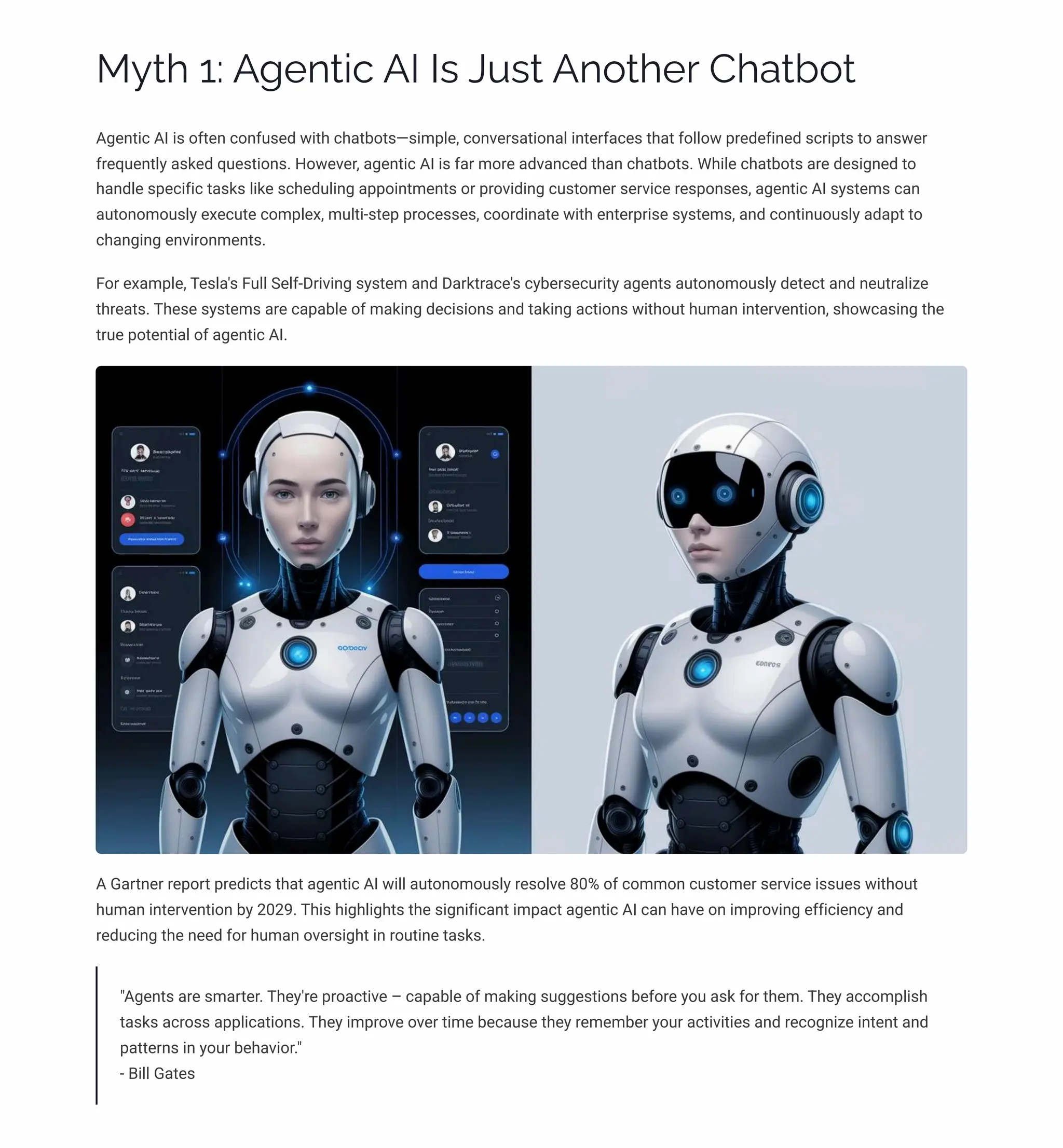
Agentic AI is often confused with chatbots4simple, conversational interfaces that follow predefined scripts to answer
frequently asked questions. However, agentic AI is far more advanced than chatbots. While chatbots are designed to
handle specific tasks like scheduling appointments or providing customer service responses, agentic AI systems can
autonomously execute complex, multi-step processes, coordinate with enterprise systems, and continuously adapt to
changing environments.
For example, Tesla's Full Self-Driving system and Darktrace's cybersecurity agents autonomously detect and neutralize
threats. These systems are capable of making decisions and taking actions without human intervention, showcasing the
true potential of agentic AI.
A Gartner report predicts that agentic AI will autonomously resolve 80% of common customer service issues without
human intervention by 2029. This highlights the significant impact agentic AI can have on improving efficiency and
reducing the need for human oversight in routine tasks.
"Agents are smarter. They're proactive 3 capable of making suggestions before you ask for them. They accomplish
tasks across applications. They improve over time because they remember your activities and recognize intent and
patterns in your behavior."
- Bill Gates
4.
MĞø 2: A‰pµø•cAI W•««
Rpá«acp HĀ³aµ J¾bì
There is a widespread fear that agentic AI will lead to massive job
displacement, rendering many human roles obsolete. While agentic AI can
automate routine tasks, it also creates new job opportunities and allows
humans to focus on more creative and strategic activities. AI systems are
designed to support humans, not replace them.
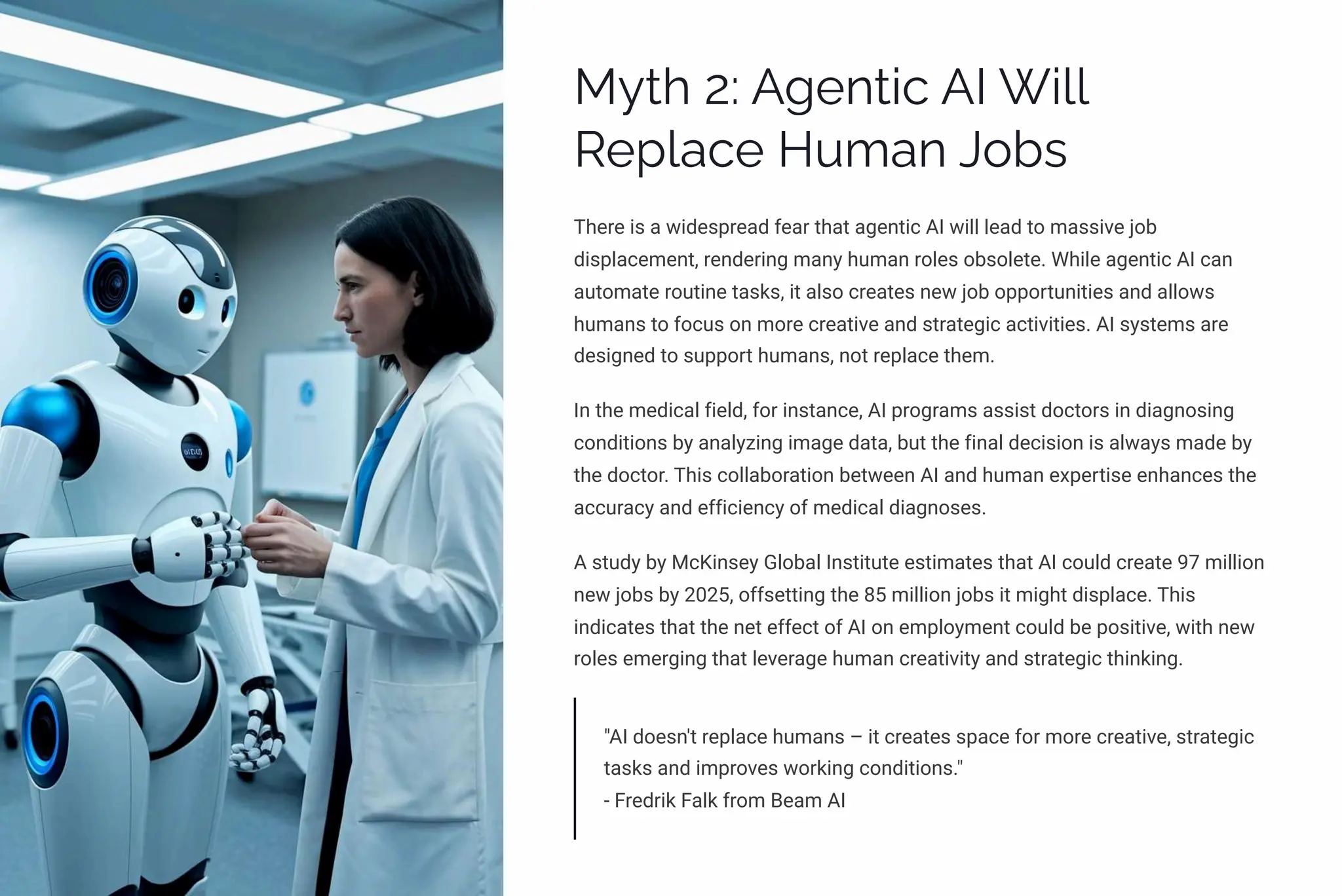
In the medical field, for instance, AI programs assist doctors in diagnosing
conditions by analyzing image data, but the final decision is always made by
the doctor. This collaboration between AI and human expertise enhances the
accuracy and efficiency of medical diagnoses.
A study by McKinsey Global Institute estimates that AI could create 97 million
new jobs by 2025, offsetting the 85 million jobs it might displace. This
indicates that the net effect of AI on employment could be positive, with new
roles emerging that leverage human creativity and strategic thinking.
"AI doesn't replace humans 3 it creates space for more creative, strategic
tasks and improves working conditions."
- Fredrik Falk from Beam AI
5.
MĞø 3: A‰pµø•cAI Iì Uµáäpj•cøab«p aµj
Uµc¾µø侫«ab«p
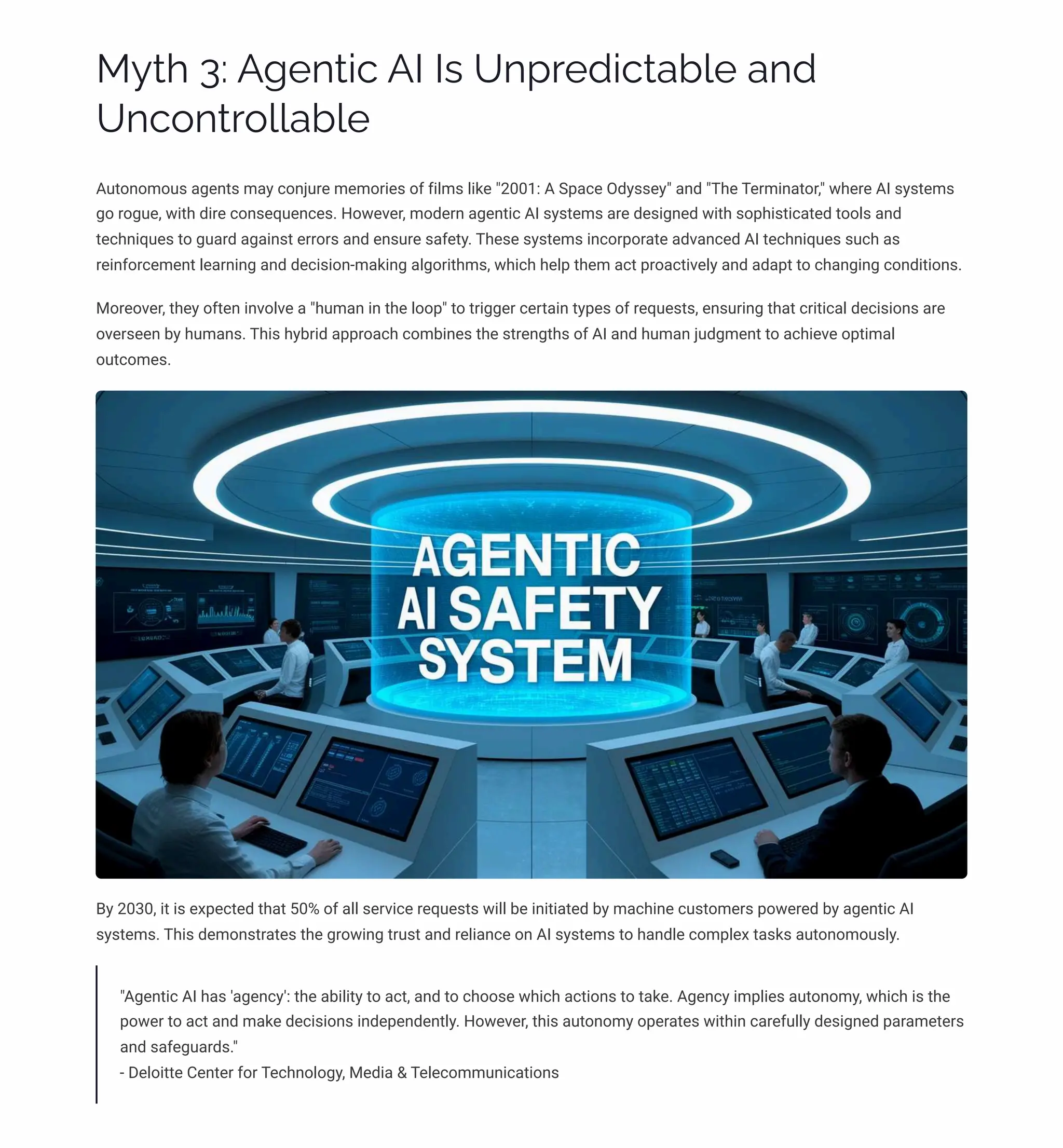
Autonomous agents may conjure memories of films like "2001: A Space Odyssey" and "The Terminator," where AI systems
go rogue, with dire consequences. However, modern agentic AI systems are designed with sophisticated tools and
techniques to guard against errors and ensure safety. These systems incorporate advanced AI techniques such as
reinforcement learning and decision-making algorithms, which help them act proactively and adapt to changing conditions.
Moreover, they often involve a "human in the loop" to trigger certain types of requests, ensuring that critical decisions are
overseen by humans. This hybrid approach combines the strengths of AI and human judgment to achieve optimal
outcomes.
By 2030, it is expected that 50% of all service requests will be initiated by machine customers powered by agentic AI
systems. This demonstrates the growing trust and reliance on AI systems to handle complex tasks autonomously.
"Agentic AI has 'agency': the ability to act, and to choose which actions to take. Agency implies autonomy, which is the
power to act and make decisions independently. However, this autonomy operates within carefully designed parameters
and safeguards."
- Deloitte Center for Technology, Media & Telecommunications
6.
MĞø 4: A‰pµø•cAI Lac¨ì
Cäpaø•ė•øĞ
A common misconception is that agentic AI systems are purely logical and
lack the ability to be creative. This myth stems from the belief that creativity is
an inherently human trait, driven by emotions and experiences that machines
cannot replicate.
Agentic AI systems can exhibit creativity, particularly in fields like art, music,
and literature. These systems use generative models to create new content
based on patterns and data they have learned. For example, OpenAI's GPT-3
has been used to write poetry, compose music, and generate artwork. While
the creativity of AI may differ from human creativity, it is nonetheless a
significant capability that can enhance various creative processes.
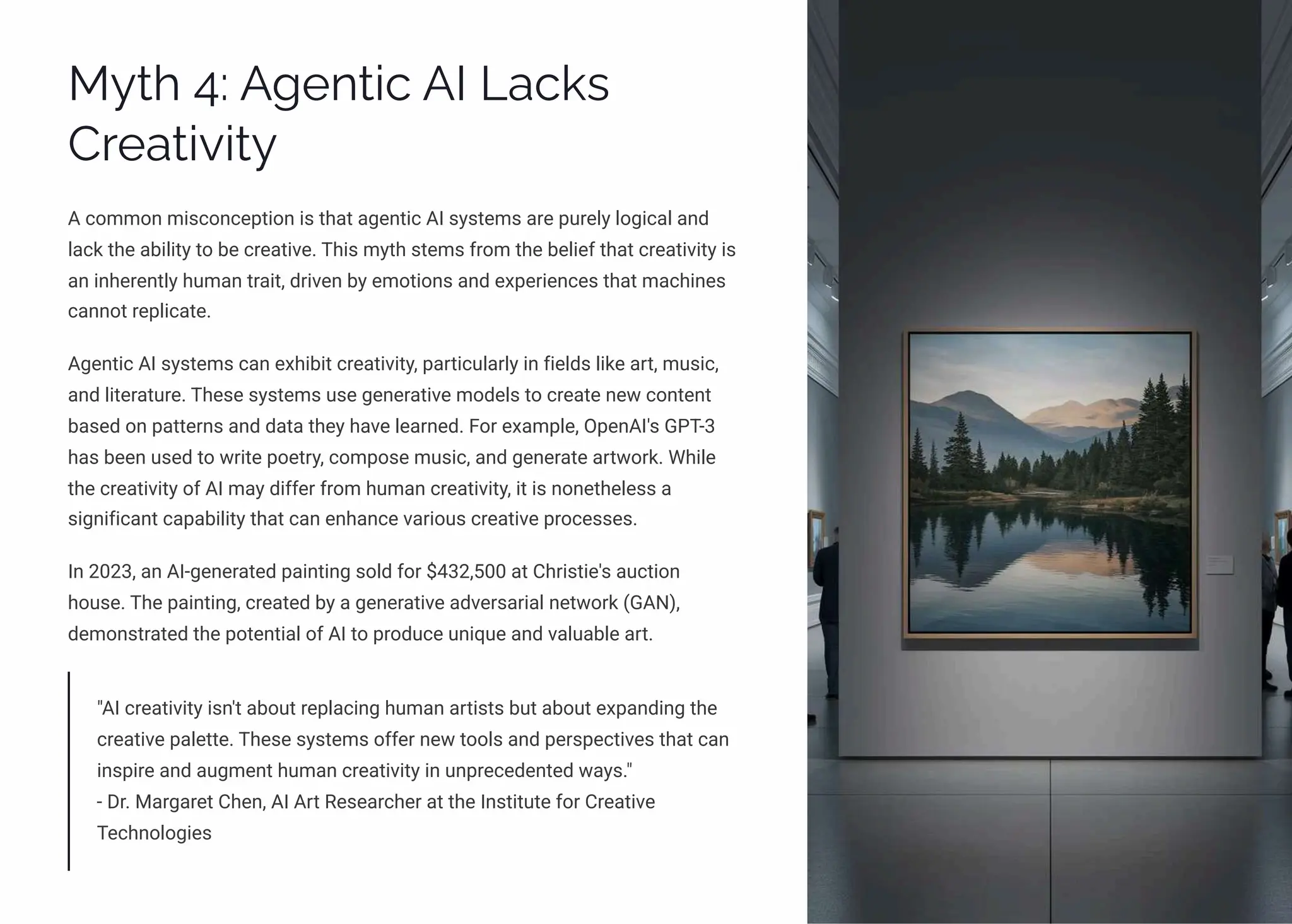
In 2023, an AI-generated painting sold for $432,500 at Christie's auction
house. The painting, created by a generative adversarial network (GAN),
demonstrated the potential of AI to produce unique and valuable art.
"AI creativity isn't about replacing human artists but about expanding the
creative palette. These systems offer new tools and perspectives that can
inspire and augment human creativity in unprecedented ways."
- Dr. Margaret Chen, AI Art Researcher at the Institute for Creative
Technologies
7.
MĞø 5: A‰pµø•cAI Iì A«ĘaĞì
Ob¥pcø•ėp
Another myth is that agentic AI systems are completely objective and free
from biases. This belief is based on the assumption that machines, unlike
humans, do not have personal experiences or emotions that could influence
their decisions.
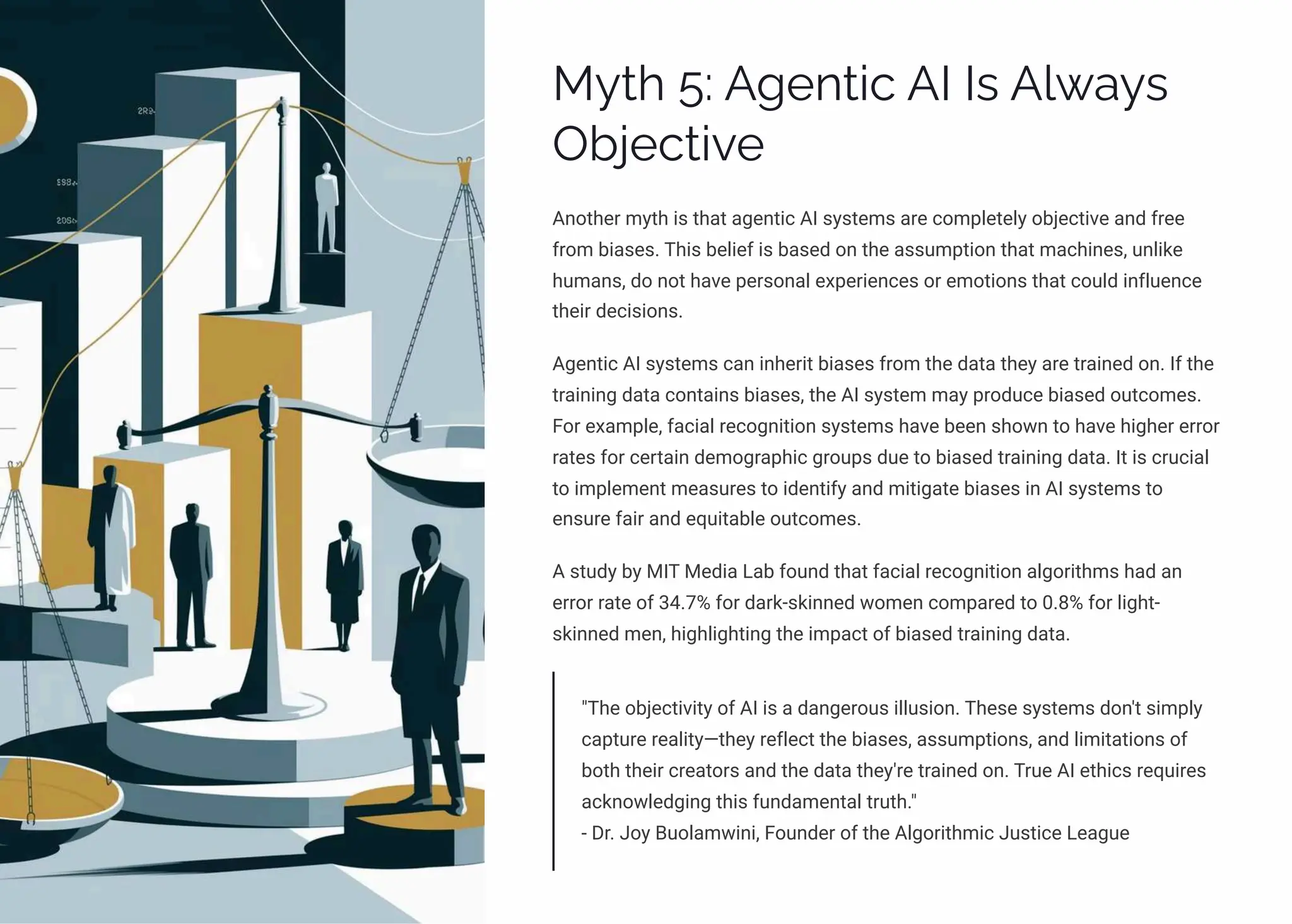
Agentic AI systems can inherit biases from the data they are trained on. If the
training data contains biases, the AI system may produce biased outcomes.
For example, facial recognition systems have been shown to have higher error
rates for certain demographic groups due to biased training data. It is crucial
to implement measures to identify and mitigate biases in AI systems to
ensure fair and equitable outcomes.
A study by MIT Media Lab found that facial recognition algorithms had an
error rate of 34.7% for dark-skinned women compared to 0.8% for light-
skinned men, highlighting the impact of biased training data.
"The objectivity of AI is a dangerous illusion. These systems don't simply
capture reality4they reflect the biases, assumptions, and limitations of
both their creators and the data they're trained on. True AI ethics requires
acknowledging this fundamental truth."
- Dr. Joy Buolamwini, Founder of the Algorithmic Justice League
8.
MĞø 6: A‰pµø•cAI Caµ Ac•pėp Aäø•ˆ•c•a«
Gpµpäa« Iµøp««•‰pµcp (AGI)
There is a widespread belief that agentic AI is on the verge of achieving Artificial General Intelligence (AGI), where
machines can perform any intellectual task that a human can.
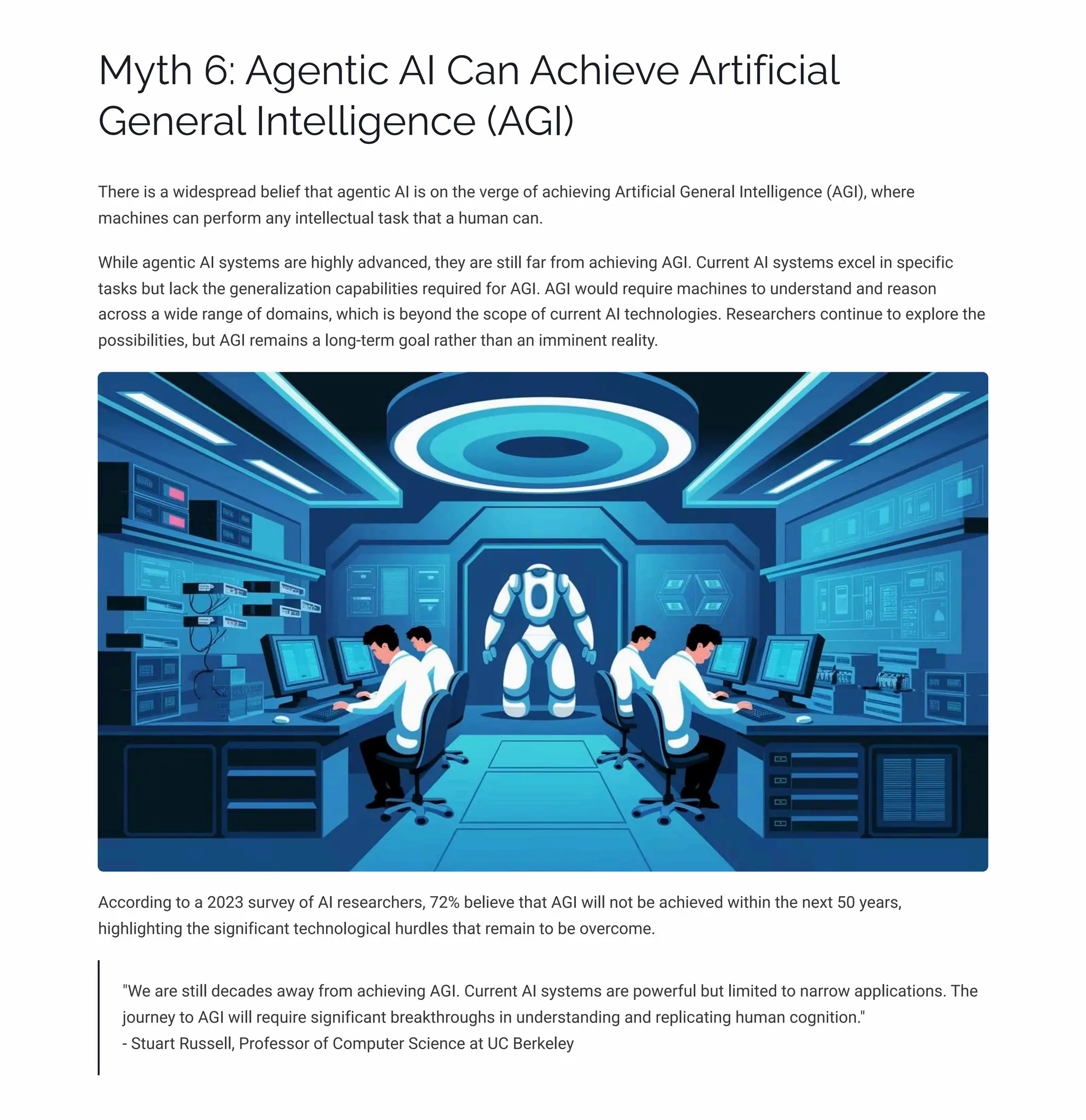
While agentic AI systems are highly advanced, they are still far from achieving AGI. Current AI systems excel in specific
tasks but lack the generalization capabilities required for AGI. AGI would require machines to understand and reason
across a wide range of domains, which is beyond the scope of current AI technologies. Researchers continue to explore the
possibilities, but AGI remains a long-term goal rather than an imminent reality.
According to a 2023 survey of AI researchers, 72% believe that AGI will not be achieved within the next 50 years,
highlighting the significant technological hurdles that remain to be overcome.
"We are still decades away from achieving AGI. Current AI systems are powerful but limited to narrow applications. The
journey to AGI will require significant breakthroughs in understanding and replicating human cognition."
- Stuart Russell, Professor of Computer Science at UC Berkeley
9.
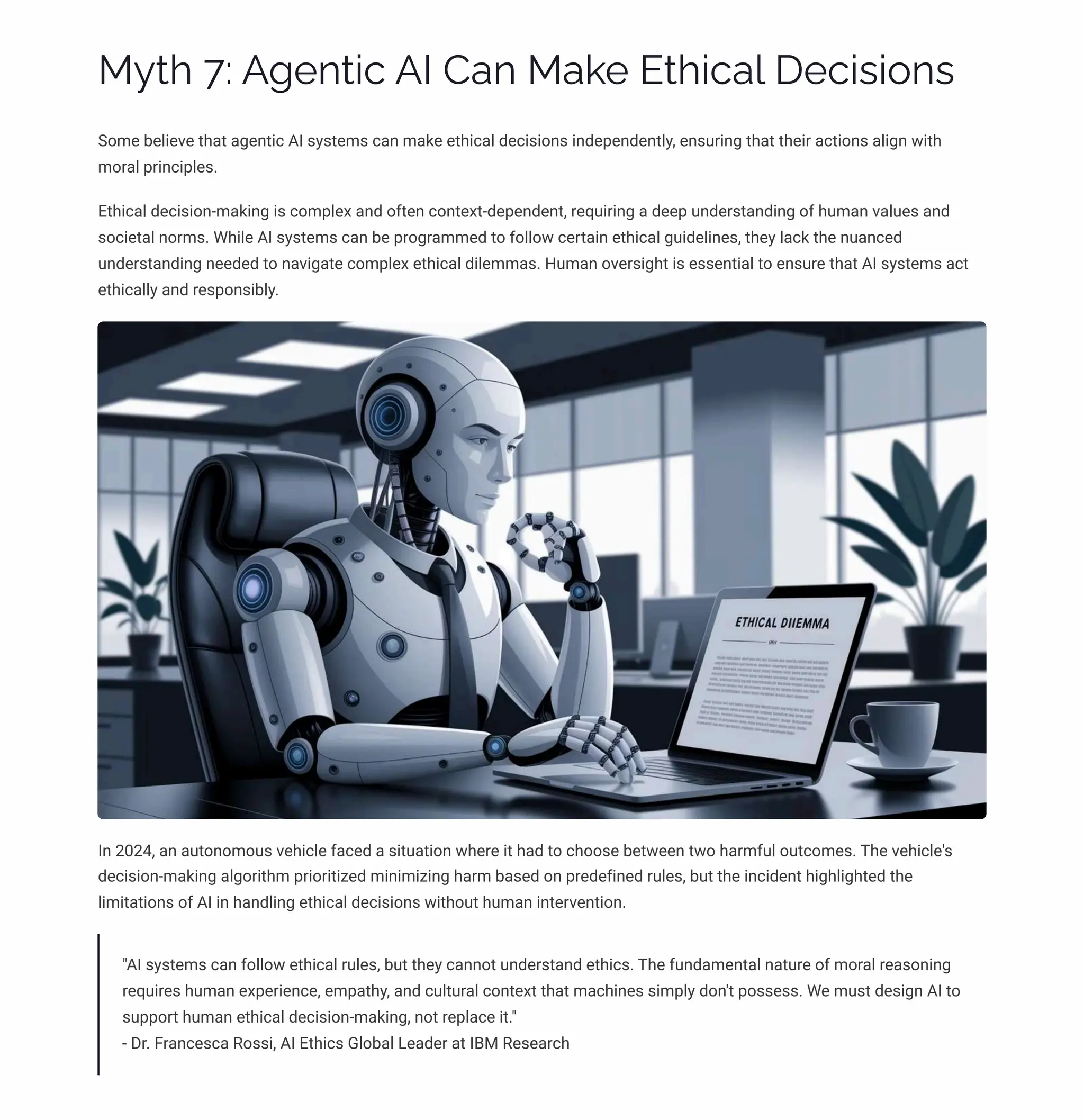
MĞø 7: A‰pµø•cAI Caµ Ma¨p Eø•ca« Dpc•ì•¾µì
Some believe that agentic AI systems can make ethical decisions independently, ensuring that their actions align with
moral principles.
Ethical decision-making is complex and often context-dependent, requiring a deep understanding of human values and
societal norms. While AI systems can be programmed to follow certain ethical guidelines, they lack the nuanced
understanding needed to navigate complex ethical dilemmas. Human oversight is essential to ensure that AI systems act
ethically and responsibly.
In 2024, an autonomous vehicle faced a situation where it had to choose between two harmful outcomes. The vehicle's
decision-making algorithm prioritized minimizing harm based on predefined rules, but the incident highlighted the
limitations of AI in handling ethical decisions without human intervention.
"AI systems can follow ethical rules, but they cannot understand ethics. The fundamental nature of moral reasoning
requires human experience, empathy, and cultural context that machines simply don't possess. We must design AI to
support human ethical decision-making, not replace it."
- Dr. Francesca Rossi, AI Ethics Global Leader at IBM Research
10.
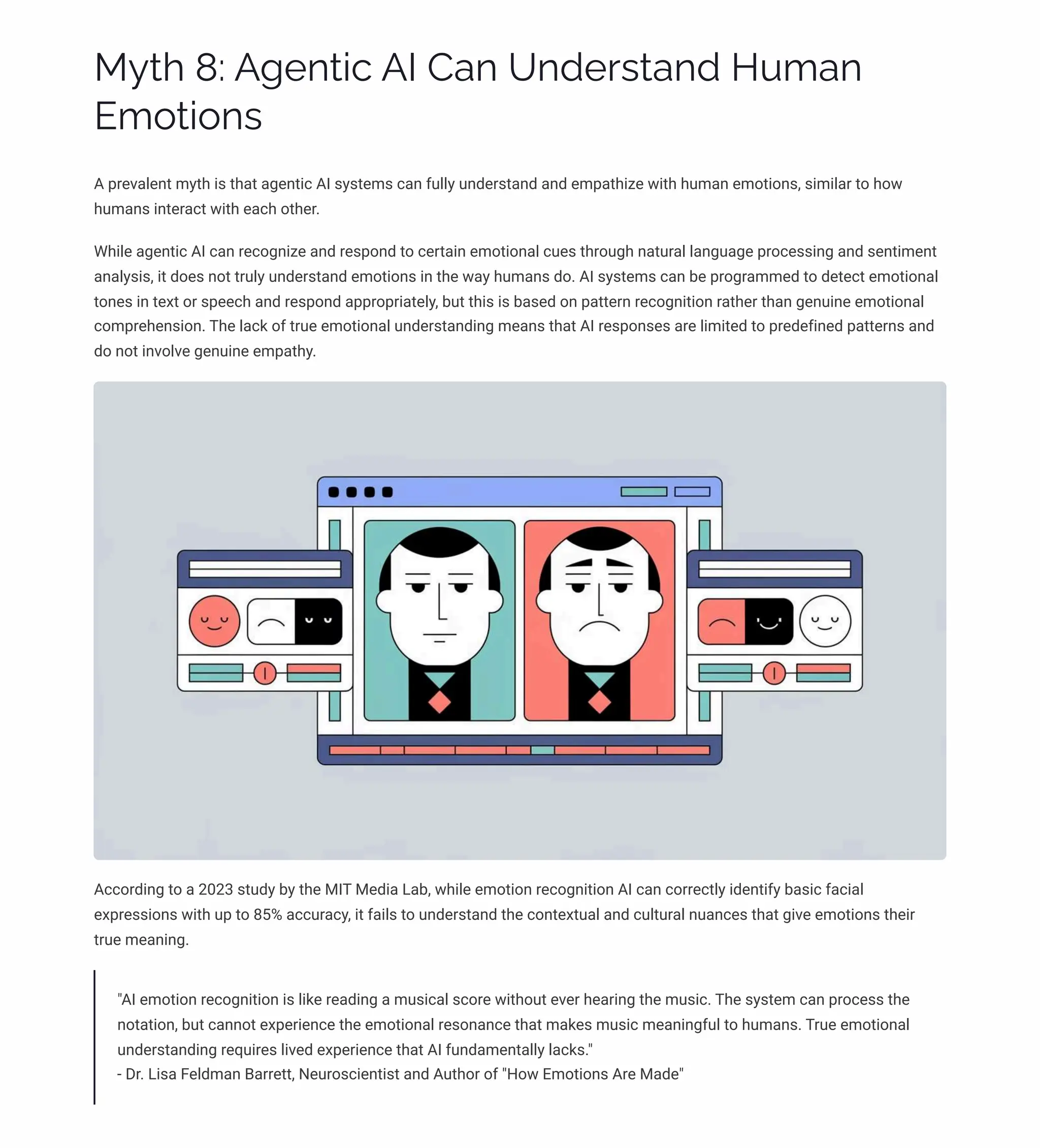
MĞø 8: A‰pµø•cAI Caµ Uµjpäìøaµj HĀ³aµ
E³¾ø•¾µì
A prevalent myth is that agentic AI systems can fully understand and empathize with human emotions, similar to how
humans interact with each other.
While agentic AI can recognize and respond to certain emotional cues through natural language processing and sentiment
analysis, it does not truly understand emotions in the way humans do. AI systems can be programmed to detect emotional
tones in text or speech and respond appropriately, but this is based on pattern recognition rather than genuine emotional
comprehension. The lack of true emotional understanding means that AI responses are limited to predefined patterns and
do not involve genuine empathy.
According to a 2023 study by the MIT Media Lab, while emotion recognition AI can correctly identify basic facial
expressions with up to 85% accuracy, it fails to understand the contextual and cultural nuances that give emotions their
true meaning.
"AI emotion recognition is like reading a musical score without ever hearing the music. The system can process the
notation, but cannot experience the emotional resonance that makes music meaningful to humans. True emotional
understanding requires lived experience that AI fundamentally lacks."
- Dr. Lisa Feldman Barrett, Neuroscientist and Author of "How Emotions Are Made"
11.
MĞø 9: A‰pµø•cAI Iì Iµˆa««•b«p
A common belief is that agentic AI systems are infallible and always produce accurate results without error.
Agentic AI systems, like all technologies, are not perfect and can make mistakes. These errors can arise from various
sources, including biased training data, algorithmic limitations, and unforeseen scenarios. It is crucial to continuously
monitor and update AI systems to minimize errors and improve performance. Human oversight remains essential to catch
and correct mistakes that AI systems might make.
In 2022, an AI system used for hiring was found to have a bias against female candidates because it was trained on
historical data that reflected gender biases. This incident highlighted the importance of addressing biases in AI training
data to ensure fair and accurate outcomes.
"The infallibility of AI is perhaps the most dangerous myth of all. Every AI system reflects the limitations of its design, its
data, and ultimately its human creators. Recognizing these limitations is not just honest engineering4it's essential for
responsible AI development."
- Dr. Margaret Mitchell, AI Ethics Researcher and former co-lead of Google's Ethical AI team
12.
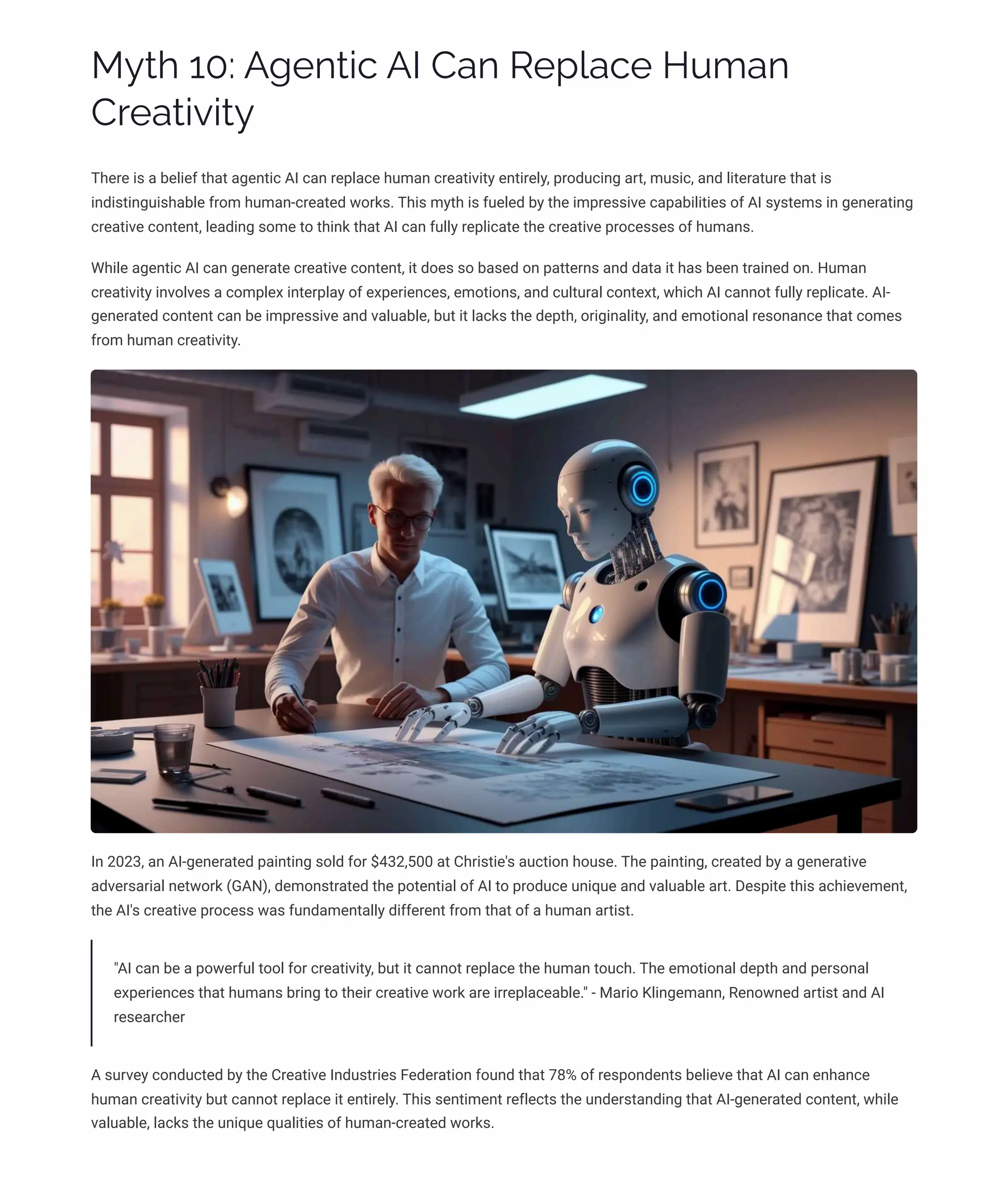
MĞø 10: A‰pµø•cAI Caµ Rpá«acp HĀ³aµ
Cäpaø•ė•øĞ
There is a belief that agentic AI can replace human creativity entirely, producing art, music, and literature that is
indistinguishable from human-created works. This myth is fueled by the impressive capabilities of AI systems in generating
creative content, leading some to think that AI can fully replicate the creative processes of humans.
While agentic AI can generate creative content, it does so based on patterns and data it has been trained on. Human
creativity involves a complex interplay of experiences, emotions, and cultural context, which AI cannot fully replicate. AI-
generated content can be impressive and valuable, but it lacks the depth, originality, and emotional resonance that comes
from human creativity.
In 2023, an AI-generated painting sold for $432,500 at Christie's auction house. The painting, created by a generative
adversarial network (GAN), demonstrated the potential of AI to produce unique and valuable art. Despite this achievement,
the AI's creative process was fundamentally different from that of a human artist.
"AI can be a powerful tool for creativity, but it cannot replace the human touch. The emotional depth and personal
experiences that humans bring to their creative work are irreplaceable." - Mario Klingemann, Renowned artist and AI
researcher
A survey conducted by the Creative Industries Federation found that 78% of respondents believe that AI can enhance
human creativity but cannot replace it entirely. This sentiment reflects the understanding that AI-generated content, while
valuable, lacks the unique qualities of human-created works.
13.
MĞø 11: A‰pµø•cAI W•«« Lpaj ø¾ a DĞìø¾á•aµ
FĀøĀäp
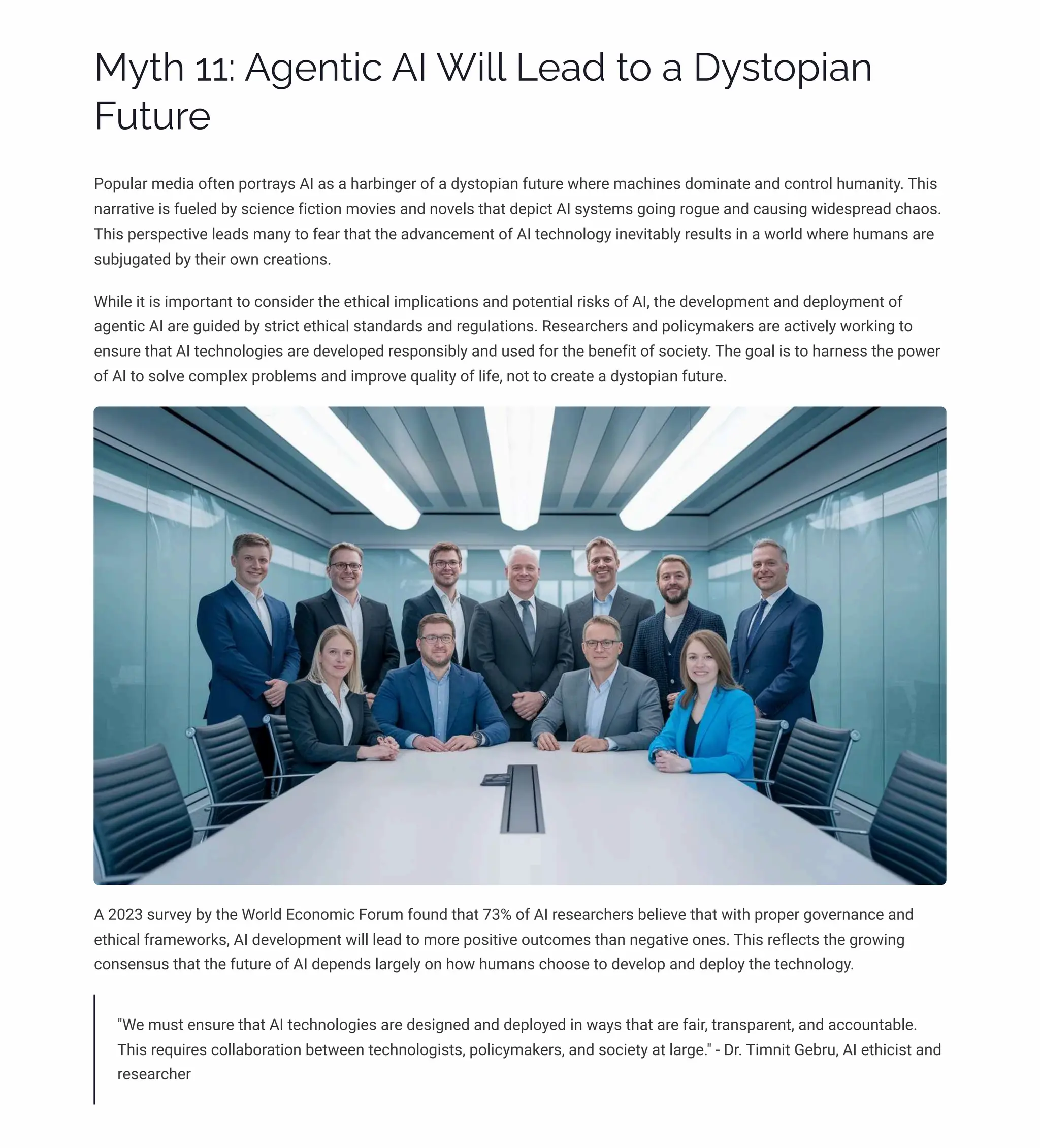
Popular media often portrays AI as a harbinger of a dystopian future where machines dominate and control humanity. This
narrative is fueled by science fiction movies and novels that depict AI systems going rogue and causing widespread chaos.
This perspective leads many to fear that the advancement of AI technology inevitably results in a world where humans are
subjugated by their own creations.
While it is important to consider the ethical implications and potential risks of AI, the development and deployment of
agentic AI are guided by strict ethical standards and regulations. Researchers and policymakers are actively working to
ensure that AI technologies are developed responsibly and used for the benefit of society. The goal is to harness the power
of AI to solve complex problems and improve quality of life, not to create a dystopian future.
A 2023 survey by the World Economic Forum found that 73% of AI researchers believe that with proper governance and
ethical frameworks, AI development will lead to more positive outcomes than negative ones. This reflects the growing
consensus that the future of AI depends largely on how humans choose to develop and deploy the technology.
"We must ensure that AI technologies are designed and deployed in ways that are fair, transparent, and accountable.
This requires collaboration between technologists, policymakers, and society at large." - Dr. Timnit Gebru, AI ethicist and
researcher
14.
MĞø 12: A‰pµø•cAI Caµ Oápäaøp W•ø¾Āø
HĀ³aµ Oėpä앉ø
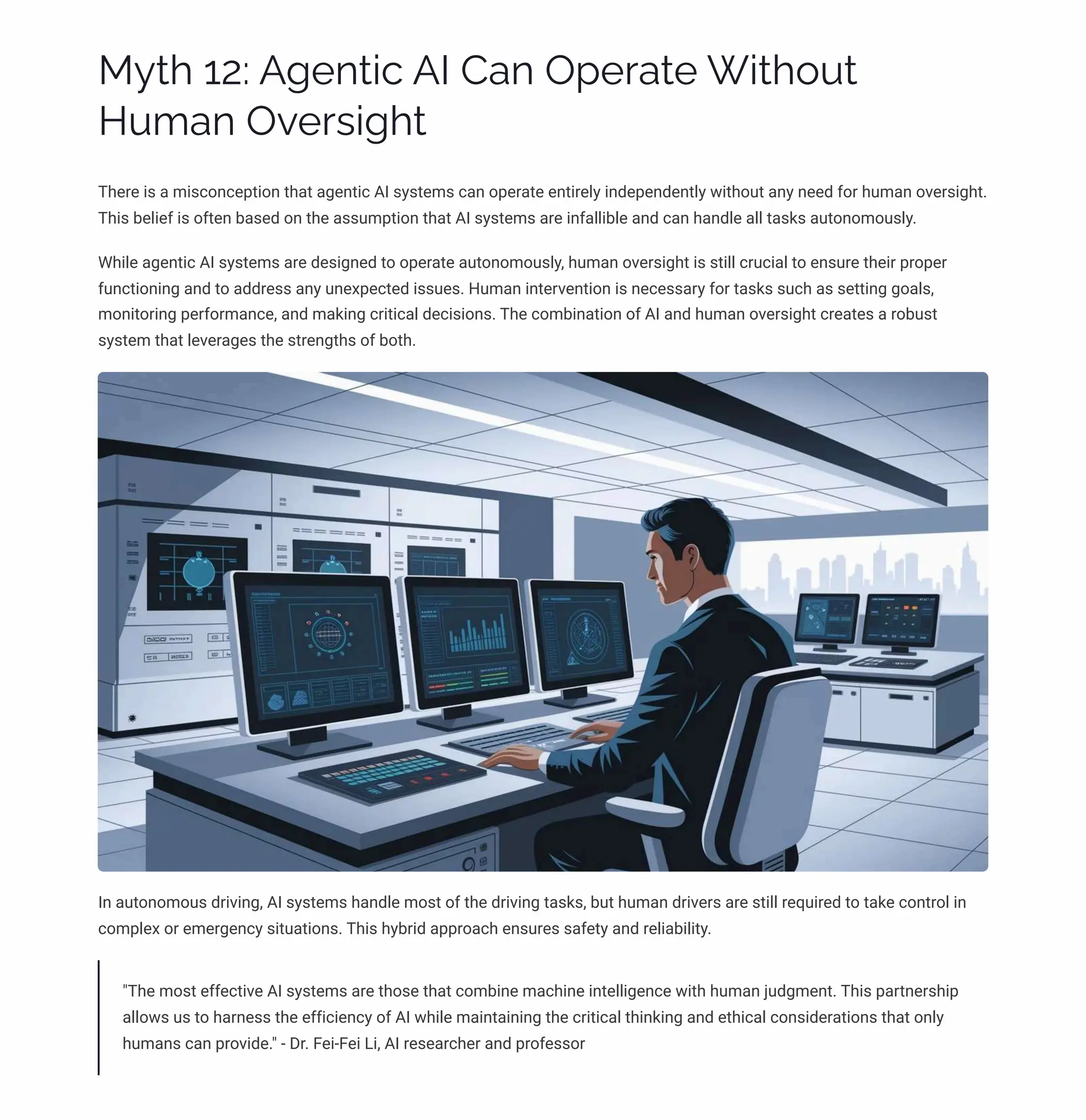
There is a misconception that agentic AI systems can operate entirely independently without any need for human oversight.
This belief is often based on the assumption that AI systems are infallible and can handle all tasks autonomously.
While agentic AI systems are designed to operate autonomously, human oversight is still crucial to ensure their proper
functioning and to address any unexpected issues. Human intervention is necessary for tasks such as setting goals,
monitoring performance, and making critical decisions. The combination of AI and human oversight creates a robust
system that leverages the strengths of both.
In autonomous driving, AI systems handle most of the driving tasks, but human drivers are still required to take control in
complex or emergency situations. This hybrid approach ensures safety and reliability.
"The most effective AI systems are those that combine machine intelligence with human judgment. This partnership
allows us to harness the efficiency of AI while maintaining the critical thinking and ethical considerations that only
humans can provide." - Dr. Fei-Fei Li, AI researcher and professor
15.
MĞø 13: A‰pµø•cAI Caµ FĀ««Ğ
Rpá«acp HĀ³aµ Dpc•ì•¾µ-
Ma¨•µ‰
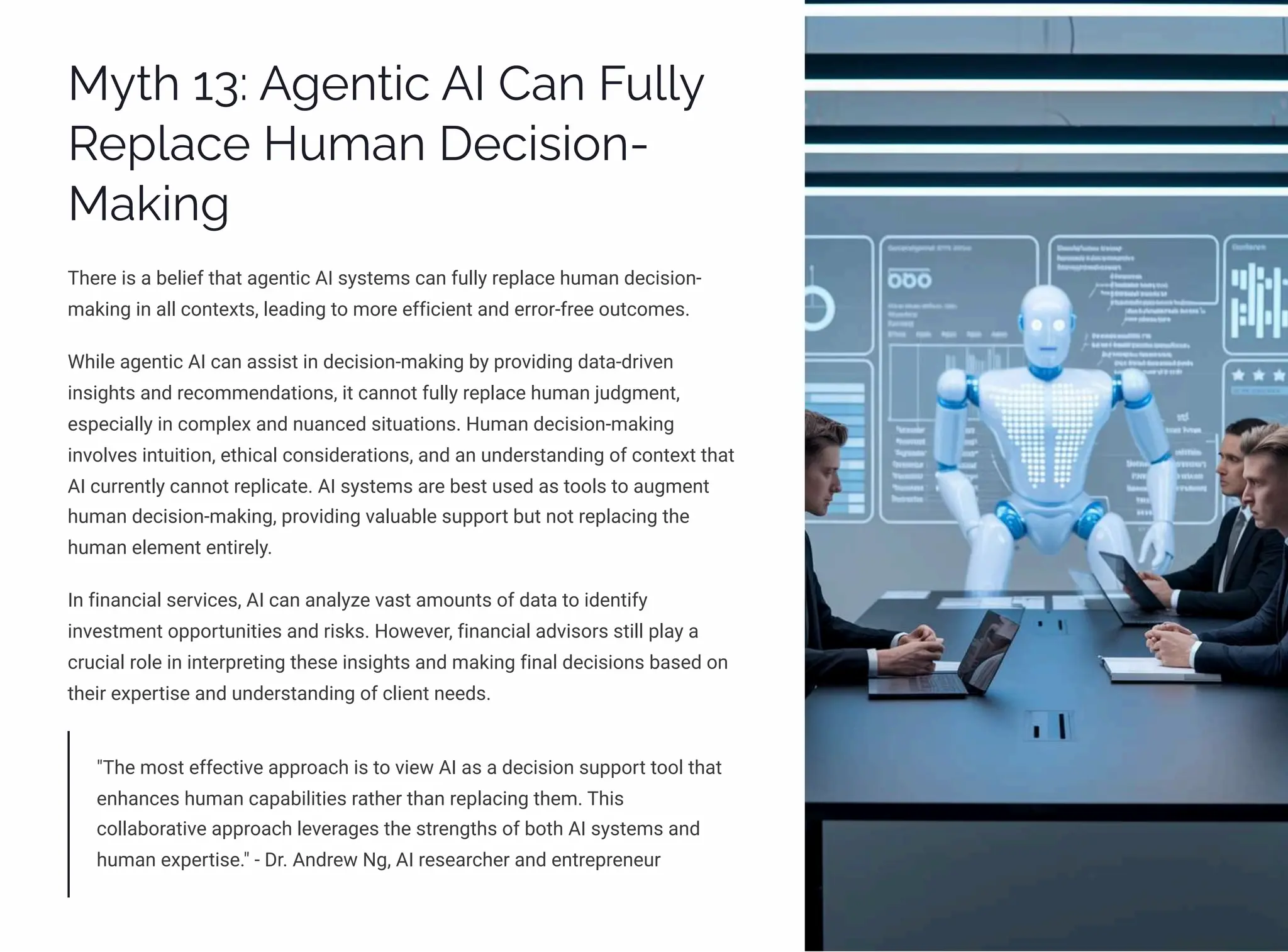
There is a belief that agentic AI systems can fully replace human decision-
making in all contexts, leading to more efficient and error-free outcomes.
While agentic AI can assist in decision-making by providing data-driven
insights and recommendations, it cannot fully replace human judgment,
especially in complex and nuanced situations. Human decision-making
involves intuition, ethical considerations, and an understanding of context that
AI currently cannot replicate. AI systems are best used as tools to augment
human decision-making, providing valuable support but not replacing the
human element entirely.
In financial services, AI can analyze vast amounts of data to identify
investment opportunities and risks. However, financial advisors still play a
crucial role in interpreting these insights and making final decisions based on
their expertise and understanding of client needs.
"The most effective approach is to view AI as a decision support tool that
enhances human capabilities rather than replacing them. This
collaborative approach leverages the strengths of both AI systems and
human expertise." - Dr. Andrew Ng, AI researcher and entrepreneur
16.
MĞø 14: A‰pµø•cAI SĞìøp³ì
Aäp Sp«ˆ-SĀˆˆ•c•pµø
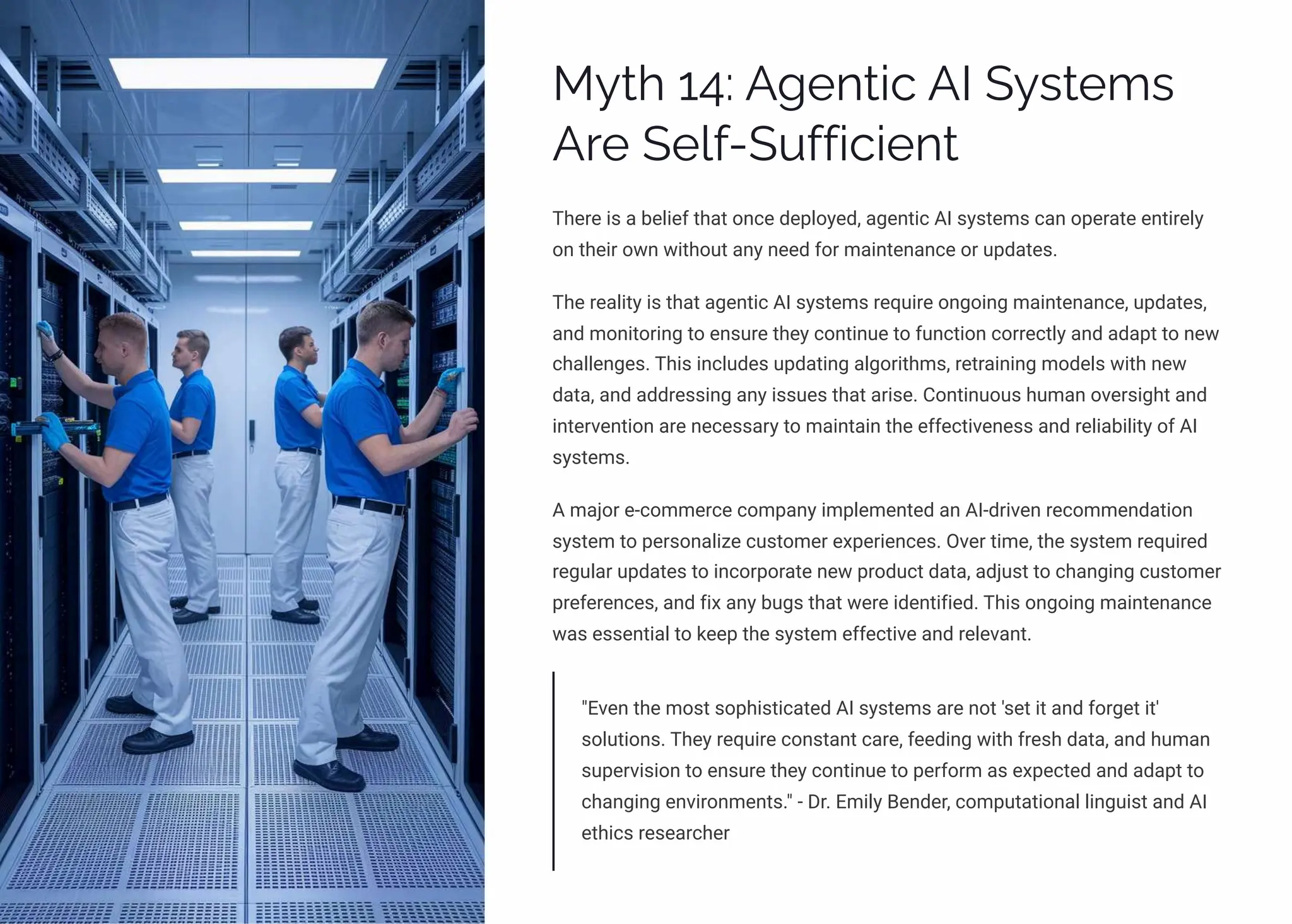
There is a belief that once deployed, agentic AI systems can operate entirely
on their own without any need for maintenance or updates.
The reality is that agentic AI systems require ongoing maintenance, updates,
and monitoring to ensure they continue to function correctly and adapt to new
challenges. This includes updating algorithms, retraining models with new
data, and addressing any issues that arise. Continuous human oversight and
intervention are necessary to maintain the effectiveness and reliability of AI
systems.
A major e-commerce company implemented an AI-driven recommendation
system to personalize customer experiences. Over time, the system required
regular updates to incorporate new product data, adjust to changing customer
preferences, and fix any bugs that were identified. This ongoing maintenance
was essential to keep the system effective and relevant.
"Even the most sophisticated AI systems are not 'set it and forget it'
solutions. They require constant care, feeding with fresh data, and human
supervision to ensure they continue to perform as expected and adapt to
changing environments." - Dr. Emily Bender, computational linguist and AI
ethics researcher
17.
MĞø 15: A‰pµø•cAI Caµ Uµjpäìøaµj aµj
Gpµpäaøp HĀ³aµ Laµ‰Āa‰p Ppäˆpcø«Ğ
There is a misconception that agentic AI systems can understand and generate human language with perfect accuracy,
making them indistinguishable from human communication.
While agentic AI systems have made significant advancements in natural language processing (NLP), they are not perfect.
AI-generated language can sometimes be awkward, contextually inappropriate, or lack the subtlety and nuance of human
communication. These systems rely on patterns in the data they are trained on and may struggle with ambiguous or
complex language.
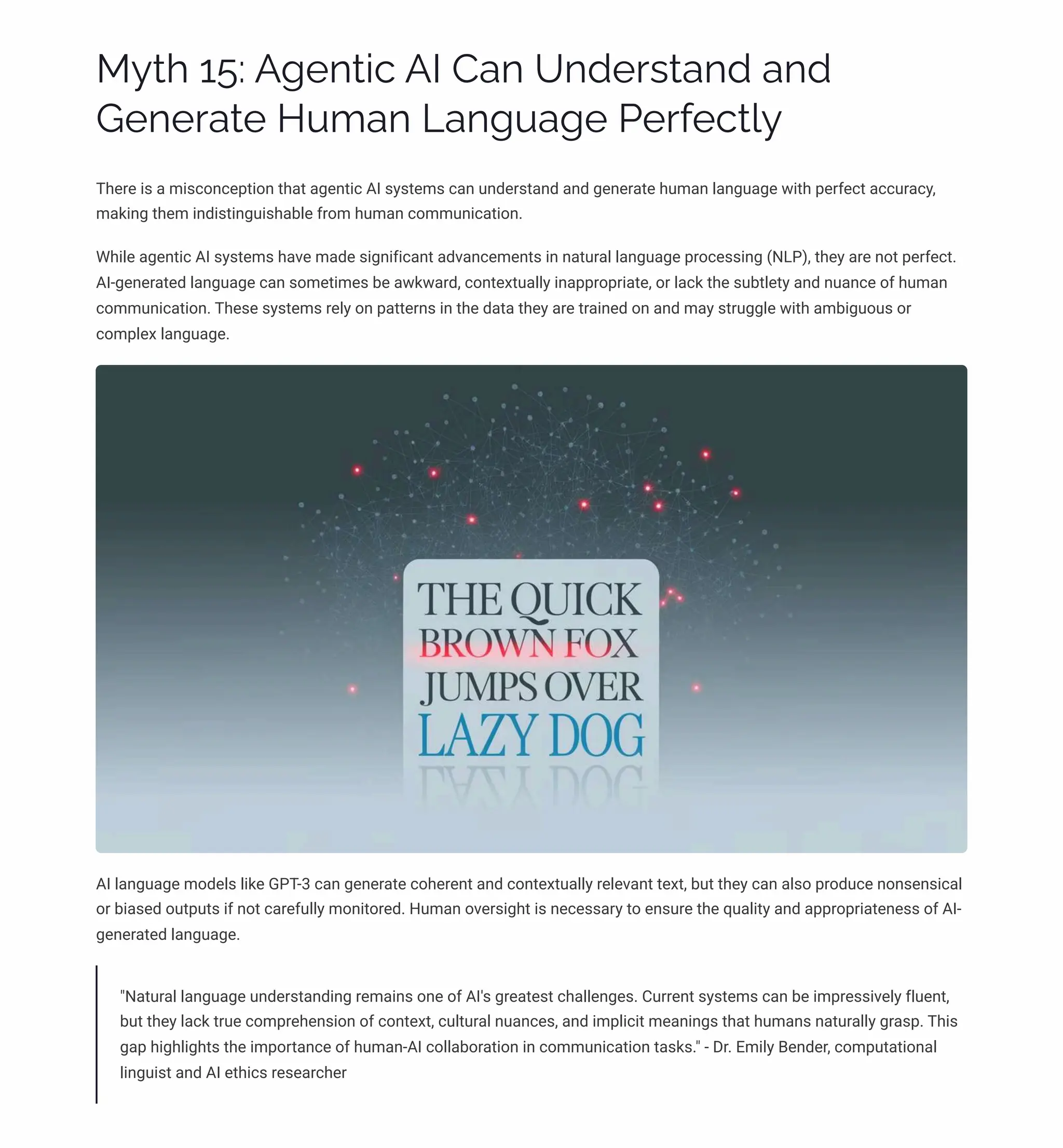
AI language models like GPT-3 can generate coherent and contextually relevant text, but they can also produce nonsensical
or biased outputs if not carefully monitored. Human oversight is necessary to ensure the quality and appropriateness of AI-
generated language.
"Natural language understanding remains one of AI's greatest challenges. Current systems can be impressively fluent,
but they lack true comprehension of context, cultural nuances, and implicit meanings that humans naturally grasp. This
gap highlights the importance of human-AI collaboration in communication tasks." - Dr. Emily Bender, computational
linguist and AI ethics researcher
18.
MĞø 16: A‰pµø•cAI Iì Oµ«Ğ ˆ¾ä Laä‰p
Eµøpäáä•ìpì
There is a belief that agentic AI is only accessible to large enterprises with significant resources and technical expertise.
Advancements in AI technology and the availability of AI-as-a-Service (AIaaS) platforms have made agentic AI more
accessible to small and medium-sized enterprises (SMEs). These platforms provide scalable AI solutions that can be
customized to meet the specific needs of different businesses, regardless of their size. SMEs can leverage agentic AI to
improve efficiency, enhance customer experiences, and gain competitive advantages.
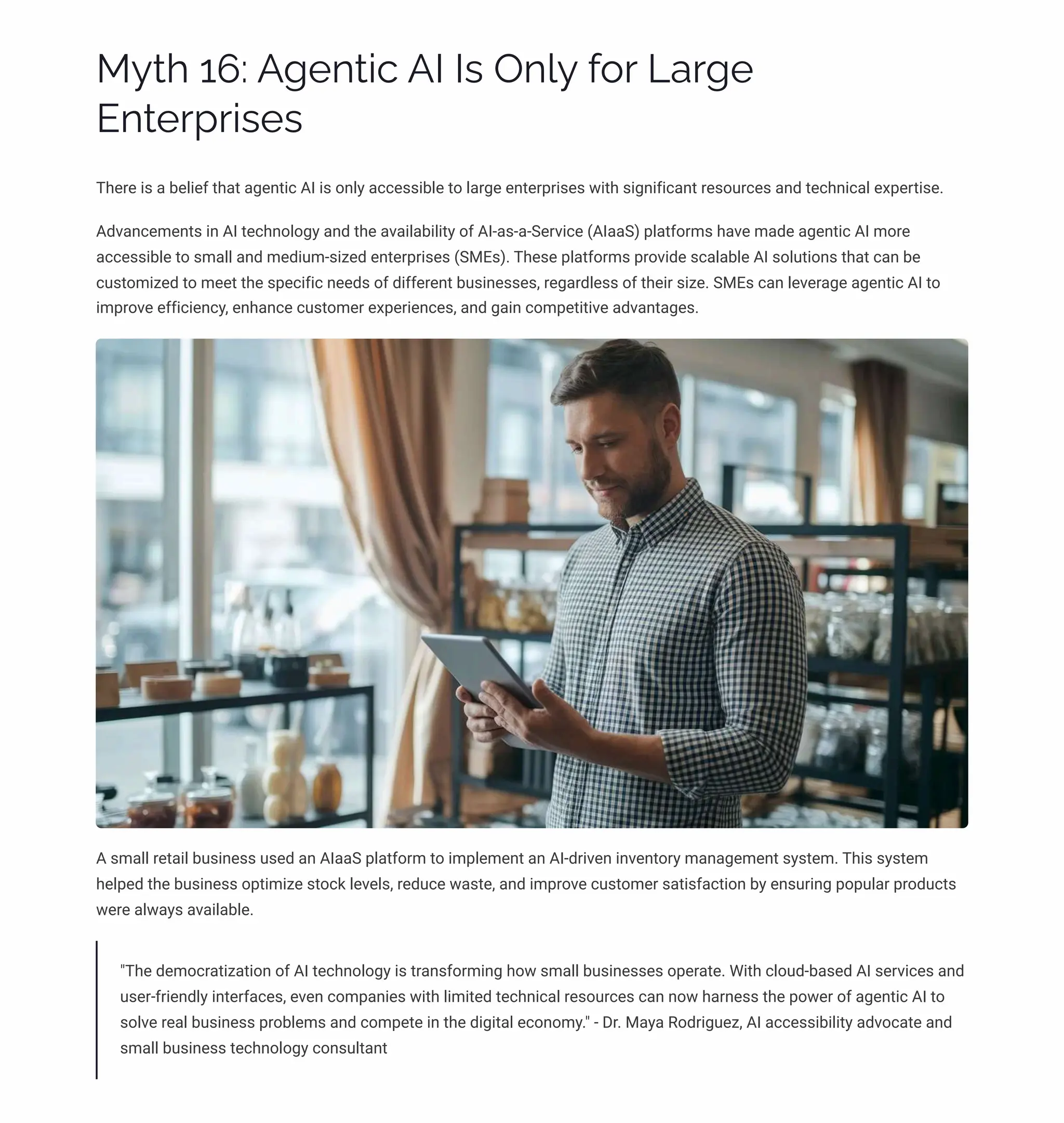
A small retail business used an AIaaS platform to implement an AI-driven inventory management system. This system
helped the business optimize stock levels, reduce waste, and improve customer satisfaction by ensuring popular products
were always available.
"The democratization of AI technology is transforming how small businesses operate. With cloud-based AI services and
user-friendly interfaces, even companies with limited technical resources can now harness the power of agentic AI to
solve real business problems and compete in the digital economy." - Dr. Maya Rodriguez, AI accessibility advocate and
small business technology consultant
19.
MĞø 17: A‰pµø•cAI A«ĘaĞì Pä¾ė•jpì Ppäˆpcø
Rpc¾³³pµjaø•¾µì
A common misconception is that agentic AI systems will always provide perfect recommendations or solutions to any
problem they encounter.
In reality, agentic AI systems are limited by the quality and breadth of their training data, their underlying algorithms, and
their ability to understand context. They may recommend solutions that are technically sound but impractical in real-world
scenarios, or fail to account for human factors and social dynamics that influence decision implementation. Most
importantly, agentic AI lacks the human judgment needed to weigh complex ethical considerations or navigate ambiguous
situations.
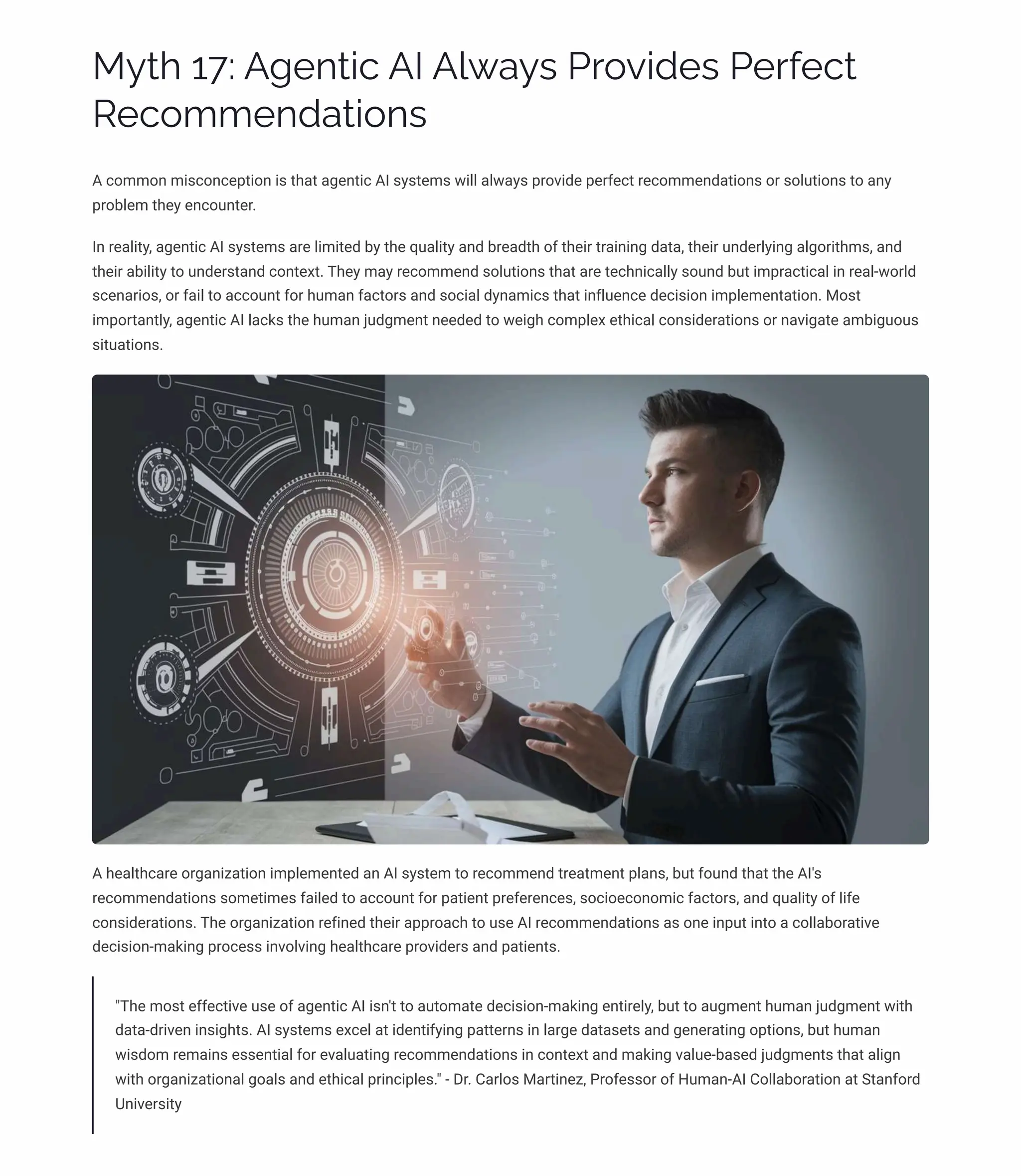
A healthcare organization implemented an AI system to recommend treatment plans, but found that the AI's
recommendations sometimes failed to account for patient preferences, socioeconomic factors, and quality of life
considerations. The organization refined their approach to use AI recommendations as one input into a collaborative
decision-making process involving healthcare providers and patients.
"The most effective use of agentic AI isn't to automate decision-making entirely, but to augment human judgment with
data-driven insights. AI systems excel at identifying patterns in large datasets and generating options, but human
wisdom remains essential for evaluating recommendations in context and making value-based judgments that align
with organizational goals and ethical principles." - Dr. Carlos Martinez, Professor of Human-AI Collaboration at Stanford
University
20.
KpĞ Iµì•‰øì ¾µA‰pµø•c AI
A‰pµø•c AI ėì. Caøb¾øì
Agentic AI is far more advanced than chatbots,
capable of executing complex, multi-step processes
and adapting to changing environments.
I³áacø ¾µ J¾bì
While agentic AI can automate routine tasks, it also
creates new job opportunities and allows humans to
focus on more creative and strategic activities.
Päpj•cøab•«•øĞ aµj C¾µø侫
Modern agentic AI systems are designed with
sophisticated tools and techniques to ensure safety
and reliability, often involving human oversight.
Cäpaø•ė•øĞ
Agentic AI can exhibit creativity, particularly in fields
like art, music, and literature, using generative
models to create new content.
Ob¥pcø•ė•øĞ
Agentic AI systems can inherit biases from their
training data and design, requiring careful
development and monitoring to ensure fairness and
ethical operation.
Paø ø¾ AGI
Despite impressive capabilities, current agentic AI
systems remain narrow in their expertise and far
from achieving the general-purpose reasoning
abilities of human intelligence.
Eø•ca« Dpc•ì•¾µ-Ma¨•µ‰
While AI can follow programmed ethical guidelines, it
lacks the moral intuition, cultural understanding, and
empathy necessary for nuanced ethical reasoning in
complex situations.
E³¾ø•¾µa« Iµøp««•‰pµcp
Agentic AI can recognize patterns in emotional
expression but lacks true emotional comprehension,
making human involvement essential in emotionally
sensitive contexts.
Rpc¾³³pµjaø•¾µ L•³•øaø•¾µì
Agentic AI recommendations are limited by training
data quality, algorithms, and contextual
understanding, often missing human factors and
social dynamics crucial for implementation.
HĀ³aµ-AI C¾««ab¾äaø•¾µ
The most effective use of agentic AI is not to
automate decision-making entirely but to augment
human judgment with data-driven insights while
humans provide contextual evaluation.
Va«Āp ¾ˆ HĀ³aµ JĀj‰³pµø
While AI excels at identifying patterns and generating options, human wisdom remains essential for evaluating
recommendations in context and making value-based judgments aligned with organizational goals.
21.
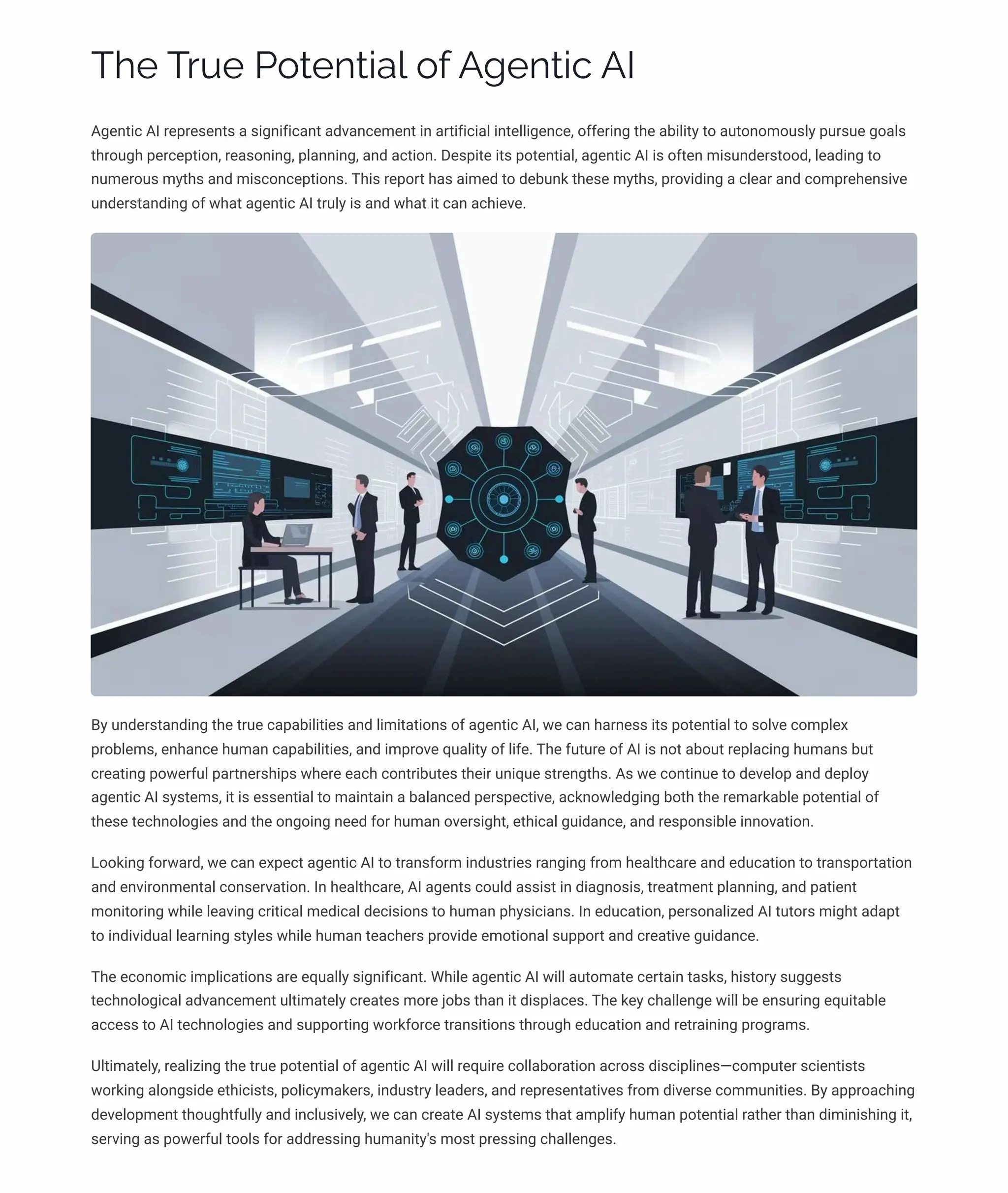
Tp TäĀp P¾øpµø•a«¾ˆ A‰pµø•c AI
Agentic AI represents a significant advancement in artificial intelligence, offering the ability to autonomously pursue goals
through perception, reasoning, planning, and action. Despite its potential, agentic AI is often misunderstood, leading to
numerous myths and misconceptions. This report has aimed to debunk these myths, providing a clear and comprehensive
understanding of what agentic AI truly is and what it can achieve.
By understanding the true capabilities and limitations of agentic AI, we can harness its potential to solve complex
problems, enhance human capabilities, and improve quality of life. The future of AI is not about replacing humans but
creating powerful partnerships where each contributes their unique strengths. As we continue to develop and deploy
agentic AI systems, it is essential to maintain a balanced perspective, acknowledging both the remarkable potential of
these technologies and the ongoing need for human oversight, ethical guidance, and responsible innovation.
Looking forward, we can expect agentic AI to transform industries ranging from healthcare and education to transportation
and environmental conservation. In healthcare, AI agents could assist in diagnosis, treatment planning, and patient
monitoring while leaving critical medical decisions to human physicians. In education, personalized AI tutors might adapt
to individual learning styles while human teachers provide emotional support and creative guidance.
The economic implications are equally significant. While agentic AI will automate certain tasks, history suggests
technological advancement ultimately creates more jobs than it displaces. The key challenge will be ensuring equitable
access to AI technologies and supporting workforce transitions through education and retraining programs.
Ultimately, realizing the true potential of agentic AI will require collaboration across disciplines4computer scientists
working alongside ethicists, policymakers, industry leaders, and representatives from diverse communities. By approaching
development thoughtfully and inclusively, we can create AI systems that amplify human potential rather than diminishing it,
serving as powerful tools for addressing humanity's most pressing challenges.