1/19
AI applications in financial compliance: An overview
leewayhertz.com/ai-in-financial-compliance/
In the vast and ever-evolving landscape of the financial industry, a prominent challenge looms with
considerable gravity: regulatory compliance. The financial sector, a cornerstone of global economies,
faces the daunting task of navigating a labyrinthine network of rules and regulations. It’s not just a matter
of ticking boxes; it’s about protecting assets, identifying risks, and safeguarding customers from financial
crimes.
In 2021 alone, the world collectively spent a staggering $213.9 billion on financial crime compliance. For
large and small financial institutions, compliance isn’t merely a matter of legality; it’s a material concern
affecting their bottom line. Legacy approaches to compliance are akin to attempting a marathon with lead
shoes, leaving institutions vulnerable to risks and fines that can soar as high as $10 billion, as seen in
2019.
Enter the silent game-changer of modern finance: Artificial Intelligence (AI). AI is quietly making a
profound impact on the compliance landscape. With its unparalleled data processing and pattern
recognition capabilities, AI serves as a practical solution that empowers financial institutions to streamline
compliance processes, improve productivity, and stay ahead of the regulatory curve.
As financial institutions grapple with the onslaught of new regulations like the Anti-Money Laundering Act
and PSD2 in the EU, AI emerges as a beacon of hope. It doesn’t just automate tasks; it redefines how
institutions manage risks, reduce false positives, prevent fraud, and address human error. In essence, AI
2/19
isn’t a buzzword; it’s a lifeline in the complex sea of compliance, offering tangible benefits and real-time
updates for simpler compliance management.
This article delves into the critical landscape of financial compliance, highlighting the need for AI-driven
solutions and exploring their benefits, applications, and use cases in financial regulatory compliance. We
will also unravel the underlying AI technologies that empower this transformation and peer into the future
to glimpse the evolving trends in AI for financial compliance.
A brief overview of financial regulatory compliance
The need for AI in financial compliance
Benefits of AI in financial compliance
Applications of AI in financial regulatory compliance
How does LeewayHertz’s generative AI platform enhance financial regulatory compliance
workflows?
AI technologies in financial regulatory compliance
Real-world examples of organizations harnessing AI for financial regulatory compliance
AI for financial regulatory compliance: Future trends
A brief overview of financial regulatory compliance
In the intricate world of finance, where every transaction carries weighty consequences, compliance
serves as the bedrock upon which trust, integrity, and the rule of law stand. Financial regulatory
compliance represents the diligent adherence to a complex web of rules, regulations, and guidelines
governing the conduct of financial institutions, businesses, and organizations.
The basics of compliance
At its simplest, financial compliance entails conforming to legal and regulatory standards set by governing
bodies, industry watchdogs, and international authorities. These standards are established to safeguard
the interests of various stakeholders, including investors, customers, and the general public.
3/19
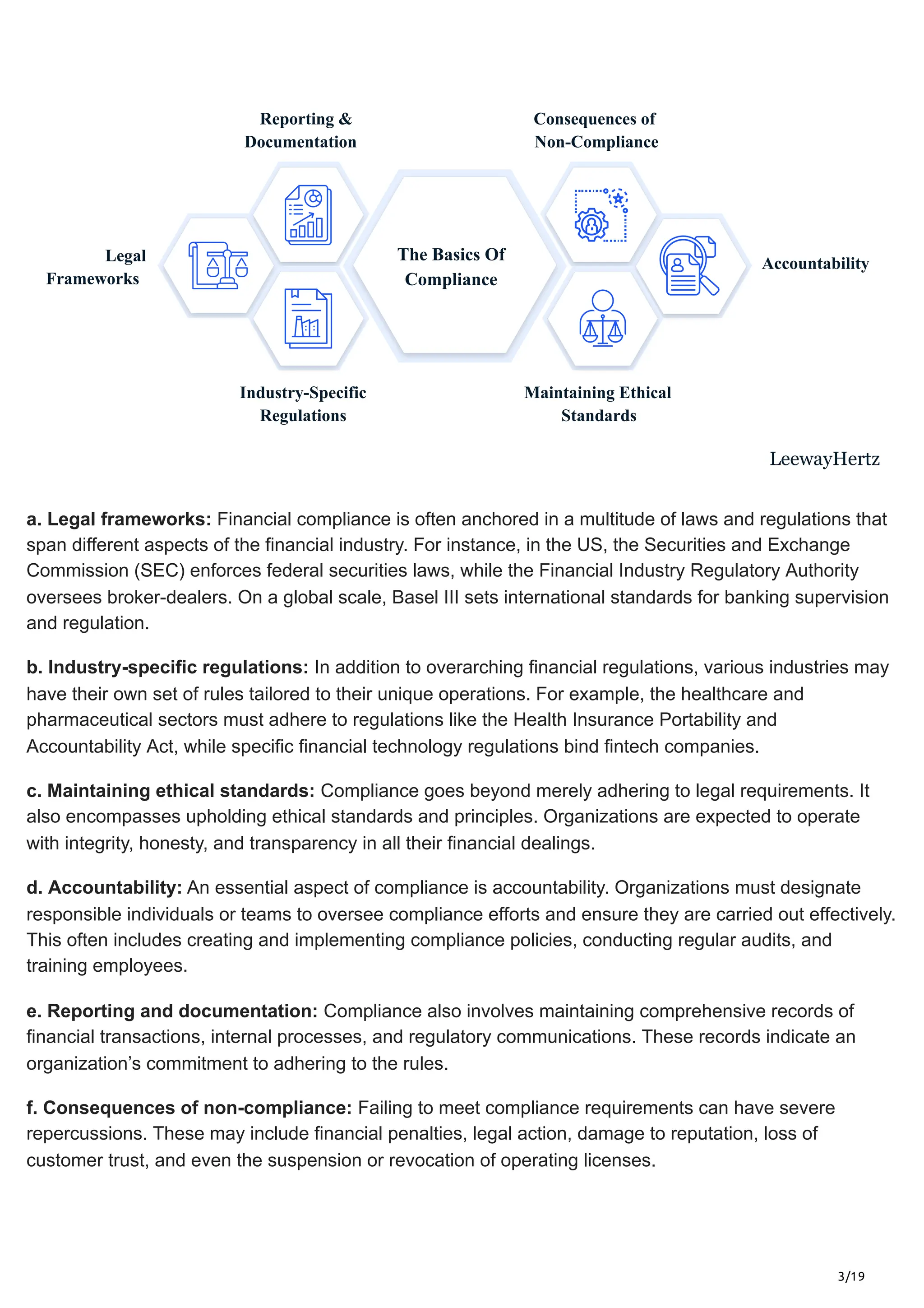
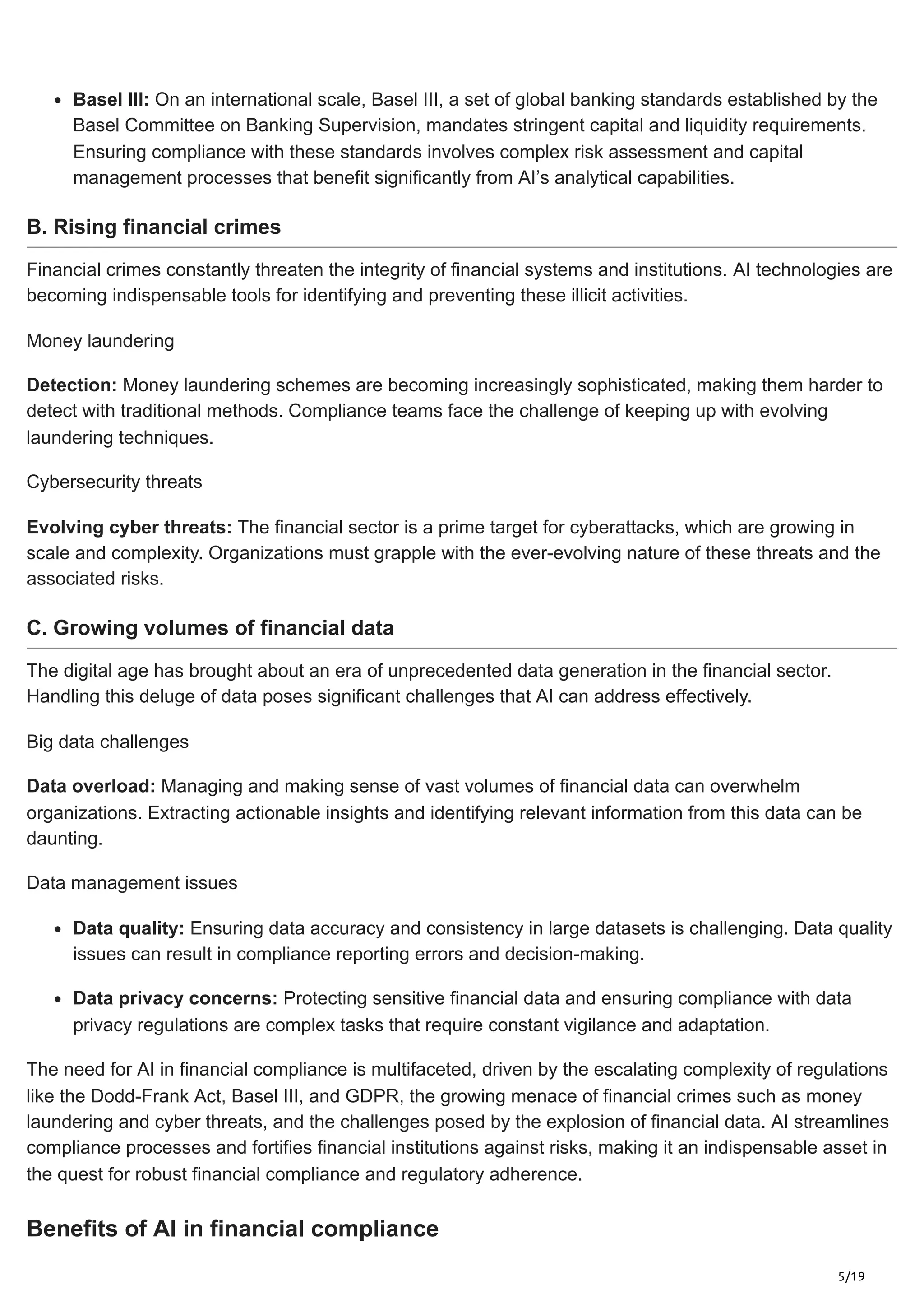
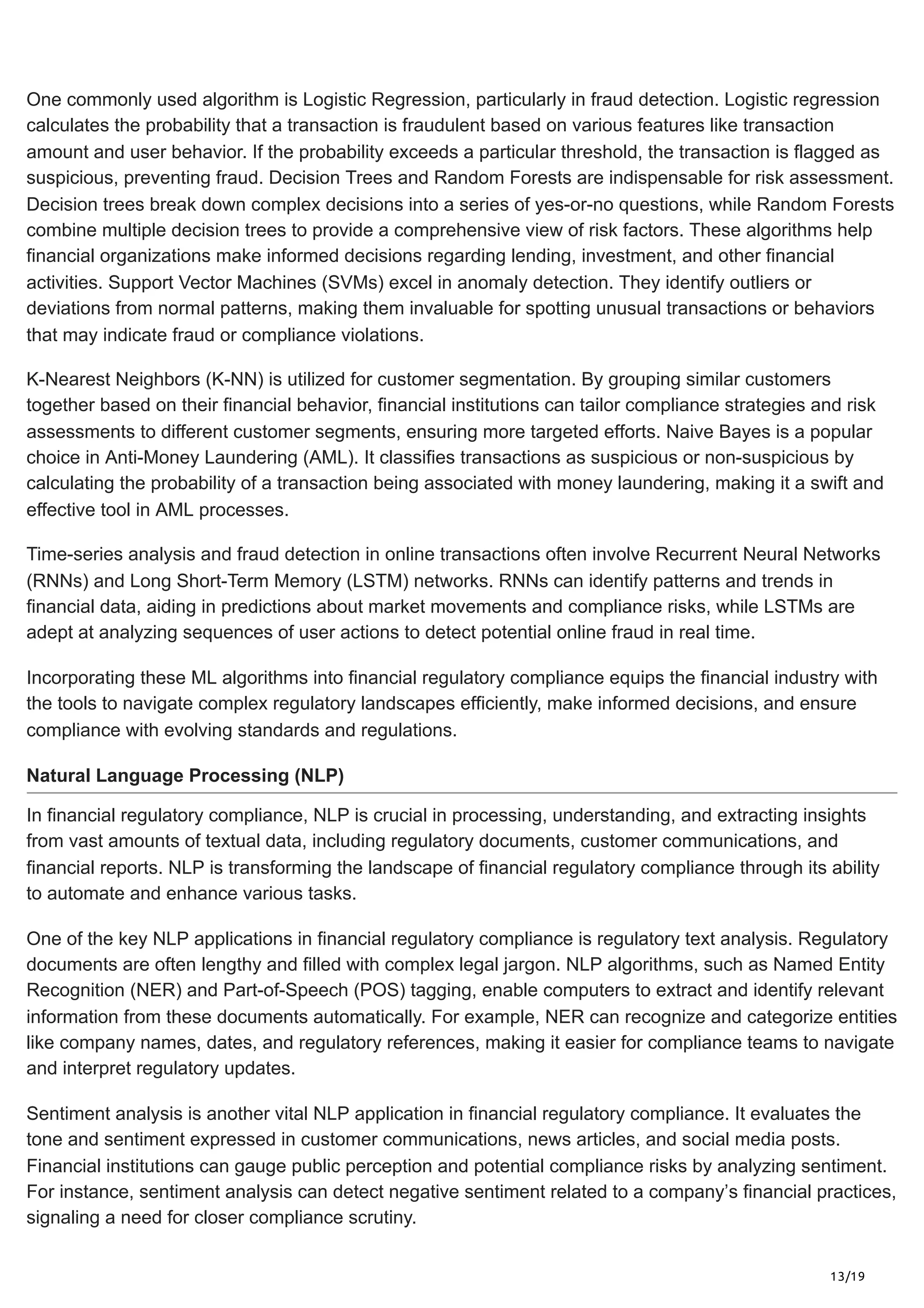
The Basics Of
Compliance
Legal
Frameworks
Accountability
Industry-Specific
Regulations
Maintaining Ethical
Standards
Reporting &
Documentation
Consequences of
Non-Compliance
LeewayHertz
a. Legal frameworks: Financial compliance is often anchored in a multitude of laws and regulations that
span different aspects of the financial industry. For instance, in the US, the Securities and Exchange
Commission (SEC) enforces federal securities laws, while the Financial Industry Regulatory Authority
oversees broker-dealers. On a global scale, Basel III sets international standards for banking supervision
and regulation.
b. Industry-specific regulations: In addition to overarching financial regulations, various industries may
have their own set of rules tailored to their unique operations. For example, the healthcare and
pharmaceutical sectors must adhere to regulations like the Health Insurance Portability and
Accountability Act, while specific financial technology regulations bind fintech companies.
c. Maintaining ethical standards: Compliance goes beyond merely adhering to legal requirements. It
also encompasses upholding ethical standards and principles. Organizations are expected to operate
with integrity, honesty, and transparency in all their financial dealings.
d. Accountability: An essential aspect of compliance is accountability. Organizations must designate
responsible individuals or teams to oversee compliance efforts and ensure they are carried out effectively.
This often includes creating and implementing compliance policies, conducting regular audits, and
training employees.
e. Reporting and documentation: Compliance also involves maintaining comprehensive records of
financial transactions, internal processes, and regulatory communications. These records indicate an
organization’s commitment to adhering to the rules.
f. Consequences of non-compliance: Failing to meet compliance requirements can have severe
repercussions. These may include financial penalties, legal action, damage to reputation, loss of
customer trust, and even the suspension or revocation of operating licenses.
4/19
In a financial landscape characterized by increasing complexity and heightened scrutiny, understanding
and implementing financial compliance basics are not optional but a fundamental imperative. By doing so,
organizations can ensure they remain on the right side of the law while building trust and credibility with
their stakeholders.
Launch your project with LeewayHertz!
Enhance financial compliance with AI! Our AI solutions for financial regulatory compliance ensure
accuracy, mitigate risks, and streamline compliance processes for your business.
Learn More
The need for AI in financial compliance
In today’s intricate financial ecosystem, the need for AI in financial compliance has emerged as an
imperative response to the industry’s myriad challenges. This section explores the reasons behind the
adoption of AI for financial compliance.
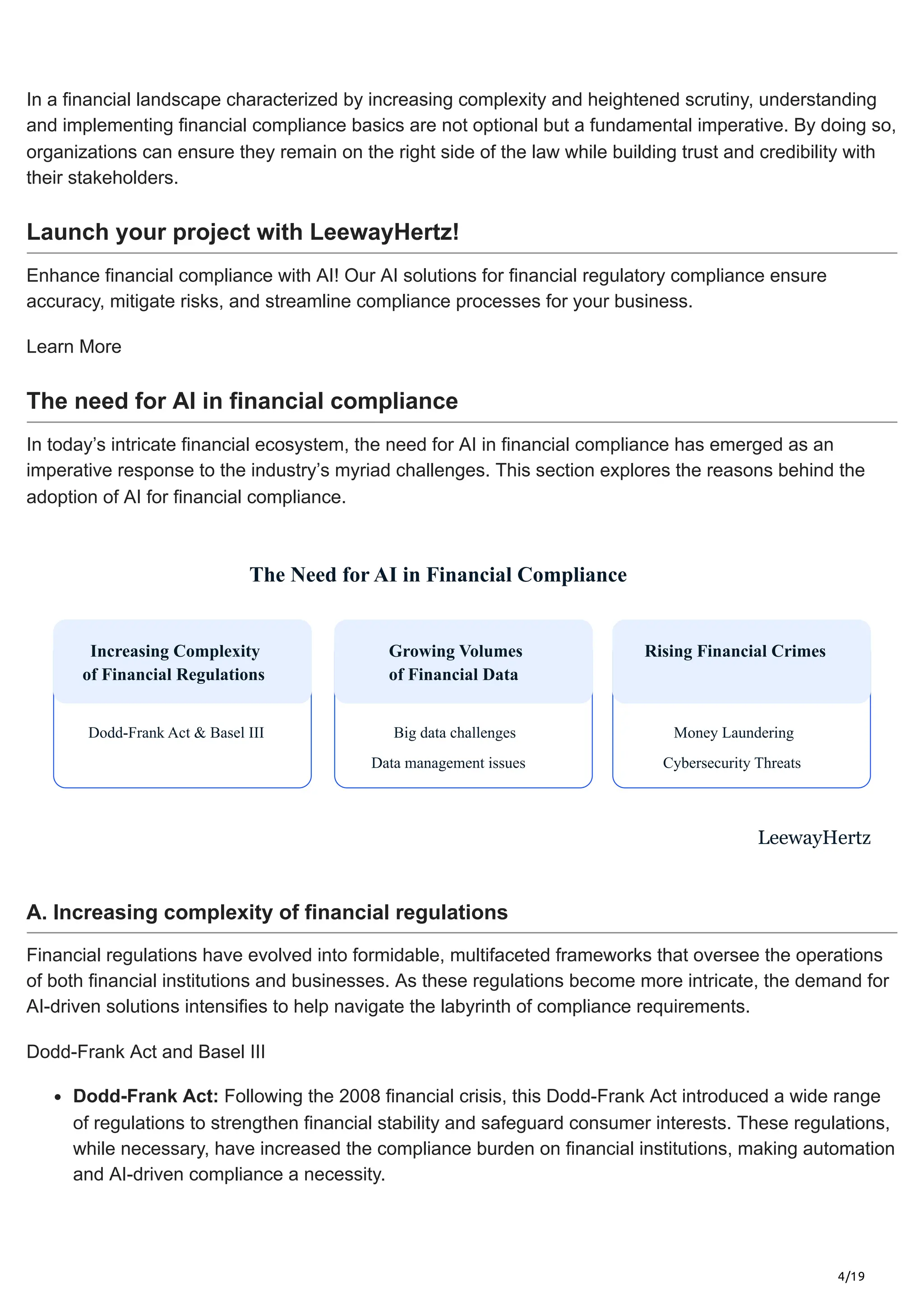
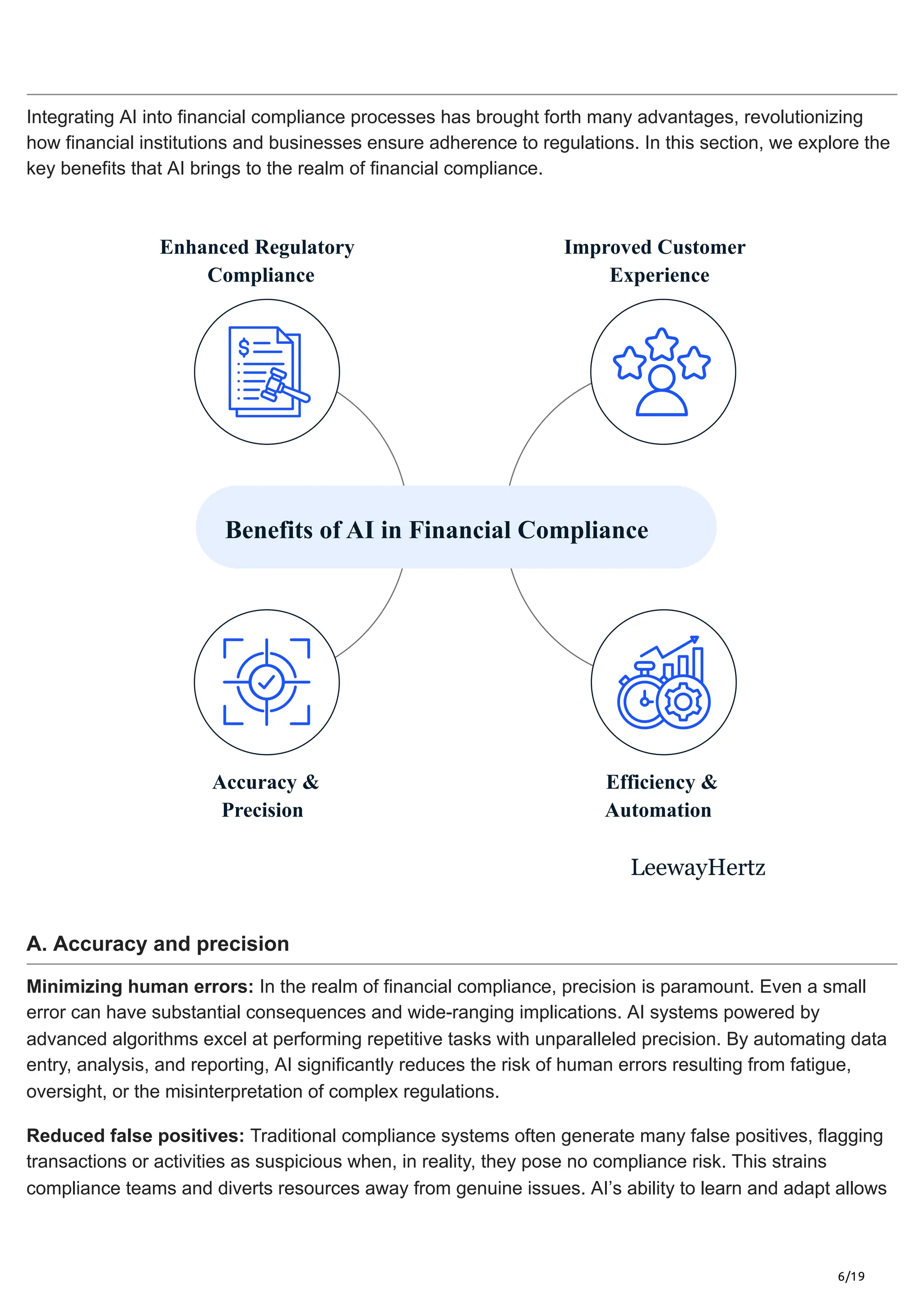
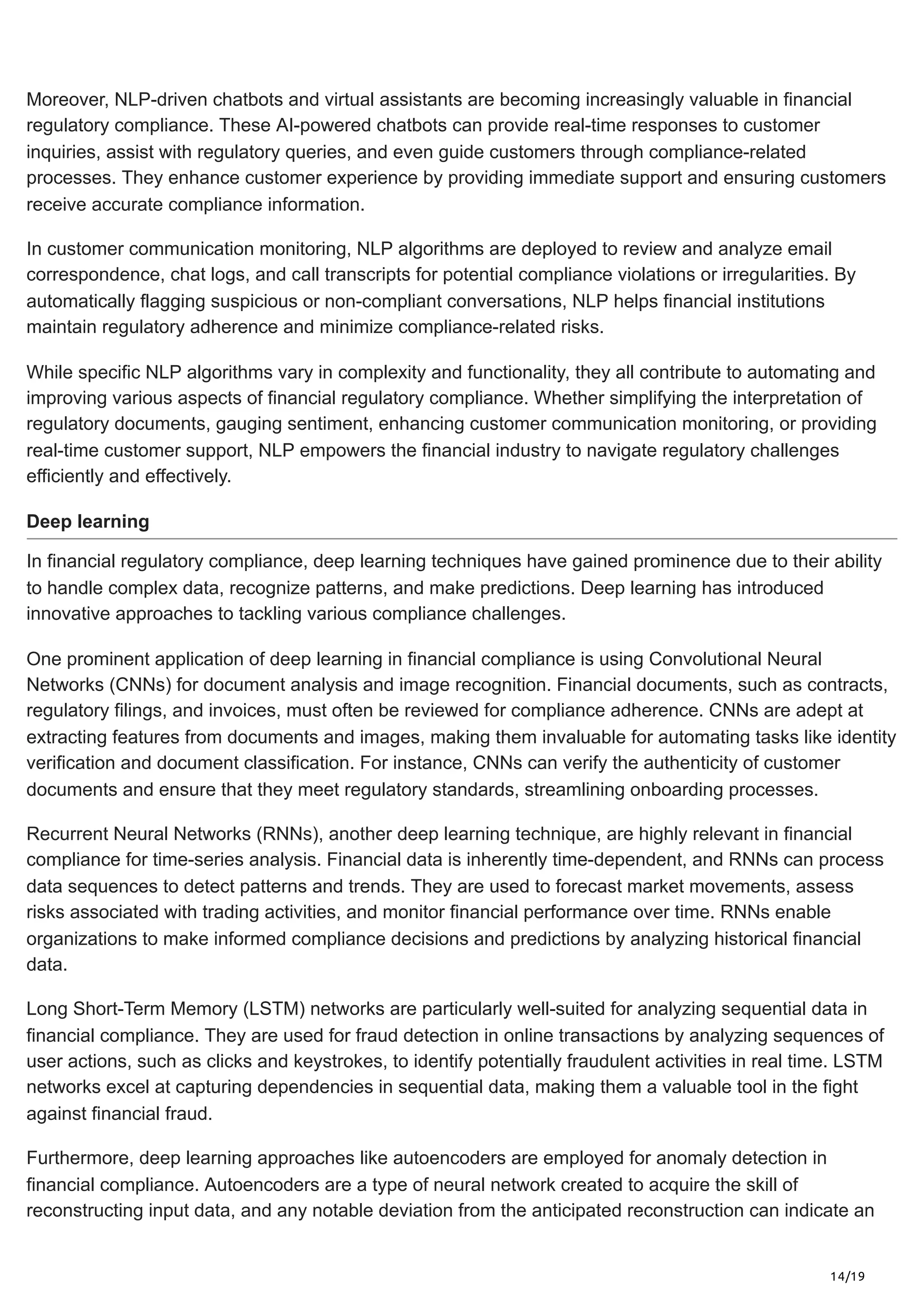
The Need for AI in Financial Compliance
Increasing Complexity
of Financial Regulations
Dodd-Frank Act & Basel III
Growing Volumes
of Financial Data
Big data challenges
Data management issues
Rising Financial Crimes
Money Laundering
Cybersecurity Threats
LeewayHertz
A. Increasing complexity of financial regulations
Financial regulations have evolved into formidable, multifaceted frameworks that oversee the operations
of both financial institutions and businesses. As these regulations become more intricate, the demand for
AI-driven solutions intensifies to help navigate the labyrinth of compliance requirements.
Dodd-Frank Act and Basel III
Dodd-Frank Act: Following the 2008 financial crisis, this Dodd-Frank Act introduced a wide range
of regulations to strengthen financial stability and safeguard consumer interests. These regulations,
while necessary, have increased the compliance burden on financial institutions, making automation
and AI-driven compliance a necessity.
5/19
Basel III: On an international scale, Basel III, a set of global banking standards established by the
Basel Committee on Banking Supervision, mandates stringent capital and liquidity requirements.
Ensuring compliance with these standards involves complex risk assessment and capital
management processes that benefit significantly from AI’s analytical capabilities.
B. Rising financial crimes
Financial crimes constantly threaten the integrity of financial systems and institutions. AI technologies are
becoming indispensable tools for identifying and preventing these illicit activities.
Money laundering
Detection: Money laundering schemes are becoming increasingly sophisticated, making them harder to
detect with traditional methods. Compliance teams face the challenge of keeping up with evolving
laundering techniques.
Cybersecurity threats
Evolving cyber threats: The financial sector is a prime target for cyberattacks, which are growing in
scale and complexity. Organizations must grapple with the ever-evolving nature of these threats and the
associated risks.
C. Growing volumes of financial data
The digital age has brought about an era of unprecedented data generation in the financial sector.
Handling this deluge of data poses significant challenges that AI can address effectively.
Big data challenges
Data overload: Managing and making sense of vast volumes of financial data can overwhelm
organizations. Extracting actionable insights and identifying relevant information from this data can be
daunting.
Data management issues
Data quality: Ensuring data accuracy and consistency in large datasets is challenging. Data quality
issues can result in compliance reporting errors and decision-making.
Data privacy concerns: Protecting sensitive financial data and ensuring compliance with data
privacy regulations are complex tasks that require constant vigilance and adaptation.
The need for AI in financial compliance is multifaceted, driven by the escalating complexity of regulations
like the Dodd-Frank Act, Basel III, and GDPR, the growing menace of financial crimes such as money
laundering and cyber threats, and the challenges posed by the explosion of financial data. AI streamlines
compliance processes and fortifies financial institutions against risks, making it an indispensable asset in
the quest for robust financial compliance and regulatory adherence.
Benefits of AI in financial compliance
6/19
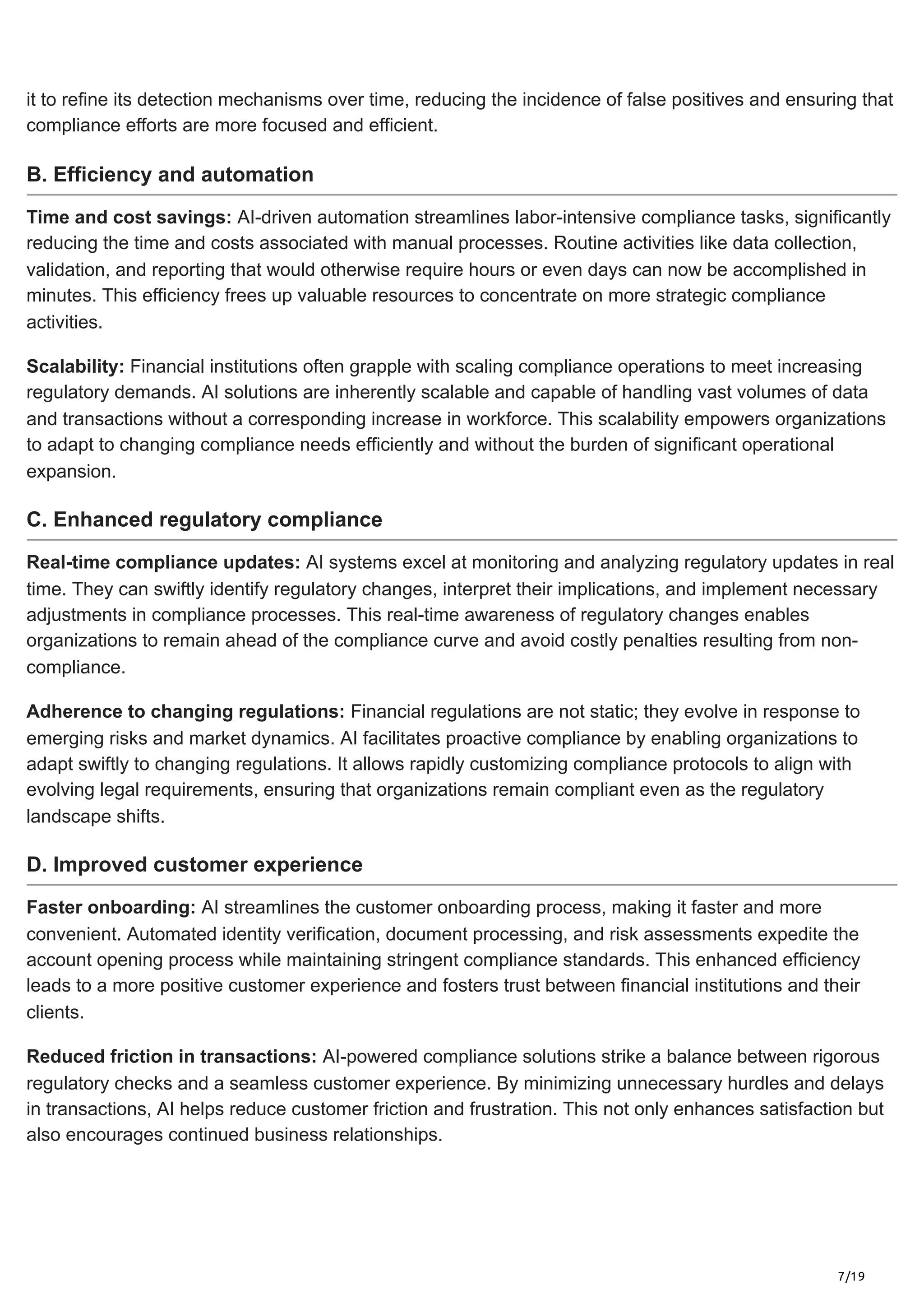
Integrating AI into financial compliance processes has brought forth many advantages, revolutionizing
how financial institutions and businesses ensure adherence to regulations. In this section, we explore the
key benefits that AI brings to the realm of financial compliance.
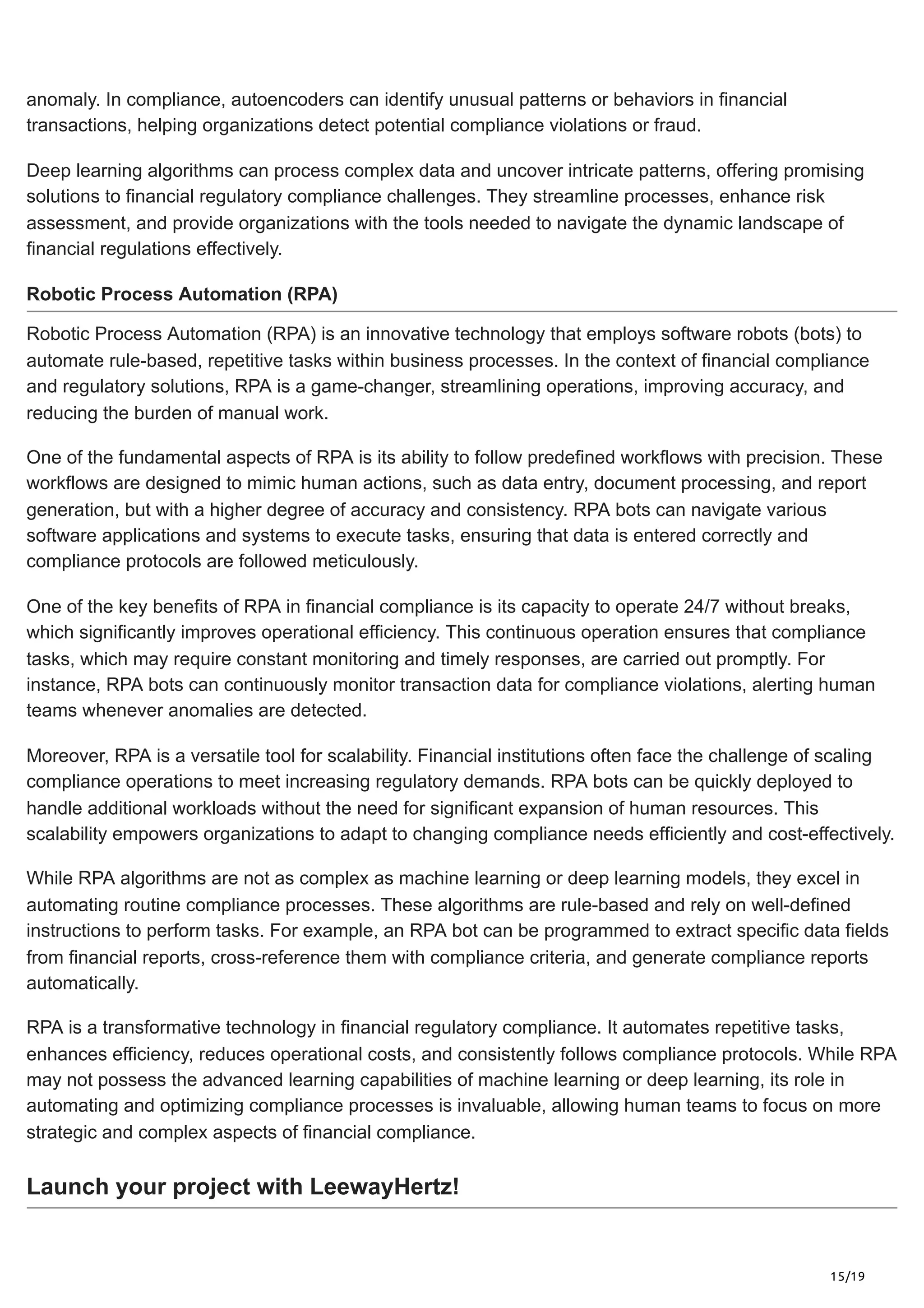
Accuracy &
Precision
Efficiency &
Automation
Enhanced Regulatory
Compliance
Improved Customer
Experience
Benefits of AI in Financial Compliance
LeewayHertz
A. Accuracy and precision
Minimizing human errors: In the realm of financial compliance, precision is paramount. Even a small
error can have substantial consequences and wide-ranging implications. AI systems powered by
advanced algorithms excel at performing repetitive tasks with unparalleled precision. By automating data
entry, analysis, and reporting, AI significantly reduces the risk of human errors resulting from fatigue,
oversight, or the misinterpretation of complex regulations.
Reduced false positives: Traditional compliance systems often generate many false positives, flagging
transactions or activities as suspicious when, in reality, they pose no compliance risk. This strains
compliance teams and diverts resources away from genuine issues. AI’s ability to learn and adapt allows
7/19
it to refine its detection mechanisms over time, reducing the incidence of false positives and ensuring that
compliance efforts are more focused and efficient.
B. Efficiency and automation
Time and cost savings: AI-driven automation streamlines labor-intensive compliance tasks, significantly
reducing the time and costs associated with manual processes. Routine activities like data collection,
validation, and reporting that would otherwise require hours or even days can now be accomplished in
minutes. This efficiency frees up valuable resources to concentrate on more strategic compliance
activities.
Scalability: Financial institutions often grapple with scaling compliance operations to meet increasing
regulatory demands. AI solutions are inherently scalable and capable of handling vast volumes of data
and transactions without a corresponding increase in workforce. This scalability empowers organizations
to adapt to changing compliance needs efficiently and without the burden of significant operational
expansion.
C. Enhanced regulatory compliance
Real-time compliance updates: AI systems excel at monitoring and analyzing regulatory updates in real
time. They can swiftly identify regulatory changes, interpret their implications, and implement necessary
adjustments in compliance processes. This real-time awareness of regulatory changes enables
organizations to remain ahead of the compliance curve and avoid costly penalties resulting from non-
compliance.
Adherence to changing regulations: Financial regulations are not static; they evolve in response to
emerging risks and market dynamics. AI facilitates proactive compliance by enabling organizations to
adapt swiftly to changing regulations. It allows rapidly customizing compliance protocols to align with
evolving legal requirements, ensuring that organizations remain compliant even as the regulatory
landscape shifts.
D. Improved customer experience
Faster onboarding: AI streamlines the customer onboarding process, making it faster and more
convenient. Automated identity verification, document processing, and risk assessments expedite the
account opening process while maintaining stringent compliance standards. This enhanced efficiency
leads to a more positive customer experience and fosters trust between financial institutions and their
clients.
Reduced friction in transactions: AI-powered compliance solutions strike a balance between rigorous
regulatory checks and a seamless customer experience. By minimizing unnecessary hurdles and delays
in transactions, AI helps reduce customer friction and frustration. This not only enhances satisfaction but
also encourages continued business relationships.
8/19
The benefits of AI in financial compliance are far-reaching. From ensuring accuracy and precision to
driving efficiency, enhancing regulatory compliance, and improving the overall customer experience, AI
has become a cornerstone in the evolution of financial compliance practices. Its ability to alleviate the
challenges of manual processes while fortifying organizations against regulatory risks makes AI an
indispensable tool in the pursuit of effective financial compliance.
Launch your project with LeewayHertz!
Enhance financial compliance with AI! Our AI solutions for financial regulatory compliance ensure
accuracy, mitigate risks, and streamline compliance processes for your business.
Learn More
Applications of AI in financial regulatory compliance
Financial regulatory compliance has traditionally relied on human oversight and manual processes, a
scenario often fraught with challenges and limitations. AI applications are redefining financial regulatory
compliance by offering unparalleled precision, efficiency, and adaptability. Let us explore some
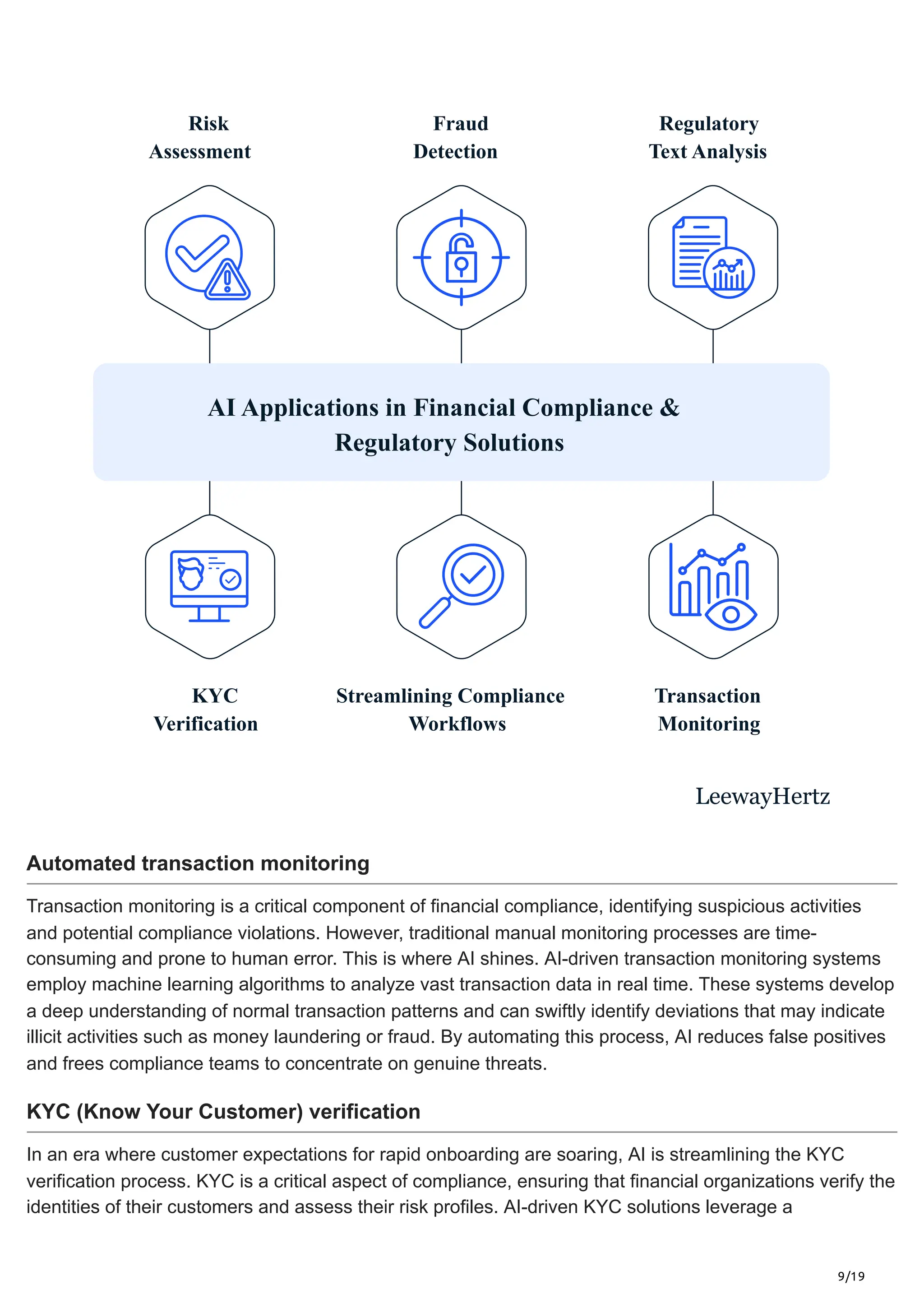
applications of AI in financial regulatory compliance:
9/19
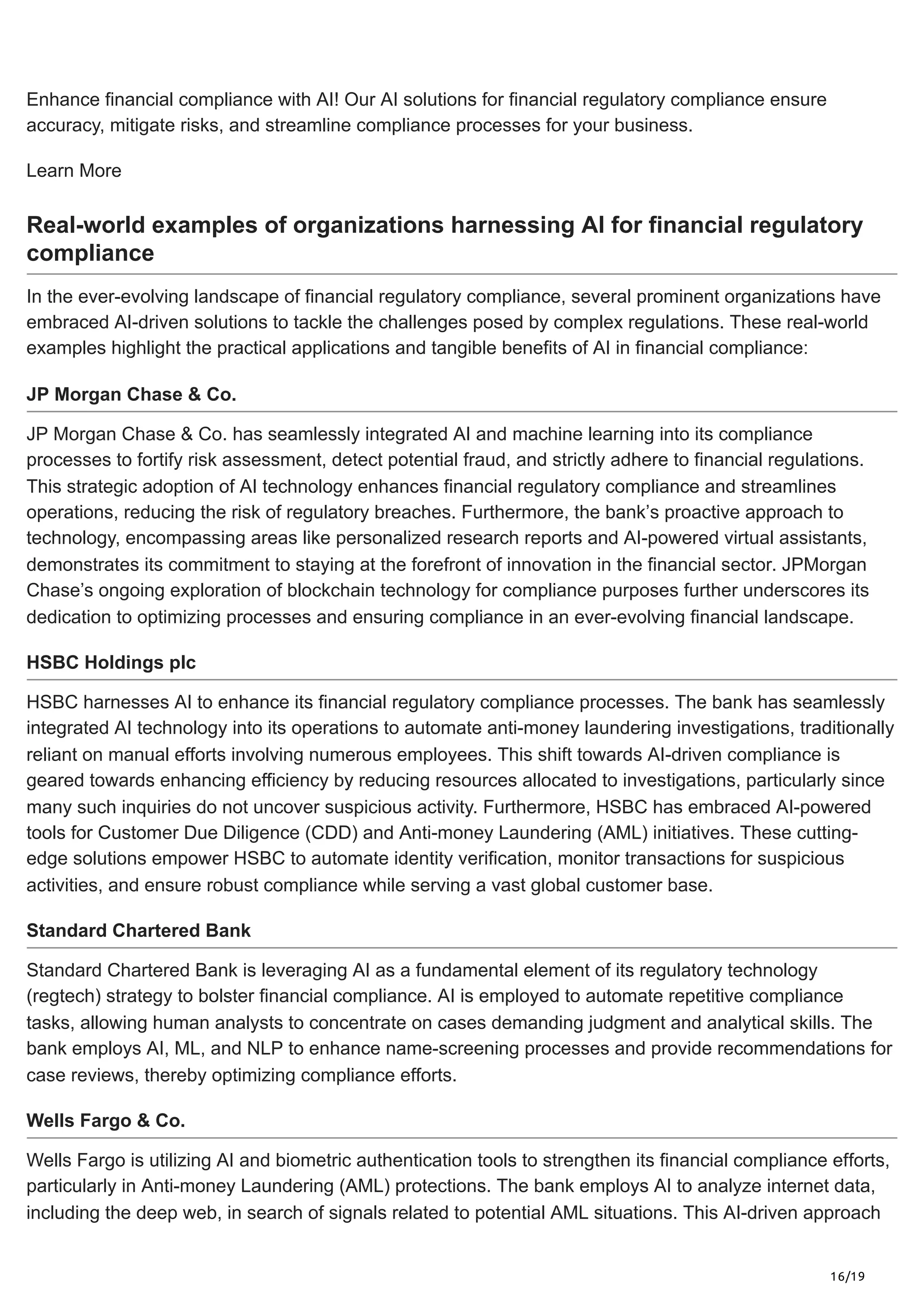
AI Applications in Financial Compliance &
Regulatory Solutions
KYC
Verification
Risk
Assessment
Transaction
Monitoring
Streamlining Compliance
Workflows
Fraud
Detection
Regulatory
Text Analysis
LeewayHertz
Automated transaction monitoring
Transaction monitoring is a critical component of financial compliance, identifying suspicious activities
and potential compliance violations. However, traditional manual monitoring processes are time-
consuming and prone to human error. This is where AI shines. AI-driven transaction monitoring systems
employ machine learning algorithms to analyze vast transaction data in real time. These systems develop
a deep understanding of normal transaction patterns and can swiftly identify deviations that may indicate
illicit activities such as money laundering or fraud. By automating this process, AI reduces false positives
and frees compliance teams to concentrate on genuine threats.
KYC (Know Your Customer) verification
In an era where customer expectations for rapid onboarding are soaring, AI is streamlining the KYC
verification process. KYC is a critical aspect of compliance, ensuring that financial organizations verify the
identities of their customers and assess their risk profiles. AI-driven KYC solutions leverage a
10/19
combination of facial recognition, document analysis, and data extraction to expedite the onboarding
process. These systems can accurately and swiftly verify customer identities, cross-referencing
information against global databases and regulatory watchlists. The result? Faster onboarding, reduced
friction for customers, and compliance adherence—all in one package.
Risk assessment and mitigation
Managing risk is at the heart of financial compliance. AI enhances risk assessment and mitigation
strategies by leveraging predictive analytics. Machine learning models can analyze historical data to
identify patterns and trends that may signify potential risks. For instance, banks and investment firms can
use AI to build predictive risk models that assess the creditworthiness of borrowers or the volatility of
investment portfolios. This empowers organizations to make data-driven decisions and proactively
address risks, ensuring compliance with regulatory requirements.
Fraud detection and prevention
Financial fraud is a persistent and evolving threat, with fraudsters employing sophisticated tactics to
evade detection. AI, however, offers solutions that can spot even the most cunning schemes. AI-based
fraud detection systems utilize machine learning algorithms to analyze transaction data, looking for
anomalies and suspicious behavior. These systems can swiftly identify potential fraud in real time,
triggering alerts for further investigation. Furthermore, AI continuously adapts to new fraud patterns,
staying one step ahead of the perpetrators.
Regulatory text analysis
The financial industry is inundated with regulatory documents, updates, and guidelines. Staying abreast
of these changes is a strenuous task. Here, Natural Language Processing (NLP) plays a crucial role. NLP
algorithms can read, comprehend, and extract insights from regulatory texts. They can analyze
documents for relevant information, interpret legal jargon, and summarize critical updates. By automating
this process, NLP-driven AI ensures compliance teams have access to the latest regulatory changes,
helping organizations stay on the right side of the law.
Streamlining compliance workflows
Repetitive and manual compliance tasks, such as data entry, document processing, and report
generation, are ideal candidates for automation. Robotic Process Automation (RPA) harnesses AI to take
over these routine tasks, freeing human resources for more strategic compliance efforts. RPA bots can
follow predefined workflows to complete tasks with precision and speed, ensuring consistency and
reducing the risk of human errors. They can also work 24/7, significantly improving efficiency and
reducing operational costs.
AI applications in financial compliance and regulatory solutions are not mere enhancements but
transformative forces. They empower financial institutions to navigate the complexities of compliance with
unprecedented accuracy, efficiency, and agility. As AI continues to evolve, its impact on compliance will
only become more profound, redefining how organizations approach regulatory challenges in the dynamic
world of finance.
11/19
How does LeewayHertz’s generative AI platform enhance financial regulatory
compliance workflows?
LeewayHertz’s generative AI platform, ZBrain, plays a transformative role in optimizing financial
regulatory compliance, navigating complex regulatory scenarios, and ensuring adherence to stringent
standards for enhanced risk management, bolstering operational efficiency and regulatory adaptability. As
a comprehensive, enterprise-ready platform, ZBrain empowers businesses to design and implement
applications tailored to their specific operational requirements. The platform uses clients’ data, whether in
the form of text, images, or documents, to train advanced LLMs like GPT-4, Vicuna, Llama 2, or GPT-
NeoX for developing contextually aware applications capable of performing diverse tasks.
Enterprises face the intricate challenges of financial compliance, encompassing navigating a complex
regulatory landscape, managing globalized compliance across diverse jurisdictions, addressing data
security and privacy concerns, allocating substantial resources, mitigating cybersecurity risks,
overcoming legacy system constraints, and staying abreast of continuous regulatory changes. ZBrain
effectively addresses these challenges through its distinctive feature called “Flow,” which provides an
intuitive interface that allows users to create intricate business logic for their apps without the need for
coding. Flow’s easy-to-use drag-and-drop interface enables the seamless integration of large language
models, prompt templates, and other generative AI models into your app’s logic for its easy
conceptualization, creation, or modification.
To comprehensively understand how ZBrain Flow works, explore this resource that outlines a range of
industry-specific Flow processes. This compilation highlights ZBrain’s adaptability and resilience,
showcasing how the platform effectively meets the diverse needs of various industries, ensuring
enterprises stay ahead in today’s rapidly evolving business landscape.
ZBrain’s potent applications optimize financial regulatory compliance, converting intricate data into
actionable insights for enhanced efficiency, improved accuracy in risk management, and increased
adaptability to dynamic regulatory changes, empowering organizations to steer complex compliance
landscapes with agility and precision. ZBrain’s holistic solutions adeptly address critical challenges within
financial regulatory compliance processes. Delve into the following section to uncover how ZBrain
ensures a streamlined and seamless approach to financial regulatory compliance within the finance and
banking sector.
AI-driven financial regulatory compliance
In the ever-evolving finance and banking industry, where strict adherence to regulatory changes is crucial
to prevent significant penalties and safeguard reputation, ZBrain offers an advanced solution to
streamline the complex task of maintaining consistent regulatory compliance.ZBrain begins the process
by aggregating diverse data, encompassing the latest regulatory updates, internal compliance records,
policy documents, and audit reports. Later, it conducts an automated Exploratory Data Analysis (EDA) to
assess the organization’s compliance status and pinpoint potential areas of concern. Employing
sophisticated methods, ZBrain transforms textual data into numerical embeddings, capturing intricate
data relationships for efficient retrieval and analysis. These embeddings are the foundation for in-depth
analysis, enhancing ZBrain’s ability to identify regulatory irregularities and deliver precise compliance
12/19
recommendations. Upon user request, ZBrain leverages the chosen AI-Language Model (LLM) to
generate a comprehensive report, leveraging the embeddings to provide profound insights, flagging focus
areas, and offering actionable suggestions for compliance. Post-generation, ZBrain employs a meticulous
parsing technique to extract relevant insights, ensuring compliance officials receive precise, actionable,
and timely recommendations. This integrated approach ensures a proactive and efficient method for
maintaining robust financial compliance.
ZBrain applications enable banking and financial institutions to enhance operational efficiency, ensure
accuracy in processing extensive compliance-related data volumes, reduce costs, enable timely
reporting, and uphold rigorous data privacy standards while effectively mitigating compliance risks. Step
into this detailed Flow to understand how ZBrain facilitates financial regulations, empowers smart
decision-making, and guarantees accurate compliance records, fostering seamless guidance and data-
driven compliance.
AI technologies in financial regulatory compliance
AI technologies play a pivotal role in modernizing financial regulatory compliance. These technologies
encompass various AI branches and tools that enhance accuracy, efficiency, and adaptability in
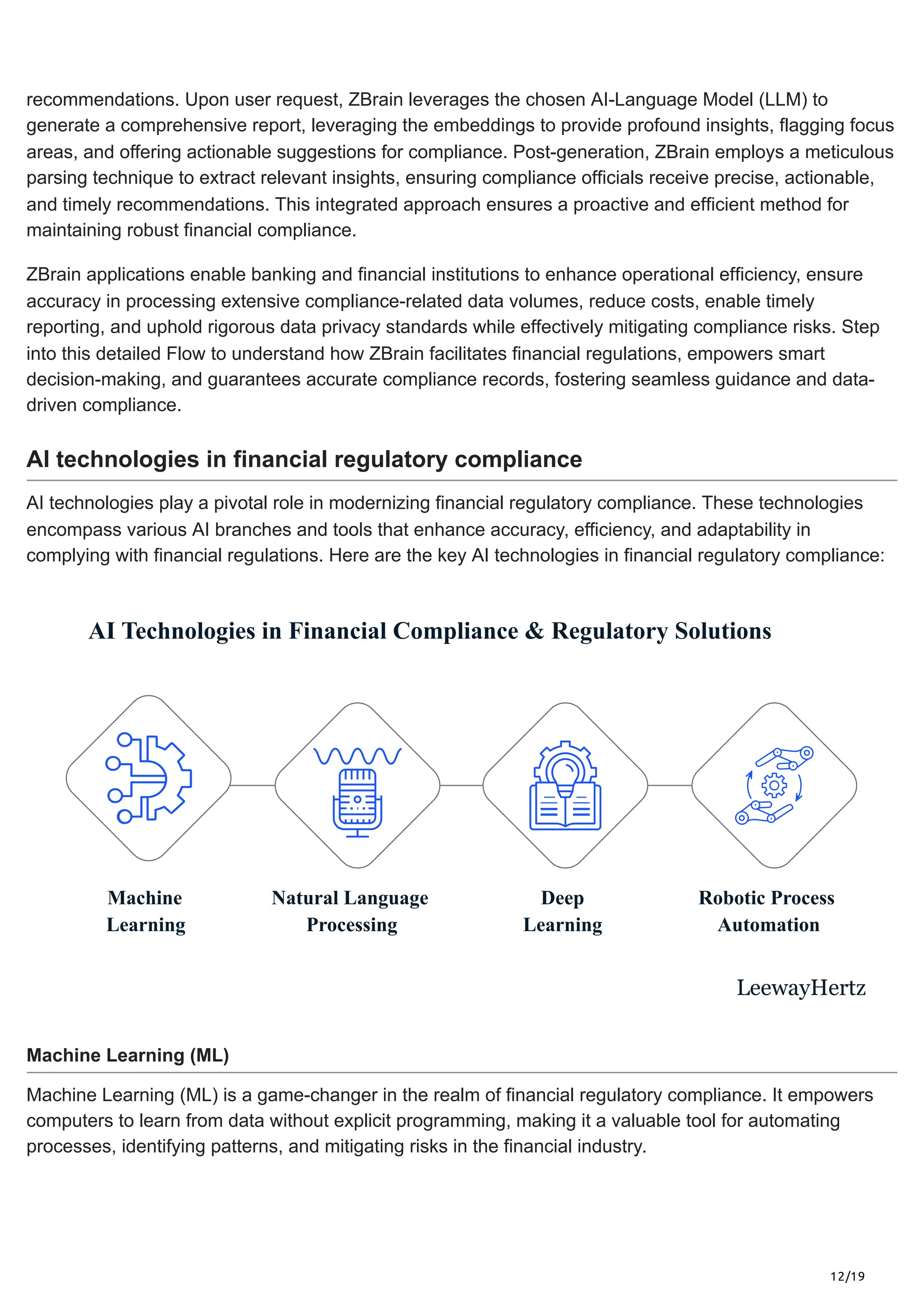
complying with financial regulations. Here are the key AI technologies in financial regulatory compliance:
LeewayHertz
AI Technologies in Financial Compliance & Regulatory Solutions
Machine
Learning
Deep
Learning
Robotic Process
Automation
Natural Language
Processing
Machine Learning (ML)
Machine Learning (ML) is a game-changer in the realm of financial regulatory compliance. It empowers
computers to learn from data without explicit programming, making it a valuable tool for automating
processes, identifying patterns, and mitigating risks in the financial industry.
13/19
One commonly used algorithm is Logistic Regression, particularly in fraud detection. Logistic regression
calculates the probability that a transaction is fraudulent based on various features like transaction
amount and user behavior. If the probability exceeds a particular threshold, the transaction is flagged as
suspicious, preventing fraud. Decision Trees and Random Forests are indispensable for risk assessment.
Decision trees break down complex decisions into a series of yes-or-no questions, while Random Forests
combine multiple decision trees to provide a comprehensive view of risk factors. These algorithms help
financial organizations make informed decisions regarding lending, investment, and other financial
activities. Support Vector Machines (SVMs) excel in anomaly detection. They identify outliers or
deviations from normal patterns, making them invaluable for spotting unusual transactions or behaviors
that may indicate fraud or compliance violations.
K-Nearest Neighbors (K-NN) is utilized for customer segmentation. By grouping similar customers
together based on their financial behavior, financial institutions can tailor compliance strategies and risk
assessments to different customer segments, ensuring more targeted efforts. Naive Bayes is a popular
choice in Anti-Money Laundering (AML). It classifies transactions as suspicious or non-suspicious by
calculating the probability of a transaction being associated with money laundering, making it a swift and
effective tool in AML processes.
Time-series analysis and fraud detection in online transactions often involve Recurrent Neural Networks
(RNNs) and Long Short-Term Memory (LSTM) networks. RNNs can identify patterns and trends in
financial data, aiding in predictions about market movements and compliance risks, while LSTMs are
adept at analyzing sequences of user actions to detect potential online fraud in real time.
Incorporating these ML algorithms into financial regulatory compliance equips the financial industry with
the tools to navigate complex regulatory landscapes efficiently, make informed decisions, and ensure
compliance with evolving standards and regulations.
Natural Language Processing (NLP)
In financial regulatory compliance, NLP is crucial in processing, understanding, and extracting insights
from vast amounts of textual data, including regulatory documents, customer communications, and
financial reports. NLP is transforming the landscape of financial regulatory compliance through its ability
to automate and enhance various tasks.
One of the key NLP applications in financial regulatory compliance is regulatory text analysis. Regulatory
documents are often lengthy and filled with complex legal jargon. NLP algorithms, such as Named Entity
Recognition (NER) and Part-of-Speech (POS) tagging, enable computers to extract and identify relevant
information from these documents automatically. For example, NER can recognize and categorize entities
like company names, dates, and regulatory references, making it easier for compliance teams to navigate
and interpret regulatory updates.
Sentiment analysis is another vital NLP application in financial regulatory compliance. It evaluates the
tone and sentiment expressed in customer communications, news articles, and social media posts.
Financial institutions can gauge public perception and potential compliance risks by analyzing sentiment.
For instance, sentiment analysis can detect negative sentiment related to a company’s financial practices,
signaling a need for closer compliance scrutiny.
14/19
Moreover, NLP-driven chatbots and virtual assistants are becoming increasingly valuable in financial
regulatory compliance. These AI-powered chatbots can provide real-time responses to customer
inquiries, assist with regulatory queries, and even guide customers through compliance-related
processes. They enhance customer experience by providing immediate support and ensuring customers
receive accurate compliance information.
In customer communication monitoring, NLP algorithms are deployed to review and analyze email
correspondence, chat logs, and call transcripts for potential compliance violations or irregularities. By
automatically flagging suspicious or non-compliant conversations, NLP helps financial institutions
maintain regulatory adherence and minimize compliance-related risks.
While specific NLP algorithms vary in complexity and functionality, they all contribute to automating and
improving various aspects of financial regulatory compliance. Whether simplifying the interpretation of
regulatory documents, gauging sentiment, enhancing customer communication monitoring, or providing
real-time customer support, NLP empowers the financial industry to navigate regulatory challenges
efficiently and effectively.
Deep learning
In financial regulatory compliance, deep learning techniques have gained prominence due to their ability
to handle complex data, recognize patterns, and make predictions. Deep learning has introduced
innovative approaches to tackling various compliance challenges.
One prominent application of deep learning in financial compliance is using Convolutional Neural
Networks (CNNs) for document analysis and image recognition. Financial documents, such as contracts,
regulatory filings, and invoices, must often be reviewed for compliance adherence. CNNs are adept at
extracting features from documents and images, making them invaluable for automating tasks like identity
verification and document classification. For instance, CNNs can verify the authenticity of customer
documents and ensure that they meet regulatory standards, streamlining onboarding processes.
Recurrent Neural Networks (RNNs), another deep learning technique, are highly relevant in financial
compliance for time-series analysis. Financial data is inherently time-dependent, and RNNs can process
data sequences to detect patterns and trends. They are used to forecast market movements, assess
risks associated with trading activities, and monitor financial performance over time. RNNs enable
organizations to make informed compliance decisions and predictions by analyzing historical financial
data.
Long Short-Term Memory (LSTM) networks are particularly well-suited for analyzing sequential data in
financial compliance. They are used for fraud detection in online transactions by analyzing sequences of
user actions, such as clicks and keystrokes, to identify potentially fraudulent activities in real time. LSTM
networks excel at capturing dependencies in sequential data, making them a valuable tool in the fight
against financial fraud.
Furthermore, deep learning approaches like autoencoders are employed for anomaly detection in
financial compliance. Autoencoders are a type of neural network created to acquire the skill of
reconstructing input data, and any notable deviation from the anticipated reconstruction can indicate an
15/19
anomaly. In compliance, autoencoders can identify unusual patterns or behaviors in financial
transactions, helping organizations detect potential compliance violations or fraud.
Deep learning algorithms can process complex data and uncover intricate patterns, offering promising
solutions to financial regulatory compliance challenges. They streamline processes, enhance risk
assessment, and provide organizations with the tools needed to navigate the dynamic landscape of
financial regulations effectively.
Robotic Process Automation (RPA)
Robotic Process Automation (RPA) is an innovative technology that employs software robots (bots) to
automate rule-based, repetitive tasks within business processes. In the context of financial compliance
and regulatory solutions, RPA is a game-changer, streamlining operations, improving accuracy, and
reducing the burden of manual work.
One of the fundamental aspects of RPA is its ability to follow predefined workflows with precision. These
workflows are designed to mimic human actions, such as data entry, document processing, and report
generation, but with a higher degree of accuracy and consistency. RPA bots can navigate various
software applications and systems to execute tasks, ensuring that data is entered correctly and
compliance protocols are followed meticulously.
One of the key benefits of RPA in financial compliance is its capacity to operate 24/7 without breaks,
which significantly improves operational efficiency. This continuous operation ensures that compliance
tasks, which may require constant monitoring and timely responses, are carried out promptly. For
instance, RPA bots can continuously monitor transaction data for compliance violations, alerting human
teams whenever anomalies are detected.
Moreover, RPA is a versatile tool for scalability. Financial institutions often face the challenge of scaling
compliance operations to meet increasing regulatory demands. RPA bots can be quickly deployed to
handle additional workloads without the need for significant expansion of human resources. This
scalability empowers organizations to adapt to changing compliance needs efficiently and cost-effectively.
While RPA algorithms are not as complex as machine learning or deep learning models, they excel in
automating routine compliance processes. These algorithms are rule-based and rely on well-defined
instructions to perform tasks. For example, an RPA bot can be programmed to extract specific data fields
from financial reports, cross-reference them with compliance criteria, and generate compliance reports
automatically.
RPA is a transformative technology in financial regulatory compliance. It automates repetitive tasks,
enhances efficiency, reduces operational costs, and consistently follows compliance protocols. While RPA
may not possess the advanced learning capabilities of machine learning or deep learning, its role in
automating and optimizing compliance processes is invaluable, allowing human teams to focus on more
strategic and complex aspects of financial compliance.
Launch your project with LeewayHertz!
16/19
Enhance financial compliance with AI! Our AI solutions for financial regulatory compliance ensure
accuracy, mitigate risks, and streamline compliance processes for your business.
Learn More
Real-world examples of organizations harnessing AI for financial regulatory
compliance
In the ever-evolving landscape of financial regulatory compliance, several prominent organizations have
embraced AI-driven solutions to tackle the challenges posed by complex regulations. These real-world
examples highlight the practical applications and tangible benefits of AI in financial compliance:
JP Morgan Chase & Co.
JP Morgan Chase & Co. has seamlessly integrated AI and machine learning into its compliance
processes to fortify risk assessment, detect potential fraud, and strictly adhere to financial regulations.
This strategic adoption of AI technology enhances financial regulatory compliance and streamlines
operations, reducing the risk of regulatory breaches. Furthermore, the bank’s proactive approach to
technology, encompassing areas like personalized research reports and AI-powered virtual assistants,
demonstrates its commitment to staying at the forefront of innovation in the financial sector. JPMorgan
Chase’s ongoing exploration of blockchain technology for compliance purposes further underscores its
dedication to optimizing processes and ensuring compliance in an ever-evolving financial landscape.
HSBC Holdings plc
HSBC harnesses AI to enhance its financial regulatory compliance processes. The bank has seamlessly
integrated AI technology into its operations to automate anti-money laundering investigations, traditionally
reliant on manual efforts involving numerous employees. This shift towards AI-driven compliance is
geared towards enhancing efficiency by reducing resources allocated to investigations, particularly since
many such inquiries do not uncover suspicious activity. Furthermore, HSBC has embraced AI-powered
tools for Customer Due Diligence (CDD) and Anti-money Laundering (AML) initiatives. These cutting-
edge solutions empower HSBC to automate identity verification, monitor transactions for suspicious
activities, and ensure robust compliance while serving a vast global customer base.
Standard Chartered Bank
Standard Chartered Bank is leveraging AI as a fundamental element of its regulatory technology
(regtech) strategy to bolster financial compliance. AI is employed to automate repetitive compliance
tasks, allowing human analysts to concentrate on cases demanding judgment and analytical skills. The
bank employs AI, ML, and NLP to enhance name-screening processes and provide recommendations for
case reviews, thereby optimizing compliance efforts.
Wells Fargo & Co.
Wells Fargo is utilizing AI and biometric authentication tools to strengthen its financial compliance efforts,
particularly in Anti-money Laundering (AML) protections. The bank employs AI to analyze internet data,
including the deep web, in search of signals related to potential AML situations. This AI-driven approach
17/19
allows for a more in-depth investigation. By leveraging AI and biometrics, Wells Fargo aims to proactively
identify patterns and signals that human analysts might overlook, bolstering its defenses against money
laundering and digital fraud.
These real-world examples demonstrate that AI is not just an abstract concept but a tangible and effective
tool that leading financial institutions rely on to effectively navigate the intricate world of financial
compliance.
AI for financial regulatory compliance: Future trends
AI for financial compliance is reshaping the landscape of the financial industry. Here are some future AI
trends for financial regulatory compliance that will shape the industry in the coming years:
Explainable AI (XAI)
One of the emerging trends in AI for financial regulatory compliance is the emphasis on Explainable AI
(XAI). As regulatory bodies require transparency in decision-making processes, XAI seeks to make AI
algorithms more understandable and interpretable. Financial institutions are increasingly investing in AI
models that provide accurate results and offer clear explanations of how those results are derived. This
trend aims to enhance regulatory compliance by ensuring that AI-driven decisions are not perceived as
black boxes but can be scrutinized and justified.
Regulatory technology (RegTech) ecosystems
The evolution of RegTech ecosystems is another significant trend. These ecosystems combine various
technologies, including AI, to offer comprehensive solutions for compliance challenges. Financial
institutions can streamline their compliance efforts by integrating AI-powered tools for risk assessment,
fraud detection, and transaction monitoring. These ecosystems facilitate cross-functional collaboration
and enable organizations to meet complex regulatory requirements efficiently.
AI-enhanced Customer Due Diligence (CDD)
Customer Due Diligence is crucial to financial compliance, especially in Anti-money Laundering (AML)
and Know Your Customer (KYC) processes. AI is increasingly being used to enhance CDD by automating
identity verification, risk assessment, and ongoing monitoring. The future trend is to integrate AI solutions
that identify suspicious activities and provide insights into customer behavior, enabling organizations to
manage compliance risks proactively.
Predictive compliance analytics
AI-powered predictive analytics is set to transform compliance efforts. AI models can proactively forecast
potential compliance breaches or fraudulent activities by examining historical data and recognizing
patterns. Financial institutions can use these insights to implement preventive measures and minimize
compliance risks. Predictive compliance analytics also assist in resource allocation, enabling
organizations to focus on high-risk areas.
Blockchain and AI integration
18/19
Integrating blockchain technology with AI is a promising trend in financial regulatory compliance.
Blockchain’s immutable ledger can enhance transparency and traceability in financial transactions.
Combined with AI, it can automate the auditing process, ensuring that transactions comply with
regulations in real time. This integration can reduce the likelihood of fraud and simplify regulatory
reporting.
Cross-border compliance solutions
With the globalization of financial markets, cross-border compliance has become increasingly complex. AI
is expected to be pivotal in developing solutions that streamline compliance across multiple jurisdictions.
These solutions will interpret local regulations and assess their impact on global operations, enabling
financial institutions to navigate regulatory differences seamlessly.
Ethical AI in compliance
As AI becomes more integrated into compliance processes, ethical considerations are gaining
importance. The future trend is to develop AI systems that adhere to ethical principles, ensuring fairness,
transparency, and accountability in decision-making. This approach aligns with regulators’ increasing
focus on responsible AI deployment.
The landscape of AI in financial regulatory compliance is marked by dynamic evolution as technology
continually advances to meet the demands of an ever-shifting regulatory environment. This underscores
the pivotal role of AI in adapting and responding effectively to the ongoing challenges posed by the
changing regulatory landscape within the financial sector.
By embracing these emerging trends, financial institutions and businesses can not only enhance their
compliance efforts but also position themselves as leaders in navigating the complex regulatory
landscape of the future.
Conclusion
AI has emerged as a potent force, reshaping how financial institutions navigate the intricate web of rules
and regulations in the dynamic realm of financial regulatory compliance. Regardless of their size, financial
institutions grapple with the weighty task of compliance, where precision and adaptability are paramount.
Traditional methods are akin to moving at a snail’s pace in a fast-changing landscape, leaving
organizations vulnerable. With its remarkable data processing capabilities and pattern recognition, AI
serves as a lifeline.
AI’s impact is evident in its ability to streamline compliance, enhance accuracy, and provide real-time
updates. It delivers tangible benefits, from efficiency to improved customer experiences. It automates
complex tasks and simplifies adherence to regulations, reducing human errors. AI promises a future of
transparency, comprehensive solutions, and simplified processes. It is not just a tool but an evolution—a
practical step towards a more compliant financial future.
In this ever-evolving landscape, AI is the bridge to a future where compliance is efficient and transparent,
paving the way for a more secure and accountable financial industry. AI is not just a trend; it’s the catalyst
for change, here to stay.
19/19
Ready to harness the power of AI to transform financial regulatory compliance? Contact LeewayHertz
today to explore tailored AI solutions to streamline your regulatory processes and enhance compliance
efficiency.

AI applications in financial compliance An overview.pdf

  • 1.
    1/19 AI applications infinancial compliance: An overview leewayhertz.com/ai-in-financial-compliance/ In the vast and ever-evolving landscape of the financial industry, a prominent challenge looms with considerable gravity: regulatory compliance. The financial sector, a cornerstone of global economies, faces the daunting task of navigating a labyrinthine network of rules and regulations. It’s not just a matter of ticking boxes; it’s about protecting assets, identifying risks, and safeguarding customers from financial crimes. In 2021 alone, the world collectively spent a staggering $213.9 billion on financial crime compliance. For large and small financial institutions, compliance isn’t merely a matter of legality; it’s a material concern affecting their bottom line. Legacy approaches to compliance are akin to attempting a marathon with lead shoes, leaving institutions vulnerable to risks and fines that can soar as high as $10 billion, as seen in 2019. Enter the silent game-changer of modern finance: Artificial Intelligence (AI). AI is quietly making a profound impact on the compliance landscape. With its unparalleled data processing and pattern recognition capabilities, AI serves as a practical solution that empowers financial institutions to streamline compliance processes, improve productivity, and stay ahead of the regulatory curve. As financial institutions grapple with the onslaught of new regulations like the Anti-Money Laundering Act and PSD2 in the EU, AI emerges as a beacon of hope. It doesn’t just automate tasks; it redefines how institutions manage risks, reduce false positives, prevent fraud, and address human error. In essence, AI
  • 2.
    2/19 isn’t a buzzword;it’s a lifeline in the complex sea of compliance, offering tangible benefits and real-time updates for simpler compliance management. This article delves into the critical landscape of financial compliance, highlighting the need for AI-driven solutions and exploring their benefits, applications, and use cases in financial regulatory compliance. We will also unravel the underlying AI technologies that empower this transformation and peer into the future to glimpse the evolving trends in AI for financial compliance. A brief overview of financial regulatory compliance The need for AI in financial compliance Benefits of AI in financial compliance Applications of AI in financial regulatory compliance How does LeewayHertz’s generative AI platform enhance financial regulatory compliance workflows? AI technologies in financial regulatory compliance Real-world examples of organizations harnessing AI for financial regulatory compliance AI for financial regulatory compliance: Future trends A brief overview of financial regulatory compliance In the intricate world of finance, where every transaction carries weighty consequences, compliance serves as the bedrock upon which trust, integrity, and the rule of law stand. Financial regulatory compliance represents the diligent adherence to a complex web of rules, regulations, and guidelines governing the conduct of financial institutions, businesses, and organizations. The basics of compliance At its simplest, financial compliance entails conforming to legal and regulatory standards set by governing bodies, industry watchdogs, and international authorities. These standards are established to safeguard the interests of various stakeholders, including investors, customers, and the general public.
  • 3.
    3/19 The Basics Of Compliance Legal Frameworks Accountability Industry-Specific Regulations MaintainingEthical Standards Reporting & Documentation Consequences of Non-Compliance LeewayHertz a. Legal frameworks: Financial compliance is often anchored in a multitude of laws and regulations that span different aspects of the financial industry. For instance, in the US, the Securities and Exchange Commission (SEC) enforces federal securities laws, while the Financial Industry Regulatory Authority oversees broker-dealers. On a global scale, Basel III sets international standards for banking supervision and regulation. b. Industry-specific regulations: In addition to overarching financial regulations, various industries may have their own set of rules tailored to their unique operations. For example, the healthcare and pharmaceutical sectors must adhere to regulations like the Health Insurance Portability and Accountability Act, while specific financial technology regulations bind fintech companies. c. Maintaining ethical standards: Compliance goes beyond merely adhering to legal requirements. It also encompasses upholding ethical standards and principles. Organizations are expected to operate with integrity, honesty, and transparency in all their financial dealings. d. Accountability: An essential aspect of compliance is accountability. Organizations must designate responsible individuals or teams to oversee compliance efforts and ensure they are carried out effectively. This often includes creating and implementing compliance policies, conducting regular audits, and training employees. e. Reporting and documentation: Compliance also involves maintaining comprehensive records of financial transactions, internal processes, and regulatory communications. These records indicate an organization’s commitment to adhering to the rules. f. Consequences of non-compliance: Failing to meet compliance requirements can have severe repercussions. These may include financial penalties, legal action, damage to reputation, loss of customer trust, and even the suspension or revocation of operating licenses.
  • 4.
    4/19 In a financiallandscape characterized by increasing complexity and heightened scrutiny, understanding and implementing financial compliance basics are not optional but a fundamental imperative. By doing so, organizations can ensure they remain on the right side of the law while building trust and credibility with their stakeholders. Launch your project with LeewayHertz! Enhance financial compliance with AI! Our AI solutions for financial regulatory compliance ensure accuracy, mitigate risks, and streamline compliance processes for your business. Learn More The need for AI in financial compliance In today’s intricate financial ecosystem, the need for AI in financial compliance has emerged as an imperative response to the industry’s myriad challenges. This section explores the reasons behind the adoption of AI for financial compliance. The Need for AI in Financial Compliance Increasing Complexity of Financial Regulations Dodd-Frank Act & Basel III Growing Volumes of Financial Data Big data challenges Data management issues Rising Financial Crimes Money Laundering Cybersecurity Threats LeewayHertz A. Increasing complexity of financial regulations Financial regulations have evolved into formidable, multifaceted frameworks that oversee the operations of both financial institutions and businesses. As these regulations become more intricate, the demand for AI-driven solutions intensifies to help navigate the labyrinth of compliance requirements. Dodd-Frank Act and Basel III Dodd-Frank Act: Following the 2008 financial crisis, this Dodd-Frank Act introduced a wide range of regulations to strengthen financial stability and safeguard consumer interests. These regulations, while necessary, have increased the compliance burden on financial institutions, making automation and AI-driven compliance a necessity.
  • 5.
    5/19 Basel III: Onan international scale, Basel III, a set of global banking standards established by the Basel Committee on Banking Supervision, mandates stringent capital and liquidity requirements. Ensuring compliance with these standards involves complex risk assessment and capital management processes that benefit significantly from AI’s analytical capabilities. B. Rising financial crimes Financial crimes constantly threaten the integrity of financial systems and institutions. AI technologies are becoming indispensable tools for identifying and preventing these illicit activities. Money laundering Detection: Money laundering schemes are becoming increasingly sophisticated, making them harder to detect with traditional methods. Compliance teams face the challenge of keeping up with evolving laundering techniques. Cybersecurity threats Evolving cyber threats: The financial sector is a prime target for cyberattacks, which are growing in scale and complexity. Organizations must grapple with the ever-evolving nature of these threats and the associated risks. C. Growing volumes of financial data The digital age has brought about an era of unprecedented data generation in the financial sector. Handling this deluge of data poses significant challenges that AI can address effectively. Big data challenges Data overload: Managing and making sense of vast volumes of financial data can overwhelm organizations. Extracting actionable insights and identifying relevant information from this data can be daunting. Data management issues Data quality: Ensuring data accuracy and consistency in large datasets is challenging. Data quality issues can result in compliance reporting errors and decision-making. Data privacy concerns: Protecting sensitive financial data and ensuring compliance with data privacy regulations are complex tasks that require constant vigilance and adaptation. The need for AI in financial compliance is multifaceted, driven by the escalating complexity of regulations like the Dodd-Frank Act, Basel III, and GDPR, the growing menace of financial crimes such as money laundering and cyber threats, and the challenges posed by the explosion of financial data. AI streamlines compliance processes and fortifies financial institutions against risks, making it an indispensable asset in the quest for robust financial compliance and regulatory adherence. Benefits of AI in financial compliance
  • 6.
    6/19 Integrating AI intofinancial compliance processes has brought forth many advantages, revolutionizing how financial institutions and businesses ensure adherence to regulations. In this section, we explore the key benefits that AI brings to the realm of financial compliance. Accuracy & Precision Efficiency & Automation Enhanced Regulatory Compliance Improved Customer Experience Benefits of AI in Financial Compliance LeewayHertz A. Accuracy and precision Minimizing human errors: In the realm of financial compliance, precision is paramount. Even a small error can have substantial consequences and wide-ranging implications. AI systems powered by advanced algorithms excel at performing repetitive tasks with unparalleled precision. By automating data entry, analysis, and reporting, AI significantly reduces the risk of human errors resulting from fatigue, oversight, or the misinterpretation of complex regulations. Reduced false positives: Traditional compliance systems often generate many false positives, flagging transactions or activities as suspicious when, in reality, they pose no compliance risk. This strains compliance teams and diverts resources away from genuine issues. AI’s ability to learn and adapt allows
  • 7.
    7/19 it to refineits detection mechanisms over time, reducing the incidence of false positives and ensuring that compliance efforts are more focused and efficient. B. Efficiency and automation Time and cost savings: AI-driven automation streamlines labor-intensive compliance tasks, significantly reducing the time and costs associated with manual processes. Routine activities like data collection, validation, and reporting that would otherwise require hours or even days can now be accomplished in minutes. This efficiency frees up valuable resources to concentrate on more strategic compliance activities. Scalability: Financial institutions often grapple with scaling compliance operations to meet increasing regulatory demands. AI solutions are inherently scalable and capable of handling vast volumes of data and transactions without a corresponding increase in workforce. This scalability empowers organizations to adapt to changing compliance needs efficiently and without the burden of significant operational expansion. C. Enhanced regulatory compliance Real-time compliance updates: AI systems excel at monitoring and analyzing regulatory updates in real time. They can swiftly identify regulatory changes, interpret their implications, and implement necessary adjustments in compliance processes. This real-time awareness of regulatory changes enables organizations to remain ahead of the compliance curve and avoid costly penalties resulting from non- compliance. Adherence to changing regulations: Financial regulations are not static; they evolve in response to emerging risks and market dynamics. AI facilitates proactive compliance by enabling organizations to adapt swiftly to changing regulations. It allows rapidly customizing compliance protocols to align with evolving legal requirements, ensuring that organizations remain compliant even as the regulatory landscape shifts. D. Improved customer experience Faster onboarding: AI streamlines the customer onboarding process, making it faster and more convenient. Automated identity verification, document processing, and risk assessments expedite the account opening process while maintaining stringent compliance standards. This enhanced efficiency leads to a more positive customer experience and fosters trust between financial institutions and their clients. Reduced friction in transactions: AI-powered compliance solutions strike a balance between rigorous regulatory checks and a seamless customer experience. By minimizing unnecessary hurdles and delays in transactions, AI helps reduce customer friction and frustration. This not only enhances satisfaction but also encourages continued business relationships.

  • 8.
    8/19 The benefits ofAI in financial compliance are far-reaching. From ensuring accuracy and precision to driving efficiency, enhancing regulatory compliance, and improving the overall customer experience, AI has become a cornerstone in the evolution of financial compliance practices. Its ability to alleviate the challenges of manual processes while fortifying organizations against regulatory risks makes AI an indispensable tool in the pursuit of effective financial compliance. Launch your project with LeewayHertz! Enhance financial compliance with AI! Our AI solutions for financial regulatory compliance ensure accuracy, mitigate risks, and streamline compliance processes for your business. Learn More Applications of AI in financial regulatory compliance Financial regulatory compliance has traditionally relied on human oversight and manual processes, a scenario often fraught with challenges and limitations. AI applications are redefining financial regulatory compliance by offering unparalleled precision, efficiency, and adaptability. Let us explore some applications of AI in financial regulatory compliance:
  • 9.
    9/19 AI Applications inFinancial Compliance & Regulatory Solutions KYC Verification Risk Assessment Transaction Monitoring Streamlining Compliance Workflows Fraud Detection Regulatory Text Analysis LeewayHertz Automated transaction monitoring Transaction monitoring is a critical component of financial compliance, identifying suspicious activities and potential compliance violations. However, traditional manual monitoring processes are time- consuming and prone to human error. This is where AI shines. AI-driven transaction monitoring systems employ machine learning algorithms to analyze vast transaction data in real time. These systems develop a deep understanding of normal transaction patterns and can swiftly identify deviations that may indicate illicit activities such as money laundering or fraud. By automating this process, AI reduces false positives and frees compliance teams to concentrate on genuine threats. KYC (Know Your Customer) verification In an era where customer expectations for rapid onboarding are soaring, AI is streamlining the KYC verification process. KYC is a critical aspect of compliance, ensuring that financial organizations verify the identities of their customers and assess their risk profiles. AI-driven KYC solutions leverage a
  • 10.
    10/19 combination of facialrecognition, document analysis, and data extraction to expedite the onboarding process. These systems can accurately and swiftly verify customer identities, cross-referencing information against global databases and regulatory watchlists. The result? Faster onboarding, reduced friction for customers, and compliance adherence—all in one package. Risk assessment and mitigation Managing risk is at the heart of financial compliance. AI enhances risk assessment and mitigation strategies by leveraging predictive analytics. Machine learning models can analyze historical data to identify patterns and trends that may signify potential risks. For instance, banks and investment firms can use AI to build predictive risk models that assess the creditworthiness of borrowers or the volatility of investment portfolios. This empowers organizations to make data-driven decisions and proactively address risks, ensuring compliance with regulatory requirements. Fraud detection and prevention Financial fraud is a persistent and evolving threat, with fraudsters employing sophisticated tactics to evade detection. AI, however, offers solutions that can spot even the most cunning schemes. AI-based fraud detection systems utilize machine learning algorithms to analyze transaction data, looking for anomalies and suspicious behavior. These systems can swiftly identify potential fraud in real time, triggering alerts for further investigation. Furthermore, AI continuously adapts to new fraud patterns, staying one step ahead of the perpetrators. Regulatory text analysis The financial industry is inundated with regulatory documents, updates, and guidelines. Staying abreast of these changes is a strenuous task. Here, Natural Language Processing (NLP) plays a crucial role. NLP algorithms can read, comprehend, and extract insights from regulatory texts. They can analyze documents for relevant information, interpret legal jargon, and summarize critical updates. By automating this process, NLP-driven AI ensures compliance teams have access to the latest regulatory changes, helping organizations stay on the right side of the law. Streamlining compliance workflows Repetitive and manual compliance tasks, such as data entry, document processing, and report generation, are ideal candidates for automation. Robotic Process Automation (RPA) harnesses AI to take over these routine tasks, freeing human resources for more strategic compliance efforts. RPA bots can follow predefined workflows to complete tasks with precision and speed, ensuring consistency and reducing the risk of human errors. They can also work 24/7, significantly improving efficiency and reducing operational costs. AI applications in financial compliance and regulatory solutions are not mere enhancements but transformative forces. They empower financial institutions to navigate the complexities of compliance with unprecedented accuracy, efficiency, and agility. As AI continues to evolve, its impact on compliance will only become more profound, redefining how organizations approach regulatory challenges in the dynamic world of finance.
  • 11.
    11/19 How does LeewayHertz’sgenerative AI platform enhance financial regulatory compliance workflows? LeewayHertz’s generative AI platform, ZBrain, plays a transformative role in optimizing financial regulatory compliance, navigating complex regulatory scenarios, and ensuring adherence to stringent standards for enhanced risk management, bolstering operational efficiency and regulatory adaptability. As a comprehensive, enterprise-ready platform, ZBrain empowers businesses to design and implement applications tailored to their specific operational requirements. The platform uses clients’ data, whether in the form of text, images, or documents, to train advanced LLMs like GPT-4, Vicuna, Llama 2, or GPT- NeoX for developing contextually aware applications capable of performing diverse tasks. Enterprises face the intricate challenges of financial compliance, encompassing navigating a complex regulatory landscape, managing globalized compliance across diverse jurisdictions, addressing data security and privacy concerns, allocating substantial resources, mitigating cybersecurity risks, overcoming legacy system constraints, and staying abreast of continuous regulatory changes. ZBrain effectively addresses these challenges through its distinctive feature called “Flow,” which provides an intuitive interface that allows users to create intricate business logic for their apps without the need for coding. Flow’s easy-to-use drag-and-drop interface enables the seamless integration of large language models, prompt templates, and other generative AI models into your app’s logic for its easy conceptualization, creation, or modification. To comprehensively understand how ZBrain Flow works, explore this resource that outlines a range of industry-specific Flow processes. This compilation highlights ZBrain’s adaptability and resilience, showcasing how the platform effectively meets the diverse needs of various industries, ensuring enterprises stay ahead in today’s rapidly evolving business landscape. ZBrain’s potent applications optimize financial regulatory compliance, converting intricate data into actionable insights for enhanced efficiency, improved accuracy in risk management, and increased adaptability to dynamic regulatory changes, empowering organizations to steer complex compliance landscapes with agility and precision. ZBrain’s holistic solutions adeptly address critical challenges within financial regulatory compliance processes. Delve into the following section to uncover how ZBrain ensures a streamlined and seamless approach to financial regulatory compliance within the finance and banking sector. AI-driven financial regulatory compliance In the ever-evolving finance and banking industry, where strict adherence to regulatory changes is crucial to prevent significant penalties and safeguard reputation, ZBrain offers an advanced solution to streamline the complex task of maintaining consistent regulatory compliance.ZBrain begins the process by aggregating diverse data, encompassing the latest regulatory updates, internal compliance records, policy documents, and audit reports. Later, it conducts an automated Exploratory Data Analysis (EDA) to assess the organization’s compliance status and pinpoint potential areas of concern. Employing sophisticated methods, ZBrain transforms textual data into numerical embeddings, capturing intricate data relationships for efficient retrieval and analysis. These embeddings are the foundation for in-depth analysis, enhancing ZBrain’s ability to identify regulatory irregularities and deliver precise compliance
  • 12.
    12/19 recommendations. Upon userrequest, ZBrain leverages the chosen AI-Language Model (LLM) to generate a comprehensive report, leveraging the embeddings to provide profound insights, flagging focus areas, and offering actionable suggestions for compliance. Post-generation, ZBrain employs a meticulous parsing technique to extract relevant insights, ensuring compliance officials receive precise, actionable, and timely recommendations. This integrated approach ensures a proactive and efficient method for maintaining robust financial compliance. ZBrain applications enable banking and financial institutions to enhance operational efficiency, ensure accuracy in processing extensive compliance-related data volumes, reduce costs, enable timely reporting, and uphold rigorous data privacy standards while effectively mitigating compliance risks. Step into this detailed Flow to understand how ZBrain facilitates financial regulations, empowers smart decision-making, and guarantees accurate compliance records, fostering seamless guidance and data- driven compliance. AI technologies in financial regulatory compliance AI technologies play a pivotal role in modernizing financial regulatory compliance. These technologies encompass various AI branches and tools that enhance accuracy, efficiency, and adaptability in complying with financial regulations. Here are the key AI technologies in financial regulatory compliance: LeewayHertz AI Technologies in Financial Compliance & Regulatory Solutions Machine Learning Deep Learning Robotic Process Automation Natural Language Processing Machine Learning (ML) Machine Learning (ML) is a game-changer in the realm of financial regulatory compliance. It empowers computers to learn from data without explicit programming, making it a valuable tool for automating processes, identifying patterns, and mitigating risks in the financial industry.
  • 13.
    13/19 One commonly usedalgorithm is Logistic Regression, particularly in fraud detection. Logistic regression calculates the probability that a transaction is fraudulent based on various features like transaction amount and user behavior. If the probability exceeds a particular threshold, the transaction is flagged as suspicious, preventing fraud. Decision Trees and Random Forests are indispensable for risk assessment. Decision trees break down complex decisions into a series of yes-or-no questions, while Random Forests combine multiple decision trees to provide a comprehensive view of risk factors. These algorithms help financial organizations make informed decisions regarding lending, investment, and other financial activities. Support Vector Machines (SVMs) excel in anomaly detection. They identify outliers or deviations from normal patterns, making them invaluable for spotting unusual transactions or behaviors that may indicate fraud or compliance violations. K-Nearest Neighbors (K-NN) is utilized for customer segmentation. By grouping similar customers together based on their financial behavior, financial institutions can tailor compliance strategies and risk assessments to different customer segments, ensuring more targeted efforts. Naive Bayes is a popular choice in Anti-Money Laundering (AML). It classifies transactions as suspicious or non-suspicious by calculating the probability of a transaction being associated with money laundering, making it a swift and effective tool in AML processes. Time-series analysis and fraud detection in online transactions often involve Recurrent Neural Networks (RNNs) and Long Short-Term Memory (LSTM) networks. RNNs can identify patterns and trends in financial data, aiding in predictions about market movements and compliance risks, while LSTMs are adept at analyzing sequences of user actions to detect potential online fraud in real time. Incorporating these ML algorithms into financial regulatory compliance equips the financial industry with the tools to navigate complex regulatory landscapes efficiently, make informed decisions, and ensure compliance with evolving standards and regulations. Natural Language Processing (NLP) In financial regulatory compliance, NLP is crucial in processing, understanding, and extracting insights from vast amounts of textual data, including regulatory documents, customer communications, and financial reports. NLP is transforming the landscape of financial regulatory compliance through its ability to automate and enhance various tasks. One of the key NLP applications in financial regulatory compliance is regulatory text analysis. Regulatory documents are often lengthy and filled with complex legal jargon. NLP algorithms, such as Named Entity Recognition (NER) and Part-of-Speech (POS) tagging, enable computers to extract and identify relevant information from these documents automatically. For example, NER can recognize and categorize entities like company names, dates, and regulatory references, making it easier for compliance teams to navigate and interpret regulatory updates. Sentiment analysis is another vital NLP application in financial regulatory compliance. It evaluates the tone and sentiment expressed in customer communications, news articles, and social media posts. Financial institutions can gauge public perception and potential compliance risks by analyzing sentiment. For instance, sentiment analysis can detect negative sentiment related to a company’s financial practices, signaling a need for closer compliance scrutiny.
  • 14.
    14/19 Moreover, NLP-driven chatbotsand virtual assistants are becoming increasingly valuable in financial regulatory compliance. These AI-powered chatbots can provide real-time responses to customer inquiries, assist with regulatory queries, and even guide customers through compliance-related processes. They enhance customer experience by providing immediate support and ensuring customers receive accurate compliance information. In customer communication monitoring, NLP algorithms are deployed to review and analyze email correspondence, chat logs, and call transcripts for potential compliance violations or irregularities. By automatically flagging suspicious or non-compliant conversations, NLP helps financial institutions maintain regulatory adherence and minimize compliance-related risks. While specific NLP algorithms vary in complexity and functionality, they all contribute to automating and improving various aspects of financial regulatory compliance. Whether simplifying the interpretation of regulatory documents, gauging sentiment, enhancing customer communication monitoring, or providing real-time customer support, NLP empowers the financial industry to navigate regulatory challenges efficiently and effectively. Deep learning In financial regulatory compliance, deep learning techniques have gained prominence due to their ability to handle complex data, recognize patterns, and make predictions. Deep learning has introduced innovative approaches to tackling various compliance challenges. One prominent application of deep learning in financial compliance is using Convolutional Neural Networks (CNNs) for document analysis and image recognition. Financial documents, such as contracts, regulatory filings, and invoices, must often be reviewed for compliance adherence. CNNs are adept at extracting features from documents and images, making them invaluable for automating tasks like identity verification and document classification. For instance, CNNs can verify the authenticity of customer documents and ensure that they meet regulatory standards, streamlining onboarding processes. Recurrent Neural Networks (RNNs), another deep learning technique, are highly relevant in financial compliance for time-series analysis. Financial data is inherently time-dependent, and RNNs can process data sequences to detect patterns and trends. They are used to forecast market movements, assess risks associated with trading activities, and monitor financial performance over time. RNNs enable organizations to make informed compliance decisions and predictions by analyzing historical financial data. Long Short-Term Memory (LSTM) networks are particularly well-suited for analyzing sequential data in financial compliance. They are used for fraud detection in online transactions by analyzing sequences of user actions, such as clicks and keystrokes, to identify potentially fraudulent activities in real time. LSTM networks excel at capturing dependencies in sequential data, making them a valuable tool in the fight against financial fraud. Furthermore, deep learning approaches like autoencoders are employed for anomaly detection in financial compliance. Autoencoders are a type of neural network created to acquire the skill of reconstructing input data, and any notable deviation from the anticipated reconstruction can indicate an
  • 15.
    15/19 anomaly. In compliance,autoencoders can identify unusual patterns or behaviors in financial transactions, helping organizations detect potential compliance violations or fraud. Deep learning algorithms can process complex data and uncover intricate patterns, offering promising solutions to financial regulatory compliance challenges. They streamline processes, enhance risk assessment, and provide organizations with the tools needed to navigate the dynamic landscape of financial regulations effectively. Robotic Process Automation (RPA) Robotic Process Automation (RPA) is an innovative technology that employs software robots (bots) to automate rule-based, repetitive tasks within business processes. In the context of financial compliance and regulatory solutions, RPA is a game-changer, streamlining operations, improving accuracy, and reducing the burden of manual work. One of the fundamental aspects of RPA is its ability to follow predefined workflows with precision. These workflows are designed to mimic human actions, such as data entry, document processing, and report generation, but with a higher degree of accuracy and consistency. RPA bots can navigate various software applications and systems to execute tasks, ensuring that data is entered correctly and compliance protocols are followed meticulously. One of the key benefits of RPA in financial compliance is its capacity to operate 24/7 without breaks, which significantly improves operational efficiency. This continuous operation ensures that compliance tasks, which may require constant monitoring and timely responses, are carried out promptly. For instance, RPA bots can continuously monitor transaction data for compliance violations, alerting human teams whenever anomalies are detected. Moreover, RPA is a versatile tool for scalability. Financial institutions often face the challenge of scaling compliance operations to meet increasing regulatory demands. RPA bots can be quickly deployed to handle additional workloads without the need for significant expansion of human resources. This scalability empowers organizations to adapt to changing compliance needs efficiently and cost-effectively. While RPA algorithms are not as complex as machine learning or deep learning models, they excel in automating routine compliance processes. These algorithms are rule-based and rely on well-defined instructions to perform tasks. For example, an RPA bot can be programmed to extract specific data fields from financial reports, cross-reference them with compliance criteria, and generate compliance reports automatically. RPA is a transformative technology in financial regulatory compliance. It automates repetitive tasks, enhances efficiency, reduces operational costs, and consistently follows compliance protocols. While RPA may not possess the advanced learning capabilities of machine learning or deep learning, its role in automating and optimizing compliance processes is invaluable, allowing human teams to focus on more strategic and complex aspects of financial compliance. Launch your project with LeewayHertz!
  • 16.
    16/19 Enhance financial compliancewith AI! Our AI solutions for financial regulatory compliance ensure accuracy, mitigate risks, and streamline compliance processes for your business. Learn More Real-world examples of organizations harnessing AI for financial regulatory compliance In the ever-evolving landscape of financial regulatory compliance, several prominent organizations have embraced AI-driven solutions to tackle the challenges posed by complex regulations. These real-world examples highlight the practical applications and tangible benefits of AI in financial compliance: JP Morgan Chase & Co. JP Morgan Chase & Co. has seamlessly integrated AI and machine learning into its compliance processes to fortify risk assessment, detect potential fraud, and strictly adhere to financial regulations. This strategic adoption of AI technology enhances financial regulatory compliance and streamlines operations, reducing the risk of regulatory breaches. Furthermore, the bank’s proactive approach to technology, encompassing areas like personalized research reports and AI-powered virtual assistants, demonstrates its commitment to staying at the forefront of innovation in the financial sector. JPMorgan Chase’s ongoing exploration of blockchain technology for compliance purposes further underscores its dedication to optimizing processes and ensuring compliance in an ever-evolving financial landscape. HSBC Holdings plc HSBC harnesses AI to enhance its financial regulatory compliance processes. The bank has seamlessly integrated AI technology into its operations to automate anti-money laundering investigations, traditionally reliant on manual efforts involving numerous employees. This shift towards AI-driven compliance is geared towards enhancing efficiency by reducing resources allocated to investigations, particularly since many such inquiries do not uncover suspicious activity. Furthermore, HSBC has embraced AI-powered tools for Customer Due Diligence (CDD) and Anti-money Laundering (AML) initiatives. These cutting- edge solutions empower HSBC to automate identity verification, monitor transactions for suspicious activities, and ensure robust compliance while serving a vast global customer base. Standard Chartered Bank Standard Chartered Bank is leveraging AI as a fundamental element of its regulatory technology (regtech) strategy to bolster financial compliance. AI is employed to automate repetitive compliance tasks, allowing human analysts to concentrate on cases demanding judgment and analytical skills. The bank employs AI, ML, and NLP to enhance name-screening processes and provide recommendations for case reviews, thereby optimizing compliance efforts. Wells Fargo & Co. Wells Fargo is utilizing AI and biometric authentication tools to strengthen its financial compliance efforts, particularly in Anti-money Laundering (AML) protections. The bank employs AI to analyze internet data, including the deep web, in search of signals related to potential AML situations. This AI-driven approach
  • 17.
    17/19 allows for amore in-depth investigation. By leveraging AI and biometrics, Wells Fargo aims to proactively identify patterns and signals that human analysts might overlook, bolstering its defenses against money laundering and digital fraud. These real-world examples demonstrate that AI is not just an abstract concept but a tangible and effective tool that leading financial institutions rely on to effectively navigate the intricate world of financial compliance. AI for financial regulatory compliance: Future trends AI for financial compliance is reshaping the landscape of the financial industry. Here are some future AI trends for financial regulatory compliance that will shape the industry in the coming years: Explainable AI (XAI) One of the emerging trends in AI for financial regulatory compliance is the emphasis on Explainable AI (XAI). As regulatory bodies require transparency in decision-making processes, XAI seeks to make AI algorithms more understandable and interpretable. Financial institutions are increasingly investing in AI models that provide accurate results and offer clear explanations of how those results are derived. This trend aims to enhance regulatory compliance by ensuring that AI-driven decisions are not perceived as black boxes but can be scrutinized and justified. Regulatory technology (RegTech) ecosystems The evolution of RegTech ecosystems is another significant trend. These ecosystems combine various technologies, including AI, to offer comprehensive solutions for compliance challenges. Financial institutions can streamline their compliance efforts by integrating AI-powered tools for risk assessment, fraud detection, and transaction monitoring. These ecosystems facilitate cross-functional collaboration and enable organizations to meet complex regulatory requirements efficiently. AI-enhanced Customer Due Diligence (CDD) Customer Due Diligence is crucial to financial compliance, especially in Anti-money Laundering (AML) and Know Your Customer (KYC) processes. AI is increasingly being used to enhance CDD by automating identity verification, risk assessment, and ongoing monitoring. The future trend is to integrate AI solutions that identify suspicious activities and provide insights into customer behavior, enabling organizations to manage compliance risks proactively. Predictive compliance analytics AI-powered predictive analytics is set to transform compliance efforts. AI models can proactively forecast potential compliance breaches or fraudulent activities by examining historical data and recognizing patterns. Financial institutions can use these insights to implement preventive measures and minimize compliance risks. Predictive compliance analytics also assist in resource allocation, enabling organizations to focus on high-risk areas. Blockchain and AI integration
  • 18.
    18/19 Integrating blockchain technologywith AI is a promising trend in financial regulatory compliance. Blockchain’s immutable ledger can enhance transparency and traceability in financial transactions. Combined with AI, it can automate the auditing process, ensuring that transactions comply with regulations in real time. This integration can reduce the likelihood of fraud and simplify regulatory reporting. Cross-border compliance solutions With the globalization of financial markets, cross-border compliance has become increasingly complex. AI is expected to be pivotal in developing solutions that streamline compliance across multiple jurisdictions. These solutions will interpret local regulations and assess their impact on global operations, enabling financial institutions to navigate regulatory differences seamlessly. Ethical AI in compliance As AI becomes more integrated into compliance processes, ethical considerations are gaining importance. The future trend is to develop AI systems that adhere to ethical principles, ensuring fairness, transparency, and accountability in decision-making. This approach aligns with regulators’ increasing focus on responsible AI deployment. The landscape of AI in financial regulatory compliance is marked by dynamic evolution as technology continually advances to meet the demands of an ever-shifting regulatory environment. This underscores the pivotal role of AI in adapting and responding effectively to the ongoing challenges posed by the changing regulatory landscape within the financial sector. By embracing these emerging trends, financial institutions and businesses can not only enhance their compliance efforts but also position themselves as leaders in navigating the complex regulatory landscape of the future. Conclusion AI has emerged as a potent force, reshaping how financial institutions navigate the intricate web of rules and regulations in the dynamic realm of financial regulatory compliance. Regardless of their size, financial institutions grapple with the weighty task of compliance, where precision and adaptability are paramount. Traditional methods are akin to moving at a snail’s pace in a fast-changing landscape, leaving organizations vulnerable. With its remarkable data processing capabilities and pattern recognition, AI serves as a lifeline. AI’s impact is evident in its ability to streamline compliance, enhance accuracy, and provide real-time updates. It delivers tangible benefits, from efficiency to improved customer experiences. It automates complex tasks and simplifies adherence to regulations, reducing human errors. AI promises a future of transparency, comprehensive solutions, and simplified processes. It is not just a tool but an evolution—a practical step towards a more compliant financial future. In this ever-evolving landscape, AI is the bridge to a future where compliance is efficient and transparent, paving the way for a more secure and accountable financial industry. AI is not just a trend; it’s the catalyst for change, here to stay.
  • 19.
    19/19 Ready to harnessthe power of AI to transform financial regulatory compliance? Contact LeewayHertz today to explore tailored AI solutions to streamline your regulatory processes and enhance compliance efficiency.