
1
|
MTL: The Professional Development Programme
Agreement and After
AGREEMENT AND
AFTER
Making the deal stick
MTL: The Professional Development Programme
2
|
MTL: The Professional Development Programme
Agreement and After
Attribution: All images are from sources where a Creative Commons license exists for commercial use. All icons are on subscription
from thenounproject. All clipart is from free sources. The MTL Professional Development Programme is copyright of Manage Train
Learn.
Agreement
andAfter
Introduction: There are three important things to do before you close power
negotiations. Firstly, you need to seal the agreement. Secondly, you need to sell the
deal to your constituents. Thirdly, you need to take time to reflect on your
experience, learn from it and resolve to play even better next time. In this topic, we’ll
look at 7 aspects of the agreement stage of negotiations.
3
|
MTL: The Professional Development Programme
Agreement and After
1. DO'S AND
DON'TS
You need to be as alert, tough and business-like
at the agreement stage as at any other stage of
negotiations. Do put the agreement in writing.
Do check the detail carefully. Do ensure you have
an implementation plan. Do decide how you're
going to resolve differences of implementation.
Don't hurry the agreement stage. Don't agree to
something you don't want. Don't agree for the
sake of getting things over with. Don't drop your
readiness to walk away even at this late a stage if
the agreement isn't right.
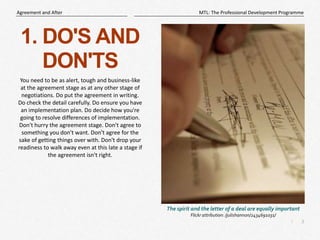
The spirit and the letter of a deal are equally important
Flickr attribution: /julishannon/2434691031/
4
|
MTL: The Professional Development Programme
Agreement and After
2. THE BEST
GLOSS
No agreement is likely to succeed unless it has
the support of your negotiating team, the other
side, and your constituents. The arguments you
use to convince each of the different groups may
vary with each group. For instance, you might
have to sell the agreement to your own side by
putting the best gloss on things often to the
point of making things look better than they are.
It was a tough deal but we have strengthened our position
Flickr attribution: /strelka/9104213818/
5
|
MTL: The Professional Development Programme
Agreement and After
3. TRUST
The extent to which you have to put an
agreement in writing reflects the levels of trust
between yourself and the other side. Distrust
and mistrust force many businesses to put
agreements in writing. This approach contrasts
sharply with "the Chinese handshake" approach
of some countries where trust is signified by not
putting things in writing but by a simple
handshake.
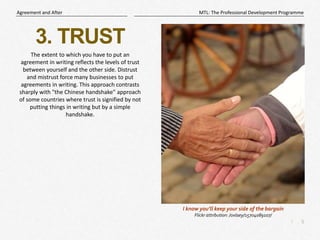
I know you’ll keep your side of the bargain
Flickr attribution: /oxlaey/15704089107/
6
|
MTL: The Professional Development Programme
Agreement and After
4. THE
FOLLOW-
THROUGH
It is a good idea to include an implementation
plan in any negotiated agreement. This outlines
who does what, when, how and where. If you
can involve someone from the other side in the
implementation package, it is likely to smooth
the implementation, avoid problems of
interpretation and increase trust. Always pencil
in reviews and follow-up meetings to check
everything goes through correctly.
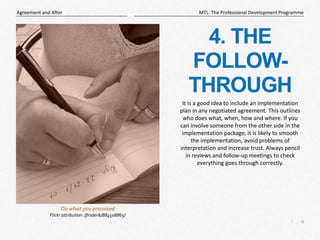
Do what you promised
Flickr attribution: /froderik/884508865/
7
|
MTL: The Professional Development Programme
Agreement and After
5. HOW DID
WE DO?
At the end of any negotiations, you should
review your performance and learn from it. The
Huthwaite Organisation found the following to
be key skills in successful negotiators: 1. they
listened patiently and asked a lot of questions; 2.
they tested understanding; 3. they were able to
take criticism; 4. they didn't give much away; 5.
they were able to say "no"; 6. they didn't argue;
7. they were ingenious with ideas for solutions;
8. they had a sense of humour.
Maybe we misjudged one or two things
Flickr attribution: /strelka/9085063521/
8
|
MTL: The Professional Development Programme
Agreement and After
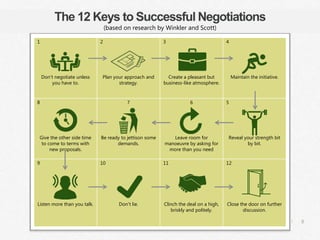
The 12 Keys to Successful Negotiations
1
Don't negotiate unless
you have to.
2
Plan your approach and
strategy.
3
Create a pleasant but
business-like atmosphere.
4
Maintain the initiative.
8
Give the other side time
to come to terms with
new proposals.
7
Be ready to jettison some
demands.
6
Leave room for
manoeuvre by asking for
more than you need
5
Reveal your strength bit
by bit.
9
Listen more than you talk.
10
Don't lie.
11
Clinch the deal on a high,
briskly and politely.
12
Close the door on further
discussion.
(based on research by Winkler and Scott)
9
|
MTL: The Professional Development Programme
Agreement and After
6. BORN
NEGOTIATORS
One of the things that distinguishes those who
are good at negotiations from those who aren’t
is the ability to be comfortable with ambiguity.
Samfrits Le Poole recalls buying a small plane for
an amazingly low price of $14,500. When he
asked the owner why the price was so low, the
man replied that he was wracked by many "what
if’s?", eg "What if he didn't get another offer?",
"What if the next person offered lower?" He
preferred certainty to ambiguity and
consequently made a bad deal.
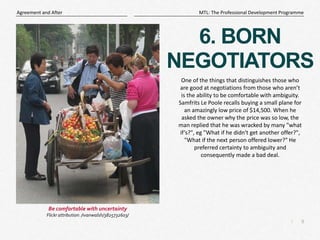
Be comfortable with uncertainty
Flickr attribution: /ivanwalsh/3825732603/
10
|
MTL: The Professional Development Programme
Agreement and After
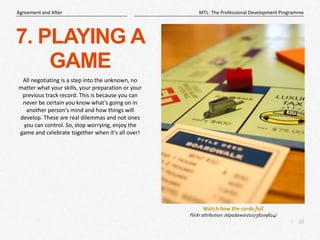
7. PLAYING A
GAME
All negotiating is a step into the unknown, no
matter what your skills, your preparation or your
previous track record. This is because you can
never be certain you know what's going on in
another person's mind and how things will
develop. These are real dilemmas and not ones
you can control. So, stop worrying, enjoy the
game and celebrate together when it's all over!
Watch how the cards fall
Flickr attribution: /elpadawan/10738209824/
11
|
MTL: The Professional Development Programme
Agreement and After
Are Negotiations the Same as a Game?
Henry Calero, author of “Winning
the Negotiation”, says that, while
there are many similarities
between negotiating and playing a
game, there are also some key
differences.
For starters, a game is designed to
have winners and losers, (although
anyone taking part would regard
themselves as winners merely for
doing something they enjoy). By
contrast, a negotiation can have
winners on both sides.
Secondly, all games are regulated
by rules that lay down what players
can and cannot do. By contrast,
negotiations have no laid-down
rules at all (although they have
rituals and expected ways of
behaving based on organisational
or country culture).
Finally, all games have time limits.
By contrast, negotiations may take
as long as they take, (although
there is a limit based on expense
and energy exhaustion).
Henry Calero says that, in view of the similarities and dissimilarities between negotiations and
games, it is better to see negotiations as a process rather than a game.
12
|
MTL: The Professional Development Programme
Agreement and After
This has been a Slide Topic from Manage Train Learn
AFinal
Word
Although negotiations can be a serious business, the best approach is often to treat them like a
game in which there are skills, rituals, and rules. When you use every occasion of negotiations to
practice and learn, your chances of winning will undoubtedly improve.

Agreement and After

  • 1.
    1 | MTL: The ProfessionalDevelopment Programme Agreement and After AGREEMENT AND AFTER Making the deal stick MTL: The Professional Development Programme
  • 2.
    2 | MTL: The ProfessionalDevelopment Programme Agreement and After Attribution: All images are from sources where a Creative Commons license exists for commercial use. All icons are on subscription from thenounproject. All clipart is from free sources. The MTL Professional Development Programme is copyright of Manage Train Learn. Agreement andAfter Introduction: There are three important things to do before you close power negotiations. Firstly, you need to seal the agreement. Secondly, you need to sell the deal to your constituents. Thirdly, you need to take time to reflect on your experience, learn from it and resolve to play even better next time. In this topic, we’ll look at 7 aspects of the agreement stage of negotiations.
  • 3.
    3 | MTL: The ProfessionalDevelopment Programme Agreement and After 1. DO'S AND DON'TS You need to be as alert, tough and business-like at the agreement stage as at any other stage of negotiations. Do put the agreement in writing. Do check the detail carefully. Do ensure you have an implementation plan. Do decide how you're going to resolve differences of implementation. Don't hurry the agreement stage. Don't agree to something you don't want. Don't agree for the sake of getting things over with. Don't drop your readiness to walk away even at this late a stage if the agreement isn't right. The spirit and the letter of a deal are equally important Flickr attribution: /julishannon/2434691031/
  • 4.
    4 | MTL: The ProfessionalDevelopment Programme Agreement and After 2. THE BEST GLOSS No agreement is likely to succeed unless it has the support of your negotiating team, the other side, and your constituents. The arguments you use to convince each of the different groups may vary with each group. For instance, you might have to sell the agreement to your own side by putting the best gloss on things often to the point of making things look better than they are. It was a tough deal but we have strengthened our position Flickr attribution: /strelka/9104213818/
  • 5.
    5 | MTL: The ProfessionalDevelopment Programme Agreement and After 3. TRUST The extent to which you have to put an agreement in writing reflects the levels of trust between yourself and the other side. Distrust and mistrust force many businesses to put agreements in writing. This approach contrasts sharply with "the Chinese handshake" approach of some countries where trust is signified by not putting things in writing but by a simple handshake. I know you’ll keep your side of the bargain Flickr attribution: /oxlaey/15704089107/
  • 6.
    6 | MTL: The ProfessionalDevelopment Programme Agreement and After 4. THE FOLLOW- THROUGH It is a good idea to include an implementation plan in any negotiated agreement. This outlines who does what, when, how and where. If you can involve someone from the other side in the implementation package, it is likely to smooth the implementation, avoid problems of interpretation and increase trust. Always pencil in reviews and follow-up meetings to check everything goes through correctly. Do what you promised Flickr attribution: /froderik/884508865/
  • 7.
    7 | MTL: The ProfessionalDevelopment Programme Agreement and After 5. HOW DID WE DO? At the end of any negotiations, you should review your performance and learn from it. The Huthwaite Organisation found the following to be key skills in successful negotiators: 1. they listened patiently and asked a lot of questions; 2. they tested understanding; 3. they were able to take criticism; 4. they didn't give much away; 5. they were able to say "no"; 6. they didn't argue; 7. they were ingenious with ideas for solutions; 8. they had a sense of humour. Maybe we misjudged one or two things Flickr attribution: /strelka/9085063521/
  • 8.
    8 | MTL: The ProfessionalDevelopment Programme Agreement and After The 12 Keys to Successful Negotiations 1 Don't negotiate unless you have to. 2 Plan your approach and strategy. 3 Create a pleasant but business-like atmosphere. 4 Maintain the initiative. 8 Give the other side time to come to terms with new proposals. 7 Be ready to jettison some demands. 6 Leave room for manoeuvre by asking for more than you need 5 Reveal your strength bit by bit. 9 Listen more than you talk. 10 Don't lie. 11 Clinch the deal on a high, briskly and politely. 12 Close the door on further discussion. (based on research by Winkler and Scott)
  • 9.
    9 | MTL: The ProfessionalDevelopment Programme Agreement and After 6. BORN NEGOTIATORS One of the things that distinguishes those who are good at negotiations from those who aren’t is the ability to be comfortable with ambiguity. Samfrits Le Poole recalls buying a small plane for an amazingly low price of $14,500. When he asked the owner why the price was so low, the man replied that he was wracked by many "what if’s?", eg "What if he didn't get another offer?", "What if the next person offered lower?" He preferred certainty to ambiguity and consequently made a bad deal. Be comfortable with uncertainty Flickr attribution: /ivanwalsh/3825732603/
  • 10.
    10 | MTL: The ProfessionalDevelopment Programme Agreement and After 7. PLAYING A GAME All negotiating is a step into the unknown, no matter what your skills, your preparation or your previous track record. This is because you can never be certain you know what's going on in another person's mind and how things will develop. These are real dilemmas and not ones you can control. So, stop worrying, enjoy the game and celebrate together when it's all over! Watch how the cards fall Flickr attribution: /elpadawan/10738209824/
  • 11.
    11 | MTL: The ProfessionalDevelopment Programme Agreement and After Are Negotiations the Same as a Game? Henry Calero, author of “Winning the Negotiation”, says that, while there are many similarities between negotiating and playing a game, there are also some key differences. For starters, a game is designed to have winners and losers, (although anyone taking part would regard themselves as winners merely for doing something they enjoy). By contrast, a negotiation can have winners on both sides. Secondly, all games are regulated by rules that lay down what players can and cannot do. By contrast, negotiations have no laid-down rules at all (although they have rituals and expected ways of behaving based on organisational or country culture). Finally, all games have time limits. By contrast, negotiations may take as long as they take, (although there is a limit based on expense and energy exhaustion). Henry Calero says that, in view of the similarities and dissimilarities between negotiations and games, it is better to see negotiations as a process rather than a game.
  • 12.
    12 | MTL: The ProfessionalDevelopment Programme Agreement and After This has been a Slide Topic from Manage Train Learn AFinal Word Although negotiations can be a serious business, the best approach is often to treat them like a game in which there are skills, rituals, and rules. When you use every occasion of negotiations to practice and learn, your chances of winning will undoubtedly improve.