Agile Methodology
What are we going to talk about today?
• Defining Agile
• Need for Agile Methodology
• Agile Manifesto
• Practical implementations of Agile
• Challenges in Implementation
• Future Trends in Agile
Defining Agile
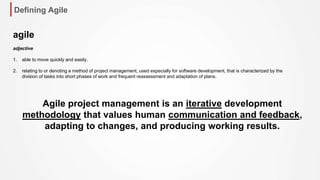
agile
adjective
1. able to move quickly and easily.
2. relating to or denoting a method of project management, used especially for software development, that is characterized by the
division of tasks into short phases of work and frequent reassessment and adaptation of plans.
Agile project management is an iterative development
methodology that values human communication and feedback,
adapting to changes, and producing working results.
Need for Agile
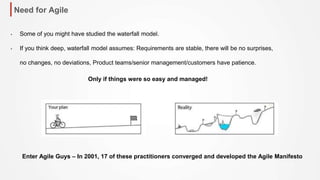
• Some of you might have studied the waterfall model.
• If you think deep, waterfall model assumes: Requirements are stable, there will be no surprises,
no changes, no deviations, Product teams/senior management/customers have patience.
Only if things were so easy and managed!
Enter Agile Guys – In 2001, 17 of these practitioners converged and developed the Agile Manifesto
Agile Manifesto
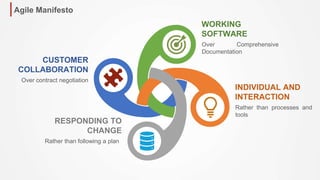
INDIVIDUAL AND
INTERACTION
Rather than processes and
tools
CUSTOMER
COLLABORATION
Over contract negotiation
RESPONDING TO
CHANGE
Rather than following a plan
WORKING
SOFTWARE
Over Comprehensive
Documentation
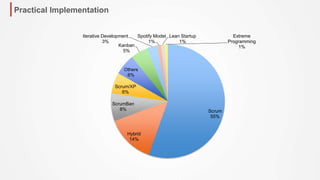
Practical Implementation
Scrum
55%
Hybrid
14%
ScrumBan
8%
Scrum/XP
6%
Others
6%
Kanban
5%
Iterative Development
3%
Spotify Model
1%
Lean Startup
1%
Extreme
Programming
1%
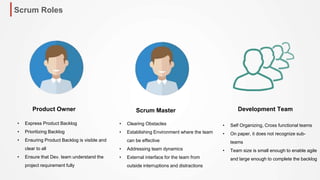
Scrum Roles
Product Owner Scrum Master Development Team
• Express Product Backlog
• Prioritizing Backlog
• Ensuring Product Backlog is visible and
clear to all
• Ensure that Dev. team understand the
project requirement fully
• Clearing Obstacles
• Establishing Environment where the team
can be effective
• Addressing team dynamics
• External interface for the team from
outside interruptions and distractions
• Self Organizing, Cross functional teams
• On paper, it does not recognize sub-
teams
• Team size is small enough to enable agile
and large enough to complete the backlog
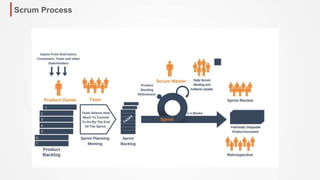
Scrum Process
Playing the Ball Point Game
• Everyone is a part of one team
• Each Ball must have air time
• Each ball must be touched at least once by every member
• Balls can’t be passed to your direct neighbor on immediate left or right
• Each Ball must be returned to the same person who introduced into the system
• There are a total of 5 iterations.
Challenges in Agile Implementation
• Complete Buy-in from customer, management may not come. Company values at odds with Agile.
• Backlogs Management- Too Big, Too old.
• Team Dynamics is not conducive to Agile.
• Too many meetings.
• Person-Role fit.
• Ego issues (I Vs We)- Decision making might become problematic
• Attrition is common – Documentation will start to happen and at that agile gets dead.
• Testing related problems – May get less time.
Future Trends in Agile
• Agile itself is a future
• Move fast and test fast.
• Continuous Integration and Continuous Delivery.
• DevOps
Key takeaways
• It is a SW Development methodology.
• Agile is a mindset and a approach, there is no flow chart in Agile.
• It came into being because the previous models did not cater to unforeseen situations.
• There are multiple ways of implementing it, scrum being the most widely used.
• Scrum involves iterative development in short sprints.
• Like any thing else on this planet, agile has its own set of challenges.
• But Agile is here to stay and hence.
KEEP CALM
AND
LEARN AGILE
Chat with me
ashutosh@2pir.in, a@gargashutosh.com
+919810134649
B-26, Sector-2, Noida
www.2pir.in
www.gargashutosh.com

Agile for Dummies

  • 1.
  • 3.
    What are wegoing to talk about today? • Defining Agile • Need for Agile Methodology • Agile Manifesto • Practical implementations of Agile • Challenges in Implementation • Future Trends in Agile
  • 4.
    Defining Agile agile adjective 1. ableto move quickly and easily. 2. relating to or denoting a method of project management, used especially for software development, that is characterized by the division of tasks into short phases of work and frequent reassessment and adaptation of plans. Agile project management is an iterative development methodology that values human communication and feedback, adapting to changes, and producing working results.
  • 5.
    Need for Agile •Some of you might have studied the waterfall model. • If you think deep, waterfall model assumes: Requirements are stable, there will be no surprises, no changes, no deviations, Product teams/senior management/customers have patience. Only if things were so easy and managed! Enter Agile Guys – In 2001, 17 of these practitioners converged and developed the Agile Manifesto
  • 6.
    Agile Manifesto INDIVIDUAL AND INTERACTION Ratherthan processes and tools CUSTOMER COLLABORATION Over contract negotiation RESPONDING TO CHANGE Rather than following a plan WORKING SOFTWARE Over Comprehensive Documentation
  • 7.
  • 8.
    Scrum Roles Product OwnerScrum Master Development Team • Express Product Backlog • Prioritizing Backlog • Ensuring Product Backlog is visible and clear to all • Ensure that Dev. team understand the project requirement fully • Clearing Obstacles • Establishing Environment where the team can be effective • Addressing team dynamics • External interface for the team from outside interruptions and distractions • Self Organizing, Cross functional teams • On paper, it does not recognize sub- teams • Team size is small enough to enable agile and large enough to complete the backlog
  • 9.
  • 10.
    Playing the BallPoint Game • Everyone is a part of one team • Each Ball must have air time • Each ball must be touched at least once by every member • Balls can’t be passed to your direct neighbor on immediate left or right • Each Ball must be returned to the same person who introduced into the system • There are a total of 5 iterations.
  • 11.
    Challenges in AgileImplementation • Complete Buy-in from customer, management may not come. Company values at odds with Agile. • Backlogs Management- Too Big, Too old. • Team Dynamics is not conducive to Agile. • Too many meetings. • Person-Role fit. • Ego issues (I Vs We)- Decision making might become problematic • Attrition is common – Documentation will start to happen and at that agile gets dead. • Testing related problems – May get less time.
  • 12.
    Future Trends inAgile • Agile itself is a future • Move fast and test fast. • Continuous Integration and Continuous Delivery. • DevOps
  • 13.
    Key takeaways • Itis a SW Development methodology. • Agile is a mindset and a approach, there is no flow chart in Agile. • It came into being because the previous models did not cater to unforeseen situations. • There are multiple ways of implementing it, scrum being the most widely used. • Scrum involves iterative development in short sprints. • Like any thing else on this planet, agile has its own set of challenges. • But Agile is here to stay and hence.
  • 14.
  • 15.
    Chat with me ashutosh@2pir.in,a@gargashutosh.com +919810134649 B-26, Sector-2, Noida www.2pir.in www.gargashutosh.com