A comparative study on VGI and
professional noise data
Irene Garcia
Joaquín Torres
Luis Rodríguez
Joaquín Huerta
AGILE 2014 Session 1: Data Capture and Mapping
4th June 2014
Background
• Every 4 years, university commissions noise pollution study in
Campus
• Following ISO 1996 for acoustic reports
• Low spatiotemporal resolution
• High cost for small entities or communities of users
Background
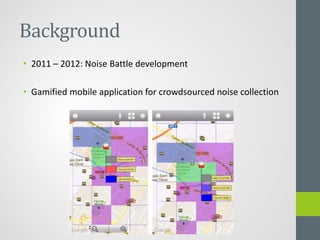
• 2011 – 2012: Noise Battle development
• Gamified mobile application for crowdsourced noise collection
Motivation
How good is VGI noise data compared
to professional sampling?
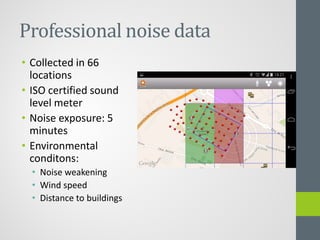
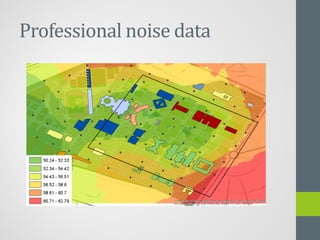
Professional noise data
• Collected in 66
locations
• ISO certified sound
level meter
• Noise exposure: 5
minutes
• Environmental
conditons:
• Noise weakening
• Wind speed
• Distance to buildings
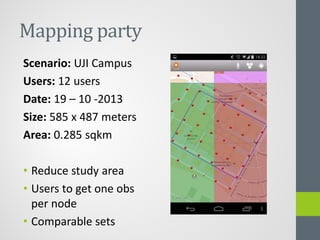
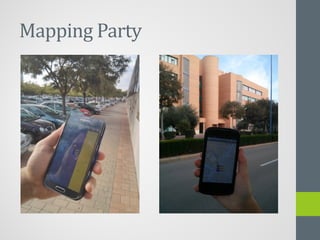
Mapping party
Scenario: UJI Campus
Users: 12 users
Date: 19 – 10 -2013
Size: 585 x 487 meters
Area: 0.285 sqkm
• Reduce study area
• Users to get one obs
per node
• Comparable sets
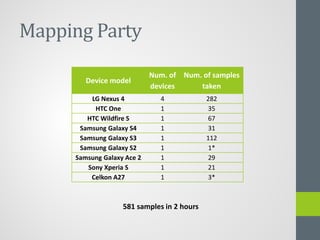
Mapping Party
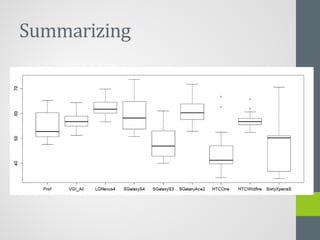
Device model
Num. of
devices
Num. of samples
taken
LG Nexus 4 4 282
HTC One 1 35
HTC Wildfire S 1 67
Samsung Galaxy S4 1 31
Samsung Galaxy S3 1 112
Samsung Galaxy S2 1 1*
Samsung Galaxy Ace 2 1 29
Sony Xperia S 1 21
Celkon A27 1 3*
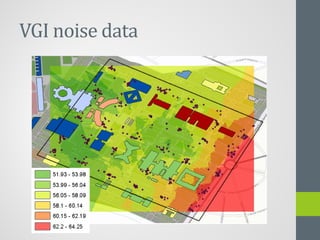
581 samples in 2 hours
Mapping Party
Professional noise data
VGI noise data
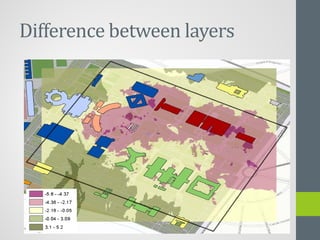
Difference between layers
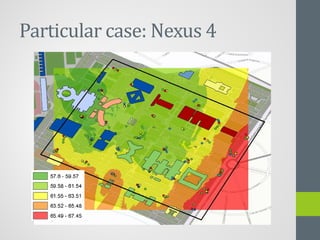
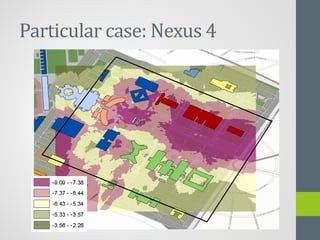
Particular case: Nexus 4
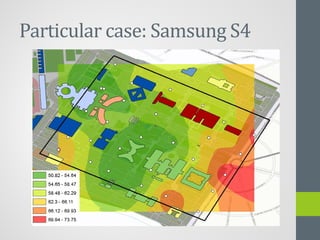
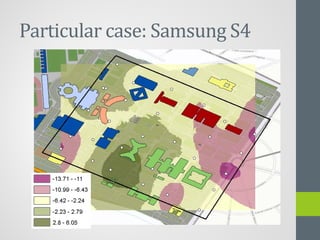
Particular case: Samsung S4
Summarizing
Conclusions
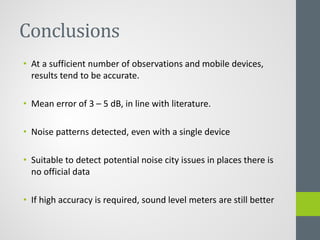
• At a sufficient number of observations and mobile devices,
results tend to be accurate.
• Mean error of 3 – 5 dB, in line with literature.
• Noise patterns detected, even with a single device
• Suitable to detect potential noise city issues in places there is
no official data
• If high accuracy is required, sound level meters are still better
Thanks for your
attention!
Questions?
irene.garcia@uji.es
http://www.geotec.uji.es/

AGILE Conference - Castelló (2014)