DRUPAL Projects!

Agile? Fixed – Price?
...and HOW to succeed!

1/16
What
Is a project
●

Does not end in itself

●

(Hopefully!) Clear goal

●

Unique

●

Start AND END (!)

●

Limited resources
2/16
How
To make projects successfull?
●

Know, what you want (SMART)

●

Spread the goals in your team

●

Plan! (The way to your goals)
=> Remember: A goal without a plan is
just a wish!
3/16
What
To differentiate?
●

Project management method

●

Payment and delivery agreements

●

Contract types
=> Each must be clear defined, all can
be mixed with each other
4/16
Which
PM methods exist?
●

Agil (Scrum)

●

Waterfall

●

(... other derived methods)

5/16
Agile PM
characteristics
●

Requirements always change

●

Iteration ("mini-projects")

●

High flexibility

●

Increasing business value each iteration
6/16
Agile PM
Advanages
●

Flexibility

●

Product will adapt itself

●

More value each iteration

●

Quick first usable results
7/16
Agile PM
Disadvantages
●

Duration for the TOTAL project unknown

●

TOTAL costs unknown

●

Results are not clear from the beginning

8/16
Waterfall-model
Characteristics
●

Clear and specific requirements

●

Project planed from the very beginning

●

Step by step iterations

●

V-Model derived
9/16
Waterfall-model
Advantages
●

Well known costs for clear requirements

●

Predictable timeline

●

Result is clear defined

●

Highest possible project control
10/16
Waterfall-model
Disatavantages
●

Less flexibility

●

Long planning phase

●

Result may be unusable due to changing
requirements

11/16
Payment-modalities
When you will get paid
●

●

Payment method is not related to PM
method
Clear agreement what needs to be done
to get paid!

12/16
Which
Price models exist?
●

●

Fixed price (mostly contract for work and
labor)
- Fixed price for fixed delivery or service
Price per hour (T&M)
- Fixed price for a service unit (time)

13/16
Which
Contracts exist
●

Fixed price contract (Result owed)

●

Time & Material (Just the work is owed)

●

NOTHING ELSE!

14/16
What
Always to clearify
●

HOW the project will be managed

●

WHO is responsible for WHAT

●

WHAT is owed / needs to be delivered?

●

WHEN you will be paid
15/16
Fixed-Price contract
characteristics
●

Clear and specific result is owed

●

Extra costs because of flexibility

●

Safety (result AND price are fixed)

●

Conflicts because of change requests
16/16
Time & Material
Characteristics
●

Only working time owed

●

No result owed

●

Customer buys a team

●

Conflicts because of „quiet“ extra costs
17/16
Which
Variants exist?
NONE!
Only variation on project organisation

18/16
Which
Variants exist?
●

Fixed price without agility

●

Fixed price for single iterations

●

Agile fixed price

●

Fixed price „for everything" and agile
management (!)
19/16
Which
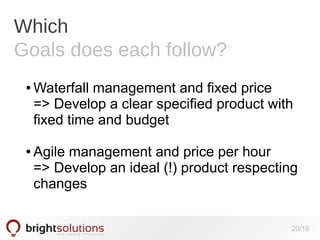
Goals does each follow?
●

●

Waterfall management and fixed price
=> Develop a clear specified product with
fixed time and budget
Agile management and price per hour
=> Develop an ideal (!) product respecting
changes
20/16
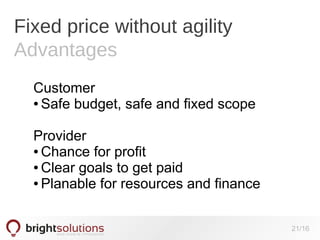
Fixed price without agility
Advantages
Customer
● Safe budget, safe and fixed scope
Provider
● Chance for profit
● Clear goals to get paid
● Planable for resources and finance
21/16
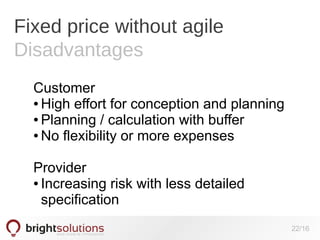
Fixed price without agile
Disadvantages
Customer
● High effort for conception and planning
● Planning / calculation with buffer
● No flexibility or more expenses
Provider
● Increasing risk with less detailed
specification
22/16
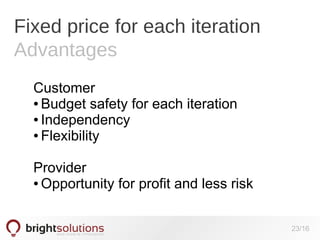
Fixed price for each iteration
Advantages
Customer
● Budget safety for each iteration
● Independency
● Flexibility
Provider
● Opportunity for profit and less risk
23/16
Fixed price for each iteration
Disadvantages
Customer
● No total price for complete project
Provider
● Low planning safety for resources and
budget

24/16
Agile fixed price
How does it work?
Requirements with estimations can be
changed by new requirements with the
same estimation.

25/16
Agile fixed price
What do you need?
Well planned project requirements and
estimations to make these requiremetns
interchangable.

26/16
Agile fixed price
Advantages
Safety by fixed price for fixed feature set
● Flexibility by priorisation
● Transparency
●

=> Fair break down of risks and
opportunities of project was set up the right
way
27/16
Agile fixed price
Disadvantages
●

●

Change requests only with agreement of
both parties
Detailed specification required

28/16
Fixed price AND agile

Fixed price for „all“ AND
Agile management
=> Does not match, will never work!
=> Desaster for the project!

29/16
Fixed price and agile
What does that mean?
Fixed price for „all“ AND
agile management
=> Changes are included in fixed price

30/16
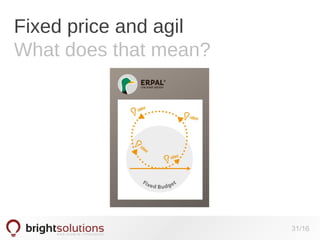
Fixed price and agil
What does that mean?

31/16
Fixed price and agile
What will happen?
●

When and why will you get paid?

●

What needs to be done for the fixed price?

●

When will the project end?

32/16
Fixed price and agile
What will happen?
Conclusion: The PROVIDER agrees to do
EVERYTHING the customer wants and as
long the customer wants him to do this.

33/16
Fixed price AND agile
How will it end?
●

More and more feature requests as
changes cannot be avoid

●

Budget overdue

●

Quality will suffer

●

Unsatisfied project partners
34/16
Fixed price
What to keep in mind
●

●

Fixed price = clear requirements
Clear agreement WHAT needs to be done
for WHICH price

●

Warranty

●

Specify acceptance and approval tests
35/16
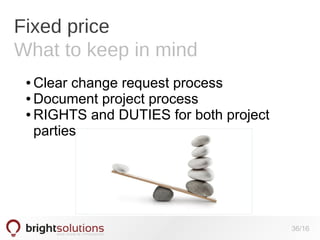
Fixed price
What to keep in mind
Clear change request process
● Document project process
● RIGHTS and DUTIES for both project
parties
●

36/16
Common mistakes
To avoid
„We don't need a contract“
● „Just trust me“
● „We will pay by progress“
● „We want a web page such as XYZ“
● „Design will be delivered later“
● „No clear responsibilities“
● „More developers = quicker results“
●

37/16
Most mistakes
In any case
Have their origin in the planning,
agreements and setup of the project!
PLAN
● MESSURE
● COMMUNICATE
●

●

Your goals well!
38/16
Agile and fixed price Drupal projects

Agile and fixed price Drupal projects

  • 1.
    DRUPAL Projects! Agile? Fixed– Price? ...and HOW to succeed! 1/16
  • 2.
    What Is a project ● Doesnot end in itself ● (Hopefully!) Clear goal ● Unique ● Start AND END (!) ● Limited resources 2/16
  • 3.
    How To make projectssuccessfull? ● Know, what you want (SMART) ● Spread the goals in your team ● Plan! (The way to your goals) => Remember: A goal without a plan is just a wish! 3/16
  • 4.
    What To differentiate? ● Project managementmethod ● Payment and delivery agreements ● Contract types => Each must be clear defined, all can be mixed with each other 4/16
  • 5.
    Which PM methods exist? ● Agil(Scrum) ● Waterfall ● (... other derived methods) 5/16
  • 6.
    Agile PM characteristics ● Requirements alwayschange ● Iteration ("mini-projects") ● High flexibility ● Increasing business value each iteration 6/16
  • 7.
    Agile PM Advanages ● Flexibility ● Product willadapt itself ● More value each iteration ● Quick first usable results 7/16
  • 8.
    Agile PM Disadvantages ● Duration forthe TOTAL project unknown ● TOTAL costs unknown ● Results are not clear from the beginning 8/16
  • 9.
    Waterfall-model Characteristics ● Clear and specificrequirements ● Project planed from the very beginning ● Step by step iterations ● V-Model derived 9/16
  • 10.
    Waterfall-model Advantages ● Well known costsfor clear requirements ● Predictable timeline ● Result is clear defined ● Highest possible project control 10/16
  • 11.
    Waterfall-model Disatavantages ● Less flexibility ● Long planningphase ● Result may be unusable due to changing requirements 11/16
  • 12.
    Payment-modalities When you willget paid ● ● Payment method is not related to PM method Clear agreement what needs to be done to get paid! 12/16
  • 13.
    Which Price models exist? ● ● Fixedprice (mostly contract for work and labor) - Fixed price for fixed delivery or service Price per hour (T&M) - Fixed price for a service unit (time) 13/16
  • 14.
    Which Contracts exist ● Fixed pricecontract (Result owed) ● Time & Material (Just the work is owed) ● NOTHING ELSE! 14/16
  • 15.
    What Always to clearify ● HOWthe project will be managed ● WHO is responsible for WHAT ● WHAT is owed / needs to be delivered? ● WHEN you will be paid 15/16
  • 16.
    Fixed-Price contract characteristics ● Clear andspecific result is owed ● Extra costs because of flexibility ● Safety (result AND price are fixed) ● Conflicts because of change requests 16/16
  • 17.
    Time & Material Characteristics ● Onlyworking time owed ● No result owed ● Customer buys a team ● Conflicts because of „quiet“ extra costs 17/16
  • 18.
    Which Variants exist? NONE! Only variationon project organisation 18/16
  • 19.
    Which Variants exist? ● Fixed pricewithout agility ● Fixed price for single iterations ● Agile fixed price ● Fixed price „for everything" and agile management (!) 19/16
  • 20.
    Which Goals does eachfollow? ● ● Waterfall management and fixed price => Develop a clear specified product with fixed time and budget Agile management and price per hour => Develop an ideal (!) product respecting changes 20/16
  • 21.
    Fixed price withoutagility Advantages Customer ● Safe budget, safe and fixed scope Provider ● Chance for profit ● Clear goals to get paid ● Planable for resources and finance 21/16
  • 22.
    Fixed price withoutagile Disadvantages Customer ● High effort for conception and planning ● Planning / calculation with buffer ● No flexibility or more expenses Provider ● Increasing risk with less detailed specification 22/16
  • 23.
    Fixed price foreach iteration Advantages Customer ● Budget safety for each iteration ● Independency ● Flexibility Provider ● Opportunity for profit and less risk 23/16
  • 24.
    Fixed price foreach iteration Disadvantages Customer ● No total price for complete project Provider ● Low planning safety for resources and budget 24/16
  • 25.
    Agile fixed price Howdoes it work? Requirements with estimations can be changed by new requirements with the same estimation. 25/16
  • 26.
    Agile fixed price Whatdo you need? Well planned project requirements and estimations to make these requiremetns interchangable. 26/16
  • 27.
    Agile fixed price Advantages Safetyby fixed price for fixed feature set ● Flexibility by priorisation ● Transparency ● => Fair break down of risks and opportunities of project was set up the right way 27/16
  • 28.
    Agile fixed price Disadvantages ● ● Changerequests only with agreement of both parties Detailed specification required 28/16
  • 29.
    Fixed price ANDagile Fixed price for „all“ AND Agile management => Does not match, will never work! => Desaster for the project! 29/16
  • 30.
    Fixed price andagile What does that mean? Fixed price for „all“ AND agile management => Changes are included in fixed price 30/16
  • 31.
    Fixed price andagil What does that mean? 31/16
  • 32.
    Fixed price andagile What will happen? ● When and why will you get paid? ● What needs to be done for the fixed price? ● When will the project end? 32/16
  • 33.
    Fixed price andagile What will happen? Conclusion: The PROVIDER agrees to do EVERYTHING the customer wants and as long the customer wants him to do this. 33/16
  • 34.
    Fixed price ANDagile How will it end? ● More and more feature requests as changes cannot be avoid ● Budget overdue ● Quality will suffer ● Unsatisfied project partners 34/16
  • 35.
    Fixed price What tokeep in mind ● ● Fixed price = clear requirements Clear agreement WHAT needs to be done for WHICH price ● Warranty ● Specify acceptance and approval tests 35/16
  • 36.
    Fixed price What tokeep in mind Clear change request process ● Document project process ● RIGHTS and DUTIES for both project parties ● 36/16
  • 37.
    Common mistakes To avoid „Wedon't need a contract“ ● „Just trust me“ ● „We will pay by progress“ ● „We want a web page such as XYZ“ ● „Design will be delivered later“ ● „No clear responsibilities“ ● „More developers = quicker results“ ● 37/16
  • 38.
    Most mistakes In anycase Have their origin in the planning, agreements and setup of the project! PLAN ● MESSURE ● COMMUNICATE ● ● Your goals well! 38/16