AGGREGATES
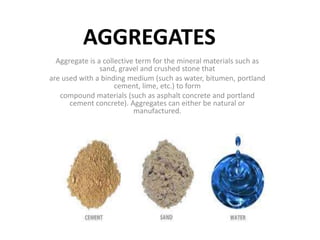
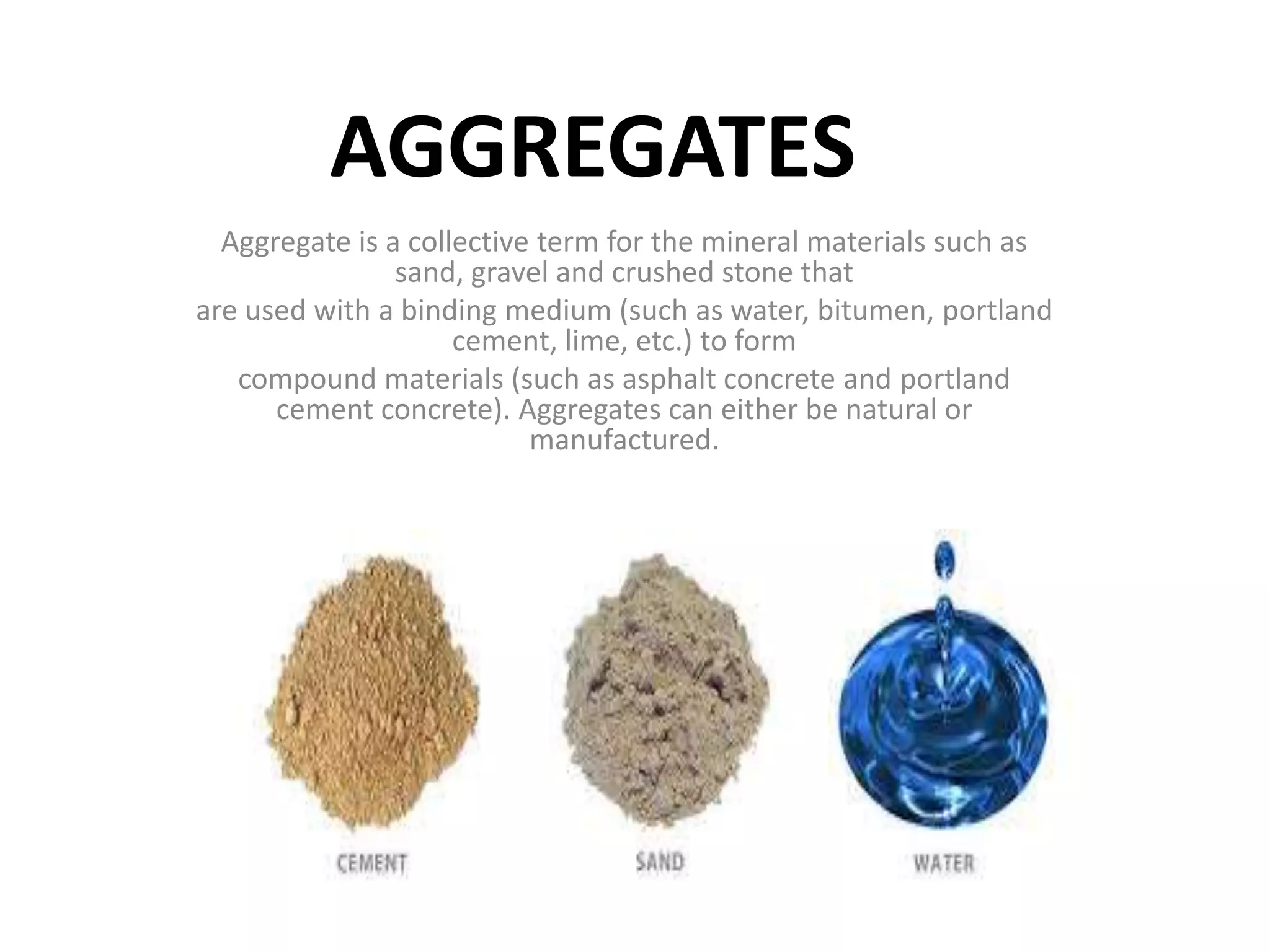
Aggregate is a collective term for the mineral materials such as
sand, gravel and crushed stone that
are used with a binding medium (such as water, bitumen, portland
cement, lime, etc.) to form
compound materials (such as asphalt concrete and portland
cement concrete). Aggregates can either be natural or
manufactured.
FINE AGGREGATES
• The aggregates which passes through a 4.75
mm IS sieve.
• Sand is generally considered to have a lower
size limit of about 0.07
• Material between 0.06 mm and 0.00 mm is
classified as silt
• Other left particles are called as clay
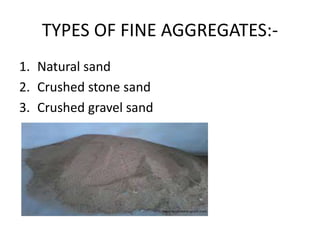
TYPES OF FINE AGGREGATES:-
1. Natural sand
2. Crushed stone sand
3. Crushed gravel sand
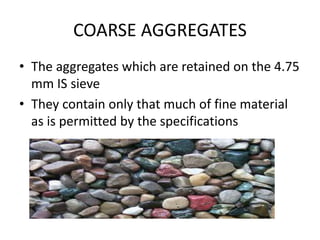
COARSE AGGREGATES
• The aggregates which are retained on the 4.75
mm IS sieve
• They contain only that much of fine material
as is permitted by the specifications
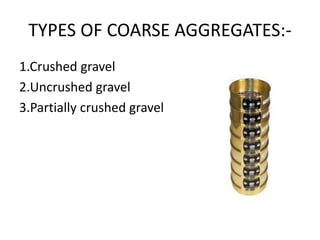
TYPES OF COARSE AGGREGATES:-
1.Crushed gravel
2.Uncrushed gravel
3.Partially crushed gravel
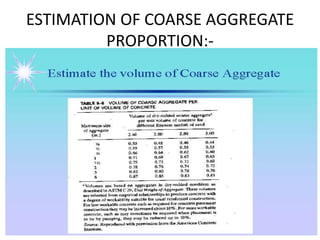
ESTIMATION OF COARSE AGGREGATE
PROPORTION:-
Estimation of Fine Aggregate
Proportion
Estimation of Fine Aggregate Proportion
With the completion of procedure given in 4.4, all the ingredients have
been estimated except the coarse
and fine aggregate content. These quantities are
determined by finding out the absolute volume of cementitious
material, water and the chemical admixture; by dividing their mass by
their respective specific gravity, multiplying by III 000 and subtracting
the result of their summation from unit volume. The values so
obtained are divided into Coarse and Fine Aggregate fractions by
volume in accordance with coarse aggregate proportion already
determined in 4.4. The coarse and fine aggregate
contents are then determined by multiplying with their respective
specific gravities and multiplying by
1000.
Volume of coarse aggregate is required to be
increased
to decrease the fine aggregate content and vice
versa at the rate of -/+ 0.01 for every ± 0.05
change in water-cement ratio
In 1925, Duff Abrams introduced the concept of fineness modulus (FM) for estimating the
proportions of fine and course aggregates in concrete mixtures. The premise: "aggregate of
the same fineness modulus will require the same quantity of water to produce a mix of the
same consistency and give a concrete of the same strength." Before calculating FM, lab
technicians perform a sieve analysis to determine the particle size distribution, or grading, of
the aggregate sample. FM is the sum of the total percentages retained on each specified sieve
divided by 100. ASTM C 33 requires the FM of fine aggregate to be between 2.3 and 3.1. The
higher the FM, the coarser the aggregate. Fine aggregate affects many concrete properties,
including workability and finishability. Usually, a lower FM results in more paste, making
concrete easier to finish. For the high cement contents used in the production of high-
strength concrete, coarse sand with an FM around 3.0 produces concrete with the best
workability and highest compressive strength.
Fineness Modulus

AGGREGATES.pptx

  • 1.
    AGGREGATES Aggregate is acollective term for the mineral materials such as sand, gravel and crushed stone that are used with a binding medium (such as water, bitumen, portland cement, lime, etc.) to form compound materials (such as asphalt concrete and portland cement concrete). Aggregates can either be natural or manufactured.
  • 2.
    FINE AGGREGATES • Theaggregates which passes through a 4.75 mm IS sieve. • Sand is generally considered to have a lower size limit of about 0.07 • Material between 0.06 mm and 0.00 mm is classified as silt • Other left particles are called as clay
  • 3.
    TYPES OF FINEAGGREGATES:- 1. Natural sand 2. Crushed stone sand 3. Crushed gravel sand
  • 4.
    COARSE AGGREGATES • Theaggregates which are retained on the 4.75 mm IS sieve • They contain only that much of fine material as is permitted by the specifications
  • 5.
    TYPES OF COARSEAGGREGATES:- 1.Crushed gravel 2.Uncrushed gravel 3.Partially crushed gravel
  • 6.
    ESTIMATION OF COARSEAGGREGATE PROPORTION:-
  • 7.
    Estimation of FineAggregate Proportion Estimation of Fine Aggregate Proportion With the completion of procedure given in 4.4, all the ingredients have been estimated except the coarse and fine aggregate content. These quantities are determined by finding out the absolute volume of cementitious material, water and the chemical admixture; by dividing their mass by their respective specific gravity, multiplying by III 000 and subtracting the result of their summation from unit volume. The values so obtained are divided into Coarse and Fine Aggregate fractions by volume in accordance with coarse aggregate proportion already determined in 4.4. The coarse and fine aggregate contents are then determined by multiplying with their respective specific gravities and multiplying by 1000.
  • 8.
    Volume of coarseaggregate is required to be increased to decrease the fine aggregate content and vice versa at the rate of -/+ 0.01 for every ± 0.05 change in water-cement ratio
  • 9.
    In 1925, DuffAbrams introduced the concept of fineness modulus (FM) for estimating the proportions of fine and course aggregates in concrete mixtures. The premise: "aggregate of the same fineness modulus will require the same quantity of water to produce a mix of the same consistency and give a concrete of the same strength." Before calculating FM, lab technicians perform a sieve analysis to determine the particle size distribution, or grading, of the aggregate sample. FM is the sum of the total percentages retained on each specified sieve divided by 100. ASTM C 33 requires the FM of fine aggregate to be between 2.3 and 3.1. The higher the FM, the coarser the aggregate. Fine aggregate affects many concrete properties, including workability and finishability. Usually, a lower FM results in more paste, making concrete easier to finish. For the high cement contents used in the production of high- strength concrete, coarse sand with an FM around 3.0 produces concrete with the best workability and highest compressive strength. Fineness Modulus