The British Isles
Discovening some general aspects of British life
Contents
1 British Isles 1
1.1 Etymology . . . . . . . . . . . . . . . . . . . . . . . . . . . . . . . . . . . . . . . . . . . . . . . 1
1.2 Geography . . . . . . . . . . . . . . . . . . . . . . . . . . . . . . . . . . . . . . . . . . . . . . . 2
1.3 Flora and fauna . . . . . . . . . . . . . . . . . . . . . . . . . . . . . . . . . . . . . . . . . . . . 3
1.4 Demographics . . . . . . . . . . . . . . . . . . . . . . . . . . . . . . . . . . . . . . . . . . . . . 4
1.5 History . . . . . . . . . . . . . . . . . . . . . . . . . . . . . . . . . . . . . . . . . . . . . . . . . 4
1.6 Politics . . . . . . . . . . . . . . . . . . . . . . . . . . . . . . . . . . . . . . . . . . . . . . . . . 6
1.6.1 British–Irish Council . . . . . . . . . . . . . . . . . . . . . . . . . . . . . . . . . . . . . 7
1.7 Culture . . . . . . . . . . . . . . . . . . . . . . . . . . . . . . . . . . . . . . . . . . . . . . . . 8
1.8 Transportation . . . . . . . . . . . . . . . . . . . . . . . . . . . . . . . . . . . . . . . . . . . . . 8
1.9 See also . . . . . . . . . . . . . . . . . . . . . . . . . . . . . . . . . . . . . . . . . . . . . . . . 9
1.10 References . . . . . . . . . . . . . . . . . . . . . . . . . . . . . . . . . . . . . . . . . . . . . . . 9
1.11 Further reading . . . . . . . . . . . . . . . . . . . . . . . . . . . . . . . . . . . . . . . . . . . . 12
1.12 External links . . . . . . . . . . . . . . . . . . . . . . . . . . . . . . . . . . . . . . . . . . . . . 12
2 Politics of the United Kingdom 13
2.1 History . . . . . . . . . . . . . . . . . . . . . . . . . . . . . . . . . . . . . . . . . . . . . . . . . 13
2.2 The Crown . . . . . . . . . . . . . . . . . . . . . . . . . . . . . . . . . . . . . . . . . . . . . . . 13
2.3 Executive . . . . . . . . . . . . . . . . . . . . . . . . . . . . . . . . . . . . . . . . . . . . . . . 14
2.3.1 The United Kingdom Government . . . . . . . . . . . . . . . . . . . . . . . . . . . . . . 14
2.3.2 Devolved national administrations . . . . . . . . . . . . . . . . . . . . . . . . . . . . . . 15
2.4 Legislatures . . . . . . . . . . . . . . . . . . . . . . . . . . . . . . . . . . . . . . . . . . . . . . 15
2.4.1 UK Parliament . . . . . . . . . . . . . . . . . . . . . . . . . . . . . . . . . . . . . . . . 15
2.4.2 Devolved national legislatures . . . . . . . . . . . . . . . . . . . . . . . . . . . . . . . . . 17
2.5 Judiciary . . . . . . . . . . . . . . . . . . . . . . . . . . . . . . . . . . . . . . . . . . . . . . . . 19
2.5.1 England, Wales and Northern Ireland . . . . . . . . . . . . . . . . . . . . . . . . . . . . . 19
2.5.2 Scotland . . . . . . . . . . . . . . . . . . . . . . . . . . . . . . . . . . . . . . . . . . . . 19
2.6 Electoral systems . . . . . . . . . . . . . . . . . . . . . . . . . . . . . . . . . . . . . . . . . . . 20
2.7 Political parties . . . . . . . . . . . . . . . . . . . . . . . . . . . . . . . . . . . . . . . . . . . . 20
2.7.1 Conservatives (Tories) . . . . . . . . . . . . . . . . . . . . . . . . . . . . . . . . . . . . 21
2.7.2 Labour . . . . . . . . . . . . . . . . . . . . . . . . . . . . . . . . . . . . . . . . . . . . 22
2.7.3 Scottish National Party . . . . . . . . . . . . . . . . . . . . . . . . . . . . . . . . . . . . 23
2.7.4 Liberal Democrats . . . . . . . . . . . . . . . . . . . . . . . . . . . . . . . . . . . . . . 23
i
ii CONTENTS
2.7.5 Northern Ireland parties . . . . . . . . . . . . . . . . . . . . . . . . . . . . . . . . . . . . 23
2.7.6 Plaid Cymru . . . . . . . . . . . . . . . . . . . . . . . . . . . . . . . . . . . . . . . . . 23
2.7.7 Other parliamentary parties . . . . . . . . . . . . . . . . . . . . . . . . . . . . . . . . . . 23
2.7.8 Non-Parliamentary political parties . . . . . . . . . . . . . . . . . . . . . . . . . . . . . . 24
2.7.9 Current political landscape . . . . . . . . . . . . . . . . . . . . . . . . . . . . . . . . . . 24
2.7.10 Membership . . . . . . . . . . . . . . . . . . . . . . . . . . . . . . . . . . . . . . . . . . 25
2.8 Local government . . . . . . . . . . . . . . . . . . . . . . . . . . . . . . . . . . . . . . . . . . . 25
2.9 European Union . . . . . . . . . . . . . . . . . . . . . . . . . . . . . . . . . . . . . . . . . . . . 25
2.10 International organization participation . . . . . . . . . . . . . . . . . . . . . . . . . . . . . . . . 25
2.11 See also . . . . . . . . . . . . . . . . . . . . . . . . . . . . . . . . . . . . . . . . . . . . . . . . 27
2.12 References . . . . . . . . . . . . . . . . . . . . . . . . . . . . . . . . . . . . . . . . . . . . . . . 27
2.13 Further reading . . . . . . . . . . . . . . . . . . . . . . . . . . . . . . . . . . . . . . . . . . . . 28
2.14 External links . . . . . . . . . . . . . . . . . . . . . . . . . . . . . . . . . . . . . . . . . . . . . 28
3 Education in the United Kingdom 30
3.1 Key Stages . . . . . . . . . . . . . . . . . . . . . . . . . . . . . . . . . . . . . . . . . . . . . . . 30
3.2 Stages . . . . . . . . . . . . . . . . . . . . . . . . . . . . . . . . . . . . . . . . . . . . . . . . . 30
3.3 Rankings . . . . . . . . . . . . . . . . . . . . . . . . . . . . . . . . . . . . . . . . . . . . . . . . 30
3.4 See also . . . . . . . . . . . . . . . . . . . . . . . . . . . . . . . . . . . . . . . . . . . . . . . . 30
3.5 References . . . . . . . . . . . . . . . . . . . . . . . . . . . . . . . . . . . . . . . . . . . . . . . 31
3.6 Further reading . . . . . . . . . . . . . . . . . . . . . . . . . . . . . . . . . . . . . . . . . . . . 31
3.7 External links . . . . . . . . . . . . . . . . . . . . . . . . . . . . . . . . . . . . . . . . . . . . . 31
4 Universities in the United Kingdom 32
4.1 History . . . . . . . . . . . . . . . . . . . . . . . . . . . . . . . . . . . . . . . . . . . . . . . . . 32
4.2 Admission . . . . . . . . . . . . . . . . . . . . . . . . . . . . . . . . . . . . . . . . . . . . . . . 33
4.3 Funding . . . . . . . . . . . . . . . . . . . . . . . . . . . . . . . . . . . . . . . . . . . . . . . . 33
4.3.1 Reputation . . . . . . . . . . . . . . . . . . . . . . . . . . . . . . . . . . . . . . . . . . 34
4.4 Peculiarities . . . . . . . . . . . . . . . . . . . . . . . . . . . . . . . . . . . . . . . . . . . . . . 34
4.5 Representation . . . . . . . . . . . . . . . . . . . . . . . . . . . . . . . . . . . . . . . . . . . . . 35
4.6 Post-nominal abbreviations . . . . . . . . . . . . . . . . . . . . . . . . . . . . . . . . . . . . . . 35
4.7 Mergers . . . . . . . . . . . . . . . . . . . . . . . . . . . . . . . . . . . . . . . . . . . . . . . . 36
4.8 Value of academic degrees . . . . . . . . . . . . . . . . . . . . . . . . . . . . . . . . . . . . . . 36
4.9 See also . . . . . . . . . . . . . . . . . . . . . . . . . . . . . . . . . . . . . . . . . . . . . . . . 36
4.10 References . . . . . . . . . . . . . . . . . . . . . . . . . . . . . . . . . . . . . . . . . . . . . . . 36
4.11 External links . . . . . . . . . . . . . . . . . . . . . . . . . . . . . . . . . . . . . . . . . . . . . 37
5 National Health Service 38
5.1 The UK individual systems . . . . . . . . . . . . . . . . . . . . . . . . . . . . . . . . . . . . . . 38
5.2 History . . . . . . . . . . . . . . . . . . . . . . . . . . . . . . . . . . . . . . . . . . . . . . . . . 38
5.2.1 Recent (2010 – present) . . . . . . . . . . . . . . . . . . . . . . . . . . . . . . . . . . . . 39
5.3 Structure . . . . . . . . . . . . . . . . . . . . . . . . . . . . . . . . . . . . . . . . . . . . . . . . 39
CONTENTS iii
5.4 Funding and expenditures . . . . . . . . . . . . . . . . . . . . . . . . . . . . . . . . . . . . . . . 39
5.5 See also . . . . . . . . . . . . . . . . . . . . . . . . . . . . . . . . . . . . . . . . . . . . . . . . 40
5.6 References . . . . . . . . . . . . . . . . . . . . . . . . . . . . . . . . . . . . . . . . . . . . . . . 40
5.7 Further reading . . . . . . . . . . . . . . . . . . . . . . . . . . . . . . . . . . . . . . . . . . . . 40
5.8 External links . . . . . . . . . . . . . . . . . . . . . . . . . . . . . . . . . . . . . . . . . . . . . 41
5.9 Text and image sources, contributors, and licenses . . . . . . . . . . . . . . . . . . . . . . . . . . 42
5.9.1 Text . . . . . . . . . . . . . . . . . . . . . . . . . . . . . . . . . . . . . . . . . . . . . . 42
5.9.2 Images . . . . . . . . . . . . . . . . . . . . . . . . . . . . . . . . . . . . . . . . . . . . 44
5.9.3 Content license . . . . . . . . . . . . . . . . . . . . . . . . . . . . . . . . . . . . . . . . 46
Chapter 1
British Isles
The British Isles are a group of islands off the north-
western coast of continental Europe that consist of the
islands of Great Britain, Ireland and over six thousand
smaller isles.[6]
Two sovereign states are located on the
islands: Ireland (a republic which covers roughly five-
sixths of the island with the same name)[7]
and the United
Kingdom of Great Britain and Northern Ireland (which
includes the countries of England, Scotland, Wales and
Northern Ireland). The British Isles also include three
dependencies of the British Crown: the Isle of Man and,
by tradition, the Bailiwick of Jersey and the Bailiwick of
Guernsey in the Channel Islands, although the latter are
not physically a part of the archipelago.[8][9]
The oldest rocks in the group are in the north west of
Scotland, Ireland and North Wales and are 2,700 million
years old.[10]
During the Silurian period the north-western
regions collided with the south-east, which had been part
of a separate continental landmass. The topography of
the islands is modest in scale by global standards. Ben
Nevis rises to an elevation of only 1,344 metres (4,409
ft), and Lough Neagh, which is notably larger than other
lakes on the isles, covers 390 square kilometres (151 sq
mi). The climate is temperate marine, with mild win-
ters and warm summers. The North Atlantic Drift brings
significant moisture and raises temperatures 11 °C (20
°F) above the global average for the latitude. This led
to a landscape which was long dominated by temperate
rainforest, although human activity has since cleared the
vast majority of forest cover. The region was re-inhabited
after the last glacial period of Quaternary glaciation, by
12,000 BC when Great Britain was still a peninsula of
the European continent. Ireland, which became an island
by 12,000 BC, was not inhabited until after 8000 BC.[11]
Great Britain became an island by 5600 BC.
Hiberni (Ireland), Pictish (northern Britain) and Britons
(southern Britain) tribes, all speaking Insular Celtic,[12]
inhabited the islands at the beginning of the 1st mil-
lennium AD. Much of Brittonic-controlled Britain was
conquered by the Roman Empire from AD 43. The
first Anglo-Saxons arrived as Roman power waned in
the 5th century and eventually dominated the bulk of
what is now England.[13]
Viking invasions began in the
9th century, followed by more permanent settlements
and political change—particularly in England. The sub-
sequent Norman conquest of England in 1066 and the
later Angevin partial conquest of Ireland from 1169 led
to the imposition of a new Norman ruling elite across
much of Britain and parts of Ireland. By the Late Mid-
dle Ages, Great Britain was separated into the King-
doms of England and Scotland, while control in Ireland
fluxed between Gaelic kingdoms, Hiberno-Norman lords
and the English-dominated Lordship of Ireland, soon re-
stricted only to The Pale. The 1603 Union of the Crowns,
Acts of Union 1707 and Acts of Union 1800 attempted
to consolidate Britain and Ireland into a single politi-
cal unit, the United Kingdom of Great Britain and Ire-
land, with the Isle of Man and the Channel Islands re-
maining as Crown Dependencies. The expansion of the
British Empire and migrations following the Irish Famine
and Highland Clearances resulted in the distribution of
the islands’ population and culture throughout the world
and a rapid de-population of Ireland in the second half
of the 19th century. Most of Ireland seceded from the
United Kingdom after the Irish War of Independence and
the subsequent Anglo-Irish Treaty (1919–1922), with six
counties remaining in the UK as Northern Ireland.
The term British Isles is controversial in Ireland,[6][14]
where there are objections to its usage due to the associa-
tion of the word British with Ireland.[15]
The Government
of Ireland does not recognise or use the term[16]
and
its embassy in London discourages its use.[17]
As a
result, Britain and Ireland is used as an alternative
description,[15][18][19]
and Atlantic Archipelago has had
limited use among a minority in academia,[20][21][22][23]
although British Isles is still commonly employed.[18]
Within them, they are also sometimes referred to as these
islands.
1.1 Etymology
Main articles: Britain (name), British Isles naming
dispute and Terminology of the British Isles
The earliest known references to the islands as a group
appeared in the writings of sea-farers from the ancient
Greek colony of Massalia.[24][25]
The original records
have been lost; however, later writings, e.g. Avienus's
1
2 CHAPTER 1. BRITISH ISLES
Ora maritima, that quoted from the Massaliote Periplus
(6th century BC) and from Pytheas's On the Ocean (circa
325–320 BC)[26]
have survived. In the 1st century BC,
Diodorus Siculus has Prettanikē nēsos,[27]
“the British Is-
land”, and Prettanoi,[28]
“the Britons”.[25]
Strabo used
Βρεττανική (Brettanike),[29][30][31]
and Marcian of Her-
aclea, in his Periplus maris exteri, used αἱ Πρεττανικαί
νῆσοι (the Prettanic Isles) to refer to the islands.[32]
His-
torians today, though not in absolute agreement, largely
agree that these Greek and Latin names were proba-
bly drawn from native Celtic-language names for the
archipelago.[33]
Along these lines, the inhabitants of
the islands were called the Πρεττανοί (Priteni or Pre-
tani).[25][34]
The shift from the “P” of Pretannia to the “B”
of Britannia by the Romans occurred during the time of
Julius Caesar.[35]
The classical writer, Ptolemy, referred to the larger is-
land as great Britain (megale Britannia) and to Ireland as
little Britain (mikra Brettania) in his work, Almagest (147–
148 AD).[36]
In his later work, Geography (c. 150 AD),
he gave these islands the names[37]
Alwion [sic], Iwernia,
and Mona (the Isle of Man), suggesting these may have
been native names of the individual islands not known
to him at the time of writing Almagest.[38]
The name Al-
bion appears to have fallen out of use sometime after the
Roman conquest of Great Britain, after which Britain be-
came the more common-place name for the island called
Great Britain.[35]
The earliest known use of the phrase Brytish Iles in
the English language is dated 1577 in a work by John
Dee.[39]
Today, this name is seen by some as carry-
ing imperialist overtones[18]
although it is still commonly
used. Other names used to describe the islands include
the Anglo-Celtic Isles,[40][41]
Atlantic archipelago, British-
Irish Isles,[42]
Britain and Ireland, UK and Ireland, and
British Isles and Ireland.[43]
Owing to political and na-
tional associations with the word British, the Govern-
ment of Ireland does not use the term British Isles[16]
and
in documents drawn up jointly between the British and
Irish governments, the archipelago is referred to simply
as “these islands”.[44]
Nonetheless, British Isles is still the
most widely accepted term for the archipelago.[44]
1.2 Geography
See also: Geography of England, Geography of
Wales, Geography of Scotland, Geography of Ireland,
Geography of the United Kingdom, Geography of the Isle
of Man and Geography of the Channel Islands
The British Isles lie at the juncture of several regions
with past episodes of tectonic mountain building. These
orogenic belts form a complex geology that records a huge
and varied span of Earth’s history.[45]
Of particular note
was the Caledonian Orogeny during the Ordovician Pe-
riod, c. 488–444 Ma and early Silurian period, when
the craton Baltica collided with the terrane Avalonia to
The British Isles in relation to the north-west European
continental shelf.
form the mountains and hills in northern Britain and
Ireland. Baltica formed roughly the northwestern half
of Ireland and Scotland. Further collisions caused the
Variscan orogeny in the Devonian and Carboniferous pe-
riods, forming the hills of Munster, southwest England,
and southern Wales. Over the last 500 million years the
land that forms the islands has drifted northwest from
around 30°S, crossing the equator around 370 million
years ago to reach its present northern latitude.[46]
The islands have been shaped by numerous glaciations
during the Quaternary Period, the most recent being
the Devensian. As this ended, the central Irish Sea
was deglaciated and the English Channel flooded, with
sea levels rising to current levels some 4,000 to 5,000
years ago, leaving the British Isles in their current form.
Whether or not there was a land bridge between Great
Britain and Ireland at this time is somewhat disputed,
though there was certainly a single ice sheet covering the
entire sea.
The west coasts of Ireland and Scotland that directly face
the Atlantic Ocean are generally characterised by long
peninsulas, and headlands and bays; the internal and east-
ern coasts are “smoother”.
There are about 136 permanently inhabited islands in
the group, the largest two being Great Britain and Ire-
land. Great Britain is to the east and covers 83,700 sq
mi (217,000 km2
).[47]
Ireland is to the west and cov-
ers 32,590 sq mi (84,400 km2
).[47]
The largest of the
other islands are to be found in the Hebrides, Orkney and
Shetland to the north, Anglesey and the Isle of Man be-
tween Great Britain and Ireland, and the Channel Islands
near the coast of France.
The islands are at relatively low altitudes, with central
Ireland and southern Great Britain particularly low lying:
the lowest point in the islands is Holme, Cambridgeshire
at −2.75 m (−9.02 ft).[48]
The Scottish Highlands in the
northern part of Great Britain are mountainous, with Ben
Nevis being the highest point on the islands at 1,343 m
(4,406 ft).[49]
Other mountainous areas include Wales and
parts of Ireland, however only seven peaks in these areas
reach above 1,000 m (3,281 ft). Lakes on the islands are
generally not large, although Lough Neagh in Northern
1.3. FLORA AND FAUNA 3
Ireland is an exception, covering 150 square miles (390
km2
). The largest freshwater body in Great Britain (by
area) is Loch Lomond at 27.5 square miles (71 km2
), and
Loch Ness, by volume whilst Loch Morar is the deep-
est freshwater body in the British Isles, with a maximum
depth of 310 m (1,017 ft).[50]
There are a number of
major rivers within the British Isles. The longest is the
Shannon in Ireland at 224 mi (360 km). The river Sev-
ern at 220 mi (354 km) is the longest in Great Britain.
The isles have a temperate marine climate. The North
Atlantic Drift (“Gulf Stream”) which flows from the Gulf
of Mexico brings with it significant moisture and raises
temperatures 11 °C (20 °F) above the global average for
the islands’ latitudes.[51]
Winters are cool and wet, with
summers mild and also wet. Most Atlantic depressions
pass to the north of the islands, combined with the gen-
eral westerly circulation and interactions with the land-
mass, this imposes an east-west variation in climate.[52]
1.3 Flora and fauna
See also: Fauna of Great Britain, Fauna of Ireland and
Trees of Britain and Ireland
The islands enjoy a mild climate and varied soils, giving
Some female red deer in Killarney National Park, Ireland.
rise to a diverse pattern of vegetation. Animal and plant
life is similar to that of the northwestern European conti-
nent. There are however, fewer numbers of species, with
Ireland having even less. All native flora and fauna in Ire-
land is made up of species that migrated from elsewhere
in Europe, and Great Britain in particular. The only win-
dow when this could have occurred was between the end
of the last Ice Age (about 12,000 years ago) and when the
land bridge connecting the two islands was flooded by sea
(about 8,000 years ago).
As with most of Europe, prehistoric Britain and Ireland
were covered with forest and swamp. Clearing began
around 6000 BC and accelerated in medieval times. De-
spite this, Britain retained its primeval forests longer than
most of Europe due to a small population and later devel-
opment of trade and industry, and wood shortages were
not a problem until the 17th century. By the 18th cen-
tury, most of Britain’s forests were consumed for ship-
building or manufacturing charcoal and the nation was
forced to import lumber from Scandinavia, North Amer-
ica, and the Baltic. Most forest land in Ireland is main-
tained by state forestation programmes. Almost all land
outside urban areas is farmland. However, relatively large
areas of forest remain in east and north Scotland and in
southeast England. Oak, elm, ash and beech are amongst
the most common trees in England. In Scotland, pine
and birch are most common. Natural forests in Ireland
are mainly oak, ash, wych elm, birch and pine. Beech
and lime, though not native to Ireland, are also common
there. Farmland hosts a variety of semi-natural vegeta-
tion of grasses and flowering plants. Woods, hedgerows,
mountain slopes and marshes host heather, wild grasses,
gorse and bracken.
Many larger animals, such as wolf, bear and the Euro-
pean elk are today extinct. However, some species such
as red deer are protected. Other small mammals, such
as rabbits, foxes, badgers, hares, hedgehogs, and stoats,
are very common and the European beaver has been
reintroduced in parts of Scotland. Wild boar have also
been reintroduced to parts of southern England, follow-
ing escapes from boar farms and illegal releases. Many
rivers contain otters and seals are common on coasts.
Over 200 species of bird reside permanently and another
200 migrate. Common types are the common chaffinch,
common blackbird, house sparrow and common starling;
all small birds. Large birds are declining in number, ex-
cept for those kept for game such as pheasant, partridge,
and red grouse. Fish are abundant in the rivers and lakes,
in particular salmon, trout, perch and pike. Sea fish in-
clude dogfish, cod, sole, pollock and bass, as well as
mussels, crab and oysters along the coast. There are more
than 21,000 species of insects.
Few species of reptiles or amphibians are found in Great
Britain or Ireland. Only three snakes are native to Great
Britain: the common European adder, the grass snake and
the smooth snake;[53]
none are native to Ireland. In gen-
eral, Great Britain has slightly more variation and native
wild life, with weasels, polecats, wildcats, most shrews,
moles, water voles, roe deer and common toads also be-
ing absent from Ireland. This pattern is also true for birds
and insects. Notable exceptions include the Kerry slug
and certain species of wood lice native to Ireland but not
Great Britain.
Domestic animals include the Connemara pony, Shetland
pony, English Mastiff, Irish wolfhound and many vari-
eties of cattle and sheep.
4 CHAPTER 1. BRITISH ISLES
1.4 Demographics
See also: Demographics of the Republic of Ireland and
Demography of the United Kingdom
The demographics of the British Isles today are charac-
5000 +
2500 - 5000
1000 - 2500
500 - 1000
250 - 500
100 - 250
50 - 100
25 - 50
0 - 25
Population density
Population density per km² of the British Isles’ regions.
terised by a generally high density of population in Eng-
land, which accounts for almost 80% of the total popu-
lation of the islands. In elsewhere on Great Britain and
on Ireland, high density of population is limited to areas
around, or close to, a few large cities. The largest urban
area by far is the Greater London Urban Area with 9 mil-
lion inhabitants. Other major populations centres include
Greater Manchester Urban Area (2.4 million), West Mid-
lands conurbation (2.4 million), West Yorkshire Urban
Area (1.6 million) in England,[54]
Greater Glasgow (1.2
million) in Scotland[55]
and Greater Dublin Area (1.1 mil-
lion) in Ireland.
The population of England rose rapidly during the 19th
and 20th centuries whereas the populations of Scotland
and Wales have shown little increase during the 20th
century, with the population of Scotland remaining un-
changed since 1951. Ireland for most of its history com-
prised a population proportionate to its land area (about
one third of the total population). However, since the
Great Irish Famine, the population of Ireland has fallen
to less than one tenth of the population of the British Isles.
The famine, which caused a century-long population de-
cline, drastically reduced the Irish population and perma-
nently altered the demographic make-up of the British
Isles. On a global scale, this disaster led to the creation
of an Irish diaspora that numbers fifteen times the current
population of the island.
The linguistic heritage of the British Isles is rich,[56]
with
twelve languages from six groups across four branches of
the Indo-European family. The Insular Celtic languages
of the Goidelic sub-group (Irish, Manx and Scottish
Gaelic) and the Brittonic sub-group (Cornish, Welsh and
Breton, spoken in north-western France) are the only re-
maining Celtic languages—the last of their continental
relations becoming extinct before the 7th century.[57]
The
Norman languages of Guernésiais, Jèrriais and Sarkese
spoken in the Channel Islands are similar to French. A
cant, called Shelta, is spoken by Irish Travellers, often
as a means to conceal meaning from those outside the
group.[58]
However, English, sometimes in the form of
Scots, is the dominant language, with few monoglots re-
maining in the other languages of the region.[59]
The Norn
language of Orkney and Shetland became extinct around
1880.[60]
1.5 History
Main article: History of the British Isles
At the end of the last ice age, what are now the British
Isles were joined to the European mainland as a mass of
land extending north west from the modern-day northern
coastline of France, Belgium and the Netherlands. Ice
covered almost all of what is now Scotland, most of Ire-
land and Wales, and the hills of northern England. From
14,000 to 10,000 years ago, as the ice melted, sea lev-
els rose separating Ireland from the mainland and also
creating the Isle of Man. About two to four millennia
later, Great Britain became separated from the mainland.
Britain probably became repopulated with people before
the ice age ended and certainly before it became sepa-
rated from the mainland. It is likely that Ireland became
settled by sea after it had already become an island.
At the time of the Roman Empire, about two thousand
years ago, various tribes, which spoke Celtic dialects of
the Insular Celtic group, were inhabiting the islands. The
Romans expanded their civilisation to control southern
Great Britain but were impeded in advancing any further,
building Hadrian’s Wall to mark the northern frontier of
their empire in 122 AD. At that time, Ireland was pop-
ulated by a people known as Hiberni, the northern third
or so of Great Britain by a people known as Picts and the
southern two thirds by Britons.
Anglo-Saxons arrived as Roman power waned in the 5th
century AD. Initially, their arrival seems to have been at
the invitation of the Britons as mercenaries to repulse
incursions by the Hiberni and Picts. In time, Anglo-
1.5. HISTORY 5
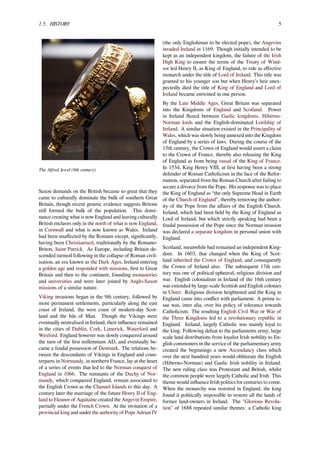
The Alfred Jewel (9th century)
Saxon demands on the British became so great that they
came to culturally dominate the bulk of southern Great
Britain, though recent genetic evidence suggests Britons
still formed the bulk of the population. This domi-
nance creating what is now England and leaving culturally
British enclaves only in the north of what is now England,
in Cornwall and what is now known as Wales. Ireland
had been unaffected by the Romans except, significantly,
having been Christianised, traditionally by the Romano-
Briton, Saint Patrick. As Europe, including Britain de-
scended turmoil following in the collapse of Roman civil-
isation, an era known as the Dark Ages, Ireland entering
a golden age and responded with missions, first to Great
Britain and then to the continent, founding monasteries
and universities and were later joined by Anglo-Saxon
missions of a similar nature.
Viking invasions began in the 9th century, followed by
more permanent settlements, particularly along the east
coast of Ireland, the west coast of modern-day Scot-
land and the Isle of Man. Though the Vikings were
eventually neutralised in Ireland, their influence remained
in the cities of Dublin, Cork, Limerick, Waterford and
Wexford. England however was slowly conquered around
the turn of the first millennium AD, and eventually be-
came a feudal possession of Denmark. The relations be-
tween the descendants of Vikings in England and coun-
terparts in Normandy, in northern France, lay at the heart
of a series of events that led to the Norman conquest of
England in 1066. The remnants of the Duchy of Nor-
mandy, which conquered England, remain associated to
the English Crown as the Channel Islands to this day. A
century later the marriage of the future Henry II of Eng-
land to Eleanor of Aquitaine created the Angevin Empire,
partially under the French Crown. At the invitation of a
provincial king and under the authority of Pope Adrian IV
(the only Englishman to be elected pope), the Angevins
invaded Ireland in 1169. Though initially intended to be
kept as an independent kingdom, the failure of the Irish
High King to ensure the terms of the Treaty of Wind-
sor led Henry II, as King of England, to rule as effective
monarch under the title of Lord of Ireland. This title was
granted to his younger son but when Henry’s heir unex-
pectedly died the title of King of England and Lord of
Ireland became entwined in one person.
By the Late Middle Ages, Great Britain was separated
into the Kingdoms of England and Scotland. Power
in Ireland fluxed between Gaelic kingdoms, Hiberno-
Norman lords and the English-dominated Lordship of
Ireland. A similar situation existed in the Principality of
Wales, which was slowly being annexed into the Kingdom
of England by a series of laws. During the course of the
15th century, the Crown of England would assert a claim
to the Crown of France, thereby also releasing the King
of England as from being vassal of the King of France.
In 1534, King Henry VIII, at first having been a strong
defender of Roman Catholicism in the face of the Refor-
mation, separated from the Roman Church after failing to
secure a divorce from the Pope. His response was to place
the King of England as “the only Supreme Head in Earth
of the Church of England", thereby removing the author-
ity of the Pope from the affairs of the English Church.
Ireland, which had been held by the King of England as
Lord of Ireland, but which strictly speaking had been a
feudal possession of the Pope since the Norman invasion
was declared a separate kingdom in personal union with
England.
Scotland, meanwhile had remained an independent King-
dom. In 1603, that changed when the King of Scot-
land inherited the Crown of England, and consequently
the Crown of Ireland also. The subsequent 17th cen-
tury was one of political upheaval, religious division and
war. English colonialism in Ireland of the 16th century
was extended by large-scale Scottish and English colonies
in Ulster. Religious division heightened and the King in
England came into conflict with parliament. A prime is-
sue was, inter alia, over his policy of tolerance towards
Catholicism. The resulting English Civil War or War of
the Three Kingdoms led to a revolutionary republic in
England. Ireland, largely Catholic was mainly loyal to
the king. Following defeat to the parliaments army, large
scale land distributions from loyalist Irish nobility to En-
glish commoners in the service of the parliamentary army
created the beginnings a new Ascendancy class which
over the next hundred years would obliterate the English
(Hiberno-Norman) and Gaelic Irish nobility in Ireland.
The new ruling class was Protestant and British, whilst
the common people were largely Catholic and Irish. This
theme would influence Irish politics for centuries to come.
When the monarchy was restored in England, the king
found it politically impossible to restore all the lands of
former land-owners in Ireland. The "Glorious Revolu-
tion" of 1688 repeated similar themes: a Catholic king
6 CHAPTER 1. BRITISH ISLES
James VI of Scotland (James I of England)
pushing for religious tolerance in opposition to a Protes-
tant parliament in England. The king’s army was defeated
at the Battle of the Boyne and at the militarily crucial
Battle of Aughrim in Ireland. Resistance held out, and
a guarantee of religious tolerance was a cornerstone of
the Treaty of Limerick. However, in the evolving po-
litical climate, the terms of Limerick were superseded,
a new monarchy was installed, and the new Irish parlia-
ment was packed with the new elite which legislated in-
creasing intolerant Penal Laws, which discommoded both
Dissenters and Catholics.
The Kingdoms of England and Scotland were unified in
1707 creating the Kingdom of Great Britain. Following
an attempted republican revolution in Ireland in 1798,
the Kingdoms of Ireland and Great Britain were unified
in 1801, creating the United Kingdom. The Isle of Man
and the Channel Islands remaining outside of the United
Kingdom but with their ultimate good governance being
the responsibility of the British Crown (effectively the
British government). Although, the colonies of North
American that would become the United States of Amer-
ica were lost by the start of the 19th century, the British
Empire expanded rapidly elsewhere. A century later it
would cover one third of the globe. Poverty in the United
Kingdom remained desperate however and industrialisa-
tion in England led to terrible condition for the working
class. Mass migrations following the Irish Famine and
Highland Clearances resulted in the distribution of the
islands’ population and culture throughout the world and
a rapid de-population of Ireland in the second-half of the
19th century. Most of Ireland seceded from the United
Kingdom after the Irish War of Independence and the
subsequent Anglo-Irish Treaty (1919–1922), with the six
counties that formed Northern Ireland remaining as an
autonomous region of the UK.
1.6 Politics
Main article: Politics in the British Isles
See also: Ireland–United Kingdom relations, Politics of
the United Kingdom, Politics of the Republic of Ireland,
Ireland-Isle of Man relations, Politics of the Isle of Man,
Politics of Jersey, Politics of Guernsey, Politics of Alder-
ney and Politics of Sark
There are two sovereign states in the isles: Ireland and the
Subdivisions of the British Isles
United Kingdom of Great Britain and Northern Ireland.
Ireland, sometimes called the Republic of Ireland, gov-
erns five sixths of the island of Ireland, with the remain-
der of the island forming Northern Ireland. Northern Ire-
land is a part of the United Kingdom of Great Britain and
Northern Ireland, usually shortened to simply the United
Kingdom, which governs the remainder of the archipelago
with the exception of the Isle of Man and the Channel Is-
lands. The Isle of Man and the two states of the Channel
Islands, Jersey and Guernsey, are known as the Crown
Dependencies. They exercise constitutional rights of
self-government and judicial independence;[61]
responsi-
1.6. POLITICS 7
bility for international representation rests largely upon
the UK (in consultation with the respective governments);
and responsibility for defence is reserved by the UK. The
United Kingdom is made up of four constituent parts:
England, Scotland and Wales, forming Great Britain, and
Northern Ireland in the north-east of the island of Ire-
land. Of these, Scotland, Wales and Northern Ireland
have "devolved" governments meaning that they have
their own parliaments/assemblies and are self-governing
with respect to certain areas set down by law. For judicial
purposes, Scotland, Northern Ireland and England and
Wales (the latter being one entity) form separate legal ju-
risdiction, with there being no single law for the UK as a
whole.
Ireland, the United Kingdom and the three Crown De-
pendencies are all parliamentary democracies, with their
own separate parliaments. All parts of the United King-
dom return members to parliament in London. In addi-
tion to this, voters in Scotland, Wales and Northern Ire-
land return members to a parliament in Edinburgh and
to assemblies in Cardiff and Belfast respectively. Gover-
nance in the norm is by majority rule, however, Northern
Ireland uses a system of power sharing whereby unionists
and nationalists share executive posts proportionately and
where the assent of both groups are required for the
Northern Ireland Assembly to make certain decisions. (In
the context of Northern Ireland, unionists are those who
want Northern Ireland to remain a part of the United
Kingdom and nationalists are those who want Northern
Ireland join with the rest of Ireland.) The British monarch
is the head of state for all parts of the isles except for
the Republic of Ireland, where the head of state is the
President of Ireland.
Ireland and the United Kingdom are both part of the Eu-
ropean Union (EU). The Crown Dependencies are not a
part of the EU however do participate in certain aspects
that were negotiated as a part of the UK’s accession to
the EU.[61][62][63]
Neither the United Kingdom or Ireland
are part of the Schengen area, that allow passport-free
travel between EU members states. However, since the
partition of Ireland, an informal free-travel area had ex-
isted across the region. In 1997, this area required for-
mal recognition during the course of negotiations for the
Amsterdam Treaty of the European Union and is now
known as the Common Travel Area.
Reciprocal arrangements allow British and Irish citizens
to full voting rights in the two states. Exceptions to this
are presidential elections and constitutional referendums
in the Republic of Ireland, for which there is no compara-
ble franchise in the other states. In the United Kingdom,
these pre-date European Union law, and in both juris-
dictions go further than that required by European Union
law. Other EU nationals may only vote in local and Eu-
ropean Parliament elections while resident in either the
UK or Ireland. In 2008, a UK Ministry of Justice report
investigating how to strengthen the British sense of cit-
izenship proposed to end this arrangement arguing that,
“the right to vote is one of the hallmarks of the political
status of citizens; it is not a means of expressing closeness
between countries.”[64]
In addition, some civil bodies are organised throughout
the islands as a whole. For example the Samaritans,
which is deliberately organised without regard to national
boundaries on the basis that a service which is not politi-
cal or religious should not recognise sectarian or political
divisions. The RNLI, the life boats service, is also or-
ganised throughout the islands as a whole, covering the
waters of the United Kingdom, Ireland, the Isle of Man,
and the Channel Islands.[65]
The Northern Ireland Peace Process has led to a num-
ber of unusual arrangements between the Republic of
Ireland, Northern Ireland and the United Kingdom. For
example, citizens of Northern Ireland are entitled to the
choice of Irish or British citizenship or both and the Gov-
ernments of Ireland and the United Kingdom consult on
matters not devolved to the Northern Ireland Executive.
The Northern Ireland Executive and the Government of
Ireland also meet as the North/South Ministerial Council
to develop policies common across the island of Ireland.
These arrangements were made following the 1998 Good
Friday Agreement.
1.6.1 British–Irish Council
Main article: British–Irish Council
Another body established under the Good Friday Agree-
ment, the British–Irish Council, is made up of all of the
states and territories of the British Isles. The British–Irish
Parliamentary Assembly (Irish: Tionól Pharlaiminteach
na Breataine agus na hÉireann) predates the British–Irish
Council and was established in 1990. Originally it com-
prised 25 members of the Oireachtas, the Irish parlia-
ment, and 25 members of the parliament of the United
Kingdom, with the purpose of building mutual under-
standing between members of both legislatures. Since
then the role and scope of the body has been expanded to
include representatives from the Scottish Parliament, the
National Assembly for Wales, the Northern Ireland As-
sembly, the States of Jersey, the States of Guernsey and
the High Court of Tynwald (Isle of Man).
The Council does not have executive powers but meets
biannually to discuss issues of mutual importance. Simi-
larly, the Parliamentary Assembly has no legislative pow-
ers but investigates and collects witness evidence from the
public on matters of mutual concern to its members. Re-
ports on its findings are presented to the Governments
of Ireland and the United Kingdom. During the Febru-
ary 2008 meeting of the British–Irish Council, it was
agreed to set up a standing secretariat that would serve
as a permanent 'civil service' for the Council.[66]
Leading
on from developments in the British–Irish Council, the
chair of the British–Irish Inter-Parliamentary Assembly,
8 CHAPTER 1. BRITISH ISLES
Niall Blaney, has suggested that the body should shadow
the British–Irish Council’s work.[67]
1.7 Culture
See also: Culture of Ireland, Culture of the United King-
dom, Sport in Ireland and Sport in the United Kingdom
The United Kingdom and Ireland have separate media,
One Day Cricket International at Lord’s; England v Australia 10
July 2005
Pádraig Harrington teeing off at the Open Championship (golf)
in 2007.
although British television, newspapers and magazines
are widely available in Ireland,[68]
giving people in Ire-
land a high level of familiarity with cultural matters in
the United Kingdom. Irish newspapers are also available
in the UK, and Irish state and private television is widely
available in Northern Ireland. Certain reality TV shows
have embraced the whole of the islands, for example The
X Factor, seasons 3, 4 and 7 of which featured auditions in
Dublin and were open to Irish voters, whilst the show pre-
viously known as Britain’s Next Top Model became Britain
and Ireland’s Next Top Model in 2011. A few cultural
events are organised for the island group as a whole. For
example, the Costa Book Awards are awarded to authors
resident in the UK or Ireland. The Man Booker Prize is
awarded to authors from the Commonwealth of Nations
and Ireland. The Mercury Music Prize is handed out ev-
ery year to the best album from a British or Irish musician
or group.
Many globally popular sports had modern rules codified
in the British Isles, including golf, association football,
cricket, rugby, snooker and darts, as well as many minor
sports such as croquet, bowls, pitch and putt, water polo
and handball. A number of sports are popular through-
out the British Isles, the most prominent of which is
association football. While this is organised separately
in different national associations, leagues and national
teams, even within the UK, it is a common passion in
all parts of the islands. Rugby union is also widely en-
joyed across the islands with four national teams from
England, Ireland, Scotland and Wales. The British and
Irish Lions is a team chosen from each national team
and undertakes tours of the southern hemisphere rugby
playing nations every four years. Ireland play as a united
team, represented by players from both Northern Ireland
and the Republic. These national rugby teams play each
other each year for the Triple Crown as part of the Six
Nations Championship. Also since 2001 the professional
club teams of Ireland, Scotland, Wales and Italy compete
against each other in the RaboDirect Pro12.
The Ryder Cup in golf was originally played between a
United States team and a team representing Great Britain
and Ireland. From 1979 onwards this was expanded to
include the whole of Europe.
1.8 Transportation
See also: Transport in Ireland and Transport in the United
Kingdom
London Heathrow Airport is Europe’s busiest airport in
HSC Stena Explorer, a large fast ferry the formerly operated
Holyhead–Dun Laoghaire route between Great Britain and Ire-
land.
terms of passenger traffic and the Dublin-London route
is the busiest air route in Europe.[69]
The English Chan-
nel and the southern North Sea are the busiest seaways in
the world.[70]
The Channel Tunnel, opened in 1994, links
1.10. REFERENCES 9
Great Britain to France and is the second-longest rail tun-
nel in the world.
The idea of building a tunnel under the Irish Sea has
been raised since 1895,[71]
when it was first investigated.
Several potential Irish Sea tunnel projects have been pro-
posed, most recently the Tusker Tunnel between the ports
of Rosslare and Fishguard proposed by The Institute of
Engineers of Ireland in 2004.[72]
A rail tunnel was pro-
posed in 1997 on a different route, between Dublin and
Holyhead, by British engineering firm Symonds. Either
tunnel, at 50 mi (80 km), would be by far the longest in the
world, and would cost an estimated €20 billion. A pro-
posal in 2007,[73]
estimated the cost of building a bridge
from County Antrim in Northern Ireland to Galloway in
Scotland at £3.5bn (€5bn).
1.9 See also
• Extreme points of the British Isles
• List of islands in the British Isles
• British Islands
1.10 References
[1] “British Isles”. focal.ie Terminology Database. Foras na
Gaeilge / Dublin City University. Retrieved 23 Septem-
ber 2010. the British Isles s pl (Tíreolaíocht · Geog-
raphy; Polaitíocht · Politics; Stair · History; Logainm-
neacha » Ceantar/Réigiún · Placenames » Area/Region)
Na hOileáin bhriontanacha
[2] University of Glasgow Department of Celtic
[3] Office of The President of Tynwald (PDF)
[4] “RÈGLEMENT (1953) (AMENDEMENT)
SUR L’IMPORTATION ET L’EXPORTATION
D’ANIMAUX”. States of Jersey. Retrieved 2 February
2012.
[5] COUNTRY/TERRITORY INDEX, ISLAND DIREC-
TORY, United Nations Environment Programme. Re-
trieved 9th August 2015.
Island Facts, Isle of Man Government. Retrieved 9 Au-
gust 2015.
According to the UNEP, the Channel Islands have a land
area of 194 km², the Republic of Ireland has a land area of
70,282 km², and the United Kingdom has a land area of
244,111 km². According to the Isle of Man Government,
the Isle of Man has a land area of 572 km². Therefore,
the overall land area of the British Isles is 315,159 km²
[6] “British Isles”, Encyclopædia Britannica
[7] The diplomatic and constitutional name of the Irish state
is simply Ireland. For disambiguation purposes, Republic
of Ireland is often used although technically not the name
of the state but, according to the Republic of Ireland Act
1948, the state “may be described” as such.
[8] Oxford English Dictionary: “British Isles: a geographical
term for the islands comprising Great Britain and Ireland
with all their offshore islands including the Isle of Man and
the Channel Islands.”
[9] Alan, Lew; Colin, Hall; Dallen, Timothy (2008). World
Geography of Travel and Tourism: A Regional Approach.
Oxford: Elsevier. ISBN 978-0-7506-7978-7. The British
Isles comprise more than 6,000 islands off the northwest
coast of continental Europe, including the countries of the
United Kingdom of Great Britain (England, Scotland and
Wales) and Northern Ireland, and the Republic of Ireland.
The group also includes the United Kingdom crown de-
pendencies of the Isle of Man, and by tradition, the Chan-
nel Islands (the Bailiwicks of Guernsey and Jersey), even
though these islands are strictly speaking an archipelago
immediately off the coast of Normandy (France) rather
than part of the British Isles.
[10] Woodcock, Nigel H.; Rob Strachan (2012). Geological
History of Britain and Ireland. John Wiley & Sons. pp.
49–50. ISBN 978-1-1182-7403-3.
[11] http://www.tara.tcd.ie/bitstream/2262/40560/1/
Edwards%26Brooks_INJ08_TARA.pdf
[12] Koch
[13] British Have Changed Little Since Ice Age, Gene Study
SaysJames Owen for National Geographic News, 19 July
2005
[14] Social work in the British Isles by Malcolm Payne, Steven
Shardlow When we think about social work in the British
Isles, a contentious term if ever there was one, what do we
expect to see?
[15] Davies, Alistair; Sinfield, Alan (2000), British Culture
of the Postwar: An Introduction to Literature and Soci-
ety, 1945–1999, Routledge, p. 9, ISBN 0-415-12811-
0, Some of the Irish dislike the 'British' in 'British Isles’,
while a minority of the Welsh and Scottish are not keen
on 'Great Britain'. ... In response to these difficulties,
'Britain and Ireland' is becoming preferred official usage
if not in the vernacular, although there is a growing trend
amongst some critics to refer to Britain and Ireland as 'the
archipelago'.
[16] "Written Answers – Official Terms”, Dáil Éireann, Vol-
ume 606, 28 September 2005. In his response, the Irish
Minister for Foreign Affairs stated that “The British Isles
is not an officially recognised term in any legal or inter-
governmental sense. It is without any official status. The
Government, including the Department of Foreign Af-
fairs, does not use this term. Our officials in the Em-
bassy of Ireland, London, continue to monitor the media
in Britain for any abuse of the official terms as set out in
the Constitution of Ireland and in legislation. These in-
clude the name of the State, the President, Taoiseach and
others.”
[17] Sharrock, David (3 October 2006), “New atlas lets Ire-
land slip shackles of Britain”, The Times (UK), retrieved
7 July 2010, A spokesman for the Irish Embassy in Lon-
don said: “The British Isles has a dated ring to it, as if we
are still part of the Empire. We are independent, we are
10 CHAPTER 1. BRITISH ISLES
not part of Britain, not even in geographical terms. We
would discourage its usage [sic].”
[18] Hazlett, Ian (2003). The Reformation in Britain and Ire-
land: an introduction. Continuum International Publish-
ing Group. p. 17. ISBN 978-0-567-08280-0. At the
outset, it should be stated that while the expression 'The
British Isles’ is evidently still commonly employed, its in-
termittent use throughout this work is only in the geo-
graphic sense, in so far as that is acceptable. Since the
early twentieth century, that nomenclature has been re-
garded by some as increasingly less usable. It has been
perceived as cloaking the idea of a 'greater England', or an
extended south-eastern English imperium, under a com-
mon Crown since 1603 onwards. ... Nowadays, how-
ever, 'Britain and Ireland' is the more favoured expression,
though there are problems with that too. ... There is no
consensus on the matter, inevitably. It is unlikely that the
ultimate in non-partisanship that has recently appeared the
(East) 'Atlantic Archipelago' will have any appeal beyond
captious scholars.
[19] “Guardian Style Guide”, Guardian (London), 19 Decem-
ber 2008, A geographical term taken to mean Great
Britain, Ireland and some or all of the adjacent islands
such as Orkney, Shetland and the Isle of Man. The phrase
is best avoided, given its (understandable) unpopularity
in the Irish Republic. The plate in the National Geo-
graphic Atlas of the World once titled British Isles now
reads Britain and Ireland.
[20] Norquay, Glenda; Smyth, Gerry (2002), Across the
margins: cultural identity and change in the Atlantic
archipelago, Manchester University Press, p. 4, ISBN
0-7190-5749-3, The term we favour here—Atlantic
Archipelago—may prove to be of no greater use in the
long run, but at this stage it does at least have the merit of
questioning the ideology underpinning more established
nomenclature.
[21] Schwyzer, Philip; Mealor, Simon (2004), Archipelagic
identities: literature and identity in the Atlantic
Archipelago, Ashgate Publishing, p. 10, ISBN 0-
7546-3584-8, In some ways 'Atlantic Archipelago' is
intended to do the work of including without excluding,
and while it seems to have taken root in terms of academic
conferences and publishing, I don't see it catching on in
popular discourse or official political circles, at least not
in a hurry.
[22] Kumar, Krishan (2003), The Making of English National
Identity, Cambridge University Press, p. 6, ISBN 0-521-
77736-4, Some scholars, seeking to avoid the political
and ethnic connotations of 'the British Isles’, have pro-
posed the 'Atlantic Archipelago' or even 'the East Atlantic
Archipelago' (see, e.g. Pocock 1975a: 606; 1995: 292n;
Tompson, 1986) Not surprisingly this does not seem to
have caught on with the general public, though it has found
increasing favour with scholars promoting the new 'British
History'.
[23] David Armitage; Michael Braddick (2002), The British
Atlantic world, 1500–1800, Palgrave Macmillan, p. 284,
ISBN 0-333-96340-7, British and Irish historians increas-
ingly use 'Atlantic archipelago' as a less metro-centric
term for what is popularly known as the British Isles.
[24] Foster, p. 1.
[25] Allen, p. 172–174.
[26] Harley, p. 150.
[27] Diodorus Siculus’ Bibliotheca Historica Book V. Chapter
XXI. Section 1 Greek text at the Perseus Project.
[28] Diodorus Siculus’ Bibliotheca Historica Book V. Chapter
XXI. Section 2 Greek text at the Perseus Project.
[29] Strabo’s Geography Book I. Chapter IV. Section 2 Greek
text and English translation at the Perseus Project.
[30] Strabo’s Geography Book IV. Chapter II. Section 1 Greek
text and English translation at the Perseus Project.
[31] Strabo’s Geography Book IV. Chapter IV. Section 1 Greek
text and English translation at the Perseus Project.
[32] Marcianus Heracleensis; Müller, Karl Otfried; et al.
(1855). “Periplus Maris Exteri, Liber Prior, Prooemium”.
In Firmin Didot, Ambrosio. Geographi Graeci Minores 1.
Paris. pp. 516–517. Greek text and Latin Translation
thereof archived at the Open Library Project.DjVu
[33] Davies, p. 47.
[34] Snyder, p. 68.
[35] Snyder, p. 12.
[36] Claudius Ptolemy (1898). "Ἕκθεσις τῶν κατὰ
παράλληλον ἰδιωμάτων: κβ',κε'". In Heiberg, J.L.
Claudii Ptolemaei Opera quae exstant omnia (PDF). vol.1
Syntaxis Mathematica. Leipzig: in aedibus B.G.Teubneri.
pp. 112–113.
[37] Claudius Ptolemy (1843). “Book II, Prooemium and
chapter β', paragraph 12”. In Nobbe, Carolus Fridericus
Augustus. Claudii Ptolemaei Geographia (PDF). vol.1.
Leipzig: sumptibus et typis Caroli Tauchnitii. pp. 59,
67.
[38] Freeman, Philip (2001). Ireland and the classical world.
Austin, Texas: University of Texas Press. p. 65. ISBN
0-292-72518-3.
[39] John Dee, 1577. 1577 J. Arte Navigation, p. 65 “The
syncere Intent, and faythfull Aduise, of Georgius Gemis-
tus Pletho, was, I could..frame and shape very much of
Gemistus those his two Greek Orations..for our Brytish
Iles, and in better and more allowable manner.” From the
OED, s.v. “British Isles”
[40] D. A. Coleman (1982), Demography of immigrants and
minority groups in the United Kingdom: proceedings of the
eighteenth annual symposium of the Eugenics Society, Lon-
don 1981, Volume 1981, Academic Press, p. 213, ISBN
0-12-179780-5, The geographical term British Isles is not
generally acceptable in Ireland, the term these islands be-
ing widely used instead. I prefer the Anglo-Celtic Isles, or
the North-West European Archipelago.
[41] Irish historical studies: Joint Journal of the Irish Historical
Society and the Ulster Society for Irish Historical Studies,
Hodges, Figgis & Co., 1990, p. 98, There is mug to be
said for considering the archipelago as a whole, for a his-
tory of the British or Anglo-Celtic isles or 'these islands’.
1.10. REFERENCES 11
[42] John Oakland, 2003, British Civilization: A Student’s
Dictionary, Routledge: London
British-Irish Isles, the (geography) see
BRITISH ISLES
British Isles, the (geography) A ge-
ographical (not political or CONSTITU-
TIONAL) term for ENGLAND, SCOT-
LAND, WALES, and IRELAND (including
the REPUBLIC OF IRELAND), together
with all offshore islands. A more accurate
(and politically acceptable) term today is the
British-Irish Isles.
[43] “Blackwellreference.com”. Blackwellreference.com. Re-
trieved 7 November 2010.
[44] World and its Peoples: Ireland and United Kingdom, Lon-
don: Marshall Cavendish, 2010, p. 8, The nomenclature
of Great Britain and Ireland and the status of the differ-
ent parts of the archipelago are often confused by peo-
ple in other parts of the world. The name British Isles
is commonly used by geographers for the archipelago; in
the Republic of Ireland, however, this name is considered
to be exclusionary. In the Republic of Ireland, the name
British-Irish Isles is occasionally used. However, the term
British-Irish Isles is not recognized by international geog-
raphers. In all documents jointly drawn up by the British
and Irish governments, the archipelago is simply referred
to as “these islands.” The name British Isles remains the
only generally accepted terms for the archipelago off the
northwestern coast of mainland Europe.
[45] Goudie, Andrew S.; D. Brunsden (1994). The Environ-
ment of the British Isles, an Atlas. Oxford: Clarendon
Press. p. 2.
[46] Ibid., p. 5.
[47]
[48] BBC News (29 November 2002). “UK’s lowest spot is
getting lower”. England: BBC. p. 1. Retrieved 4 July
2010.
[49] “Encyclopædia Britannica online:Ben Nevis”. Ency-
clopædia Britannica. 2010. Retrieved 5 July 2010.
[50] Gazetteer for Scotland Morar, Loch
[51] Mayes, Julian; Dennis Wheeler (1997). Regional Climates
of the British Isles. London: Routledge. p. 13.
[52] Ibid., pp. 13–14.
[53] “Guide to British Snakes”. Wildlife Britain wildlifebri-
tain.com. Retrieved 17 August 2010.
[54] http://www.ons.gov.uk/ons/about-ons/
what-we-do/publication-scheme/
published-ad-hoc-data/population/august-2012/
mid-2010-urban-area-syoa-ests-england-and-wales.xls
[55] Mid-2010 population estimates - Settlements in order of
size General Register Office for Scotland
[56] WB Lockwood (1975), Languages of the British Isles Past
and Present, British Columbia: Ladysmith, ISBN 0-233-
96666-8, An introduction to the rich linguistic heritage of
Great Britain and Ireland.
[57] Waddel, John; Conroy, Jane (1999), Spriggs, Matthew,
ed., “Celts and Other: Maritime Contact and Lin-
guistic Change”, Archaeology and Language (London:
Routledge) 35: 127, ISBN 0-415-11786-0, Continen-
tal Celtic includes Gaulish, Lepontic, Hispano-Celtic (or
Celtiberian) and Galatian. All were extinct by the seventh
century AD.
[58] Varner, Gary (2008), Charles G. Leland: The Man & the
Myth, Morrisville, North Carolina: Lulu Press, p. 41,
ISBN 978-1-4357-4394-6, Shelta does in fact exist as a
secret language as is used to conceal meaning from out-
siders, used primarily in Gypsy business or negotiations
or when speaking around the police.
[59] J. M. Y. Simpson, R. E. Asher (1994), The Encyclopedia
of Language and Linguistics, Volume 5, Oxford: Perg-
amon Press, p. 2505, ISBN 978-0-08-035943-4, Thus,
apart from the very young, there are virtually no monoglot
speakers of Irish, Scots Gaelic, or Welsh.
[60] Hindley, Reg (1990), The Death of the Irish Language:
A Qualified Obituary, Oxon: Taylor & Francis, p. 221,
ISBN 0-415-04339-5, Three indigenous language have
died in the British Isles since around 1780: Cornish (tradi-
tionally in 1777), Norn (the Norse language of Shetland:
c. 1880), Manx (1974).
[61] “Jersey’s relationship with the UK and EU”. Gov.je. Re-
trieved 7 November 2010.
[62] “States of Guernsey: Constitution”. Gov.gg. Retrieved 7
November 2010.
[63] “Relationship with European Union – Isle of Man Gov-
ernment – Chief Secretarys Office”. Gov.im. Retrieved
7 November 2010.
[64] Goldsmith, 2008, Citizenship: Our Common Bond, Min-
istry of Justice: London Archived January 20, 2012 at the
Wayback Machine
[65] RNLI.org.uk, The RNLI is a charity that provides a 24-
hour lifesaving service around the UK and Republic of
Ireland.
[66] [Communiqué of the British-Irish Council], February
2008
[67] Martina Purdy, 28 February 2008 2008, Unionists urged
to drop boycott, BBC: London
[68] “Ireland”. Museum.tv. Retrieved 17 October 2008.
[69] Seán McCárthaigh, Dublin–London busiest air traffic
route within EU Irish Examiner, 31 March 2003
[70] Hardisty, Jack (1990), The British Seas: an Introduction to
the Oceanography and Resources of the North-west Euro-
pean Continental Shelf, London: Routledge, p. 5, ISBN
0-415-03586-4, No only are the English Channel and
the Southern North Sea, in particular, the busiest ship-
ping clearways in the world, but the seas are also sources
12 CHAPTER 1. BRITISH ISLES
of the European community’s industrial wealth (fisheries,
petroleum, aggregates, and power) ad sinks for the dis-
posal of refuse from its intensely urbanized and industri-
alized coats.
[71] “Tunnel under the Sea”, The Washington Post, 2 May
1897 (Archive link)
[72] Tunnel 'vision' under Irish Sea, BBC, 23 December 2004
[73] BBC News, From Twinbrook to the Trevi Fountain, 21
August 2007
1.11 Further reading
• Allen, Stephen (2007). Lords of Battle: The World
of the Celtic Warrior. Osprey Publishing. ISBN 1-
84176-948-7.
• Collingwood, Robin George (1998). Roman Britain
and the English Settlements. Biblo & Tannen Pub-
lishers. ISBN 0-8196-1160-3.
• Davies, Norman (2000). The Isles a History.
Macmillan. ISBN 0-333-69283-7.
• Ferguson, Niall (2004). Empire. Basic Books.
ISBN 0-465-02329-0. Retrieved 22 July 2009.
• Foster (editor), Robert Fitzroy; Donnchadh O Cor-
rain (1 November 2001). The Oxford History of Ire-
land. Oxford University Press. ISBN 0-19-280202-
X.
• Harley, John Brian; David Woodward (1987). The
History of Cartography: Cartography in prehis-
toric, ancient, and medieval Europe and the Mediter-
ranean. Humana Press. ISBN 0-226-31633-5.
• Maddison, Angus (2001). The World Economy:
A Millennial Perspective. Organisation for Eco-
nomic Co-operation and Development. ISBN 92-
64-18654-9. Retrieved 22 July 2009.
• Markale, Jean (1994). King of the Celts. Bear &
Company. ISBN 0-89281-452-7.
• Snyder, Christopher (2003). The Britons. Blackwell
Publishing. ISBN 0-631-22260-X.
• A History of Britain: At the Edge of the World,
3500 B.C. – 1603 A.D. by Simon Schama,
BBC/Miramax, 2000 ISBN 978-0-7868-6675-5
• A History of Britain—The Complete Collection on
DVD by Simon Schama, BBC 2002
• Shortened History of England by G. M. Trevelyan
Penguin Books ISBN 978-0-14-023323-0
1.12 External links
• An interactive geological map of the British Isles.
Chapter 2
Politics of the United Kingdom
The United Kingdom is a unitary democracy governed
within the framework of a constitutional monarchy, in
which the Monarch is the head of state and the Prime
Minister of the United Kingdom is the head of govern-
ment. Executive power is exercised by Her Majesty’s
Government, on behalf of and by the consent of the
Monarch, as well as by the devolved Governments of
Scotland and Wales, and the Northern Ireland Executive.
Legislative power is vested in the two chambers of the
Parliament of the United Kingdom, the House of Com-
mons and the House of Lords, as well as in the Scottish
parliament and Welsh and Northern Ireland assemblies.
The judiciary is independent of the executive and the leg-
islature. The highest court is the Supreme Court of the
United Kingdom.
The UK political system is a multi-party system. Since
the 1920s, the two largest political parties have been the
Conservative Party and the Labour Party. Before the
Labour Party rose in British politics, the Liberal Party
was the other major political party along with the Con-
servatives. Though coalition and minority governments
have been an occasional feature of parliamentary politics,
the first-past-the-post electoral system used for general
elections tends to maintain the dominance of these two
parties, though each has in the past century relied upon
a third party such as the Liberal Democrats to deliver a
working majority in Parliament. A Conservative-Liberal
Democrat coalition government held office from 2010
until 2015, the first coalition since 1945.[1]
The coalition
ended following Parliamentary elections on May 7, 2015,
in which the Conservative Party won an outright major-
ity of 330 seats in the House of Commons, while their
coalition partners lost all but eight seats.[2]
With the partition of Ireland, Northern Ireland received
home rule in 1920, though civil unrest meant direct rule
was restored in 1972. Support for nationalist parties in
Scotland and Wales led to proposals for devolution in the
1970s though only in the 1990s did devolution actually
happen. Today, Scotland, Wales and Northern Ireland
each possess a legislature and executive, with devolution
in Northern Ireland being conditional on participation in
certain all-Ireland institutions. The United Kingdom re-
mains responsible for non-devolved matters and, in the
case of Northern Ireland, co-operates with the Republic
of Ireland.
It is a matter of dispute as to whether increased autonomy
and devolution of executive and legislative powers has
contributed to the increase in support for independence.
The principal pro-independence party, the Scottish Na-
tional Party, became a minority government in 2007 and
then went on to win an overall majority of MSPs at the
2011 Scottish parliament elections and forms the Scottish
Government administration. A 2014 referendum on in-
dependence led to a rejection of the proposal, but with
45% voting to secede. In Northern Ireland, the largest
Pro-Belfast Agreement party, Sinn Féin, not only advo-
cates Northern Ireland’s unification with the Republic of
Ireland, but also abstains from taking their elected seats in
the Westminster government, as this would entail taking
a pledge of allegiance to the British monarch.
The constitution of the United Kingdom is uncodified,
being made up of constitutional conventions, statutes and
other elements such as EU law. This system of govern-
ment, known as the Westminster system, has been adopted
by other countries, especially those that were formerly
parts of the British Empire.
The United Kingdom is also responsible for several de-
pendencies, which fall into two categories: the Crown
dependencies, in the immediate vicinity of the UK, and
British Overseas Territories, which originated as colonies
of the British Empire.
2.1 History
Main articles: Politics of England, Postwar Britain and
History of the United Kingdom (1945–present)
2.2 The Crown
Main article: Monarchy of the United Kingdom
The British Monarch, currently Queen Elizabeth II, is the
Chief of State of the United Kingdom. Though she takes
13
14 CHAPTER 2. POLITICS OF THE UNITED KINGDOM
little direct part in government, the Crown remains the
fount in which ultimate executive power over Govern-
ment lies. These powers are known as Royal Preroga-
tive and can be used for a vast amount of things, such as
the issue or withdrawal of passports, to the dismissal of
the Prime Minister or even the Declaration of War. The
powers are delegated from the Monarch personally, in the
name of the Crown, and can be handed to various min-
isters, or other Officers of the Crown, and can purposely
bypass the consent of Parliament.
The head of Her Majesty’s Government; the Prime Min-
ister, also has weekly meetings with the sovereign, where
she may express her feelings, warn, or advise the Prime
Minister in the Government’s work.[3]
According to the uncodified constitution of the United
Kingdom, the monarch has the following powers:[4]
Domestic Powers
• The power to dismiss and appoint a Prime Minister
• The power to dismiss and appoint other ministers
• The power to summon, prorogue and dissolve Par-
liament
• The power to grant or refuse Royal Assent to bills
(making them valid and law)
• The power to commission officers in the Armed
Forces
• The power to command the Armed Forces of the
United Kingdom
• The power to appoint members to the Queen’s
Council
• The power to issue and withdraw passports
• The power to grant Prerogative of mercy (though
Capital Punishment is abolished, this power is still
used to remedy errors in sentence calculation)
• The power to grant honours
• The power to create corporations via Royal Charter
Foreign Powers
• The power to ratify and make treaties
• The power to declare War and Peace
• The power to deploy the Armed Forces overseas
• The power to recognize states
• The power to credit and receive diplomats
2.3 Executive
Executive power in the United Kingdom is exercised
by the Sovereign, Queen Elizabeth II, via Her Majesty’s
Government and the devolved national authorities - the
Scottish Government, the Welsh Assembly Government
and the Northern Ireland Executive.
2.3.1 The United Kingdom Government
The monarch appoints a Prime Minister as the head
of Her Majesty’s Government in the United Kingdom,
guided by the strict convention that the Prime Minister
should be the member of the House of Commons most
likely to be able to form a Government with the support
of that House. In practice, this means that the leader of
the political party with an absolute majority of seats in
the House of Commons is chosen to be the Prime Minis-
ter. If no party has an absolute majority, the leader of the
largest party is given the first opportunity to form a coali-
tion. The Prime Minister then selects the other Ministers
which make up the Government and act as political heads
of the various Government Departments. About twenty
of the most senior government ministers make up the
Cabinet and approximately 100 ministers in total com-
prise the government. In accordance with constitutional
convention, all ministers within the government are either
Members of Parliament or peers in the House of Lords.
As in some other parliamentary systems of government
(especially those based upon the Westminster System),
the executive (called “the government”) is drawn from
and is answerable to Parliament - a successful vote of no
confidence will force the government either to resign or
to seek a parliamentary dissolution and a general election.
In practice, members of parliament of all major parties
are strictly controlled by whips who try to ensure they vote
according to party policy. If the government has a large
majority, then they are very unlikely to lose enough votes
to be unable to pass legislation.
The Prime Minister and the Cabinet
The Prime Minister is the most senior minister in the
Cabinet. He or she is responsible for chairing Cabinet
meetings, selecting Cabinet ministers (and all other posi-
tions in Her Majesty’s government), and formulating gov-
ernment policy. The Prime Minister being the de facto
leader of the UK, he or she exercises executive functions
that are nominally vested in the sovereign (by way of the
Royal Prerogatives). Historically, the British monarch
was the sole source of executive powers in the govern-
ment. However, following the lead of the Hanoverian
monarchs, an arrangement of a “Prime Minister” chair-
ing and leading the Cabinet began to emerge. Over time,
this arrangement became the effective executive branch
of government, as it assumed the day-to-day functioning
2.4. LEGISLATURES 15
of the British government away from the sovereign.
Theoretically, the Prime Minister is primus inter pares
(,i.e. Latin for “first among equals”) among their Cab-
inet colleagues. While the Prime Minister is the senior
Cabinet Minister, they are theoretically bound to make
executive decisions in a collective fashion with the other
Cabinet ministers. The Cabinet, along with the PM, con-
sists of Secretaries of State from the various government
departments, the Lord High Chancellor, the Lord Privy
Seal, the President of the Board of Trade, the Chancellor
of the Duchy of Lancaster and Ministers without port-
folio. Cabinet meetings are typically held weekly, while
Parliament is in session.
Government departments and the Civil Service
The Government of the United Kingdom contains a num-
ber of ministries known mainly, though not exclusively as
departments, e.g., Department for Education. These are
politically led by a Government Minister who is often a
Secretary of State and member of the Cabinet. He or she
may also be supported by a number of junior Ministers.
In practice, several government departments and Minis-
ters have responsibilities that cover England alone, with
devolved bodies having responsibility for Scotland, Wales
and Northern Ireland, (for example - the Department of
Health), or responsibilities that mainly focus on England
(such as the Department for Education).
Implementation of the Minister’s decisions is carried out
by a permanent politically neutral organisation known as
the civil service. Its constitutional role is to support the
Government of the day regardless of which political party
is in power. Unlike some other democracies, senior civil
servants remain in post upon a change of Government.
Administrative management of the Department is led by
a head civil servant known in most Departments as a
Permanent Secretary. The majority of the civil service
staff in fact work in executive agencies, which are sepa-
rate operational organisations reporting to Departments
of State.
“Whitehall” is often used as a metonym for the central
core of the Civil Service. This is because most Govern-
ment Departments have headquarters in and around the
former Royal Palace Whitehall.
2.3.2 Devolved national administrations
Scottish Government
Main article: Scottish Government
The Scottish Government is responsible for all issues that
are not explicitly reserved to the United Kingdom Parlia-
ment at Westminster, by the Scotland Act; including NHS
Scotland, education, justice, rural affairs, and transport.
It manages an annual budget of more than £25 billion.[5]
The government is led by the First Minister, assisted by
various Ministers with individual portfolios and remits.
The Scottish Parliament nominates a Member to be ap-
pointed as First Minister by the Queen. The First Minis-
ter then appoints their Ministers (now known as Cabinet
Secretaries) and junior Ministers, subject to approval by
the Parliament. The First Minister, the Ministers (but
not junior ministers), the Lord Advocate and Solicitor
General are the Members of the 'Scottish Executive', as
set out in the Scotland Act 1998. They are collectively
known as “the Scottish Ministers”.
Welsh Government
Main article: Welsh Government
The Welsh Government and the National Assembly for
Wales have more limited powers than those devolved
to Scotland,[6]
although following the passing of the
Government of Wales Act 2006 and the Welsh devolu-
tion referendum, 2011, the Assembly can now legislate
in some areas through an Act of the National Assembly
for Wales. Following the 2011 election, Welsh Labour
held exactly half of the seats in the Assembly, falling just
short of an overall majority. A Welsh Labour Govern-
ment was subsequently formed headed by Carwyn Jones.
Northern Ireland Executive
Main article: Northern Ireland Executive
The Northern Ireland Executive and Assembly have pow-
ers closer to those already devolved to Scotland. The
Northern Ireland Executive is led by a diarchy, cur-
rently First Minister Peter Robinson (Democratic Union-
ist Party) and deputy First Minister Martin McGuinness
(Sinn Féin).[7]
2.4 Legislatures
The UK Parliament is the supreme legislative body
in the United Kingdom (i.e., there is parliamentary
sovereignty), and Government is drawn from and answer-
able to it. Parliament is bicameral, consisting of the
House of Commons and the House of Lords. There is
also a devolved Scottish Parliament and devolved Assem-
blies in Wales and Northern Ireland, with varying degrees
of legislative authority.
2.4.1 UK Parliament
16 CHAPTER 2. POLITICS OF THE UNITED KINGDOM
Parliament meets at the Palace of Westminster
House of Commons
Main article: British House of Commons
The Countries of the United Kingdom are divided into
parliamentary constituencies of broadly equal population
by the four Boundary Commissions. Each constituency
elects a Member of Parliament (MP) to the House of
Commons at General Elections and, if required, at by-
elections. As of 2010 there are 650 constituencies (there
were 646 before that year’s general election). Of the 650
MPs, all but one - Lady Sylvia Hermon - belong to a
political party.
In modern times, all Prime Ministers and Leaders of the
Opposition have been drawn from the Commons, not the
Lords. Alec Douglas-Home resigned from his peerages
days after becoming Prime Minister in 1963, and the last
Prime Minister before him from the Lords left in 1902
(the Marquess of Salisbury).
One party usually has a majority in Parliament, because
of the use of the First Past the Post electoral system,
which has been conducive in creating the current two
party system. The monarch normally asks a person com-
missioned to form a government simply whether it can
survive in the House of Commons, something which ma-
jority governments are expected to be able to do. In
exceptional circumstances the monarch asks someone
to 'form a government' with a parliamentary minority[8]
which in the event of no party having a majority requires
the formation of a coalition government. This option is
only ever taken at a time of national emergency, such as
war-time. It was given in 1916 to Andrew Bonar Law,
and when he declined, to David Lloyd George and in 1940
to Winston Churchill. A government is not formed by a
vote of the House of Commons, it is a commission from
the monarch. The House of Commons gets its first chance
to indicate confidence in the new government when it
votes on the Speech from the Throne (the legislative pro-
gramme proposed by the new government).
House of Lords
Main article: House of Lords
The House of Lords was previously a largely hereditary
aristocratic chamber, although including life peers, and
Lords Spiritual. It is currently mid-way through exten-
sive reforms, the most recent of these being enacted in
the House of Lords Act 1999. The house consists of
two very different types of member, the Lords Temporal
and Lords Spiritual. Lords Temporal include appointed
members (life peers with no hereditary right for their de-
scendants to sit in the house) and ninety-two remaining
hereditary peers, elected from among, and by, the hold-
ers of titles which previously gave a seat in the House
of Lords. The Lords Spiritual represent the established
Church of England and number twenty-six: the Five An-
cient Sees (Canterbury, York, London, Winchester and
Durham), and the 21 next-most senior bishops.
The House of Lords currently acts to review legislation
initiated by the House of Commons, with the power to
propose amendments, and can exercise a suspensive veto.
This allows it to delay legislation if it does not approve it
for twelve months. However, the use of vetoes is limited
by convention and by the operation of the Parliament Acts
1911 and 1949: the Lords may not veto the “money bills”
or major manifesto promises (see Salisbury convention).
Persistent use of the veto can also be overturned by the
Commons, under a provision of the Parliament Act 1911.
Often governments will accept changes in legislation in
order to avoid both the time delay, and the negative pub-
licity of being seen to clash with the Lords. However the
Lords still retain a full veto in acts which would extend
the life of Parliament beyond the 5-year term limit intro-
duced by the Parliament Act 1911.
The Constitutional Reform Act 2005 outlined plans for
a Supreme Court of the United Kingdom to replace the
role of the Law Lords.
The House of Lords was replaced as the final court of ap-
peal on civil cases within the United Kingdom on 1 Octo-
ber 2009, by the Supreme Court of the United Kingdom.
2.4. LEGISLATURES 17
2.4.2 Devolved national legislatures
Main article: Devolution in the United Kingdom
Though the UK parliament remains the sovereign parlia-
ment, Scotland has a parliament and Wales and Northern
Ireland have assemblies. De jure, each could have its
powers broadened, narrowed or changed by an Act of the
UK Parliament. The UK is a unitary state with a devolved
system of government. This contrasts with a federal sys-
tem, in which sub-parliaments or state parliaments and
assemblies have a clearly defined constitutional right to
exist and a right to exercise certain constitutionally guar-
anteed and defined functions and cannot be unilaterally
abolished by Acts of the central parliament.
All three devolved institutions are elected by proportional
representation: the Additional Member System is used in
Scotland and Wales, and Single Transferable Vote is used
in Northern Ireland.
England, therefore, is the only country in the UK not to
have its own devolved parliament. However, senior politi-
cians of all main parties have voiced concerns in regard
to the West Lothian Question,[9][10]
which is raised where
certain policies for England are set by MPs from all four
constituent nations whereas similar policies for Scotland
or Wales might be decided in the devolved assemblies by
legislators from those countries alone. Alternative pro-
posals for English regional government have stalled, fol-
lowing a poorly received referendum on devolved govern-
ment for the North East of England, which had hitherto
been considered the region most in favour of the idea,
with the exception of Cornwall, where there is widespread
support for a Cornish Assembly, including all five Cor-
nish MPs.[11][12]
England is therefore governed according
to the balance of parties across the whole of the United
Kingdom.
The government has no plans to establish an English par-
liament or assembly although several pressure groups[13]
are calling for one. One of their main arguments is that
MPs (and thus voters) from different parts of the UK have
inconsistent powers. Currently an MP from Scotland can
vote on legislation which affects only England but MPs
from England (or indeed Scotland) cannot vote on mat-
ters devolved to the Scottish parliament. Indeed, the for-
mer Prime Minister Gordon Brown, who is an MP for a
Scottish constituency, introduced some laws that only af-
fect England and not his own constituency. This anomaly
is known as the West Lothian question.
The policy of the UK Government in England was to
establish elected regional assemblies with no legislative
powers. The London Assembly was the first of these, es-
tablished in 2000, following a referendum in 1998, but
further plans were abandoned following rejection of a
proposal for an elected assembly in North East England
in a referendum in 2004. Unelected regional assemblies
remain in place in eight regions of England.
Scottish Parliament
Main article: Scottish Parliament
The Scottish Parliament is the national, unicameral leg-
The Scottish Parliament Building in Holyrood, Edinburgh, seat
of the Scottish Parliament.
The debating chamber of the Scottish Parliament.
islature of Scotland, located in the Holyrood area of
the capital Edinburgh. The Parliament, informally re-
ferred to as “Holyrood”[14]
(cf. "Westminster"), is a
democratically elected body comprising 129 members
who are known as Members of the Scottish Parliament,
or MSPs. Members are elected for four-year terms un-
der the mixed member proportional representation sys-
tem. As a result, 73 MSPs represent individual geograph-
ical constituencies elected by the plurality (“first past
the post”) system, with a further 56 returned from eight
additional member regions, each electing seven MSPs.[15]
The current Scottish Parliament was established by the
Scotland Act 1998 and its first meeting as a devolved
legislature was on 12 May 1999. The parliament has the
power to pass laws and has limited tax-varying capability.
Another of its roles is to hold the Scottish Government
to account. The “devolved matters” over which it has
responsibility include education, health, agriculture, and
justice. A degree of domestic authority, and all foreign
policy, remains with the UK Parliament in Westminster.
18 CHAPTER 2. POLITICS OF THE UNITED KINGDOM
The public take part in Parliament in a way that is not
the case at Westminster through Cross-Party Groups on
policy topics which the interested public join and attend
meetings of alongside Members of the Scottish Parlia-
ment (MSPs).
The resurgence in Celtic language and identity, as well
as 'regional' politics and development, has contributed to
forces pulling against the unity of the state.[16]
This was
clearly demonstrated when - although some argue it was
influenced by general public dillusionment with Labour
- the Scottish National Party (SNP) became the largest
party in the Scottish Parliament by one seat.
Alex Salmond (leader of SNP) has since made history
by becoming the first First Minister of Scotland from a
party other than Labour. The SNP governed as a minority
administration at Holyrood following the 2007 Scottish
Parliament election. Nationalism (support for breaking
up the UK) has experienced a dramatic rise in popular-
ity in recent years, with a pivotal moment coming at the
2011 Scottish Parliament election where the SNP capi-
talised on the collapse of the Liberal Democrat support
to improve on their 2007 performance to win the first ever
outright majority at Holyrood (despite the voting system
being specifically designed to prevent majorities), with
Labour remaining the largest opposition party.
This election result prompted the leader of the three main
opposition parties to resign. Iain Gray was succeeded as
Scottish Labour leader by Johann Lamont, Scottish Con-
servative and Unionist leader, Annabel Goldie was re-
placed by Ruth Davidson, and Tavish Scott, leader of the
Scottish Liberal Democrats was replaced by Willie Ren-
nie.
A major SNP manifesto pledge was to hold a referendum
on Scottish Independence, which was duly granted by the
UK Government and held on the 18th September 2014.
When the nationalists came to power in 2011, opinion
polls placed support for independence at around 31%, but
in 2014, 45% voted to leave the union. In the wake of
the referendum defeat, membership of the SNP surged
to over 100,000, overtaking the Liberal Democrats as the
third largest political party in the UK by membership,
and in the general election of May 2015 the SNP swept
the board and took 56 of the 59 Westminster constituen-
cies in Scotland (far surpassing their previous best of 11
seats in the late 1970s) and winning more than 50% of
the Scottish vote.
Alex Salmond resigned as First Minister of Scotland and
leader of the SNP following the country’s rejection of in-
dependence in September 2014, and was succeeded in
both roles by the deputy First Minister and deputy leader
of the SNP, Nicola Sturgeon. Also in the wake of the ref-
erendum, Scottish Labour leader, Johann Lamont, stood
down and Jim Murphy was elected to replace her. As
Mr. Murphy is not currently an MSP, the Labour group
in the Scottish Parliament is led by their deputy leader in
Scotland, Kezia Dugdale.
National Assembly for Wales
Main article: National Assembly for Wales
The National Assembly for Wales is the devolved
The Senedd - The Welsh Assembly Building
assembly with power to make legislation in Wales. The
Assembly comprises 60 members, who are known as
Assembly Members, or AMs (Welsh: Aelod y Cynull-
iad). Members are elected for four-year terms under an
additional members system, where 40 AMs represent ge-
ographical constituencies elected by the plurality system,
and 20 AMs from five electoral regions using the d'Hondt
method of proportional representation.
The Siambr - The debating chamber of the Welsh Assembly
The Assembly was created by the Government of Wales
Act 1998, which followed a referendum in 1997. On its
creation, most of the powers of the Welsh Office and
Secretary of State for Wales were transferred to it. The
Assembly had no powers to initiate primary legislation
until limited law-making powers were gained through
the Government of Wales Act 2006. Its primary law-
making powers were enhanced following a Yes vote in the
referendum on 3 March 2011, making it possible for it to
legislate without having to consult the UK parliament, nor
the Secretary of State for Wales in the 20 areas that are
devolved.[17]
2.5. JUDICIARY 19
Northern Ireland Assembly
Main article: Northern Ireland Assembly
The government of Northern Ireland was established as
Parliament Buildings in Stormont, Belfast, seat of the Northern
Ireland Assembly.
a result of the 1998 Good Friday Agreement. This cre-
ated the Northern Ireland Assembly. The Assembly is
a unicameral body consisting of 108 members elected
under the Single Transferable Vote form of proportional
representation. The Assembly is based on the principle of
power-sharing, in order to ensure that both communities
in Northern Ireland, unionist and nationalist, participate
in governing the region. It has power to legislate in a wide
range of areas and to elect the Northern Ireland Execu-
tive (cabinet). It sits at Parliament Buildings at Stormont
in Belfast.
The Assembly has authority to legislate in a field of com-
petences known as “transferred matters”. These matters
are not explicitly enumerated in the Northern Ireland Act
1998 but instead include any competence not explicitly
retained by the Parliament at Westminster. Powers re-
served by Westminster are divided into “excepted mat-
ters”, which it retains indefinitely, and “reserved mat-
ters”, which may be transferred to the competence of
the Northern Ireland Assembly at a future date. Health,
criminal law and education are “transferred” while royal
relations are all “excepted”.
While the Assembly was in suspension, due to issues in-
volving the main parties and the Provisional Irish Repub-
lican Army (IRA), its legislative powers were exercised
by the UK government, which effectively had power to
legislate by decree. Laws that would normally be within
the competence of the Assembly were passed by the UK
government in the form of Orders-in-Council rather than
legislative acts.
There has been a significant decrease in violence over
the last twenty years, though the situation remains tense,
with the more hard-line parties such as Sinn Féin and the
Democratic Unionist Party now holding the most parlia-
mentary seats (see Demographics and politics of North-
ern Ireland).
2.5 Judiciary
See also: Courts of the United Kingdom and Law of the
United Kingdom
The United Kingdom does not have a single legal system
due to it being created by the political union of previ-
ously independent countries with the terms of the Treaty
of Union guaranteeing the continued existence of Scot-
land’s separate legal system. Today the UK has three dis-
tinct systems of law: English law, Northern Ireland law
and Scots law. Recent constitutional changes saw a new
Supreme Court of the United Kingdom come into be-
ing in October 2009 that took on the appeal functions of
the Appellate Committee of the House of Lords.[18]
The
Judicial Committee of the Privy Council, comprising the
same members as the Supreme Court, is the highest court
of appeal for several independent Commonwealth coun-
tries, the UK overseas territories, and the British crown
dependencies.
2.5.1 England, Wales and Northern Ire-
land
Main articles: English law and Northern Ireland law
Both English law, which applies in England and Wales,
and Northern Ireland law are based on common-law prin-
ciples. The essence of common-law is that law is made
by judges sitting in courts, applying their common sense
and knowledge of legal precedent (stare decisis) to the
facts before them. The Courts of England and Wales are
headed by the Senior Courts of England and Wales, con-
sisting of the Court of Appeal, the High Court of Justice
(for civil cases) and the Crown Court (for criminal cases).
The Supreme Court of the United Kingdom is the high-
est court in the land for both criminal and civil cases in
England, Wales, and Northern Ireland and any decision it
makes is binding on every other court in the hierarchy.
2.5.2 Scotland
Main article: Scots law
Scots law, a hybrid system based on both common-law
and civil-law principles, applies in Scotland. The chief
courts are the Court of Session, for civil cases, and
the High Court of Justiciary, for criminal cases. The
Supreme Court of the United Kingdom serves as the high-
est court of appeal for civil cases under Scots law. Sheriff
courts deal with most civil and criminal cases including
conducting criminal trials with a jury, known that as Sher-
iff solemn Court, or with a Sheriff and no jury, known as
(Sheriff summary Court). The Sheriff courts provide a lo-
cal court service with 49 Sheriff courts organised across
20 CHAPTER 2. POLITICS OF THE UNITED KINGDOM
six Sheriffdoms.
2.6 Electoral systems
Main article: Elections in the United Kingdom
Various electoral systems are used in the UK:
• The first-past-the-post system is used for general
elections to the House of Commons, and also for
some local government elections in England and
Wales.
• The plurality-at-large voting (the bloc vote) is also
used for some local government elections in England
and Wales.
• The additional member system is used for elections
to the Scottish Parliament, the National Assembly
for Wales (Welsh Assembly) and London Assembly.
The system is implemented differently in each of the
three locations.
• The single transferable vote system is used in
Northern Ireland to elect the Northern Ireland As-
sembly, local councils, and Members of the Euro-
pean Parliament, and in Scotland to elect local coun-
cils.
• The alternative vote system is used for by-elections
in Scottish local councils.
• The party-list proportional representation system is
used for European Parliament elections in England,
Scotland and Wales.
• The supplementary vote is used to elect directly
elected mayors in England, including the mayor of
London.
The use of the first-past-the-post to elect members of Par-
liament is unusual among European nations. The use of
the system means that when three or more candidates re-
ceive a significant share of the vote, MPs are often elected
from individual constituencies with a plurality (receiving
more votes than any other candidate), but not an absolute
majority (50 percent plus one vote).
Elections and political parties in the United Kingdom
are affected by Duverger’s law, the political science
principle which states that plurality voting systems, such
as first-past-the-post, tend to lead to the development of
two-party systems. The UK, like several other states,
has sometimes been called a “two-and-a-half” party sys-
tem, because parliamentary politics is dominated by the
Labour Party and Conservative Party, with the Liberal
Democrats holding a significant number of seats (but
still substantially less than Labour and the Conserva-
tives), and several small parties (some of them regional
or nationalist) trailing far behind in number of seats.
In the last few general elections, voter mandates for West-
minster in the 30–40% ranges have been swung into 60%
parliamentary majorities. No single party has won a ma-
jority of the popular vote since the Third National Gov-
ernment of Stanley Baldwin in 1935. On two occasions
since World War II – 1951 and February 1974 – a party
that came in second in the popular vote actually came out
with the larger number of seats.
Electoral reform for parliamentary elections have been
proposed many times. The Jenkins Commission report
in October 1998 suggested implementing the Alternative
Vote Top-up (also called alternative vote plus or AV+)
in parliamentary elections. Under this proposal, most
MPs would be directly elected from constituencies by
the alternative vote, with a number of additional mem-
bers elected from “top-up lists.” However, no action was
taken by the Labour government at the time. There are a
number of groups in the UK campaigning for electoral
reform, including the Electoral Reform Society, Make
Votes Count Coalition and Fairshare.
The 2010 general election resulted in a hung parliament
(no single party being able to command a majority in the
House of Commons). This was only the second general
election since World War II to return a hung parliament,
the first being the February 1974 election. The Conser-
vatives gained the most seats (ending 13 years of Labour
government) and the largest percentage of the popular
vote, but fell 20 seats short of a majority.
The Conservatives and Liberal Democrats entered into
a new coalition government, headed by David Cameron.
Under the terms of the coalition agreement the govern-
ment committed itself to hold a referendum in May 2011
on whether to change parliamentary elections from first-
past-the-post to AV. Electoral reform was a major prior-
ity for the Liberal Democrats, who favour proportional
representation but were able to negotiate only a refer-
endum on AV with the Conservatives. The coalition
partners campaigned on opposite sides, with the Liberal
Democrats supporting AV and the Conservatives oppos-
ing it. The referendum resulted in the Conservative’s
favour and the first-past-the-post system was maintained.
2.7 Political parties
There are two main parties in the United Kingdom: the
Conservative Party, and the Labour Party. The Scottish
National Party is the third party in terms of representa-
tives elected and party membership.[19]
The modern Conservative Party was founded in 1834 and
is an outgrowth of the Tory movement or party, which
began in 1678. Today it is still colloquially referred to
as the Tory Party and its members as Tories. The Lib-
2.7. POLITICAL PARTIES 21
2005 election results by age group: voters for Conservative (blue),
Labour (red), Lib Dem (yellow), other parties (green); and those
not voting (grey).
eral Democrats were formed in 1988 by a merger of the
Liberal Party and the Social Democratic Party (SDP),
a Labour breakaway formed in 1981. The Liberals and
SDP had contested elections together as the SDP–Liberal
Alliance for seven years before. The modern Liberal
Party had been founded in 1859 as an outgrowth of the
Whig movement or party (which began at the same time
as the Tory party and was its historical rival) as well as
the Radical and Peelite tendencies.
The Liberal Party was one of the two dominant parties
(along with the Conservatives) from its founding until the
1920s, when it rapidly declined and was supplanted on
the left by the Labour Party, which was founded in 1900
and formed its first government in 1924. Since that time,
the Labour and Conservatives parties have been domi-
nant, with the Liberals (later Liberal Democrats) being
the third largest party until 2015, when they lost 48 of
their 57 seats, while the Scottish National Party went from
6 seats to 56. Founded in 1934, the SNP advocates for
Scottish independence and has had continuous represen-
tation in Parliament since 1967. The SNP currently leads
a majority government in the Scottish Parliament.
Minor parties also hold seats in parliament:
• Plaid Cymru, the Welsh nationalist party, has had
continuous representation in Parliament since 1974.
Plaid has the third-largest number of seats in the
National Assembly for Wales, after Welsh Labour
and the Welsh Conservative & Unionist Party, and
participated with the former in the coalition agree-
ment in the Assembly before the 2011 election.
• In Northern Ireland, all 18 MPs are from par-
ties that only contest elections in Northern Ireland
(except for Sinn Féin, which contests elections in
both Northern Ireland and the Republic of Ireland).
The unionist Democratic Unionist Party (DUP), the
republican Sinn Féin, the nationalist Social Demo-
cratic and Labour Party (SDLP), and the nonsec-
tarian Alliance Party of Northern Ireland all gained
seats in Parliament in the 2010 election, the Alliance
Party for the first time. Sinn Féin has a policy of
abstentionism and so its MPs refuse to take their
seats in Parliament. DUP, Sinn Féin, the Ulster
Unionist Party (UUP), and the SDLP are considered
the four major parties in Northern Ireland, holding
the most seats in the Northern Ireland Assembly.
In the most recent general election in 2015, the Conserva-
tives, who in the previous parliament had led a coalition
with the Liberal Democrats, gained a majority of seats
and went on to form the government.
2.7.1 Conservatives (Tories)
Main article: Conservative Party (UK)
The Conservative Party won the largest number of seats
at the 2015 general election, returning 330 MPs (plus
the Speaker’s seat, uncontested, bringing the total MPs
to 331), enough to make an overall majority, and went on
to form the government.
The Conservative party can trace its origin back to 1662,
with the Court Party and the Country Party being formed
in the aftermath of the English Civil War. The Court
Party soon became known as the Tories, a name that has
stuck despite the official name being 'Conservative'. The
term “Tory” originates from the Exclusion Bill crisis of
1678-1681 - the Whigs were those who supported the ex-
clusion of the Roman Catholic Duke of York from the
thrones of England, Ireland and Scotland, and the To-
ries were those who opposed it. Both names were orig-
inally insults: a "whiggamore" was a horse drover (See
Whiggamore Raid), and a “tory” (Tóraidhe) was an Irish
term for an outlaw, later applied to Irish Confederates
and Irish Royalists, during the Wars of the Three King-
doms.[20]
Generally, the Tories were associated with lesser gentry
and the Church of England, while Whigs were more as-
sociated with trade, money, larger land holders (or “land
magnates”), expansion and tolerance of Catholicism.
The Rochdale Radicals were a group of more ex-
treme reformists who were also heavily involved in the
cooperative movement. They sought to bring about a
more equal society, and are considered by modern stan-
dards to be left-wing.
After becoming associated with repression of popular
discontent in the years after 1815, the Tories under-
went a fundamental transformation under the influence
of Robert Peel, himself an industrialist rather than a
landowner, who in his 1834 "Tamworth Manifesto" out-
lined a new “Conservative” philosophy of reforming ills
while conserving the good.
Though Peel’s supporters subsequently split from their
colleagues over the issue of free trade in 1846, ultimately
joining the Whigs and the Radicals to form what would
become the Liberal Party, Peel’s version of the party’s
22 CHAPTER 2. POLITICS OF THE UNITED KINGDOM
underlying outlook was retained by the remaining Tories,
who adopted his label of Conservative as the official name
of their party.
The Conservatives enjoyed 18 years of Government be-
tween 1979 and 1997, first under the country’s only ever
female Prime Minister, Margaret Thatcher, and then un-
der John Major. The crushing defeat of the 1997 election
saw the Conservative Party lose over half their seats from
1992 and saw the party re-align with public perceptions
of them.
In 2008, the Conservative Party formed a pact with the
Ulster Unionist Party to select joint candidates for Euro-
pean and House of Commons elections; this angered the
DUP as by splitting the Unionist vote, republican parties
will be elected in some areas.[21]
After thirteen years as the official opposition, the Party
returned to power as part of a coalition with the Liberal
Democrats in 2010, going on to form a majority govern-
ment in 2015.
Historically, the party has been the mainland party most
pre-occupied by British Unionism, as attested to by the
party’s full name, the Conservative & Unionist Party.
This resulted in the merger between the Conservatives
and Joseph Chamberlain’s Liberal Unionist Party, com-
posed of former Liberals who opposed Irish home rule.
The unionist tendency is still in evidence today, mani-
festing sometimes as a scepticism or opposition to de-
volution, firm support for the continued existence of the
United Kingdom in the face of movements advocating in-
dependence from the UK, and a historic link with the cul-
tural unionism of Northern Ireland.
2.7.2 Labour
Main article: Labour Party (UK)
The Labour Party won the second largest number of seats
in the House of Commons at the 2015 general election,
with 232 MPs.
The history of the Labour party goes back to 1900 when a
Labour Representation Committee was established which
changed its name to “The Labour Party” in 1906. After
the First World War, this led to the demise of the Liberal
Party as the main reformist force in British politics. The
existence of the Labour Party on the left of British politics
led to a slow waning of energy from the Liberal Party,
which has consequently assumed third place in national
politics. After performing poorly in the elections of 1922,
1923 and 1924, the Liberal Party was superseded by the
Labour Party as the party of the left.
Following two brief spells in minority governments in
1924 and 1929–1931, the Labour Party had its first true
victory after World War II in the 1945 "khaki election".
Throughout the rest of the twentieth century, Labour gov-
ernments alternated with Conservative governments. The
Labour Party suffered the “wilderness years” of 1951-
1964 (three straight General Election defeats) and 1979-
1997 (four straight General Election defeats).
During this second period, Margaret Thatcher, who be-
came leader of the Conservative party in 1975, made a
fundamental change to Conservative policies, turning the
Conservative Party into an economic neoliberal party.
In the General Election of 1979 she defeated James
Callaghan's troubled Labour government after the winter
of discontent.
For most of the 1980s and the 1990s, Conservative gov-
ernments under Thatcher and her successor John Ma-
jor pursued policies of privatization, anti-trade-unionism,
and, for a time, monetarism, now known collectively as
Thatcherism.
The Labour Party elected left-winger Michael Foot as
their leader after their 1979 election defeat, and he re-
sponded to dissatisfaction with the Labour Party by pur-
suing a number of radical policies developed by its grass-
roots members. In 1981 several right-wing Labour MPs
formed a breakaway group called the Social Democratic
Party (SDP), a move which split Labour and is widely
believed to have made Labour unelectable for a decade.
The SDP formed an alliance with the Liberal Party which
contested the 1983 and 1987 general elections as a cen-
trist alternative to Labour and the Conservatives. After
some initial success, the SDP did not prosper (partly due
to its unfavourable distribution of votes in the FPTP elec-
toral system), and was accused by some of splitting the
anti-Conservative vote.
The SDP eventually merged with the Liberal Party to
form the Liberal Democrats in 1988. Support for the new
party has increased since then, and the Liberal Democrats
(often referred to as LibDems) in 1997 and 2001 gained
an increased number of seats in the House of Commons.
The Labour Party was badly defeated in the Conservative
landslide of the 1983 general election, and Michael Foot
was replaced shortly thereafter by Neil Kinnock as leader.
Kinnock progressively expelled members of Militant, a
far left group which practised entryist, and moderated
many of the party’s policies. Despite these changes, and
because of Kinnock’s negative media image, Labour was
defeated in the 1987 and 1992 general elections, and he
was succeeded by John Smith .
Tony Blair became leader of the Labour party after John
Smith’s sudden death from a heart attack in 1994. He
continued to move the Labour Party towards the 'centre'
by loosening links with the unions and embracing many
of Margaret Thatcher’s liberal economic policies. This,
coupled with the professionalising of the party machine’s
approach to the media, helped Labour win a historic land-
slide in the 1997 General Election, after 18 years of Con-
servative government. Some observers say the Labour
Party had by then morphed from a democratic socialist
party to a social democratic party, a process which deliv-
2.7. POLITICAL PARTIES 23
ered three general election victories but alienated some
of its core base - leading to the formation of the Socialist
Labour Party (UK).
A subset of Labour MPs stand as joint Labour and Co-
operative candidates due to a long-standing electoral al-
liance between the Labour Party and the Co-op Party -
the political arm of the British co-operative movement.
In the 2015 general election 42 candidates stood using the
Labour and Co-operative Party description,[22]
of which
24 were elected.[23]
2.7.3 Scottish National Party
Main article: Scottish National Party
The Scottish National Party won the third largest number
of seats in the House of Commons at the 2015 general
election, with 56 MPs.
The SNP has enjoyed parliamentary representation con-
tinuously since 1967. Following the 2007 Scottish par-
liament elections, the SNP emerged as the largest party
with 47 MSPs and formed a minority government with
Alex Salmond the First Minister. After the 2011 Scot-
tish election, the SNP won enough seats to form a major-
ity government.
Members of the Scottish National Party and Plaid Cymru
work together as a single parliamentary group[24]
follow-
ing a formal pact signed in 1986. This group currently
has 59 MPs.
2.7.4 Liberal Democrats
Main article: Liberal Democrats
The Liberal Democrats won the joint-fourth largest num-
ber of seats at the 2015 general election, returning 8 MPs.
The Liberal Democrats were formed in 1988 by a merger
of the Liberal Party with the Social Democratic Party, but
can trace their origin back to the Whigs and the Rochdale
Radicals who evolved into the Liberal Party. The term
'Liberal Party' was first used officially in 1868, though it
had been in use colloquially for decades beforehand. The
Liberal Party formed a government in 1868 and then al-
ternated with the Conservative Party as the party of gov-
ernment throughout the late 19th century and early 20th
century.
The Liberal Democrats are heavily a party on Constitu-
tional and Political Reforms, including changing the vot-
ing system for General Elections (UK Alternative Vote
referendum, 2011), abolishing the House of Lords and
replacing it with a 300-member elected Senate, introduc-
ing Fixed Five Year Parliaments, and introducing a Na-
tional Register of Lobbyists. They also support what they
see as greater fairness and social mobility. In government
the party promoted legislation introducing a pupil pre-
mium - funding for schools directed at the poorest stu-
dents to give them an equal chance in life. They also sup-
ported same sex marriage and increasing the income tax
threshold to £10,000, a pre-election manifesto commit-
ment.
2.7.5 Northern Ireland parties
Main article: List of political parties in Northern Ireland
The Democratic Unionist Party had 8 MPs elected at the
2015 election. Founded in 1971 by Ian Paisley, it has
grown to become the larger of the two main unionist po-
litical parties in Northern Ireland. Other Northern Ire-
land parties represented at Westminster include the Social
Democratic and Labour Party (3 MPs), the Ulster Union-
ist Party, the Alliance Party of Northern Ireland (1 MP)
and Sinn Féin (4 MPs). Sinn Féin MPs refuse to take
their seats and sit in a 'foreign' parliament.
2.7.6 Plaid Cymru
Main article: Plaid Cymru
Plaid Cymru has enjoyed parliamentary representation
continuously since 1974 and had 3 MPs elected at the
2015 election. Following the 2007 Welsh Assembly elec-
tions, they joined Labour as the junior partner in a coali-
tion government, but have fallen down to the third largest
party in the Assembly after the 2011 Assembly elections,
and become an opposition party.
2.7.7 Other parliamentary parties
The Green Party of England and Wales kept its only MP,
Caroline Lucas, in the 2015 General Election (it had pre-
viously had an MP in 1992; Cynog Dafis, Ceredigion,
who was elected on a joint Plaid Cymru/Green Party
ticket). It also has seats in the European Parliament,
two seats on the London Assembly and around 120 lo-
cal councillors.
The UK Independence Party (UKIP) has 1 MP and 24
seats in the European Parliament as well as seats in the
House of Lords and a number of local councillors. UKIP
also has a MLA in the Northern Ireland Assembly. UKIP
has become an emerging alternative party among some
voters, gaining the third largest share of the vote in the
2015 General Election and the largest share of the vote
of any party (27%) in the 2014 European elections. In
2014 UKIP gained its first MP following the defection
and re-election of Douglas Carswell in the 2014 Clacton
by-election. They campaign mainly on issues such as re-
ducing immigration and EU withdrawal.
24 CHAPTER 2. POLITICS OF THE UNITED KINGDOM
The Respect party, a left-wing group that came out of
the anti-war movement had one MP, George Galloway
between 2010 and 2015. It also has a small number of
seats on local councils across the country.
There are usually a small number of Independent politi-
cians in parliament with no party allegiance. In mod-
ern times, this has usually occurred when a sitting mem-
ber leaves their party, and some such MPs have been re-
elected as independents. The only current Independent
MP is Lady Hermon, previously of the Ulster Unionist
Party. However, since 1950 only two new members have
been elected as independents without having ever stood
for a major party:
• Martin Bell represented the Tatton constituency in
Cheshire between 1997 and 2001. He was elected
following a “sleaze” scandal involving the sitting
Conservative MP, Neil Hamilton—Bell, a BBC
journalist, stood as an anticorruption independent
candidate, and the Labour and Liberal Democrat
parties withdrew their candidates from the election.
• Dr. Richard Taylor MP was elected for the Wyre
Forest constituency in the 2001 on a platform oppos-
ing the closure of Kidderminster hospital. He later
established Health Concern, the party under which
he ran in 2005.
2.7.8 Non-Parliamentary political parties
Other UK political parties exist, but generally do not suc-
ceed in returning MPs to Parliament.
The Scottish Green Party has 2 MSPs in the Scottish Par-
liament and a number of local councillors.
The Green Party (Ireland) has one MLAs in the Northern
Ireland Assembly as well as local councillors.
The British National Party (BNP) won two seats in the
European Parliament in the 2009 European Elections, but
currently has none. It also has a number of councillors.
The Libertarian Party was founded in 2008 and has
contested several local elections and parliamentary con-
stituencies, gaining some local councillors.
The English Democrats, which wants a parliament for
England, has some local councillors and had its candidate
elected mayor of Doncaster in 2009.[25]
Other parties include: the Socialist Labour Party (UK),
the Free England Party, the Communist Party of Britain,
the Socialist Party (England and Wales), the Socialist
Workers Party, the Scottish Socialist Party, the Liberal
Party, Mebyon Kernow (a Cornish nationalist party) in
Cornwall, Veritas, the Communist Left Alliance (in Fife)
and the Pirate Party UK.
Several local parties contest only within a specific area,
a single county, borough or district. Examples include
the Better Bedford Independent Party, which was one of
the dominant parties in Bedford Borough Council and led
by Bedford’s former Mayor, Frank Branston. The most
notable local party is Health Concern, which controlled a
single seat in the UK Parliament from 2001 to 2010.
The Jury Team, launched in March 2009 and described as
a “non-party party”, is an umbrella organisation seeking
to increase the number of independent members of both
domestic and European members of Parliament in Great
Britain.[26]
The Official Monster Raving Loony Party was founded in
1983. The OMRLP are distinguished by having a delib-
erately bizarre manifesto, which contains things that seem
to be impossible or too absurd to implement – usually to
highlight what they see as real-life absurdities. In spite of
(or perhaps because of) a reputation more satirical than
serious, they have routinely been successful in local elec-
tions.
2.7.9 Current political landscape
Since winning the largest number of seats and votes in
the 2010 general election, the Conservatives under David
Cameron are now behind the Labour Party now led by
Ed Miliband. Their coalition partners have also expe-
rienced a decline in support in opinion polls. At the
same time, support for the UK Independence Party and
the Green Party of England and Wales has advanced,
with some polls now placing them ahead of the Lib-
eral Democrats.[27]
Furthermore, in the Eastleigh by-
election UKIP advanced by 24% to take second place
from the Conservatives, less than 5% behind the Liberal
Democrats who retained the seat.[28]
In Scotland, the Scottish National Party won the Scottish
parliamentary election in May 2007 and gaining support
in most national opinion polls since then.[29]
In July 2008,
the SNP won the by-election in Glasgow East, winning
the third safest Labour seat in Scotland with a swing of
22.54%.[30]
In October of the same year, after public
predictions by the SNP’s leader Alex Salmond that they
would win another by-election in Glenrothes, the seat was
won by Labour with a majority of 6,737 and an increased
share of the vote.
In the 2009 European Parliament election, the SNP re-
ceived for the first time the largest share of the European
election vote in Scotland,[31]
and in Wales the Conser-
vative Party received more votes than the Labour Party
for the first time since 1918.[32]
In Northern Ireland, the
Democratic Unionist Party's (DUP) received its worst
ever European election result, and for the first time an
Irish Republican party, Sinn Féin, topped the poll in
Northern Ireland.[33]
In the 2010 General election the SNP won the six seats
they had won in the previous General election of 2005.
They then won an overall majority of seats in the 2011
2.10. INTERNATIONAL ORGANIZATION PARTICIPATION 25
Scottish parliamentary election, retaining control of the
Scottish government in the process.
2.7.10 Membership
All political parties have membership schemes that allow
members of the public to actively influence the policy and
direction of the party to varying degrees, though partic-
ularly at a local level. Membership of British political
parties is around 1% of the British electorate,[34]
which
is lower than in all European countries except for Poland
and Latvia.[35]
Overall membership to a political party
has been in decline since the 1950s.[36]
In 1951, the Con-
servative Party had 2.2 million members, and a year later
in 1952 the Labour Party reached their peak of 1 million
members (of an electorate of around 34 million).[37]
The table below details the membership numbers of po-
litical parties that have more than 5,000 members.
No data could be collected for the four parties of North-
ern Ireland: the DUP, UUP, SDLP, and Sinn Féin.
However, in January 1997, it was estimated that the
UUP had 10-12,000 members, and the DUP had 5,000
members.[46]
2.8 Local government
Main articles: Local government in England, Local
government in Scotland, Local government in Wales and
Local government in Northern Ireland
The UK is divided into a variety of different types of
Local Authorities, with different functions and respon-
sibilities.
England has a mix of two-tier and single-tier councils
in different parts of the country. In Greater London, a
unique two-tier system exists, with power shared between
the London borough councils, and the Greater London
Authority which is headed by an elected mayor.
Unitary Authorities are used throughout Scotland, Wales
and Northern Ireland.
2.9 European Union
Further information: European Movement UK,
Euroscepticism in the United Kingdom and Members of
the European Parliament from the United Kingdom
The United Kingdom first joined the European Economic
Community in January 1973, and has remained a mem-
ber of the European Union (EU) that it evolved into; UK
citizens, and other EU citizens resident in the UK, elect
73 members to represent them in the European Parlia-
ment in Brussels and Strasbourg.
The UK’s membership in the Union has been objected to
over questions of sovereignty,[47]
and in recent years there
have been divisions in both major parties over whether
the UK should form greater ties within the EU, or reduce
the EU’s supranational powers. Opponents of greater Eu-
ropean integration are known as "Eurosceptics", while
supporters are known as “Europhiles”. Division over Eu-
rope is prevalent in both major parties, although the Con-
servative Party is seen as most divided over the issue,
both whilst in Government up to 1997 and after 2010,
and between those dates as the opposition. However, the
Labour Party is also divided, with conflicting views over
UK adoption of the euro whilst in Government (1997–
2010), although the party is largely in favour of further
integration where in the country’s interest.
UK nationalists have long campaigned against European
integration. The strong showing of the eurosceptic UK
Independence Party (UKIP) since the 2004 European
Parliament elections has shifted the debate over UK rela-
tions with the EU.
In March 2008, Parliament decided to not hold a
referendum on the ratification of the Treaty of Lis-
bon, signed in December 2007.[48]
This was despite the
Labour government promising in 2004 to hold a referen-
dum on the previously proposed Constitution for Europe.
2.10 International organization
participation
• African Development Bank
• Asian Development Bank
• Australia Group
• Bank for International Settlements
• Commonwealth of Nations
• Caribbean Development Bank (non-regional)
• Council of Europe
• CERN
• Euro-Atlantic Partnership Council
• European Bank for Reconstruction and Develop-
ment
• European Investment Bank
• European Space Agency
• European Union
• Food and Agriculture Organization
26 CHAPTER 2. POLITICS OF THE UNITED KINGDOM
• G5, G6, G7, G8
• G10
• Inmarsat
• Inter-American Development Bank
• International Atomic Energy Agency
• International Bank for Reconstruction and Develop-
ment
• International Civil Aviation Organization
• International Chamber of Commerce
• International Confederation of Free Trade Unions
• International Criminal Court
• International Criminal Police Organization - Inter-
pol
• International Development Association
• International Energy Agency
• International Federation of Red Cross and Red
Crescent Societies
• International Finance Corporation
• International Fund for Agricultural Development
• International Hydrographic Organization
• International Labour Organization
• International Maritime Organization
• International Monetary Fund
• International Olympic Committee (IOC)
• International Organization for Migration (IOM)
(observer)
• International Organization for Standardization
(ISO)
• International Red Cross and Red Crescent Move-
ment
• International Telecommunications Satellite Organi-
zation (Intelsat)
• International Telecommunication Union (ITU)
• International Whaling Commission
• MONUC
• Non-Aligned Movement (NAM) (guest)
• North Atlantic Treaty Organization (NATO)
• Nuclear Energy Agency (NEA)
• Nuclear Suppliers Group (NSG)
• Organisation for Economic Co-operation and De-
velopment
• Organisation for the Prohibition of Chemical
Weapons
• Organization for Security and Co-operation in Eu-
rope (OSCE)
• Organization of American States (OAS) (observer)
• Permanent Court of Arbitration
• Secretariat of the Pacific Community (SPC)
• UNESCO
• United Nations
• United Nations Conference on Trade and Develop-
ment (UNCTAD)
• United Nations Economic Commission for Africa
(associate)
• United Nations Economic Commission for Europe
• United Nations Economic Commission for Latin
America and the Caribbean
• United Nations Economic and Social Commission
for Asia and the Pacific
• United Nations High Commissioner for Refugees
(UNHCR)
• United Nations Industrial Development Organiza-
tion (UNIDO)
• United Nations Interim Administration Mission in
Kosovo (UNMIK)
• United Nations Iraq-Kuwait Observation Mission
(UNIKOM)
• United Nations Mission in Bosnia and Herzegovina
(UNMIBH)
• United Nations Mission in Sierra Leone (UNAM-
SIL)
• United Nations Observer Mission in Georgia (UN-
OMIG)
• United Nations Peacekeeping Force in Cyprus (UN-
FICYP)
• United Nations Relief and Works Agency for Pales-
tine Refugees in the Near East (UNRWA)
• United Nations Security Council (permanent mem-
ber)
• Universal Postal Union (UPU)
2.12. REFERENCES 27
• UNTAET
• Western European Union
• World Confederation of Labour
• World Customs Organization
• World Health Organization
• World Intellectual Property Organization
• World Meteorological Organization
• World Trade Organization
• Zangger Committee
2.11 See also
• British political scandals
• British Polling Council
• List of British political defections
• Parliament in the Making
• Parliament Week
• Pressure groups in the United Kingdom
• Referendums in the United Kingdom
2.12 References
[1] “General Election results through time, 1945–2001”.
BBC News. Retrieved 2006-05-19.
[2] http://www.telegraph.co.uk/news/
general-election-2015/11475225/
results-time-and-facts.html
[3] http://www.royal.gov.uk/MonarchUK/
QueenandGovernment/QueenandPrimeMinister.aspx
[4] Dyer, Clare (2003-10-21). “Mystery lifted on Queen’s
powers”. The Guardian (London).
[5] About the Scottish Executive, Scotland.gov.uk
[6] “Structure and powers of the Assembly”. BBC News.
1992-04-09. Retrieved 2008-10-21.
[7] “Devolved Government - Ministers and their depart-
ments”. Northern Ireland Executive. Archived from the
original on July 25, 2008. Retrieved 2008-10-17.
[8] The formal request from the monarch is either to (a) form
a government capable of surviving in the House of Com-
mons (which by implication does not require a majority
behind it, given that skilled minority governments can and
do survive for long periods); or (b) form a government ca-
pable of commanding a majority in the Commons, which
by implication requires a majority behind it
[9] Jones, George (2006-01-17). “Baker seeks end to West
Lothian question”. London: The Daily Telegraph. Re-
trieved 2006-05-16.
[10] “No English parliament — Falconer”. BBC. 2006-03-10.
Retrieved 2006-05-16.
[11] BBC News 2001 - Blair gets Cornish assembly call
[12] BBC news 2003 - Prescott pressed on Cornish Assembly
poll
[13] including The Campaign for an English Parliament
[14] “Scottish Parliament Word Bank”. Scottish Parliament.
Retrieved 2006-11-14.
[15] “Scottish Parliament MSPs”. Scottish Parliament. Re-
trieved 2006-11-14.
[16] “The Celtic League”. Retrieved 2006-05-20.
[17] “Wales says Yes in referendum vote”. BBC News. 4 March
2011.
[18] Constitutional reform: A Supreme Court for the United
Kingdom PDF (252 KB), Department for Constitutional
Affairs. Retrieved on 2006-05-22
[19]
[20] Oxford English Dictionary (Second Edition 1989). Whig
n.2, whiggamore, and tory 1. a.
[21] Pact will 'empower NI electorate' BBC News, 6 December
2008
[22] “Parliamentary candidates”. The Co-operative Party. Re-
trieved 8 May 2015.
[23] “General Election results”. The Co-operative Party. 8
May 2015. Retrieved 8 May 2015.
[24] Plaid Cymru/Scottish National Party Parliamentary
Teams www.parliament.uk, accessed August 15, 2008
[25] /8084538.stm English Democrat wins mayor vote BBC
NEWS 5 June 2009
[26] Gourlay, Chris (2009-03-08). “Tycoon finances 'X Fac-
tor' party to clean up politics”. London: The Sunday
Times. Retrieved 2009-05-10.
[27]
[28] “Eastleigh by-election: Lib Dems hold on despite UKIP
surge”. BBC News. 1 March 2013. Retrieved 29 July
2014.
[29] SNP claims record poll lead over Labour www.theherald.
co.uk, accessed August 14, 2008
[30] SNP stuns Labour in Glasgow East news.bbc.co.uk, ac-
cessed August 14, 2008
[31] “Salmond hails 'historic' Euro win”. BBC News. 8 June
2009. Retrieved 2009-06-09.
[32] “Tories top European poll in Wales”. BBC News. 8 June
2009. Retrieved 2009-06-09.
28 CHAPTER 2. POLITICS OF THE UNITED KINGDOM
[33] “DUP’s worst ever Euro poll result”. BBC News. 8 June
2009. Retrieved 2009-06-09.
[34] The Guardian - British Democracy In Terminal Decline
[35] The Telegraph - Our Politics Is Bursting With Life, It’s
The Parties That Are Dying
[36] BBC - Can Political Parties Be Saved From Extinction
[37] Parliament UK - Membership of British Political Parties
[38]
[39] http://www.greenparty.org.uk/news/2015/04/15/
membership-of-the-green-party-of-england-and-wales-passes-60,
000. Missing or empty |title= (help)
[40] http://www.bbc.co.uk/news/uk-politics-28542408.
Missing or empty |title= (help)
[41] Liberal Democrat Voice website, accessed 21 May 2014
[42] The Guardian - Plaid Cymru Membership Increase. 27
January 2012
[43] “SCOTTISH GREENS WELCOME LATEST HOLY-
ROOD POLL”. Scottish Green Party. 2015-06-09. Re-
trieved 2015-10-24.
[44] “SNP Conference 2015: Who are the party’s new mem-
bers?". BBC. 16 October 2015. Retrieved 24 October
2015.
[45] Independence Party, UK (28 August 2014). “UKIP Is De-
lighted To Announce Yet Another Record Membership
Figure”. Newton Abbott, Devon, England.
[46] British Elections and Parties Review, Volume 7. Edited
by David Denver. Hosted by Google Books. Published by
Routledge, 18 Oct 2013.
[47] Browne, Anthony (14 September 2005). “Europe Wins
The Power To Jail British Citizens”. London: The Times.
Retrieved 20 October 2008.
[48] “UK rebel lawmakers beaten on EU vote”. CNN. 2008-
03-05. Archived from the original on 2008-03-09. Re-
trieved 2008-03-05.
2.13 Further reading
• Oxford Dictionary of National Biography (2004)
online; short scholarly biographies of all the major
people who died by 2009
• Addison, Paul and Harriet Jones, eds. A Compan-
ion to Contemporary Britain: 1939–2000 (2005)
excerpt and text search
• Budge, Ian, et al. eds. The New British Politics (4th
ed. 2007) 712pp
• Butler, David. British General Elections Since 1945
(1995) 195pp; excerpt and text search
• Cannon, John, ed. The Oxford Companion to British
History (2003), historical encyclopedia; 4000 en-
tries in 1046pp excerpt and text search
• Childs, David. Britain since 1945: A Political His-
tory (2012) excerpt and text search
• Cook, Chris and John Stevenson, eds. Longman
Companion to Britain Since 1945 (1995) 336pp
• Hennessy, Peter. The Prime Minister: The Office and
Its Holders Since 1945 (2001) except and text search;
Attlee to Blair; 688pp
• Jones, Harriet, and Mark Clapson, eds. The Rout-
ledge Companion to Britain in the Twentieth Century
(2009) excerpt and text search
• King, Anthony. The British Constitution (2011)
464pp
• Leventhal, F.M. Twentieth-Century Britain: An En-
cyclopedia (2nd ed. 2002) 640pp; short articles by
scholars
• Marr, Andrew. A History of Modern Britain (2009);
also published as The Making of Modern Britain
(2010), popular history 1945–2005
• Pugh, Martin. Speak for Britain!: A New History of
the Labour Party (2011) excerpt and text search
• Ramsden, John, ed. The Oxford Companion to
Twentieth-Century British Politics (2005) excerpt
and text search
2.14 External links
• Prospect Magazine - UK based political magazine
focussing on British and international politics, cul-
tural essays and arguments
• British Politics - the only academic journal devoted
purely to the study of political issues in Britain
• Directgov, main entry point for citizens to the UK
government
• Directgov - Guide to Government
• Official UK parliament website
• Official UK parliamentary membership by party
• British Government and Politics on the Internet from
the Keele University School of Politics
• British Politics and Policy at LSE The London
School of Economics’ UK politics and policy blog
• ePolitix - UK Politics news website
• British Government and Politics Compiled by a re-
tired English Librarian
2.14. EXTERNAL LINKS 29
• Women’s Parliamentary Radio Interviews and re-
sources about women politicians in the UK
Chapter 3
Education in the United Kingdom
For details of education in each country, see Education
in Wales, Education in England, Education in Scotland,
and Education in Northern Ireland.
Education in the United Kingdom is a devolved mat-
ter with each of the countries of the United King-
dom having separate systems under separate govern-
ments: the UK Government is responsible for England;
whilst the Scottish Government, the Welsh Government
and the Northern Ireland Executive are responsible for
Scotland,[1]
Wales[2]
and Northern Ireland, respectively.
3.1 Key Stages
A Key Stage is a stage of the state education system in
England, Wales, Northern Ireland and the British Terri-
tory of Gibraltar setting the educational knowledge ex-
pected of students at various ages, often associated with
a test or evaluation. The term is also used in some other
countries such as Hong Kong and Australia (some states)
although the ages at which each Key Stage applies differ
from England. The Scottish Curriculum for Excellence
does not use the concept of Key Stages in a comparable
way to the other countries of the UK [3]
The stages are as follows:[4]
3.2 Stages
In each country there are five stages of education: early
years, primary, secondary, further education (FE) and
higher education (HE).[5]
The law states that full time ed-
ucation is compulsory for all children between the ages
of 5 (4 in Northern Ireland) and 16, the compulsory
school age (CSA).[5]
In England, compulsory education
or training has been extended to 18 for those born af-
ter 1 September 1997. This full-time education does not
need to be at a school and a number of parents choose
to home educate.[6]
Before they reach compulsory school
age, children can be educated at nursery if parents wish
though there is only limited government funding for such
places.[7]
Further Education is non-compulsory, and cov-
ers non-advanced education which can be taken at further
(including tertiary) education colleges and Higher Edu-
cation institutions (HEIs). The fifth stage, Higher Educa-
tion, is study beyond A levels or BTECs (and their equiv-
alent) which, for most full-time students, takes place in
universities and other Higher Education institutions and
colleges.
The National Curriculum (NC), established in 1988, pro-
vides a framework for education in England and Wales
between the ages of 5 and 18. Though the National
Curriculum is not compulsory it is followed by most
state schools, but some private schools, academies, free
schools and home educators design their own curricula.[8]
In Scotland the nearest equivalent is the Curriculum for
Excellence programme, and in Northern Ireland there
is something known as the common curriculum.[7]
The
Scottish qualifications the National 4/5s, Highers and
Advanced Highers are highly similar to the English
Advanced Subsidiary (AS) and Advanced Level (A2)
courses.[9]
3.3 Rankings
Traditionally a high-performing country in international
rankings of education, the UK has stagnated in recent
years in such rankings as the Programme for Interna-
tional Student Assessment (PISA) tests; in 2013 for
reading and maths the country as a whole stood in the
middle-rankings, a position broadly similar to three years
before.[10]
Within the UK Scotland performed marginally
better than England; both were slightly ahead of Northern
Ireland and markedly ahead of Wales.[11]
However these
results contradict those of the education and publishing
firm Pearson published in 2014, which placed the UK in
second place across European countries and sixth world-
wide; these rankings took account of higher-education
graduate rates, which may have accounted for the higher
ranking than in PISA.[12]
3.4 See also
• Higher education in the United Kingdom
30
3.7. EXTERNAL LINKS 31
• Home education in the United Kingdom
• Faith schools in the United Kingdom
• Dyslexia support in the United Kingdom
• Examination boards in the United Kingdom
• Special education in the United Kingdom
• Teachers’ trade unions in the United Kingdom
3.5 References
[1] The Scottish Government scotland.gov.uk, accessed 6
June 2009
[2] About wales.gov.uk, accessed 6 June 2009
[3] http://www.educationscotland.gov.uk/
learningandteaching/thecurriculum/
howisprogressassessed/stages/ Education Scotland:
Curriculum Levels (in the Curriculum for Excellence)
[4] BBC Learning Article: “The National Curriculum and
Key Stages in England”
[5] “EDUCATION SYSTEM IN THE UK” (PDF). British
Government. Retrieved 3 December 2013.
[6] Guardian article
[7] “THE EDUCATION SYSTEMS OF ENGLAND &
WALES, SCOTLAND AND NORTHERN IRELAND”
(PDF). British Council. Retrieved 3 December 2013.
[8] Education Otherwise website
[9] “The British Education System”. HMC Projects. Re-
trieved 3 December 2013.
[10] Coughlan, Sean. “UK makes no progress in Pisa tests”.
BBC. Retrieved 3 December 2013.
[11] “Pisa ranks Wales’ education the worst in the UK”. BBC.
Retrieved 3 December 2013.
[12] Coughlan, Sean. “UK 'second best education in Europe'".
BBC. Retrieved 8 May 2014.
3.6 Further reading
• Blatchford, Roy (2014). The Restless School. John
Catt Educational. p. 136. ISBN 978-1909717077.
• Christodoulou, Daisy (2014). Seven Myths About
Education. Routledge. p. 148. ISBN 978-
0415746823.
• Gearon, Liam (2002). Education in the United
Kingdom. David Fulton Publishers Ltd. ISBN
1853467154.
• Giddens, Anthony; Griffiths, Simon (2006).
Sociology. Polity Press. pp. 682–728. ISBN
0745633781.
• Machin, Stephen; Vignoles, Anna (2005). What’s
The Good Of Education? The Economics Of Educa-
tion In The UK. Princeton University Press. ISBN
0691117349.
• Peal, Robert (2014). Progressively worse: The Bur-
den of Bad Ideas in British Schools. Civitas. p. 298.
ISBN 978-1906837624.
• Staples N., Rebecca; Cochran, Moncrieff (2008).
Early Childhood Education: An International En-
cyclopedia IV. Praeger. pp. 1281–1318. ISBN
0313341435.
3.7 External links
• Department for Education at the UK government
• Studies from the Office for National Statistics re-
garding Children, Education and Skills
• Information on education in United Kingdom,
OECD - Contains indicators and information about
United Kingdom and how it compares to other
OECD and non-OECD countries
• Diagram of British education systems, OECD - Us-
ing 1997 ISCED classification of programmes and
typical ages.
• Fully searchable UK school guide independent and
state
Chapter 4
Universities in the United Kingdom
“British Universities” redirects here. For the cricket team
of this name, see British Universities cricket team.
Universities in the United Kingdom have generally
Trinity College, Cambridge
been instituted by Royal Charter, Papal Bull, Act of
Parliament or an instrument of government under the
Education Reform Act 1988; in any case, generally with
the approval of the Privy Council, only such recognized
bodies can award degrees of any kind. Undergraduate ap-
plications to almost all UK universities are managed by
UCAS - the Universities and Colleges Admissions Ser-
vice.
Most UK universities fall into one or more of seven cat-
egories:
• Ancient universities - the seven universities founded
before 1800;
• London, Durham and its former constituent col-
lege at Newcastle, and the colleges of the former
University of Wales (at Lampeter, Aberystwyth,
Bangor and Cardiff) - chartered in the 19th century;
• Red Brick universities - large civic universities char-
tered at the beginning of the 20th century before
World War II;
• Plate Glass universities - universities chartered after
1966 (formerly described as the 'new universities’ or
the 'Robbins expansion' universities);
• The Open University - The UK’s 'open to all' distance
learning university (est. 1968);
• New Universities - Post-1992 universities formed
from Polytechnics or Colleges of Higher Education.
• Russell Group - self-selected association of 24 pub-
lic research universities.
The central co-ordinating body for universities in the
United Kingdom is Universities UK.
4.1 History
• Ancient universities
• University of London
• Red brick university
• Robbins Report (1963) and Plate glass university
• Jarratt report (1985)
In the years following the end of the Second World War,
local education authorities (LEAs) paid student tuition
fees and provided non-mature students with a mainte-
nance grant. Under the Education Act 1962 a national
mandatory award of student maintenance grant was es-
tablished, payable by the LEAs to students on most full-
time courses. In 1980, the level of grant increased from
£380 to £1,430.[1]
As the university population rose during the 1980s the
sums paid to universities became linked to their per-
formance and efficiency, and by the mid-1990s funding
per student had dropped by 40% since the mid-1970s,
while numbers of full-time students had reached around
2,000,000 (around a third of the age group), up from
around 1,300,000.
In 1989 the levels of maintenance grants were frozen at
£2,265 – which since 1985 had been means tested – but a
system of student loans was introduced to provide for ad-
ditional funding. Initially loans of up to £420 were avail-
able, and could be taken out by all students.[1]
The costs
32
4.3. FUNDING 33
of tuition continued to be met in full for all domestic stu-
dents.
Following an investigation into the future of universities,
the July 1997 report of the National Committee of In-
quiry into Higher Education,[2]
chaired by the then Sir
Ronald (later Lord) Dearing recommended the ending of
universal free higher education, and that students should
pay £1,000 towards the cost of their tuition fees, which
would be recovered in the form of a graduate tax.
At the time of the Dearing Report, tuition fees were still
paid in full by the local education authorities, student
grants of up to £1,755 (£2,160 in London) were linked to
family income, and a subsidised student loan of £1,685
(£2,085 in London) was available. Instead of follow-
ing Dearing’s suggestions, the grant was replaced by the
present loan scheme, introduced for students starting in
1998. There was a transition year when about half the
previous means-tested grant was available, though they
still had to pay the new £1,000 tuition fee. From 1999,
the grant was abolished altogether.
The abolition of tuition fees was a major issue in the
1999 Scottish Parliamentary elections, and subsequently
was part of the agreement that led to the Labour/Liberal
Democrats coalition that governed Scotland from 1999 to
2003.
From the academic year 2006/7, a new system of tu-
ition fees was introduced in England. These variable tu-
ition fees of up to £3,000 per year are paid up-front as
previously, but new student loans are available that may
only be used to pay for tuition fees, and must be repaid
upon graduation, in addition to the existing loan. In fact,
there is very little variation in the tuition fees charged by
universities—nearly all charge the maximum tuition fee
on all courses. Instead, the differences appear in the na-
ture and value of various 'access’ bursaries that are on
offer.
4.2 Admission
The universities in the United Kingdom (with the excep-
tion of The Open University) share an undergraduate ad-
mission system operated by UCAS. Applications must
be made by 15 October for admissions to Oxford and
Cambridge (and medicine, dentistry and veterinary sci-
ence courses) and by 15 January for admissions to other
UK universities.[3]
Many universities now operate the Credit Accumulation
and Transfer Scheme (CATS) and all universities in Scot-
land use the Scottish Credit and Qualifications Frame-
work (SCQF) enabling easier transfer between courses
and institutions.
One-half of universities have lost confidence in the grades
that are awarded by secondary schools, and require many
applicants to sit for a competitive entrance examination.
According to the Schools Minister, “strong evidence has
been emerging of grade inflation across subjects” in re-
cent years.[4]
Some subjects, particularly where highly competitive or
that lead to a professional qualification, require that stu-
dents be interviewed prior to being offered a place on the
chosen course.
4.3 Funding
See also: Tuition fees (UK)
The vast majority of United Kingdom universities are
government financed, with only four private universities
(the charitable University of Buckingham, Regent’s Uni-
versity London and profit-making University of Law[5]
and BPP University) where the government does not sub-
sidise the tuition fees. There is also Richmond, The
American International University in London which es-
sentially offers an American liberal arts education.
British undergraduate students and students from other
European Union countries who qualify as home students
have to pay university tuition fees up to a maximum of
£9,000. A government-provided loan may only be used
towards tuition fee costs. Scottish and European Union
students studying in Scotland have their tuition fees paid
by the Student Awards Agency for Scotland. Students are
also entitled to apply for government-provided loans to
pay for living costs, a portion of which is also means-
tested. A new grant is also available, which is means-
tested and offers up to £2,700 a year. As part of the deal
allowing universities to charge higher tuition fees, all uni-
versities are required to offer bursaries to those in receipt
of the full government grant. Different funding arrange-
ments are in place for students on National Health Ser-
vice (NHS) being eligible for a non-means tested bursary,
while healthcare students on degree level courses are eli-
gible for a means tested bursary, and are not eligible for
the full student loan as a result of their bursary entitle-
ment.
Students living in the UK, if they are from non-European
countries, have to pay the same fees as overseas students
at a very high rate, even if they have been in the UK for
more than 3 years, without Indefinite Leave to Remain.
Such students are not eligible for loan from the Students
Loan Company either.
On 9 December 2010 the House of Commons voted to
increase the cap on tuition fees to £9,000 per year.
Students in Scotland, Wales, and Northern Ireland are
also eligible for a means-tested grant, and many universi-
ties provide bursaries to students with low financial capa-
bilities. Non-European Union students are not subsidised
by the United Kingdom government and so have to pay
much higher tuition fees.
34 CHAPTER 4. UNIVERSITIES IN THE UNITED KINGDOM
In principle, all postgraduate students are liable for tuition
fees—though a variety of scholarship and assistantship
schemes provide support. The main sources of funding
for postgraduate students are research councils such as
the AHRC (Arts and Humanities Research Council) and
ESRC (Economic and Social Research Council).
King’s College London, one of the founding colleges of University
of London.
4.3.1 Reputation
Main article: League Tables of British Universities
British universities tend to have a strong reputation in-
ternationally for two reasons: history and research out-
put. The UK’s role in the industrial and scientific revo-
lutions, combined with its imperial history and the sheer
longevity of its ancient universities, are significant fac-
tors as to why these institutions are world-renowned. The
University of Cambridge, for example, has produced 90
Nobel Laureates to date - more than any other univer-
sity in the world.[6]
The reputation of British institutions
is maintained today by their continuous stream of world-
class research output. The larger research-intensive civic
universities are members of the Russell Group, which re-
ceives two-thirds of all research funding in the UK.
The perceived rankings of universities in the United
Kingdom is also heavily influenced by the popularity in
recent years of newspaper league tables that rank univer-
sities by teaching and research. Only four universities in
the UK have never been ranked outside the top ten, with
Oxford, Cambridge, LSE and Warwick having become
constant features at the summit of national ranking ta-
bles, while Cambridge, LSE and Oxford University have
consistently ranked in the top 3 positions.
The UK’s top universities have fared well in interna-
tional rankings, where three of them were in the world
top ten according to the Times Higher Education World
University Rankings in 2013, these being Oxford (2nd),
Cambridge (7th) and Imperial (10th); while the top 40 are
being completed by UCL (21st), LSE (32nd), KCL (38th)
and Edinburgh (39th). Times Higher Education World
University Rankings is a widely acknowledged interna-
tional ranking of universities.[7]
A Chinese Academic
Ranking of World Universities also places Cambridge (5th
place) and Oxford (9th place) in the World top ten in
2013, with University College London (20th), Imperial
College London (22nd) following in the top 30 and The
University of Manchester (38th), University of Edin-
burgh (45th) and King’s College London (59th) follow-
ing in the top 60 ARWU 2014 report. As to QS World
University Rankings, these UK universities are in the
top 20: Cambridge (3rd), UCL (4th), Imperial (5th),
Oxford (6th), Edinburgh (17th) and KCL (19th). The
University of Warwick and the University of York ranked
3rd and 6th respectively in the 2012 QS Top 50 under 50
universities.[8]
The UK also has more of the best “young”
universities than virtually any other country in the world
- along with Australia it has 14 elite universities under 50
years old.[9]
The London School of Economics been seen to con-
sistently perform worse than might be expected within
global league tables. The school was ranked 11th in
the world in 2004 and 2005 within the THE-QS World
University Rankings, the School, but dropped to 66th
and 67th in the 2008 and 2009 edition. The school ad-
ministration asserts that the fall was due to a controver-
sial change in methodology which hindered social sci-
ence institutions.[10]
In January 2010, THE concluded
that their existing methodology system with Quacquarelli
Symonds was flawed in such a way that it was unfairly
biased against certain schools, including LSE.[11]
The UK Golden Triangle Universities of Cambridge,
Oxford, KCL, UCL, Imperial and LSE, along with
Edinburgh, Manchester and Bristol tend to be part of the
highest ranked UK universities in majority of the leading
international league tables.
UK universities are linked with the world’s fastest national
computer network run by JANET and funded by JISC.
4.4 Peculiarities
In England and Wales the majority of young full-time
university students attend universities situated a long dis-
tance from their family homes; this is not generally the
case for universities in most European countries, such as
4.6. POST-NOMINAL ABBREVIATIONS 35
Italy or Spain. For this reason most universities in the
United Kingdom provide (or at least help organise) rented
accommodation for many of their students, particularly
in the first year; some British universities provide accom-
modation for the full duration of their courses. For this
reason the lifestyle of university students in the United
Kingdom can be quite different from those of European
universities where the majority of students live at home
with their parents. The introduction of university fees
paid by students from 2006 onwards has led many English
and Welsh students to apply to institutions closer to their
family’s homes to reduce the additional costs of moving
and living further away.
The University of London from its reform in 1900[12]
and
the University of Wales from its inception have been fed-
eral universities; they have a governing body with over-
all responsibility for the maintenance of standards at the
constituent colleges. Recently, however, there has been
considerable pressure from the larger colleges to become
more autonomous and, in some cases, completely inde-
pendent institutions. Example of this were the seces-
sion of Imperial College London from the University of
London and Cardiff University leaving the University of
Wales. Cardiff’s departure and policies pursued by the
Welsh Government have led to the breakup of the Uni-
versity of Wales, which is to merge with the University
of Wales Trinity Saint David.[13]
The London School of Economics (part of the Univer-
sity of London) was founded with Articles of Associa-
tion and is actually a company registered at Companies
House, having no Royal Charter or founding Act of Par-
liament. The University of Buckingham was the only pri-
vate university in the UK until 2012.
Another anomaly is that University of Warwick, origi-
nally to be named the University of Warwickshire when it
was established in 1965, is several miles from Warwick,
the county town, and is situated on the southern edge of
Coventry in the West Midlands county. Following the
county boundary changes, Warwick University's campus
straddles the Warwickshire and city of Coventry bound-
ary, although many of its students live in the nearby towns
of Kenilworth and Leamington Spa, Warwickshire.
4.5 Representation
See also: Governance in higher education
UK universities have a statutory obligation to support
their students in the establishment of some form of
Students’ Union (sometimes also called a “Students’ As-
sociation” or “Guild of Students”, and, in the Scottish An-
cients, a Students’ Representative Council). These asso-
ciations are usually members of the National Union of
Students of the United Kingdom and/ or their local NUS
area organisation.
Whether or not universities actually do conform to such
statutory obligations, and if, for example, the code of
practice of the NUS is followed when determining the
make-up of such bodies is a hotly contested and ambigu-
ous matter. There is no real or well-implemented vetting
service used to ensure that, for example, Students’ Union
Presidents are fairly (or non-discriminatingly) selected –
or that a minimal, standardised and regional method of
ensuring an allocation of annual university funding is di-
rected towards such students’ union bodies.
4.6 Post-nominal abbreviations
In common with practice worldwide, graduates of univer-
sities in the United Kingdom often place not only their
academic qualifications but also the names of the univer-
sities that awarded them after their name, the university
typically being placed in parentheses, thus: John Smith,
Esq, BSc (Sheffield). Degrees are generally listed in as-
cending order of seniority followed by diplomas. An ex-
ception may be made when a degree of a different uni-
versity falls between two degrees of the same university:
John Smith, PhD (London), MSci (York).
The oldest British universities are typically denoted by an
abbreviation of their Latin name. 'Oxon', 'Cantab', and
'Lond' for Oxford, Cambridge and London, respectively,
are almost ubiquitous except, perhaps curiously, within
those institutions themselves. Sometimes, as in the case
of 'St And' for University of St Andrews, or 'Lond' for
University of London, the Latin and English abbrevia-
tions are identical ('Londin' is also, though more rarely,
used). More recently established universities also use
Latin abbreviations, especially when they share the name
of an episcopal see, in which case they sometimes use the
same abbreviation that the bishop uses for his signature.
The following are among the most common:
• Aber (Aberdonensis) for University of Aberdeen, al-
though at risk of confusion with Aberystwyth (which
has the aber.ac.uk domain)
• Cantab (Cantabrigiensis) for University of Cam-
bridge
• Cantuar (Cantuariensis) for Archbishop of Canter-
bury, alias a Lambeth degree, and more recently
University of Kent
• Cicest (Cicestensis) for University of Chichester
• Dund (Dundensis) for University of Dundee
• Dunelm (Dunelmensis) for Durham University
• Ebor (Eboracensis) for University of York
• Edin (Edinburgensis) for University of Edinburgh
• Exon (Exoniensis) for University of Exeter
36 CHAPTER 4. UNIVERSITIES IN THE UNITED KINGDOM
• Glas (Glasguensis) for University of Glasgow
• Lpol (Liverpolis) for University of Liverpool
• Lond (Londiniensis) for University of London
• Manc (Mancuniensis) for University of Manchester
• Open for The Open University
• Oxon (Oxoniensis) or Oxf for University of Oxford
• Soton (Sotoniensis) for University of Southampton
• St And (Sancti Andreae) for University of St An-
drews
• Wigorn (Wigorniensis) for University of Worcester
• Winton (Wintonensis) for University of Winchester
The Latin abbreviation for the University of Wales (Cam-
brensis) could cause confusion as an abbreviation for
Cambridge.
On 30 March 2007 the University of Oxford issued a
document entitled 'Oxford University Calendar: Notes on
Style', which promulgated a new system of abbreviations
for use in University publications. The general rule is
to use the first syllable and the first letter of the second
syllable. Thus Oxford and Cambridge became 'Oxf' and
'Camb'. The change was controversial (p. 2, n. 1) but was
considered essential to preserve consistency since most of
the United Kingdom’s universities can be rendered only
in English. This document also counsels against the use
of parentheses.
4.7 Mergers
In 2011, a merger was proposed between two univer-
sities in Scotland: University of Abertay Dundee and
University of Dundee. A merger occurred between
three institutions in Wales: University of Wales Lam-
peter and Trinity University College merged in 2010 to
form the University of Wales, Trinity Saint David, with
Swansea Metropolitan University joining in 2012 and the
University of Wales committed to joining in the future. In
2011 a merger was proposed between two other universi-
ties in Wales: University of Glamorgan and the University
of Wales, Newport, which became the University of
South Wales in April 2013.
4.8 Value of academic degrees
A study by the Office for National Statistics has found
that, although university graduates are consistently more
likely to be employed than other people, they are increas-
ingly likely to be overqualified for the jobs which they
do hold. The study also found that the type of degree
is significant. On average, medical undergraduates earn
the most at £45,600 per year, while media and infor-
mation studies undergraduates earn the least at £21,000
per year. Finally, a degree from a Russell Group school
is worth considerably more than a degree from a non-
Russell school.[14]
A study from the Higher Education Statistics Agency
has found that, six months after graduation, the propor-
tion of graduates who are either in full-time employment
or studying for an advanced degree ranges from 78.7%
for civil engineers to 51.2% for artists. There is also a
wide variation in the proportion of graduates who are
underemployed. For example, the most common em-
ployment fields for civil and mechanical engineers are
engineering and construction. On the other hand, the
most common workplaces for media studies graduates are
shops and restaurants.[15]
Another concern is the decline in academic standards.
Faculty are under increasing pressure from administra-
tors to award students good marks and grades without re-
gard for those students’ actual abilities, both to keep those
students in school paying tuition and to boost the school’s
graduation rates. Students often use course evaluations to
criticize any instructor who they feel has been making the
course too difficult, even if an objective evaluation would
show that the course has been too easy.[16][17]
4.9 See also
• Academic ranks in the United Kingdom
• Colleges within UK universities
• GuildHE
• Jisc
• Skills Funding Agency
4.10 References
[1] http://www.telegraph.co.uk/
education/educationnews/8057871/
Grants-loans-and-tuition-fees-a-timeline-of-how-university-funding-has-ev
html
[2] “Welcome to this site”. Leeds.ac.uk. Retrieved 2010-05-
28.
[3] UCAS website “Important Dates”
[4] Paton, Graeme (13 July 2012). “More students forced to
sit university admissions tests”. The Telegraph. Retrieved
14 July 2012.
[5] “Britain’s first profit-making university opened”. The
Telegraph. 22 November 2012. Retrieved 8 December
2012.
4.11. EXTERNAL LINKS 37
[6] “University of Cambridge”. Archived from the original on
2008-02-13. Retrieved 2006-06-11. (archived from the
original on 2008-02-13).
To the Cambridge official count could be added Eric
Maskin (Economics 2007), a Research Fellow at Jesus
College in 1976. The official count also excludes Roger
D. Kornberg (Chemistry 2006) and Andrew Fire (Physiol-
ogy/Medicine 2006), postdocs at the MRC Laboratory of
Molecular Biology in 1972-76 and 1983-86, respectively.
[7] “Times Higher Education”. Times Higher Education. Re-
trieved 2014-09-01.
[8] http://www.theguardian.com/higher-education-network/
2012/may/29/top-50-universities-under-50-2012
[9] www.thewur.com
[10]
[11] “LSE in university league tables – External Relations Di-
vision – Administrative and academic support divisions
– Services and divisions – Staff and students – Home”.
.lse.ac.uk. Retrieved 26 April 2010.
[12] https://books.google.com.pr/books?id=
vyPiAAAAMAAJ&pg=PA7&source=gbs_toc_r&
cad=4#v=onepage&q&f=false
[13] http://wales.ac.uk/Resources/Documents/Merger/
UWMerger-FAQs-Oct2012.pdf
[14] “Graduates in the UK Labour Market - 2013” (PDF)
(Press release). Office for National Statistics. 19 Novem-
ber 2013. Retrieved 24 November 2013.
[15] “What do graduates do?". Higher Education Careers Ser-
vices Unit. Higher Education Statistics Agency. October
2015. Retrieved 23 October 2015.
[16] Alderman, Geoffrey (10 March 2010). “Why univer-
sity standards have fallen”. Guardian. Retrieved 30 June
2015.
[17] Paton, Graeme (23 October 2014). “Education standards
'in decline' at overcrowded universities”. Telegraph. Re-
trieved 30 June 2015.
4.11 External links
• “List of UK Universities also showing accommoda-
tion for students and parents”.
• Catherine Armstrong. “What is a University in the
UK”.
• Universities in the United Kingdom at DMOZ
• Guardian Special Report - UK Higher Education
• Studies Concerning Higher Education and Adult
Learning from the Office for National Statistics
Chapter 5
National Health Service
Each of the four countries of the United Kingdom has a
publicly funded health care referred to as the National
Health Service (NHS) though only the NHS in England
uses this name officially. The terms National Health
Service or NHS are also used to refer to the four systems
collectively.
The systems are primarily funded through central taxation
and each provides a comprehensive range of health ser-
vices, the vast majority of which are free at the point of
use for people legally resident in the United Kingdom.
Each system operates independently and is accountable
to its own political authority. However, some functions
might be routinely performed on behalf of the UK De-
partment of Health or for one of the other three systems.
For example, Northern Ireland has no high security men-
tal hospitals and thus depends on using hospitals in Great
Britain, routinely Carstairs State Mental Hospital in Scot-
land for male patients and Rampton Secure Hospital in
England for female patients. [1]
5.1 The UK individual systems
• National Health Service (England)
• Health and Social Care in Northern Ireland
• NHS Scotland
• NHS Wales
All services are often referred to as “the NHS”, although
only the English NHS is officially called the “National
Health Service”. All of the services were founded in
1948, based on legislation passed in 1946, 1947 and
1948. NHS Wales was part of the same structure as Eng-
land until powers over the NHS in Wales were transferred
to the Secretary of State for Wales in 1969, and responsi-
bility for NHS Wales was passed to the Welsh Assembly
(now the Welsh Government) under devolution in 1999.
5.2 History
Main articles: History of the National Health Service
(England), History of NHS Scotland and History of NHS
Leaflet concerning the launch of the NHS in England and Wales.
Wales
The Labour Government elected in 1945 had made man-
ifesto commitments[2]
to implement the recommenda-
tions of the Beveridge Report of 1942. The report’s rec-
ommendation to create “comprehensive health and reha-
bilitation services for prevention and cure of disease”[3]
was implemented across the United Kingdom on 5 July
1948. The services were initially funded through general
taxation and National Insurance as part of the introduc-
tion of a wider Welfare State. The NHS was a bipartisan
invention, agreed upon and accepted by both the Labour
and Conservative parties.[4]
Services were initially en-
tirely free at the point of use, although some prescription
charges were soon introduced in response to economic
38
5.3. STRUCTURE 39
Aneurin Bevan, who spearheaded the establishment of the Na-
tional Health Service
difficulties. These charges are still in place with the En-
glish NHS, but not in the other three systems.
In the UK Parliament at Westminster, the new health ser-
vices were established through two Acts:
• The National Health Service Act 1946, creating the
National Health Service in England and Wales
• The National Health Service (Scotland) Act 1947,
creating the National Health Service in Scotland
From 1969 the National Health Service in Wales became
a separate entity under the Secretary of State for Wales.
In the Parliament of Northern Ireland at Stormont:
• Health Services Act (Northern Ireland) 1948, creat-
ing a Health Service in Northern Ireland.
5.2.1 Recent (2010 – present)
Following devolution in the United Kingdom from 1998
onward, control over the non-English services (other than
those reserved to the UK Parliament) passed to the de-
volved national governments, with the UK Government
retaining control over the English NHS. The English NHS
underwent a major reorganisation in the years after 2010
in the run-up to and passing of the Health and Social Care
Act 2012.
5.3 Structure
Each system operates independently, and is politically ac-
countable to the relevant government: the Scottish Gov-
ernment, Welsh Government, the Northern Ireland Exec-
utive, and the UK Government which is responsible for
England’s NHS.
Despite their separate funding and administration, there
is no discrimination when a resident of one country of the
United Kingdom requires treatment in another, although
a patient will often be returned to their home area when
they are fit to be moved. The financial and administrative
consequences are dealt with by the organisations involved
and no personal involvement by the patient is required.
Treatment of people not resident in the United Kingdom
is subject to mostly uniform arrangements made by or
delegated to the UK Department of Health rather than
any individual health service. Foreign nationals always
receive treatment free at the time of use for emergencies.
Foreign nationals also receive free treatment if they have
been legally resident in the UK for 12 months, have re-
cently arrived to take up permanent residence, are claim-
ing asylum or have other legal resident status. Citizens of
European Economic Area nations, as well as those from
countries with which the UK has a reciprocal arrange-
ments, are also entitled to free treatment by using the
European Health Insurance Card.[5][6]
Foreign nationals
may be subject to an interview to establish their nation-
ality and residence status, which must be resolved before
non-emergency treatment can commence. Patients who
do not qualify for free treatment are asked to pay in ad-
vance, or to sign a written undertaking to pay.
Treatment for injuries caused in a road traffic accident
has been chargeable since the 1930s, but such charges
were not generally enforced until the Road Traffic (NHS
Charges) Act 1999 came into force to direct the charges
to the insurers of the vehicles involved. This necessarily
involves patients in the charging process even though they
are not personally billed for treatment.
5.4 Funding and expenditures
Each National Health Service is mainly funded ultimately
from general taxation (with a much smaller amount from
National Insurance contributions). Other, less significant
sources of income include charging overseas visitors and
their insurers for the cost of NHS treatment, charges to
patients for prescriptions and dental treatment, hospital
car parking, patient telephone services, etc. NHS Trusts
can earn income through treating patients privately; in
England Trusts generate 0.6% of core revenues this way,
much less in the rest of the UK.[7]
Expenditure can be measured in a number of ways to
be able to compare it from year to year. The amount
40 CHAPTER 5. NATIONAL HEALTH SERVICE
of money spent is one way, and is either reported in
actual or real (adjusted for inflation) terms. After ris-
ing during the Labour government (1997–2010), in real
terms funding has remained broadly constant during the
Conservative-led coalition government since it came to
power in 2010.[8]
The Conservatives had promised to
'ring-fence' the health budget and protect it from cuts.[9]
Another way to look at expenditure is as a percentage of
economic output, or GDP. According to indicators from
the World Bank, the UK spent about 9.4% of its GDP
on health in 2013. This is lower than both the average of
all European Union countries, 10.2%, and industrialised
countries (i.e. OECD countries), 12.4% of GDP.[10]
Fi-
nally, expenditure can be considered on a per person basis
or even an age-adjust person basis. This is important be-
cause the population of the UK is both growing and age-
ing. In 2013, NHS England only (the figures are not avail-
able for the whole UK at the moment) spent £1980.97 per
age-adjusted person.[11]
Expenditure for 2012/13 was projected to be:
• £108.9 billion for National Health Service (Eng-
land)[12]
• £3.9bn for Health and Social Care in Northern Ire-
land[13]
• £9.38bn for NHS Scotland[14]
• £5.3bn for NHS Wales[15]
The UK Parliament sets the overall budget available to the
NHS in England. It also allocates a block grant to each de-
volved national government to spend on local needs. Each
government may choose how much of its block grant to
spend on its health care system.
5.5 See also
• Healthcare in the United Kingdom
• Scottish Government Health and Social Care Direc-
torates
• British Medical Association
• Royal College of General Practitioners
• Gibraltar Health Authority
5.6 References
[1] The Transfer of Mentally Disordered Patients – Guidance
on the transfer of mentally disordered patients detained
under the Mental Health (NI) Order 1986 to and from
Hospitals in Great Britain – August 2011
[2] “Let Us Face the Future: A Declaration of Labour Policy
for the Consideration of the Nation”. Labour Party. 1945.
Retrieved 3 March 2013.
[3] Beveridge, William (November 1942). “Social Insurance
and Allied Services” (PDF). HM Stationery Office. Re-
trieved 3 March 2013.
[4] Kynaston, David (2009). Family Britain 1951-7. London:
Bloomsbury. p. 79. ISBN 9780747583851.
[5] “NHS charges for people from abroad”. Citizens Advice.
Retrieved 2010-11-16.
[6] “Bilateral healthcare agreement countries”. UK Depart-
ment of Health. Retrieved 2011-07-22.
[7] “NHS funding” (PDF).
[8] “UK spending on public and private health care”. Nuffield
Trust. Retrieved 12 January 2015.
[9] Barker, Alex. “Cameron keeps pledge to raise NHS
spending in real terms”. Financial Times. Retrieved 12
January 2015.
[10] . Nuffield Trust http://www.nuffieldtrust.org.uk/
data-and-charts/uk-health-spending-share-gdp. Re-
trieved 12 January 2015. Missing or empty |title=
(help)
[11] “Public spending on health care in England per age-
adjusted person”. Nuffield Trust. Retrieved 12 January
2015.
[12] About the National Health Service (NHS) in England –
NHS Choices. Nhs.uk (2013-01-28). Retrieved on 2013-
08-24.
[13] 20120628 – June 2012. Hscboard.hscni.net. Retrieved
on 2013-08-24.
[14]
[15] NHS expenditure by budget category and year.
Statswales.wales.gov.uk (2013-03-27). Retrieved on
2013-08-24.
5.7 Further reading
• Gorsky, Martin. “The British National Health Ser-
vice 1948–2008: A Review of the Historiography,”
Social History of Medicine, Dec 2008, Vol. 21 Issue
3, pp 437–460
• Hacker, Jacob S. “The Historical Logic of National
Health Insurance: Structure and Sequence in the
Development of British, Canadian, and U.S. Med-
ical Policy,” Studies in American Political Develop-
ment, April 1998, Vol. 12 Issue 1, pp 57–130
• Rivett G C From Cradle to Grave – the first 50 (65)
years of the NHS. King’s Fund, London, 1998 now
updated to 2014 and available at www.nhshistory.
co.uk
5.8. EXTERNAL LINKS 41
• Stewart, John. “The Political Economy of the
British National Health Service, 1945–1975: Op-
portunities and Constraints,” Medical History, Oct
2008, Vol. 52 Issue 4, pp 453–470
• Valier, Helen K. “The Manchester Royal Infirmary,
1945–97: a microcosm of the National Health Ser-
vice,” Bulletin of the John Rylands University Li-
brary of Manchester, 2005, Vol. 87 Issue 1, pp 167–
192
• Webster, Charles. “Conflict and Consensus: Ex-
plaining the British Health Service,” Twentieth Cen-
tury British History, April 1990, Vol. 1 Issue 2, pp
115–151
• Webster, Charles. Health Services since the War.
'Vol. 1:' Problems of Health Care. The National
Health Service before 1957 (1988) 479pp
5.8 External links
• NHS Choices official website for England’s NHS
• Health and Social Care in Northern Ireland official
website for Health & Personal Social Services in
Northern Ireland
• NHS Scotland official website for NHS Scotland
• Health in Wales official website for NHS Wales
• Birth of the national Health Service BBC archive
collection of programmes and documents
42 CHAPTER 5. NATIONAL HEALTH SERVICE
5.9 Text and image sources, contributors, and licenses
5.9.1 Text
• British Isles Source: https://en.wikipedia.org/wiki/British_Isles?oldid=687717000 Contributors: Derek Ross, Bryan Derksen, Zundark,
Sjc, Khendon, Eob, Deb, Hephaestos, Leandrod, Jtdirl, Dan Koehl, Menchi, Ixfd64, 172, Sannse, Minesweeper, Ellywa, Ahoerste-
meier, Jimfbleak, Muriel Gottrop~enwiki, Jdforrester, Kwekubo, Kaihsu, Jimregan, John K, EdH, Jengod, Charles Matthews, Andy G,
DJ Clayworth, Grendelkhan, Morwen, Ringomassa, Fibonacci, Omegatron, Bevo, Nickshanks, Warofdreams, Wetman, Jusjih, Adam Carr,
Michael Glass, Hjr, Robbot, Pigsonthewing, Rjp uk, Owain, PBS, Boffin, Modulatum, Auric, Gidonb, Timrollpickering, Bkell, Mervyn,
Wikibot, Ddstretch, Wereon, DocWatson42, MPF, Seabhcan, Zigger, Peruvianllama, Curps, Alison, Henry Flower, Duncharris, Ezhiki,
Iota, Mboverload, Zoney, Djegan, AlistairMcMillan, Avaragado, Wmahan, Chowbok, Fergananim, Auximines, Fys, Gdr, Beland, Ever-
type, Huntington, Kesac, DragonflySixtyseven, Grinner, Necrothesp, Arcturus, Grunners, Neutrality, JohnArmagh, Klemen Kocjancic,
Demiurge, WikiDon, Trevor MacInnis, Canterbury Tail, Esperant, Blorg, Brianjd, D6, Jayjg, Poccil, An Siarach, Rich Farmbrough,
KillerChihuahua, Sladen, Florian Blaschke, Dave souza, LeeHunter, Dbachmann, Mani1, SpookyMulder, Rannpháirtí anaithnid (old),
Stbalbach, Bender235, Jaberwocky6669, Jnestorius, QuartierLatin1968, Susvolans, RoyBoy, Bill Thayer, Jonathan Drain, Bobo192, Ia-
munknown, John Vandenberg, Cmdrjameson, Wiki-Ed, Man vyi, Kjkolb, Pharos, HasharBot~enwiki, Jumbuck, Kwigell, Grutness, Alan-
sohn, Duffman~enwiki, Polarscribe, Lyndafis, Andrew Gray, AzaToth, Lectonar, TheVenerableBede, SlimVirgin, Kurieeto, Snowolf,
Garrisonroo, Bucephalus, SidP, Saga City, ProhibitOnions, Deacon of Pndapetzim, Jrleighton, Portcullis, Mcmillin24, Elethiomel, Bko-
bres, SteinbDJ, Alai, Mattbrundage, Feline1, Embryomystic, Tfz, Postrach, Bastin, Kuohatti, Stemonitis, Snowmanmelting, Angr, Kelly
Martin, Vashti, Woohookitty, Doctor Boogaloo, RHaworth, Daniel Case, Shabbyj, SP-KP, Jeff3000, Lapsed Pacifist, Fulub Le Breton,
Jdorney, Doric Loon, Ruziklan, Bretagne 44, Jimgawn, RichardWeiss, Rnt20, SteveCrook, Graham87, Blisco, Magister Mathematicae,
Cuchullain, BD2412, Mucky Duck, Rjwilmsi, Angusmclellan, Seidenstud, Koavf, Erebus555, Enzedbrit, Vary, Red King, Lugnad, Ril-
lian, Sdornan, Wooddoo-eng, Funnyhat, Oblivious, Ligulem, Bdegfcunbbfv, Ucucha, DirkvdM, Fish and karate, Leithp, Wobble, FlaBot,
Cauleyflower, Nihiltres, MacRusgail, NeoFreak, Lordelph, Chobot, Damac, Gwernol, The Rambling Man, Siddhant, YurikBot, Huw
Powell, Snappy, Osioni, RussBot, Red Slash, Lofty, Pigman, Padraig, Stephenb, Grubber, Gaius Cornelius, Gillean666, NawlinWiki,
Robertvan1, Welsh, Bastun, Retired username, Robdurbar, Banes, PhilipO, Jonto, Aaron Schulz, Lockesdonkey, Wangi, Fenian Swine,
Joshurtree, Wknight94, Jezzabr, Jkelly, Deville, Ninly, Barryob, Chase me ladies, I'm the Cavalry, Closedmouth, SMcCandlish, Smur-
rayinchester, Windyjarhead, Thelb4, Hayden120, Anclation~enwiki, JLaTondre, Mais oui!, Rhion, Shtove, Kingboyk, Mejor Los Indios,
Howsoonhathtime, Snalwibma, Amalthea, Scolaire, SmackBot, Paulc1001, Elonka, Narson, Reedy, Prodego, InverseHypercube, Knowl-
edgeOfSelf, CTC, Pgk, Goldfishbutt, C.Fred, Bazza 7, Setanta747 (locked), Jfurr1981, Alosel, ZerodEgo, Canthusus, Kintetsubuffalo,
TharkunColl, Mauls, Xaosflux, AdamCarden, Sloman, Gilliam, Ohnoitsjamie, Hmains, Angelbo, VDQ, Durova, Chris the speller, Jamie
C, Morrismaciver, Gold heart, Bjmullan, MalafayaBot, Hibernian, Wibblywobbly, CSWarren, El Gringo, GoodDay, Tsca.bot, Aquar-
ius Rising, Cripipper, OrphanBot, MJCdetroit, Ww2censor, Rrburke, Hippo43, Greenshed, Bardsandwarriors, AndySimpson, Martin-
Robinson, Nakon, Shadow1, Dreadstar, RandomP, Polymath69, JephSullivan, Politis, Kendrick7, Razor83, Ck lostsword, Rockpocket,
Ohconfucius, SashatoBot, Nishkid64, BrownHairedGirl, Anlace, Zahid Abdassabur, John, MayerG, Monucg, Scientizzle, MilborneOne,
JorisvS, DMurphy, Green Giant, Highpriority, Mabuska, Lancslad, Aleenf1, Ckatz, The Man in Question, Ian Dalziel, A. Parrot, Polzsa,
Wikipete, JHunterJ, Pondle, Beetstra, Billreid, British TV, AxG, Waggers, Mets501, MAG1, Skinsmoke, MarkThomas, EricR, Nuttah,
Fasach Nua, PaulGS, Eopsid, Joseph Solis in Australia, Beano ni, ColinBell, Ro2000, Shoreranger, Iolar Iontach, Chris55, ChrisCork,
Fvasconcellos, Daggerstab, CmdrObot, Tanthalas39, Amalas, Picaroon, Naomhain, Soul phire, Stevo1000, Atari 667, Mitchell-16, Blu
sonic, ShelfSkewed, Birdhurst, Jcully, Oden, King Hildebrand, Rcpaterson, AndrewHowse, Jac16888, Cydebot, Aodhdubh, Danrok,
Ntsimp, Wiki01916, Kanags, Achangeisasgoodasa, Alfirin, Slavechild, ThatPeskyCommoner, Nick Ottery, Condix, DumbBOT, Honto-
gaichiban, Abtract, Ebyabe, Mtpaley, Podgeb, Lo2u, Joowwww, Jon C., Thijs!bot, Epbr123, Kahastok, Mawfive, Osborne, Kablammo,
SilasW, Smile a While, James086, Gaimhreadhan, Das Sampson, Nick Number, Lyteroptes, Stui, Mentifisto, MurphiaMan, Yorkshire
Phoenix, AntiVandalBot, Widefox, Obiwankenobi, Seaphoto, Lostcaesar, Crabula, Sion8, InSPURation, Toohool, Lordofthejungle, Sil-
ver seren, Ray Eston Smith Jr, Thepiper, Pconlon, Storkk, Myanw, Ghmyrtle, Gervius, Starsweep, PresN, Canadian-Bacon, Volcanoguy,
JAnDbot, Niaz, Robidy, Ericoides, MelForbes, Adresia, Orcue, Sophie means wisdom, Sarah777, Aubadaurada, UtDicitur, GurchBot,
Maias, Acroterion, Bencherlite, Magioladitis, Pharillon, Hroðulf, Pedro, Parsecboy, Bongwarrior, VoABot II, Stonemad GB, AJRG, Vin-
tagekits, Appraiser, Mclay1, Careless hx, Ling.Nut, Britannia Rules!, Smihael, Trugster, Snowded, WikieWikieWikie, KConWiki, BjF,
Lonewolf BC, Cheela, Chris G, Xtifr, Enaidmawr, Charitwo, Welshleprechaun, Stephenchou0722, Mark Wheaver, MartinBot, Matt Lewis,
WeaselADAPT, Keith D, R'n'B, Lost Number, Wiki Raja, Codyman1, DrFrench, PalestineRemembered, Peter Clarke, Violask81976,
Macaldo, Uncle Dick, YourPTR!, Dispenser, Osidge, Zimmer79, 7T7, Billthekid77, Frankdeano, AntiSpamBot, (jarbarf), Rossenglish,
Suckindiesel, Toon05, Aatomic1, Jamesontai, Munsterdevil, Fletch 2002, Ajfweb, TWCarlson, Marc Esnouf, Alan012, Jarry1250, HighK-
ing, W. Frank, TridtheKid, D.de.loinsigh, Idioma-bot, Xnuala, Black Kite, G2bambino, Sam Blacketer, VolkovBot, One Night In Hackney,
Rtdixon86, Kelapstick, Appleman30, Strangelights, Chienlit, Yem75, TXiKiBoT, Vinnielu2, Asarlaí, A4bot, Tomsega, Rei-bot, JayC,
Broadbot, Reece Kelly, Cambridge42, Superruss, Nolo31, PDFbot, Noformation, Ilyushka88, Guest9999, Bik1973, Ross1912, Maxim,
SheffieldSteel, BigDunc, Triglyph2, Cantiorix, Synthebot, MarkyMarkIreland, Thanatos666, Dmcq, Monty845, Quantpole, Mikel-Fikel
82, Nouse4aname, Rwheuving, Darkieboy236, The Red Hat of Pat Ferrick, Sleepinbuff, SieBot, Tresiden, Thecul, PeterCanthropus, Tom-
myjs, Triwbe, Lucasbfrbot, Barliner, Nua eire, Gurabamhlaidhduit, Bsherr, Cameron, Daithiquinn, Pretty Green, Lightmouse, Ealdgyth,
Hobartimus, IdreamofJeanie, Anarchocelt, MichiganCharms, Jza84, Denisarona, Stanstaple, Invertzoo, Laburke, Martarius, Sfan00 IMG,
ClueBot, LAX, Setanta Saki, Justin W Smith, Fyyer, Rjd0060, Plastikspork, EverydayMuffin, RashersTierney, Fionnsci, Gaia Octavia
Agrippa, Knepflerle, CyrilThePig4, Arakunem, Mild Bill Hiccup, Xavexgoem, Tim131, Niceguyedc, Chesterdrawers, Otolemur crassicau-
datus, Edgrmarriott, Anonymous101, Tomeasy, Cacadores, Sun Creator, Cenarium, Razorflame, SchreiberBike, Kakofonous, Thingg, Jane
Bennet, Versus22, DumZiBoT, Life of Riley, Camboxer, TimTay, Glasgowfinder, Stickee, Mtorpey, Gliderman, Rockybiggs, TFOWR,
WikHead, SilvonenBot, Tameamseo, Wotapalaver, Wikipéire, Jack forbes (renamed), Felix Folio Secundus, Kei Jo, Orlaigh, Qwerta369,
Yousou, Manuel Trujillo Berges, Some jerk on the Internet, Appellative, Silas Stoat, Ronhjones, TutterMouse, Jeanne boleyn, Fieldday-
sunday, CanadianLinuxUser, RTG, Daicaregos, Glane23, Proton donor, Roux, Favonian, CarterBar, Lucian Sunday, Setanta747, AgadaU-
rbanit, Tassedethe, Tide rolls, Lightbot, Luckas Blade, Teles, Pureditor, Jeffsmith1970, WikiDreamer Bot, LuK3, Suzumebachisecret,
Margin1522, Legobot, Luckas-bot, Yobot, Mooretwin, Legobot II, Damien Kerr, Gobbleswoggler, Popzmaster, Mister Flash, LemonMon-
day, MacTire02, Jonesy1289, AnomieBOT, Archon 2488, 1exec1, Endrick Shellycoat, Jeni, Collieuk, AdjustShift, ThatsGrand, Opole.pl,
Materialscientist, Tempac, Fr Jack Hackett, The High Fin Sperm Whale, Citation bot, HellBhoy, Dessence, Editstan, OllieFury, SitNGo,
Dunlavin Green, MidnightBlueMan, LilHelpa, Xqbot, Titch Tucker, The Banner, Fmph, Khajidha, ArmchairVexillologistDonLives!, Al-
fabarry, BritishWatcher, LevenBoy, J04n, Rownon, Xavierized, Geopersona, Toothphairy, Sabrebd, Eckerslike, Sophus Bie, Shadow-
jams, WebCiteBOT, Sesu Prime, Erik9bot, Narson’sPetFerret, Legobot III, Racula, FrescoBot, Catterick, Partyguinness, MusicInThe-
5.9. TEXT AND IMAGE SOURCES, CONTRIBUTORS, AND LICENSES 43
House, Thayts, Van Speijk, Hrotovice, Footyfanatic3000, HJ Mitchell, Cliff Topp, Citation bot 1, Þjóðólfr, Noahkoch, Pinethicket, Tóraí,
Martinvl, GlyndŵrBóraimhe, RedBot, Aglait, Jamesinderbyshire, Full-date unlinking bot, Nora lives, Koakhtzvigad, Jauhienij, FoxBot,
Codf1977, TobeBot, Trappist the monk, TheBritishExplorer, ‫عقیل‬ ‫,کاشف‬ TintoDeSerrano, Kerneweger, SunCluster, Lotje, Green-
leavesontrees, Reaper Eternal, Senra, Diannaa, Stroppolo, Dreary Steeples, DARTH SIDIOUS 2, RjwilmsiBot, Chipmunkdavis, Ver-
noWhitney, Rwood128, Avatarion, EmausBot, John of Reading, Boundarylayer, GoingBatty, JuanJose, Kernowabc, Wikipelli, Suhaum,
Werieth, Triton Rocker, ZéroBot, Fæ, Shuipzv3, IrishBriton, CreepOut, Pickuptha'Musket, H3llBot, Unreal7, 19irishlad83, Wayne Slam,
Rcsprinter123, Jay-Sebastos, Geosciencewriter, Danmuz, Uthican, Orchid33, Sasobtmk, Ciarán Mór, ChuispastonBot, Themanyear1000,
Xanchester, ClueBot NG, Rich Smith, MelbourneStar, A520, PaleCloudedWhite, Jazzyteff, Slant a380, Frietjes, Delusion23, Hazhk,
O.Koslowski, Keith Durham, Kevrs2, Helpful Pixie Bot, Calidum, Lowercase sigmabot, Murry1975, Nikopolis1912, Fiolar1580, ISTB351,
Skyifictionable, AnBeachaire, ElphiBot, AvocatoBot, Mark Arsten, Robocon1, Evilhanky1989, Tea and a lump o' cake, Robbiesergent,
Redsquirrel118, Justincheng12345-bot, Mdann52, IkbenFrank, Pbuckley55, Cyberbot II, Britannia4ever, Rectipaedia, YFdyh-bot, Gara-
mond Lethe, JohnathanBraithwaite231231231, Rinkle gorge, JYBot, Soni, Nuclear278910, Spirit of Eagle, Lugia2453, Irishbyname, Mary
Huntingdon, Kawaii-Soft, Rob984, Jingle57, Daniel9944, Eyesnore, AlwynJPie, Gaz and Gaming Fan, Antiochus the Great, Righty123456,
Eócorr1, Iain clarke123, Johnnyj98, Monkbot, Jnj6, Hanloj1, Cousin Bluey, Mackbad, Scarlettail, Raywj1993, Lor, WatermillockCom-
mon, Tymon.r, Castanté, Rach08, CFindlay12, Lukesabro, Sonarimpulse, KasparBot, Minuslinus and Anonymous: 749
• Politics of the United Kingdom Source: https://en.wikipedia.org/wiki/Politics_of_the_United_Kingdom?oldid=687332449 Contribu-
tors: TwoOneTwo, The Epopt, Derek Ross, Bryan Derksen, Gareth Owen, Andre Engels, Khendon, Deb, Nate Silva, Roadrunner, For-
mulax~enwiki, Camembert, Mintguy, Tedernst, Rbrwr, Edward, Michael Hardy, Jtdirl, MartinHarper, Gabbe, Ixfd64, Minesweeper,
Pcb21, Iulianu, G-Man, Angela, Jdforrester, Randywombat, Jiang, Kaihsu, Evercat, Atob, Oliver Crow, Tb, Wik, Zoicon5, Dmp~enwiki,
Dinopup, Astrotrain, Jake Nelson, Morwen, Ed g2s, Nickshanks, Lord Emsworth, Mackensen, Andrew Yong, Warofdreams, Bloodshedder,
David.Monniaux, Francs2000, 2toise, Robbot, TomPhil, Owain, Chrism, PBS, RedWolf, Lowellian, Chris Roy, Henrygb, Timrollpicker-
ing, Wereon, Profoss, Mushroom, Ruakh, Gangle, Cyrius, Dmn, Cutler, Davidcannon, Alan Liefting, SimonMayer, Fabiform, Admbws,
Nichalp, Washington irving, Wilfried Derksen, Mark Richards, Everyking, Gareth Wyn, Zoney, Deus Ex, TerokNor, Schoelle, Chowbok,
Andycjp, Keith Edkins, Knutux, Quadell, SimonArlott, The Land, OwenBlacker, Grinner, Soupfrog, EuroTom, Keresaspa, Twilde, Neutral-
ity, Neale Monks, Canterbury Tail, EugeneZelenko, Rich Farmbrough, BC Lafferty, Sargant, Vsmith, Bishonen, Atchom, David Schaich,
Moochocoogle, Trey Stone, CanisRufus, *drew, Andreww, Bobo192, NetBot, Key45, Dpaajones, Jguk 2, Giraffedata, Nk, Cspurrier,
Pperos, Sam Korn, Pharos, Voyager, Storm Rider, Danski14, Alansohn, Enirac Sum, ChrisUK, Qwghlm, Arthena, Philip Cross, An-
drewpmk, Ricky81682, Craigy144, Wikidea, SamUK, Cjnm, JK the unwise, Zantastik, Jrleighton, H2g2bob, Jguk, Cmc0, Capecodeph,
TShilo12, Lkinkade, Angr, Joriki, Woohookitty, Ma Baker, TheoClarke, Tabletop, Lapsed Pacifist, Terence, Algorithm, Laurel Bush,
Nleseul, Jebur~enwiki, BD2412, RxS, Paulo Andrade, Drachenfyre, Electionworld, Rjwilmsi, Koavf, George Burgess, SpNeo, Ttwaring,
FlaBot, Ground Zero, JdforresterBot, Crazycomputers, MacRusgail, Mark83, Spudtater, Bmicomp, Aberwulf, Gdrbot, Bgwhite, Gwer-
nol, YurikBot, Bennity, NTBot~enwiki, Huw Powell, RussBot, Red Slash, Chaser, Gaius Cornelius, Salsb, Wimt, Arichnad, Rjensen,
Sylvain1972, Journalist, Robdurbar, Davidkinnen, Tony1, Lapafrax, Zarboki, Alexliamw, Max Schwarz, TransUtopian, Deville, Doktor-
buk, Lt-wiki-bot, TheMadBaron, Barryob, GraemeL, Duroy~enwiki, The Bruce, Whobot, Mais oui!, Flibberti, Philip Stevens, UK 007,
Ryūkotsusei, C mon, BonsaiViking, SmackBot, Argyll Lassie, Villeneuve1982, Rrius, Davewild, Bwithh, Apartmento, Gilliam, Rakela,
Thom2002, Sirex98, JaT~enwiki, Sceptic~enwiki, Psycho 79, Bhoesicol, Robth, DHN-bot~enwiki, Da Vynci, A. B., Verrai, GoodDay,
OneVeryBadMan, Daveee1, JMcDermott, Size J Battery, Darryl.matheson, Andy120290, Kfishman, Meiktila, Salt Yeung, Blake’s Star,
Stevekettell, ShadowUltra, Andeggs, Skinnyweed, Globaltraveller, Jamiedouglas, Xtrememachineuk, Martianlostinspace, Nathanael Bar-
Aur L., Xdamr, BrownHairedGirl, Crwth, Gobonobo, Alexandermcnaughton, Robofish, Fig wright, 16@r, Beetstra, MrTrev, Mets501,
RHB, Caiaffa, RodCrosby, Burto88, Parsleyij, Nehrams2020, BananaFiend, Ghughesarch, Lcg, The Giant Puffin, Pegasus1138, Ru-
bisco~enwiki, Leaky caldron, ShawnML2, Lucy-marie, Ryjlars, AGK, Courcelles, FairuseBot, J Milburn, Thedemonhog, CmdrObot, Mat-
tbr, Naomhain, Karenjc, RecycledArt.org, Jakubukaj, Jibbist, Shirulashem, Lord of the Isles, Rougher07, JamesAM, Barticus88, Biruitorul,
Tozznok, Nick Number, Dalliance, Grazvi, Sinan90, AntiVandalBot, Llykstw, Psygeek, Obiwankenobi, Kbthompson, Darklilac, Yel-
lowdesk, JAnDbot, MER-C, The Transhumanist, Matthew Fennell, SiobhanHansa, Mgiz, Typochimp, Magioladitis, Poiuytre, VoABot II,
AlexJW, Monsumo, JaGa, War wizard90, DancingPenguin, Pauly04, Keith D, CommonsDelinker, DrKay, Rxk9784, Stoffl4ever, Yonide-
bot, Ginsengbomb, Aqwis, McSly, Little Professor, Samtheboy, Rossenglish, GhostPirate, Belovedfreak, MKoltnow, Themoodyblue,
MetsFan76, Cometstyles, Andy Marchbanks, Sandy Scott, CardinalDan, Wikieditor06, G2bambino, VolkovBot, TreasuryTag, Stephen
G Graham, Soliloquial, Fences and windows, Philip Trueman, TXiKiBoT, Psychiatristnick, Chrisieboy, Tintintintin, UnitedStatesian,
Christopher Connor, Timhogs, Isis4563, Naravorgaara, Phenry99, Leonupton, SieBot, StAnselm, SE7, Barliner, Dzw49, Lightmouse,
Fratrep, Blairdancer, TaerkastUA, Adam1516, Graham Lippiatt, PolScribe, User59, Ironman1104, ClueBot, Poisonous-pastry, Pipep-
Bot, The Thing That Should Not Be, Swedish fusilier, Cirt, DragonBot, Gnome de plume, Fishiehelper2, MickMacNee, Antodav2007,
AnthonyFair, MasterOfHisOwnDomain, Cooltrainer Hugh, XLinkBot, Jprw, NellieBly, Bazj, Addbot, Leonxavier, DFS454, Glane23,
AndersBot, SpBot, Andrewandjames, Tassedethe, Lightbot, Zorrobot, Rickye 5, Ranceinnoose2, Arxiloxos, Iamtheman2345, Yobot,
Ptbotgourou, Fraggle81, DisillusionedBitterAndKnackered, HandGrenadePins, Galoubet, Geord0, Materialscientist, Kimico92, Impera-
torExercitus, Chromenano, BasilSorbie, James500, Rbrown115, ArthurBot, Tatarian, Capricorn42, Sodacan, Sfgiants906, BritishWatcher,
Saalstin, Trafford09, Shadowjams, MatthewDJones, Welshsocialist, Tetraedycal, Cannolis, Kittloverandfan, Richhaddon, Tóraí, Finaghy,
JoToEsq, DanielR235, Gasta220, Reconsider the static, Tim1357, Danerobe, Gvotno, Merlinsorca, Minimac, RjwilmsiBot, Chipmunk-
davis, EmausBot, Sky4t0k, Orphan Wiki, T3dkjn89q00vl02Cxp1kqs3x7, States52, Dishcmds, The Emperor of Byzantium, Mo ainm,
Anna.McFaith, Traxs7, Frazerparkin112, Lustralaustral, Webination, Saintdowen, H3llBot, Completefailure, Makecat, Cgilson, Saruman-
the-white, ClueBot NG, James childs, Qaz Janssen, Kanemcl, Widr, TheBassoon, Oddbodz, Popcornduff, BG19bot, Roxyrox181, Speed-
Prog, MusikAnimal, WikiHannibal, RGloucester, IkbenFrank, ThunderingTyphoons!, Cyberbot II, Soulparadox, Mogism, Deturtlemon1,
Bapps27, KingQueenPrince, Slurpy121, Dragonister, Vanamonde93, Eyesnore, Bluidsports, Puthoni, Glenmeister, Whizz40, Voerman,
TF92, Charlemagne987, Jasonhm101, MatzWhat, BethNaught, Thomastrdedwards6729, Dai Pritchard, Ross Penman, Harka1998, ICon-
norPatrick, Walris443, Storminboo, Becca6343, Colettescotland, Malcomburetta, Muibueno and Anonymous: 525
• Education in the United Kingdom Source: https://en.wikipedia.org/wiki/Education_in_the_United_Kingdom?oldid=686330769 Con-
tributors: The Cunctator, The Anome, SGBailey, Mic, Tiles, Arwel Parry, Angela, Daveryan, Marknew, WhisperToMe, Francs2000,
Ke4roh, Owain, PBS, Seglea, Postdlf, Alan Liefting, Ausir, Everyking, Tagishsimon, Gadfium, Samantha45455, Freakofnurture, Cnyborg,
Dave souza, Aranel, Adambro, Bobo192, Espoo, Wiki-uk, Stephen Turner, DanShearer, Drbreznjev, Pcpcpc, Jeff3000, Dolfrog, Waldir,
Prashanthns, Tizio, Angusmclellan, JoshuacUK, TrinkerBell, CalJW, JdforresterBot, Changchih228, Frelke, Str1977, Quuxplusone, CJLL
Wright, Chobot, DVdm, RussBot, Green Tentacle, Bachrach44, Welsh, Rmky87, Davidkinnen, Zwobot, Dbfirs, Ms2ger, Jezzabr, Zzuuzz,
Valiant Son, Mais oui!, Tarquin Binary, Canadianism, SmackBot, Emoscopes, Well, girl, look at you!, Wegesrand, Setanta747 (locked),
HeartofaDog, BenPhil, Salt Yeung, Richard0612, Skinnyweed, LDHan, Aled D, Vgy7ujm, J 1982, Regan123, Gboyers, IronGargoyle,
16@r, Doczilla, UKintheUS, RichardF, Smiles Aloud, Leaky caldron, ChrisCork, Eddorey2k3, CBM, JohnCD, Pit-yacker, Cydebot,
44 CHAPTER 5. NATIONAL HEALTH SERVICE
Ntsimp, Gogo Dodo, Red Director, Alexfrance250291, Tkynerd, Lo2u, Esc luver, Sparklenight, Thijs!bot, MichaelT1979, Stannered, An-
tiVandalBot, Nipisiquit, Asnac, Magioladitis, VoABot II, Xn4, Zagubov, Lost tourist, Naohiro19, Emeraude, Classicalclarinet, Dahliarose,
Chriswiki, SuzanneKn, Josh Tumath, Andy Marchbanks, Inwind, Alex MacGregor, Lights, Sweeny111, V-VA, Tphh, Eror007, Nebuduck,
FrstFrs, Sintaku, LeaveSleaves, Bleaney, MaCRoEco, AdRock, Akuku, Lightmouse, Vanished User 8902317830, Jza84, ClueBot, The
Thing That Should Not Be, TIY, MartinezRuben, WestonxXx, Kanguole, Fishiehelper2, Derbyadhag, Versus22, MasterOfHisOwnDo-
main, Nightrider 83, Ism schism, MystBot, Notuncurious, Crispness, HexaChord, Addbot, Fgnievinski, SpellingBot, LaaknorBot, MikeF9,
SpBot, Luckas-bot, Yobot, AnomieBOT, Materialscientist, Citation bot, Neurolysis, Jonathan321, Capricorn42, AlecStewart, Rharun,
Zhozefiine, Drutton57, Tbhotch, Reach Out to the Truth, EmausBot, Dewritech, Zictor23, Lisaweyn, Unreal7, SporkBot, Tolly4bolly,
Rangoon11, Petrb, ClueBot NG, Akuindo, Widr, HIDECCHI001, MusikAnimal, LoneWolf1992, JZCL, 220 of Borg, MadGuy7023,
Tommy Pinball, 7Sidz, Almirex977, Diddpql, FinnOleary, Poohead360, GaeilgeLeBhurDToil, SusGow and Anonymous: 188
• Universities in the United Kingdom Source: https://en.wikipedia.org/wiki/Universities_in_the_United_Kingdom?oldid=687243525
Contributors: Derek Ross, Mav, The Anome, Tarquin, Sjc, Imran, AdamWill, SGBailey, Nikai, IMSoP, Bjh21, Kierant, Savirr, Max-
imus Rex, Robminchin, Seglea, Postdlf, Nilmerg, Timrollpickering, Laney, Lupin, Mark Richards, Djegan, VampWillow, Ragib, Beland,
Vanished user 1234567890, Icairns, Biot, Frangibility, Esperant, An Siarach, Discospinster, Loganberry, Violetriga, CanisRufus, Bobo192,
Rje, Linuxlad, Guy Harris, Joolz, Wikidea, Maccoinnich, Vanished user 91cjsdfijwert8uj0oijff, Dirac1933, Aliceinlampyland, Stockholm-
Syndrome, FrancisTyers, DrDaveHPP, Woohookitty, Jsernest, Waldir, Rnt20, Sjö, ElKevbo, Ground Zero, Apollo the Archer, MacRusgail,
Mark83, Mark J, Str1977, Darranc, UkPaolo, Wavelength, Splash, Gaius Cornelius, Banes, RFBailey, Davidkinnen, Joshurtree, Zzuuzz,
AlexD, Nippoo, SmackBot, Rex the first, Mauls, Hmains, Ian3055, Abandon all arr now, Sadads, Champion150, Flyguy649, Badgerpatrol,
Dwrein, Vgy7ujm, Satansrubberduck, ThomasL, Bogle, Emillier, CBM, Anih, Pathh, ShelfSkewed, Oosoom, Oxonian2006, PamD, Itsmej-
udith, JustAGal, JCam, Deipnosophista, Swannick, Wikipedian002, AlexanderLondon, Welshleprechaun, R'n'B, Poker Flunky, Mrborat,
Pwimageglow, Tomsega, Costela, 1yesfan, MrASingh, Bonus bon, Nicolayeeles, Dw63, Cj1340, Sjmtlewy, SE7, Warren Whyte, Davidfoll-
som, Titan09, Jza84, Jan1nad, Fishiehelper2, Derbyadhag, Hellyskiia1, SchreiberBike, Qwfp, Miami33139, Mabelina, Cashkid121, Key-
mou, Fgnievinski, Lemonade100, Pottedrice, Lightbot, Weaseloid, Legobot, Yobot, Kookyunii, AnomieBOT, Live.aloha, Tucoxn, Materi-
alscientist, Jamhead91, Ldyajmf, Cameron Scott, Crookesmoor, Sabrebd, Zhozefiine, FrescoBot, Greedyhalibut, Nightsturm, Moonraker,
Rwood128, GrindtXX, Rangoon11, ClueBot NG, Ulighed20, Physics is all gnomes, Reg porter, Widr, Lawsonstu, Unimergersuk, Khazar2,
Soulparadox, Mogism, Sport and politics, NoMatterTryAgain, Ugog Nizdast, Kanavs, Mrmattu, Fil Brit, Cryptophage and Anonymous:
220
• National Health Service Source: https://en.wikipedia.org/wiki/National_Health_Service?oldid=688054297 Contributors: Michael Hardy,
G-Man, Kaihsu, Kierant, Owain, Nmg20, Marcos, Discospinster, Alansohn, Rwendland, Tainter, Brookie, Pol098, SDC, BD2412, Tim!,
Kinu, Jmcc150, Phantomsteve, Hauskalainen, Rsrikanth05, Rjensen, RFBailey, Jpbowen, Lucasreddinger, Barryob, Chase me ladies, I'm
the Cavalry, Mais oui!, Rathfelder, Tom Morris, Mauls, Aleksmot, Ottawakismet, Thom2002, JaT~enwiki, Mattythewhite, Breadand-
cheese, Khukri, Kuru, Gnevin, Dl2000, BananaFiend, Iridescent, Richard75, Bonás, Myasuda, Cydebot, MBRZ48, Sharkli, Scroggie,
Optimist on the run, Legis, Epbr123, Salavat, Mentifisto, BenJWoodcroft, Jamie S, 200cake, Responsible?, Snowded, Zagubov, Keith D,
R'n'B, Fondls, J.delanoy, JaySherman88, Rbakker99, Flatterworld, Doomsday28, KylieTastic, Indubitably, Omutumo, Dirkbb, Euryalus,
Jauerback, Grundle2600, Bentogoa, Mtaylor848, Jza84, ClueBot, Geoffreyrivett, Excirial, Fishiehelper2, D0nnie Dark0 96, JasonAQuest,
Knezovjb, DumZiBoT, ‫,ברוקולי‬ XLinkBot, D.M. from Ukraine, Addbot, Catfish61, CanadianLinuxUser, Douglas the Comeback Kid,
Proxima Centauri, Chamal N, Favonian, Zorrobot, Frehley, Luckas-bot, Yobot, 2D, Aoso0ck, Raimundo Pastor, AnomieBOT, Peter-
cascio, Justme89, Roadnote, Chromenano, ArthurBot, Xqbot, Gymnophoria, Doulos Christos, January2009, Verbum Veritas, LincolnSt,
Jade0970, DrSearch, Efelante planante Efelante, RedBot, Ecoleg, Smifis, Drutton57, Merlinsorca, Ysgol Rhiwabon, RjwilmsiBot, Skame-
crazy123, Rayman60, EmausBot, Sir Arthur Williams, Sky4t0k, Wikipelli, Fæ, Druzhnik, Unreal7, Tolly4bolly, Rcsprinter123, Gsarwa,
Matthewrbowker, ClueBot NG, Somedifferentstuff, Widr, Exurbis67, Nationalstudentsurvey, BG19bot, Steve Milburn, George Ponderevo,
Darkness Shines, Compfreak7, Safehaven86, Anbu121, EricEnfermero, BattyBot, YFdyh-bot, Dexbot, Mogism, ChrisSampson87, Mel-
onkelon, Oliknibbs, Ugog Nizdast, Bomph, Drchriswilliams, Amortias, The Original Bob, Nhssos, Crystallizedcarbon, Liance, Papitizer,
HymanFam, Jason.nlw, User 75649, Blitzernnn, Jenifar87 and Anonymous: 142
5.9.2 Images
• File:A_coloured_voting_box.svg Source: https://upload.wikimedia.org/wikipedia/en/0/01/A_coloured_voting_box.svg License: Cc-by-
sa-3.0 Contributors: ? Original artist: ?
• File:Alfred_Jewel.jpg Source: https://upload.wikimedia.org/wikipedia/commons/a/ae/Alfred_Jewel.jpg License: CC BY-SA 3.0 Con-
tributors: Own work Original artist: Richard M Buck http://www.flickr.com/tortipede/ (Tortipede (<a href='//commons.wikimedia.org/
wiki/User_talk:Tortipede' title='User talk:Tortipede'>talk</a>))
• File:Aneurin_Bevan_and_his_wife_Jenny_Lee_in_Corwen_(15368872658).jpg Source: https://upload.wikimedia.org/wikipedia/
commons/8/87/Aneurin_Bevan_and_his_wife_Jenny_Lee_in_Corwen_%2815368872658%29.jpg License: CC0 Contributors: Aneurin
Bevan and his wife Jenny Lee in Corwen Original artist: Geoff Charles
• File:British-Isles-NW-European-shelf.png Source: https://upload.wikimedia.org/wikipedia/commons/f/f3/
British-Isles-NW-European-shelf.png License: Public domain Contributors: ? Original artist: ?
• File:British_Isles_(orthographic_projection).svg Source: https://upload.wikimedia.org/wikipedia/commons/5/58/British_Isles_
%28orthographic_projection%29.svg License: CC BY-SA 3.0 Contributors:
• France (orthographic projection).svg Original artist: Rob
• File:British_Isles_population_density_2011_NUTS3.svg Source: https://upload.wikimedia.org/wikipedia/commons/5/5c/British_
Isles_population_density_2011_NUTS3.svg License: CC BY-SA 3.0 Contributors:
Background map: Ordnance Survey OpenData Boundary-Line:
Original artist: Nilfanion, created using Ordnance Survey data
• File:British_Isles_terms.gif Source: https://upload.wikimedia.org/wikipedia/commons/3/35/British_Isles_terms.gif License: CC BY-
SA 3.0 Contributors: Transferred from en.wikipedia to Commons. Original artist: Matt Lewis at English Wikipedia
• File:Commons-logo.svg Source: https://upload.wikimedia.org/wikipedia/en/4/4a/Commons-logo.svg License: ? Contributors: ? Original
artist: ?
5.9. TEXT AND IMAGE SOURCES, CONTRIBUTORS, AND LICENSES 45
• File:Debating_chamber,_Scottish_Parliament_(31-05-2006).jpg Source: https://upload.wikimedia.org/wikipedia/commons/9/9e/
Debating_chamber%2C_Scottish_Parliament_%2831-05-2006%29.jpg License: CC-BY-SA-3.0 Contributors: Own work Original artist:
User:pschemp
• File:Debating_chamber_of_the_Welsh_Assembly_(2006).jpg Source: https://upload.wikimedia.org/wikipedia/commons/3/33/
Debating_chamber_of_the_Welsh_Assembly_%282006%29.jpg License: Public domain Contributors: Transferred from en.wikipedia;
transfer was stated to be made by User:Bonas. Original artist: Original uploader was UKWiki at en.wikipedia
• File:Edinburgh_Scottish_Parliament01_2006-04-29.jpg Source: https://upload.wikimedia.org/wikipedia/commons/5/52/Edinburgh_
Scottish_Parliament01_2006-04-29.jpg License: CC-BY-SA-3.0 Contributors: ? Original artist: ?
• File:Flag_of_the_United_Kingdom.svg Source: https://upload.wikimedia.org/wikipedia/en/a/ae/Flag_of_the_United_Kingdom.svg Li-
cense: PD Contributors: ? Original artist: ?
• File:Folder_Hexagonal_Icon.svg Source: https://upload.wikimedia.org/wikipedia/en/4/48/Folder_Hexagonal_Icon.svg License: Cc-by-
sa-3.0 Contributors: ? Original artist: ?
• File:Irl-female_red_deer_Killarney.jpg Source: https://upload.wikimedia.org/wikipedia/commons/a/aa/Irl-female_red_deer_
Killarney.jpg License: CC BY 2.0 Contributors: originally posted to Flickr as Hinds Original artist: mozzercork
• File:James_I_of_England_by_Daniel_Mytens.jpg Source: https://upload.wikimedia.org/wikipedia/commons/7/72/James_I_of_
England_by_Daniel_Mytens.jpg License: Public domain Contributors: Scanned from the book The National Portrait Gallery History of the
Kings and Queens of England by David Williamson, ISBN 1855142287. Original artist: Daniël Mijtens (circa 1590–circa 1647)
• File:Lords_match_in_progress.jpg Source: https://upload.wikimedia.org/wikipedia/commons/0/00/Lords_match_in_progress.jpg Li-
cense: CC BY-SA 2.0 Contributors: http://www.flickr.com/photos/hobbs_images/244373014/ Original artist: Flickr user, hobbs luton
• File:MODIS_-_Great_Britain_and_Ireland_-_2012-06-04_during_heat_wave.jpg Source: https://upload.wikimedia.org/wikipedia/
commons/5/53/MODIS_-_Great_Britain_and_Ireland_-_2012-06-04_during_heat_wave.jpg License: Public domain Contributors: De-
scription text and image both imported from http://modis.gsfc.nasa.gov/gallery/individual.php?db_date=2012-06-04 Original artist: Jeff
Schmaltz, MODIS Land Rapid Response Team, NASA GSFC (Goddard Space Flight Center)
• File:MS_Stena_Explorer_Dun_Laoghaire.jpg Source: https://upload.wikimedia.org/wikipedia/commons/d/d3/MS_Stena_Explorer_
Dun_Laoghaire.jpg License: CC BY-SA 2.0 Contributors: STENA EXPLORER Original artist: William Murphy from Dublin, Ireland
• File:Nuvola_apps_bookcase.svg Source: https://upload.wikimedia.org/wikipedia/commons/a/a5/Nuvola_apps_bookcase.svg Li-
cense: LGPL Contributors: The source code of this SVG is <a data-x-rel='nofollow' class='external text' href='//validator.
w3.org/check?uri=https%3A%2F%2Fcommons.wikimedia.org%2Fwiki%2FSpecial%3AFilepath%2FNuvola_apps_bookcase.
svg,<span>,&,</span>,ss=1#source'>valid</a>. Original artist: Peter Kemp
• File:Palace_of_Westminster_-_Clock_Tower_and_New_Palace_Yard_from_the_west_-_240404.jpg Source: https:
//upload.wikimedia.org/wikipedia/commons/2/2a/Palace_of_Westminster_-_Clock_Tower_and_New_Palace_Yard_from_the_
west_-_240404.jpg License: CC-BY-SA-3.0 Contributors: Originally from en.wikipedia; description page is (was) here Original artist:
User Tagishsimon on en.wikipedia
• File:Pádraig_Harrington_2007.jpg Source: https://upload.wikimedia.org/wikipedia/commons/e/e3/P%C3%A1draig_Harrington_
2007.jpg License: CC BY 2.0 Contributors: http://www.flickr.com/photos/26298797@N07/2662617930/in/set-72157606127924478/
Original artist: SN#1
• File:Question_book-new.svg Source: https://upload.wikimedia.org/wikipedia/en/9/99/Question_book-new.svg License: Cc-by-sa-3.0
Contributors:
Created from scratch in Adobe Illustrator. Based on Image:Question book.png created by User:Equazcion Original artist:
Tkgd2007
• File:Royal_Coat_of_Arms_of_the_United_Kingdom.svg Source: https://upload.wikimedia.org/wikipedia/commons/9/98/Royal_
Coat_of_Arms_of_the_United_Kingdom.svg License: CC BY-SA 3.0 Contributors: Own work Original artist: Sodacan
• File:Royal_Coat_of_Arms_of_the_United_Kingdom_(HM_Government).svg Source: https://upload.wikimedia.org/wikipedia/
commons/1/1a/Royal_Coat_of_Arms_of_the_United_Kingdom_%28HM_Government%29.svg License: CC BY-SA 3.0 Contributors:
Own work Original artist: Sodacan
• File:Senedd.JPG Source: https://upload.wikimedia.org/wikipedia/commons/c/c3/Senedd.JPG License: Public domain Contributors:
Transferred from en.wikipedia Original artist: UKWiki at en.wikipedia
• File:Stormont_Parliamentary_Building_01.JPG Source: https://upload.wikimedia.org/wikipedia/commons/4/45/Stormont_
Parliamentary_Building_01.JPG License: CC-BY-SA-3.0 Contributors: en:Image:DSCF6636.JPG Original artist: en:User:Dom0803
• File:Strand102.jpg Source: https://upload.wikimedia.org/wikipedia/commons/7/70/Strand102.jpg License: Public domain Contributors:
http://upload.wikimedia.org/wikipedia/en/7/70/Strand102.jpg Original artist: Flaming Ferrari (talk)
• File:Symbol_list_class.svg Source: https://upload.wikimedia.org/wikipedia/en/d/db/Symbol_list_class.svg License: Public domain Con-
tributors: ? Original artist: ?
• File:The_New_National_Health_Service_Leaflet_1948.pdf Source: https://upload.wikimedia.org/wikipedia/commons/6/63/The_
New_National_Health_Service_Leaflet_1948.pdf License: Public domain Contributors: National Health Service Western Isles Health
Board Original artist: Ministry of Health, and the Central Office Of Information
• File:TrinityCollegeCamGreatCourt.jpg Source: https://upload.wikimedia.org/wikipedia/commons/d/df/
TrinityCollegeCamGreatCourt.jpg License: CC BY-SA 2.0 Contributors: http://www.andrewdunnphoto.com/ Original artist: Andrew
Dunn
• File:Uk_general_election_2005_by_age.png Source: https://upload.wikimedia.org/wikipedia/en/3/35/Uk_general_election_2005_by_
age.png License: PD Contributors:
Self made, based on data in General Election 2005 Research Paper, p73 (section L); which reports an estimate from MORI. Figures
calculated by reducing the support per party by turnout. Original artist:
h2g2bob
46 CHAPTER 5. NATIONAL HEALTH SERVICE
5.9.3 Content license
• Creative Commons Attribution-Share Alike 3.0

The British Isles

  • 1.
    The British Isles Discoveningsome general aspects of British life
  • 2.
    Contents 1 British Isles1 1.1 Etymology . . . . . . . . . . . . . . . . . . . . . . . . . . . . . . . . . . . . . . . . . . . . . . . 1 1.2 Geography . . . . . . . . . . . . . . . . . . . . . . . . . . . . . . . . . . . . . . . . . . . . . . . 2 1.3 Flora and fauna . . . . . . . . . . . . . . . . . . . . . . . . . . . . . . . . . . . . . . . . . . . . 3 1.4 Demographics . . . . . . . . . . . . . . . . . . . . . . . . . . . . . . . . . . . . . . . . . . . . . 4 1.5 History . . . . . . . . . . . . . . . . . . . . . . . . . . . . . . . . . . . . . . . . . . . . . . . . . 4 1.6 Politics . . . . . . . . . . . . . . . . . . . . . . . . . . . . . . . . . . . . . . . . . . . . . . . . . 6 1.6.1 British–Irish Council . . . . . . . . . . . . . . . . . . . . . . . . . . . . . . . . . . . . . 7 1.7 Culture . . . . . . . . . . . . . . . . . . . . . . . . . . . . . . . . . . . . . . . . . . . . . . . . 8 1.8 Transportation . . . . . . . . . . . . . . . . . . . . . . . . . . . . . . . . . . . . . . . . . . . . . 8 1.9 See also . . . . . . . . . . . . . . . . . . . . . . . . . . . . . . . . . . . . . . . . . . . . . . . . 9 1.10 References . . . . . . . . . . . . . . . . . . . . . . . . . . . . . . . . . . . . . . . . . . . . . . . 9 1.11 Further reading . . . . . . . . . . . . . . . . . . . . . . . . . . . . . . . . . . . . . . . . . . . . 12 1.12 External links . . . . . . . . . . . . . . . . . . . . . . . . . . . . . . . . . . . . . . . . . . . . . 12 2 Politics of the United Kingdom 13 2.1 History . . . . . . . . . . . . . . . . . . . . . . . . . . . . . . . . . . . . . . . . . . . . . . . . . 13 2.2 The Crown . . . . . . . . . . . . . . . . . . . . . . . . . . . . . . . . . . . . . . . . . . . . . . . 13 2.3 Executive . . . . . . . . . . . . . . . . . . . . . . . . . . . . . . . . . . . . . . . . . . . . . . . 14 2.3.1 The United Kingdom Government . . . . . . . . . . . . . . . . . . . . . . . . . . . . . . 14 2.3.2 Devolved national administrations . . . . . . . . . . . . . . . . . . . . . . . . . . . . . . 15 2.4 Legislatures . . . . . . . . . . . . . . . . . . . . . . . . . . . . . . . . . . . . . . . . . . . . . . 15 2.4.1 UK Parliament . . . . . . . . . . . . . . . . . . . . . . . . . . . . . . . . . . . . . . . . 15 2.4.2 Devolved national legislatures . . . . . . . . . . . . . . . . . . . . . . . . . . . . . . . . . 17 2.5 Judiciary . . . . . . . . . . . . . . . . . . . . . . . . . . . . . . . . . . . . . . . . . . . . . . . . 19 2.5.1 England, Wales and Northern Ireland . . . . . . . . . . . . . . . . . . . . . . . . . . . . . 19 2.5.2 Scotland . . . . . . . . . . . . . . . . . . . . . . . . . . . . . . . . . . . . . . . . . . . . 19 2.6 Electoral systems . . . . . . . . . . . . . . . . . . . . . . . . . . . . . . . . . . . . . . . . . . . 20 2.7 Political parties . . . . . . . . . . . . . . . . . . . . . . . . . . . . . . . . . . . . . . . . . . . . 20 2.7.1 Conservatives (Tories) . . . . . . . . . . . . . . . . . . . . . . . . . . . . . . . . . . . . 21 2.7.2 Labour . . . . . . . . . . . . . . . . . . . . . . . . . . . . . . . . . . . . . . . . . . . . 22 2.7.3 Scottish National Party . . . . . . . . . . . . . . . . . . . . . . . . . . . . . . . . . . . . 23 2.7.4 Liberal Democrats . . . . . . . . . . . . . . . . . . . . . . . . . . . . . . . . . . . . . . 23 i
  • 3.
    ii CONTENTS 2.7.5 NorthernIreland parties . . . . . . . . . . . . . . . . . . . . . . . . . . . . . . . . . . . . 23 2.7.6 Plaid Cymru . . . . . . . . . . . . . . . . . . . . . . . . . . . . . . . . . . . . . . . . . 23 2.7.7 Other parliamentary parties . . . . . . . . . . . . . . . . . . . . . . . . . . . . . . . . . . 23 2.7.8 Non-Parliamentary political parties . . . . . . . . . . . . . . . . . . . . . . . . . . . . . . 24 2.7.9 Current political landscape . . . . . . . . . . . . . . . . . . . . . . . . . . . . . . . . . . 24 2.7.10 Membership . . . . . . . . . . . . . . . . . . . . . . . . . . . . . . . . . . . . . . . . . . 25 2.8 Local government . . . . . . . . . . . . . . . . . . . . . . . . . . . . . . . . . . . . . . . . . . . 25 2.9 European Union . . . . . . . . . . . . . . . . . . . . . . . . . . . . . . . . . . . . . . . . . . . . 25 2.10 International organization participation . . . . . . . . . . . . . . . . . . . . . . . . . . . . . . . . 25 2.11 See also . . . . . . . . . . . . . . . . . . . . . . . . . . . . . . . . . . . . . . . . . . . . . . . . 27 2.12 References . . . . . . . . . . . . . . . . . . . . . . . . . . . . . . . . . . . . . . . . . . . . . . . 27 2.13 Further reading . . . . . . . . . . . . . . . . . . . . . . . . . . . . . . . . . . . . . . . . . . . . 28 2.14 External links . . . . . . . . . . . . . . . . . . . . . . . . . . . . . . . . . . . . . . . . . . . . . 28 3 Education in the United Kingdom 30 3.1 Key Stages . . . . . . . . . . . . . . . . . . . . . . . . . . . . . . . . . . . . . . . . . . . . . . . 30 3.2 Stages . . . . . . . . . . . . . . . . . . . . . . . . . . . . . . . . . . . . . . . . . . . . . . . . . 30 3.3 Rankings . . . . . . . . . . . . . . . . . . . . . . . . . . . . . . . . . . . . . . . . . . . . . . . . 30 3.4 See also . . . . . . . . . . . . . . . . . . . . . . . . . . . . . . . . . . . . . . . . . . . . . . . . 30 3.5 References . . . . . . . . . . . . . . . . . . . . . . . . . . . . . . . . . . . . . . . . . . . . . . . 31 3.6 Further reading . . . . . . . . . . . . . . . . . . . . . . . . . . . . . . . . . . . . . . . . . . . . 31 3.7 External links . . . . . . . . . . . . . . . . . . . . . . . . . . . . . . . . . . . . . . . . . . . . . 31 4 Universities in the United Kingdom 32 4.1 History . . . . . . . . . . . . . . . . . . . . . . . . . . . . . . . . . . . . . . . . . . . . . . . . . 32 4.2 Admission . . . . . . . . . . . . . . . . . . . . . . . . . . . . . . . . . . . . . . . . . . . . . . . 33 4.3 Funding . . . . . . . . . . . . . . . . . . . . . . . . . . . . . . . . . . . . . . . . . . . . . . . . 33 4.3.1 Reputation . . . . . . . . . . . . . . . . . . . . . . . . . . . . . . . . . . . . . . . . . . 34 4.4 Peculiarities . . . . . . . . . . . . . . . . . . . . . . . . . . . . . . . . . . . . . . . . . . . . . . 34 4.5 Representation . . . . . . . . . . . . . . . . . . . . . . . . . . . . . . . . . . . . . . . . . . . . . 35 4.6 Post-nominal abbreviations . . . . . . . . . . . . . . . . . . . . . . . . . . . . . . . . . . . . . . 35 4.7 Mergers . . . . . . . . . . . . . . . . . . . . . . . . . . . . . . . . . . . . . . . . . . . . . . . . 36 4.8 Value of academic degrees . . . . . . . . . . . . . . . . . . . . . . . . . . . . . . . . . . . . . . 36 4.9 See also . . . . . . . . . . . . . . . . . . . . . . . . . . . . . . . . . . . . . . . . . . . . . . . . 36 4.10 References . . . . . . . . . . . . . . . . . . . . . . . . . . . . . . . . . . . . . . . . . . . . . . . 36 4.11 External links . . . . . . . . . . . . . . . . . . . . . . . . . . . . . . . . . . . . . . . . . . . . . 37 5 National Health Service 38 5.1 The UK individual systems . . . . . . . . . . . . . . . . . . . . . . . . . . . . . . . . . . . . . . 38 5.2 History . . . . . . . . . . . . . . . . . . . . . . . . . . . . . . . . . . . . . . . . . . . . . . . . . 38 5.2.1 Recent (2010 – present) . . . . . . . . . . . . . . . . . . . . . . . . . . . . . . . . . . . . 39 5.3 Structure . . . . . . . . . . . . . . . . . . . . . . . . . . . . . . . . . . . . . . . . . . . . . . . . 39
  • 4.
    CONTENTS iii 5.4 Fundingand expenditures . . . . . . . . . . . . . . . . . . . . . . . . . . . . . . . . . . . . . . . 39 5.5 See also . . . . . . . . . . . . . . . . . . . . . . . . . . . . . . . . . . . . . . . . . . . . . . . . 40 5.6 References . . . . . . . . . . . . . . . . . . . . . . . . . . . . . . . . . . . . . . . . . . . . . . . 40 5.7 Further reading . . . . . . . . . . . . . . . . . . . . . . . . . . . . . . . . . . . . . . . . . . . . 40 5.8 External links . . . . . . . . . . . . . . . . . . . . . . . . . . . . . . . . . . . . . . . . . . . . . 41 5.9 Text and image sources, contributors, and licenses . . . . . . . . . . . . . . . . . . . . . . . . . . 42 5.9.1 Text . . . . . . . . . . . . . . . . . . . . . . . . . . . . . . . . . . . . . . . . . . . . . . 42 5.9.2 Images . . . . . . . . . . . . . . . . . . . . . . . . . . . . . . . . . . . . . . . . . . . . 44 5.9.3 Content license . . . . . . . . . . . . . . . . . . . . . . . . . . . . . . . . . . . . . . . . 46
  • 5.
    Chapter 1 British Isles TheBritish Isles are a group of islands off the north- western coast of continental Europe that consist of the islands of Great Britain, Ireland and over six thousand smaller isles.[6] Two sovereign states are located on the islands: Ireland (a republic which covers roughly five- sixths of the island with the same name)[7] and the United Kingdom of Great Britain and Northern Ireland (which includes the countries of England, Scotland, Wales and Northern Ireland). The British Isles also include three dependencies of the British Crown: the Isle of Man and, by tradition, the Bailiwick of Jersey and the Bailiwick of Guernsey in the Channel Islands, although the latter are not physically a part of the archipelago.[8][9] The oldest rocks in the group are in the north west of Scotland, Ireland and North Wales and are 2,700 million years old.[10] During the Silurian period the north-western regions collided with the south-east, which had been part of a separate continental landmass. The topography of the islands is modest in scale by global standards. Ben Nevis rises to an elevation of only 1,344 metres (4,409 ft), and Lough Neagh, which is notably larger than other lakes on the isles, covers 390 square kilometres (151 sq mi). The climate is temperate marine, with mild win- ters and warm summers. The North Atlantic Drift brings significant moisture and raises temperatures 11 °C (20 °F) above the global average for the latitude. This led to a landscape which was long dominated by temperate rainforest, although human activity has since cleared the vast majority of forest cover. The region was re-inhabited after the last glacial period of Quaternary glaciation, by 12,000 BC when Great Britain was still a peninsula of the European continent. Ireland, which became an island by 12,000 BC, was not inhabited until after 8000 BC.[11] Great Britain became an island by 5600 BC. Hiberni (Ireland), Pictish (northern Britain) and Britons (southern Britain) tribes, all speaking Insular Celtic,[12] inhabited the islands at the beginning of the 1st mil- lennium AD. Much of Brittonic-controlled Britain was conquered by the Roman Empire from AD 43. The first Anglo-Saxons arrived as Roman power waned in the 5th century and eventually dominated the bulk of what is now England.[13] Viking invasions began in the 9th century, followed by more permanent settlements and political change—particularly in England. The sub- sequent Norman conquest of England in 1066 and the later Angevin partial conquest of Ireland from 1169 led to the imposition of a new Norman ruling elite across much of Britain and parts of Ireland. By the Late Mid- dle Ages, Great Britain was separated into the King- doms of England and Scotland, while control in Ireland fluxed between Gaelic kingdoms, Hiberno-Norman lords and the English-dominated Lordship of Ireland, soon re- stricted only to The Pale. The 1603 Union of the Crowns, Acts of Union 1707 and Acts of Union 1800 attempted to consolidate Britain and Ireland into a single politi- cal unit, the United Kingdom of Great Britain and Ire- land, with the Isle of Man and the Channel Islands re- maining as Crown Dependencies. The expansion of the British Empire and migrations following the Irish Famine and Highland Clearances resulted in the distribution of the islands’ population and culture throughout the world and a rapid de-population of Ireland in the second half of the 19th century. Most of Ireland seceded from the United Kingdom after the Irish War of Independence and the subsequent Anglo-Irish Treaty (1919–1922), with six counties remaining in the UK as Northern Ireland. The term British Isles is controversial in Ireland,[6][14] where there are objections to its usage due to the associa- tion of the word British with Ireland.[15] The Government of Ireland does not recognise or use the term[16] and its embassy in London discourages its use.[17] As a result, Britain and Ireland is used as an alternative description,[15][18][19] and Atlantic Archipelago has had limited use among a minority in academia,[20][21][22][23] although British Isles is still commonly employed.[18] Within them, they are also sometimes referred to as these islands. 1.1 Etymology Main articles: Britain (name), British Isles naming dispute and Terminology of the British Isles The earliest known references to the islands as a group appeared in the writings of sea-farers from the ancient Greek colony of Massalia.[24][25] The original records have been lost; however, later writings, e.g. Avienus's 1
  • 6.
    2 CHAPTER 1.BRITISH ISLES Ora maritima, that quoted from the Massaliote Periplus (6th century BC) and from Pytheas's On the Ocean (circa 325–320 BC)[26] have survived. In the 1st century BC, Diodorus Siculus has Prettanikē nēsos,[27] “the British Is- land”, and Prettanoi,[28] “the Britons”.[25] Strabo used Βρεττανική (Brettanike),[29][30][31] and Marcian of Her- aclea, in his Periplus maris exteri, used αἱ Πρεττανικαί νῆσοι (the Prettanic Isles) to refer to the islands.[32] His- torians today, though not in absolute agreement, largely agree that these Greek and Latin names were proba- bly drawn from native Celtic-language names for the archipelago.[33] Along these lines, the inhabitants of the islands were called the Πρεττανοί (Priteni or Pre- tani).[25][34] The shift from the “P” of Pretannia to the “B” of Britannia by the Romans occurred during the time of Julius Caesar.[35] The classical writer, Ptolemy, referred to the larger is- land as great Britain (megale Britannia) and to Ireland as little Britain (mikra Brettania) in his work, Almagest (147– 148 AD).[36] In his later work, Geography (c. 150 AD), he gave these islands the names[37] Alwion [sic], Iwernia, and Mona (the Isle of Man), suggesting these may have been native names of the individual islands not known to him at the time of writing Almagest.[38] The name Al- bion appears to have fallen out of use sometime after the Roman conquest of Great Britain, after which Britain be- came the more common-place name for the island called Great Britain.[35] The earliest known use of the phrase Brytish Iles in the English language is dated 1577 in a work by John Dee.[39] Today, this name is seen by some as carry- ing imperialist overtones[18] although it is still commonly used. Other names used to describe the islands include the Anglo-Celtic Isles,[40][41] Atlantic archipelago, British- Irish Isles,[42] Britain and Ireland, UK and Ireland, and British Isles and Ireland.[43] Owing to political and na- tional associations with the word British, the Govern- ment of Ireland does not use the term British Isles[16] and in documents drawn up jointly between the British and Irish governments, the archipelago is referred to simply as “these islands”.[44] Nonetheless, British Isles is still the most widely accepted term for the archipelago.[44] 1.2 Geography See also: Geography of England, Geography of Wales, Geography of Scotland, Geography of Ireland, Geography of the United Kingdom, Geography of the Isle of Man and Geography of the Channel Islands The British Isles lie at the juncture of several regions with past episodes of tectonic mountain building. These orogenic belts form a complex geology that records a huge and varied span of Earth’s history.[45] Of particular note was the Caledonian Orogeny during the Ordovician Pe- riod, c. 488–444 Ma and early Silurian period, when the craton Baltica collided with the terrane Avalonia to The British Isles in relation to the north-west European continental shelf. form the mountains and hills in northern Britain and Ireland. Baltica formed roughly the northwestern half of Ireland and Scotland. Further collisions caused the Variscan orogeny in the Devonian and Carboniferous pe- riods, forming the hills of Munster, southwest England, and southern Wales. Over the last 500 million years the land that forms the islands has drifted northwest from around 30°S, crossing the equator around 370 million years ago to reach its present northern latitude.[46] The islands have been shaped by numerous glaciations during the Quaternary Period, the most recent being the Devensian. As this ended, the central Irish Sea was deglaciated and the English Channel flooded, with sea levels rising to current levels some 4,000 to 5,000 years ago, leaving the British Isles in their current form. Whether or not there was a land bridge between Great Britain and Ireland at this time is somewhat disputed, though there was certainly a single ice sheet covering the entire sea. The west coasts of Ireland and Scotland that directly face the Atlantic Ocean are generally characterised by long peninsulas, and headlands and bays; the internal and east- ern coasts are “smoother”. There are about 136 permanently inhabited islands in the group, the largest two being Great Britain and Ire- land. Great Britain is to the east and covers 83,700 sq mi (217,000 km2 ).[47] Ireland is to the west and cov- ers 32,590 sq mi (84,400 km2 ).[47] The largest of the other islands are to be found in the Hebrides, Orkney and Shetland to the north, Anglesey and the Isle of Man be- tween Great Britain and Ireland, and the Channel Islands near the coast of France. The islands are at relatively low altitudes, with central Ireland and southern Great Britain particularly low lying: the lowest point in the islands is Holme, Cambridgeshire at −2.75 m (−9.02 ft).[48] The Scottish Highlands in the northern part of Great Britain are mountainous, with Ben Nevis being the highest point on the islands at 1,343 m (4,406 ft).[49] Other mountainous areas include Wales and parts of Ireland, however only seven peaks in these areas reach above 1,000 m (3,281 ft). Lakes on the islands are generally not large, although Lough Neagh in Northern
  • 7.
    1.3. FLORA ANDFAUNA 3 Ireland is an exception, covering 150 square miles (390 km2 ). The largest freshwater body in Great Britain (by area) is Loch Lomond at 27.5 square miles (71 km2 ), and Loch Ness, by volume whilst Loch Morar is the deep- est freshwater body in the British Isles, with a maximum depth of 310 m (1,017 ft).[50] There are a number of major rivers within the British Isles. The longest is the Shannon in Ireland at 224 mi (360 km). The river Sev- ern at 220 mi (354 km) is the longest in Great Britain. The isles have a temperate marine climate. The North Atlantic Drift (“Gulf Stream”) which flows from the Gulf of Mexico brings with it significant moisture and raises temperatures 11 °C (20 °F) above the global average for the islands’ latitudes.[51] Winters are cool and wet, with summers mild and also wet. Most Atlantic depressions pass to the north of the islands, combined with the gen- eral westerly circulation and interactions with the land- mass, this imposes an east-west variation in climate.[52] 1.3 Flora and fauna See also: Fauna of Great Britain, Fauna of Ireland and Trees of Britain and Ireland The islands enjoy a mild climate and varied soils, giving Some female red deer in Killarney National Park, Ireland. rise to a diverse pattern of vegetation. Animal and plant life is similar to that of the northwestern European conti- nent. There are however, fewer numbers of species, with Ireland having even less. All native flora and fauna in Ire- land is made up of species that migrated from elsewhere in Europe, and Great Britain in particular. The only win- dow when this could have occurred was between the end of the last Ice Age (about 12,000 years ago) and when the land bridge connecting the two islands was flooded by sea (about 8,000 years ago). As with most of Europe, prehistoric Britain and Ireland were covered with forest and swamp. Clearing began around 6000 BC and accelerated in medieval times. De- spite this, Britain retained its primeval forests longer than most of Europe due to a small population and later devel- opment of trade and industry, and wood shortages were not a problem until the 17th century. By the 18th cen- tury, most of Britain’s forests were consumed for ship- building or manufacturing charcoal and the nation was forced to import lumber from Scandinavia, North Amer- ica, and the Baltic. Most forest land in Ireland is main- tained by state forestation programmes. Almost all land outside urban areas is farmland. However, relatively large areas of forest remain in east and north Scotland and in southeast England. Oak, elm, ash and beech are amongst the most common trees in England. In Scotland, pine and birch are most common. Natural forests in Ireland are mainly oak, ash, wych elm, birch and pine. Beech and lime, though not native to Ireland, are also common there. Farmland hosts a variety of semi-natural vegeta- tion of grasses and flowering plants. Woods, hedgerows, mountain slopes and marshes host heather, wild grasses, gorse and bracken. Many larger animals, such as wolf, bear and the Euro- pean elk are today extinct. However, some species such as red deer are protected. Other small mammals, such as rabbits, foxes, badgers, hares, hedgehogs, and stoats, are very common and the European beaver has been reintroduced in parts of Scotland. Wild boar have also been reintroduced to parts of southern England, follow- ing escapes from boar farms and illegal releases. Many rivers contain otters and seals are common on coasts. Over 200 species of bird reside permanently and another 200 migrate. Common types are the common chaffinch, common blackbird, house sparrow and common starling; all small birds. Large birds are declining in number, ex- cept for those kept for game such as pheasant, partridge, and red grouse. Fish are abundant in the rivers and lakes, in particular salmon, trout, perch and pike. Sea fish in- clude dogfish, cod, sole, pollock and bass, as well as mussels, crab and oysters along the coast. There are more than 21,000 species of insects. Few species of reptiles or amphibians are found in Great Britain or Ireland. Only three snakes are native to Great Britain: the common European adder, the grass snake and the smooth snake;[53] none are native to Ireland. In gen- eral, Great Britain has slightly more variation and native wild life, with weasels, polecats, wildcats, most shrews, moles, water voles, roe deer and common toads also be- ing absent from Ireland. This pattern is also true for birds and insects. Notable exceptions include the Kerry slug and certain species of wood lice native to Ireland but not Great Britain. Domestic animals include the Connemara pony, Shetland pony, English Mastiff, Irish wolfhound and many vari- eties of cattle and sheep.
  • 8.
    4 CHAPTER 1.BRITISH ISLES 1.4 Demographics See also: Demographics of the Republic of Ireland and Demography of the United Kingdom The demographics of the British Isles today are charac- 5000 + 2500 - 5000 1000 - 2500 500 - 1000 250 - 500 100 - 250 50 - 100 25 - 50 0 - 25 Population density Population density per km² of the British Isles’ regions. terised by a generally high density of population in Eng- land, which accounts for almost 80% of the total popu- lation of the islands. In elsewhere on Great Britain and on Ireland, high density of population is limited to areas around, or close to, a few large cities. The largest urban area by far is the Greater London Urban Area with 9 mil- lion inhabitants. Other major populations centres include Greater Manchester Urban Area (2.4 million), West Mid- lands conurbation (2.4 million), West Yorkshire Urban Area (1.6 million) in England,[54] Greater Glasgow (1.2 million) in Scotland[55] and Greater Dublin Area (1.1 mil- lion) in Ireland. The population of England rose rapidly during the 19th and 20th centuries whereas the populations of Scotland and Wales have shown little increase during the 20th century, with the population of Scotland remaining un- changed since 1951. Ireland for most of its history com- prised a population proportionate to its land area (about one third of the total population). However, since the Great Irish Famine, the population of Ireland has fallen to less than one tenth of the population of the British Isles. The famine, which caused a century-long population de- cline, drastically reduced the Irish population and perma- nently altered the demographic make-up of the British Isles. On a global scale, this disaster led to the creation of an Irish diaspora that numbers fifteen times the current population of the island. The linguistic heritage of the British Isles is rich,[56] with twelve languages from six groups across four branches of the Indo-European family. The Insular Celtic languages of the Goidelic sub-group (Irish, Manx and Scottish Gaelic) and the Brittonic sub-group (Cornish, Welsh and Breton, spoken in north-western France) are the only re- maining Celtic languages—the last of their continental relations becoming extinct before the 7th century.[57] The Norman languages of Guernésiais, Jèrriais and Sarkese spoken in the Channel Islands are similar to French. A cant, called Shelta, is spoken by Irish Travellers, often as a means to conceal meaning from those outside the group.[58] However, English, sometimes in the form of Scots, is the dominant language, with few monoglots re- maining in the other languages of the region.[59] The Norn language of Orkney and Shetland became extinct around 1880.[60] 1.5 History Main article: History of the British Isles At the end of the last ice age, what are now the British Isles were joined to the European mainland as a mass of land extending north west from the modern-day northern coastline of France, Belgium and the Netherlands. Ice covered almost all of what is now Scotland, most of Ire- land and Wales, and the hills of northern England. From 14,000 to 10,000 years ago, as the ice melted, sea lev- els rose separating Ireland from the mainland and also creating the Isle of Man. About two to four millennia later, Great Britain became separated from the mainland. Britain probably became repopulated with people before the ice age ended and certainly before it became sepa- rated from the mainland. It is likely that Ireland became settled by sea after it had already become an island. At the time of the Roman Empire, about two thousand years ago, various tribes, which spoke Celtic dialects of the Insular Celtic group, were inhabiting the islands. The Romans expanded their civilisation to control southern Great Britain but were impeded in advancing any further, building Hadrian’s Wall to mark the northern frontier of their empire in 122 AD. At that time, Ireland was pop- ulated by a people known as Hiberni, the northern third or so of Great Britain by a people known as Picts and the southern two thirds by Britons. Anglo-Saxons arrived as Roman power waned in the 5th century AD. Initially, their arrival seems to have been at the invitation of the Britons as mercenaries to repulse incursions by the Hiberni and Picts. In time, Anglo-
  • 9.
    1.5. HISTORY 5 TheAlfred Jewel (9th century) Saxon demands on the British became so great that they came to culturally dominate the bulk of southern Great Britain, though recent genetic evidence suggests Britons still formed the bulk of the population. This domi- nance creating what is now England and leaving culturally British enclaves only in the north of what is now England, in Cornwall and what is now known as Wales. Ireland had been unaffected by the Romans except, significantly, having been Christianised, traditionally by the Romano- Briton, Saint Patrick. As Europe, including Britain de- scended turmoil following in the collapse of Roman civil- isation, an era known as the Dark Ages, Ireland entering a golden age and responded with missions, first to Great Britain and then to the continent, founding monasteries and universities and were later joined by Anglo-Saxon missions of a similar nature. Viking invasions began in the 9th century, followed by more permanent settlements, particularly along the east coast of Ireland, the west coast of modern-day Scot- land and the Isle of Man. Though the Vikings were eventually neutralised in Ireland, their influence remained in the cities of Dublin, Cork, Limerick, Waterford and Wexford. England however was slowly conquered around the turn of the first millennium AD, and eventually be- came a feudal possession of Denmark. The relations be- tween the descendants of Vikings in England and coun- terparts in Normandy, in northern France, lay at the heart of a series of events that led to the Norman conquest of England in 1066. The remnants of the Duchy of Nor- mandy, which conquered England, remain associated to the English Crown as the Channel Islands to this day. A century later the marriage of the future Henry II of Eng- land to Eleanor of Aquitaine created the Angevin Empire, partially under the French Crown. At the invitation of a provincial king and under the authority of Pope Adrian IV (the only Englishman to be elected pope), the Angevins invaded Ireland in 1169. Though initially intended to be kept as an independent kingdom, the failure of the Irish High King to ensure the terms of the Treaty of Wind- sor led Henry II, as King of England, to rule as effective monarch under the title of Lord of Ireland. This title was granted to his younger son but when Henry’s heir unex- pectedly died the title of King of England and Lord of Ireland became entwined in one person. By the Late Middle Ages, Great Britain was separated into the Kingdoms of England and Scotland. Power in Ireland fluxed between Gaelic kingdoms, Hiberno- Norman lords and the English-dominated Lordship of Ireland. A similar situation existed in the Principality of Wales, which was slowly being annexed into the Kingdom of England by a series of laws. During the course of the 15th century, the Crown of England would assert a claim to the Crown of France, thereby also releasing the King of England as from being vassal of the King of France. In 1534, King Henry VIII, at first having been a strong defender of Roman Catholicism in the face of the Refor- mation, separated from the Roman Church after failing to secure a divorce from the Pope. His response was to place the King of England as “the only Supreme Head in Earth of the Church of England", thereby removing the author- ity of the Pope from the affairs of the English Church. Ireland, which had been held by the King of England as Lord of Ireland, but which strictly speaking had been a feudal possession of the Pope since the Norman invasion was declared a separate kingdom in personal union with England. Scotland, meanwhile had remained an independent King- dom. In 1603, that changed when the King of Scot- land inherited the Crown of England, and consequently the Crown of Ireland also. The subsequent 17th cen- tury was one of political upheaval, religious division and war. English colonialism in Ireland of the 16th century was extended by large-scale Scottish and English colonies in Ulster. Religious division heightened and the King in England came into conflict with parliament. A prime is- sue was, inter alia, over his policy of tolerance towards Catholicism. The resulting English Civil War or War of the Three Kingdoms led to a revolutionary republic in England. Ireland, largely Catholic was mainly loyal to the king. Following defeat to the parliaments army, large scale land distributions from loyalist Irish nobility to En- glish commoners in the service of the parliamentary army created the beginnings a new Ascendancy class which over the next hundred years would obliterate the English (Hiberno-Norman) and Gaelic Irish nobility in Ireland. The new ruling class was Protestant and British, whilst the common people were largely Catholic and Irish. This theme would influence Irish politics for centuries to come. When the monarchy was restored in England, the king found it politically impossible to restore all the lands of former land-owners in Ireland. The "Glorious Revolu- tion" of 1688 repeated similar themes: a Catholic king
  • 10.
    6 CHAPTER 1.BRITISH ISLES James VI of Scotland (James I of England) pushing for religious tolerance in opposition to a Protes- tant parliament in England. The king’s army was defeated at the Battle of the Boyne and at the militarily crucial Battle of Aughrim in Ireland. Resistance held out, and a guarantee of religious tolerance was a cornerstone of the Treaty of Limerick. However, in the evolving po- litical climate, the terms of Limerick were superseded, a new monarchy was installed, and the new Irish parlia- ment was packed with the new elite which legislated in- creasing intolerant Penal Laws, which discommoded both Dissenters and Catholics. The Kingdoms of England and Scotland were unified in 1707 creating the Kingdom of Great Britain. Following an attempted republican revolution in Ireland in 1798, the Kingdoms of Ireland and Great Britain were unified in 1801, creating the United Kingdom. The Isle of Man and the Channel Islands remaining outside of the United Kingdom but with their ultimate good governance being the responsibility of the British Crown (effectively the British government). Although, the colonies of North American that would become the United States of Amer- ica were lost by the start of the 19th century, the British Empire expanded rapidly elsewhere. A century later it would cover one third of the globe. Poverty in the United Kingdom remained desperate however and industrialisa- tion in England led to terrible condition for the working class. Mass migrations following the Irish Famine and Highland Clearances resulted in the distribution of the islands’ population and culture throughout the world and a rapid de-population of Ireland in the second-half of the 19th century. Most of Ireland seceded from the United Kingdom after the Irish War of Independence and the subsequent Anglo-Irish Treaty (1919–1922), with the six counties that formed Northern Ireland remaining as an autonomous region of the UK. 1.6 Politics Main article: Politics in the British Isles See also: Ireland–United Kingdom relations, Politics of the United Kingdom, Politics of the Republic of Ireland, Ireland-Isle of Man relations, Politics of the Isle of Man, Politics of Jersey, Politics of Guernsey, Politics of Alder- ney and Politics of Sark There are two sovereign states in the isles: Ireland and the Subdivisions of the British Isles United Kingdom of Great Britain and Northern Ireland. Ireland, sometimes called the Republic of Ireland, gov- erns five sixths of the island of Ireland, with the remain- der of the island forming Northern Ireland. Northern Ire- land is a part of the United Kingdom of Great Britain and Northern Ireland, usually shortened to simply the United Kingdom, which governs the remainder of the archipelago with the exception of the Isle of Man and the Channel Is- lands. The Isle of Man and the two states of the Channel Islands, Jersey and Guernsey, are known as the Crown Dependencies. They exercise constitutional rights of self-government and judicial independence;[61] responsi-
  • 11.
    1.6. POLITICS 7 bilityfor international representation rests largely upon the UK (in consultation with the respective governments); and responsibility for defence is reserved by the UK. The United Kingdom is made up of four constituent parts: England, Scotland and Wales, forming Great Britain, and Northern Ireland in the north-east of the island of Ire- land. Of these, Scotland, Wales and Northern Ireland have "devolved" governments meaning that they have their own parliaments/assemblies and are self-governing with respect to certain areas set down by law. For judicial purposes, Scotland, Northern Ireland and England and Wales (the latter being one entity) form separate legal ju- risdiction, with there being no single law for the UK as a whole. Ireland, the United Kingdom and the three Crown De- pendencies are all parliamentary democracies, with their own separate parliaments. All parts of the United King- dom return members to parliament in London. In addi- tion to this, voters in Scotland, Wales and Northern Ire- land return members to a parliament in Edinburgh and to assemblies in Cardiff and Belfast respectively. Gover- nance in the norm is by majority rule, however, Northern Ireland uses a system of power sharing whereby unionists and nationalists share executive posts proportionately and where the assent of both groups are required for the Northern Ireland Assembly to make certain decisions. (In the context of Northern Ireland, unionists are those who want Northern Ireland to remain a part of the United Kingdom and nationalists are those who want Northern Ireland join with the rest of Ireland.) The British monarch is the head of state for all parts of the isles except for the Republic of Ireland, where the head of state is the President of Ireland. Ireland and the United Kingdom are both part of the Eu- ropean Union (EU). The Crown Dependencies are not a part of the EU however do participate in certain aspects that were negotiated as a part of the UK’s accession to the EU.[61][62][63] Neither the United Kingdom or Ireland are part of the Schengen area, that allow passport-free travel between EU members states. However, since the partition of Ireland, an informal free-travel area had ex- isted across the region. In 1997, this area required for- mal recognition during the course of negotiations for the Amsterdam Treaty of the European Union and is now known as the Common Travel Area. Reciprocal arrangements allow British and Irish citizens to full voting rights in the two states. Exceptions to this are presidential elections and constitutional referendums in the Republic of Ireland, for which there is no compara- ble franchise in the other states. In the United Kingdom, these pre-date European Union law, and in both juris- dictions go further than that required by European Union law. Other EU nationals may only vote in local and Eu- ropean Parliament elections while resident in either the UK or Ireland. In 2008, a UK Ministry of Justice report investigating how to strengthen the British sense of cit- izenship proposed to end this arrangement arguing that, “the right to vote is one of the hallmarks of the political status of citizens; it is not a means of expressing closeness between countries.”[64] In addition, some civil bodies are organised throughout the islands as a whole. For example the Samaritans, which is deliberately organised without regard to national boundaries on the basis that a service which is not politi- cal or religious should not recognise sectarian or political divisions. The RNLI, the life boats service, is also or- ganised throughout the islands as a whole, covering the waters of the United Kingdom, Ireland, the Isle of Man, and the Channel Islands.[65] The Northern Ireland Peace Process has led to a num- ber of unusual arrangements between the Republic of Ireland, Northern Ireland and the United Kingdom. For example, citizens of Northern Ireland are entitled to the choice of Irish or British citizenship or both and the Gov- ernments of Ireland and the United Kingdom consult on matters not devolved to the Northern Ireland Executive. The Northern Ireland Executive and the Government of Ireland also meet as the North/South Ministerial Council to develop policies common across the island of Ireland. These arrangements were made following the 1998 Good Friday Agreement. 1.6.1 British–Irish Council Main article: British–Irish Council Another body established under the Good Friday Agree- ment, the British–Irish Council, is made up of all of the states and territories of the British Isles. The British–Irish Parliamentary Assembly (Irish: Tionól Pharlaiminteach na Breataine agus na hÉireann) predates the British–Irish Council and was established in 1990. Originally it com- prised 25 members of the Oireachtas, the Irish parlia- ment, and 25 members of the parliament of the United Kingdom, with the purpose of building mutual under- standing between members of both legislatures. Since then the role and scope of the body has been expanded to include representatives from the Scottish Parliament, the National Assembly for Wales, the Northern Ireland As- sembly, the States of Jersey, the States of Guernsey and the High Court of Tynwald (Isle of Man). The Council does not have executive powers but meets biannually to discuss issues of mutual importance. Simi- larly, the Parliamentary Assembly has no legislative pow- ers but investigates and collects witness evidence from the public on matters of mutual concern to its members. Re- ports on its findings are presented to the Governments of Ireland and the United Kingdom. During the Febru- ary 2008 meeting of the British–Irish Council, it was agreed to set up a standing secretariat that would serve as a permanent 'civil service' for the Council.[66] Leading on from developments in the British–Irish Council, the chair of the British–Irish Inter-Parliamentary Assembly,
  • 12.
    8 CHAPTER 1.BRITISH ISLES Niall Blaney, has suggested that the body should shadow the British–Irish Council’s work.[67] 1.7 Culture See also: Culture of Ireland, Culture of the United King- dom, Sport in Ireland and Sport in the United Kingdom The United Kingdom and Ireland have separate media, One Day Cricket International at Lord’s; England v Australia 10 July 2005 Pádraig Harrington teeing off at the Open Championship (golf) in 2007. although British television, newspapers and magazines are widely available in Ireland,[68] giving people in Ire- land a high level of familiarity with cultural matters in the United Kingdom. Irish newspapers are also available in the UK, and Irish state and private television is widely available in Northern Ireland. Certain reality TV shows have embraced the whole of the islands, for example The X Factor, seasons 3, 4 and 7 of which featured auditions in Dublin and were open to Irish voters, whilst the show pre- viously known as Britain’s Next Top Model became Britain and Ireland’s Next Top Model in 2011. A few cultural events are organised for the island group as a whole. For example, the Costa Book Awards are awarded to authors resident in the UK or Ireland. The Man Booker Prize is awarded to authors from the Commonwealth of Nations and Ireland. The Mercury Music Prize is handed out ev- ery year to the best album from a British or Irish musician or group. Many globally popular sports had modern rules codified in the British Isles, including golf, association football, cricket, rugby, snooker and darts, as well as many minor sports such as croquet, bowls, pitch and putt, water polo and handball. A number of sports are popular through- out the British Isles, the most prominent of which is association football. While this is organised separately in different national associations, leagues and national teams, even within the UK, it is a common passion in all parts of the islands. Rugby union is also widely en- joyed across the islands with four national teams from England, Ireland, Scotland and Wales. The British and Irish Lions is a team chosen from each national team and undertakes tours of the southern hemisphere rugby playing nations every four years. Ireland play as a united team, represented by players from both Northern Ireland and the Republic. These national rugby teams play each other each year for the Triple Crown as part of the Six Nations Championship. Also since 2001 the professional club teams of Ireland, Scotland, Wales and Italy compete against each other in the RaboDirect Pro12. The Ryder Cup in golf was originally played between a United States team and a team representing Great Britain and Ireland. From 1979 onwards this was expanded to include the whole of Europe. 1.8 Transportation See also: Transport in Ireland and Transport in the United Kingdom London Heathrow Airport is Europe’s busiest airport in HSC Stena Explorer, a large fast ferry the formerly operated Holyhead–Dun Laoghaire route between Great Britain and Ire- land. terms of passenger traffic and the Dublin-London route is the busiest air route in Europe.[69] The English Chan- nel and the southern North Sea are the busiest seaways in the world.[70] The Channel Tunnel, opened in 1994, links
  • 13.
    1.10. REFERENCES 9 GreatBritain to France and is the second-longest rail tun- nel in the world. The idea of building a tunnel under the Irish Sea has been raised since 1895,[71] when it was first investigated. Several potential Irish Sea tunnel projects have been pro- posed, most recently the Tusker Tunnel between the ports of Rosslare and Fishguard proposed by The Institute of Engineers of Ireland in 2004.[72] A rail tunnel was pro- posed in 1997 on a different route, between Dublin and Holyhead, by British engineering firm Symonds. Either tunnel, at 50 mi (80 km), would be by far the longest in the world, and would cost an estimated €20 billion. A pro- posal in 2007,[73] estimated the cost of building a bridge from County Antrim in Northern Ireland to Galloway in Scotland at £3.5bn (€5bn). 1.9 See also • Extreme points of the British Isles • List of islands in the British Isles • British Islands 1.10 References [1] “British Isles”. focal.ie Terminology Database. Foras na Gaeilge / Dublin City University. Retrieved 23 Septem- ber 2010. the British Isles s pl (Tíreolaíocht · Geog- raphy; Polaitíocht · Politics; Stair · History; Logainm- neacha » Ceantar/Réigiún · Placenames » Area/Region) Na hOileáin bhriontanacha [2] University of Glasgow Department of Celtic [3] Office of The President of Tynwald (PDF) [4] “RÈGLEMENT (1953) (AMENDEMENT) SUR L’IMPORTATION ET L’EXPORTATION D’ANIMAUX”. States of Jersey. Retrieved 2 February 2012. [5] COUNTRY/TERRITORY INDEX, ISLAND DIREC- TORY, United Nations Environment Programme. Re- trieved 9th August 2015. Island Facts, Isle of Man Government. Retrieved 9 Au- gust 2015. According to the UNEP, the Channel Islands have a land area of 194 km², the Republic of Ireland has a land area of 70,282 km², and the United Kingdom has a land area of 244,111 km². According to the Isle of Man Government, the Isle of Man has a land area of 572 km². Therefore, the overall land area of the British Isles is 315,159 km² [6] “British Isles”, Encyclopædia Britannica [7] The diplomatic and constitutional name of the Irish state is simply Ireland. For disambiguation purposes, Republic of Ireland is often used although technically not the name of the state but, according to the Republic of Ireland Act 1948, the state “may be described” as such. [8] Oxford English Dictionary: “British Isles: a geographical term for the islands comprising Great Britain and Ireland with all their offshore islands including the Isle of Man and the Channel Islands.” [9] Alan, Lew; Colin, Hall; Dallen, Timothy (2008). World Geography of Travel and Tourism: A Regional Approach. Oxford: Elsevier. ISBN 978-0-7506-7978-7. The British Isles comprise more than 6,000 islands off the northwest coast of continental Europe, including the countries of the United Kingdom of Great Britain (England, Scotland and Wales) and Northern Ireland, and the Republic of Ireland. The group also includes the United Kingdom crown de- pendencies of the Isle of Man, and by tradition, the Chan- nel Islands (the Bailiwicks of Guernsey and Jersey), even though these islands are strictly speaking an archipelago immediately off the coast of Normandy (France) rather than part of the British Isles. [10] Woodcock, Nigel H.; Rob Strachan (2012). Geological History of Britain and Ireland. John Wiley & Sons. pp. 49–50. ISBN 978-1-1182-7403-3. [11] http://www.tara.tcd.ie/bitstream/2262/40560/1/ Edwards%26Brooks_INJ08_TARA.pdf [12] Koch [13] British Have Changed Little Since Ice Age, Gene Study SaysJames Owen for National Geographic News, 19 July 2005 [14] Social work in the British Isles by Malcolm Payne, Steven Shardlow When we think about social work in the British Isles, a contentious term if ever there was one, what do we expect to see? [15] Davies, Alistair; Sinfield, Alan (2000), British Culture of the Postwar: An Introduction to Literature and Soci- ety, 1945–1999, Routledge, p. 9, ISBN 0-415-12811- 0, Some of the Irish dislike the 'British' in 'British Isles’, while a minority of the Welsh and Scottish are not keen on 'Great Britain'. ... In response to these difficulties, 'Britain and Ireland' is becoming preferred official usage if not in the vernacular, although there is a growing trend amongst some critics to refer to Britain and Ireland as 'the archipelago'. [16] "Written Answers – Official Terms”, Dáil Éireann, Vol- ume 606, 28 September 2005. In his response, the Irish Minister for Foreign Affairs stated that “The British Isles is not an officially recognised term in any legal or inter- governmental sense. It is without any official status. The Government, including the Department of Foreign Af- fairs, does not use this term. Our officials in the Em- bassy of Ireland, London, continue to monitor the media in Britain for any abuse of the official terms as set out in the Constitution of Ireland and in legislation. These in- clude the name of the State, the President, Taoiseach and others.” [17] Sharrock, David (3 October 2006), “New atlas lets Ire- land slip shackles of Britain”, The Times (UK), retrieved 7 July 2010, A spokesman for the Irish Embassy in Lon- don said: “The British Isles has a dated ring to it, as if we are still part of the Empire. We are independent, we are
  • 14.
    10 CHAPTER 1.BRITISH ISLES not part of Britain, not even in geographical terms. We would discourage its usage [sic].” [18] Hazlett, Ian (2003). The Reformation in Britain and Ire- land: an introduction. Continuum International Publish- ing Group. p. 17. ISBN 978-0-567-08280-0. At the outset, it should be stated that while the expression 'The British Isles’ is evidently still commonly employed, its in- termittent use throughout this work is only in the geo- graphic sense, in so far as that is acceptable. Since the early twentieth century, that nomenclature has been re- garded by some as increasingly less usable. It has been perceived as cloaking the idea of a 'greater England', or an extended south-eastern English imperium, under a com- mon Crown since 1603 onwards. ... Nowadays, how- ever, 'Britain and Ireland' is the more favoured expression, though there are problems with that too. ... There is no consensus on the matter, inevitably. It is unlikely that the ultimate in non-partisanship that has recently appeared the (East) 'Atlantic Archipelago' will have any appeal beyond captious scholars. [19] “Guardian Style Guide”, Guardian (London), 19 Decem- ber 2008, A geographical term taken to mean Great Britain, Ireland and some or all of the adjacent islands such as Orkney, Shetland and the Isle of Man. The phrase is best avoided, given its (understandable) unpopularity in the Irish Republic. The plate in the National Geo- graphic Atlas of the World once titled British Isles now reads Britain and Ireland. [20] Norquay, Glenda; Smyth, Gerry (2002), Across the margins: cultural identity and change in the Atlantic archipelago, Manchester University Press, p. 4, ISBN 0-7190-5749-3, The term we favour here—Atlantic Archipelago—may prove to be of no greater use in the long run, but at this stage it does at least have the merit of questioning the ideology underpinning more established nomenclature. [21] Schwyzer, Philip; Mealor, Simon (2004), Archipelagic identities: literature and identity in the Atlantic Archipelago, Ashgate Publishing, p. 10, ISBN 0- 7546-3584-8, In some ways 'Atlantic Archipelago' is intended to do the work of including without excluding, and while it seems to have taken root in terms of academic conferences and publishing, I don't see it catching on in popular discourse or official political circles, at least not in a hurry. [22] Kumar, Krishan (2003), The Making of English National Identity, Cambridge University Press, p. 6, ISBN 0-521- 77736-4, Some scholars, seeking to avoid the political and ethnic connotations of 'the British Isles’, have pro- posed the 'Atlantic Archipelago' or even 'the East Atlantic Archipelago' (see, e.g. Pocock 1975a: 606; 1995: 292n; Tompson, 1986) Not surprisingly this does not seem to have caught on with the general public, though it has found increasing favour with scholars promoting the new 'British History'. [23] David Armitage; Michael Braddick (2002), The British Atlantic world, 1500–1800, Palgrave Macmillan, p. 284, ISBN 0-333-96340-7, British and Irish historians increas- ingly use 'Atlantic archipelago' as a less metro-centric term for what is popularly known as the British Isles. [24] Foster, p. 1. [25] Allen, p. 172–174. [26] Harley, p. 150. [27] Diodorus Siculus’ Bibliotheca Historica Book V. Chapter XXI. Section 1 Greek text at the Perseus Project. [28] Diodorus Siculus’ Bibliotheca Historica Book V. Chapter XXI. Section 2 Greek text at the Perseus Project. [29] Strabo’s Geography Book I. Chapter IV. Section 2 Greek text and English translation at the Perseus Project. [30] Strabo’s Geography Book IV. Chapter II. Section 1 Greek text and English translation at the Perseus Project. [31] Strabo’s Geography Book IV. Chapter IV. Section 1 Greek text and English translation at the Perseus Project. [32] Marcianus Heracleensis; Müller, Karl Otfried; et al. (1855). “Periplus Maris Exteri, Liber Prior, Prooemium”. In Firmin Didot, Ambrosio. Geographi Graeci Minores 1. Paris. pp. 516–517. Greek text and Latin Translation thereof archived at the Open Library Project.DjVu [33] Davies, p. 47. [34] Snyder, p. 68. [35] Snyder, p. 12. [36] Claudius Ptolemy (1898). "Ἕκθεσις τῶν κατὰ παράλληλον ἰδιωμάτων: κβ',κε'". In Heiberg, J.L. Claudii Ptolemaei Opera quae exstant omnia (PDF). vol.1 Syntaxis Mathematica. Leipzig: in aedibus B.G.Teubneri. pp. 112–113. [37] Claudius Ptolemy (1843). “Book II, Prooemium and chapter β', paragraph 12”. In Nobbe, Carolus Fridericus Augustus. Claudii Ptolemaei Geographia (PDF). vol.1. Leipzig: sumptibus et typis Caroli Tauchnitii. pp. 59, 67. [38] Freeman, Philip (2001). Ireland and the classical world. Austin, Texas: University of Texas Press. p. 65. ISBN 0-292-72518-3. [39] John Dee, 1577. 1577 J. Arte Navigation, p. 65 “The syncere Intent, and faythfull Aduise, of Georgius Gemis- tus Pletho, was, I could..frame and shape very much of Gemistus those his two Greek Orations..for our Brytish Iles, and in better and more allowable manner.” From the OED, s.v. “British Isles” [40] D. A. Coleman (1982), Demography of immigrants and minority groups in the United Kingdom: proceedings of the eighteenth annual symposium of the Eugenics Society, Lon- don 1981, Volume 1981, Academic Press, p. 213, ISBN 0-12-179780-5, The geographical term British Isles is not generally acceptable in Ireland, the term these islands be- ing widely used instead. I prefer the Anglo-Celtic Isles, or the North-West European Archipelago. [41] Irish historical studies: Joint Journal of the Irish Historical Society and the Ulster Society for Irish Historical Studies, Hodges, Figgis & Co., 1990, p. 98, There is mug to be said for considering the archipelago as a whole, for a his- tory of the British or Anglo-Celtic isles or 'these islands’.
  • 15.
    1.10. REFERENCES 11 [42]John Oakland, 2003, British Civilization: A Student’s Dictionary, Routledge: London British-Irish Isles, the (geography) see BRITISH ISLES British Isles, the (geography) A ge- ographical (not political or CONSTITU- TIONAL) term for ENGLAND, SCOT- LAND, WALES, and IRELAND (including the REPUBLIC OF IRELAND), together with all offshore islands. A more accurate (and politically acceptable) term today is the British-Irish Isles. [43] “Blackwellreference.com”. Blackwellreference.com. Re- trieved 7 November 2010. [44] World and its Peoples: Ireland and United Kingdom, Lon- don: Marshall Cavendish, 2010, p. 8, The nomenclature of Great Britain and Ireland and the status of the differ- ent parts of the archipelago are often confused by peo- ple in other parts of the world. The name British Isles is commonly used by geographers for the archipelago; in the Republic of Ireland, however, this name is considered to be exclusionary. In the Republic of Ireland, the name British-Irish Isles is occasionally used. However, the term British-Irish Isles is not recognized by international geog- raphers. In all documents jointly drawn up by the British and Irish governments, the archipelago is simply referred to as “these islands.” The name British Isles remains the only generally accepted terms for the archipelago off the northwestern coast of mainland Europe. [45] Goudie, Andrew S.; D. Brunsden (1994). The Environ- ment of the British Isles, an Atlas. Oxford: Clarendon Press. p. 2. [46] Ibid., p. 5. [47] [48] BBC News (29 November 2002). “UK’s lowest spot is getting lower”. England: BBC. p. 1. Retrieved 4 July 2010. [49] “Encyclopædia Britannica online:Ben Nevis”. Ency- clopædia Britannica. 2010. Retrieved 5 July 2010. [50] Gazetteer for Scotland Morar, Loch [51] Mayes, Julian; Dennis Wheeler (1997). Regional Climates of the British Isles. London: Routledge. p. 13. [52] Ibid., pp. 13–14. [53] “Guide to British Snakes”. Wildlife Britain wildlifebri- tain.com. Retrieved 17 August 2010. [54] http://www.ons.gov.uk/ons/about-ons/ what-we-do/publication-scheme/ published-ad-hoc-data/population/august-2012/ mid-2010-urban-area-syoa-ests-england-and-wales.xls [55] Mid-2010 population estimates - Settlements in order of size General Register Office for Scotland [56] WB Lockwood (1975), Languages of the British Isles Past and Present, British Columbia: Ladysmith, ISBN 0-233- 96666-8, An introduction to the rich linguistic heritage of Great Britain and Ireland. [57] Waddel, John; Conroy, Jane (1999), Spriggs, Matthew, ed., “Celts and Other: Maritime Contact and Lin- guistic Change”, Archaeology and Language (London: Routledge) 35: 127, ISBN 0-415-11786-0, Continen- tal Celtic includes Gaulish, Lepontic, Hispano-Celtic (or Celtiberian) and Galatian. All were extinct by the seventh century AD. [58] Varner, Gary (2008), Charles G. Leland: The Man & the Myth, Morrisville, North Carolina: Lulu Press, p. 41, ISBN 978-1-4357-4394-6, Shelta does in fact exist as a secret language as is used to conceal meaning from out- siders, used primarily in Gypsy business or negotiations or when speaking around the police. [59] J. M. Y. Simpson, R. E. Asher (1994), The Encyclopedia of Language and Linguistics, Volume 5, Oxford: Perg- amon Press, p. 2505, ISBN 978-0-08-035943-4, Thus, apart from the very young, there are virtually no monoglot speakers of Irish, Scots Gaelic, or Welsh. [60] Hindley, Reg (1990), The Death of the Irish Language: A Qualified Obituary, Oxon: Taylor & Francis, p. 221, ISBN 0-415-04339-5, Three indigenous language have died in the British Isles since around 1780: Cornish (tradi- tionally in 1777), Norn (the Norse language of Shetland: c. 1880), Manx (1974). [61] “Jersey’s relationship with the UK and EU”. Gov.je. Re- trieved 7 November 2010. [62] “States of Guernsey: Constitution”. Gov.gg. Retrieved 7 November 2010. [63] “Relationship with European Union – Isle of Man Gov- ernment – Chief Secretarys Office”. Gov.im. Retrieved 7 November 2010. [64] Goldsmith, 2008, Citizenship: Our Common Bond, Min- istry of Justice: London Archived January 20, 2012 at the Wayback Machine [65] RNLI.org.uk, The RNLI is a charity that provides a 24- hour lifesaving service around the UK and Republic of Ireland. [66] [Communiqué of the British-Irish Council], February 2008 [67] Martina Purdy, 28 February 2008 2008, Unionists urged to drop boycott, BBC: London [68] “Ireland”. Museum.tv. Retrieved 17 October 2008. [69] Seán McCárthaigh, Dublin–London busiest air traffic route within EU Irish Examiner, 31 March 2003 [70] Hardisty, Jack (1990), The British Seas: an Introduction to the Oceanography and Resources of the North-west Euro- pean Continental Shelf, London: Routledge, p. 5, ISBN 0-415-03586-4, No only are the English Channel and the Southern North Sea, in particular, the busiest ship- ping clearways in the world, but the seas are also sources
  • 16.
    12 CHAPTER 1.BRITISH ISLES of the European community’s industrial wealth (fisheries, petroleum, aggregates, and power) ad sinks for the dis- posal of refuse from its intensely urbanized and industri- alized coats. [71] “Tunnel under the Sea”, The Washington Post, 2 May 1897 (Archive link) [72] Tunnel 'vision' under Irish Sea, BBC, 23 December 2004 [73] BBC News, From Twinbrook to the Trevi Fountain, 21 August 2007 1.11 Further reading • Allen, Stephen (2007). Lords of Battle: The World of the Celtic Warrior. Osprey Publishing. ISBN 1- 84176-948-7. • Collingwood, Robin George (1998). Roman Britain and the English Settlements. Biblo & Tannen Pub- lishers. ISBN 0-8196-1160-3. • Davies, Norman (2000). The Isles a History. Macmillan. ISBN 0-333-69283-7. • Ferguson, Niall (2004). Empire. Basic Books. ISBN 0-465-02329-0. Retrieved 22 July 2009. • Foster (editor), Robert Fitzroy; Donnchadh O Cor- rain (1 November 2001). The Oxford History of Ire- land. Oxford University Press. ISBN 0-19-280202- X. • Harley, John Brian; David Woodward (1987). The History of Cartography: Cartography in prehis- toric, ancient, and medieval Europe and the Mediter- ranean. Humana Press. ISBN 0-226-31633-5. • Maddison, Angus (2001). The World Economy: A Millennial Perspective. Organisation for Eco- nomic Co-operation and Development. ISBN 92- 64-18654-9. Retrieved 22 July 2009. • Markale, Jean (1994). King of the Celts. Bear & Company. ISBN 0-89281-452-7. • Snyder, Christopher (2003). The Britons. Blackwell Publishing. ISBN 0-631-22260-X. • A History of Britain: At the Edge of the World, 3500 B.C. – 1603 A.D. by Simon Schama, BBC/Miramax, 2000 ISBN 978-0-7868-6675-5 • A History of Britain—The Complete Collection on DVD by Simon Schama, BBC 2002 • Shortened History of England by G. M. Trevelyan Penguin Books ISBN 978-0-14-023323-0 1.12 External links • An interactive geological map of the British Isles.
  • 17.
    Chapter 2 Politics ofthe United Kingdom The United Kingdom is a unitary democracy governed within the framework of a constitutional monarchy, in which the Monarch is the head of state and the Prime Minister of the United Kingdom is the head of govern- ment. Executive power is exercised by Her Majesty’s Government, on behalf of and by the consent of the Monarch, as well as by the devolved Governments of Scotland and Wales, and the Northern Ireland Executive. Legislative power is vested in the two chambers of the Parliament of the United Kingdom, the House of Com- mons and the House of Lords, as well as in the Scottish parliament and Welsh and Northern Ireland assemblies. The judiciary is independent of the executive and the leg- islature. The highest court is the Supreme Court of the United Kingdom. The UK political system is a multi-party system. Since the 1920s, the two largest political parties have been the Conservative Party and the Labour Party. Before the Labour Party rose in British politics, the Liberal Party was the other major political party along with the Con- servatives. Though coalition and minority governments have been an occasional feature of parliamentary politics, the first-past-the-post electoral system used for general elections tends to maintain the dominance of these two parties, though each has in the past century relied upon a third party such as the Liberal Democrats to deliver a working majority in Parliament. A Conservative-Liberal Democrat coalition government held office from 2010 until 2015, the first coalition since 1945.[1] The coalition ended following Parliamentary elections on May 7, 2015, in which the Conservative Party won an outright major- ity of 330 seats in the House of Commons, while their coalition partners lost all but eight seats.[2] With the partition of Ireland, Northern Ireland received home rule in 1920, though civil unrest meant direct rule was restored in 1972. Support for nationalist parties in Scotland and Wales led to proposals for devolution in the 1970s though only in the 1990s did devolution actually happen. Today, Scotland, Wales and Northern Ireland each possess a legislature and executive, with devolution in Northern Ireland being conditional on participation in certain all-Ireland institutions. The United Kingdom re- mains responsible for non-devolved matters and, in the case of Northern Ireland, co-operates with the Republic of Ireland. It is a matter of dispute as to whether increased autonomy and devolution of executive and legislative powers has contributed to the increase in support for independence. The principal pro-independence party, the Scottish Na- tional Party, became a minority government in 2007 and then went on to win an overall majority of MSPs at the 2011 Scottish parliament elections and forms the Scottish Government administration. A 2014 referendum on in- dependence led to a rejection of the proposal, but with 45% voting to secede. In Northern Ireland, the largest Pro-Belfast Agreement party, Sinn Féin, not only advo- cates Northern Ireland’s unification with the Republic of Ireland, but also abstains from taking their elected seats in the Westminster government, as this would entail taking a pledge of allegiance to the British monarch. The constitution of the United Kingdom is uncodified, being made up of constitutional conventions, statutes and other elements such as EU law. This system of govern- ment, known as the Westminster system, has been adopted by other countries, especially those that were formerly parts of the British Empire. The United Kingdom is also responsible for several de- pendencies, which fall into two categories: the Crown dependencies, in the immediate vicinity of the UK, and British Overseas Territories, which originated as colonies of the British Empire. 2.1 History Main articles: Politics of England, Postwar Britain and History of the United Kingdom (1945–present) 2.2 The Crown Main article: Monarchy of the United Kingdom The British Monarch, currently Queen Elizabeth II, is the Chief of State of the United Kingdom. Though she takes 13
  • 18.
    14 CHAPTER 2.POLITICS OF THE UNITED KINGDOM little direct part in government, the Crown remains the fount in which ultimate executive power over Govern- ment lies. These powers are known as Royal Preroga- tive and can be used for a vast amount of things, such as the issue or withdrawal of passports, to the dismissal of the Prime Minister or even the Declaration of War. The powers are delegated from the Monarch personally, in the name of the Crown, and can be handed to various min- isters, or other Officers of the Crown, and can purposely bypass the consent of Parliament. The head of Her Majesty’s Government; the Prime Min- ister, also has weekly meetings with the sovereign, where she may express her feelings, warn, or advise the Prime Minister in the Government’s work.[3] According to the uncodified constitution of the United Kingdom, the monarch has the following powers:[4] Domestic Powers • The power to dismiss and appoint a Prime Minister • The power to dismiss and appoint other ministers • The power to summon, prorogue and dissolve Par- liament • The power to grant or refuse Royal Assent to bills (making them valid and law) • The power to commission officers in the Armed Forces • The power to command the Armed Forces of the United Kingdom • The power to appoint members to the Queen’s Council • The power to issue and withdraw passports • The power to grant Prerogative of mercy (though Capital Punishment is abolished, this power is still used to remedy errors in sentence calculation) • The power to grant honours • The power to create corporations via Royal Charter Foreign Powers • The power to ratify and make treaties • The power to declare War and Peace • The power to deploy the Armed Forces overseas • The power to recognize states • The power to credit and receive diplomats 2.3 Executive Executive power in the United Kingdom is exercised by the Sovereign, Queen Elizabeth II, via Her Majesty’s Government and the devolved national authorities - the Scottish Government, the Welsh Assembly Government and the Northern Ireland Executive. 2.3.1 The United Kingdom Government The monarch appoints a Prime Minister as the head of Her Majesty’s Government in the United Kingdom, guided by the strict convention that the Prime Minister should be the member of the House of Commons most likely to be able to form a Government with the support of that House. In practice, this means that the leader of the political party with an absolute majority of seats in the House of Commons is chosen to be the Prime Minis- ter. If no party has an absolute majority, the leader of the largest party is given the first opportunity to form a coali- tion. The Prime Minister then selects the other Ministers which make up the Government and act as political heads of the various Government Departments. About twenty of the most senior government ministers make up the Cabinet and approximately 100 ministers in total com- prise the government. In accordance with constitutional convention, all ministers within the government are either Members of Parliament or peers in the House of Lords. As in some other parliamentary systems of government (especially those based upon the Westminster System), the executive (called “the government”) is drawn from and is answerable to Parliament - a successful vote of no confidence will force the government either to resign or to seek a parliamentary dissolution and a general election. In practice, members of parliament of all major parties are strictly controlled by whips who try to ensure they vote according to party policy. If the government has a large majority, then they are very unlikely to lose enough votes to be unable to pass legislation. The Prime Minister and the Cabinet The Prime Minister is the most senior minister in the Cabinet. He or she is responsible for chairing Cabinet meetings, selecting Cabinet ministers (and all other posi- tions in Her Majesty’s government), and formulating gov- ernment policy. The Prime Minister being the de facto leader of the UK, he or she exercises executive functions that are nominally vested in the sovereign (by way of the Royal Prerogatives). Historically, the British monarch was the sole source of executive powers in the govern- ment. However, following the lead of the Hanoverian monarchs, an arrangement of a “Prime Minister” chair- ing and leading the Cabinet began to emerge. Over time, this arrangement became the effective executive branch of government, as it assumed the day-to-day functioning
  • 19.
    2.4. LEGISLATURES 15 ofthe British government away from the sovereign. Theoretically, the Prime Minister is primus inter pares (,i.e. Latin for “first among equals”) among their Cab- inet colleagues. While the Prime Minister is the senior Cabinet Minister, they are theoretically bound to make executive decisions in a collective fashion with the other Cabinet ministers. The Cabinet, along with the PM, con- sists of Secretaries of State from the various government departments, the Lord High Chancellor, the Lord Privy Seal, the President of the Board of Trade, the Chancellor of the Duchy of Lancaster and Ministers without port- folio. Cabinet meetings are typically held weekly, while Parliament is in session. Government departments and the Civil Service The Government of the United Kingdom contains a num- ber of ministries known mainly, though not exclusively as departments, e.g., Department for Education. These are politically led by a Government Minister who is often a Secretary of State and member of the Cabinet. He or she may also be supported by a number of junior Ministers. In practice, several government departments and Minis- ters have responsibilities that cover England alone, with devolved bodies having responsibility for Scotland, Wales and Northern Ireland, (for example - the Department of Health), or responsibilities that mainly focus on England (such as the Department for Education). Implementation of the Minister’s decisions is carried out by a permanent politically neutral organisation known as the civil service. Its constitutional role is to support the Government of the day regardless of which political party is in power. Unlike some other democracies, senior civil servants remain in post upon a change of Government. Administrative management of the Department is led by a head civil servant known in most Departments as a Permanent Secretary. The majority of the civil service staff in fact work in executive agencies, which are sepa- rate operational organisations reporting to Departments of State. “Whitehall” is often used as a metonym for the central core of the Civil Service. This is because most Govern- ment Departments have headquarters in and around the former Royal Palace Whitehall. 2.3.2 Devolved national administrations Scottish Government Main article: Scottish Government The Scottish Government is responsible for all issues that are not explicitly reserved to the United Kingdom Parlia- ment at Westminster, by the Scotland Act; including NHS Scotland, education, justice, rural affairs, and transport. It manages an annual budget of more than £25 billion.[5] The government is led by the First Minister, assisted by various Ministers with individual portfolios and remits. The Scottish Parliament nominates a Member to be ap- pointed as First Minister by the Queen. The First Minis- ter then appoints their Ministers (now known as Cabinet Secretaries) and junior Ministers, subject to approval by the Parliament. The First Minister, the Ministers (but not junior ministers), the Lord Advocate and Solicitor General are the Members of the 'Scottish Executive', as set out in the Scotland Act 1998. They are collectively known as “the Scottish Ministers”. Welsh Government Main article: Welsh Government The Welsh Government and the National Assembly for Wales have more limited powers than those devolved to Scotland,[6] although following the passing of the Government of Wales Act 2006 and the Welsh devolu- tion referendum, 2011, the Assembly can now legislate in some areas through an Act of the National Assembly for Wales. Following the 2011 election, Welsh Labour held exactly half of the seats in the Assembly, falling just short of an overall majority. A Welsh Labour Govern- ment was subsequently formed headed by Carwyn Jones. Northern Ireland Executive Main article: Northern Ireland Executive The Northern Ireland Executive and Assembly have pow- ers closer to those already devolved to Scotland. The Northern Ireland Executive is led by a diarchy, cur- rently First Minister Peter Robinson (Democratic Union- ist Party) and deputy First Minister Martin McGuinness (Sinn Féin).[7] 2.4 Legislatures The UK Parliament is the supreme legislative body in the United Kingdom (i.e., there is parliamentary sovereignty), and Government is drawn from and answer- able to it. Parliament is bicameral, consisting of the House of Commons and the House of Lords. There is also a devolved Scottish Parliament and devolved Assem- blies in Wales and Northern Ireland, with varying degrees of legislative authority. 2.4.1 UK Parliament
  • 20.
    16 CHAPTER 2.POLITICS OF THE UNITED KINGDOM Parliament meets at the Palace of Westminster House of Commons Main article: British House of Commons The Countries of the United Kingdom are divided into parliamentary constituencies of broadly equal population by the four Boundary Commissions. Each constituency elects a Member of Parliament (MP) to the House of Commons at General Elections and, if required, at by- elections. As of 2010 there are 650 constituencies (there were 646 before that year’s general election). Of the 650 MPs, all but one - Lady Sylvia Hermon - belong to a political party. In modern times, all Prime Ministers and Leaders of the Opposition have been drawn from the Commons, not the Lords. Alec Douglas-Home resigned from his peerages days after becoming Prime Minister in 1963, and the last Prime Minister before him from the Lords left in 1902 (the Marquess of Salisbury). One party usually has a majority in Parliament, because of the use of the First Past the Post electoral system, which has been conducive in creating the current two party system. The monarch normally asks a person com- missioned to form a government simply whether it can survive in the House of Commons, something which ma- jority governments are expected to be able to do. In exceptional circumstances the monarch asks someone to 'form a government' with a parliamentary minority[8] which in the event of no party having a majority requires the formation of a coalition government. This option is only ever taken at a time of national emergency, such as war-time. It was given in 1916 to Andrew Bonar Law, and when he declined, to David Lloyd George and in 1940 to Winston Churchill. A government is not formed by a vote of the House of Commons, it is a commission from the monarch. The House of Commons gets its first chance to indicate confidence in the new government when it votes on the Speech from the Throne (the legislative pro- gramme proposed by the new government). House of Lords Main article: House of Lords The House of Lords was previously a largely hereditary aristocratic chamber, although including life peers, and Lords Spiritual. It is currently mid-way through exten- sive reforms, the most recent of these being enacted in the House of Lords Act 1999. The house consists of two very different types of member, the Lords Temporal and Lords Spiritual. Lords Temporal include appointed members (life peers with no hereditary right for their de- scendants to sit in the house) and ninety-two remaining hereditary peers, elected from among, and by, the hold- ers of titles which previously gave a seat in the House of Lords. The Lords Spiritual represent the established Church of England and number twenty-six: the Five An- cient Sees (Canterbury, York, London, Winchester and Durham), and the 21 next-most senior bishops. The House of Lords currently acts to review legislation initiated by the House of Commons, with the power to propose amendments, and can exercise a suspensive veto. This allows it to delay legislation if it does not approve it for twelve months. However, the use of vetoes is limited by convention and by the operation of the Parliament Acts 1911 and 1949: the Lords may not veto the “money bills” or major manifesto promises (see Salisbury convention). Persistent use of the veto can also be overturned by the Commons, under a provision of the Parliament Act 1911. Often governments will accept changes in legislation in order to avoid both the time delay, and the negative pub- licity of being seen to clash with the Lords. However the Lords still retain a full veto in acts which would extend the life of Parliament beyond the 5-year term limit intro- duced by the Parliament Act 1911. The Constitutional Reform Act 2005 outlined plans for a Supreme Court of the United Kingdom to replace the role of the Law Lords. The House of Lords was replaced as the final court of ap- peal on civil cases within the United Kingdom on 1 Octo- ber 2009, by the Supreme Court of the United Kingdom.
  • 21.
    2.4. LEGISLATURES 17 2.4.2Devolved national legislatures Main article: Devolution in the United Kingdom Though the UK parliament remains the sovereign parlia- ment, Scotland has a parliament and Wales and Northern Ireland have assemblies. De jure, each could have its powers broadened, narrowed or changed by an Act of the UK Parliament. The UK is a unitary state with a devolved system of government. This contrasts with a federal sys- tem, in which sub-parliaments or state parliaments and assemblies have a clearly defined constitutional right to exist and a right to exercise certain constitutionally guar- anteed and defined functions and cannot be unilaterally abolished by Acts of the central parliament. All three devolved institutions are elected by proportional representation: the Additional Member System is used in Scotland and Wales, and Single Transferable Vote is used in Northern Ireland. England, therefore, is the only country in the UK not to have its own devolved parliament. However, senior politi- cians of all main parties have voiced concerns in regard to the West Lothian Question,[9][10] which is raised where certain policies for England are set by MPs from all four constituent nations whereas similar policies for Scotland or Wales might be decided in the devolved assemblies by legislators from those countries alone. Alternative pro- posals for English regional government have stalled, fol- lowing a poorly received referendum on devolved govern- ment for the North East of England, which had hitherto been considered the region most in favour of the idea, with the exception of Cornwall, where there is widespread support for a Cornish Assembly, including all five Cor- nish MPs.[11][12] England is therefore governed according to the balance of parties across the whole of the United Kingdom. The government has no plans to establish an English par- liament or assembly although several pressure groups[13] are calling for one. One of their main arguments is that MPs (and thus voters) from different parts of the UK have inconsistent powers. Currently an MP from Scotland can vote on legislation which affects only England but MPs from England (or indeed Scotland) cannot vote on mat- ters devolved to the Scottish parliament. Indeed, the for- mer Prime Minister Gordon Brown, who is an MP for a Scottish constituency, introduced some laws that only af- fect England and not his own constituency. This anomaly is known as the West Lothian question. The policy of the UK Government in England was to establish elected regional assemblies with no legislative powers. The London Assembly was the first of these, es- tablished in 2000, following a referendum in 1998, but further plans were abandoned following rejection of a proposal for an elected assembly in North East England in a referendum in 2004. Unelected regional assemblies remain in place in eight regions of England. Scottish Parliament Main article: Scottish Parliament The Scottish Parliament is the national, unicameral leg- The Scottish Parliament Building in Holyrood, Edinburgh, seat of the Scottish Parliament. The debating chamber of the Scottish Parliament. islature of Scotland, located in the Holyrood area of the capital Edinburgh. The Parliament, informally re- ferred to as “Holyrood”[14] (cf. "Westminster"), is a democratically elected body comprising 129 members who are known as Members of the Scottish Parliament, or MSPs. Members are elected for four-year terms un- der the mixed member proportional representation sys- tem. As a result, 73 MSPs represent individual geograph- ical constituencies elected by the plurality (“first past the post”) system, with a further 56 returned from eight additional member regions, each electing seven MSPs.[15] The current Scottish Parliament was established by the Scotland Act 1998 and its first meeting as a devolved legislature was on 12 May 1999. The parliament has the power to pass laws and has limited tax-varying capability. Another of its roles is to hold the Scottish Government to account. The “devolved matters” over which it has responsibility include education, health, agriculture, and justice. A degree of domestic authority, and all foreign policy, remains with the UK Parliament in Westminster.
  • 22.
    18 CHAPTER 2.POLITICS OF THE UNITED KINGDOM The public take part in Parliament in a way that is not the case at Westminster through Cross-Party Groups on policy topics which the interested public join and attend meetings of alongside Members of the Scottish Parlia- ment (MSPs). The resurgence in Celtic language and identity, as well as 'regional' politics and development, has contributed to forces pulling against the unity of the state.[16] This was clearly demonstrated when - although some argue it was influenced by general public dillusionment with Labour - the Scottish National Party (SNP) became the largest party in the Scottish Parliament by one seat. Alex Salmond (leader of SNP) has since made history by becoming the first First Minister of Scotland from a party other than Labour. The SNP governed as a minority administration at Holyrood following the 2007 Scottish Parliament election. Nationalism (support for breaking up the UK) has experienced a dramatic rise in popular- ity in recent years, with a pivotal moment coming at the 2011 Scottish Parliament election where the SNP capi- talised on the collapse of the Liberal Democrat support to improve on their 2007 performance to win the first ever outright majority at Holyrood (despite the voting system being specifically designed to prevent majorities), with Labour remaining the largest opposition party. This election result prompted the leader of the three main opposition parties to resign. Iain Gray was succeeded as Scottish Labour leader by Johann Lamont, Scottish Con- servative and Unionist leader, Annabel Goldie was re- placed by Ruth Davidson, and Tavish Scott, leader of the Scottish Liberal Democrats was replaced by Willie Ren- nie. A major SNP manifesto pledge was to hold a referendum on Scottish Independence, which was duly granted by the UK Government and held on the 18th September 2014. When the nationalists came to power in 2011, opinion polls placed support for independence at around 31%, but in 2014, 45% voted to leave the union. In the wake of the referendum defeat, membership of the SNP surged to over 100,000, overtaking the Liberal Democrats as the third largest political party in the UK by membership, and in the general election of May 2015 the SNP swept the board and took 56 of the 59 Westminster constituen- cies in Scotland (far surpassing their previous best of 11 seats in the late 1970s) and winning more than 50% of the Scottish vote. Alex Salmond resigned as First Minister of Scotland and leader of the SNP following the country’s rejection of in- dependence in September 2014, and was succeeded in both roles by the deputy First Minister and deputy leader of the SNP, Nicola Sturgeon. Also in the wake of the ref- erendum, Scottish Labour leader, Johann Lamont, stood down and Jim Murphy was elected to replace her. As Mr. Murphy is not currently an MSP, the Labour group in the Scottish Parliament is led by their deputy leader in Scotland, Kezia Dugdale. National Assembly for Wales Main article: National Assembly for Wales The National Assembly for Wales is the devolved The Senedd - The Welsh Assembly Building assembly with power to make legislation in Wales. The Assembly comprises 60 members, who are known as Assembly Members, or AMs (Welsh: Aelod y Cynull- iad). Members are elected for four-year terms under an additional members system, where 40 AMs represent ge- ographical constituencies elected by the plurality system, and 20 AMs from five electoral regions using the d'Hondt method of proportional representation. The Siambr - The debating chamber of the Welsh Assembly The Assembly was created by the Government of Wales Act 1998, which followed a referendum in 1997. On its creation, most of the powers of the Welsh Office and Secretary of State for Wales were transferred to it. The Assembly had no powers to initiate primary legislation until limited law-making powers were gained through the Government of Wales Act 2006. Its primary law- making powers were enhanced following a Yes vote in the referendum on 3 March 2011, making it possible for it to legislate without having to consult the UK parliament, nor the Secretary of State for Wales in the 20 areas that are devolved.[17]
  • 23.
    2.5. JUDICIARY 19 NorthernIreland Assembly Main article: Northern Ireland Assembly The government of Northern Ireland was established as Parliament Buildings in Stormont, Belfast, seat of the Northern Ireland Assembly. a result of the 1998 Good Friday Agreement. This cre- ated the Northern Ireland Assembly. The Assembly is a unicameral body consisting of 108 members elected under the Single Transferable Vote form of proportional representation. The Assembly is based on the principle of power-sharing, in order to ensure that both communities in Northern Ireland, unionist and nationalist, participate in governing the region. It has power to legislate in a wide range of areas and to elect the Northern Ireland Execu- tive (cabinet). It sits at Parliament Buildings at Stormont in Belfast. The Assembly has authority to legislate in a field of com- petences known as “transferred matters”. These matters are not explicitly enumerated in the Northern Ireland Act 1998 but instead include any competence not explicitly retained by the Parliament at Westminster. Powers re- served by Westminster are divided into “excepted mat- ters”, which it retains indefinitely, and “reserved mat- ters”, which may be transferred to the competence of the Northern Ireland Assembly at a future date. Health, criminal law and education are “transferred” while royal relations are all “excepted”. While the Assembly was in suspension, due to issues in- volving the main parties and the Provisional Irish Repub- lican Army (IRA), its legislative powers were exercised by the UK government, which effectively had power to legislate by decree. Laws that would normally be within the competence of the Assembly were passed by the UK government in the form of Orders-in-Council rather than legislative acts. There has been a significant decrease in violence over the last twenty years, though the situation remains tense, with the more hard-line parties such as Sinn Féin and the Democratic Unionist Party now holding the most parlia- mentary seats (see Demographics and politics of North- ern Ireland). 2.5 Judiciary See also: Courts of the United Kingdom and Law of the United Kingdom The United Kingdom does not have a single legal system due to it being created by the political union of previ- ously independent countries with the terms of the Treaty of Union guaranteeing the continued existence of Scot- land’s separate legal system. Today the UK has three dis- tinct systems of law: English law, Northern Ireland law and Scots law. Recent constitutional changes saw a new Supreme Court of the United Kingdom come into be- ing in October 2009 that took on the appeal functions of the Appellate Committee of the House of Lords.[18] The Judicial Committee of the Privy Council, comprising the same members as the Supreme Court, is the highest court of appeal for several independent Commonwealth coun- tries, the UK overseas territories, and the British crown dependencies. 2.5.1 England, Wales and Northern Ire- land Main articles: English law and Northern Ireland law Both English law, which applies in England and Wales, and Northern Ireland law are based on common-law prin- ciples. The essence of common-law is that law is made by judges sitting in courts, applying their common sense and knowledge of legal precedent (stare decisis) to the facts before them. The Courts of England and Wales are headed by the Senior Courts of England and Wales, con- sisting of the Court of Appeal, the High Court of Justice (for civil cases) and the Crown Court (for criminal cases). The Supreme Court of the United Kingdom is the high- est court in the land for both criminal and civil cases in England, Wales, and Northern Ireland and any decision it makes is binding on every other court in the hierarchy. 2.5.2 Scotland Main article: Scots law Scots law, a hybrid system based on both common-law and civil-law principles, applies in Scotland. The chief courts are the Court of Session, for civil cases, and the High Court of Justiciary, for criminal cases. The Supreme Court of the United Kingdom serves as the high- est court of appeal for civil cases under Scots law. Sheriff courts deal with most civil and criminal cases including conducting criminal trials with a jury, known that as Sher- iff solemn Court, or with a Sheriff and no jury, known as (Sheriff summary Court). The Sheriff courts provide a lo- cal court service with 49 Sheriff courts organised across
  • 24.
    20 CHAPTER 2.POLITICS OF THE UNITED KINGDOM six Sheriffdoms. 2.6 Electoral systems Main article: Elections in the United Kingdom Various electoral systems are used in the UK: • The first-past-the-post system is used for general elections to the House of Commons, and also for some local government elections in England and Wales. • The plurality-at-large voting (the bloc vote) is also used for some local government elections in England and Wales. • The additional member system is used for elections to the Scottish Parliament, the National Assembly for Wales (Welsh Assembly) and London Assembly. The system is implemented differently in each of the three locations. • The single transferable vote system is used in Northern Ireland to elect the Northern Ireland As- sembly, local councils, and Members of the Euro- pean Parliament, and in Scotland to elect local coun- cils. • The alternative vote system is used for by-elections in Scottish local councils. • The party-list proportional representation system is used for European Parliament elections in England, Scotland and Wales. • The supplementary vote is used to elect directly elected mayors in England, including the mayor of London. The use of the first-past-the-post to elect members of Par- liament is unusual among European nations. The use of the system means that when three or more candidates re- ceive a significant share of the vote, MPs are often elected from individual constituencies with a plurality (receiving more votes than any other candidate), but not an absolute majority (50 percent plus one vote). Elections and political parties in the United Kingdom are affected by Duverger’s law, the political science principle which states that plurality voting systems, such as first-past-the-post, tend to lead to the development of two-party systems. The UK, like several other states, has sometimes been called a “two-and-a-half” party sys- tem, because parliamentary politics is dominated by the Labour Party and Conservative Party, with the Liberal Democrats holding a significant number of seats (but still substantially less than Labour and the Conserva- tives), and several small parties (some of them regional or nationalist) trailing far behind in number of seats. In the last few general elections, voter mandates for West- minster in the 30–40% ranges have been swung into 60% parliamentary majorities. No single party has won a ma- jority of the popular vote since the Third National Gov- ernment of Stanley Baldwin in 1935. On two occasions since World War II – 1951 and February 1974 – a party that came in second in the popular vote actually came out with the larger number of seats. Electoral reform for parliamentary elections have been proposed many times. The Jenkins Commission report in October 1998 suggested implementing the Alternative Vote Top-up (also called alternative vote plus or AV+) in parliamentary elections. Under this proposal, most MPs would be directly elected from constituencies by the alternative vote, with a number of additional mem- bers elected from “top-up lists.” However, no action was taken by the Labour government at the time. There are a number of groups in the UK campaigning for electoral reform, including the Electoral Reform Society, Make Votes Count Coalition and Fairshare. The 2010 general election resulted in a hung parliament (no single party being able to command a majority in the House of Commons). This was only the second general election since World War II to return a hung parliament, the first being the February 1974 election. The Conser- vatives gained the most seats (ending 13 years of Labour government) and the largest percentage of the popular vote, but fell 20 seats short of a majority. The Conservatives and Liberal Democrats entered into a new coalition government, headed by David Cameron. Under the terms of the coalition agreement the govern- ment committed itself to hold a referendum in May 2011 on whether to change parliamentary elections from first- past-the-post to AV. Electoral reform was a major prior- ity for the Liberal Democrats, who favour proportional representation but were able to negotiate only a refer- endum on AV with the Conservatives. The coalition partners campaigned on opposite sides, with the Liberal Democrats supporting AV and the Conservatives oppos- ing it. The referendum resulted in the Conservative’s favour and the first-past-the-post system was maintained. 2.7 Political parties There are two main parties in the United Kingdom: the Conservative Party, and the Labour Party. The Scottish National Party is the third party in terms of representa- tives elected and party membership.[19] The modern Conservative Party was founded in 1834 and is an outgrowth of the Tory movement or party, which began in 1678. Today it is still colloquially referred to as the Tory Party and its members as Tories. The Lib-
  • 25.
    2.7. POLITICAL PARTIES21 2005 election results by age group: voters for Conservative (blue), Labour (red), Lib Dem (yellow), other parties (green); and those not voting (grey). eral Democrats were formed in 1988 by a merger of the Liberal Party and the Social Democratic Party (SDP), a Labour breakaway formed in 1981. The Liberals and SDP had contested elections together as the SDP–Liberal Alliance for seven years before. The modern Liberal Party had been founded in 1859 as an outgrowth of the Whig movement or party (which began at the same time as the Tory party and was its historical rival) as well as the Radical and Peelite tendencies. The Liberal Party was one of the two dominant parties (along with the Conservatives) from its founding until the 1920s, when it rapidly declined and was supplanted on the left by the Labour Party, which was founded in 1900 and formed its first government in 1924. Since that time, the Labour and Conservatives parties have been domi- nant, with the Liberals (later Liberal Democrats) being the third largest party until 2015, when they lost 48 of their 57 seats, while the Scottish National Party went from 6 seats to 56. Founded in 1934, the SNP advocates for Scottish independence and has had continuous represen- tation in Parliament since 1967. The SNP currently leads a majority government in the Scottish Parliament. Minor parties also hold seats in parliament: • Plaid Cymru, the Welsh nationalist party, has had continuous representation in Parliament since 1974. Plaid has the third-largest number of seats in the National Assembly for Wales, after Welsh Labour and the Welsh Conservative & Unionist Party, and participated with the former in the coalition agree- ment in the Assembly before the 2011 election. • In Northern Ireland, all 18 MPs are from par- ties that only contest elections in Northern Ireland (except for Sinn Féin, which contests elections in both Northern Ireland and the Republic of Ireland). The unionist Democratic Unionist Party (DUP), the republican Sinn Féin, the nationalist Social Demo- cratic and Labour Party (SDLP), and the nonsec- tarian Alliance Party of Northern Ireland all gained seats in Parliament in the 2010 election, the Alliance Party for the first time. Sinn Féin has a policy of abstentionism and so its MPs refuse to take their seats in Parliament. DUP, Sinn Féin, the Ulster Unionist Party (UUP), and the SDLP are considered the four major parties in Northern Ireland, holding the most seats in the Northern Ireland Assembly. In the most recent general election in 2015, the Conserva- tives, who in the previous parliament had led a coalition with the Liberal Democrats, gained a majority of seats and went on to form the government. 2.7.1 Conservatives (Tories) Main article: Conservative Party (UK) The Conservative Party won the largest number of seats at the 2015 general election, returning 330 MPs (plus the Speaker’s seat, uncontested, bringing the total MPs to 331), enough to make an overall majority, and went on to form the government. The Conservative party can trace its origin back to 1662, with the Court Party and the Country Party being formed in the aftermath of the English Civil War. The Court Party soon became known as the Tories, a name that has stuck despite the official name being 'Conservative'. The term “Tory” originates from the Exclusion Bill crisis of 1678-1681 - the Whigs were those who supported the ex- clusion of the Roman Catholic Duke of York from the thrones of England, Ireland and Scotland, and the To- ries were those who opposed it. Both names were orig- inally insults: a "whiggamore" was a horse drover (See Whiggamore Raid), and a “tory” (Tóraidhe) was an Irish term for an outlaw, later applied to Irish Confederates and Irish Royalists, during the Wars of the Three King- doms.[20] Generally, the Tories were associated with lesser gentry and the Church of England, while Whigs were more as- sociated with trade, money, larger land holders (or “land magnates”), expansion and tolerance of Catholicism. The Rochdale Radicals were a group of more ex- treme reformists who were also heavily involved in the cooperative movement. They sought to bring about a more equal society, and are considered by modern stan- dards to be left-wing. After becoming associated with repression of popular discontent in the years after 1815, the Tories under- went a fundamental transformation under the influence of Robert Peel, himself an industrialist rather than a landowner, who in his 1834 "Tamworth Manifesto" out- lined a new “Conservative” philosophy of reforming ills while conserving the good. Though Peel’s supporters subsequently split from their colleagues over the issue of free trade in 1846, ultimately joining the Whigs and the Radicals to form what would become the Liberal Party, Peel’s version of the party’s
  • 26.
    22 CHAPTER 2.POLITICS OF THE UNITED KINGDOM underlying outlook was retained by the remaining Tories, who adopted his label of Conservative as the official name of their party. The Conservatives enjoyed 18 years of Government be- tween 1979 and 1997, first under the country’s only ever female Prime Minister, Margaret Thatcher, and then un- der John Major. The crushing defeat of the 1997 election saw the Conservative Party lose over half their seats from 1992 and saw the party re-align with public perceptions of them. In 2008, the Conservative Party formed a pact with the Ulster Unionist Party to select joint candidates for Euro- pean and House of Commons elections; this angered the DUP as by splitting the Unionist vote, republican parties will be elected in some areas.[21] After thirteen years as the official opposition, the Party returned to power as part of a coalition with the Liberal Democrats in 2010, going on to form a majority govern- ment in 2015. Historically, the party has been the mainland party most pre-occupied by British Unionism, as attested to by the party’s full name, the Conservative & Unionist Party. This resulted in the merger between the Conservatives and Joseph Chamberlain’s Liberal Unionist Party, com- posed of former Liberals who opposed Irish home rule. The unionist tendency is still in evidence today, mani- festing sometimes as a scepticism or opposition to de- volution, firm support for the continued existence of the United Kingdom in the face of movements advocating in- dependence from the UK, and a historic link with the cul- tural unionism of Northern Ireland. 2.7.2 Labour Main article: Labour Party (UK) The Labour Party won the second largest number of seats in the House of Commons at the 2015 general election, with 232 MPs. The history of the Labour party goes back to 1900 when a Labour Representation Committee was established which changed its name to “The Labour Party” in 1906. After the First World War, this led to the demise of the Liberal Party as the main reformist force in British politics. The existence of the Labour Party on the left of British politics led to a slow waning of energy from the Liberal Party, which has consequently assumed third place in national politics. After performing poorly in the elections of 1922, 1923 and 1924, the Liberal Party was superseded by the Labour Party as the party of the left. Following two brief spells in minority governments in 1924 and 1929–1931, the Labour Party had its first true victory after World War II in the 1945 "khaki election". Throughout the rest of the twentieth century, Labour gov- ernments alternated with Conservative governments. The Labour Party suffered the “wilderness years” of 1951- 1964 (three straight General Election defeats) and 1979- 1997 (four straight General Election defeats). During this second period, Margaret Thatcher, who be- came leader of the Conservative party in 1975, made a fundamental change to Conservative policies, turning the Conservative Party into an economic neoliberal party. In the General Election of 1979 she defeated James Callaghan's troubled Labour government after the winter of discontent. For most of the 1980s and the 1990s, Conservative gov- ernments under Thatcher and her successor John Ma- jor pursued policies of privatization, anti-trade-unionism, and, for a time, monetarism, now known collectively as Thatcherism. The Labour Party elected left-winger Michael Foot as their leader after their 1979 election defeat, and he re- sponded to dissatisfaction with the Labour Party by pur- suing a number of radical policies developed by its grass- roots members. In 1981 several right-wing Labour MPs formed a breakaway group called the Social Democratic Party (SDP), a move which split Labour and is widely believed to have made Labour unelectable for a decade. The SDP formed an alliance with the Liberal Party which contested the 1983 and 1987 general elections as a cen- trist alternative to Labour and the Conservatives. After some initial success, the SDP did not prosper (partly due to its unfavourable distribution of votes in the FPTP elec- toral system), and was accused by some of splitting the anti-Conservative vote. The SDP eventually merged with the Liberal Party to form the Liberal Democrats in 1988. Support for the new party has increased since then, and the Liberal Democrats (often referred to as LibDems) in 1997 and 2001 gained an increased number of seats in the House of Commons. The Labour Party was badly defeated in the Conservative landslide of the 1983 general election, and Michael Foot was replaced shortly thereafter by Neil Kinnock as leader. Kinnock progressively expelled members of Militant, a far left group which practised entryist, and moderated many of the party’s policies. Despite these changes, and because of Kinnock’s negative media image, Labour was defeated in the 1987 and 1992 general elections, and he was succeeded by John Smith . Tony Blair became leader of the Labour party after John Smith’s sudden death from a heart attack in 1994. He continued to move the Labour Party towards the 'centre' by loosening links with the unions and embracing many of Margaret Thatcher’s liberal economic policies. This, coupled with the professionalising of the party machine’s approach to the media, helped Labour win a historic land- slide in the 1997 General Election, after 18 years of Con- servative government. Some observers say the Labour Party had by then morphed from a democratic socialist party to a social democratic party, a process which deliv-
  • 27.
    2.7. POLITICAL PARTIES23 ered three general election victories but alienated some of its core base - leading to the formation of the Socialist Labour Party (UK). A subset of Labour MPs stand as joint Labour and Co- operative candidates due to a long-standing electoral al- liance between the Labour Party and the Co-op Party - the political arm of the British co-operative movement. In the 2015 general election 42 candidates stood using the Labour and Co-operative Party description,[22] of which 24 were elected.[23] 2.7.3 Scottish National Party Main article: Scottish National Party The Scottish National Party won the third largest number of seats in the House of Commons at the 2015 general election, with 56 MPs. The SNP has enjoyed parliamentary representation con- tinuously since 1967. Following the 2007 Scottish par- liament elections, the SNP emerged as the largest party with 47 MSPs and formed a minority government with Alex Salmond the First Minister. After the 2011 Scot- tish election, the SNP won enough seats to form a major- ity government. Members of the Scottish National Party and Plaid Cymru work together as a single parliamentary group[24] follow- ing a formal pact signed in 1986. This group currently has 59 MPs. 2.7.4 Liberal Democrats Main article: Liberal Democrats The Liberal Democrats won the joint-fourth largest num- ber of seats at the 2015 general election, returning 8 MPs. The Liberal Democrats were formed in 1988 by a merger of the Liberal Party with the Social Democratic Party, but can trace their origin back to the Whigs and the Rochdale Radicals who evolved into the Liberal Party. The term 'Liberal Party' was first used officially in 1868, though it had been in use colloquially for decades beforehand. The Liberal Party formed a government in 1868 and then al- ternated with the Conservative Party as the party of gov- ernment throughout the late 19th century and early 20th century. The Liberal Democrats are heavily a party on Constitu- tional and Political Reforms, including changing the vot- ing system for General Elections (UK Alternative Vote referendum, 2011), abolishing the House of Lords and replacing it with a 300-member elected Senate, introduc- ing Fixed Five Year Parliaments, and introducing a Na- tional Register of Lobbyists. They also support what they see as greater fairness and social mobility. In government the party promoted legislation introducing a pupil pre- mium - funding for schools directed at the poorest stu- dents to give them an equal chance in life. They also sup- ported same sex marriage and increasing the income tax threshold to £10,000, a pre-election manifesto commit- ment. 2.7.5 Northern Ireland parties Main article: List of political parties in Northern Ireland The Democratic Unionist Party had 8 MPs elected at the 2015 election. Founded in 1971 by Ian Paisley, it has grown to become the larger of the two main unionist po- litical parties in Northern Ireland. Other Northern Ire- land parties represented at Westminster include the Social Democratic and Labour Party (3 MPs), the Ulster Union- ist Party, the Alliance Party of Northern Ireland (1 MP) and Sinn Féin (4 MPs). Sinn Féin MPs refuse to take their seats and sit in a 'foreign' parliament. 2.7.6 Plaid Cymru Main article: Plaid Cymru Plaid Cymru has enjoyed parliamentary representation continuously since 1974 and had 3 MPs elected at the 2015 election. Following the 2007 Welsh Assembly elec- tions, they joined Labour as the junior partner in a coali- tion government, but have fallen down to the third largest party in the Assembly after the 2011 Assembly elections, and become an opposition party. 2.7.7 Other parliamentary parties The Green Party of England and Wales kept its only MP, Caroline Lucas, in the 2015 General Election (it had pre- viously had an MP in 1992; Cynog Dafis, Ceredigion, who was elected on a joint Plaid Cymru/Green Party ticket). It also has seats in the European Parliament, two seats on the London Assembly and around 120 lo- cal councillors. The UK Independence Party (UKIP) has 1 MP and 24 seats in the European Parliament as well as seats in the House of Lords and a number of local councillors. UKIP also has a MLA in the Northern Ireland Assembly. UKIP has become an emerging alternative party among some voters, gaining the third largest share of the vote in the 2015 General Election and the largest share of the vote of any party (27%) in the 2014 European elections. In 2014 UKIP gained its first MP following the defection and re-election of Douglas Carswell in the 2014 Clacton by-election. They campaign mainly on issues such as re- ducing immigration and EU withdrawal.
  • 28.
    24 CHAPTER 2.POLITICS OF THE UNITED KINGDOM The Respect party, a left-wing group that came out of the anti-war movement had one MP, George Galloway between 2010 and 2015. It also has a small number of seats on local councils across the country. There are usually a small number of Independent politi- cians in parliament with no party allegiance. In mod- ern times, this has usually occurred when a sitting mem- ber leaves their party, and some such MPs have been re- elected as independents. The only current Independent MP is Lady Hermon, previously of the Ulster Unionist Party. However, since 1950 only two new members have been elected as independents without having ever stood for a major party: • Martin Bell represented the Tatton constituency in Cheshire between 1997 and 2001. He was elected following a “sleaze” scandal involving the sitting Conservative MP, Neil Hamilton—Bell, a BBC journalist, stood as an anticorruption independent candidate, and the Labour and Liberal Democrat parties withdrew their candidates from the election. • Dr. Richard Taylor MP was elected for the Wyre Forest constituency in the 2001 on a platform oppos- ing the closure of Kidderminster hospital. He later established Health Concern, the party under which he ran in 2005. 2.7.8 Non-Parliamentary political parties Other UK political parties exist, but generally do not suc- ceed in returning MPs to Parliament. The Scottish Green Party has 2 MSPs in the Scottish Par- liament and a number of local councillors. The Green Party (Ireland) has one MLAs in the Northern Ireland Assembly as well as local councillors. The British National Party (BNP) won two seats in the European Parliament in the 2009 European Elections, but currently has none. It also has a number of councillors. The Libertarian Party was founded in 2008 and has contested several local elections and parliamentary con- stituencies, gaining some local councillors. The English Democrats, which wants a parliament for England, has some local councillors and had its candidate elected mayor of Doncaster in 2009.[25] Other parties include: the Socialist Labour Party (UK), the Free England Party, the Communist Party of Britain, the Socialist Party (England and Wales), the Socialist Workers Party, the Scottish Socialist Party, the Liberal Party, Mebyon Kernow (a Cornish nationalist party) in Cornwall, Veritas, the Communist Left Alliance (in Fife) and the Pirate Party UK. Several local parties contest only within a specific area, a single county, borough or district. Examples include the Better Bedford Independent Party, which was one of the dominant parties in Bedford Borough Council and led by Bedford’s former Mayor, Frank Branston. The most notable local party is Health Concern, which controlled a single seat in the UK Parliament from 2001 to 2010. The Jury Team, launched in March 2009 and described as a “non-party party”, is an umbrella organisation seeking to increase the number of independent members of both domestic and European members of Parliament in Great Britain.[26] The Official Monster Raving Loony Party was founded in 1983. The OMRLP are distinguished by having a delib- erately bizarre manifesto, which contains things that seem to be impossible or too absurd to implement – usually to highlight what they see as real-life absurdities. In spite of (or perhaps because of) a reputation more satirical than serious, they have routinely been successful in local elec- tions. 2.7.9 Current political landscape Since winning the largest number of seats and votes in the 2010 general election, the Conservatives under David Cameron are now behind the Labour Party now led by Ed Miliband. Their coalition partners have also expe- rienced a decline in support in opinion polls. At the same time, support for the UK Independence Party and the Green Party of England and Wales has advanced, with some polls now placing them ahead of the Lib- eral Democrats.[27] Furthermore, in the Eastleigh by- election UKIP advanced by 24% to take second place from the Conservatives, less than 5% behind the Liberal Democrats who retained the seat.[28] In Scotland, the Scottish National Party won the Scottish parliamentary election in May 2007 and gaining support in most national opinion polls since then.[29] In July 2008, the SNP won the by-election in Glasgow East, winning the third safest Labour seat in Scotland with a swing of 22.54%.[30] In October of the same year, after public predictions by the SNP’s leader Alex Salmond that they would win another by-election in Glenrothes, the seat was won by Labour with a majority of 6,737 and an increased share of the vote. In the 2009 European Parliament election, the SNP re- ceived for the first time the largest share of the European election vote in Scotland,[31] and in Wales the Conser- vative Party received more votes than the Labour Party for the first time since 1918.[32] In Northern Ireland, the Democratic Unionist Party's (DUP) received its worst ever European election result, and for the first time an Irish Republican party, Sinn Féin, topped the poll in Northern Ireland.[33] In the 2010 General election the SNP won the six seats they had won in the previous General election of 2005. They then won an overall majority of seats in the 2011
  • 29.
    2.10. INTERNATIONAL ORGANIZATIONPARTICIPATION 25 Scottish parliamentary election, retaining control of the Scottish government in the process. 2.7.10 Membership All political parties have membership schemes that allow members of the public to actively influence the policy and direction of the party to varying degrees, though partic- ularly at a local level. Membership of British political parties is around 1% of the British electorate,[34] which is lower than in all European countries except for Poland and Latvia.[35] Overall membership to a political party has been in decline since the 1950s.[36] In 1951, the Con- servative Party had 2.2 million members, and a year later in 1952 the Labour Party reached their peak of 1 million members (of an electorate of around 34 million).[37] The table below details the membership numbers of po- litical parties that have more than 5,000 members. No data could be collected for the four parties of North- ern Ireland: the DUP, UUP, SDLP, and Sinn Féin. However, in January 1997, it was estimated that the UUP had 10-12,000 members, and the DUP had 5,000 members.[46] 2.8 Local government Main articles: Local government in England, Local government in Scotland, Local government in Wales and Local government in Northern Ireland The UK is divided into a variety of different types of Local Authorities, with different functions and respon- sibilities. England has a mix of two-tier and single-tier councils in different parts of the country. In Greater London, a unique two-tier system exists, with power shared between the London borough councils, and the Greater London Authority which is headed by an elected mayor. Unitary Authorities are used throughout Scotland, Wales and Northern Ireland. 2.9 European Union Further information: European Movement UK, Euroscepticism in the United Kingdom and Members of the European Parliament from the United Kingdom The United Kingdom first joined the European Economic Community in January 1973, and has remained a mem- ber of the European Union (EU) that it evolved into; UK citizens, and other EU citizens resident in the UK, elect 73 members to represent them in the European Parlia- ment in Brussels and Strasbourg. The UK’s membership in the Union has been objected to over questions of sovereignty,[47] and in recent years there have been divisions in both major parties over whether the UK should form greater ties within the EU, or reduce the EU’s supranational powers. Opponents of greater Eu- ropean integration are known as "Eurosceptics", while supporters are known as “Europhiles”. Division over Eu- rope is prevalent in both major parties, although the Con- servative Party is seen as most divided over the issue, both whilst in Government up to 1997 and after 2010, and between those dates as the opposition. However, the Labour Party is also divided, with conflicting views over UK adoption of the euro whilst in Government (1997– 2010), although the party is largely in favour of further integration where in the country’s interest. UK nationalists have long campaigned against European integration. The strong showing of the eurosceptic UK Independence Party (UKIP) since the 2004 European Parliament elections has shifted the debate over UK rela- tions with the EU. In March 2008, Parliament decided to not hold a referendum on the ratification of the Treaty of Lis- bon, signed in December 2007.[48] This was despite the Labour government promising in 2004 to hold a referen- dum on the previously proposed Constitution for Europe. 2.10 International organization participation • African Development Bank • Asian Development Bank • Australia Group • Bank for International Settlements • Commonwealth of Nations • Caribbean Development Bank (non-regional) • Council of Europe • CERN • Euro-Atlantic Partnership Council • European Bank for Reconstruction and Develop- ment • European Investment Bank • European Space Agency • European Union • Food and Agriculture Organization
  • 30.
    26 CHAPTER 2.POLITICS OF THE UNITED KINGDOM • G5, G6, G7, G8 • G10 • Inmarsat • Inter-American Development Bank • International Atomic Energy Agency • International Bank for Reconstruction and Develop- ment • International Civil Aviation Organization • International Chamber of Commerce • International Confederation of Free Trade Unions • International Criminal Court • International Criminal Police Organization - Inter- pol • International Development Association • International Energy Agency • International Federation of Red Cross and Red Crescent Societies • International Finance Corporation • International Fund for Agricultural Development • International Hydrographic Organization • International Labour Organization • International Maritime Organization • International Monetary Fund • International Olympic Committee (IOC) • International Organization for Migration (IOM) (observer) • International Organization for Standardization (ISO) • International Red Cross and Red Crescent Move- ment • International Telecommunications Satellite Organi- zation (Intelsat) • International Telecommunication Union (ITU) • International Whaling Commission • MONUC • Non-Aligned Movement (NAM) (guest) • North Atlantic Treaty Organization (NATO) • Nuclear Energy Agency (NEA) • Nuclear Suppliers Group (NSG) • Organisation for Economic Co-operation and De- velopment • Organisation for the Prohibition of Chemical Weapons • Organization for Security and Co-operation in Eu- rope (OSCE) • Organization of American States (OAS) (observer) • Permanent Court of Arbitration • Secretariat of the Pacific Community (SPC) • UNESCO • United Nations • United Nations Conference on Trade and Develop- ment (UNCTAD) • United Nations Economic Commission for Africa (associate) • United Nations Economic Commission for Europe • United Nations Economic Commission for Latin America and the Caribbean • United Nations Economic and Social Commission for Asia and the Pacific • United Nations High Commissioner for Refugees (UNHCR) • United Nations Industrial Development Organiza- tion (UNIDO) • United Nations Interim Administration Mission in Kosovo (UNMIK) • United Nations Iraq-Kuwait Observation Mission (UNIKOM) • United Nations Mission in Bosnia and Herzegovina (UNMIBH) • United Nations Mission in Sierra Leone (UNAM- SIL) • United Nations Observer Mission in Georgia (UN- OMIG) • United Nations Peacekeeping Force in Cyprus (UN- FICYP) • United Nations Relief and Works Agency for Pales- tine Refugees in the Near East (UNRWA) • United Nations Security Council (permanent mem- ber) • Universal Postal Union (UPU)
  • 31.
    2.12. REFERENCES 27 •UNTAET • Western European Union • World Confederation of Labour • World Customs Organization • World Health Organization • World Intellectual Property Organization • World Meteorological Organization • World Trade Organization • Zangger Committee 2.11 See also • British political scandals • British Polling Council • List of British political defections • Parliament in the Making • Parliament Week • Pressure groups in the United Kingdom • Referendums in the United Kingdom 2.12 References [1] “General Election results through time, 1945–2001”. BBC News. Retrieved 2006-05-19. [2] http://www.telegraph.co.uk/news/ general-election-2015/11475225/ results-time-and-facts.html [3] http://www.royal.gov.uk/MonarchUK/ QueenandGovernment/QueenandPrimeMinister.aspx [4] Dyer, Clare (2003-10-21). “Mystery lifted on Queen’s powers”. The Guardian (London). [5] About the Scottish Executive, Scotland.gov.uk [6] “Structure and powers of the Assembly”. BBC News. 1992-04-09. Retrieved 2008-10-21. [7] “Devolved Government - Ministers and their depart- ments”. Northern Ireland Executive. Archived from the original on July 25, 2008. Retrieved 2008-10-17. [8] The formal request from the monarch is either to (a) form a government capable of surviving in the House of Com- mons (which by implication does not require a majority behind it, given that skilled minority governments can and do survive for long periods); or (b) form a government ca- pable of commanding a majority in the Commons, which by implication requires a majority behind it [9] Jones, George (2006-01-17). “Baker seeks end to West Lothian question”. London: The Daily Telegraph. Re- trieved 2006-05-16. [10] “No English parliament — Falconer”. BBC. 2006-03-10. Retrieved 2006-05-16. [11] BBC News 2001 - Blair gets Cornish assembly call [12] BBC news 2003 - Prescott pressed on Cornish Assembly poll [13] including The Campaign for an English Parliament [14] “Scottish Parliament Word Bank”. Scottish Parliament. Retrieved 2006-11-14. [15] “Scottish Parliament MSPs”. Scottish Parliament. Re- trieved 2006-11-14. [16] “The Celtic League”. Retrieved 2006-05-20. [17] “Wales says Yes in referendum vote”. BBC News. 4 March 2011. [18] Constitutional reform: A Supreme Court for the United Kingdom PDF (252 KB), Department for Constitutional Affairs. Retrieved on 2006-05-22 [19] [20] Oxford English Dictionary (Second Edition 1989). Whig n.2, whiggamore, and tory 1. a. [21] Pact will 'empower NI electorate' BBC News, 6 December 2008 [22] “Parliamentary candidates”. The Co-operative Party. Re- trieved 8 May 2015. [23] “General Election results”. The Co-operative Party. 8 May 2015. Retrieved 8 May 2015. [24] Plaid Cymru/Scottish National Party Parliamentary Teams www.parliament.uk, accessed August 15, 2008 [25] /8084538.stm English Democrat wins mayor vote BBC NEWS 5 June 2009 [26] Gourlay, Chris (2009-03-08). “Tycoon finances 'X Fac- tor' party to clean up politics”. London: The Sunday Times. Retrieved 2009-05-10. [27] [28] “Eastleigh by-election: Lib Dems hold on despite UKIP surge”. BBC News. 1 March 2013. Retrieved 29 July 2014. [29] SNP claims record poll lead over Labour www.theherald. co.uk, accessed August 14, 2008 [30] SNP stuns Labour in Glasgow East news.bbc.co.uk, ac- cessed August 14, 2008 [31] “Salmond hails 'historic' Euro win”. BBC News. 8 June 2009. Retrieved 2009-06-09. [32] “Tories top European poll in Wales”. BBC News. 8 June 2009. Retrieved 2009-06-09.
  • 32.
    28 CHAPTER 2.POLITICS OF THE UNITED KINGDOM [33] “DUP’s worst ever Euro poll result”. BBC News. 8 June 2009. Retrieved 2009-06-09. [34] The Guardian - British Democracy In Terminal Decline [35] The Telegraph - Our Politics Is Bursting With Life, It’s The Parties That Are Dying [36] BBC - Can Political Parties Be Saved From Extinction [37] Parliament UK - Membership of British Political Parties [38] [39] http://www.greenparty.org.uk/news/2015/04/15/ membership-of-the-green-party-of-england-and-wales-passes-60, 000. Missing or empty |title= (help) [40] http://www.bbc.co.uk/news/uk-politics-28542408. Missing or empty |title= (help) [41] Liberal Democrat Voice website, accessed 21 May 2014 [42] The Guardian - Plaid Cymru Membership Increase. 27 January 2012 [43] “SCOTTISH GREENS WELCOME LATEST HOLY- ROOD POLL”. Scottish Green Party. 2015-06-09. Re- trieved 2015-10-24. [44] “SNP Conference 2015: Who are the party’s new mem- bers?". BBC. 16 October 2015. Retrieved 24 October 2015. [45] Independence Party, UK (28 August 2014). “UKIP Is De- lighted To Announce Yet Another Record Membership Figure”. Newton Abbott, Devon, England. [46] British Elections and Parties Review, Volume 7. Edited by David Denver. Hosted by Google Books. Published by Routledge, 18 Oct 2013. [47] Browne, Anthony (14 September 2005). “Europe Wins The Power To Jail British Citizens”. London: The Times. Retrieved 20 October 2008. [48] “UK rebel lawmakers beaten on EU vote”. CNN. 2008- 03-05. Archived from the original on 2008-03-09. Re- trieved 2008-03-05. 2.13 Further reading • Oxford Dictionary of National Biography (2004) online; short scholarly biographies of all the major people who died by 2009 • Addison, Paul and Harriet Jones, eds. A Compan- ion to Contemporary Britain: 1939–2000 (2005) excerpt and text search • Budge, Ian, et al. eds. The New British Politics (4th ed. 2007) 712pp • Butler, David. British General Elections Since 1945 (1995) 195pp; excerpt and text search • Cannon, John, ed. The Oxford Companion to British History (2003), historical encyclopedia; 4000 en- tries in 1046pp excerpt and text search • Childs, David. Britain since 1945: A Political His- tory (2012) excerpt and text search • Cook, Chris and John Stevenson, eds. Longman Companion to Britain Since 1945 (1995) 336pp • Hennessy, Peter. The Prime Minister: The Office and Its Holders Since 1945 (2001) except and text search; Attlee to Blair; 688pp • Jones, Harriet, and Mark Clapson, eds. The Rout- ledge Companion to Britain in the Twentieth Century (2009) excerpt and text search • King, Anthony. The British Constitution (2011) 464pp • Leventhal, F.M. Twentieth-Century Britain: An En- cyclopedia (2nd ed. 2002) 640pp; short articles by scholars • Marr, Andrew. A History of Modern Britain (2009); also published as The Making of Modern Britain (2010), popular history 1945–2005 • Pugh, Martin. Speak for Britain!: A New History of the Labour Party (2011) excerpt and text search • Ramsden, John, ed. The Oxford Companion to Twentieth-Century British Politics (2005) excerpt and text search 2.14 External links • Prospect Magazine - UK based political magazine focussing on British and international politics, cul- tural essays and arguments • British Politics - the only academic journal devoted purely to the study of political issues in Britain • Directgov, main entry point for citizens to the UK government • Directgov - Guide to Government • Official UK parliament website • Official UK parliamentary membership by party • British Government and Politics on the Internet from the Keele University School of Politics • British Politics and Policy at LSE The London School of Economics’ UK politics and policy blog • ePolitix - UK Politics news website • British Government and Politics Compiled by a re- tired English Librarian
  • 33.
    2.14. EXTERNAL LINKS29 • Women’s Parliamentary Radio Interviews and re- sources about women politicians in the UK
  • 34.
    Chapter 3 Education inthe United Kingdom For details of education in each country, see Education in Wales, Education in England, Education in Scotland, and Education in Northern Ireland. Education in the United Kingdom is a devolved mat- ter with each of the countries of the United King- dom having separate systems under separate govern- ments: the UK Government is responsible for England; whilst the Scottish Government, the Welsh Government and the Northern Ireland Executive are responsible for Scotland,[1] Wales[2] and Northern Ireland, respectively. 3.1 Key Stages A Key Stage is a stage of the state education system in England, Wales, Northern Ireland and the British Terri- tory of Gibraltar setting the educational knowledge ex- pected of students at various ages, often associated with a test or evaluation. The term is also used in some other countries such as Hong Kong and Australia (some states) although the ages at which each Key Stage applies differ from England. The Scottish Curriculum for Excellence does not use the concept of Key Stages in a comparable way to the other countries of the UK [3] The stages are as follows:[4] 3.2 Stages In each country there are five stages of education: early years, primary, secondary, further education (FE) and higher education (HE).[5] The law states that full time ed- ucation is compulsory for all children between the ages of 5 (4 in Northern Ireland) and 16, the compulsory school age (CSA).[5] In England, compulsory education or training has been extended to 18 for those born af- ter 1 September 1997. This full-time education does not need to be at a school and a number of parents choose to home educate.[6] Before they reach compulsory school age, children can be educated at nursery if parents wish though there is only limited government funding for such places.[7] Further Education is non-compulsory, and cov- ers non-advanced education which can be taken at further (including tertiary) education colleges and Higher Edu- cation institutions (HEIs). The fifth stage, Higher Educa- tion, is study beyond A levels or BTECs (and their equiv- alent) which, for most full-time students, takes place in universities and other Higher Education institutions and colleges. The National Curriculum (NC), established in 1988, pro- vides a framework for education in England and Wales between the ages of 5 and 18. Though the National Curriculum is not compulsory it is followed by most state schools, but some private schools, academies, free schools and home educators design their own curricula.[8] In Scotland the nearest equivalent is the Curriculum for Excellence programme, and in Northern Ireland there is something known as the common curriculum.[7] The Scottish qualifications the National 4/5s, Highers and Advanced Highers are highly similar to the English Advanced Subsidiary (AS) and Advanced Level (A2) courses.[9] 3.3 Rankings Traditionally a high-performing country in international rankings of education, the UK has stagnated in recent years in such rankings as the Programme for Interna- tional Student Assessment (PISA) tests; in 2013 for reading and maths the country as a whole stood in the middle-rankings, a position broadly similar to three years before.[10] Within the UK Scotland performed marginally better than England; both were slightly ahead of Northern Ireland and markedly ahead of Wales.[11] However these results contradict those of the education and publishing firm Pearson published in 2014, which placed the UK in second place across European countries and sixth world- wide; these rankings took account of higher-education graduate rates, which may have accounted for the higher ranking than in PISA.[12] 3.4 See also • Higher education in the United Kingdom 30
  • 35.
    3.7. EXTERNAL LINKS31 • Home education in the United Kingdom • Faith schools in the United Kingdom • Dyslexia support in the United Kingdom • Examination boards in the United Kingdom • Special education in the United Kingdom • Teachers’ trade unions in the United Kingdom 3.5 References [1] The Scottish Government scotland.gov.uk, accessed 6 June 2009 [2] About wales.gov.uk, accessed 6 June 2009 [3] http://www.educationscotland.gov.uk/ learningandteaching/thecurriculum/ howisprogressassessed/stages/ Education Scotland: Curriculum Levels (in the Curriculum for Excellence) [4] BBC Learning Article: “The National Curriculum and Key Stages in England” [5] “EDUCATION SYSTEM IN THE UK” (PDF). British Government. Retrieved 3 December 2013. [6] Guardian article [7] “THE EDUCATION SYSTEMS OF ENGLAND & WALES, SCOTLAND AND NORTHERN IRELAND” (PDF). British Council. Retrieved 3 December 2013. [8] Education Otherwise website [9] “The British Education System”. HMC Projects. Re- trieved 3 December 2013. [10] Coughlan, Sean. “UK makes no progress in Pisa tests”. BBC. Retrieved 3 December 2013. [11] “Pisa ranks Wales’ education the worst in the UK”. BBC. Retrieved 3 December 2013. [12] Coughlan, Sean. “UK 'second best education in Europe'". BBC. Retrieved 8 May 2014. 3.6 Further reading • Blatchford, Roy (2014). The Restless School. John Catt Educational. p. 136. ISBN 978-1909717077. • Christodoulou, Daisy (2014). Seven Myths About Education. Routledge. p. 148. ISBN 978- 0415746823. • Gearon, Liam (2002). Education in the United Kingdom. David Fulton Publishers Ltd. ISBN 1853467154. • Giddens, Anthony; Griffiths, Simon (2006). Sociology. Polity Press. pp. 682–728. ISBN 0745633781. • Machin, Stephen; Vignoles, Anna (2005). What’s The Good Of Education? The Economics Of Educa- tion In The UK. Princeton University Press. ISBN 0691117349. • Peal, Robert (2014). Progressively worse: The Bur- den of Bad Ideas in British Schools. Civitas. p. 298. ISBN 978-1906837624. • Staples N., Rebecca; Cochran, Moncrieff (2008). Early Childhood Education: An International En- cyclopedia IV. Praeger. pp. 1281–1318. ISBN 0313341435. 3.7 External links • Department for Education at the UK government • Studies from the Office for National Statistics re- garding Children, Education and Skills • Information on education in United Kingdom, OECD - Contains indicators and information about United Kingdom and how it compares to other OECD and non-OECD countries • Diagram of British education systems, OECD - Us- ing 1997 ISCED classification of programmes and typical ages. • Fully searchable UK school guide independent and state
  • 36.
    Chapter 4 Universities inthe United Kingdom “British Universities” redirects here. For the cricket team of this name, see British Universities cricket team. Universities in the United Kingdom have generally Trinity College, Cambridge been instituted by Royal Charter, Papal Bull, Act of Parliament or an instrument of government under the Education Reform Act 1988; in any case, generally with the approval of the Privy Council, only such recognized bodies can award degrees of any kind. Undergraduate ap- plications to almost all UK universities are managed by UCAS - the Universities and Colleges Admissions Ser- vice. Most UK universities fall into one or more of seven cat- egories: • Ancient universities - the seven universities founded before 1800; • London, Durham and its former constituent col- lege at Newcastle, and the colleges of the former University of Wales (at Lampeter, Aberystwyth, Bangor and Cardiff) - chartered in the 19th century; • Red Brick universities - large civic universities char- tered at the beginning of the 20th century before World War II; • Plate Glass universities - universities chartered after 1966 (formerly described as the 'new universities’ or the 'Robbins expansion' universities); • The Open University - The UK’s 'open to all' distance learning university (est. 1968); • New Universities - Post-1992 universities formed from Polytechnics or Colleges of Higher Education. • Russell Group - self-selected association of 24 pub- lic research universities. The central co-ordinating body for universities in the United Kingdom is Universities UK. 4.1 History • Ancient universities • University of London • Red brick university • Robbins Report (1963) and Plate glass university • Jarratt report (1985) In the years following the end of the Second World War, local education authorities (LEAs) paid student tuition fees and provided non-mature students with a mainte- nance grant. Under the Education Act 1962 a national mandatory award of student maintenance grant was es- tablished, payable by the LEAs to students on most full- time courses. In 1980, the level of grant increased from £380 to £1,430.[1] As the university population rose during the 1980s the sums paid to universities became linked to their per- formance and efficiency, and by the mid-1990s funding per student had dropped by 40% since the mid-1970s, while numbers of full-time students had reached around 2,000,000 (around a third of the age group), up from around 1,300,000. In 1989 the levels of maintenance grants were frozen at £2,265 – which since 1985 had been means tested – but a system of student loans was introduced to provide for ad- ditional funding. Initially loans of up to £420 were avail- able, and could be taken out by all students.[1] The costs 32
  • 37.
    4.3. FUNDING 33 oftuition continued to be met in full for all domestic stu- dents. Following an investigation into the future of universities, the July 1997 report of the National Committee of In- quiry into Higher Education,[2] chaired by the then Sir Ronald (later Lord) Dearing recommended the ending of universal free higher education, and that students should pay £1,000 towards the cost of their tuition fees, which would be recovered in the form of a graduate tax. At the time of the Dearing Report, tuition fees were still paid in full by the local education authorities, student grants of up to £1,755 (£2,160 in London) were linked to family income, and a subsidised student loan of £1,685 (£2,085 in London) was available. Instead of follow- ing Dearing’s suggestions, the grant was replaced by the present loan scheme, introduced for students starting in 1998. There was a transition year when about half the previous means-tested grant was available, though they still had to pay the new £1,000 tuition fee. From 1999, the grant was abolished altogether. The abolition of tuition fees was a major issue in the 1999 Scottish Parliamentary elections, and subsequently was part of the agreement that led to the Labour/Liberal Democrats coalition that governed Scotland from 1999 to 2003. From the academic year 2006/7, a new system of tu- ition fees was introduced in England. These variable tu- ition fees of up to £3,000 per year are paid up-front as previously, but new student loans are available that may only be used to pay for tuition fees, and must be repaid upon graduation, in addition to the existing loan. In fact, there is very little variation in the tuition fees charged by universities—nearly all charge the maximum tuition fee on all courses. Instead, the differences appear in the na- ture and value of various 'access’ bursaries that are on offer. 4.2 Admission The universities in the United Kingdom (with the excep- tion of The Open University) share an undergraduate ad- mission system operated by UCAS. Applications must be made by 15 October for admissions to Oxford and Cambridge (and medicine, dentistry and veterinary sci- ence courses) and by 15 January for admissions to other UK universities.[3] Many universities now operate the Credit Accumulation and Transfer Scheme (CATS) and all universities in Scot- land use the Scottish Credit and Qualifications Frame- work (SCQF) enabling easier transfer between courses and institutions. One-half of universities have lost confidence in the grades that are awarded by secondary schools, and require many applicants to sit for a competitive entrance examination. According to the Schools Minister, “strong evidence has been emerging of grade inflation across subjects” in re- cent years.[4] Some subjects, particularly where highly competitive or that lead to a professional qualification, require that stu- dents be interviewed prior to being offered a place on the chosen course. 4.3 Funding See also: Tuition fees (UK) The vast majority of United Kingdom universities are government financed, with only four private universities (the charitable University of Buckingham, Regent’s Uni- versity London and profit-making University of Law[5] and BPP University) where the government does not sub- sidise the tuition fees. There is also Richmond, The American International University in London which es- sentially offers an American liberal arts education. British undergraduate students and students from other European Union countries who qualify as home students have to pay university tuition fees up to a maximum of £9,000. A government-provided loan may only be used towards tuition fee costs. Scottish and European Union students studying in Scotland have their tuition fees paid by the Student Awards Agency for Scotland. Students are also entitled to apply for government-provided loans to pay for living costs, a portion of which is also means- tested. A new grant is also available, which is means- tested and offers up to £2,700 a year. As part of the deal allowing universities to charge higher tuition fees, all uni- versities are required to offer bursaries to those in receipt of the full government grant. Different funding arrange- ments are in place for students on National Health Ser- vice (NHS) being eligible for a non-means tested bursary, while healthcare students on degree level courses are eli- gible for a means tested bursary, and are not eligible for the full student loan as a result of their bursary entitle- ment. Students living in the UK, if they are from non-European countries, have to pay the same fees as overseas students at a very high rate, even if they have been in the UK for more than 3 years, without Indefinite Leave to Remain. Such students are not eligible for loan from the Students Loan Company either. On 9 December 2010 the House of Commons voted to increase the cap on tuition fees to £9,000 per year. Students in Scotland, Wales, and Northern Ireland are also eligible for a means-tested grant, and many universi- ties provide bursaries to students with low financial capa- bilities. Non-European Union students are not subsidised by the United Kingdom government and so have to pay much higher tuition fees.
  • 38.
    34 CHAPTER 4.UNIVERSITIES IN THE UNITED KINGDOM In principle, all postgraduate students are liable for tuition fees—though a variety of scholarship and assistantship schemes provide support. The main sources of funding for postgraduate students are research councils such as the AHRC (Arts and Humanities Research Council) and ESRC (Economic and Social Research Council). King’s College London, one of the founding colleges of University of London. 4.3.1 Reputation Main article: League Tables of British Universities British universities tend to have a strong reputation in- ternationally for two reasons: history and research out- put. The UK’s role in the industrial and scientific revo- lutions, combined with its imperial history and the sheer longevity of its ancient universities, are significant fac- tors as to why these institutions are world-renowned. The University of Cambridge, for example, has produced 90 Nobel Laureates to date - more than any other univer- sity in the world.[6] The reputation of British institutions is maintained today by their continuous stream of world- class research output. The larger research-intensive civic universities are members of the Russell Group, which re- ceives two-thirds of all research funding in the UK. The perceived rankings of universities in the United Kingdom is also heavily influenced by the popularity in recent years of newspaper league tables that rank univer- sities by teaching and research. Only four universities in the UK have never been ranked outside the top ten, with Oxford, Cambridge, LSE and Warwick having become constant features at the summit of national ranking ta- bles, while Cambridge, LSE and Oxford University have consistently ranked in the top 3 positions. The UK’s top universities have fared well in interna- tional rankings, where three of them were in the world top ten according to the Times Higher Education World University Rankings in 2013, these being Oxford (2nd), Cambridge (7th) and Imperial (10th); while the top 40 are being completed by UCL (21st), LSE (32nd), KCL (38th) and Edinburgh (39th). Times Higher Education World University Rankings is a widely acknowledged interna- tional ranking of universities.[7] A Chinese Academic Ranking of World Universities also places Cambridge (5th place) and Oxford (9th place) in the World top ten in 2013, with University College London (20th), Imperial College London (22nd) following in the top 30 and The University of Manchester (38th), University of Edin- burgh (45th) and King’s College London (59th) follow- ing in the top 60 ARWU 2014 report. As to QS World University Rankings, these UK universities are in the top 20: Cambridge (3rd), UCL (4th), Imperial (5th), Oxford (6th), Edinburgh (17th) and KCL (19th). The University of Warwick and the University of York ranked 3rd and 6th respectively in the 2012 QS Top 50 under 50 universities.[8] The UK also has more of the best “young” universities than virtually any other country in the world - along with Australia it has 14 elite universities under 50 years old.[9] The London School of Economics been seen to con- sistently perform worse than might be expected within global league tables. The school was ranked 11th in the world in 2004 and 2005 within the THE-QS World University Rankings, the School, but dropped to 66th and 67th in the 2008 and 2009 edition. The school ad- ministration asserts that the fall was due to a controver- sial change in methodology which hindered social sci- ence institutions.[10] In January 2010, THE concluded that their existing methodology system with Quacquarelli Symonds was flawed in such a way that it was unfairly biased against certain schools, including LSE.[11] The UK Golden Triangle Universities of Cambridge, Oxford, KCL, UCL, Imperial and LSE, along with Edinburgh, Manchester and Bristol tend to be part of the highest ranked UK universities in majority of the leading international league tables. UK universities are linked with the world’s fastest national computer network run by JANET and funded by JISC. 4.4 Peculiarities In England and Wales the majority of young full-time university students attend universities situated a long dis- tance from their family homes; this is not generally the case for universities in most European countries, such as
  • 39.
    4.6. POST-NOMINAL ABBREVIATIONS35 Italy or Spain. For this reason most universities in the United Kingdom provide (or at least help organise) rented accommodation for many of their students, particularly in the first year; some British universities provide accom- modation for the full duration of their courses. For this reason the lifestyle of university students in the United Kingdom can be quite different from those of European universities where the majority of students live at home with their parents. The introduction of university fees paid by students from 2006 onwards has led many English and Welsh students to apply to institutions closer to their family’s homes to reduce the additional costs of moving and living further away. The University of London from its reform in 1900[12] and the University of Wales from its inception have been fed- eral universities; they have a governing body with over- all responsibility for the maintenance of standards at the constituent colleges. Recently, however, there has been considerable pressure from the larger colleges to become more autonomous and, in some cases, completely inde- pendent institutions. Example of this were the seces- sion of Imperial College London from the University of London and Cardiff University leaving the University of Wales. Cardiff’s departure and policies pursued by the Welsh Government have led to the breakup of the Uni- versity of Wales, which is to merge with the University of Wales Trinity Saint David.[13] The London School of Economics (part of the Univer- sity of London) was founded with Articles of Associa- tion and is actually a company registered at Companies House, having no Royal Charter or founding Act of Par- liament. The University of Buckingham was the only pri- vate university in the UK until 2012. Another anomaly is that University of Warwick, origi- nally to be named the University of Warwickshire when it was established in 1965, is several miles from Warwick, the county town, and is situated on the southern edge of Coventry in the West Midlands county. Following the county boundary changes, Warwick University's campus straddles the Warwickshire and city of Coventry bound- ary, although many of its students live in the nearby towns of Kenilworth and Leamington Spa, Warwickshire. 4.5 Representation See also: Governance in higher education UK universities have a statutory obligation to support their students in the establishment of some form of Students’ Union (sometimes also called a “Students’ As- sociation” or “Guild of Students”, and, in the Scottish An- cients, a Students’ Representative Council). These asso- ciations are usually members of the National Union of Students of the United Kingdom and/ or their local NUS area organisation. Whether or not universities actually do conform to such statutory obligations, and if, for example, the code of practice of the NUS is followed when determining the make-up of such bodies is a hotly contested and ambigu- ous matter. There is no real or well-implemented vetting service used to ensure that, for example, Students’ Union Presidents are fairly (or non-discriminatingly) selected – or that a minimal, standardised and regional method of ensuring an allocation of annual university funding is di- rected towards such students’ union bodies. 4.6 Post-nominal abbreviations In common with practice worldwide, graduates of univer- sities in the United Kingdom often place not only their academic qualifications but also the names of the univer- sities that awarded them after their name, the university typically being placed in parentheses, thus: John Smith, Esq, BSc (Sheffield). Degrees are generally listed in as- cending order of seniority followed by diplomas. An ex- ception may be made when a degree of a different uni- versity falls between two degrees of the same university: John Smith, PhD (London), MSci (York). The oldest British universities are typically denoted by an abbreviation of their Latin name. 'Oxon', 'Cantab', and 'Lond' for Oxford, Cambridge and London, respectively, are almost ubiquitous except, perhaps curiously, within those institutions themselves. Sometimes, as in the case of 'St And' for University of St Andrews, or 'Lond' for University of London, the Latin and English abbrevia- tions are identical ('Londin' is also, though more rarely, used). More recently established universities also use Latin abbreviations, especially when they share the name of an episcopal see, in which case they sometimes use the same abbreviation that the bishop uses for his signature. The following are among the most common: • Aber (Aberdonensis) for University of Aberdeen, al- though at risk of confusion with Aberystwyth (which has the aber.ac.uk domain) • Cantab (Cantabrigiensis) for University of Cam- bridge • Cantuar (Cantuariensis) for Archbishop of Canter- bury, alias a Lambeth degree, and more recently University of Kent • Cicest (Cicestensis) for University of Chichester • Dund (Dundensis) for University of Dundee • Dunelm (Dunelmensis) for Durham University • Ebor (Eboracensis) for University of York • Edin (Edinburgensis) for University of Edinburgh • Exon (Exoniensis) for University of Exeter
  • 40.
    36 CHAPTER 4.UNIVERSITIES IN THE UNITED KINGDOM • Glas (Glasguensis) for University of Glasgow • Lpol (Liverpolis) for University of Liverpool • Lond (Londiniensis) for University of London • Manc (Mancuniensis) for University of Manchester • Open for The Open University • Oxon (Oxoniensis) or Oxf for University of Oxford • Soton (Sotoniensis) for University of Southampton • St And (Sancti Andreae) for University of St An- drews • Wigorn (Wigorniensis) for University of Worcester • Winton (Wintonensis) for University of Winchester The Latin abbreviation for the University of Wales (Cam- brensis) could cause confusion as an abbreviation for Cambridge. On 30 March 2007 the University of Oxford issued a document entitled 'Oxford University Calendar: Notes on Style', which promulgated a new system of abbreviations for use in University publications. The general rule is to use the first syllable and the first letter of the second syllable. Thus Oxford and Cambridge became 'Oxf' and 'Camb'. The change was controversial (p. 2, n. 1) but was considered essential to preserve consistency since most of the United Kingdom’s universities can be rendered only in English. This document also counsels against the use of parentheses. 4.7 Mergers In 2011, a merger was proposed between two univer- sities in Scotland: University of Abertay Dundee and University of Dundee. A merger occurred between three institutions in Wales: University of Wales Lam- peter and Trinity University College merged in 2010 to form the University of Wales, Trinity Saint David, with Swansea Metropolitan University joining in 2012 and the University of Wales committed to joining in the future. In 2011 a merger was proposed between two other universi- ties in Wales: University of Glamorgan and the University of Wales, Newport, which became the University of South Wales in April 2013. 4.8 Value of academic degrees A study by the Office for National Statistics has found that, although university graduates are consistently more likely to be employed than other people, they are increas- ingly likely to be overqualified for the jobs which they do hold. The study also found that the type of degree is significant. On average, medical undergraduates earn the most at £45,600 per year, while media and infor- mation studies undergraduates earn the least at £21,000 per year. Finally, a degree from a Russell Group school is worth considerably more than a degree from a non- Russell school.[14] A study from the Higher Education Statistics Agency has found that, six months after graduation, the propor- tion of graduates who are either in full-time employment or studying for an advanced degree ranges from 78.7% for civil engineers to 51.2% for artists. There is also a wide variation in the proportion of graduates who are underemployed. For example, the most common em- ployment fields for civil and mechanical engineers are engineering and construction. On the other hand, the most common workplaces for media studies graduates are shops and restaurants.[15] Another concern is the decline in academic standards. Faculty are under increasing pressure from administra- tors to award students good marks and grades without re- gard for those students’ actual abilities, both to keep those students in school paying tuition and to boost the school’s graduation rates. Students often use course evaluations to criticize any instructor who they feel has been making the course too difficult, even if an objective evaluation would show that the course has been too easy.[16][17] 4.9 See also • Academic ranks in the United Kingdom • Colleges within UK universities • GuildHE • Jisc • Skills Funding Agency 4.10 References [1] http://www.telegraph.co.uk/ education/educationnews/8057871/ Grants-loans-and-tuition-fees-a-timeline-of-how-university-funding-has-ev html [2] “Welcome to this site”. Leeds.ac.uk. Retrieved 2010-05- 28. [3] UCAS website “Important Dates” [4] Paton, Graeme (13 July 2012). “More students forced to sit university admissions tests”. The Telegraph. Retrieved 14 July 2012. [5] “Britain’s first profit-making university opened”. The Telegraph. 22 November 2012. Retrieved 8 December 2012.
  • 41.
    4.11. EXTERNAL LINKS37 [6] “University of Cambridge”. Archived from the original on 2008-02-13. Retrieved 2006-06-11. (archived from the original on 2008-02-13). To the Cambridge official count could be added Eric Maskin (Economics 2007), a Research Fellow at Jesus College in 1976. The official count also excludes Roger D. Kornberg (Chemistry 2006) and Andrew Fire (Physiol- ogy/Medicine 2006), postdocs at the MRC Laboratory of Molecular Biology in 1972-76 and 1983-86, respectively. [7] “Times Higher Education”. Times Higher Education. Re- trieved 2014-09-01. [8] http://www.theguardian.com/higher-education-network/ 2012/may/29/top-50-universities-under-50-2012 [9] www.thewur.com [10] [11] “LSE in university league tables – External Relations Di- vision – Administrative and academic support divisions – Services and divisions – Staff and students – Home”. .lse.ac.uk. Retrieved 26 April 2010. [12] https://books.google.com.pr/books?id= vyPiAAAAMAAJ&pg=PA7&source=gbs_toc_r& cad=4#v=onepage&q&f=false [13] http://wales.ac.uk/Resources/Documents/Merger/ UWMerger-FAQs-Oct2012.pdf [14] “Graduates in the UK Labour Market - 2013” (PDF) (Press release). Office for National Statistics. 19 Novem- ber 2013. Retrieved 24 November 2013. [15] “What do graduates do?". Higher Education Careers Ser- vices Unit. Higher Education Statistics Agency. October 2015. Retrieved 23 October 2015. [16] Alderman, Geoffrey (10 March 2010). “Why univer- sity standards have fallen”. Guardian. Retrieved 30 June 2015. [17] Paton, Graeme (23 October 2014). “Education standards 'in decline' at overcrowded universities”. Telegraph. Re- trieved 30 June 2015. 4.11 External links • “List of UK Universities also showing accommoda- tion for students and parents”. • Catherine Armstrong. “What is a University in the UK”. • Universities in the United Kingdom at DMOZ • Guardian Special Report - UK Higher Education • Studies Concerning Higher Education and Adult Learning from the Office for National Statistics
  • 42.
    Chapter 5 National HealthService Each of the four countries of the United Kingdom has a publicly funded health care referred to as the National Health Service (NHS) though only the NHS in England uses this name officially. The terms National Health Service or NHS are also used to refer to the four systems collectively. The systems are primarily funded through central taxation and each provides a comprehensive range of health ser- vices, the vast majority of which are free at the point of use for people legally resident in the United Kingdom. Each system operates independently and is accountable to its own political authority. However, some functions might be routinely performed on behalf of the UK De- partment of Health or for one of the other three systems. For example, Northern Ireland has no high security men- tal hospitals and thus depends on using hospitals in Great Britain, routinely Carstairs State Mental Hospital in Scot- land for male patients and Rampton Secure Hospital in England for female patients. [1] 5.1 The UK individual systems • National Health Service (England) • Health and Social Care in Northern Ireland • NHS Scotland • NHS Wales All services are often referred to as “the NHS”, although only the English NHS is officially called the “National Health Service”. All of the services were founded in 1948, based on legislation passed in 1946, 1947 and 1948. NHS Wales was part of the same structure as Eng- land until powers over the NHS in Wales were transferred to the Secretary of State for Wales in 1969, and responsi- bility for NHS Wales was passed to the Welsh Assembly (now the Welsh Government) under devolution in 1999. 5.2 History Main articles: History of the National Health Service (England), History of NHS Scotland and History of NHS Leaflet concerning the launch of the NHS in England and Wales. Wales The Labour Government elected in 1945 had made man- ifesto commitments[2] to implement the recommenda- tions of the Beveridge Report of 1942. The report’s rec- ommendation to create “comprehensive health and reha- bilitation services for prevention and cure of disease”[3] was implemented across the United Kingdom on 5 July 1948. The services were initially funded through general taxation and National Insurance as part of the introduc- tion of a wider Welfare State. The NHS was a bipartisan invention, agreed upon and accepted by both the Labour and Conservative parties.[4] Services were initially en- tirely free at the point of use, although some prescription charges were soon introduced in response to economic 38
  • 43.
    5.3. STRUCTURE 39 AneurinBevan, who spearheaded the establishment of the Na- tional Health Service difficulties. These charges are still in place with the En- glish NHS, but not in the other three systems. In the UK Parliament at Westminster, the new health ser- vices were established through two Acts: • The National Health Service Act 1946, creating the National Health Service in England and Wales • The National Health Service (Scotland) Act 1947, creating the National Health Service in Scotland From 1969 the National Health Service in Wales became a separate entity under the Secretary of State for Wales. In the Parliament of Northern Ireland at Stormont: • Health Services Act (Northern Ireland) 1948, creat- ing a Health Service in Northern Ireland. 5.2.1 Recent (2010 – present) Following devolution in the United Kingdom from 1998 onward, control over the non-English services (other than those reserved to the UK Parliament) passed to the de- volved national governments, with the UK Government retaining control over the English NHS. The English NHS underwent a major reorganisation in the years after 2010 in the run-up to and passing of the Health and Social Care Act 2012. 5.3 Structure Each system operates independently, and is politically ac- countable to the relevant government: the Scottish Gov- ernment, Welsh Government, the Northern Ireland Exec- utive, and the UK Government which is responsible for England’s NHS. Despite their separate funding and administration, there is no discrimination when a resident of one country of the United Kingdom requires treatment in another, although a patient will often be returned to their home area when they are fit to be moved. The financial and administrative consequences are dealt with by the organisations involved and no personal involvement by the patient is required. Treatment of people not resident in the United Kingdom is subject to mostly uniform arrangements made by or delegated to the UK Department of Health rather than any individual health service. Foreign nationals always receive treatment free at the time of use for emergencies. Foreign nationals also receive free treatment if they have been legally resident in the UK for 12 months, have re- cently arrived to take up permanent residence, are claim- ing asylum or have other legal resident status. Citizens of European Economic Area nations, as well as those from countries with which the UK has a reciprocal arrange- ments, are also entitled to free treatment by using the European Health Insurance Card.[5][6] Foreign nationals may be subject to an interview to establish their nation- ality and residence status, which must be resolved before non-emergency treatment can commence. Patients who do not qualify for free treatment are asked to pay in ad- vance, or to sign a written undertaking to pay. Treatment for injuries caused in a road traffic accident has been chargeable since the 1930s, but such charges were not generally enforced until the Road Traffic (NHS Charges) Act 1999 came into force to direct the charges to the insurers of the vehicles involved. This necessarily involves patients in the charging process even though they are not personally billed for treatment. 5.4 Funding and expenditures Each National Health Service is mainly funded ultimately from general taxation (with a much smaller amount from National Insurance contributions). Other, less significant sources of income include charging overseas visitors and their insurers for the cost of NHS treatment, charges to patients for prescriptions and dental treatment, hospital car parking, patient telephone services, etc. NHS Trusts can earn income through treating patients privately; in England Trusts generate 0.6% of core revenues this way, much less in the rest of the UK.[7] Expenditure can be measured in a number of ways to be able to compare it from year to year. The amount
  • 44.
    40 CHAPTER 5.NATIONAL HEALTH SERVICE of money spent is one way, and is either reported in actual or real (adjusted for inflation) terms. After ris- ing during the Labour government (1997–2010), in real terms funding has remained broadly constant during the Conservative-led coalition government since it came to power in 2010.[8] The Conservatives had promised to 'ring-fence' the health budget and protect it from cuts.[9] Another way to look at expenditure is as a percentage of economic output, or GDP. According to indicators from the World Bank, the UK spent about 9.4% of its GDP on health in 2013. This is lower than both the average of all European Union countries, 10.2%, and industrialised countries (i.e. OECD countries), 12.4% of GDP.[10] Fi- nally, expenditure can be considered on a per person basis or even an age-adjust person basis. This is important be- cause the population of the UK is both growing and age- ing. In 2013, NHS England only (the figures are not avail- able for the whole UK at the moment) spent £1980.97 per age-adjusted person.[11] Expenditure for 2012/13 was projected to be: • £108.9 billion for National Health Service (Eng- land)[12] • £3.9bn for Health and Social Care in Northern Ire- land[13] • £9.38bn for NHS Scotland[14] • £5.3bn for NHS Wales[15] The UK Parliament sets the overall budget available to the NHS in England. It also allocates a block grant to each de- volved national government to spend on local needs. Each government may choose how much of its block grant to spend on its health care system. 5.5 See also • Healthcare in the United Kingdom • Scottish Government Health and Social Care Direc- torates • British Medical Association • Royal College of General Practitioners • Gibraltar Health Authority 5.6 References [1] The Transfer of Mentally Disordered Patients – Guidance on the transfer of mentally disordered patients detained under the Mental Health (NI) Order 1986 to and from Hospitals in Great Britain – August 2011 [2] “Let Us Face the Future: A Declaration of Labour Policy for the Consideration of the Nation”. Labour Party. 1945. Retrieved 3 March 2013. [3] Beveridge, William (November 1942). “Social Insurance and Allied Services” (PDF). HM Stationery Office. Re- trieved 3 March 2013. [4] Kynaston, David (2009). Family Britain 1951-7. London: Bloomsbury. p. 79. ISBN 9780747583851. [5] “NHS charges for people from abroad”. Citizens Advice. Retrieved 2010-11-16. [6] “Bilateral healthcare agreement countries”. UK Depart- ment of Health. Retrieved 2011-07-22. [7] “NHS funding” (PDF). [8] “UK spending on public and private health care”. Nuffield Trust. Retrieved 12 January 2015. [9] Barker, Alex. “Cameron keeps pledge to raise NHS spending in real terms”. Financial Times. Retrieved 12 January 2015. [10] . Nuffield Trust http://www.nuffieldtrust.org.uk/ data-and-charts/uk-health-spending-share-gdp. Re- trieved 12 January 2015. Missing or empty |title= (help) [11] “Public spending on health care in England per age- adjusted person”. Nuffield Trust. Retrieved 12 January 2015. [12] About the National Health Service (NHS) in England – NHS Choices. Nhs.uk (2013-01-28). Retrieved on 2013- 08-24. [13] 20120628 – June 2012. Hscboard.hscni.net. Retrieved on 2013-08-24. [14] [15] NHS expenditure by budget category and year. Statswales.wales.gov.uk (2013-03-27). Retrieved on 2013-08-24. 5.7 Further reading • Gorsky, Martin. “The British National Health Ser- vice 1948–2008: A Review of the Historiography,” Social History of Medicine, Dec 2008, Vol. 21 Issue 3, pp 437–460 • Hacker, Jacob S. “The Historical Logic of National Health Insurance: Structure and Sequence in the Development of British, Canadian, and U.S. Med- ical Policy,” Studies in American Political Develop- ment, April 1998, Vol. 12 Issue 1, pp 57–130 • Rivett G C From Cradle to Grave – the first 50 (65) years of the NHS. King’s Fund, London, 1998 now updated to 2014 and available at www.nhshistory. co.uk
  • 45.
    5.8. EXTERNAL LINKS41 • Stewart, John. “The Political Economy of the British National Health Service, 1945–1975: Op- portunities and Constraints,” Medical History, Oct 2008, Vol. 52 Issue 4, pp 453–470 • Valier, Helen K. “The Manchester Royal Infirmary, 1945–97: a microcosm of the National Health Ser- vice,” Bulletin of the John Rylands University Li- brary of Manchester, 2005, Vol. 87 Issue 1, pp 167– 192 • Webster, Charles. “Conflict and Consensus: Ex- plaining the British Health Service,” Twentieth Cen- tury British History, April 1990, Vol. 1 Issue 2, pp 115–151 • Webster, Charles. Health Services since the War. 'Vol. 1:' Problems of Health Care. The National Health Service before 1957 (1988) 479pp 5.8 External links • NHS Choices official website for England’s NHS • Health and Social Care in Northern Ireland official website for Health & Personal Social Services in Northern Ireland • NHS Scotland official website for NHS Scotland • Health in Wales official website for NHS Wales • Birth of the national Health Service BBC archive collection of programmes and documents
  • 46.
    42 CHAPTER 5.NATIONAL HEALTH SERVICE 5.9 Text and image sources, contributors, and licenses 5.9.1 Text • British Isles Source: https://en.wikipedia.org/wiki/British_Isles?oldid=687717000 Contributors: Derek Ross, Bryan Derksen, Zundark, Sjc, Khendon, Eob, Deb, Hephaestos, Leandrod, Jtdirl, Dan Koehl, Menchi, Ixfd64, 172, Sannse, Minesweeper, Ellywa, Ahoerste- meier, Jimfbleak, Muriel Gottrop~enwiki, Jdforrester, Kwekubo, Kaihsu, Jimregan, John K, EdH, Jengod, Charles Matthews, Andy G, DJ Clayworth, Grendelkhan, Morwen, Ringomassa, Fibonacci, Omegatron, Bevo, Nickshanks, Warofdreams, Wetman, Jusjih, Adam Carr, Michael Glass, Hjr, Robbot, Pigsonthewing, Rjp uk, Owain, PBS, Boffin, Modulatum, Auric, Gidonb, Timrollpickering, Bkell, Mervyn, Wikibot, Ddstretch, Wereon, DocWatson42, MPF, Seabhcan, Zigger, Peruvianllama, Curps, Alison, Henry Flower, Duncharris, Ezhiki, Iota, Mboverload, Zoney, Djegan, AlistairMcMillan, Avaragado, Wmahan, Chowbok, Fergananim, Auximines, Fys, Gdr, Beland, Ever- type, Huntington, Kesac, DragonflySixtyseven, Grinner, Necrothesp, Arcturus, Grunners, Neutrality, JohnArmagh, Klemen Kocjancic, Demiurge, WikiDon, Trevor MacInnis, Canterbury Tail, Esperant, Blorg, Brianjd, D6, Jayjg, Poccil, An Siarach, Rich Farmbrough, KillerChihuahua, Sladen, Florian Blaschke, Dave souza, LeeHunter, Dbachmann, Mani1, SpookyMulder, Rannpháirtí anaithnid (old), Stbalbach, Bender235, Jaberwocky6669, Jnestorius, QuartierLatin1968, Susvolans, RoyBoy, Bill Thayer, Jonathan Drain, Bobo192, Ia- munknown, John Vandenberg, Cmdrjameson, Wiki-Ed, Man vyi, Kjkolb, Pharos, HasharBot~enwiki, Jumbuck, Kwigell, Grutness, Alan- sohn, Duffman~enwiki, Polarscribe, Lyndafis, Andrew Gray, AzaToth, Lectonar, TheVenerableBede, SlimVirgin, Kurieeto, Snowolf, Garrisonroo, Bucephalus, SidP, Saga City, ProhibitOnions, Deacon of Pndapetzim, Jrleighton, Portcullis, Mcmillin24, Elethiomel, Bko- bres, SteinbDJ, Alai, Mattbrundage, Feline1, Embryomystic, Tfz, Postrach, Bastin, Kuohatti, Stemonitis, Snowmanmelting, Angr, Kelly Martin, Vashti, Woohookitty, Doctor Boogaloo, RHaworth, Daniel Case, Shabbyj, SP-KP, Jeff3000, Lapsed Pacifist, Fulub Le Breton, Jdorney, Doric Loon, Ruziklan, Bretagne 44, Jimgawn, RichardWeiss, Rnt20, SteveCrook, Graham87, Blisco, Magister Mathematicae, Cuchullain, BD2412, Mucky Duck, Rjwilmsi, Angusmclellan, Seidenstud, Koavf, Erebus555, Enzedbrit, Vary, Red King, Lugnad, Ril- lian, Sdornan, Wooddoo-eng, Funnyhat, Oblivious, Ligulem, Bdegfcunbbfv, Ucucha, DirkvdM, Fish and karate, Leithp, Wobble, FlaBot, Cauleyflower, Nihiltres, MacRusgail, NeoFreak, Lordelph, Chobot, Damac, Gwernol, The Rambling Man, Siddhant, YurikBot, Huw Powell, Snappy, Osioni, RussBot, Red Slash, Lofty, Pigman, Padraig, Stephenb, Grubber, Gaius Cornelius, Gillean666, NawlinWiki, Robertvan1, Welsh, Bastun, Retired username, Robdurbar, Banes, PhilipO, Jonto, Aaron Schulz, Lockesdonkey, Wangi, Fenian Swine, Joshurtree, Wknight94, Jezzabr, Jkelly, Deville, Ninly, Barryob, Chase me ladies, I'm the Cavalry, Closedmouth, SMcCandlish, Smur- rayinchester, Windyjarhead, Thelb4, Hayden120, Anclation~enwiki, JLaTondre, Mais oui!, Rhion, Shtove, Kingboyk, Mejor Los Indios, Howsoonhathtime, Snalwibma, Amalthea, Scolaire, SmackBot, Paulc1001, Elonka, Narson, Reedy, Prodego, InverseHypercube, Knowl- edgeOfSelf, CTC, Pgk, Goldfishbutt, C.Fred, Bazza 7, Setanta747 (locked), Jfurr1981, Alosel, ZerodEgo, Canthusus, Kintetsubuffalo, TharkunColl, Mauls, Xaosflux, AdamCarden, Sloman, Gilliam, Ohnoitsjamie, Hmains, Angelbo, VDQ, Durova, Chris the speller, Jamie C, Morrismaciver, Gold heart, Bjmullan, MalafayaBot, Hibernian, Wibblywobbly, CSWarren, El Gringo, GoodDay, Tsca.bot, Aquar- ius Rising, Cripipper, OrphanBot, MJCdetroit, Ww2censor, Rrburke, Hippo43, Greenshed, Bardsandwarriors, AndySimpson, Martin- Robinson, Nakon, Shadow1, Dreadstar, RandomP, Polymath69, JephSullivan, Politis, Kendrick7, Razor83, Ck lostsword, Rockpocket, Ohconfucius, SashatoBot, Nishkid64, BrownHairedGirl, Anlace, Zahid Abdassabur, John, MayerG, Monucg, Scientizzle, MilborneOne, JorisvS, DMurphy, Green Giant, Highpriority, Mabuska, Lancslad, Aleenf1, Ckatz, The Man in Question, Ian Dalziel, A. Parrot, Polzsa, Wikipete, JHunterJ, Pondle, Beetstra, Billreid, British TV, AxG, Waggers, Mets501, MAG1, Skinsmoke, MarkThomas, EricR, Nuttah, Fasach Nua, PaulGS, Eopsid, Joseph Solis in Australia, Beano ni, ColinBell, Ro2000, Shoreranger, Iolar Iontach, Chris55, ChrisCork, Fvasconcellos, Daggerstab, CmdrObot, Tanthalas39, Amalas, Picaroon, Naomhain, Soul phire, Stevo1000, Atari 667, Mitchell-16, Blu sonic, ShelfSkewed, Birdhurst, Jcully, Oden, King Hildebrand, Rcpaterson, AndrewHowse, Jac16888, Cydebot, Aodhdubh, Danrok, Ntsimp, Wiki01916, Kanags, Achangeisasgoodasa, Alfirin, Slavechild, ThatPeskyCommoner, Nick Ottery, Condix, DumbBOT, Honto- gaichiban, Abtract, Ebyabe, Mtpaley, Podgeb, Lo2u, Joowwww, Jon C., Thijs!bot, Epbr123, Kahastok, Mawfive, Osborne, Kablammo, SilasW, Smile a While, James086, Gaimhreadhan, Das Sampson, Nick Number, Lyteroptes, Stui, Mentifisto, MurphiaMan, Yorkshire Phoenix, AntiVandalBot, Widefox, Obiwankenobi, Seaphoto, Lostcaesar, Crabula, Sion8, InSPURation, Toohool, Lordofthejungle, Sil- ver seren, Ray Eston Smith Jr, Thepiper, Pconlon, Storkk, Myanw, Ghmyrtle, Gervius, Starsweep, PresN, Canadian-Bacon, Volcanoguy, JAnDbot, Niaz, Robidy, Ericoides, MelForbes, Adresia, Orcue, Sophie means wisdom, Sarah777, Aubadaurada, UtDicitur, GurchBot, Maias, Acroterion, Bencherlite, Magioladitis, Pharillon, Hroðulf, Pedro, Parsecboy, Bongwarrior, VoABot II, Stonemad GB, AJRG, Vin- tagekits, Appraiser, Mclay1, Careless hx, Ling.Nut, Britannia Rules!, Smihael, Trugster, Snowded, WikieWikieWikie, KConWiki, BjF, Lonewolf BC, Cheela, Chris G, Xtifr, Enaidmawr, Charitwo, Welshleprechaun, Stephenchou0722, Mark Wheaver, MartinBot, Matt Lewis, WeaselADAPT, Keith D, R'n'B, Lost Number, Wiki Raja, Codyman1, DrFrench, PalestineRemembered, Peter Clarke, Violask81976, Macaldo, Uncle Dick, YourPTR!, Dispenser, Osidge, Zimmer79, 7T7, Billthekid77, Frankdeano, AntiSpamBot, (jarbarf), Rossenglish, Suckindiesel, Toon05, Aatomic1, Jamesontai, Munsterdevil, Fletch 2002, Ajfweb, TWCarlson, Marc Esnouf, Alan012, Jarry1250, HighK- ing, W. Frank, TridtheKid, D.de.loinsigh, Idioma-bot, Xnuala, Black Kite, G2bambino, Sam Blacketer, VolkovBot, One Night In Hackney, Rtdixon86, Kelapstick, Appleman30, Strangelights, Chienlit, Yem75, TXiKiBoT, Vinnielu2, Asarlaí, A4bot, Tomsega, Rei-bot, JayC, Broadbot, Reece Kelly, Cambridge42, Superruss, Nolo31, PDFbot, Noformation, Ilyushka88, Guest9999, Bik1973, Ross1912, Maxim, SheffieldSteel, BigDunc, Triglyph2, Cantiorix, Synthebot, MarkyMarkIreland, Thanatos666, Dmcq, Monty845, Quantpole, Mikel-Fikel 82, Nouse4aname, Rwheuving, Darkieboy236, The Red Hat of Pat Ferrick, Sleepinbuff, SieBot, Tresiden, Thecul, PeterCanthropus, Tom- myjs, Triwbe, Lucasbfrbot, Barliner, Nua eire, Gurabamhlaidhduit, Bsherr, Cameron, Daithiquinn, Pretty Green, Lightmouse, Ealdgyth, Hobartimus, IdreamofJeanie, Anarchocelt, MichiganCharms, Jza84, Denisarona, Stanstaple, Invertzoo, Laburke, Martarius, Sfan00 IMG, ClueBot, LAX, Setanta Saki, Justin W Smith, Fyyer, Rjd0060, Plastikspork, EverydayMuffin, RashersTierney, Fionnsci, Gaia Octavia Agrippa, Knepflerle, CyrilThePig4, Arakunem, Mild Bill Hiccup, Xavexgoem, Tim131, Niceguyedc, Chesterdrawers, Otolemur crassicau- datus, Edgrmarriott, Anonymous101, Tomeasy, Cacadores, Sun Creator, Cenarium, Razorflame, SchreiberBike, Kakofonous, Thingg, Jane Bennet, Versus22, DumZiBoT, Life of Riley, Camboxer, TimTay, Glasgowfinder, Stickee, Mtorpey, Gliderman, Rockybiggs, TFOWR, WikHead, SilvonenBot, Tameamseo, Wotapalaver, Wikipéire, Jack forbes (renamed), Felix Folio Secundus, Kei Jo, Orlaigh, Qwerta369, Yousou, Manuel Trujillo Berges, Some jerk on the Internet, Appellative, Silas Stoat, Ronhjones, TutterMouse, Jeanne boleyn, Fieldday- sunday, CanadianLinuxUser, RTG, Daicaregos, Glane23, Proton donor, Roux, Favonian, CarterBar, Lucian Sunday, Setanta747, AgadaU- rbanit, Tassedethe, Tide rolls, Lightbot, Luckas Blade, Teles, Pureditor, Jeffsmith1970, WikiDreamer Bot, LuK3, Suzumebachisecret, Margin1522, Legobot, Luckas-bot, Yobot, Mooretwin, Legobot II, Damien Kerr, Gobbleswoggler, Popzmaster, Mister Flash, LemonMon- day, MacTire02, Jonesy1289, AnomieBOT, Archon 2488, 1exec1, Endrick Shellycoat, Jeni, Collieuk, AdjustShift, ThatsGrand, Opole.pl, Materialscientist, Tempac, Fr Jack Hackett, The High Fin Sperm Whale, Citation bot, HellBhoy, Dessence, Editstan, OllieFury, SitNGo, Dunlavin Green, MidnightBlueMan, LilHelpa, Xqbot, Titch Tucker, The Banner, Fmph, Khajidha, ArmchairVexillologistDonLives!, Al- fabarry, BritishWatcher, LevenBoy, J04n, Rownon, Xavierized, Geopersona, Toothphairy, Sabrebd, Eckerslike, Sophus Bie, Shadow- jams, WebCiteBOT, Sesu Prime, Erik9bot, Narson’sPetFerret, Legobot III, Racula, FrescoBot, Catterick, Partyguinness, MusicInThe-
  • 47.
    5.9. TEXT ANDIMAGE SOURCES, CONTRIBUTORS, AND LICENSES 43 House, Thayts, Van Speijk, Hrotovice, Footyfanatic3000, HJ Mitchell, Cliff Topp, Citation bot 1, Þjóðólfr, Noahkoch, Pinethicket, Tóraí, Martinvl, GlyndŵrBóraimhe, RedBot, Aglait, Jamesinderbyshire, Full-date unlinking bot, Nora lives, Koakhtzvigad, Jauhienij, FoxBot, Codf1977, TobeBot, Trappist the monk, TheBritishExplorer, ‫عقیل‬ ‫,کاشف‬ TintoDeSerrano, Kerneweger, SunCluster, Lotje, Green- leavesontrees, Reaper Eternal, Senra, Diannaa, Stroppolo, Dreary Steeples, DARTH SIDIOUS 2, RjwilmsiBot, Chipmunkdavis, Ver- noWhitney, Rwood128, Avatarion, EmausBot, John of Reading, Boundarylayer, GoingBatty, JuanJose, Kernowabc, Wikipelli, Suhaum, Werieth, Triton Rocker, ZéroBot, Fæ, Shuipzv3, IrishBriton, CreepOut, Pickuptha'Musket, H3llBot, Unreal7, 19irishlad83, Wayne Slam, Rcsprinter123, Jay-Sebastos, Geosciencewriter, Danmuz, Uthican, Orchid33, Sasobtmk, Ciarán Mór, ChuispastonBot, Themanyear1000, Xanchester, ClueBot NG, Rich Smith, MelbourneStar, A520, PaleCloudedWhite, Jazzyteff, Slant a380, Frietjes, Delusion23, Hazhk, O.Koslowski, Keith Durham, Kevrs2, Helpful Pixie Bot, Calidum, Lowercase sigmabot, Murry1975, Nikopolis1912, Fiolar1580, ISTB351, Skyifictionable, AnBeachaire, ElphiBot, AvocatoBot, Mark Arsten, Robocon1, Evilhanky1989, Tea and a lump o' cake, Robbiesergent, Redsquirrel118, Justincheng12345-bot, Mdann52, IkbenFrank, Pbuckley55, Cyberbot II, Britannia4ever, Rectipaedia, YFdyh-bot, Gara- mond Lethe, JohnathanBraithwaite231231231, Rinkle gorge, JYBot, Soni, Nuclear278910, Spirit of Eagle, Lugia2453, Irishbyname, Mary Huntingdon, Kawaii-Soft, Rob984, Jingle57, Daniel9944, Eyesnore, AlwynJPie, Gaz and Gaming Fan, Antiochus the Great, Righty123456, Eócorr1, Iain clarke123, Johnnyj98, Monkbot, Jnj6, Hanloj1, Cousin Bluey, Mackbad, Scarlettail, Raywj1993, Lor, WatermillockCom- mon, Tymon.r, Castanté, Rach08, CFindlay12, Lukesabro, Sonarimpulse, KasparBot, Minuslinus and Anonymous: 749 • Politics of the United Kingdom Source: https://en.wikipedia.org/wiki/Politics_of_the_United_Kingdom?oldid=687332449 Contribu- tors: TwoOneTwo, The Epopt, Derek Ross, Bryan Derksen, Gareth Owen, Andre Engels, Khendon, Deb, Nate Silva, Roadrunner, For- mulax~enwiki, Camembert, Mintguy, Tedernst, Rbrwr, Edward, Michael Hardy, Jtdirl, MartinHarper, Gabbe, Ixfd64, Minesweeper, Pcb21, Iulianu, G-Man, Angela, Jdforrester, Randywombat, Jiang, Kaihsu, Evercat, Atob, Oliver Crow, Tb, Wik, Zoicon5, Dmp~enwiki, Dinopup, Astrotrain, Jake Nelson, Morwen, Ed g2s, Nickshanks, Lord Emsworth, Mackensen, Andrew Yong, Warofdreams, Bloodshedder, David.Monniaux, Francs2000, 2toise, Robbot, TomPhil, Owain, Chrism, PBS, RedWolf, Lowellian, Chris Roy, Henrygb, Timrollpicker- ing, Wereon, Profoss, Mushroom, Ruakh, Gangle, Cyrius, Dmn, Cutler, Davidcannon, Alan Liefting, SimonMayer, Fabiform, Admbws, Nichalp, Washington irving, Wilfried Derksen, Mark Richards, Everyking, Gareth Wyn, Zoney, Deus Ex, TerokNor, Schoelle, Chowbok, Andycjp, Keith Edkins, Knutux, Quadell, SimonArlott, The Land, OwenBlacker, Grinner, Soupfrog, EuroTom, Keresaspa, Twilde, Neutral- ity, Neale Monks, Canterbury Tail, EugeneZelenko, Rich Farmbrough, BC Lafferty, Sargant, Vsmith, Bishonen, Atchom, David Schaich, Moochocoogle, Trey Stone, CanisRufus, *drew, Andreww, Bobo192, NetBot, Key45, Dpaajones, Jguk 2, Giraffedata, Nk, Cspurrier, Pperos, Sam Korn, Pharos, Voyager, Storm Rider, Danski14, Alansohn, Enirac Sum, ChrisUK, Qwghlm, Arthena, Philip Cross, An- drewpmk, Ricky81682, Craigy144, Wikidea, SamUK, Cjnm, JK the unwise, Zantastik, Jrleighton, H2g2bob, Jguk, Cmc0, Capecodeph, TShilo12, Lkinkade, Angr, Joriki, Woohookitty, Ma Baker, TheoClarke, Tabletop, Lapsed Pacifist, Terence, Algorithm, Laurel Bush, Nleseul, Jebur~enwiki, BD2412, RxS, Paulo Andrade, Drachenfyre, Electionworld, Rjwilmsi, Koavf, George Burgess, SpNeo, Ttwaring, FlaBot, Ground Zero, JdforresterBot, Crazycomputers, MacRusgail, Mark83, Spudtater, Bmicomp, Aberwulf, Gdrbot, Bgwhite, Gwer- nol, YurikBot, Bennity, NTBot~enwiki, Huw Powell, RussBot, Red Slash, Chaser, Gaius Cornelius, Salsb, Wimt, Arichnad, Rjensen, Sylvain1972, Journalist, Robdurbar, Davidkinnen, Tony1, Lapafrax, Zarboki, Alexliamw, Max Schwarz, TransUtopian, Deville, Doktor- buk, Lt-wiki-bot, TheMadBaron, Barryob, GraemeL, Duroy~enwiki, The Bruce, Whobot, Mais oui!, Flibberti, Philip Stevens, UK 007, Ryūkotsusei, C mon, BonsaiViking, SmackBot, Argyll Lassie, Villeneuve1982, Rrius, Davewild, Bwithh, Apartmento, Gilliam, Rakela, Thom2002, Sirex98, JaT~enwiki, Sceptic~enwiki, Psycho 79, Bhoesicol, Robth, DHN-bot~enwiki, Da Vynci, A. B., Verrai, GoodDay, OneVeryBadMan, Daveee1, JMcDermott, Size J Battery, Darryl.matheson, Andy120290, Kfishman, Meiktila, Salt Yeung, Blake’s Star, Stevekettell, ShadowUltra, Andeggs, Skinnyweed, Globaltraveller, Jamiedouglas, Xtrememachineuk, Martianlostinspace, Nathanael Bar- Aur L., Xdamr, BrownHairedGirl, Crwth, Gobonobo, Alexandermcnaughton, Robofish, Fig wright, 16@r, Beetstra, MrTrev, Mets501, RHB, Caiaffa, RodCrosby, Burto88, Parsleyij, Nehrams2020, BananaFiend, Ghughesarch, Lcg, The Giant Puffin, Pegasus1138, Ru- bisco~enwiki, Leaky caldron, ShawnML2, Lucy-marie, Ryjlars, AGK, Courcelles, FairuseBot, J Milburn, Thedemonhog, CmdrObot, Mat- tbr, Naomhain, Karenjc, RecycledArt.org, Jakubukaj, Jibbist, Shirulashem, Lord of the Isles, Rougher07, JamesAM, Barticus88, Biruitorul, Tozznok, Nick Number, Dalliance, Grazvi, Sinan90, AntiVandalBot, Llykstw, Psygeek, Obiwankenobi, Kbthompson, Darklilac, Yel- lowdesk, JAnDbot, MER-C, The Transhumanist, Matthew Fennell, SiobhanHansa, Mgiz, Typochimp, Magioladitis, Poiuytre, VoABot II, AlexJW, Monsumo, JaGa, War wizard90, DancingPenguin, Pauly04, Keith D, CommonsDelinker, DrKay, Rxk9784, Stoffl4ever, Yonide- bot, Ginsengbomb, Aqwis, McSly, Little Professor, Samtheboy, Rossenglish, GhostPirate, Belovedfreak, MKoltnow, Themoodyblue, MetsFan76, Cometstyles, Andy Marchbanks, Sandy Scott, CardinalDan, Wikieditor06, G2bambino, VolkovBot, TreasuryTag, Stephen G Graham, Soliloquial, Fences and windows, Philip Trueman, TXiKiBoT, Psychiatristnick, Chrisieboy, Tintintintin, UnitedStatesian, Christopher Connor, Timhogs, Isis4563, Naravorgaara, Phenry99, Leonupton, SieBot, StAnselm, SE7, Barliner, Dzw49, Lightmouse, Fratrep, Blairdancer, TaerkastUA, Adam1516, Graham Lippiatt, PolScribe, User59, Ironman1104, ClueBot, Poisonous-pastry, Pipep- Bot, The Thing That Should Not Be, Swedish fusilier, Cirt, DragonBot, Gnome de plume, Fishiehelper2, MickMacNee, Antodav2007, AnthonyFair, MasterOfHisOwnDomain, Cooltrainer Hugh, XLinkBot, Jprw, NellieBly, Bazj, Addbot, Leonxavier, DFS454, Glane23, AndersBot, SpBot, Andrewandjames, Tassedethe, Lightbot, Zorrobot, Rickye 5, Ranceinnoose2, Arxiloxos, Iamtheman2345, Yobot, Ptbotgourou, Fraggle81, DisillusionedBitterAndKnackered, HandGrenadePins, Galoubet, Geord0, Materialscientist, Kimico92, Impera- torExercitus, Chromenano, BasilSorbie, James500, Rbrown115, ArthurBot, Tatarian, Capricorn42, Sodacan, Sfgiants906, BritishWatcher, Saalstin, Trafford09, Shadowjams, MatthewDJones, Welshsocialist, Tetraedycal, Cannolis, Kittloverandfan, Richhaddon, Tóraí, Finaghy, JoToEsq, DanielR235, Gasta220, Reconsider the static, Tim1357, Danerobe, Gvotno, Merlinsorca, Minimac, RjwilmsiBot, Chipmunk- davis, EmausBot, Sky4t0k, Orphan Wiki, T3dkjn89q00vl02Cxp1kqs3x7, States52, Dishcmds, The Emperor of Byzantium, Mo ainm, Anna.McFaith, Traxs7, Frazerparkin112, Lustralaustral, Webination, Saintdowen, H3llBot, Completefailure, Makecat, Cgilson, Saruman- the-white, ClueBot NG, James childs, Qaz Janssen, Kanemcl, Widr, TheBassoon, Oddbodz, Popcornduff, BG19bot, Roxyrox181, Speed- Prog, MusikAnimal, WikiHannibal, RGloucester, IkbenFrank, ThunderingTyphoons!, Cyberbot II, Soulparadox, Mogism, Deturtlemon1, Bapps27, KingQueenPrince, Slurpy121, Dragonister, Vanamonde93, Eyesnore, Bluidsports, Puthoni, Glenmeister, Whizz40, Voerman, TF92, Charlemagne987, Jasonhm101, MatzWhat, BethNaught, Thomastrdedwards6729, Dai Pritchard, Ross Penman, Harka1998, ICon- norPatrick, Walris443, Storminboo, Becca6343, Colettescotland, Malcomburetta, Muibueno and Anonymous: 525 • Education in the United Kingdom Source: https://en.wikipedia.org/wiki/Education_in_the_United_Kingdom?oldid=686330769 Con- tributors: The Cunctator, The Anome, SGBailey, Mic, Tiles, Arwel Parry, Angela, Daveryan, Marknew, WhisperToMe, Francs2000, Ke4roh, Owain, PBS, Seglea, Postdlf, Alan Liefting, Ausir, Everyking, Tagishsimon, Gadfium, Samantha45455, Freakofnurture, Cnyborg, Dave souza, Aranel, Adambro, Bobo192, Espoo, Wiki-uk, Stephen Turner, DanShearer, Drbreznjev, Pcpcpc, Jeff3000, Dolfrog, Waldir, Prashanthns, Tizio, Angusmclellan, JoshuacUK, TrinkerBell, CalJW, JdforresterBot, Changchih228, Frelke, Str1977, Quuxplusone, CJLL Wright, Chobot, DVdm, RussBot, Green Tentacle, Bachrach44, Welsh, Rmky87, Davidkinnen, Zwobot, Dbfirs, Ms2ger, Jezzabr, Zzuuzz, Valiant Son, Mais oui!, Tarquin Binary, Canadianism, SmackBot, Emoscopes, Well, girl, look at you!, Wegesrand, Setanta747 (locked), HeartofaDog, BenPhil, Salt Yeung, Richard0612, Skinnyweed, LDHan, Aled D, Vgy7ujm, J 1982, Regan123, Gboyers, IronGargoyle, 16@r, Doczilla, UKintheUS, RichardF, Smiles Aloud, Leaky caldron, ChrisCork, Eddorey2k3, CBM, JohnCD, Pit-yacker, Cydebot,
  • 48.
    44 CHAPTER 5.NATIONAL HEALTH SERVICE Ntsimp, Gogo Dodo, Red Director, Alexfrance250291, Tkynerd, Lo2u, Esc luver, Sparklenight, Thijs!bot, MichaelT1979, Stannered, An- tiVandalBot, Nipisiquit, Asnac, Magioladitis, VoABot II, Xn4, Zagubov, Lost tourist, Naohiro19, Emeraude, Classicalclarinet, Dahliarose, Chriswiki, SuzanneKn, Josh Tumath, Andy Marchbanks, Inwind, Alex MacGregor, Lights, Sweeny111, V-VA, Tphh, Eror007, Nebuduck, FrstFrs, Sintaku, LeaveSleaves, Bleaney, MaCRoEco, AdRock, Akuku, Lightmouse, Vanished User 8902317830, Jza84, ClueBot, The Thing That Should Not Be, TIY, MartinezRuben, WestonxXx, Kanguole, Fishiehelper2, Derbyadhag, Versus22, MasterOfHisOwnDo- main, Nightrider 83, Ism schism, MystBot, Notuncurious, Crispness, HexaChord, Addbot, Fgnievinski, SpellingBot, LaaknorBot, MikeF9, SpBot, Luckas-bot, Yobot, AnomieBOT, Materialscientist, Citation bot, Neurolysis, Jonathan321, Capricorn42, AlecStewart, Rharun, Zhozefiine, Drutton57, Tbhotch, Reach Out to the Truth, EmausBot, Dewritech, Zictor23, Lisaweyn, Unreal7, SporkBot, Tolly4bolly, Rangoon11, Petrb, ClueBot NG, Akuindo, Widr, HIDECCHI001, MusikAnimal, LoneWolf1992, JZCL, 220 of Borg, MadGuy7023, Tommy Pinball, 7Sidz, Almirex977, Diddpql, FinnOleary, Poohead360, GaeilgeLeBhurDToil, SusGow and Anonymous: 188 • Universities in the United Kingdom Source: https://en.wikipedia.org/wiki/Universities_in_the_United_Kingdom?oldid=687243525 Contributors: Derek Ross, Mav, The Anome, Tarquin, Sjc, Imran, AdamWill, SGBailey, Nikai, IMSoP, Bjh21, Kierant, Savirr, Max- imus Rex, Robminchin, Seglea, Postdlf, Nilmerg, Timrollpickering, Laney, Lupin, Mark Richards, Djegan, VampWillow, Ragib, Beland, Vanished user 1234567890, Icairns, Biot, Frangibility, Esperant, An Siarach, Discospinster, Loganberry, Violetriga, CanisRufus, Bobo192, Rje, Linuxlad, Guy Harris, Joolz, Wikidea, Maccoinnich, Vanished user 91cjsdfijwert8uj0oijff, Dirac1933, Aliceinlampyland, Stockholm- Syndrome, FrancisTyers, DrDaveHPP, Woohookitty, Jsernest, Waldir, Rnt20, Sjö, ElKevbo, Ground Zero, Apollo the Archer, MacRusgail, Mark83, Mark J, Str1977, Darranc, UkPaolo, Wavelength, Splash, Gaius Cornelius, Banes, RFBailey, Davidkinnen, Joshurtree, Zzuuzz, AlexD, Nippoo, SmackBot, Rex the first, Mauls, Hmains, Ian3055, Abandon all arr now, Sadads, Champion150, Flyguy649, Badgerpatrol, Dwrein, Vgy7ujm, Satansrubberduck, ThomasL, Bogle, Emillier, CBM, Anih, Pathh, ShelfSkewed, Oosoom, Oxonian2006, PamD, Itsmej- udith, JustAGal, JCam, Deipnosophista, Swannick, Wikipedian002, AlexanderLondon, Welshleprechaun, R'n'B, Poker Flunky, Mrborat, Pwimageglow, Tomsega, Costela, 1yesfan, MrASingh, Bonus bon, Nicolayeeles, Dw63, Cj1340, Sjmtlewy, SE7, Warren Whyte, Davidfoll- som, Titan09, Jza84, Jan1nad, Fishiehelper2, Derbyadhag, Hellyskiia1, SchreiberBike, Qwfp, Miami33139, Mabelina, Cashkid121, Key- mou, Fgnievinski, Lemonade100, Pottedrice, Lightbot, Weaseloid, Legobot, Yobot, Kookyunii, AnomieBOT, Live.aloha, Tucoxn, Materi- alscientist, Jamhead91, Ldyajmf, Cameron Scott, Crookesmoor, Sabrebd, Zhozefiine, FrescoBot, Greedyhalibut, Nightsturm, Moonraker, Rwood128, GrindtXX, Rangoon11, ClueBot NG, Ulighed20, Physics is all gnomes, Reg porter, Widr, Lawsonstu, Unimergersuk, Khazar2, Soulparadox, Mogism, Sport and politics, NoMatterTryAgain, Ugog Nizdast, Kanavs, Mrmattu, Fil Brit, Cryptophage and Anonymous: 220 • National Health Service Source: https://en.wikipedia.org/wiki/National_Health_Service?oldid=688054297 Contributors: Michael Hardy, G-Man, Kaihsu, Kierant, Owain, Nmg20, Marcos, Discospinster, Alansohn, Rwendland, Tainter, Brookie, Pol098, SDC, BD2412, Tim!, Kinu, Jmcc150, Phantomsteve, Hauskalainen, Rsrikanth05, Rjensen, RFBailey, Jpbowen, Lucasreddinger, Barryob, Chase me ladies, I'm the Cavalry, Mais oui!, Rathfelder, Tom Morris, Mauls, Aleksmot, Ottawakismet, Thom2002, JaT~enwiki, Mattythewhite, Breadand- cheese, Khukri, Kuru, Gnevin, Dl2000, BananaFiend, Iridescent, Richard75, Bonás, Myasuda, Cydebot, MBRZ48, Sharkli, Scroggie, Optimist on the run, Legis, Epbr123, Salavat, Mentifisto, BenJWoodcroft, Jamie S, 200cake, Responsible?, Snowded, Zagubov, Keith D, R'n'B, Fondls, J.delanoy, JaySherman88, Rbakker99, Flatterworld, Doomsday28, KylieTastic, Indubitably, Omutumo, Dirkbb, Euryalus, Jauerback, Grundle2600, Bentogoa, Mtaylor848, Jza84, ClueBot, Geoffreyrivett, Excirial, Fishiehelper2, D0nnie Dark0 96, JasonAQuest, Knezovjb, DumZiBoT, ‫,ברוקולי‬ XLinkBot, D.M. from Ukraine, Addbot, Catfish61, CanadianLinuxUser, Douglas the Comeback Kid, Proxima Centauri, Chamal N, Favonian, Zorrobot, Frehley, Luckas-bot, Yobot, 2D, Aoso0ck, Raimundo Pastor, AnomieBOT, Peter- cascio, Justme89, Roadnote, Chromenano, ArthurBot, Xqbot, Gymnophoria, Doulos Christos, January2009, Verbum Veritas, LincolnSt, Jade0970, DrSearch, Efelante planante Efelante, RedBot, Ecoleg, Smifis, Drutton57, Merlinsorca, Ysgol Rhiwabon, RjwilmsiBot, Skame- crazy123, Rayman60, EmausBot, Sir Arthur Williams, Sky4t0k, Wikipelli, Fæ, Druzhnik, Unreal7, Tolly4bolly, Rcsprinter123, Gsarwa, Matthewrbowker, ClueBot NG, Somedifferentstuff, Widr, Exurbis67, Nationalstudentsurvey, BG19bot, Steve Milburn, George Ponderevo, Darkness Shines, Compfreak7, Safehaven86, Anbu121, EricEnfermero, BattyBot, YFdyh-bot, Dexbot, Mogism, ChrisSampson87, Mel- onkelon, Oliknibbs, Ugog Nizdast, Bomph, Drchriswilliams, Amortias, The Original Bob, Nhssos, Crystallizedcarbon, Liance, Papitizer, HymanFam, Jason.nlw, User 75649, Blitzernnn, Jenifar87 and Anonymous: 142 5.9.2 Images • File:A_coloured_voting_box.svg Source: https://upload.wikimedia.org/wikipedia/en/0/01/A_coloured_voting_box.svg License: Cc-by- sa-3.0 Contributors: ? Original artist: ? • File:Alfred_Jewel.jpg Source: https://upload.wikimedia.org/wikipedia/commons/a/ae/Alfred_Jewel.jpg License: CC BY-SA 3.0 Con- tributors: Own work Original artist: Richard M Buck http://www.flickr.com/tortipede/ (Tortipede (<a href='//commons.wikimedia.org/ wiki/User_talk:Tortipede' title='User talk:Tortipede'>talk</a>)) • File:Aneurin_Bevan_and_his_wife_Jenny_Lee_in_Corwen_(15368872658).jpg Source: https://upload.wikimedia.org/wikipedia/ commons/8/87/Aneurin_Bevan_and_his_wife_Jenny_Lee_in_Corwen_%2815368872658%29.jpg License: CC0 Contributors: Aneurin Bevan and his wife Jenny Lee in Corwen Original artist: Geoff Charles • File:British-Isles-NW-European-shelf.png Source: https://upload.wikimedia.org/wikipedia/commons/f/f3/ British-Isles-NW-European-shelf.png License: Public domain Contributors: ? Original artist: ? • File:British_Isles_(orthographic_projection).svg Source: https://upload.wikimedia.org/wikipedia/commons/5/58/British_Isles_ %28orthographic_projection%29.svg License: CC BY-SA 3.0 Contributors: • France (orthographic projection).svg Original artist: Rob • File:British_Isles_population_density_2011_NUTS3.svg Source: https://upload.wikimedia.org/wikipedia/commons/5/5c/British_ Isles_population_density_2011_NUTS3.svg License: CC BY-SA 3.0 Contributors: Background map: Ordnance Survey OpenData Boundary-Line: Original artist: Nilfanion, created using Ordnance Survey data • File:British_Isles_terms.gif Source: https://upload.wikimedia.org/wikipedia/commons/3/35/British_Isles_terms.gif License: CC BY- SA 3.0 Contributors: Transferred from en.wikipedia to Commons. Original artist: Matt Lewis at English Wikipedia • File:Commons-logo.svg Source: https://upload.wikimedia.org/wikipedia/en/4/4a/Commons-logo.svg License: ? Contributors: ? Original artist: ?
  • 49.
    5.9. TEXT ANDIMAGE SOURCES, CONTRIBUTORS, AND LICENSES 45 • File:Debating_chamber,_Scottish_Parliament_(31-05-2006).jpg Source: https://upload.wikimedia.org/wikipedia/commons/9/9e/ Debating_chamber%2C_Scottish_Parliament_%2831-05-2006%29.jpg License: CC-BY-SA-3.0 Contributors: Own work Original artist: User:pschemp • File:Debating_chamber_of_the_Welsh_Assembly_(2006).jpg Source: https://upload.wikimedia.org/wikipedia/commons/3/33/ Debating_chamber_of_the_Welsh_Assembly_%282006%29.jpg License: Public domain Contributors: Transferred from en.wikipedia; transfer was stated to be made by User:Bonas. Original artist: Original uploader was UKWiki at en.wikipedia • File:Edinburgh_Scottish_Parliament01_2006-04-29.jpg Source: https://upload.wikimedia.org/wikipedia/commons/5/52/Edinburgh_ Scottish_Parliament01_2006-04-29.jpg License: CC-BY-SA-3.0 Contributors: ? Original artist: ? • File:Flag_of_the_United_Kingdom.svg Source: https://upload.wikimedia.org/wikipedia/en/a/ae/Flag_of_the_United_Kingdom.svg Li- cense: PD Contributors: ? Original artist: ? • File:Folder_Hexagonal_Icon.svg Source: https://upload.wikimedia.org/wikipedia/en/4/48/Folder_Hexagonal_Icon.svg License: Cc-by- sa-3.0 Contributors: ? Original artist: ? • File:Irl-female_red_deer_Killarney.jpg Source: https://upload.wikimedia.org/wikipedia/commons/a/aa/Irl-female_red_deer_ Killarney.jpg License: CC BY 2.0 Contributors: originally posted to Flickr as Hinds Original artist: mozzercork • File:James_I_of_England_by_Daniel_Mytens.jpg Source: https://upload.wikimedia.org/wikipedia/commons/7/72/James_I_of_ England_by_Daniel_Mytens.jpg License: Public domain Contributors: Scanned from the book The National Portrait Gallery History of the Kings and Queens of England by David Williamson, ISBN 1855142287. Original artist: Daniël Mijtens (circa 1590–circa 1647) • File:Lords_match_in_progress.jpg Source: https://upload.wikimedia.org/wikipedia/commons/0/00/Lords_match_in_progress.jpg Li- cense: CC BY-SA 2.0 Contributors: http://www.flickr.com/photos/hobbs_images/244373014/ Original artist: Flickr user, hobbs luton • File:MODIS_-_Great_Britain_and_Ireland_-_2012-06-04_during_heat_wave.jpg Source: https://upload.wikimedia.org/wikipedia/ commons/5/53/MODIS_-_Great_Britain_and_Ireland_-_2012-06-04_during_heat_wave.jpg License: Public domain Contributors: De- scription text and image both imported from http://modis.gsfc.nasa.gov/gallery/individual.php?db_date=2012-06-04 Original artist: Jeff Schmaltz, MODIS Land Rapid Response Team, NASA GSFC (Goddard Space Flight Center) • File:MS_Stena_Explorer_Dun_Laoghaire.jpg Source: https://upload.wikimedia.org/wikipedia/commons/d/d3/MS_Stena_Explorer_ Dun_Laoghaire.jpg License: CC BY-SA 2.0 Contributors: STENA EXPLORER Original artist: William Murphy from Dublin, Ireland • File:Nuvola_apps_bookcase.svg Source: https://upload.wikimedia.org/wikipedia/commons/a/a5/Nuvola_apps_bookcase.svg Li- cense: LGPL Contributors: The source code of this SVG is <a data-x-rel='nofollow' class='external text' href='//validator. w3.org/check?uri=https%3A%2F%2Fcommons.wikimedia.org%2Fwiki%2FSpecial%3AFilepath%2FNuvola_apps_bookcase. svg,<span>,&,</span>,ss=1#source'>valid</a>. Original artist: Peter Kemp • File:Palace_of_Westminster_-_Clock_Tower_and_New_Palace_Yard_from_the_west_-_240404.jpg Source: https: //upload.wikimedia.org/wikipedia/commons/2/2a/Palace_of_Westminster_-_Clock_Tower_and_New_Palace_Yard_from_the_ west_-_240404.jpg License: CC-BY-SA-3.0 Contributors: Originally from en.wikipedia; description page is (was) here Original artist: User Tagishsimon on en.wikipedia • File:Pádraig_Harrington_2007.jpg Source: https://upload.wikimedia.org/wikipedia/commons/e/e3/P%C3%A1draig_Harrington_ 2007.jpg License: CC BY 2.0 Contributors: http://www.flickr.com/photos/26298797@N07/2662617930/in/set-72157606127924478/ Original artist: SN#1 • File:Question_book-new.svg Source: https://upload.wikimedia.org/wikipedia/en/9/99/Question_book-new.svg License: Cc-by-sa-3.0 Contributors: Created from scratch in Adobe Illustrator. Based on Image:Question book.png created by User:Equazcion Original artist: Tkgd2007 • File:Royal_Coat_of_Arms_of_the_United_Kingdom.svg Source: https://upload.wikimedia.org/wikipedia/commons/9/98/Royal_ Coat_of_Arms_of_the_United_Kingdom.svg License: CC BY-SA 3.0 Contributors: Own work Original artist: Sodacan • File:Royal_Coat_of_Arms_of_the_United_Kingdom_(HM_Government).svg Source: https://upload.wikimedia.org/wikipedia/ commons/1/1a/Royal_Coat_of_Arms_of_the_United_Kingdom_%28HM_Government%29.svg License: CC BY-SA 3.0 Contributors: Own work Original artist: Sodacan • File:Senedd.JPG Source: https://upload.wikimedia.org/wikipedia/commons/c/c3/Senedd.JPG License: Public domain Contributors: Transferred from en.wikipedia Original artist: UKWiki at en.wikipedia • File:Stormont_Parliamentary_Building_01.JPG Source: https://upload.wikimedia.org/wikipedia/commons/4/45/Stormont_ Parliamentary_Building_01.JPG License: CC-BY-SA-3.0 Contributors: en:Image:DSCF6636.JPG Original artist: en:User:Dom0803 • File:Strand102.jpg Source: https://upload.wikimedia.org/wikipedia/commons/7/70/Strand102.jpg License: Public domain Contributors: http://upload.wikimedia.org/wikipedia/en/7/70/Strand102.jpg Original artist: Flaming Ferrari (talk) • File:Symbol_list_class.svg Source: https://upload.wikimedia.org/wikipedia/en/d/db/Symbol_list_class.svg License: Public domain Con- tributors: ? Original artist: ? • File:The_New_National_Health_Service_Leaflet_1948.pdf Source: https://upload.wikimedia.org/wikipedia/commons/6/63/The_ New_National_Health_Service_Leaflet_1948.pdf License: Public domain Contributors: National Health Service Western Isles Health Board Original artist: Ministry of Health, and the Central Office Of Information • File:TrinityCollegeCamGreatCourt.jpg Source: https://upload.wikimedia.org/wikipedia/commons/d/df/ TrinityCollegeCamGreatCourt.jpg License: CC BY-SA 2.0 Contributors: http://www.andrewdunnphoto.com/ Original artist: Andrew Dunn • File:Uk_general_election_2005_by_age.png Source: https://upload.wikimedia.org/wikipedia/en/3/35/Uk_general_election_2005_by_ age.png License: PD Contributors: Self made, based on data in General Election 2005 Research Paper, p73 (section L); which reports an estimate from MORI. Figures calculated by reducing the support per party by turnout. Original artist: h2g2bob
  • 50.
    46 CHAPTER 5.NATIONAL HEALTH SERVICE 5.9.3 Content license • Creative Commons Attribution-Share Alike 3.0