AFRICAN DEVELOPMENT                                       ENDPOVERTY


                                                           Millennium Campaign


                                                          Vol.1 Jan - April 2009


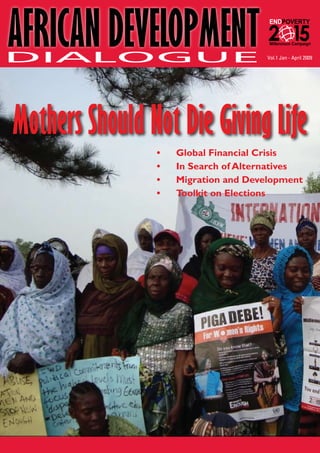
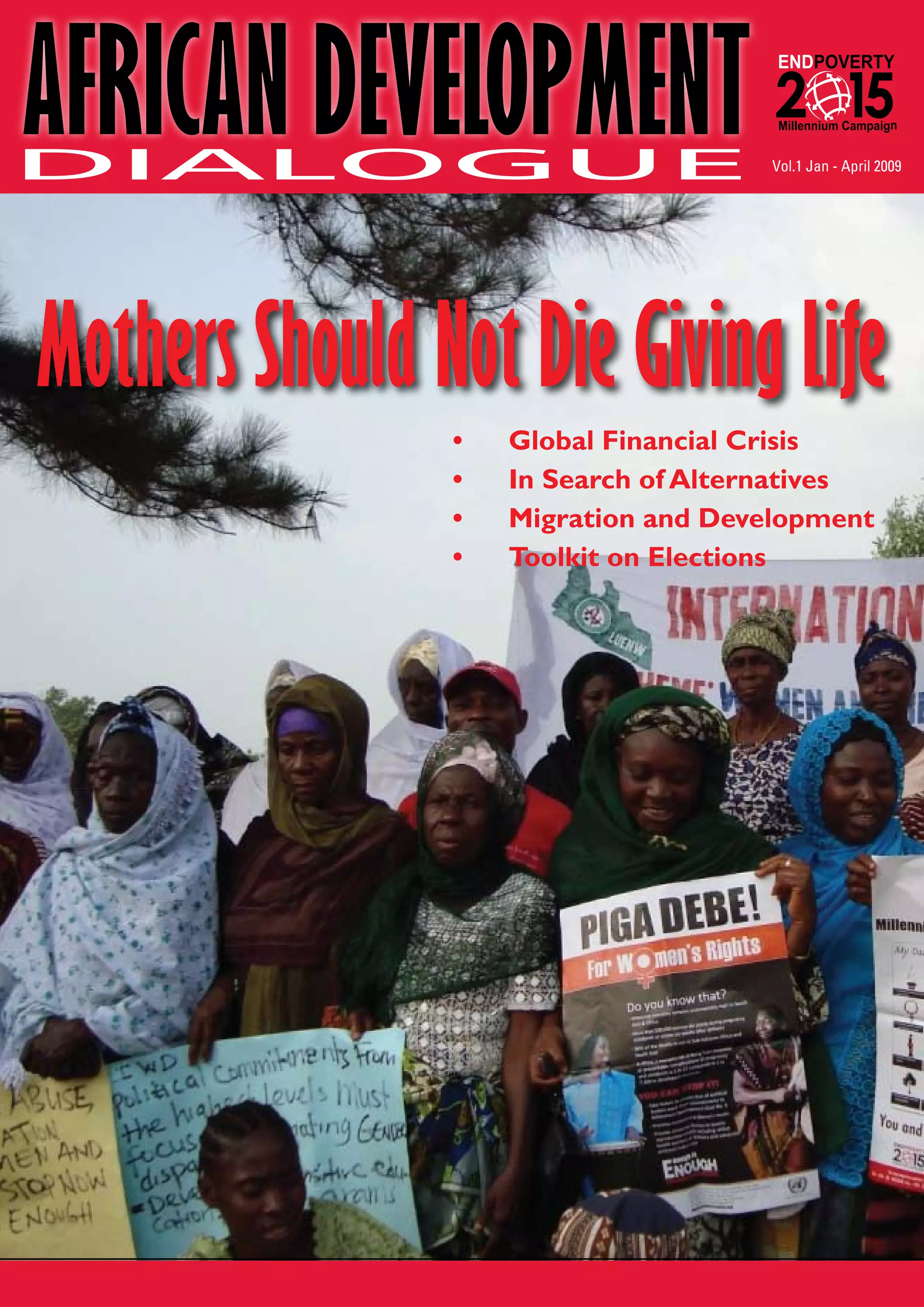
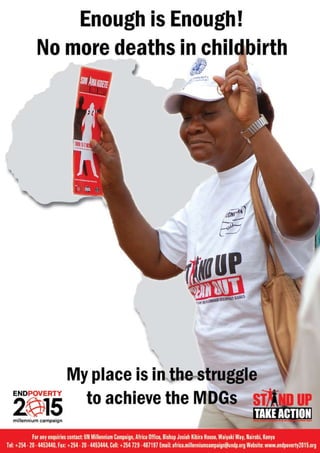
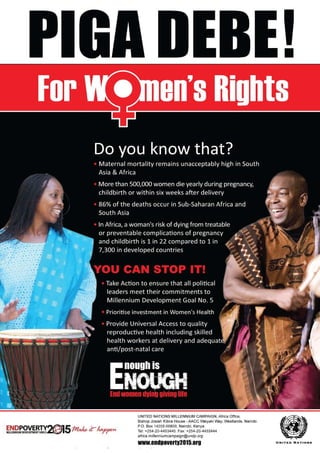
Mothers Should Not Die Giving Life
                 •	     Global Financial Crisis
                 •	     In Search of Alternatives
                 •	     Migration and Development
                 •	     Toolkit on Elections


                African Development Dialogue January - April 2009       1
About United Nations Millennium Campaign

                                           UNMC Africa
                                  Office based in Nairobi,
                         Kenya, supports civil society
                    and citizen engagement in the campaign for
                  the achievement of Millennium Development Goals. The organisation works
               with various partners including civil society organisations among them faith based
           organisations, youth and women organisations, parliamentarians and local governments in
       14 priority countries in the South, East and West Africa. It is a small team headed by a Deputy
     Director with a Communications Coordinator and a Policy advisor and also Advocacy / Programme,
   Communications and administrative and Finance Associates.

  UNMC’s primary partner is the Global Call to Action Against Poverty (GCAP), which has since its inception in
 2005, offered civil society organisations a platform to undertake collective and collaborative action. UNMC also
works with a range of other stakeholders who may not necessarily be part of the GCAP. Increasingly, UNMC is also
 building strategic partnerships with private sector players including communications companies, media houses, financial
   and other commercial institutions.

               Both at the global and regional levels and also nationally we also cooperate, collaborate or coordinate our support with
                                          other development partners including All Africa Conference of Chuches (AACC), United
                                                     Cities and Local Governments Association , UCLGA-Africa, Micah Challenge,
                                                      OXFAM-NOVIB, Africa Office of Action Aid internatiobnal (AAI) , Pan Africa
                                                       Programme of OXFAM-GB and others.

                                                       The UNMC Africa Office is one of the regional hubs of the global
                                                        UNMC headquartered in New York . The global Director is based
                                                           in New York but is assisted by regional teams headed by
                                                              Deputy Directors in other regions of the world (Africa,
                                                               Asia and Europe) and Communications (New York). In
                                                                Spain, Italy, Germany and Portugal UNMC has National
                                                                campaign offices. All regional and National offices
                                                               work closely through the Global secretariat to deliver as
                                                               One campaign in support of furthering the MDGs based
                                                            on the different priorities set for different regions and
                                                            countries. For instance in the North, the campaign
                                                              focuses on Goal 8 issues while in the South,
                                                                emphasis is on accountability and delivery
                                                                 on goals 1-7. Both North and South
                                                                  collaborate and cooperate to identify
                                                                   strategic partnership that can
                                                                      strengthen the achievements
                                                                        of these goals in all
                                                                          countries.


      United Nations Millennium Campaign, All African Conference of Churches
                   P.O. Box 14205-00800, Waiyaki Way Nairobi Kenya
             Tel: 254-20-4453440/4454025 Fax: 254-20-4443241/4453444
    Email: africa.millenniumcampaign@undp.org Website: www.endpoverty2015.org
Contents


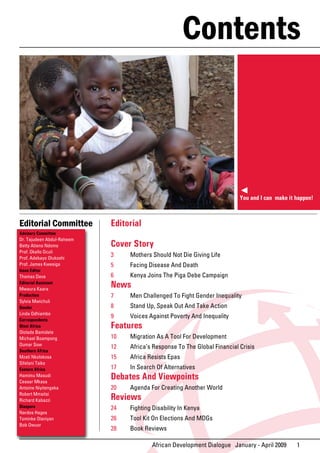
                                                                           You and I can make it happen!


Editorial Committee         Editorial
Advisory Committee
Dr. Tajudeen Abdul-Raheem
Betty Atieno Ndomo          Cover Story
Prof. Okello Oculi
Prof. Adebayo Olukoshi
                            3    Mothers Should Not Die Giving Life
Prof. James Kwesiga         5    Facing Disease And Death
Issue Editor
Thomas Deve                 6    Kenya Joins The Piga Debe Campaign
Editorial Assistant
Mwaura Kaara
                            News
Production                  7    Men Challenged To Fight Gender Inequality
Sylvia Mwichuli
Gender                      8    Stand Up, Speak Out And Take Action
Linda Odhiambo
                            9    Voices Against Poverty And Inequality
Correspondents
West Africa                 Features
Ololade Bamidele
Michael Boampong            10   Migration As A Tool For Development
Oumar Sow
                            12   Africa’s Response To The Global Financial Crisis
Southern Africa
Mzati Nkolokosa             15   Africa Resists Epas
Sifelani Tsiko
Eastern Africa              17   In Search Of Alternatives
Hamimu Masudi
Ceasar Mkasa
                            Debates And Viewpoints
Antoine Niyitengeka         20   Agenda For Creating Another World
Robert Mmaitsi
Richard Kabazzi             Reviews
Diaspora                    24   Fighting Disability In Kenya
Nardos Hagos
Tominke Olaniyan            26   Tool Kit On Elections And MDGs
Bob Owuor
                            28   Book Reviews

                                         African Development Dialogue January - April 2009       1
Editorial
                 Holding governments to account for the achievement
                        of the Millennium Development Goals

W
         e are introducing a magazine whose broad objective                 and	environmental	sustainability	—	can	be	measured.	They	also	
         will be to support citizen’s efforts towards holding their         embody	basic	human	rights	—	the	rights	of	each	person	on	the	
         governments to account for the achievement of the                  planet to health, education, shelter and security. The Goals are
Millennium Development Goals (MDGs). Its editorial policy will              ambitious but feasible and, together with the comprehensive
deliberately seek to promote the vision of the United Nations               United Nations development agenda, set the course for the
Millennium Campaign in Africa especially on initiatives seeking             world’s	efforts	to	alleviate	extreme	poverty	by	2015.
to:
                                                                            There has been real progress made towards achieving some of
    •	    Consolidate	 efforts	 by	 anti-poverty	 campaigners	              the Goals, even in regions where the challenges are greatest.
          towards enhancing governance and accountability                   A	number	of	recent	successes	across	the	developing	world	—	
          processes at national, sub-national and global levels             including	 improved	 macroeconomic	 indicators,	 expansion	 of	
          for accelerating the pace of achieving MDGs                       AIDS treatment and increased agricultural productivity, school
                                                                            enrolment	and	access	to	water	and	sanitation	—	demonstrate	
    •	    Reach	 out	 to	 the	 expanded	 constituency	 for	 the	            that rapid progress is possible when sound national policies
          MDGs within various groups including faith based                  are matched with increased overseas development assistance
          groups, youth/student groups parliamentarians, local              (ODA) and technical support from the international system. The
          authorities, social movements and selected sections of            accomplishments made testify to the unprecedented degree
          the private sector                                                of commitment by developing countries and their partners to
                                                                            the United Nations Millennium Declaration, and the growing
    •	    Expand	campaign	further	into	socially	excluded	groups	            success in building and strengthening the global partnership for
          including disability organizations                                development.

    •	    Build	 and	 strengthen	 strategic	 partnerships	 with	            There has been real progress made towards achieving some of
          various groups organizations and institutions                     the Goals, even in regions where the challenges are greatest.
                                                                            A	number	of	recent	successes	across	the	developing	world	—	
    •	    Promote	evidence	based	advocacy	by	use	of	government	             including	 improved	 macroeconomic	 indicators,	 expansion	 of	
          reports, shadow reports, citizen scorecards, fact                 AIDS treatment and increased agricultural productivity, school
          sheets and other relevant tool kits developed within the          enrolment	and	access	to	water	and	sanitation	—	demonstrate	
          context	of	the	campaign	and	finally	mainstream	gender	            that rapid progress is possible when sound national policies are
          and showcase struggles the women’s movement is                    matched with increased ODA and technical support from the
          engaged in at all levels.                                         international system. The accomplishments made testify to the
                                                                            unprecedented degree of commitment by developing countries
One of the main objectives of introducing the magazine is to                and their partners to the United Nations Millennium Declaration,
provide an accessible and effective communication channel                   and the growing success in building and strengthening the
that provides a platform for informed and inclusive debate                  global partnership for development.
on development issues in general and how they relate with
Millennium Development Goals in particular in order to advance              Poverty and inequality are growing at an alarming rate globally
the cause of the poor.                                                      and many governments in Africa are claiming that they are not
                                                                            going to MDGs by 2015. Ironically, globalisation has thrown up
The	 magazine	 is	 expected	 to	 provide	 antipoverty	 campaigners	         many opportunities for social and economic progress, but these
with	 opportunities	 to	 influence	 domestic,	 regional	 and	               have	 been	 unevenly	 distributed	 to	 the	 extent	 that	 developing	
international policies through amplifying the voices of the                 countries	are	experiencing	unprecedented	marginalisation	and	
underprivileged	and	socially	excluded	in	addition	to	those	of	our	          reaping	less	and	less	from	the	progress	humanity	is	experiencing	
partners in the campaign.                                                   in the last decade.

Eradicating	 extreme	 poverty	 continues	 to	 be	 one	 of	 the	 main	       Empirical evidence available on performance indicators for
challenges of our time, and is a major concern of the international         MDGs shows that it is too early for governments in developing
community. Ending this scourge will require the combined efforts            countries to give up meeting targets as we have just gone past
of all, governments, civil society organizations and the private            the midpoint. The positive areas especially in education, health
sector,	 in	 the	 context	 of	 a	 stronger	 and	 more	 effective	 global	   and	maternal	health	for	example,	underlines	the	urgency	for	a	
partnership for development.                                                collective	need	to	explore	alternative	diverse	and	participatory	
                                                                            economic systems that are adapted to local and national
The MDGs set time-bound targets, by which progress in reducing              realities, while also prioritizing and protecting equity, democracy
income poverty, hunger, disease, lack of adequate shelter and               and diversity, human rights, labour rights, ecology, food security
exclusion	—	while	promoting	gender	equality,	health,	education	             and sustainable production and consumption.
Cover Story


      Mothers Should Not Die Giving Life
       It is not morally or politically right and it cannot be acceptable that mothers
       die giving life. Argues Dr. Tajudeen Abdul-Raheem*


T
       he United Nations Millennium
       Campaign is launching a report
       this week on maternal mortality to
coincide with the International Women’s
Day, March 8 and we are also joining
with various National partners and UN
agencies and governments in various
countries across Africa in a month long
series of activities to draw attention to the
alarming number of women who continue
to die while giving birth or as a result of
complications of pregnancies. Many of
these deaths are preventable and their
prevention	is	definitely	less	costly	both	in	
human and material terms to the families
involved and the society in general.

The	 paradox	 of	 the	 situation	 is	 that	
millions of children in Asia and Africa now
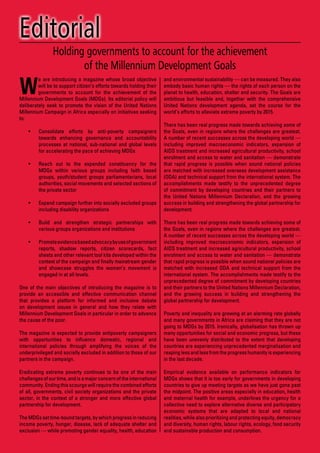
have a better chance of living beyond                         Rallying behind Piga Debe Campaign on International Women’s Day in Liberia
the age of 5 years. If more children are
living, why are the mothers dying in such            Niger is one of the poorest countries in         sister died in a ‘private’ clinic, one of many
scandalous numbers? Who is going to                  Africa and the most dangerous place              that have mushroomed in response to the
nurture and care for these children with             to give birth with women facing an               crisis in the public health sector. Most
improved chances of living beyond 5 ,                astonishing 1 in 7 chance of dying. Nigeria      of these “private” clinics are owned by
universal access to education and more               makes up 2% of the world’s population, it        Doctors and other Medical staff ‘working’
opportunities beyond 2015?                           accounts for 10% of its maternal deaths.         in the public sector. So really the only
                                                                                                      dividing line between public and private
Official	statistics	reveal	a	shocking	trend	         While statistics can educate and raise           is	 the	 ‘extra’	 money	 that	 those	 who	 can	
of mothers dying in circumstances that are           awareness, they remain statistics. We            afford pay in order to buy themselves
preventable. Despite the fact that some              do not see human beings in them. Until           extra	 care	 and	 time	 of	 the	 overworked	
countries have invested on provision of              they are humanised, we may not feel their        public professionals.
basic health care, in developing countries,          impact directly. I have been banging on
only 35% of births are attended by skilled           about MMR for quite some time now. But           But it is all a game of chances because
health workers.                                      it hit me directly recently. A young sister of   many of these ‘private’ clinics do not have
In sub-Saharan Africa, a woman has                   mine, Asmau (better known as TALATUA)            requisite facilities and often fallback on the
1 in 16 chance of dying in pregnancy or              aged 33, died two hours after delivering         privatised sections of public facilities. So
childbirth, compared to a 1 in 4,000 risk            her second child, a boy, whom she never          the closer one is to better public hospitals
in a developing country. More than half              held.                                            and other medical establishments like
a million women die in pregnancy and                                                                  dedicated gynaecological, paediatric and
childbirth every year: of these deaths, 99           Asmau was not an illiterate woman. She           other specialist hospitals like Teaching
% are in developing countries. Neonatal              was a senior science teacher, while the          hospitals, the better are one’s chances of
mortality accounts for almost 40 % of                husband is a college principal. Both fall        buying off a slice of the public service for
estimated 9.7 million children under-                far beyond the so called ‘ordinary man           one’s health. Consequently, regardless
five	 deaths	 and	 for	 nearly	 60	 %	 of	 infant	   and woman’ as their income could ‘buy’           of your economic status, your access to
(under-one) deaths.                                  them better access to health facilities. My      better public or private health facilities is

                                                                       African Development Dialogue January - April 2009                          3
Cover Story
                                                                                                     by strong institutions, funding
                                                                                                     and accountability mechanisms.
                                                                                                     Special attention should be given
                                                                                                     to marginalized groups in health
                                                                                                     system strategies and all efforts
                                                                                                     should be made to guarantee
                                                                                                     meaningful     participation   of
                                                                                                     women       and      communities
                                                                                                     in the design, development,
                                                                                                     implementation and monitoring of
                                                                                                     programs and policies to combat
                                                                                                     maternal deaths.

                                                                                                     Most importantly, developing
                                                                                                     innovative      strategies      to
                                                                                                     rapidly increase access to
                                                                                                     skilled health workers for
                                                                                                     emergency obstetric care and
                                                                                                     comprehensive        reproductive
                                                                                                     health     services,     including
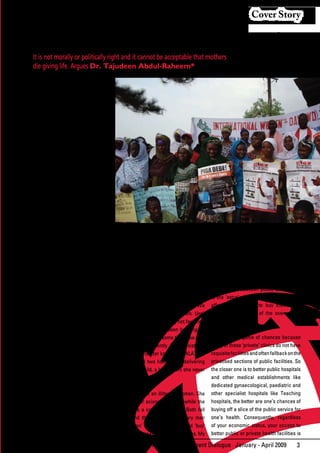
      It is not God’s will that children should be brought up without mothers                        expansion	of	responsibilities	(and	
                                                                                             corresponding enhanced compensation)
predetermined by the location. If you are or wives and concubines, not to talk of and greatly increased numbers of nurses,
closer to the big cities, your chances are ministers	and	other	state	officials		instead	 midwives and non-physician clinicians is
better.                                          of providing for citizens who badly need one of the few ways in which governments
                                                 these services. It is not about lack of can demonstrate political will aimed at
In a continent where most of our resources, but lack of people-friendly reducing the alarming maternity mortality
peoples still live in rural areas, it is highly public priorities. If the Minister of health rates.
precarious that the health and life span of of	a	country	goes	abroad	on	the	flimsiest	
mothers and other citizens are based on of health reasons and the minister of It is not morally or politically right and it
such a random selection. It means that the education does not have any of his or her cannot be acceptable that mothers die
majority of our peoples are condemned to children in the educational services his or giving life. In memory of my mother who
inferior access to good medical facilities. her ministry is providing, why should the sacrificed	 everything	 for	 her	 ‘first	 child’	
Even in the capital cities, your residential public trust the services?                      and other children; my grandmother who
area and economic well being conditions                                                      nurtured and loved me unconditionally; my
your access.                                     It is not possible for majority of the great grandmother whom I was privileged
                                                 citizens to privatise their way out of      to know; my eight sisters who are now
Our people try to cope with every calamity,      public services whether in health or        reduced to seven because of Asmau’s
many of them avoidable, preventable and          education. Therefore citizens’ pressure     untimely death; and in honour of my two
human-made, by insisting that “It is God’s       must be placed on governments so that       wonderful daughters, Aida and Ayesha
will”. Since God does not protest and has        public policy responds positive towards     and their mum, Mounira and my numerous
no instant rebuttal department, everything       better provision of these services to the   nieces, women cousins, sisters-in-law
can be blamed on him.                            citizens.                                   and all women, I have pledged myself
                                                                                             to support the PIGA DEBE Campaign on
It is not God’s will that children should        Enough is enough!!!                         women’s rights of the United Nations
be brought up without their mothers. It          While citizens must stand up and speak      Millennium Campaign with particular
is the way in which we plan our society          out to draw attention to the alarming       focus on maternal health. Mothers should
that leads to women being penalised for          number of women who continue to die         not be dying giving life.
doing what is natural to womanhood. It is        while giving birth, Governments in turn
unacceptable that governments that can           must develop national action plans for      *Dr. Tajudeen Abdul-Raheem, was the Deputy
find	 money	 for	 unjust	 wars,	 the	 private	                                               Director, United Nations Millennium Campaign
                                                 the reduction of maternal mortality that
                                                                                             who passed away in a tragic road accident on
security of the president and his wife           adopt a human rights approach supported     25th May, 2009

4        African Development Dialogue January - April 2009
Cover Story


                        Facing Disease And Death
How many hundreds of billions of dollars have been pumped into failing banks and investment institutions
over these past few months, in order to save them from collapse? Why can’t the leaders of the world do
something similar to save large portions of humanity especially women and children from starvation, disease
and death? Writes Dorothy Ngoma*


I
    am a nurse midwife and have been              As we commemorate
    one for many years. What I think              this         International
    and what I say to you is based on my          Women’s Day, under the
experiences	as	a	nurse	midwife	meeting	           theme “End violence,
countless	patients	and	families	in	extreme	       support women in
distress, facing disease and death at a           politics”, let us look for
level that is hard to imagine for people          the solutions that are
living comfortable lives or those in the          possible	 to	 find.	 	 We	
developed countries.                              can stop this continuing
                                                  tragedy.       Education,
Every day in Malawi, 16 pregnant women            Health, water, food and
die in villages or hospital during child birth.   good health nutrition as
By the end of the year, 984 women/100000          well as gender balance
births will have died, but not even one           are crucial for achieving
of them will be registered by the media           economic development
as a great scandal or something to be             and eradicating poverty
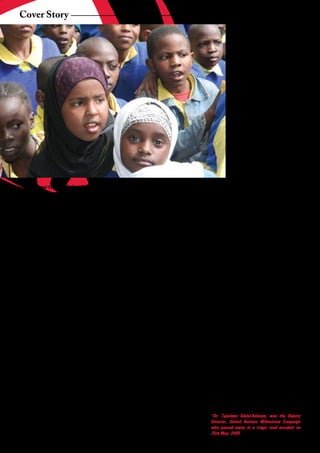
                                                                                   Protect and save lives especially those of girls and women
corrected. What would have happened if
so many mothers-to-be died in a hospital          while at the same time empowering
like “Mwaiwathu” or Adventist Hospital in         women politically. These are basic             •	      Access	to	emergency	obstetric		
Blantyre, Malawi let alone in New York or         human and women’s rights and are a must                care when life
London. Do the lives of these poor women          for each and every woman living on this                threatening complications
in poor communities have less value than          planet.                                                occur.
those “who have”?                                                                                •	      Family	planning	services	that		
                                                  Free primary education is beyond the                   will increase survival
Many of you out there are the leaders             reach of women in most poor countries,                 rate for both women
and movers in this world that we all live         yet absolutely vital to provide countries              and children.
in. People especially women from poor             with	 qualified	 human	 resources	 to	 meet	   •	      Eradication,	or	at	the	very	least		
communities who are the majority in               the challenges of the future. If the girl              containment, of
developing countries need support and             children and others are not educated                   diseases like malaria, TB, HIV
hope that their lives are valuable enough         then how much poverty violence and                     and AIDS.
for us to put resources on the table to           criminality will they cause as they grow
save them. Many do not really believe             into unhealthy, lawless, uneducated            The global human resource crisis of too
that a difference will be made. To them,          adults?                                        few health care workers can be solved.
we just give it lip service. But you can          We need predictable donor-funding for          We in Africa can rise to the challenge.
make a difference. WE can make a                  the public education system in order to:       Give us the means and we can train
difference, indeed we are obliged to make                                                        hundreds, thousands, tens of thousands
a difference.                                     •	       increase	enrolment                    of new health care workers, to cope with
I believe that the world has enough               •	       retain	girls	in	school                the challenges facing our country Malawi
resources to solve the problems it faces.         •	       prevent	early	marriages	and		         and the world as a whole.
How many hundreds of billions of dollars                   early pregnancies
have been pumped into failing banks and           Achievement of universal access to health      On this note let me congratulate the
investment institutions over these past           care remains a distant dream in most poor      Malawian Head of State, Dr. Bingu wa
few months, in order to save them from            countries. The world needs over 4 million      Mutharika for nominating Joyce Banda,
collapse? Why can’t the leaders of the            skilled health care workers including          a female Member of Parliament to be
world do something similar to save large          Nurses and Midwives to protect and save        his running mate during the May 2009
portions of humanity especially women             lives especially those of girls and women.     General Elections. Involving women in
and children from starvation, disease and         Shortages are a challenge not only to          high	decision	making	offices	will	make	a	
death? Is this not an important cause to          developing countries, but globally. We         difference to society at large and women
support?                                          need to provide:                               and children in particular.

                                                                    African Development Dialogue January - April 2009                     5
Cover Story
 In terms of water and sanitation, 1 billion
people especially women have no access
to safe drinking water whilst 2.5 billion
lack access to basic sanitation services.
                                                           Campaign On Maternal
We must increase assistance and support
to scale up implementation of water and
sanitation interventions for the poorest
                                                             Mortality Launched
and most vulnerable groups especially
women. It is essential that efforts must
be made to target those who entirely lack
access to such basic services.

We implore government leaders to
provide strong leadership while involving
stakeholders and providing political
momentum to successfully attain the
MDGs especially those that target women
by 2015.

Key strategies should include:

•	       Increasing	and	retaining	the		
	        number	of	well	qualified		 	
         health personnel including
         Nurses and Midwives.
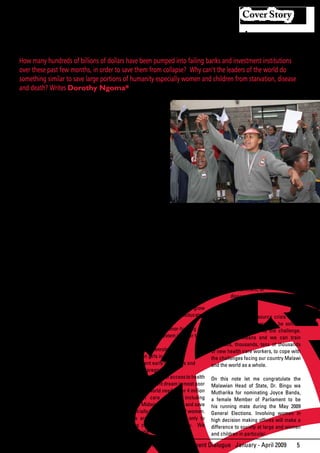
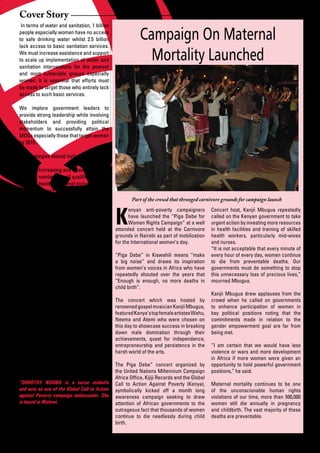
•	       Increasing	availability	and			                Part of the crowd that thronged carnivore grounds for campaign launch
         supply of drugs.


                                               K
•	       Improving	health	and		       	               enyan anti-poverty campaigners           Concert host, Kanjii Mbugua repeatedly
         educational facilities.                      have launched the “Piga Debe for         called on the Kenyan government to take
•	       equipment	and	improving		 	                  Women Rights Campaign” at a well         urgent action by investing more resources
                                               attended concert held at the Carnivore          in health facilities and training of skilled
	        financial	management	and	
                                               grounds in Nairobi as part of mobilization      health workers, particularly mid-wives
•	       Accountability	in	all	government		
                                               for the International women’s day.              and nurses.
         systems so that
                                                                                               “It is not acceptable that every minute of
         services within public sector         “Piga Debe” in Kiswahili means “make            every hour of every day, women continue
	        are	financed	adequately.	             a big noise” and draws its inspiration          to die from preventable deaths. Our
                                               from women’s voices in Africa who have          governments must do something to stop
As you read this article, at least three       repeatedly shouted over the years that          this unnecessary loss of precious lives,”
women have died giving birth. One per          “Enough is enough, no more deaths in            mourned Mbugua.
minute, every hour, day, every week and        child birth”.
month of the year, over 500,000 women die                                                      Kanjii Mbugua drew applauses from the
every year. An additional 500,000 women        The concert which was hosted by                 crowd when he called on governments
will die by 2015 due to unsafe abortions.      renowned gospel musician Kanjii Mbugua,         to enhance participation of women in
Can we let this continue?                      featured Kenya’s top female artistes Wahu,      key political positions noting that the
                                               Neema and Atemi who were chosen on              commitments made in relation to the
Failure to act with vigorous strength and      this day to showcase success in breaking        gender empowerment goal are far from
                                               down male domination through their              being met.
conviction represents a fundamental
                                               achievements, quest for independence,
social injustice and a violation of basic
                                               entrepreneurship and persistence in the         “I am certain that we would have less
human rights, especially those of the
                                               harsh world of the arts.                        violence or wars and more development
poor women and children of our society.                                                        in Africa if more women were given an
History will be our judge. I urge all of us    The Piga Debe” concert organized by             opportunity to hold powerful government
to act.                                        the United Nations Millennium Campaign          positions,” he said.
                                               Africa	Office,	Kijiji	Records	and	the	Global	
*DOROTHY NGOMA is a nurse midwife              Call to Action Against Poverty (Kenya),         Maternal mortality continues to be one
and acts as one of the Global Call to Action   symbolically kicked off a month long            of the unconscionable human rights
against Poverty campaign ambassador. She       awareness campaign seeking to draw              violations of our time, more than 500,000
is based in Malawi.                            attention of African governments to the         women still die annually in pregnancy
                                               outrageous fact that thousands of women         and childbirth. The vast majority of these
                                               continue to die needlessly during child         deaths are preventable.
                                               birth.


6       African Development Dialogue January - April 2009
News

 Men Challenged To Eliminate Gender Inequality
Motor vehicle theft is a non bailable offence in Zambia and so should be defilement crime, Parliament should
be better placed to enact a law that will deter perpetrators from committing sexual atrocities against girls.’
Writes Nelson Banda*


Z
     ambians have been challenged to          to their lives and privileges or as attack   saying	 “defilement	 should	 be	 unbailable	
     promote equality between men and         on their way of life but as an incentive     offence and the minimum sentence for a
     women by supporting the recently         for working towards achieving gender         defiler	should	be	25	years	“.
unveiled Yellow Ribbon campaign.              equality.
                                                                                           Despite Zambia being a Signatory to
Launched by the Zambia National Women         The Yellow     Ribbon campaign was           the SADC Declaration and African
‘s Lobby Men ‘s Network Project, the          launched during the 16 Days of Activism      Union Protocol and other international
campaign seeks to remind all that the         and will be distributed to government        instruments on the protection of women
country’s leadership appended its             departments, ministers, members of           and girls, women and girls are constantly
signature to the SADC and African Union       Parliament and the President and his         living in fear of being violated. Girls’ rights
Principles on promoting gender equality.      staff.                                       are	not	respected,	fulfilled,	protected	and	
                                                                                           promoted.
The campaign will be targeting men to         In a related event, the Men’s Network
sensitize other men and boys, through         Project in Zambia has handed over a          As a response to the increasing number
efforts that will capture their curiosity     petition to Members of Parliament asking     of	 defilement	 cases,	 the	 Men’s	 Network	
toward change. The Men’s Network              them to enact appropriate legalisation on    Project launched the petition in July
recognises the importance to mobilise a       defilement	as	a	non	bailable	offence.	The	   to collect 5000 signatures to petition
mass of men to begin to challenge their       petition with over 5000 signatures was       Government to enact legislation so that
attitudes and regard women as equal           handed over to members of Parliament         defilement	crime	becomes	a	non	bailable	
partners. The campaign will add value to      at Parliament Building during the 16 Days    offence.
changing the mindset of thousands of men      Campaign.
that gender equality is achievable.                                                         The Men’s networked argued that motor
The Yellow Ribbon Campaign will be            The Men’s Network was prompted to vehicle theft is a non bailable offence
the largest men’s advocacy effort             petition the MPs because of the increasing in	 Zambia	 and	 so	 should	 be	 defilement	
of mobilizing men on equality, equal          number	of	defilement	being	reported	in	the	 crime adding that ‘Parliament will be
participation and denouncing men‘s            Zambian media According to the Young better placed to enact a law that will deter
attitudes that disadvantage women.            Women Christian Association, a total of perpetrators	 from	 committing	 sexual	
Wearing a yellow ribbon will be a symbol      184	 defilement	 cases	 were	 recorded	 at	 atrocities against girls.’
of men’s opposition to gender inequality      its Drop in Centre from January to March
and a personal pledge to never commit,        2008 alone and another 70 cases were The petition was placed in strategic
condone or remain silent about gender         recorded in Kasama town, 850 kilometres places for people to sign such the church,
inequality against women and girls. It will   north of the capital, Lusaka. In additional, media houses, markets, banks schools.
be a symbol of saying, “men of our time       the University Teaching Hospital, the Members of the Network also went out
believe in gender equality.”                  country‘s largest hospital records an on the streets as foot soldiers to collect
                                              average	 of	 33	 cases	 of	 defilement	 per	 signatures. Car Stickers with messages
The yellow ribbon will be men‘s personal      month.                                        such as Make DEFILEMENT A NON
commitment towards eliminating gender                                                       BAILABLE OFFENCE were printed and
inequality, challenging men to speak out      The Network charged that as victims of given to Members of Parliament. Nelson
against gender barriers, beliefs, language    physical	 and	 sexual	 abuse,	 girls	 suffer	 Banda	is	a	journalist,	sexual	reproductive	
and negative attitudes that society has on    long term physical, emotional and mental health counsellor and Coordinator of the
women. The campaign is targeted at men        damage that hinder their ability to learn Zambia National Women’s Lobby Men’s
but will work in partnership with women       and become effective leaders in their Network Project
to create a society free of inequalities.     communities.
The Yellow Ribbon is a symbol of                                                            *Nelson Banda is a journalist, sexual
educating young men and boys about the        Outspoken members of Parliament of the reproductive health counsellor and
importance of observing gender equality       opposition Patriotic Front, Jean Kapata and Coordinator of the Zambia National Women’s
and denouncing negative attitudes             Chilufya Mumbi received the petition on Lobby Men’s Network Project
against women and girls. Men should           behalf of other parliamentarians. The two
not perceive gender equality as a threat      MPs	 have	 waged	 a	 war	 against	 defilers	

                                                               African Development Dialogue January - April 2009                       7
News

    Stand Up Speak Out and Take Action
                                                                                         Results in education are very disappointing.
The government has not met many of its commitments in relation to                        Only 55.7% complete primary school
MDGs, CSOs in Senegal are calling for global governments to act and                      for	 example.	 This	 means	 that	 many	 of	
show political commitment in relation to eradication of poverty, writes                  the children do not acquire the basic
                                                                                         knowledge needed for advancement in
Oumar Sow*                                                                               society.

                                                                                         Given some of these trends, some
                                                                                         observers argue that Senegal will not
                                                                                         achieve the goal of reducing poverty to
                                                                                         50% by 2015. Reports emanating from the
                                                                                         World Bank and UNDP noted that only 38%
                                                                                         of the MDGs targets would be achieved.

                                                                                         It is in this vein that anti-poverty
                                                                                         campaigners are calling for the
                                                                                         accelerated achievement of MDGs by
                                                                                         mobilising citizens to stand up against
                                                                                         injustice and calling on political leaders
                                                                                         to	act	to	act	in	order	extreme	poverty	and	
                                                                                         inequality.

                                                                                         After three days of mobilisation which
                                                                                         began on October 17, no less than eleven
                                                                                         11 events had been organized, ranging
                                                                                         from panels, concerts, sporting events to
                    Leveraging on the numbers mobilized in Senegal                       televised debates throughout the country,
                                                                                         in four attracting almost 230 650 people


S
       enegal’s      regional      capitals,   The most affected are women, children     who	 expressed	 their	 solidarity	 	 with	 the	
       Saint-Louis, Dakar, Thies and           and persons with special status such as   campaign.
       Tambacounda hosted antipoverty          the disabled.
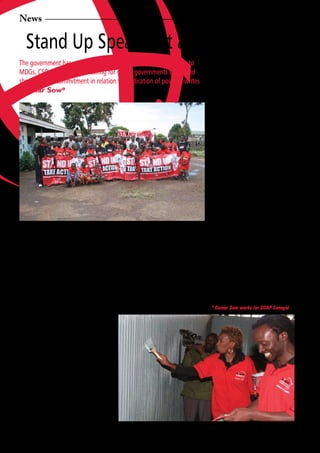
activities that were organised to celebrate                                                One of the major highlight was the
the 2008 World Day against, hunger,            For	 example,	 the	 mortality	 rate	 among	 involvement of women in special
poverty and inequality.                        children under 5 years remains high and mobilisation called “POTS”. Each
                                               is located at 121 per thousand, while the participating woman carried an empty
Organising around the slogan: “STAND           maternal mortality rate has stagnated pot, spoons, and an empty bag of rice
UP and act together against poverty and        at 401 deaths per hundred thousand live symbolizing hunger and the necessity of
inequality”, Senegalese campaigners            births in 2005.                             women’s access to land.
highlighted social and political demands
generated by civil society organizations                                                 * Oumar Sow works for GCAP Senegal
monitoring the Millennium Development
Goals

Arguing that the government has not
met many of its commitments in relation
to MDGs, CSOs in Senegal are calling
for global governments to act and show
political commitment in relation to
eradication of poverty and the ushering in
of sustainable development.

Senegal	has	more	than	five	million	people	
affected	by	extreme	hunger	and	poverty.	
The	final	evaluation	of	the	PRSP	2	based	on	
the results provided by the recent survey
on poverty in Senegal (ESPS) indicates
that the proportion of individuals living
below the poverty line decreased slightly               Leading Kenyan artists Wahu and Jah Key Marley participate in
from 57.1% in 2001 to 50.6% in 2005.                                      cleaning a children home

8       African Development Dialogue January - April 2009
News

  Voices Against Poverty And Inequality
T
      HE Stand Up and Take Action Against             up for those who cannot
      Poverty concert which was held in               speak for themselves.
      the sprawling Chitungwiza town,                 Let us spread awareness
about 35km south of Harare, Zimbabwe’                 of poverty particularly
capital city was a huge success with top              here in Chitungwiza
local musicians driving the message home              where access to basic
on	the	need	to	eradicate	extreme	poverty	             health, water, food and
with some lively performances.                        education is a problem
                                                      to many.”
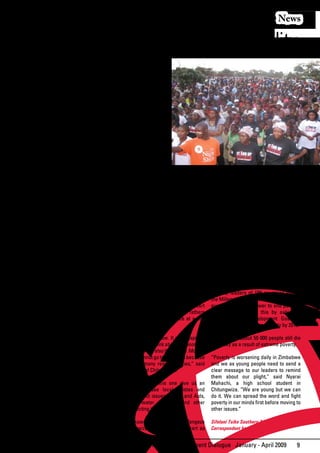
The concert which was held to mark
the World poverty Day, held every year                His song ‘Zvichanaka’
on October 17, got off to a great start               (things are going to be
with the St Agnes Catholic Church Quoir               alright) and a lively act
churning out some powerful gospel tunes               sent the audience wild
that spoke about God’s unending love for              and yearning for more.
humanity –poor and rich.
                                                      Jazz inspiration Victor
Their enthusiasm for drumming and dance               Kunonga wooed the                             “one of the best shows he’s ever had”,
was contagious as much of the audience                hearts of the mature with his fusion of       and was moved to tears by Fungisayi’s
got on their feet to join in one number.              jazz, powerful drumming and traditional       powerful gospel tunes.
The little ones in the audience danced                mbira rhythms.
and enjoyed this concert which drew an                                                              The concert was held as part of the United
enthusiastic audience of more than 5 000        “We	must	fight	to	end	hunger	and	poverty.	          Nations Millennium Campaign initiative to
people at Chitungwiza Town Centre.              Let us join hands with others across the            raise awareness on the importance of
                                                world to Stand Up and Take Action Against           ending	 extreme	 poverty	 and	 reminding	
Top Zimbabwean gospel songbird, Poverty,” he said.                                                  world leaders to honour their pledge to
Fungisayi Zvakavapano-Mashavave who Popular urban grooves group, MaFrik                             end poverty and suffering around the
has won numerous accolades, won a tugged at the hearts of the young with                            world by 2015.
standing ovation when she raised the their sing-along love songs spiced up with
profile	 of	 poverty	 issues	 at	 the	 concert	 a passionate appeal to world leaders to               Similar events were held worldwide with
by her dance-along-tunes and vibrant adopt policies that will help the youth to                       calls for action against poverty and piling
performance.                                    realise their hopes and dreams.                       pressure on multilateral institutions and
                                                                                                      leaders in both rich and poor nations
The renowned gospel singer told                       “Poverty is not good at all for us the to	 honour	 and	 exceed	 the	 Millennium	
thousands at the Town Centre that: “Even              young	generation.	 Lets	fight	it	to	help	 us	 Development Goals.
if life is tough and the going is rough, God          realise our dreams and talents,” said 2nga
is with us. The God of the poor is with us.           (Tunga), one of the Mafrik group member. In 2000, leaders of 189 countries signed
Let’s	put	trust	in	Him	to	fight	poverty.”                                                             the Millennium Declaration agreeing to do
                                                      It was an unforgettable family concert everything in their power to end poverty.
Her music was irresistible. The crowd                 that gave children, mothers and fathers They pledged to do this by achieving
went wild when she belted her popular                 alike	 chance	 to	 mix	 and	 dance	 at	 a	 day	 the Millennium Development Goals, a
songs.                                                concert.                                        roadmap	to	end	extreme	poverty	by	2015.

Another popular gospel artist, Pastor G,              “This was a good show. It was inspiring       Despite this, about 50 000 people still die
thrilled the audience with his powerful               and reminds us to think about the poor, the   everyday	as	a	result	of	extreme	poverty.
voice and energetic dances. He urged                  weak and sick and also the elderly. Most of
people	 to	 take	 a	 firm	 stand	 in	 the	 fight	     us women cannot go to night gigs because      “Poverty is worsening daily in Zimbabwe
against poverty in Africa.                            we have so many responsibilities,” said       and we as young people need to send a
                                                      Agnes Moyo, of Chitungwiza.                   clear message to our leaders to remind
“From the informal settlements of Kibera                                                            them about our plight,” said Nyarai
in Kenya, to the informal settlements of              “Day concert like this one give us an         Mahachi, a high school student in
Soweto in South Africa and Mbare in                   opportunity to see local artistes and         Chitungwiza. “We are young but we can
Zimbabwe, the hungry child in strife-torn             also hear about issues on HIV and Aids,       do	 it.	 We	 can	 spread	 the	 word	 and	 fight	
Darfur to Mabvuku in Zimbabwe without                 education, water problems and other           poverty	in	our	minds	first	before	moving	to	
water and Chitungwiza hit by cholera,                 issues affecting the town.”                   other issues.”
let	 us	 join	 our	 hands	 in	 the	 fight	 against	
poverty,” he said as he took to the stage.            Sam Makuwaza, a resident of Zengeza           Sifelani Tsiko Southern African
“We as entertainers urge you to speak                 in Chitungwiza described the concert as       Correspondent based in Zimbabwe


                                                                       African Development Dialogue January - April 2009                         9
Feature


     Migration as a tool for development


The productivity and earnings of the migrants are potentially a significant force for poverty reduction and
as such, well planned migration policy initiatives can help developing countries reach their Millennium
Development Goals (MDGs) targets, argues Michael Boampong*


A
       ddressing international migration        numbered 191 million in 2005. Of these, 115    societies throughout the world; it has also
       has undoubtedly become a pressing        million lived in developed countries and       underscored the clear linkage between
       issue not only for governments but       76 million in developing countries. The        migration and development, as well as the
also for a broad range of actors all over       European	 Union	 Ghana	 Migration	 Profile	    opportunities for co-development.”
the world. Many studies have suggested          has established that in 2006, there were
that whilst migration can cause brain           about 189,461 Ghanaian migrants spread       Remittances represent an important way
drain to countries of origin for reasons        across the Organization for Economic         out	of	extreme	poverty	for	a	large	number	
related to disparities in income levels         Cooperation and Development (OECD)           of	people.	Worldwide,	flows	of	remittances	
and other economic conditions, properly         countries. This represents 0.86 percent of   were	 expected	 to	 reach	 $318	 billion	 in	
managed migration can result in “brain          Ghana’s total population of 22,113,000.      2007. Recorded remittances to developing
gain”	 and	 other	 culminating	 benefits	 in	                                                countries are estimated to have reached
the form of remittances and brain re-gain       International migration has enormous $240	billion	in	2007.	Remittances	are	now	
upon the successful return of migrants.         economic,       social,    and     cultural close	 to	 triple	 the	 value	 of	 the	 Official	
The productivity and earnings of the            implications in both origin and destination Development Assistance (ODA) provided
migrants	 are	 potentially	 a	 significant	     countries.	As	noted	in	Kofi	Annan’s	report,	 to low-income countries and comprise the
force for poverty reduction and as such,        (former Secretary-General of the United second-largest	source	of	external	funding	
well planned migration policy initiatives       Nations) on International Migration and for developing countries after Foreign
can help developing countries reach             Development (2006), “migration in the Direct Investment.
their Millennium Development Goals              context	 of	 globalization	 has	 not	 only	
(MDGs) targets. International migrants          created challenges and opportunities for The estimated 3.6 million Africans in

10      African Development Dialogue January - April 2009
Feature
the Diaspora are directly or indirectly        human rights of irregular migrants are              There are growing populations of Diaspora
contributing to the achievement of the         also a key issue here even when arrested            communities in most developed countries
Millennium Development Goals. The              by the destination country. The Aeneas              and	 it	 will	 be	 expedient	 on	 the	 part	 of	
remittances migrants send to their relatives   Project, which is a project that is yet to          Africa to see how its governments can
or households in particular, sustain           be implemented by the IOM International             tap on the skills of Diaspora communities
livelihoods through increased purchasing       Organization for Migration with the                 by trying to promote their civic rights
power for education, food, health, and         support of the Ministry of Manpower Youth           and responsibilities in their countries of
other current needs of consumption; all        and Employment and also the European                origin. Promoting dual citizenship is very
of which are key to reaching the MDGs          Union (EU), is worth mentioning here. This          important at this stage as it can increase
through poverty reduction and the              project	is	expected	to	help	Ghanaians	to	           the amount of commitment through
enhancement of economic development.           fill	up	job	vacancies	in	Italy.	                    donations to some critical areas of
Whereas some people have migrated                                                                  development by Diaspora communities.
through legal forms, others have done so       Governments must work to ensure that
in a clandestine manner. Daily images are      decent working and living conditions                Since most migrants and as a matter
portrayed – pictorially as well as verbally    prevail in Africa so that potential                 of fact irregular emigrants prefer the
– of the different accounts of the harsh       migrants have the option to migrate or              informal channel of sending remittances,
realities confronting thousands of youths      not to migrate. In this case the decision to        there is the need for the banks in Africa
of African descent staking attempts at         migrate becomes a genuine choice.                   to design a regulatory framework that will
finding	 the	 so-called	 greener	 pastures	                                                        integrate the informal channels of sending
in the Western countries, particularly         Migration is key component of Goal eight - Global   migrant remittances into the formal
Europe and America.                            Partnership for Development.                        channels. Additionally, educating people
                                                                                                   on	 financial	 matters	 is	 a	 critical	 step	 in	
This begs us to ask more questions on          It has also been affected by failures to            the development process and is also
why this situation has arisen. What are        promote environmental sustainability and            becoming important among remittance
the driving forces and what can be done        the negative consequences of climate                recipients.
to develop a partnership that can save the     change. Distress migration is now on
thousands of lives that are lost through       the increase now due to environmental               In conclusion, governments must design
migration?                                     degradation and catastrophic events such            policies and programs that can manage
                                               as sudden loss of land caused by climate            international migration and tap its
During a study that was conducted              extremes	 such	 as	 storm	 surges,	 thus	           positive	benefits	towards	the	accelerated	
recently by Young People We Care (YPWC)        changing	 existing	 patterns	 of	 movement	         achievements of MDGs.
and also a recent youth consultation on        for goods and humans. It is important for
Migration and Development towards              both developed and developing nations to            *Michael Boampong is the Director of Young
the Global Forum on Migration and              take steps to address the issue of climate          People We Care in Ghana
Development in the Philippines, there          change to reduce the rate of climate
were some interesting comments that            change induced migration.
some young people made.

Young people recommended that
governments should implement policies
that encourage youths to stay and engage
themselves in positive activities that
can contribute to development of their
country. National Youth Policies that
entail strategies and programmes for
developing the capacity of young people
and also the creation of well paying jobs
and good working conditions for young
people are important in reducing the level
of migration caused by unemployment or
underemployment.

Migration has grown into a global issue
that requires a new set of progressive
immigration policies that recognize
peoples’ right to mobility. This includes
streamlining and regularizing visa
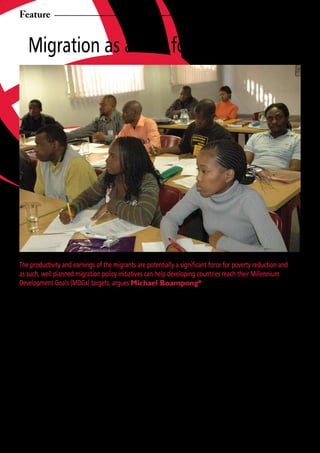
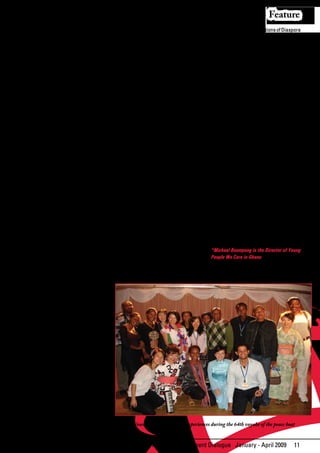
procedures. Governments should create                    Young people share their experiences during the 64th voyahe of the peace boat
more legal channels for migration. The


                                                                   African Development Dialogue January - April 2009                            11
Feature

     Africa’s Response to the Global Financial Crisis
Representatives of the civil society in Africa and other stakeholders in the continent’s development met in
Midrand, South Africa, from 23-24 February 2009, to critically engage on the nature and implications of the
current global financial crisis on Africa as well as an all-inclusive Africa’s response.


T
      hey observed that the current At the end of their deliberations, they put                  Furthermore,	 existing	 African	
      global	 financial	 and	 economic	 forward the following recommendations:                   institutions should be capacitated
      crisis is a result of failure in the                                                       to better generate African-
model of development, characterized by              MACRO-ECONOMIC POLICY:                       owned knowledge, planning,
excessive	 deregulation	 and	 liberalization	       Shared Growth & People-centred               coordination and response to
in all sectors of the economy. Africa               development                                  Africa’s special needs;
has	 been	 nominally	 affected	 by	 the	 first	
generation	 impact	 of	 the	 financial	 crisis,	 1. Realizing that the current global      4.    A moratorium of African debt
in	part,	because	its	financial	markets	are	         economic model and system has                service payments should be
insulated and not fully integrated into the         not	benefited	the	vast	majority	of	          emplaced and such funds put
global	financial	system.		                          Africans, particularly in the form           into a facility managed by ADB
                                                    of appreciable reduction in the              that could address the short-
However, Africa will be particularly hard           level of poverty in Africa, there is         term needs of highly indebted
hit and is now facing an unprecedented              the urgent need for a new people-            African countries and to bailout
crisis in the productive sectors of the             centred macroeconomic policy                 the poor. Domestic savings
economy as evidenced by pervasive                   framework, which puts people at              from debt cancellation should
reductions in growth targets, contraction           the centre of economic planning,             be invested in social services;
of	economic	activities;	reduction	in	export	        processes and development.                   However, the long-term goal of
earnings and trade credits, remittances             This approach, as a principle,               African governments should be
from the African Diaspora; divestments,             should be mainstreamed into                  a comprehensive cancellation
company closures; retrenchments and                 all facets of macro-economic                 of Africa’s debts to allow for
increasing unemployment. This current               policy by African Governments                full economic recovery and the
financial	 crisis	 has	 compounded	 the	            and their supporting institutions,           meeting of the necessary socio-
existing	 challenges	 and	 shocks	 caused	          with human development as end-               economic needs of the African
by high food and energy prices, which               goal;                                        people;
have impacted on the African poor,
particularly women, children and small- 2.          Monetary and Fiscal Policy should      5.    African countries should resist
scale producers. African countries                  move	 beyond	 the	 excessive	                the temptation to relapse into
will inevitably be unable to meet their             focus on “stabilization” and                 heavy	external	debt	as	the	risk	of	
development goals, including the MDGs, if           inflation-targeting	 and	 re-focus	          renewed indebtedness increases
far-reaching political and socio-economic           on promoting better conditions               with the global economic
restructuring is not undertaken, urgently.          for domestic investment to                   downturn. They should consider
                                                    create decent jobs, as well as               creating sovereign funds as a
They acknowledged and commended the                 shared growth that promotes                  means of addressing the liquidity
Tunis Outcomes arising from the Meeting             human development, stimulate                 crisis;
of African Ministers of Finance/Economic            local economic activity and
Planning and Central Bank Governors,                development and public spending        6.	   Diversification	 of	 the	 economic	
held in Tunisia on 12 November 2008,                in critical social sectors;                  base, including promoting value
through the joint initiative of the African                                                      adding industries in Africa is
Union Commission, UN Economic 3.                    African countries must urgently              needed to address the perennial
Commission for Africa (UN-ECA) and                  create their own policy space to             challenge of dependence on a
African Development Bank (ADB).                     enable them to use appropriate               few	 primary	 commodity	 exports	
                                                    fiscal	 and	 monetary	 policy	               and	 to	 meet	 the	 deficit	 created	
The group argued that the voice and views           to	 fight	 recession	 induced	               by	 reduced	 export	 capacity/
of the African people should be heard and           by	 the	 global	 financial	 and	             earnings in the medium to
should complement the Tunis Process in              economic crises. This option                 long term as Africa responds
responding to this crisis in an all-inclusive       will help counter the policy                 to	 this	 twin	 crisis	 of	 financial	
manner. They emphasized the need for                restrictions placed on them by               and economic nature. Such
urgent and decisive actions by African              the Bretton Woods institutions,              value added production of base
peoples, governments and institutions as            which currently dominate and                 resources must be pushed
well as development partners.                       control	 the	 global	 financial	             and enforced in addition to
                                                    and economic architecture.                   retaining economic value of


12      African Development Dialogue January - April 2009
Feature

      African resources in Africa and               multilateral trading system under               AFRICAN      INTEGRATION      –
      promoting African SMEs;                       the WTO in order to strengthen                  Strengthening the African Union
                                                    and facilitate Africa’s trade                   and its NEPAD Programme
7.    Top priority should be given                  capacity,	 and	 finally	 increase,	
      to agriculture for its crucial                in real terms, intra-Africa trade        17.    Africa must move rapidly
      role in food security and in                  and regional integration given                  towards putting in place a pan-
      providing industrial hub for                  the reduction in revenues from                  African economic governance
      agro-processing      and   agri-              international trade in primary                  architecture that regulates all
      business, the strengthening                   commodities;                                    financial	 institutions/systems,	
      of Africa’s industrial base and                                                               capital	 flows	 and	 trade	
      boosting capacity to create job               SOCIAL AND HUMAN DIMENSION:                     relations;
      opportunities;                                Bailing out the Poor
                                                                                             18.	   As	part	of	finding	an	alternative	
8.    Domestic resource mobilization          12.   African     Governments        and              to the present control by
      should become a critical arena                their development partners,                     IFIs, Africa must strengthen
      of leadership and strategy for                particularly G8/OECD countries,                 existing	 continental	 political/
      Africa, in line with the AU/                  should	 promptly	 and	 fully	 fulfill	          economic institutions as well as
      NEPAD priority strategies. Given              their development commitments/                  operationalizing and resourcing
      the high probability of reduced               pledges	for	the	benefit	of	African	             the	    financial	   governance	
      aid,	 FDI	 inflows	 and	 fall-out	            people;                                         structures	 identified	 in	 the	
      on	 over-reliance	 on	 external	                                                              Constitutive Act establishing
      sources for budget support,             13.   Special targeted interventions                  the African Union, namely the
      Africa should embrace inward-                 should be taken to address the                  African Investment Bank (AIB),
      looking strategies, including the             needs of the most vulnerable                    the African Monetary Fund
      utilization of local resources,               groups through access to                        (AMF) and the African Central
      adding value to African                       credit, agricultural inputs, health             Bank (ACB);
      commodities. A paradigm shift                 services and social protection.
      that will accompany this process              These should be prioritized              19.    African governments, with the
      is the resumption of domestic                 in the national budgets and                     support of African institutions,
      demand-led          development               development programs/plans to                   and in conjunction with
      strategy;                                     reflect	the	new	focus	on	people-                stakeholders drawn from the
                                                    centred macro-economic policy;                  private sector, labour, civil
9.    The African State should return                                                               society, should undertake broad
      to its traditional development          14.   Ongoing economic reforms                        assessment of the impact of
      role, with a more activist and                in various African countries                    current economic crisis on their
      interventionist character, to                 need to be more pro-poor with                   national economic programs and
      protect the poor and vulnerable,              initiatives such as public works                plans, with a view to designing
      offer      the     much-needed                programmes being implemented                    appropriate response strategies
      leadership,     direction     and             to ensure greater employment                    to address the impact of the
      energy to the African people in               opportunities;                                  financial	crisis;	
      these critical times. Therefore,        15.   African Governments should
      rebuilding the African State is               urgently      introduce     where        20.    At the regional level, each REC
      most fundamental, to avoid the                applicable,        and     enforce              should undertake assessment of
      syndrome of the failing or failed,            appropriate       regulations   to              the manifestation of the economic
      degraded or recovering State;                 protect the African citizens from               crisis in the regions, especially
                                                    harmful environment practices                   on      resource      mobilization,
10.   African        countries      must            as well as regulate the activities              investment      climate,     good
      continuously evaluate their                   of multinational corporations                   governance, favourable trade
      partnership with the developed                operating in Africa;                            regulations	and	diversification	of	
      and emerging development                                                                      the economy and share results
      partners. The ‘BRIC’ countries          16.   Concurrently,African                            there-from with all stakeholders;
      (Brazil, Russia, India and China)             Governments and institutions
      do not necessarily present                    should       eliminate     waste,        21.    RECs are further urged to
      protection from crisis, not                   corruption and leakages as                      incentivise and set up regulations
      withstanding the “alternative”                part of the commitment to                       to encourage their member
      flavour	 of	 the	 relationship	 that	         enthrone       better  economic                 countries to buy from each other
      has been constructed;                         governance and management                       as a means of promoting intra-
                                                    reflecting	 transparency,	 probity	             Africa trade and building the
11.   Africa should vigorously pursue               and accountability in public                    regional economy;
      trade-acceleration using the                  expenditure;		


                                                             African Development Dialogue January - April 2009                     13
Feature
22.   To     fast-track     continental          the NEPAD Programme at this                   Role of Civil Society
      integration, African solidarity            stage, African Governments and
      and collaboration is required to           institutions as well as regional        30.   Civil society to be one of the key
      confront global challenges and             business groupings should                     players in the implementation
      place regional and continental             provide	 substantial	 financial	              of these initiatives, at national,
      interests     above    individual          support to AU/NEPAD-inspired                  regional and continental levels,
      needs. In this respect, ongoing            special dedicated mechanisms                  recognizing the reality of the
      negotiations between Africa                and facilities, including the                 structural constraints inherent
      and the European Union on                  IPPF, APRM, AFFM, ICF, CAADP                  in the regional and continental
      the     Economic     Partnership           Trust Fund, African Action Plan               bodies in Africa;
      Agreements (EPAs), should be               and others. Such action by
      suspended forthwith, as this               Africans will demonstrate their         31.   Support and be actively
      process undermines and limits              commitment to upholding the                   engaged in the efforts by African
      the African policy space;                  principle of an African-led and               Governments to disseminate and
                                                 owned development agenda;                     educate Africans on the impact
23.   African institutions, particularly                                                       of this economic crisis, and in
      the        AU        Commission,           GLOBAL FINANCIAL                              doing so, assist in discovering
      NEPAD Secretariat, African                 INSTITUTIONS:                                 new ways of thinking and to
      Development       Bank     (ADB),          Pro-developmentFinancial                      re-conceptualise the African
      African	 Export-Import	 Bank	              Architecture                                  strategic approaches to these
      and their regional development                                                           issues;
      counterpart-institutions should      26.   The Bretton Woods Institutions
      be strengthened, instead of                and other IFIs must be                  32.   Africa to be proactive instead of
      creating new or parallel ones.             restructured to make them more                reacting to the global situation
      These institutions should be made          democratic and accountable                    and for CSOs to set up task
      more democratic, responsive                through increased African                     teams to support the leadership
      and accountable to Africans                representation and elimination of             role that the AU/NEPAD could
      and restructured to promote                their current policy over-reach;              play in confronting this crisis;
      intra-Africa trade and regional
      integration. Most importantly, the   27.   Governance structures and               33.   Bring Africa’s leadership together
      ADB should provide assistance              appointment of the IMF/                       to provide rescue plans to
      to African countries through               World	 Bank	 executives	 should	              address the urgent development
      short to medium term measures,             be premised on merit and                      issues associated with political
      as response strategy;                      democratic	principles	that	reflect	           instability,	 financial/	 and	 socio-
                                                 the nature of the membership                  economic crisis;
24.   To achieve this, regular                   and the present global economic
      assessment of African institutions         reality;                                34.   Fashion out an active role for the
      should be undertaken to re-                                                              organized private sector across
      appraise their mandates, roles       28.   African governments, private                  the continent in creating the
      and responsibilities in delivery           sector and civil society should               awareness on the magnitude
      and addressing the economic                seek to use forthcoming forums                of the crisis and its impact and
      crisis and Africa’s development            of the G8/G20 to push the IMF/                implications at national and
      challenges;                                World Bank and other global                   regional levels, particularly
                                                 players	for	a	new	global	financial	           in relation to private sector
25.   AU Commission and NEPAD                    architecture that is responsive               development and public-private
      Secretariat to undertake, as soon          to Africa’s needs, where African              partnerships (PPP) ventures;
      as practicable, a comprehensive            voice and views are taken into
      analysis of the direct impact of           account in development policy           35.   CSOs to also assist in informing
      the	financial	crisis	on	AU/NEPAD	          formulation and support by the                policy making, through continued
      priority programmes/projects and           Bretton Woods institutions;                   dialogue and coordination with
      the sectoral strategies/action                                                           public sector to provide inputs of
      plans, to ensure that alternative    29.   G8/OECD countries should                      strategy and insights.
      and       innovative      methods          honour their recent pledges not
      are sourced to support the                 to	 reduce	 official	 development	
      continuation of these programs,            assistance (ODA) as a result of
      in the event that partnership              the	 global	 financial	 crisis,	 and	
      support	 wanes.	 Specifically,	            instead increase aid to meet
      while encouraging a technical              the international development
      review of the implementation of            targets, including AU/NEPAD
                                                 and MDGs;


14    African Development Dialogue January - April 2009
Feature

                                      Africa resists EPAs
Agricultural sectors have been greatly weakened by hasty and excessive trade liberalization that has allowed
cheap and illegally subsidized imports, often from Europe, to wipe out domestic production even in their
home markets. Writes Mwaura Kaara*


E
      vidence      is    mounting,      right    Added	 to	 the	 devastation	 of	 inflation	 is	
                                                                                                   warned that accepting EU’s insistence that
      across	 the	 world,	 of	 the	 extreme	     the threat of looming global recession.
                                                                                                   Pacific	 Island	 (and	 other	 ACP)	 countries	
      destructiveness of maintaining and         The slowdown of economies is starting
                                                                                                   should remove protection of the infant
upholding unbridled so-called ‘free market       and spreading from the main Western
                                                                                                   industries within 20 years will remove “our
economics’ as the only method and means          economies. Major European economies,
                                                                                                   space to give time for our infant industries
of organizing and managing economies.            the most important single destination of
                                                                                                   to mature before entering what is going
Governments in Africa, the Caribbean and         ACP	exports	will	slowdown.	As	the	British	
                                                                                                   to be a very competitive global trading
the	 Pacific(ACP)	 who	 are	 in	 the	 middle	    government now openly admits, it is faced
                                                                                                   environment [and] will retard industrial
of negotiating Economic Partnership              with its worst economic crises in 60 years.
                                                                                                   development in our countries. Giving up
Agreements (EPAs) must draw the fullest          Inevitably, this downturn will also mean a
                                                                                                   this right forever will be the highest price
lessons of this in any decisions they take       drop	in	demand	for	ACP	exports.	Market	
                                                                                                   we will pay and we just simply cannot
to manage and address their economic             failure	and	inflation	threatens	to	wipe	out	
                                                                                                   afford that”. As there is no ‘sunset’, i.e. no
relations and challenges, such as the fuel       the relative growth that many ACP primary
                                                                                                   time limit, on the duration of the EPAs, the
price	crisis,	the	fallout	of	global	financial	   commodity	exporters	have	enjoyed	in	just	
                                                                                                   word “forever” is like eternal damnation.
crisis	and	the	relentless	price	inflation	in	    the last few years, while intensifying the
                                                                                                   EPAs will prevent and paralyze the
basic food that have engulfed hundreds           competition they face.
                                                                                                   development,        industrialization     and
of millions of people in their countries,
                                                                                                   diversification	of	ACP	economies	forever.
bringing many to the brink of renewed         Already, ACP share of trade in the EU,
threat of starvation and sparking turmoil     their single most important market, has
                                                                                                   Aid will also dry up as the advanced
and food riots across these regions.          fallen relative to other competitors. As
                                                                                                   economies	bail	out	their	financial	sectors	
                                              a September 2008 UN report on Africa’s
                                                                                                   from	 the	 excesses	 of	 liberalization.	 The	
Trade justice activists are now arguing performance under trade liberalization
                                                                                                   EU has made it clear that there is no
that one of the lessons must be the shows	–	Africa’s	export	market	share	has	
                                                                                                   new substantive ‘aid’ to address EPA
renunciation of the free trade ‘Economic dropped from 6% to 3% of world trade since
                                                                                                   implementation and adjustment costs.
Partnership Agreements’ between the the 1980s, the self-same period that trade
                                                                                                   Rather they insist that ACP countries make
ACP and the European Union (EU). Indeed, liberalization and structural adjustment
                                                                                                   up the cost by introducing and imposing
ACP economies face unprecedented and were ruthlessly brought to power and
                                                                                                   reforms on their suffering populations
extreme	 economic	 challenges	 in	 the	 installed as one-party dictators in the
                                                                                                   –	 including	 tax	 reforms	 that	 target	 the	
coming period. This is the worst time to continents economic policy regime. As
                                                                                                   informal sector and the consumption of
institutionalize free trade regimes even with all dictatorships we were told: “there
                                                                                                   goods and services by working people
more deeply and fundamentally than they is no alternative”. EPAs are a continuation
                                                                                                   and the poor. This must be set against
have already taken root.                      and not an alternative to the disastrous
                                                                                                   the fact that EPA measures to eliminate
                                              trade performance of developing regions
                                                                                                   trade	 taxes	 and	 to	 further	 liberalize	 and	
The majority of ACP states are among due to sweeping trade liberalization.
                                                                                                   reduce	taxation	on	‘investors’	means	that	
those whose productive Agricultural
                                                                                                   the	 tax	 burden	 for	 EU	 commodities	 and	
sectors have been greatly weakened by The disaster of such loss of market share
                                                                                                   multinational companies is eliminated or
hasty	 and	 excessive	 trade	 liberalization	 cannot be compensated for by making
                                                                                                   reduced,	while	more	taxation	of	the	ACP	
that has allowed cheap and illegally the protection of marginal preferences
                                                                                                   poor is introduced or increased. EPA will
subsidized imports, often from Europe, for	 ACP	 primary	 commodity	 exports	 to	
                                                                                                   increase poverty and inequality within
to wipe out domestic production even EU markets the heart of ACP trade and
                                                                                                   the ACP and between the ACP and other
in their home markets. Because of such economic policy – as the whole world
                                                                                                   regions, especially the EU itself.
liberalization, too many ACP economies knows the value of those preferences are
have transitioned from relative food self- being eroded every day, because of global
                                                                                                   The	regressive	tax	reforms	are	among	the	
sufficiency	to	food	import	dependency	in	 lowering of tariffs in the WTO and through
                                                                                                   ‘conditions’ for EU disbursement of their
an	extremely	short	time.	Such	economies	 bilateral free trade agreements. By making
                                                                                                   part of their ‘contribution’ to ‘mitigate’ the
will have no protection whatsoever from a virtue of this necessity of ‘preferences’
                                                                                                   cost of adjustment and implementation
the	 imported	 inflation	 –	 through	 food	 for ACP primary products, EPAs offer no
                                                                                                   of EPAs for ACP countries. No doubt
imports – that is already wrecking, and means of addressing ACP loss of market
                                                                                                   falling ACP government revenue from
will continue to wreck lives in the ACP share, i.e. ACP marginalization, in world
                                                                                                   trade and customs duties will add to their
regions, which are amongst the poorest trade and the world economy.
                                                                                                   dependence on aid. But this ‘aid’, as we
in the world. EPAs will increase this
                                                                                                   have seen, will not be forthcoming. EPAs
vulnerability. In addition, such imports Moreover, ACP marginalization is also due
                                                                                                   will increase ACP aid dependency and EUs
will continue undermine what remains of to a failure to diversify ACP economies
                                                                                                   use and abuse of aid conditionality - even
local production even further, over the and	 exports.	 Only	 this	 week	 in	 Brussels,	
                                                                                                   as	they	cut	aid	flows.	The	danger	of	this	
longer term. And: EPAs will make this trade	delegations	from	the	Pacific	region	
                                                                                                   increase and abuse of ‘aid conditionality’
permanent.
                                                                    African Development Dialogue January - April 2009                         15
Feature
by the EU has already been manifest in         forward proposals and even resolved to              Parliaments and other stakeholders are
the EPA process, as was borne out by the       negotiate and agree a non-reciprocal                being marginalized by the EPA process.
public	row	that	broke	out	between	Pacific	     ‘goods only’ EPAs with the EU. Further if           All parliamentary statements and reports
and	EU	officials	over	the	latter’s	threat	to	  negotiations continue, ACP governments              from across the ACP and in the EU itself
withhold	 flows	 of	 already-existing	 ‘aid’	 if	
                                               should insist on the removal of punitive            warns against the grave anti-development
the	Pacific	did	not	accept	EU	demands	in	      tariffs	imposed	by	the	EU	on	exports	from	          impact of an all encompassing free trade
the EPA. The future looks dire indeed.         ACP countries, such as Nigeria, who have            EPA between for ACP countries, because
                                               so far not completely buckled under EU              free trade agreements between countries
But the damage can be repaired. ACP pressure to agree ‘interim EPAs’. As the                       and economies at diametrically opposed
governments have the responsibility above referred to EU Parliamentary report                      levels of development will have only one
and the authority to take measures to do of September 17 clearly and forcefully                    winner. The EU is the world’s largest
this. They must re-open and review all reminds: “neither the conclusion nor the                    trading bloc, while ACP regions are
‘EPA agreements’, both interim EPAs and renunciation of an EPA should lead to a                    amongst the poorest in the world.
comprehensive EPAs that were initialed situation	where	an	ACP	country	may	find	
in November and December 2007. These itself in a less favourable position than                     As Guyana’s President said last year
so-called ‘agreements’ were emergency it was under the trade provisions of the                     when he took the case against the EPA
defensive measure taken at the end of Cotonou	 Agreement”.	 The	 punitive	 taxes	                  and its profound anti-developmental
2007 under the undue pressure of the imposed by the EU on the vulnerable                           dangers before the UN General Assembly
EU’s	 threat	 to	 disrupt	 exports	 from	 ACP	 Nigerian cocoa sector, already costing              last in August: ““Even at this late hour, I
countries into the European market. They millions of dollars in the last few months                wish to plead [for the] review [of] these
were ‘initialed’ as statements of intent alone, is against the legally binding                     agreements before they irretrievably harm
under	 conditions	 of	 extreme	 pressures,	 provisions of the Cotonou Agreement and                …	the	ACP	(African,	Caribbean	and	Pacific	
and cannot be accepted as being legally the EU’s legal obligations. That the EU is                 states).” Civic organizations from across
binding and can be challenged and blocked prepared	 to	 impose	 draconian	 taxes	 on	              the ACP are now demanding that ACP
altogether on the basis of a number of products from the poorest economies                         leaders stand up and measure up to their
legal instruments, such as the Vienna and regions of the world, simply to get                      primary responsibilities to their peoples.
Convention on International Treaties. The its way of securing the monopoly of its                  There is no time when such leadership has
EU parliament’s report on ‘Development commodities, companies and capital over                     been	 so	 needed	 to	 affirm	 the	 continued	
Impact of EPAs’ (ref: 2008/2170 (INI)), those regions, is simply unconscionable                    relevance and to assure the future of the
dated 17th September 2008, recounts how and unacceptable. The ACP must reject                      ACP group. There has scarcely ever been
ACP countries “were pushed” into these this categorically and demand its removal.                  a greater necessity for bold leadership
so-called agreements without options or This support to countries such as Nigeria                  that not only protects our economies while
alternative transitional solutions (which against EU trade aggression is also                      ensuring that unworkable and disastrous
the EU was and is under legal obligation necessary to re-build the ACP unity that                  orthodoxies,	 especially	 that	 of	 unbridled	
to	ensure)	such	as	“extending	GSP+	to	all	 has been badly strained and shattered by                free market liberalization and free trade,
ACP countries”.                                the EPA process so far.                             are reversed.

It is prudent to consider suspending                All measures must be taken to ensure that      There is now overwhelming evidence
all negotiations towards free trade                 ACP unity at sub-regional and pan-ACP          which compels civic organizations and
agreements on ‘Trade in Services’ with              levels in the EPAs negotiations is achieved.   trade justice activists to continue in their
the	EU,	as	the	Pacific	region	has	just	done.	       The coordination and harmonization of          determination to Stop the EPAs altogether.
Services must not be part of the EPAs.              ACP positions and of the minimum trade         The growing voices and opposition of
This must be coupled by the rejection the           reform measures that prevent disruption        women’s organizations, farmers groups,
inclusion of Trade-Related Issues in the            of	 fragile	 export	 sectors	 WHILST	          trade unionists, students, NGOs, and
EPAs – i.e. the ‘Singapore Issues’ such as          satisfying WTO compatibility requires          diverse range of actors in and beyond the
Investment and Government Procurement               the foundational pillar of unity between       ACP must be raised more than ever. The
(public tenders and contracts), which               ACP LDCs and non-LDCs through their            ACP includes many hundreds of millions;
in any case they have already rejected              universal	access	to	EBA	and	GSP+	export	       it brings together the largest number of
in the WTO but are being imposed on                 regimes. The unity of ACP sub-regions          countries in any one grouping, apart from
them through the backdoor of EPAs. It               and the ACP as a whole also requires           the UN General Assembly. Its voice, our
is doubtful that many of the ACP regions            an insistence on the minimum that is           voice, is the voice of democracy.
negotiating the EPAs even have a legal              acceptable to all – i.e. a non-reciprocal
mandate to include these Singapore                  ‘goods only’ trade agreement with the EU.      Today, the Africa Trade Network give
Issues in the negotiation. The special              This is the only sure basis for Regional       expression	 to	 that	 voice	 and	 has	 been	
inquiry into the EPAs commissioned by               Integration and South-South cooperation        saying over the years: “Stop the EPAs
French President Sarkozy (in his capacity           for ACP countries.                             now. Get Up, Stand Up!”
as EU President), known as ‘the Taubira
report’ recommends removing Singapore               African citizens must mobilize and make *Mwaura Kaara is the UNMC Editorial
and Trade-related Issues from the EPAs as           preparations to reject all pressures to Assistant and Youth and Student focal point.
a vital measure to restore ACP countries’           short-circuit and side-step democratic
confidence	in	the	EU’s	good	faith.	                 constitutional	 rules	 for	 the	 ratification	
Governments must take a leaf from Guyana            and adoption of international treaties
the Government of Guyana which has put              by Parliaments of ACP member-states.


16       African Development Dialogue January - April 2009
Feature

                         In search of Alternatives
Tendai Makanza* argues that the search for alternatives is not                              WB and IMF amongst others) power of
just another academic exercise.                                                             the G8 states, collectively constituting the
                                                                                            Empire. Its alleged gravitational property
                                                                                            has nothing to do with reality; it is a self-
                                                                                            serving myth perpetuated by the imperial
                                                                                            nations through systematic media
                                                                                            disinformation and fatuous academic
                                                                                            discourse.

                                                                                            Indeed, capital-led globalisation is even
                                                                                            at the root of the crisis in Africa. It is by
                                                                                            now agreed by wide sections of Southern
                                                                                            African society that the neo-liberal
                                                                                            paradigm of development has failed
                                                                                            the people. Poverty has not only been
                                                                                            entrenched but it has also deepened, and
                                                                                            the gap between the rich and the poor has
                                                                                            increased.

                                                                                            It follows that there must be an alternative
                                                                                            and that such an alternative is of vital
                                                                                            importance. The Alternatives to Neo-


G
                                                                                            liberalism in Southern Africa (ANSA)
        lobalisation is often presented as against oppression has been the principal initiative represents an attempt to address
        something from which one cannot mode	of	African	existence,	almost	a	way	 this need. Its roots reach back as far as
        escape. It is compared to gravity, of life for most Africans for the best part of 1993, when the Zimbabwe Congress of
described as part of the natural order a hundred years.                                     Trade Unions (ZiCTU) took the initiative to
of things, a fact of life or even as an                                                     formulate an alternative to the Economic
opportunity for the people of the South to Unfortunately,	the	first	generation	political	 Structural Adjustment Programme, ESAP,
benefit.	 However,	 these	 are	 all	 pseudo- leaders after political independence from which had been introduced in Zimbabwe
scientific	 utterances	 and	 ideological	 1957 (when Ghana got its independence) in 1991.
statements that mask the true reality through the 1960s and 70s were caught
of things. Globalisation is a man-made up in the cold war and the ideological Based	 on	 the	 experience	 gained	 in	
strategy, a policy response of capitalist battles of the period. Some of them, Zimbabwe, in 2003 the ANSA initiative
nations	 in	 crisis.	 Capital	 expands	 or	 like Julius Nyerere of Tanzania, tried took off, but now as a regional programme
globalises not in order to increase the to	 experiment	 with	 their	 own	 versions	 and initiative. Initially, a small group of
welfare of people or advance “democracy” of African socialism; others like Jomo individuals linked to the ZiCTU worked out
but	to	increase	or	sustain	private	profits	so	 Kenyatta of Kenya followed the capitalist the principles of an alternative approach
that	the	system	can	survive	for	the	benefit	 model; and yet others tried various and	 provided	 scientific	 and	 research	
of those who control it. Indeed, capital-led versions	 of	 “scientific	 socialism”.	 After	 materials. The project was gradually
globalisation lies at the root of the crisis in the end of the cold war, and the demise broadened until, in January 2005,
Africa. An alternative is therefore possible of the Soviet Union in the early 1990s, the representatives	from	affiliates	of	SATUCC	
and necessary.                                  capitalist system came out triumphant, adopted the programme. Since then, the
                                                and all alternative options appeared to initiative has aimed at and gained wider
A passive acceptance of destiny forced have vanished. Hence the increasingly name and recognition among progressive
on Africa from outside goes against strident assertion of the unavoidability of academics, unions, social movements and
the grain of Africa’s history. Africans neo-liberal globalisation.                          beyond, both within and outside Africa.
fought to resist colonial occupation, and
in some places resistance went on for However, the myth of the inevitability The ANSA initiative aims at providing
some three decades after the carving of globalisation is as misleading as the individuals, movements, organizations,
up of Africa at the Berlin Conference of myth about Africa’s passive acceptance. institutions policy makes and implementers
1884-5.	 Then,	 when	 Africa	 was	 finally	 Globalisation is nothing but a policy with an alternative development
subjugated and occupied, Africans put up response of the capitalist nations in crisis, programme that is both visionary and
resistance against the occupation itself the beginning of which goes back to the practical. It is not just another academic
for	 another	 five	 decades	 and	 more,	 and	 mid-1970s. Contemporary globalisation exercise,	 it	 is	 meant	 to	 stimulate	 the	
finally	liberated	themselves	from	colonial	 is part of the strategy of transnational growth of a mass movement which can
rule, and its vicious offspring such as corporations backed by the military, successfully advocate for a radical
apartheid. In other words, resistance political and institutional (including WTO, alternative for our region.


                                                               African Development Dialogue January - April 2009                     17
Feature
The root causes of underdevelopment            African countries, the majority of the          as high income consumer goods given
ANSA’s overall economic analysis               households live and work in what we are         the inability to produce these locally
revolves around dualism and enclavity          labelling the communal sector.                  due to lack of critical minimum level of
and	 external	 dependency	 as	 the	 root	      The root problem of under-development           effective demand. The formal sector is not
causes of pervasive unemployment, and          now lies in the fact that the majority of the   able to play its dynamic role in terms of
hence underdevelopment, in Southern            labour force is involved in low productivity    transforming the economy through trickle
Africa.                                        pursuits that result in incomes and             down effects, since the linkages with the
                                               consumption levels that are close to            non-formal sector are minimal and mostly
Dualism and enclavity                          poverty. The relationship between the           restricted to use of cheap labour.
The terms dualism and enclavity are used three	 sectors	 and	 the	 external	 world	
to describe Southern African economies is such that it tends to reproduce                      The urban informal sector is well known
that are generally characterised by a the continued marginalisation of the                     for	 its	 deficiencies	 in	 terms	 of	 lack	 of	
relatively small formal sector, which majority and continues to constrain the                  capital, improvised technology, high
co-exists	 but	 is	 separate	 from	 a	 large	 development of the economy as a whole.           transaction costs and inadequate access
informal sector, the latter one located                                                        to infrastructure. There is an absence of an
both within urban areas and rural regions Internal distortions                                 adequate facilitating legal, regulatory and
(the communal sector).                         Underlying        this      problem        of   institutional regime for assets, intellectual
The formal economy consists of capitalists underdevelopment are internal and                   property and market transactions As a
interested	 in	 profit	 making	 and	 workers	 external	distortions,	distortions	which	the	     consequence, the urban informal sector
who primarily depend on wages for their ‘free’ capitalist market system has not                is	 prone	 to	 lateral	 expansion,	 depressed	
sustenance. In Africa it can be assumed been able to solve. Indeed, it has even                returns that verge toward subsistence,
that less than 20% of the labour force caused, reproduced and strengthened                     stunted growth and endemic poverty for
earns a living in the formal sector. The these distortions. They therefore have to             many.
sector consists of large, medium, small be carefully analysed and understood,                  Although the communal sector may
and micro enterprises that are formally after which a successful strategy to solve             have developed production methods and
registered and recognised; as such they them can be formulated.                                non-farm activities that are appropriate
encompass activities in the primary,                                                           for the environment in which they live,
secondary and tertiary sectors of the ANSA is not a grouping, a political party                the sector has not been able to be fully
economy.                                       or a movement. It is not an advance party       integrated into modern forms of economic
                                               either. You cannot become a member.             organisation. The sector shares a number
The urban informal sector is a residual ANSA is a non-partisan, facilitation                   of the characteristics of the urban
sector, which has come to have a high project, the function of which is to act                 informal sector, like the absence of
degree of permanence in many African as a focal point, guide and catalyst                      social and economic infrastructure, the
countries. It is a sector characterised that stimulates people, institutions and               absence of an adequate facilitating legal,
by	 easy	 entry	 and	 exit,	 driven	 by	 self- movements in the region and beyond              regulatory and institutional regime, high
employment	 activities	 that	 reflect	 to join hands and forge alliances in a                  transaction costs and inadequate access
linkages with the formal sector and rural common pursuit of an alternative to neo-             to information useful for participation in
sector as well as the ingenuity of the liberalism. ANSA is an initiative of the                the modern economy. There is an outward
individuals involved in the sector. Levels Zimbabwe Congress of Trade Unions                   migration of able-bodied males. In some
of productivity are low in terms of returns (ZiCTU) in co-operation with the Southern          countries the shortage of land due to land
per hour worked, while wages tend to be African Trade Union Co-ordination                      degradation or land appropriation is also
below poverty levels. This sector absorbs Council (SATUCC) and the African Labour              resulting in increasing marginalisation of
surplus labour from the rural and the formal Research Network (ALRN). It is facilitated        peasants.
sector such as retrenchees. Generally by the Labour and Economic Development
about one third of the labour force in Research Institute of Zimbabwe (LEDRIZ).                Thus, participants in both the urban
many countries tends to be involved in For more information about the ANSA-                    informal sector and the rural communal
urban informal sector activities. In some initiative, contact the ANSA Secretariat             sector are unable to lift themselves since
regional countries the informal economy at timothy@ledriz.co.zw, 78 East Road,                 their capabilities and their environment
is in fact the ‘mainstream’ economy.           Avondale, Harare, Zimbabwe; Telephone           is highly compromised. They are also not
                                               +263-4-30	38	46	or	33	98	3.                     able	 to	 benefit	 from	 trickle	 down	 effects	
The communal sector is the original                                                            from the formal sector or abroad in the
traditional or pre-capitalist sector with all The formal sector shows a bias toward            absence of facilitating interventions.
the variations this entails in the African large-scale enterprises and against
context.	 The	 present-day	 communal	 the evolution of dynamic micro,                          External distortions
sector is also highly differentiated and small, medium enterprise. It favours                  The global environment has had
has a number of linkages with the formal relatively capital intensive methods of               the tendency to perpetuate the
and urban informal sectors. However, the production that are not warranted by the              underdevelopment based on enclavity.
majority of the households are involved amount of labour available, given high                 For	example,	with	regard	to	its	interaction	
in low productivity farm and non-farm unemployment rates. It is biased toward                  with the formal sector, this has been such
pursuits in which surplus generation externally	 driven	 demand	 given	 that	 the	             that	 it	 reinforces	 both	 primary	 export	
is low and primarily not directed at majority of the domestic population lacks                 and import dependency in a manner that
accumulation but consumption. In most effective demand. It favours imports of                  does not facilitate the transformation
                                               capital and intermediary goods as well

18      African Development Dialogue January - April 2009
Feature
and upgrading of the domestic economy.         is	 dominated	 by	 an	 export-oriented	 the present system, where mobilisation is
Terms of trade have generally been to the      strategy, based on foreign investments seen	as	a	threat	to	the	existing	system,	and	
disadvantage of the formal sector in African   and ownership).                            where the representative democracy can
economies. Monopolistic tendencies                                                        sign away the future rights of people).
and protectionism among the developed          3. Grassroots-led regional integration (as
countries	have	made	it	difficult	to	acquire	   opposed to the current fragmentation of Framework for an alternative policy
competitive advantage that would allow         the region by the Empire).                 Based on the above analysis and guided
the developing countries to compete on an                                                 by the 10 principles, the ANSA Declaration
equal level with the developed countries       4. A strategic, selective delinking from then submits a detailed alternative policy
and	even	allow	them	to	reconfigure	their	      neo-liberal globalisation (as opposed and strategy for sustainable human
exports	 and	 imports.	 African	 countries	    to further deepening of integration development in Southern Africa. It does
due to a lack of domestic demand and           within	 the	 existing	 iniquitous	 global	 that both in general terms as well as for
due to lower growth rates have not been        system), and preparing for leveraged the various sectors like manufacturing,
able to attract foreign investment to          negotiated relinking in a restructured agriculture, trade and mining; for macro-
the degree needed to promote dynamic           and transformed global production and economics	 and	 finance;	 for	 policies	 like	
growth and development even when               distribution system.                       education & training, science & technology
they have attempted to live up to the                                                     and infrastructure; and for cross-cutting
policy recommendations of international        5. An alternative policy on science and issues like gender and culture.
institutions such as the World Bank and        technology based on harnessing and
the IMF.                                       owning the collective knowledge and It should be well understood that the
                                               wisdom of the people (as opposed to the ANSA Declaration only sets out the
More generally the international economy       present blind emulation of techno-science general alternative policy framework
has been dominated by private and public       of the empire).                            for the region. It is necessary that each
interests which have systemically pushed       6. A strategy of alliance and networking country will formulate and push for its own
for economic transaction regimes that          with national, regional and global specific	 alternative	 policy	 and	 strategy	
work primarily to serve their interest         progressive forces (as opposed to the within this regional framework. The ANSA
rather than the development needs of           present system of co-optation of social programme is actively working towards
countries such as those in Africa.             forces in the capital-led globalisation this follow up. A training and advocacy
                                               process).                                  programme is also being developed.
As another consequence of the above
problems,	 African	 countries	 find	           7. A strategy with a politically governed      As said before, the ANSA programme
themselves in a dilemma whereby                redistribution of the wealth and               is	 not	 a	 separate	 academic	 exercise;	 it	
disarticulations at the national level,        opportunities from the so-called formal        is aimed at stimulating and facilitating
coupled	 with	 external	 dependency,	          sector in society to the informal sectors      the growth of a mass movement, the
militate against effective regional co-        (as opposed to the present system of           ideal being that the numerous localised
operation and national development             misallocation of resources, and the            centres of resistance and initiatives for
within	a	regional	context	as	well.             integration of the informal sectors            alternatives will in the end pressurise for
                                               through their providing cheap inputs and       change from a common perspective.
The ANSA Declaration                           a reservoir of semi-employed labour).
This analysis shows why a neo-liberal ‘free’                                                  ANSA therefore seeks active co-
market system can not solve our problems       8. A strategy where women’s rights are         operation and mutual reinforcement
and, at the same time, provides a concrete     in focus as the basis for a healthy and        with progressive individuals, unions,
framework for alternative policies and         productive society (as opposed to the          churches, youth and women groups,
strategies, which can indeed bring about       present	system	based	on	the	exploitation	      social movements etc. within the region,
sustainable, human development. It is the      of women labour).                              the continent and beyond to join forces
foundation upon which a comprehensive                                                         to pressurise for often very practical and
ANSA Declaration has been developed,           9. A strategy where education addresses        local alternatives, placed within a broader
which, in turn, serves as the basis for        the needs for sustainable human                vision and strategy.
ANSA’s further plans and activities.           development, and which is aimed at
                                               improving the technical and managerial as      A start has been made already with
The declaration sets out the 10 principles     well as research and development skills        the Economic Partnership Agreements
of the ANSA strategy:                          of workers and those directly in control of    (EPAs) where Trade Unions in the SADC
                                               matters of production and governance (as       are getting together to deliberately and
1. At political and social level, a people-    opposed to education for a bureaucratic        systemati cally lobby and campaign for
led strategy (as opposed to IMF-WB-            and academic elite).                           alternatives to the anticipated EPAs
WTO-donor-led).                                                                               which are being imposed on us by the
                                               10. A strategy where peoples’ mobilisation     EU. Privatisation and commercialisation
2. At the economic level, an alternative       and visible demonstrations, and open           issues	are	definite	other	possible	areas	of	
production system, one that is based on        hearings, in support of the evolving ethical   action and levers for a common demand
domestic demand and human needs and            and developmental state, are seen as           for an alternative policy.
the use of local resources and domestic        embodying the democratic strength of the
savings, that is autocentric development       society, creating a dynamic, participatory     *Tendai Makanza is the Associate Programme
(as opposed to the present system that         and radical democracy (as opposed to           officer at ANSA.

                                                                 African Development Dialogue January - April 2009                      19
Debates and Viewpoints

            Agenda For Creating Another World
Democratization implies the recognition and definition of human rights, their formulation in terms of juridical
rights, the institutional guarantee of their genuine respect. Individual freedom and the emancipation of the human
being from all forms of oppression are inseparable from people’s empowerment. Writes Samir Amin*


 D
         emocratization is a process which        Political ideologies and projects should         the	 fields	 of	 action.	 In	 its	 expansion,	
         could not be reduced to a static         be analyzed and discussed from the angle         the capitalist market is also trying to
         and	definitive	formula,	like	the	one	    of their positive or negative contribution       appropriate the disposal of all renewable
 evoked by “representative democracy”             to	democratization	as	defined	here,	based	       and non-renewable natural resources of
 (multiparty-ism, election, human rights).        on the universal values depicted in diverse      the planet, thus aggravating the long-term
 Democratization – synonym of people’s            cultures. Democracy building at all levels       perspectives concerning the survival of
 power – concerns all aspects of social           of social reality constitutes the objective      humanity. The privatization of land should
 life,	and	not	exclusively	the	management	        of democratic and progressive people’s           be recognized as a particularly serious
 of its politics.                                 movements concerned and associated               danger for the survival of the peasant half
                                                  with the South South Solidarity Network.         of humankind
 It concerns all relations between                Alternatives to the capitalist market and
 individuals, within the family, in places of     the present global economic order                An alternative development matching the
 work, in their relations with the economic,                                                       satisfaction of human needs should not be
 administrative and political decision-          Capitalism is not a “market economy” but limited to “poverty reduction”, itself largely
 makers. These relations are both individual     a capitalist market economy. Here, the generated by the logics commanding
 and collective (class relations which are       market is regulated by the domination of the	 expansion	 of	 capitalist	 markets.	 A	
 by nature unequal in the capitalist society,    the capitalist interests, which prevail over genuine alternative development should
 founded on the private appropriation of         those	of	the	exploited	and	ruled	classes,	 help transform livelihoods in the direction
 the means of production by a minority,          whose members are reduced to the status of the real emancipation of the popular
 excluding	 the	 people).	 Those	 limits	 are	   of labor force providers and conditioned masses and of individuals. “Indicators”
 limits	of	democracy	–	whenever	it	exists	       and passive consumers. The capitalist of the progress achieved in that direction
 – in capitalism.                                market,	 efficient	 though	 it	 may	 be	 by	 should	be	identified	and	determined.
                                                 certain of its aspects, remains guided by
 Democratization implies that one the capitalists’ individual searches for On a world scale, the capitalist market
 surpasses those limits, and thereby going profit.	 The	 people’s	 alternative	 requires	 economy is founded on the inequality
 beyond capitalism along the road of that the market be put at the service of of national partners. The logic of its
 building the socialist alternative. The ruling the people’s social and democratic aims, expansion	tends	to	aggravate	and	not	to	
 ideology and the democratic “blueprints” other forms of regulation based on the reduce those inequalities, unacceptable to
 proposed in its spirit separate “political” objectives of socialism in the making, and and rejected by the peoples of the South.
 democracy from social demands, of particularly the effective realization of the To the current practices and projects (in
 which	expressions	are	the	struggles	of	the	 largest equality possible.                            the	 fields	 of	 trade,	 foreign	 investment	
 ruled	 and	 exploited	 classes	 against	 the	                                                     and	 capital	 flows,	 debt)	 proposed	 by	 the	
 unilateral logic of capital. Democratization The centralization of capital in institutions of the prevailing capitalist
 implies that political democracy be contemporary capitalism has come to globalization (IMF, World Bank, WTO,
 associated with and not dissociated from such	a	degree	that	a	few	hundred	financial	 European Community, and others), the
 social progress.                                groups are dominating most national people’s movements should put up
                                                 economies as a globalized economy positive alternatives responding to their
 Democratization concerns practice in all and	 shaping	 markets	 in	 their	 exclusive	 own objectives.
 segments of social life: the family, the interest. This capitalism of oligopolies
 enterprise (place of work), political parties, concentrates real power, economic, Alternatives to the present international
 trade unions, peasant and women’s social and political, in the hands of an political order
 organizations, local and neighboring oligarchy, enemy of humanity as a whole. Peoples need peace, nations and
 communities, and all other organizations In	 its	 expansion,	 the	 capitalist	 market	 individuals need security. Neither of these
 of civil society. Democratization implies is trying to appropriate new spheres of is permitted by the imperialist nature of
 the	 recognition	 and	 definition	 of	 human	 social life with a view to turning them the capitalist system. On the contrary,
 rights, their formulation in terms of juridical into	 places	 to	 extract	 profit	 for	 capital.	 because it is fundamentally unjust,
 rights, the institutional guarantee of their Programs for the privatization of State the maintenance of the international
 genuine respect. Individual freedom enterprises and of collectives of producers order	 necessary	 to	 the	 expansion	 of	 the	
 and the emancipation of the human or	 citizens,	 the	 commodification	 of	 oligopolistic capitalist market requires the
 being from all forms of oppression are essential public services (education, deployment of violence, including military
 inseparable from people’s empowerment. health, housing, access to water and threat and its effective implementation,
 There is no advanced socialism without electricity, transportation) respond to against all movements, peoples and
 the integration of human rights in those of that objective, by nature running counter nations repudiating submission. That’s
 working collectives and the people.             to people’s power of which it is reducing State terrorism.

 20       African Development Dialogue January - April 2009
Debates and Viewpoints
The program for “military control of              industrialization would require a transfer      regulations on international rivers, which
the planet” by the armed forces of the            of rural inhabitants to urban centers. But      is largely ignored by international law and
United States and its junior allies (NATO         this should be regulated in accordance          governed – whenever it is – by bi-national
in particular), the deployment for that           with the pace of the absorption capacities      or multi-national treaties often subject to
purpose of 600 US military bases over             of productive urban activities; and the         desirable negotiations.
the	 five	 continents,	 the	 “preventive	         formulas of agricultural management
wars”, already under way (Iraq) or being          should take this into consideration.            Access to means of production necessary
threatened	(Iran),	are	expressions	of	this	       There is no question of keeping the             to the advancement of agriculture
militarization of globalization.                  “overpopulated” rural areas in immobilism.      (credits, equipment, seeds, pesticides and
                                                  There could have been mistakes by thinking      fertilizers, commercialization institutions)
The	 execution	 of	 such	 programs	 of	 the	 that an accelerated collectivization,                could not be left to “market rules” alone.
imperialist powers, particularly of the ahead of technological possibilities and                  The people’s alternative and the socialist
first	 among	 them,	 scorns	 the	 aspirations	 requirements, could overcome the related           orientation require the intervention of
of all peoples of the South for peace and contradiction.	 Experience	 has	 shown	                 adequate	State	policies	in	these	fields	and	
security. It lies directly or indirectly at that an access to land, guaranteed to                 the	opening	up	of	action	fields	for	peasant	
the roots of the squandering represented the peasantry as a whole in formulas                     initiatives (cooperatives in diverse forms).
by the arms race. It inspires directly or linking small-scale family production with
indirectly numerous so-called “local” the market, is conducive to a rapid and                     Scientific	 and	 technological	 advances	
conflicts,	often	instrumentalized.                big increase of agricultural production,        related to agricultural and food production
                                                  in terms of peasant self-consumption            could not be guided by immediate
The people’s alternative requires rations and commercialized surpluses                            profitability	 requirements	 alone.	 The	
recognition of the equal rights of peoples alike. Continuation of this progress would             capitalist rationale is a short-term one and
and nations in globalization. It requires certainly require the invention of new                  is therefore not always sustainable. The
respect for the sovereign independence forms adapted to every stage of the path                   introduction of GMOs, for instance, leads
of nations. The people’s struggles also of socialist oriented development. But,                   to little-known risks for the reproduction
aim at orienting the sovereignty of States such forms should never be based on any                of the productive capacity of the soil (as
toward the effective sovereignty of abandonment of the principle of access                        shown	by	the	example	of	the	destruction	
peoples, by means of democratization of to	 land	 for	 all	 to	 the	 benefit	 of	 eventual	       of the soil in Argentina), for the vital
the society.                                      illusions about private appropriation of        maintenance of the bio-diversity, as it
                                                  land.                                           leads to unknown risks for human health.
Land and agriculture                                                                              Their introduction is dictated by the simple
Access to land is a question of survival A	 systematic	 reflection	 on	 popular	                  wish of agribusiness transnationals to
for the three billion peasants of Asia, peasant development programs is                           subjugate thereby peasant producers and
Africa and Latin America, i.e. nearly half necessary	more	than	ever.	This	reflection	             to regulate markets at their convenience
of humanity. No form of development could not propose the same formula for                        alone. The people’s alternative requires
is	 acceptable	 if	 it	 sacrifices	 the	 lot	 of	 all, for the diversity of situations created    that research criteria would be different.
those human beings. Yet, the capitalist by	 the	 capitalist	 expansion	 is	 extreme.	
path of development, based on private Wherever	 this	 expansion	 has	 already	                    National policies should follow the
appropriation of land, which is treated as promoted gigantic inequalities in the form             objective of food sovereignty (basic self-
a	commodity	similar	to	others,	sacrifices	 of Latin American, Southern African and                sufficiency	 of	 nations)	 and	 reject	 that	 of	
precisely the rural population “surplus” on Indian latifundias, radical land reforms              simple “food security” (capacity to pay for
the	altar	of	increase	of	the	“profitability”	 will be a must.                                     imports	 aimed	 at	 balancing	 food	 deficit)	
of the capital invested in agricultural                                                           which the World Bank and the WTO want
production (modern equipment and The	 capitalist	 expansion	 program	                             to impose.
“value” of land). The obvious result of runs                 nowadays       through     partial
this option is the transformation of the “modernizations”	 (qualified	 as	 “green	                National policies concerning the rural
planet into one of slums, from Sao Paulo revolutions”),	 of	 which	 beneficiaries	 are	           world cannot be reduced to the single
to	Mumbai,	from	Mexico	to	Bangkok,	from	 only a minority of wealthy farmers and                   component of agricultural production.
Cairo to Casablanca and Johannesburg.             agrarian capitalists and which make             Making available to rural communities
                                                  agriculture as a whole utterly dependent on     essential services (education and health
The people’s alternative – that of socialist agrobusiness. The alternative formulas of            in	the	first	place)	similar	to	those	enjoyed	
oriented development – rests on the a gradually modernized rural development                      by city dwellers constitutes an essential
judicious principle that land is a basic to	 the	 benefit	 of	 all	 cannot	 be	 the	 same.	       objective of social justice.
natural resource, and the property of the Theoretical research and practice should
peoples, particularly the peasantries living help invent their modalities.                        Structuring agricultural development
off it. The two great Asian revolutions Access to land should go along with                       policies      and      those       concerning
have	 confirmed	 the	 performance	 of	 making	 means	 for	 land	 exploitation	                    industrialization constitutes the backbone
that principle and thereby avoided the available to peasants.                                     of the global development of society.
uncontrolled	 rural	 exodus	 which	 has	                                                          The conception of these policies and
struck at the rest of the three continents. First among these means is water which,               their structure in the socialist oriented
The pursuit of this alternative implies total for that matter, cannot be any more than            development obviously runs counter to
respect for that principle at all the stages of land a “commodity similar to others”              the one resulting only from the functioning
the long socialist transition. Certainly, the (commodified).	 The	 peoples’	 access	              of	 oligopolistic	 markets	 of	 really	 existing	
urbanization accompanying a necessary to	 water	 raises	 the	 difficult	 question	 of	            capitalism. The former is founded on the

                                                                   African Development Dialogue January - April 2009                          21
Debates and Viewpoints
principles and objectives of the “worker-        the race to lower salaries. To counter           of	 labour	 fronts,	 the	 overexploitation	 of	
peasant alliance”, the realization of which      this, the building of coherent fronts linking    the “rightless” that are mainly emigrants,
cannot be left to the sole responsibility        these still largely fragmented fronts            legal or illegal.
of the central political power. The              represents the unavoidable demand of
democratization of society requires              the	definition	of	paths	of	socialist	oriented	   The objective of the fragmentation of the
that a large space should be opened to           development.                                     working classes is not new. Capitalism
collective negotiations (between peasant                                                          has always, for instance, picked up
organizations and workers’ trade unions,         In particular, at the present stage of patriarchal ideologies to discriminate
between the peasant rural world and              deployment of the imperialist capitalism against women, as well as racist ones
consumers’ organizations), with the              of globalized oligopolies, the most urgent against migrants and eventual minorities.
support of the people’s State .                  task for organizations of workers and the The success of the popular movements
                                                 working people in general is to reconstruct of discriminated minorities concerning
Agricultural production is, at the present       “united labour fronts” capable of imposing the shaping of convergences between
time, subject to a globalized offensive          full	 employment	 and	 the	 specification	 of	 their own demands and those of other,
from oligopolistic capital, promoted by          its decent conditions.                           apparently “favoured”, segments of
WTO authorities. This offensive is part of       The formulas of organization and action labour constitutes the only guarantee for
a so-called “market opening up” strategy,        inherited from the previous period of history a social progress linked to the genuine
in fact for the unilateral opening up of         (trade unions in particular), effective democratization of society.
markets	 of	 the	 South	 to	 the	 expansion	     in their times, have been eroded by the
demands of the oligopolistic capital of          current transformations in the organization Alternatives to discrimination
the North. Thus, the battles waged within        of work. These transformations do not Capitalism is a social system founded
WTO (after the accession of almost all           result “spontaneously” and unavoidably on the principle of discrimination. The
countries of the world to this institution       from the new technologies applied. They discrimination putting the masters
conceived and constructed by the                 are mainly the product of the strategies (often “owners”) of means of production
imperialist powers alone) now concern            of capital aiming to aggravate job against the popular majorities, who are
among other things the visible or disguised      insecurity, to create a reserve contingent deprived of such means, is fundamental,
subsidies	 to	 agricultural	 exports	 from	      of unemployed, to fragment conditions and it determines capitalism. There is
the North (the Doha Round). The views            done to working people. In the capitalist no “market economy” (in the liberal
of the diplomacies certain countries of          countries of the South, linked to the rural sense of the term) which is not a market
the South, which initiated a challenge to        exodus,	 this	 evolution	 has	 impoverished	 society. And the market discriminates
“WTO rules”, should be supported and             en masse the urban popular classes, of and	fragments.The	most	flagrant	of	these	
of strengthened by concerted people’s            which a growing proportion is made up of discriminations has always struck at
initiatives	 capable	 of	 defining	 coherent	    “informals”.                                     women. Certainly, the societies prior to
coordinated alternatives and immediate                                                            capitalist modernity did not ignore these
objectives for the common struggle.              The current people’s movements have discriminations. But, far from alleviating
                                                 already demonstrated their inventiveness their violence, capitalism has integrated
Alternatives to the capitalist exploitation of   in the organization of these struggles by them	into	its	practice	of	exploitation	with	a	
labor                                            applying real and advanced democratic view to instrumentalizing them and putting
The liberal ideology in essence and in           practices. They still have to go a long way them to its own objectives. When these
practice in the capitalist societies are         to turn from largely defensive strategies to objectives seem to allow some progress
based on the dissociation of the formulas        coherent and offensive political projects in the status of women, capitalism tries to
of representative political democracy –          capable of advancing the people’s limit the effects.
whenever	existent	–	from	the	fields	related	     alternative. The list of these struggles and
to	 the	 social	 progress	 of	 the	 exploited	   the constitutive objectives of the people’s The struggles of the female half of
and	oppressed	classes.	The	extension	of	         alternative are wide open to all aspects of humanity for the full juridical and real
political rights themselves to the popular       the social life, in the places of work and recognition of all their rights (in the
classes (universal balloting for instance)       in the cities (education, health, housing, statutes of family organization, at places
has been the fruit of the struggles and          essential services). The accentuated of	work,	in	the	exercise	of	citizenship)	are	
achievements of the peoples, and never           polarization	 between	 affluent	 “centers”	 not just democratic struggles (of which
“granted” from above. The labour rights          (15% of the population of the planet) they constitute a fundamental element,
(for workers’ organization, strike) and          and “peripheries” (85% of the world’s without which speaking of democratization
more generally social rights (education,         population), always dominated and of society is but empty talk); they are, and
health, social security, etc...) are also the    often empty-handed, sometimes to may increasingly be, constituent elements
fruits of these cultures. The list of demands    the	 extreme,	 which	 is	 peculiar	 to	 the	 of the socialist alternative to capitalism.
is	far	from	exhausted	and	constitutes	the	       capitalist	 expansion	 at	 all	 stages	 of	 its	 The list of segments of the popular classes
very object of current numerous popular          deployment, is at the roots of a migratory subject to effects of discrimination is long:
struggles, in the South and the North, as        pressure from the South to the North, migrants, ethnic or religious minorities,
the present time is that of an offensive by      extension	of	the	rural	exodus	in	the	South.	 patients suffering from AIDS and other
capital aiming at reducing them, under           Here, the liberal logic is caught red- pandemics, etc. Their respective demands
the	pretext	of	“market	opening	up”.	Here,	       handed for incoherence. It recommends will acquire still greater strength if they
the strategies of capital are targeting the      the worldwide opening up of markets to are linked to others in the struggle for a
extreme	 fragmentation	 of	 the	 “labour	        commodities and capital, but refuses it to socialist oriented people’s development.
markets”, to put the countries of the South      labour! This incoherence reveals the real
in positions of devastating competition by       aim of its objectives: the fragmentation

22       African Development Dialogue January - April 2009
Debates and Viewpoints
Knowledge and intellectual property               incapable of integrating the necessary             in various regions of the South (Africa,
Knowledge is a common asset of humanity.          long-term perspective. This objective limit,       Southeast Asia). The projects concerning
It should not be treated as a “vulgar             insurmountable in spite of everything said         the groupings linking countries of the
commodity”. Its private appropriation runs        about the subject, is particularly obvious         North with countries of the South, like
counter to the fundamental principles of          as regards non-renewable (petroleum                the so-called “partnerships” between the
humanist universalism.                            in particular) or renewable (water,                European Union, Africa and others, are of
                                                  forests)	resources.	The	exchange	of	non-           the same nature and carry unacceptable
The	 financial	 oligopolies	 controlling	         renewable	 natural	 resources	 exported	           forms of neo-colonialism. These formulas
the current world system pursue the               by the South for the import of renewable           obviously run counter to the people-
objective of organizing monopolistic              goods	 is	 by	 nature	 unequal;	 it	 sacrifices	   centered development perspectives of
markets	to	their	own	benefit,	contrary	to	        the future of the peoples of the South to          all peoples. The people’s movements
the claim about “transparency” which is           the	benefit	of	the	immediate	consumption	          should	 reflect	 on	 and	 promote	 regional	
supposed to be the highest virtue of the          of the North. The avowed objective of              perspectives that are different by nature in
market! To that end, they promote the             the imperialist powers is to reserve for           their objectives and the means deployed.
fragmentation of the production of things         their	 exclusive	 benefit	 the	 use	 of	 those	
completely alike in use value by abusing          resources while banning access to and              The initiation of people- and nation-
“registered trademarks”. The WTO –                use of the latter by countries of the South        centered alternatives is perhaps already in
their instrument – promotes a “global             – even by openly violating alleged market          progress in South America with the ALBA
legislation” which not only protects              rules. Yet, it is by opening such an access        initiative, which has come to complete
the technologies allegedly particular to          for the peoples of the South that the North        and correct the Mercosur. It is necessary
each of those “trademarks”, but also              would be compelled to “adjust” itself to a         to give this initiative, and others that may
overprotects those monopolies under the           better use of the resources of the planet.         draw	inspiration	from	it,	a	content	defined	
false	 pretext	 of	 defence	 of	 “intellectual	   The people’s alternative requires control          by the peoples concerned.
and industrial property”, thus ensuring           of these resources by the peoples, the
an	 abusive	 profit	 to	 those	 monopolies	       invention of new criteria matching their      General Conclusion
and raising an unsurmountable obstacle            economic usefulness on the basis of           Each of the above-mentioned themes for
against countries of the South engaged in         long-term respect for the social demands      research and action falls within the general
industrialization.                                of justice, the opening of international      perspective of elaboration of strategies
                                                  negotiations guided by the proclamation of    of people’s struggles going “beyond
At the same time, those imperialist               and genuine respect for those principles.     capitalism”, and embarking on the long
monopolies try – with WTO protection                                                            road of socialist oriented development,
– to rob the peoples of their often               The climate change constitutes henceforth based on the interests and demands of the
millenary traditional knowledge in the            a grave challenge to humanity. Due to popular classes, subjecting the regulation
fields	 of	 agricultural	 production	 and	        squandering by capitalism (greenhouse of markets and the implementation of State
pharmacopeia.	 Under	 the	 false	 pretext	        effect) or maybe by transformations policies to the objective of progressive
that	 their	 “laboratories”	 have	 indentified	   of the universe beyond the reach of strengthening of the socialist orientation
the	 specificities	 proper	 to	 peasant	          human beings, this change constitutes and not of weakening the movement.
agricultural and pharmaceutical products,         anyway a challenge requiring a long-term This option of fundamental principle
the imperialist monopolies intend to “ban”        consideration when global strategies requires a radical criticism of “really
peasants of the South from pursuing               are chosen. Here again, the dominant existing	 capitalism”,	 which	 is	 not	 the	
their production practices and compel             imperialist	 system	 sacrifices	 the	 future	 “market” praised by the ideologues of a
them to “rebuy” the selected seeds and            of the South to the sole preservation of ruling system founded on the inequality of
the products of the concerned peasant             the privileged positions of the North. The classes (liquidating all real possibilities for
societies’ own knowledge!                         socialist oriented alternative promoted people’s empowerment) and inequalities
                                                  by the people’s movements should be of	nations	(the	really	existing	capitalism	is	
Ecology and climate justice                       capable of compelling the governments of imperialist by nature). The path of socialist
The environment and ecology problems              the South to integrate this aspect in the oriented development should not be
are diverse in nature, concerning the             formulation of development strategies and reduced to a “single formula” valid for all,
squandering	 and	 exhaustion	 of	 non-            compelling the international system (the similar to the one which the “Washington
renewable and renewable natural                   World Trade Organization in particular) to consensus”          or     “post-Washington
resources, destruction of biodiversity,           respect its requirements.                     consensus” tend to impose. The roads
climate change, etc. Their “treatment”                                                          of this development are multiple and
by the market rationale not only fails            People-centered alternative regionalism and should be determined concretely by each
to produce any long-term solution, but            integration                                   people, proceeding from its own concrete
also implies unacceptable social and              The	 existing	 imperialist	 global	 system	 conditions (in particular the heritage of
international injustices. From that point of      gives absolute priority to the globalization the unequal development promoted by
view, capitalism is henceforth an obsolete        of the capitalist market and conceives capitalism/imperialism)	 and	 its	 specific	
system and the socialist oriented path – to       the regional cooperation and integration political culture. “Global non-consensus”
be shaped in the long process of transition       systems as simply “sub-systems”, should be the guiding principle for the
from capitalism – constitutes the only            constituent blocks of the globalized rebuilding of a multi-polar and negotiated
humanistic alternative.                           system. That’s the way with the European globalization.
Capitalism in particular and the market in        Union, the North American Free Trade
general are founded on certainly rational         Area	(United	States,	Canada,	Mexico)	as	 *Samir Amin is the director of the Third
but always short-term calculations,               well as the “common markets” set up World Forum based in Dakar Senegal

                                                                     African Development Dialogue January - April 2009                       23
Reviews


                     Fighting Disability in Kenya
W
          e, the 200 delegates of the Millennium Development Goals and Disability Conference in Nairobi, Kenya at the Panafric Hotel
          on 15th to 17th September 2008 from the African regions, met with the aim to enhance the capacity of leaders from the
          disability and development sectors on effective mainstreaming of disability in the Millennium Development Goals (MDGs)
in African countries.
Noting	that	MDGs	have	no	specific	reference	to	persons	with	disabilities	and	therefore	have	been	left	out	in	the	campaign	processes,	
policies, planning, programmes and implementation ;
Concerned also that disability has not been mentioned in the midway MDG report;

Further acknowledging that the convention on the rights of Persons with disabilities has just come into effect to among other things
strengthen the resolve for inclusion;

We note with dismay the continued categorisation of people with disabilities as vulnerable which further marginalises us and
consigns us to invisibility, we wish to be recognised as actors in development processes.

We resolve as Delegates that we shall;
    •	 We	communicate	the	outcome	of	this	meeting	to	our	governments	to	review,	prioritise	and	include		issues	 of	 disability	 in	
          their country statements during their high level meetings on MDGs in New York
    •	 Call	on	our	governments	to	move	and	support	a	motion	during	this	year’s	UN	general	assembly,	calling	for	the	establishment	
          of a new UN special agency on disability; to provide leadership, harmonisation, coordination and enhanced monitoring and
          reporting.
    •	 Engage	our	governments	to	ensure	that	People	with	Disabilities	are	protected	from	adverse	effects	from	rising	costs	and	
          related	vulnerabilities	and	participate	and	benefit	from	existing	social	protection	schemes	
    •	 To	lobby	governments	through	the	African	Development	Bank	and	related	partners	to	establish	an	African	disability	equity	
          fund to support economic empowerment, entrepreneurship and business of people with disabilities
    •	 Uphold	the	principle	of	gender	equity	in	disability
    •	 We	recognise	the	efforts	of	parents,	friends	and	guardians	of	people	with	disabilities	and	recognise	them	as	part	of	the	
          wider disability movement
    •	 To	promote	the	use	of	positive	language
    •	 To	encourage	the	use	of	professional	campaigners	including	goodwill	ambassadors	in	promoting	disability		 	            	
          inclusion

     We resolve that as Disabled Peoples Organisations (DPOs) we shall
     •	 Review	through	their	governments	the	Accra	development	plan	of	action	and	cause	its	implementation	for	the	benefit	of		
          PWDs in Africa
     •	 Advocate		to	ensure	that	disability	issues	are	mainstreamed	in	all	government,	UN	agencies	and	development	partners	
          policies, plans and programmes particularly those related to MDGs
     •	 Endeavour	 to	 understand	 the	 structures	 of	 various	 government,	 UN	 agencies	 and	 development	 partners	 with	 view	 to	
          engaging with them more effectively for full inclusion of Persons with disabilities
     •	 Advocate		development	partners	to	include	disability	as	a	requirement	/	condition	for	funding	development	programmes		
     •	 Engage	and	influence	the	social	development	process		
     •	 Participate	in	the	Social	Protection	processes	to	ensure	people	with	disabilities	are	included	
     •	 Advocate	 and	 lobby	 to	 be	 included	 in	 national	 poverty	 reduction	 strategies	 and	 other	 national	 development	 plans	 and	
          initiatives
     •	 Explore	avenues	of	partnership	with	private		sector	in		their	economic	empowerment	
     •	 Utilize	our	individual	and	collective	capacity	to	cause	the	implementation	of	programmes	related	to	the	MDGs	for	the	benefit	
          of Persons with disabilities
     •	 Build	our	own	capacity	to	engage	with	our	government	on	the	commitments	and	agreement	at	national	and	international	
          levels
     •	 Ensure	that	whatever	is	agreed	at	regional	or	national	workshops	cascades	downward	to	the	grassroots	and		                    	
          rural areas.
     •	 Familiarise	ourselves	with	the	disability	policies	of	different	development	agencies	and	ensure	that	they	benefit	us
     •	 Strengthen	 our	 unity,	 common	 voice	 and	 planning,	 implementation	 and	 monitoring	 processes	 whilst	 at	 the	 same	 time	
          recognising diversity in disability
     •	 Restructure	and	reform	our	internal	governance	structures	to	adopt	modern	management		and	 good	 governance	 systems	
          and increase transparency and accountability to our members
     •	 Nurture	and	mentor	youth	with	disabilities	into	leadership	succession	plans	and	support	them	towards	social	economic		
          empowerment


24       African Development Dialogue January - April 2009
Reviews

   •	   Make	a	paradigm	shift	from	charity	model	to	human	rights	and	social	development	
   •	   Strategically	engage	with	media	for	both	awareness	and	advocacy	and	built	our	capacity	to	engage	with	media
   •	   Sensitise	and	capacitate	the	media	to	various	disability	needs	and	to	urge	them	to	be	inclusive	in	their	presentation		
        and reporting
   •	   Link	with	African	Universities	to	promote	evidence	based	disability	research	and	to	promote	disability	inclusive	academic	
        programmes

   We call on the SADPD to
   •	 Establish	a	programme	to	develop	human	resource	capacity	for	policy	analysis	to	act	as	a	watch	dog	in	monitoring	disability	
        inclusion
   •	 Allocate	responsibilities	roles	and	duties	to	the	Regional	Federations	and	other	partners	in	order	to	ensure	effective,	well	–	
        monitored follow up and implementation strategies

   We urge all Government to
   •	 Ratify	and	domesticate	and	implement	the	UN	convention	on	the	rights	of	persons	with	disabilities	
   •	 Work	with	DPOs	in	nominating	the	members	of	the	panel	of	experts	in	the	convention		
   •	 Recognise	DPOs	as	agents	of	change	and	therefore	as	partners	in	development	planning	and	programmes	
   •	 African	 governments	 to	 include	 Persons	 with	 disabilities	 and	 disability	 into	 their	 poverty	 reduction	 and	 development	
        programmes.
   •	 To	put	into	place	affirmative	action	to	enhance	participation	in	political	social	and	economic	sectors.	
   •	 Include	disability	data	collection	within	the	general	national	data	collection	systems	recognising	diversity	in	disability.
   •	 Use	data	to	inform	planning	and	service	delivery	and	monitoring	and		
   •	 Highlight	and	include	disability	in	the	existing	MDG	indicators	in	partnership	with	the	disability	movement.

   We call on Development Partners to
   •	 Prioritise	disability	as	a	tool	for	planning	and	analysis	for	development	assistance	and	international	cooperation	in	all	their		
        international cooperation and assistance (aid, debt relieve and trade)
   •	 Include	and	consult	People	with	Disabilities	and	their		respective	organisations	in	planning,	implementation,			              	
        monitoring and reporting
   •	 To	include	disability	as	a	requirement	/	condition	for	funding	development	programmes	We	urge	the	UN	through	member		
        states
   •	 To	 establish	 a	 specialist	 agency	 on	 disability	 in	 the	 league	 of	 UNICEF	 or	 UNIFEM	 to	 provide	 leadership	 and	 global	
        accountability on matters related to the disabled people
   •	 To	prioritise	include	and	partner	with	the	disability	movement	in	its	entire	millennium	campaign	initiative	We	urge	the	AU	
        and related bodies to
   •	 Set	up	a	Disability	Desk	within	all	African	regional	bodies	to	monitor	the		implementation	of	both	the	convention	and	human	
        rights violation of people with disabilities within the respective regions.
   •	 Mainstream		disability	into	their	programmes	and	performance	management	systems
   •	 Establish	peer	review	mechanism	and	performance	management	system	for	disability	in	Africa
   •	 Ensure	political	and	social		economic	representation	in	NEPAD	and	to	develop	terms	of	reference	for	their	participation.	
   •	 Work	with	DPOs	to	reveal	urgently	the	structure	and	mandate	of	AFRICAN	REHABILITATION	INSTITUTE	(ARI)
   •	 Renew	the	African	decade	of	persons	with	disabilities	for	another	ten	years	by	means	of	a	proclamation	by	the	meeting	of	
        the heads of state planned for January 2009
   •	 Facilitate	self-	representation	of	Persons	with	disabilities	in	all	commissions,	Pan	Africa	Parliament	and	other	structures	

These resolutions are the outcome of the conference, formulated and spoken by the delegates at this esteemed conference.


                                                                African Development Dialogue January - April 2009                     25
Reviews


                    Tool kit on Elections and MDGs

N
        ational and sub-national elections       •	       Ensuring	environmental		 	              benefits	 from	 accomplishing	 the	 MDGs,	
        provide important opportunities                   sustainability                          because they are about creating societies
        to	 establish,	 reaffirm	 or	 redirect	 •	        Developing	a	global	partnership		       that are more stable, equitable and well
development        priorities.   This   short             for development                         off.
guidebook describes how and why the
Millennium Development Goals (MDGs)              The MDGs are linked to a high-level              Why do the goals matter during elections?
can	 be	 important	 to	 this	 process—           international	 political	 agreement—the	 When the MDGs enjoy high visibility in an
towards the larger end of achieving              Millennium Declaration, signed by leaders        election, through civil society advocacy or
human development and a better, more             from 189 countries in 2000. The declaration      under the umbrellas of political campaigns,
equitable world.                                 endorses important framework principles          they connect politics to the real issues
                                                 such    as   freedom,     equality,   shared     in people’s lives. Voters can chose the
The book is primary intended for civil           responsibility and human rights. Both            people	they	want	in	office	on	the	basis	of	
society representatives interested in            national government signatories and the          support for development objectives that
MDG advocacy during elections, although          international community have obligations         matter to them. In casting a ballot, they
it has also been designed as a resource          to strive to reach the goals, including by       weigh in on public policy directions, the
for political candidates. It walks readers       providing	sufficient	resources.	                 adequacy of public service delivery and
through basic strategies and tools to            Each	 goal	 has	 specific	 targets	 and	 the allocation of resources.
campaign for the goals, and lay the              indicators to guide progress under a
groundwork for political commitments to          2015 timeframe for achievement. This             Campaigning for the goals also provides
specific	development	achievements.					          makes them highly practical tools for            opportunities to raise public awareness
                                                 both advocates and policy makers in              about	 the	 MDGs,	 and	 discuss	 specific	
But	 first,	 two	 basic	 questions	 must	 be	 articulating a vision for development and           local and national actions to attain them.
answered: What are the MDGs? And why             planning the steps to achieve it.                Political commitment to new policies or
exactly	do	they	matter	during	elections?                                                          resources can form and grow, paving the
                                                 The goals encapsulate several decades of         way for follow up once the polls close and
What are the MDGs?                               national and international debate on what        newly	elected	politicians	take	office.	
In short, the MDGs offer eight ways              the most important, basic entry points for
to change the world. Most national               development need to be. They are both            All of these possibilities help solidify the
governments     and       the    international   universal—we	 all	 need	 health	 care	 and	 foundations of democratic governance,
community have adopted the goals as              education,	 for	 example—and	 adaptable	 such as political responsiveness and
commitments to:                                  to different environments. They specify          transparency.      When       interest     and
•	       Ending	extreme	poverty	and		            broad objectives, meaning that each              participation	 in	 an	 election	 grows—
         hunger                                  country and even locality can decide             because people can see how the outcome
•	       Achieving	universal	primary		           the	specifics	of	how	to	get	there,	across	 relates	 to	 them—political	 legitimacy	 is	
         education                               diverse political and economic systems.          bolstered as well.
•	       Promoting	gender	equality	and		
         empowering women                        Progress in achieving the MDGs involves          The widespread appeal and simplicity
•	       Reducing	child	mortality                everyone.     Politicians,    civil   society    of	 the	 MDGs	 make	 them	 a	 natural	 fit	 for	
•	       Improving	maternal	health               representatives of all stripes, private sector   election campaigns. Their straightforward
•	       Combating	HIV	and	AIDS,		 	             concerns,	 members	 of	 households—all	 messages can easily be translated into
         malaria and other diseases              have something to offer. Everyone also           communications tools and strategies


26      African Development Dialogue January - April 2009
Reviews
tailored to a variety of audiences. Civil     and carry out an MDG campaign during          beginning with an elaboration of advocacy
society groups may campaign for the goals     an election. More resources are available     techniques in Chapter III. Chapter IV
through media outreach, rallies, voter        and should be consulted on subjects such      delves into outreach to three major
education and/or face-to-face meetings        as political analysis and media outreach.     election players: political candidates
with candidates, among other options.                                                       and parties, voters and members of the
Politicians can turn to them to make          The book’s chapters are organized to          media. It highlights possible campaign
new connections with constituencies,          cover during and after phases of a typical    objectives, messages and actions related
including through MDG commitments in          election. Parts of the content may be more    to each. Chapter V sketches ways to
political platforms.                          appropriate to audiences in developing        maintain advocacy momentum after the
                                              countries. This was a deliberate choice.      election is over.
For both civil society groups and             Seven of the eight MDGs must be
politicians, the MDGs are a unifying theme    implemented	 there—and	 resources	 like	 Chapter          VI,     primarily   for   political
that can draw people together around          this book are less accessible in some         candidates and parties, discusses some
common	 purposes—even	 in	 relatively	 places. That said, Goal 8, which requires            of	 the	 benefits	 of	 including	 the	 MDGs	 in	
divisive political climates. Candidates       action by developed countries, is critical    election campaigns. It features details on
may not agree on the same approaches to       to achieving all the others, so readers in    how to use the goals during the campaign
achieving the goals, but they can endorse     those countries may want to take note of      and	 once	 in	 office,	 including	 how	 to	
them as overarching human development         relevant sections of this publication and     engage voters.
objectives important to most constituents.    adapt it accordingly.
Civil society groups might not normally                                                     Rounding out this guidebook, is a set
work on the same issues, but they can         The	first	five	chapters	are	mainly	geared	 of tools linked to each chapter. You can
come together to make a concerted joint       towards civil society advocates, and the      consult them as you read through the
push for a broad framework that will          sixth	 towards	 political	 candidates	 and	 main	 text,	 or	 together	 after	 you	 finish.	
accommodate and strengthen them all.          parties. All chapters, however, contain       Each chapter also contains “Campaign
                                              information that can be valuable to           Tales”—boxes	         illustrating	   different	
The book has been formulated by the UN        both audiences. To cultivate potential        campaigns or advocacy techniques.
Millennium Campaign, which supports           relationships and partnerships, each          These may provide ideas or inspiration
and inspires people from around the world     group	 may	 also	 benefit	 from	 learning	 to readers as you develop your own
to take action in support of the MDGs. The    about the considerations of the other.        campaign strategies. Many demonstrate
following	pages	draw	on	the	experiences	                                                    how much is possible, in all regions of
of the campaign, as well as other national    Chapters I and II highlight pre-election      the world, when people come together to
and international advocacy efforts, and the   advocacy planning and strategizing.           hope, plan, act and usher in progressive
expertise	of	people	in	politics,	media	and	 The	 first	 chapter	 explores	 some	 basic	 change.
public policy. A framework theme is that      assessments that should be done before
advocacy campaigns take many forms, but       an MDG campaign kicks off, including          In producing this publication, the United
they all involve people working together      of political trends and voting patterns.      Nations and the Millennium Campaign aim
on different activities orchestrated to       It looks at making the choice to embark       to support general democratic political
achieve a common outcome. They are            on a campaign and the decision to form        processes, as interpreted within individual
most successful when they convince            a coalition, or not. The second chapter       countries, and uphold the principles of the
people outside the campaign to take           presents the outline of a basic campaign      Millennium Declaration and the MDGs.
action—to	vote,	for	example,	or	to	support	 strategy,	 from	 defining	 objectives,	 target	 The book should in no way be read as
the passage of new legislation.               audiences and key messages, to drafting       an endorsement of particular political
                                              a plan for action.                            parties, candidates or platforms.
The book is mainly intended, for what
may	 be	 the	 first	 time,	 to	 draw	 together	 The	next	two	chapters	move	deeper	into	 Thomas Deve is the UNMC Africa Policy
the different elements required to plan       campaigning during the election itself,       Advisor


                                                                   African Development Dialogue January - April 2009                   27
Book Reviews
                                              William Gumede, The Democracy Gap:                  Mamdani contends that Darfur is not the
                                              Africa’s Wasted Years, Zed Books, 2009.             site of genocide, but rather a site where
                                              This book is a timely and powerful                  the language of genocide has been used
                                              analysis of the fate of democracy in Africa         as an instrument. The author believes that
                                              and	 asks	 why	 it	 has	 been	 so	 difficult	 to	   the war on terror provided an international
                                              sustain. At the end of colonialism, the             context	 in	 which	 the	 perpetrators	 of	
                                              liberation movements promised so much               violence in Darfur could be categorized
                                              in the name of freedom and democracy.               as “Arabs” seeking to eradicate “black
                                              However, most of the governments that               Africans” in the region.
  Dambisa Moyo, Dead Aid, Farrar, Starus & sprang from these movements have
  Giroux, 2009                                behaved in undemocratic ways. Even the              Challenging these racial distinctions,
  Moyo argues that aid is easy money. If opposition parties which came to power                   Mamdani traces the history of Sudan and
  governments had to rely upon private after the end of corrupt and authoritarian                 the	 origins	 of	 the	 current	 conflict	 from	
  financial	 markets	 they	 would	 become	 regimes have not done much better.                     atleast the 10th century and demonstrates
  accountable to lenders, and if they had For ordinary citizens, the cost of this                 how the divide between Arab and non-
  to	rely	upon	taxation	they	would	become	 “democracy gap” has been devastating-                  Arab ethnic groups is political rather than
  accountable to voters. Aid is like oil, -uncountable numbers have lost their                    racial in nature.
  enabling powerful elites to embezzle public lives, there has been a staggering loss of
  revenues. She catalogues evidence, both human potential, development has been                   The author persuasively argues that the
  statistical and anecdotal.                  stunted and societies have imploded.                conflict	 in	 Darfur	 is	 a	 political	 problem,	
                                                                                                  with a historical basis, requiring a political
  But the core of the books is that there is     Wangari Maathai, The Challenge for Africa,       solution - facilitated not by the U.N. or a
  a better alternative. Governments could        Pantheon, 2009.                                  global community but rather by the African
  find	 money	 for	 development	 through	        Wangari Maathai, Nobel Peace Prize               Union and other African states. The
  financial	 markets,	 both	 international	 and	 laureate and founder of the Green Belt           book’s introductory and closing chapters
  domestic. Historically, the governments        Movement, offers a refreshingly unique           are essential reading for those interested
  of those countries that have successfully      perspective on the challenges facing             in the topic.
  developed funded investment by recourse        Africa, even as she calls for a moral
  to international markets. In order to          revolution among Africans themselves,            Ngugi wa Thiong’o, Something Torn and
  borrow, they needed decent credit              who, she argues, are culturally                  New: An African Renaissance, Basic Civitas
  ratings; to get the ratings, they had to be    deracinated, adrift between worlds.              Books, 2009.
  transparent and prudent. The discipline        The troubles of Africa today are severe          African	 scholar	 Thiong’o	 examines	 the	
  of transparency and prudence were as           and wide-ranging. Yet what we see of             collateral damage of colonization, focusing
  important as the money in promoting            them in the media, more often than not,          on the erasure of indigenous people’s
  development. Some of the stronger              are	 tableaux	 vivantes	 connoting	 poverty,	    cultural memory along with the renaming
  African governments have at last started       dependence, and desperation. Wangari             of	 people,	 places,	 and	 objects	 to	 reflect	
  down this road. She also sees huge scope       Maathai presents a different vision,             the culture of the colonizer. Africans in the
  for	innovations	in	micro-finance,	such	as	     informed by her three decades as an              diaspora as well as those who remained
  the group borrowing pioneered by the           environmental activist and campaigner for        on the continent were treated to the same
  Grameen Bank in Bangladesh.                    democracy.	 She	 illuminates	 the	 complex	      erasure of all that preceded European
                                                 and dynamic nature of the continent, and         conquest and colonization.
  Patrick Chabal, Africa: The Politics of offers “hardheaded hope” and “realistic
  Suffering and Smiling, Zed Books, 2009         options” for change and improvement.             Thiong’o sees similar patterns among
  In this book, Patrick Chabal discusses the With	 clarity	 of	 expression,	 Maathai	             other cultures, whether the conquered
  limitations	of	existing	political	theories	of	 analyzes the most egregious “bottlenecks         people were Irish or Native American.
  Africa and proposes a different starting to development in Africa,” occurring                   But	 his	 specific	 concern	 is	 Africa,	
  point arguing that political thinking ought at the international, national, and                 where European colonialism has left the
  to be driven by the need to address the individual levels--cultural upheaval and                continent fractured and searching for
  immediacy of everyday life and death. How enduring poverty among them--and deftly               wholeness.
  do	people	define	who	they	are?	Where	do	 describes what Africans can and need to
  they belong? What do they believe? How do for themselves, stressing all the while               He points to a long tradition of African
  do they struggle to survive and improve responsibility and accountability.                      disaporic writers longing to reconnect
  their lives? What is the impact of illness                                                      to African culture. “Creative imagination
  and poverty? Are some of the critical Mahmood Mamdani, Saviors and Survivors:                   is one of the greatest of re-membering
  questions the book seeks to answer.            Darfur, Politics, and the War on Terror,         practices,” and Thiong’o argues for a
                                                   Pantheon, 2009.                                “re-membering” of indigenous African
  In doing so, Chabal proposes a radically         Mamdani continues to challenge political       culture and language and ponders
  different way of looking at politics in          and	 intellectual	 orthodoxies	 in	 his	 re-   whether an African renaissance sure
  Africa and illuminates the ways ordinary         examination	of	the	conflict	in	Darfur.	        to happen following the dark ages of
  people “suffer and smile.”                                                                      colonialism	 would	 be	 expressed	 in	
                                                   While acknowledging the horrendous             European languages. “Memory resides in
                                                   violence committed in the region,              language,” he asserts.

  28       African Development Dialogue January - April 2009
African Development Dialogue January - April 2009   29
30   African Development Dialogue January - April 2009

African Development Dialogue

  • 1.
    AFRICAN DEVELOPMENT ENDPOVERTY Millennium Campaign Vol.1 Jan - April 2009 Mothers Should Not Die Giving Life • Global Financial Crisis • In Search of Alternatives • Migration and Development • Toolkit on Elections African Development Dialogue January - April 2009 1
  • 2.
    About United NationsMillennium Campaign UNMC Africa Office based in Nairobi, Kenya, supports civil society and citizen engagement in the campaign for the achievement of Millennium Development Goals. The organisation works with various partners including civil society organisations among them faith based organisations, youth and women organisations, parliamentarians and local governments in 14 priority countries in the South, East and West Africa. It is a small team headed by a Deputy Director with a Communications Coordinator and a Policy advisor and also Advocacy / Programme, Communications and administrative and Finance Associates. UNMC’s primary partner is the Global Call to Action Against Poverty (GCAP), which has since its inception in 2005, offered civil society organisations a platform to undertake collective and collaborative action. UNMC also works with a range of other stakeholders who may not necessarily be part of the GCAP. Increasingly, UNMC is also building strategic partnerships with private sector players including communications companies, media houses, financial and other commercial institutions. Both at the global and regional levels and also nationally we also cooperate, collaborate or coordinate our support with other development partners including All Africa Conference of Chuches (AACC), United Cities and Local Governments Association , UCLGA-Africa, Micah Challenge, OXFAM-NOVIB, Africa Office of Action Aid internatiobnal (AAI) , Pan Africa Programme of OXFAM-GB and others. The UNMC Africa Office is one of the regional hubs of the global UNMC headquartered in New York . The global Director is based in New York but is assisted by regional teams headed by Deputy Directors in other regions of the world (Africa, Asia and Europe) and Communications (New York). In Spain, Italy, Germany and Portugal UNMC has National campaign offices. All regional and National offices work closely through the Global secretariat to deliver as One campaign in support of furthering the MDGs based on the different priorities set for different regions and countries. For instance in the North, the campaign focuses on Goal 8 issues while in the South, emphasis is on accountability and delivery on goals 1-7. Both North and South collaborate and cooperate to identify strategic partnership that can strengthen the achievements of these goals in all countries. United Nations Millennium Campaign, All African Conference of Churches P.O. Box 14205-00800, Waiyaki Way Nairobi Kenya Tel: 254-20-4453440/4454025 Fax: 254-20-4443241/4453444 Email: africa.millenniumcampaign@undp.org Website: www.endpoverty2015.org
  • 3.
    Contents You and I can make it happen! Editorial Committee Editorial Advisory Committee Dr. Tajudeen Abdul-Raheem Betty Atieno Ndomo Cover Story Prof. Okello Oculi Prof. Adebayo Olukoshi 3 Mothers Should Not Die Giving Life Prof. James Kwesiga 5 Facing Disease And Death Issue Editor Thomas Deve 6 Kenya Joins The Piga Debe Campaign Editorial Assistant Mwaura Kaara News Production 7 Men Challenged To Fight Gender Inequality Sylvia Mwichuli Gender 8 Stand Up, Speak Out And Take Action Linda Odhiambo 9 Voices Against Poverty And Inequality Correspondents West Africa Features Ololade Bamidele Michael Boampong 10 Migration As A Tool For Development Oumar Sow 12 Africa’s Response To The Global Financial Crisis Southern Africa Mzati Nkolokosa 15 Africa Resists Epas Sifelani Tsiko Eastern Africa 17 In Search Of Alternatives Hamimu Masudi Ceasar Mkasa Debates And Viewpoints Antoine Niyitengeka 20 Agenda For Creating Another World Robert Mmaitsi Richard Kabazzi Reviews Diaspora 24 Fighting Disability In Kenya Nardos Hagos Tominke Olaniyan 26 Tool Kit On Elections And MDGs Bob Owuor 28 Book Reviews African Development Dialogue January - April 2009 1
  • 4.
    Editorial Holding governments to account for the achievement of the Millennium Development Goals W e are introducing a magazine whose broad objective and environmental sustainability — can be measured. They also will be to support citizen’s efforts towards holding their embody basic human rights — the rights of each person on the governments to account for the achievement of the planet to health, education, shelter and security. The Goals are Millennium Development Goals (MDGs). Its editorial policy will ambitious but feasible and, together with the comprehensive deliberately seek to promote the vision of the United Nations United Nations development agenda, set the course for the Millennium Campaign in Africa especially on initiatives seeking world’s efforts to alleviate extreme poverty by 2015. to: There has been real progress made towards achieving some of • Consolidate efforts by anti-poverty campaigners the Goals, even in regions where the challenges are greatest. towards enhancing governance and accountability A number of recent successes across the developing world — processes at national, sub-national and global levels including improved macroeconomic indicators, expansion of for accelerating the pace of achieving MDGs AIDS treatment and increased agricultural productivity, school enrolment and access to water and sanitation — demonstrate • Reach out to the expanded constituency for the that rapid progress is possible when sound national policies MDGs within various groups including faith based are matched with increased overseas development assistance groups, youth/student groups parliamentarians, local (ODA) and technical support from the international system. The authorities, social movements and selected sections of accomplishments made testify to the unprecedented degree the private sector of commitment by developing countries and their partners to the United Nations Millennium Declaration, and the growing • Expand campaign further into socially excluded groups success in building and strengthening the global partnership for including disability organizations development. • Build and strengthen strategic partnerships with There has been real progress made towards achieving some of various groups organizations and institutions the Goals, even in regions where the challenges are greatest. A number of recent successes across the developing world — • Promote evidence based advocacy by use of government including improved macroeconomic indicators, expansion of reports, shadow reports, citizen scorecards, fact AIDS treatment and increased agricultural productivity, school sheets and other relevant tool kits developed within the enrolment and access to water and sanitation — demonstrate context of the campaign and finally mainstream gender that rapid progress is possible when sound national policies are and showcase struggles the women’s movement is matched with increased ODA and technical support from the engaged in at all levels. international system. The accomplishments made testify to the unprecedented degree of commitment by developing countries One of the main objectives of introducing the magazine is to and their partners to the United Nations Millennium Declaration, provide an accessible and effective communication channel and the growing success in building and strengthening the that provides a platform for informed and inclusive debate global partnership for development. on development issues in general and how they relate with Millennium Development Goals in particular in order to advance Poverty and inequality are growing at an alarming rate globally the cause of the poor. and many governments in Africa are claiming that they are not going to MDGs by 2015. Ironically, globalisation has thrown up The magazine is expected to provide antipoverty campaigners many opportunities for social and economic progress, but these with opportunities to influence domestic, regional and have been unevenly distributed to the extent that developing international policies through amplifying the voices of the countries are experiencing unprecedented marginalisation and underprivileged and socially excluded in addition to those of our reaping less and less from the progress humanity is experiencing partners in the campaign. in the last decade. Eradicating extreme poverty continues to be one of the main Empirical evidence available on performance indicators for challenges of our time, and is a major concern of the international MDGs shows that it is too early for governments in developing community. Ending this scourge will require the combined efforts countries to give up meeting targets as we have just gone past of all, governments, civil society organizations and the private the midpoint. The positive areas especially in education, health sector, in the context of a stronger and more effective global and maternal health for example, underlines the urgency for a partnership for development. collective need to explore alternative diverse and participatory economic systems that are adapted to local and national The MDGs set time-bound targets, by which progress in reducing realities, while also prioritizing and protecting equity, democracy income poverty, hunger, disease, lack of adequate shelter and and diversity, human rights, labour rights, ecology, food security exclusion — while promoting gender equality, health, education and sustainable production and consumption.
  • 5.
    Cover Story Mothers Should Not Die Giving Life It is not morally or politically right and it cannot be acceptable that mothers die giving life. Argues Dr. Tajudeen Abdul-Raheem* T he United Nations Millennium Campaign is launching a report this week on maternal mortality to coincide with the International Women’s Day, March 8 and we are also joining with various National partners and UN agencies and governments in various countries across Africa in a month long series of activities to draw attention to the alarming number of women who continue to die while giving birth or as a result of complications of pregnancies. Many of these deaths are preventable and their prevention is definitely less costly both in human and material terms to the families involved and the society in general. The paradox of the situation is that millions of children in Asia and Africa now have a better chance of living beyond Rallying behind Piga Debe Campaign on International Women’s Day in Liberia the age of 5 years. If more children are living, why are the mothers dying in such Niger is one of the poorest countries in sister died in a ‘private’ clinic, one of many scandalous numbers? Who is going to Africa and the most dangerous place that have mushroomed in response to the nurture and care for these children with to give birth with women facing an crisis in the public health sector. Most improved chances of living beyond 5 , astonishing 1 in 7 chance of dying. Nigeria of these “private” clinics are owned by universal access to education and more makes up 2% of the world’s population, it Doctors and other Medical staff ‘working’ opportunities beyond 2015? accounts for 10% of its maternal deaths. in the public sector. So really the only dividing line between public and private Official statistics reveal a shocking trend While statistics can educate and raise is the ‘extra’ money that those who can of mothers dying in circumstances that are awareness, they remain statistics. We afford pay in order to buy themselves preventable. Despite the fact that some do not see human beings in them. Until extra care and time of the overworked countries have invested on provision of they are humanised, we may not feel their public professionals. basic health care, in developing countries, impact directly. I have been banging on only 35% of births are attended by skilled about MMR for quite some time now. But But it is all a game of chances because health workers. it hit me directly recently. A young sister of many of these ‘private’ clinics do not have In sub-Saharan Africa, a woman has mine, Asmau (better known as TALATUA) requisite facilities and often fallback on the 1 in 16 chance of dying in pregnancy or aged 33, died two hours after delivering privatised sections of public facilities. So childbirth, compared to a 1 in 4,000 risk her second child, a boy, whom she never the closer one is to better public hospitals in a developing country. More than half held. and other medical establishments like a million women die in pregnancy and dedicated gynaecological, paediatric and childbirth every year: of these deaths, 99 Asmau was not an illiterate woman. She other specialist hospitals like Teaching % are in developing countries. Neonatal was a senior science teacher, while the hospitals, the better are one’s chances of mortality accounts for almost 40 % of husband is a college principal. Both fall buying off a slice of the public service for estimated 9.7 million children under- far beyond the so called ‘ordinary man one’s health. Consequently, regardless five deaths and for nearly 60 % of infant and woman’ as their income could ‘buy’ of your economic status, your access to (under-one) deaths. them better access to health facilities. My better public or private health facilities is African Development Dialogue January - April 2009 3
  • 6.
    Cover Story by strong institutions, funding and accountability mechanisms. Special attention should be given to marginalized groups in health system strategies and all efforts should be made to guarantee meaningful participation of women and communities in the design, development, implementation and monitoring of programs and policies to combat maternal deaths. Most importantly, developing innovative strategies to rapidly increase access to skilled health workers for emergency obstetric care and comprehensive reproductive health services, including It is not God’s will that children should be brought up without mothers expansion of responsibilities (and corresponding enhanced compensation) predetermined by the location. If you are or wives and concubines, not to talk of and greatly increased numbers of nurses, closer to the big cities, your chances are ministers and other state officials instead midwives and non-physician clinicians is better. of providing for citizens who badly need one of the few ways in which governments these services. It is not about lack of can demonstrate political will aimed at In a continent where most of our resources, but lack of people-friendly reducing the alarming maternity mortality peoples still live in rural areas, it is highly public priorities. If the Minister of health rates. precarious that the health and life span of of a country goes abroad on the flimsiest mothers and other citizens are based on of health reasons and the minister of It is not morally or politically right and it such a random selection. It means that the education does not have any of his or her cannot be acceptable that mothers die majority of our peoples are condemned to children in the educational services his or giving life. In memory of my mother who inferior access to good medical facilities. her ministry is providing, why should the sacrificed everything for her ‘first child’ Even in the capital cities, your residential public trust the services? and other children; my grandmother who area and economic well being conditions nurtured and loved me unconditionally; my your access. It is not possible for majority of the great grandmother whom I was privileged citizens to privatise their way out of to know; my eight sisters who are now Our people try to cope with every calamity, public services whether in health or reduced to seven because of Asmau’s many of them avoidable, preventable and education. Therefore citizens’ pressure untimely death; and in honour of my two human-made, by insisting that “It is God’s must be placed on governments so that wonderful daughters, Aida and Ayesha will”. Since God does not protest and has public policy responds positive towards and their mum, Mounira and my numerous no instant rebuttal department, everything better provision of these services to the nieces, women cousins, sisters-in-law can be blamed on him. citizens. and all women, I have pledged myself to support the PIGA DEBE Campaign on It is not God’s will that children should Enough is enough!!! women’s rights of the United Nations be brought up without their mothers. It While citizens must stand up and speak Millennium Campaign with particular is the way in which we plan our society out to draw attention to the alarming focus on maternal health. Mothers should that leads to women being penalised for number of women who continue to die not be dying giving life. doing what is natural to womanhood. It is while giving birth, Governments in turn unacceptable that governments that can must develop national action plans for *Dr. Tajudeen Abdul-Raheem, was the Deputy find money for unjust wars, the private Director, United Nations Millennium Campaign the reduction of maternal mortality that who passed away in a tragic road accident on security of the president and his wife adopt a human rights approach supported 25th May, 2009 4 African Development Dialogue January - April 2009
  • 7.
    Cover Story Facing Disease And Death How many hundreds of billions of dollars have been pumped into failing banks and investment institutions over these past few months, in order to save them from collapse? Why can’t the leaders of the world do something similar to save large portions of humanity especially women and children from starvation, disease and death? Writes Dorothy Ngoma* I am a nurse midwife and have been As we commemorate one for many years. What I think this International and what I say to you is based on my Women’s Day, under the experiences as a nurse midwife meeting theme “End violence, countless patients and families in extreme support women in distress, facing disease and death at a politics”, let us look for level that is hard to imagine for people the solutions that are living comfortable lives or those in the possible to find. We developed countries. can stop this continuing tragedy. Education, Every day in Malawi, 16 pregnant women Health, water, food and die in villages or hospital during child birth. good health nutrition as By the end of the year, 984 women/100000 well as gender balance births will have died, but not even one are crucial for achieving of them will be registered by the media economic development as a great scandal or something to be and eradicating poverty Protect and save lives especially those of girls and women corrected. What would have happened if so many mothers-to-be died in a hospital while at the same time empowering like “Mwaiwathu” or Adventist Hospital in women politically. These are basic • Access to emergency obstetric Blantyre, Malawi let alone in New York or human and women’s rights and are a must care when life London. Do the lives of these poor women for each and every woman living on this threatening complications in poor communities have less value than planet. occur. those “who have”? • Family planning services that Free primary education is beyond the will increase survival Many of you out there are the leaders reach of women in most poor countries, rate for both women and movers in this world that we all live yet absolutely vital to provide countries and children. in. People especially women from poor with qualified human resources to meet • Eradication, or at the very least communities who are the majority in the challenges of the future. If the girl containment, of developing countries need support and children and others are not educated diseases like malaria, TB, HIV hope that their lives are valuable enough then how much poverty violence and and AIDS. for us to put resources on the table to criminality will they cause as they grow save them. Many do not really believe into unhealthy, lawless, uneducated The global human resource crisis of too that a difference will be made. To them, adults? few health care workers can be solved. we just give it lip service. But you can We need predictable donor-funding for We in Africa can rise to the challenge. make a difference. WE can make a the public education system in order to: Give us the means and we can train difference, indeed we are obliged to make hundreds, thousands, tens of thousands a difference. • increase enrolment of new health care workers, to cope with I believe that the world has enough • retain girls in school the challenges facing our country Malawi resources to solve the problems it faces. • prevent early marriages and and the world as a whole. How many hundreds of billions of dollars early pregnancies have been pumped into failing banks and Achievement of universal access to health On this note let me congratulate the investment institutions over these past care remains a distant dream in most poor Malawian Head of State, Dr. Bingu wa few months, in order to save them from countries. The world needs over 4 million Mutharika for nominating Joyce Banda, collapse? Why can’t the leaders of the skilled health care workers including a female Member of Parliament to be world do something similar to save large Nurses and Midwives to protect and save his running mate during the May 2009 portions of humanity especially women lives especially those of girls and women. General Elections. Involving women in and children from starvation, disease and Shortages are a challenge not only to high decision making offices will make a death? Is this not an important cause to developing countries, but globally. We difference to society at large and women support? need to provide: and children in particular. African Development Dialogue January - April 2009 5
  • 8.
    Cover Story Interms of water and sanitation, 1 billion people especially women have no access to safe drinking water whilst 2.5 billion lack access to basic sanitation services. Campaign On Maternal We must increase assistance and support to scale up implementation of water and sanitation interventions for the poorest Mortality Launched and most vulnerable groups especially women. It is essential that efforts must be made to target those who entirely lack access to such basic services. We implore government leaders to provide strong leadership while involving stakeholders and providing political momentum to successfully attain the MDGs especially those that target women by 2015. Key strategies should include: • Increasing and retaining the number of well qualified health personnel including Nurses and Midwives. • Increasing availability and Part of the crowd that thronged carnivore grounds for campaign launch supply of drugs. K • Improving health and enyan anti-poverty campaigners Concert host, Kanjii Mbugua repeatedly educational facilities. have launched the “Piga Debe for called on the Kenyan government to take • equipment and improving Women Rights Campaign” at a well urgent action by investing more resources attended concert held at the Carnivore in health facilities and training of skilled financial management and grounds in Nairobi as part of mobilization health workers, particularly mid-wives • Accountability in all government for the International women’s day. and nurses. systems so that “It is not acceptable that every minute of services within public sector “Piga Debe” in Kiswahili means “make every hour of every day, women continue are financed adequately. a big noise” and draws its inspiration to die from preventable deaths. Our from women’s voices in Africa who have governments must do something to stop As you read this article, at least three repeatedly shouted over the years that this unnecessary loss of precious lives,” women have died giving birth. One per “Enough is enough, no more deaths in mourned Mbugua. minute, every hour, day, every week and child birth”. month of the year, over 500,000 women die Kanjii Mbugua drew applauses from the every year. An additional 500,000 women The concert which was hosted by crowd when he called on governments will die by 2015 due to unsafe abortions. renowned gospel musician Kanjii Mbugua, to enhance participation of women in Can we let this continue? featured Kenya’s top female artistes Wahu, key political positions noting that the Neema and Atemi who were chosen on commitments made in relation to the Failure to act with vigorous strength and this day to showcase success in breaking gender empowerment goal are far from down male domination through their being met. conviction represents a fundamental achievements, quest for independence, social injustice and a violation of basic entrepreneurship and persistence in the “I am certain that we would have less human rights, especially those of the harsh world of the arts. violence or wars and more development poor women and children of our society. in Africa if more women were given an History will be our judge. I urge all of us The Piga Debe” concert organized by opportunity to hold powerful government to act. the United Nations Millennium Campaign positions,” he said. Africa Office, Kijiji Records and the Global *DOROTHY NGOMA is a nurse midwife Call to Action Against Poverty (Kenya), Maternal mortality continues to be one and acts as one of the Global Call to Action symbolically kicked off a month long of the unconscionable human rights against Poverty campaign ambassador. She awareness campaign seeking to draw violations of our time, more than 500,000 is based in Malawi. attention of African governments to the women still die annually in pregnancy outrageous fact that thousands of women and childbirth. The vast majority of these continue to die needlessly during child deaths are preventable. birth. 6 African Development Dialogue January - April 2009
  • 9.
    News Men ChallengedTo Eliminate Gender Inequality Motor vehicle theft is a non bailable offence in Zambia and so should be defilement crime, Parliament should be better placed to enact a law that will deter perpetrators from committing sexual atrocities against girls.’ Writes Nelson Banda* Z ambians have been challenged to to their lives and privileges or as attack saying “defilement should be unbailable promote equality between men and on their way of life but as an incentive offence and the minimum sentence for a women by supporting the recently for working towards achieving gender defiler should be 25 years “. unveiled Yellow Ribbon campaign. equality. Despite Zambia being a Signatory to Launched by the Zambia National Women The Yellow Ribbon campaign was the SADC Declaration and African ‘s Lobby Men ‘s Network Project, the launched during the 16 Days of Activism Union Protocol and other international campaign seeks to remind all that the and will be distributed to government instruments on the protection of women country’s leadership appended its departments, ministers, members of and girls, women and girls are constantly signature to the SADC and African Union Parliament and the President and his living in fear of being violated. Girls’ rights Principles on promoting gender equality. staff. are not respected, fulfilled, protected and promoted. The campaign will be targeting men to In a related event, the Men’s Network sensitize other men and boys, through Project in Zambia has handed over a As a response to the increasing number efforts that will capture their curiosity petition to Members of Parliament asking of defilement cases, the Men’s Network toward change. The Men’s Network them to enact appropriate legalisation on Project launched the petition in July recognises the importance to mobilise a defilement as a non bailable offence. The to collect 5000 signatures to petition mass of men to begin to challenge their petition with over 5000 signatures was Government to enact legislation so that attitudes and regard women as equal handed over to members of Parliament defilement crime becomes a non bailable partners. The campaign will add value to at Parliament Building during the 16 Days offence. changing the mindset of thousands of men Campaign. that gender equality is achievable. The Men’s networked argued that motor The Yellow Ribbon Campaign will be The Men’s Network was prompted to vehicle theft is a non bailable offence the largest men’s advocacy effort petition the MPs because of the increasing in Zambia and so should be defilement of mobilizing men on equality, equal number of defilement being reported in the crime adding that ‘Parliament will be participation and denouncing men‘s Zambian media According to the Young better placed to enact a law that will deter attitudes that disadvantage women. Women Christian Association, a total of perpetrators from committing sexual Wearing a yellow ribbon will be a symbol 184 defilement cases were recorded at atrocities against girls.’ of men’s opposition to gender inequality its Drop in Centre from January to March and a personal pledge to never commit, 2008 alone and another 70 cases were The petition was placed in strategic condone or remain silent about gender recorded in Kasama town, 850 kilometres places for people to sign such the church, inequality against women and girls. It will north of the capital, Lusaka. In additional, media houses, markets, banks schools. be a symbol of saying, “men of our time the University Teaching Hospital, the Members of the Network also went out believe in gender equality.” country‘s largest hospital records an on the streets as foot soldiers to collect average of 33 cases of defilement per signatures. Car Stickers with messages The yellow ribbon will be men‘s personal month. such as Make DEFILEMENT A NON commitment towards eliminating gender BAILABLE OFFENCE were printed and inequality, challenging men to speak out The Network charged that as victims of given to Members of Parliament. Nelson against gender barriers, beliefs, language physical and sexual abuse, girls suffer Banda is a journalist, sexual reproductive and negative attitudes that society has on long term physical, emotional and mental health counsellor and Coordinator of the women. The campaign is targeted at men damage that hinder their ability to learn Zambia National Women’s Lobby Men’s but will work in partnership with women and become effective leaders in their Network Project to create a society free of inequalities. communities. The Yellow Ribbon is a symbol of *Nelson Banda is a journalist, sexual educating young men and boys about the Outspoken members of Parliament of the reproductive health counsellor and importance of observing gender equality opposition Patriotic Front, Jean Kapata and Coordinator of the Zambia National Women’s and denouncing negative attitudes Chilufya Mumbi received the petition on Lobby Men’s Network Project against women and girls. Men should behalf of other parliamentarians. The two not perceive gender equality as a threat MPs have waged a war against defilers African Development Dialogue January - April 2009 7
  • 10.
    News Stand Up Speak Out and Take Action Results in education are very disappointing. The government has not met many of its commitments in relation to Only 55.7% complete primary school MDGs, CSOs in Senegal are calling for global governments to act and for example. This means that many of show political commitment in relation to eradication of poverty, writes the children do not acquire the basic knowledge needed for advancement in Oumar Sow* society. Given some of these trends, some observers argue that Senegal will not achieve the goal of reducing poverty to 50% by 2015. Reports emanating from the World Bank and UNDP noted that only 38% of the MDGs targets would be achieved. It is in this vein that anti-poverty campaigners are calling for the accelerated achievement of MDGs by mobilising citizens to stand up against injustice and calling on political leaders to act to act in order extreme poverty and inequality. After three days of mobilisation which began on October 17, no less than eleven 11 events had been organized, ranging from panels, concerts, sporting events to Leveraging on the numbers mobilized in Senegal televised debates throughout the country, in four attracting almost 230 650 people S enegal’s regional capitals, The most affected are women, children who expressed their solidarity with the Saint-Louis, Dakar, Thies and and persons with special status such as campaign. Tambacounda hosted antipoverty the disabled. activities that were organised to celebrate One of the major highlight was the the 2008 World Day against, hunger, For example, the mortality rate among involvement of women in special poverty and inequality. children under 5 years remains high and mobilisation called “POTS”. Each is located at 121 per thousand, while the participating woman carried an empty Organising around the slogan: “STAND maternal mortality rate has stagnated pot, spoons, and an empty bag of rice UP and act together against poverty and at 401 deaths per hundred thousand live symbolizing hunger and the necessity of inequality”, Senegalese campaigners births in 2005. women’s access to land. highlighted social and political demands generated by civil society organizations * Oumar Sow works for GCAP Senegal monitoring the Millennium Development Goals Arguing that the government has not met many of its commitments in relation to MDGs, CSOs in Senegal are calling for global governments to act and show political commitment in relation to eradication of poverty and the ushering in of sustainable development. Senegal has more than five million people affected by extreme hunger and poverty. The final evaluation of the PRSP 2 based on the results provided by the recent survey on poverty in Senegal (ESPS) indicates that the proportion of individuals living below the poverty line decreased slightly Leading Kenyan artists Wahu and Jah Key Marley participate in from 57.1% in 2001 to 50.6% in 2005. cleaning a children home 8 African Development Dialogue January - April 2009
  • 11.
    News VoicesAgainst Poverty And Inequality T HE Stand Up and Take Action Against up for those who cannot Poverty concert which was held in speak for themselves. the sprawling Chitungwiza town, Let us spread awareness about 35km south of Harare, Zimbabwe’ of poverty particularly capital city was a huge success with top here in Chitungwiza local musicians driving the message home where access to basic on the need to eradicate extreme poverty health, water, food and with some lively performances. education is a problem to many.” The concert which was held to mark the World poverty Day, held every year His song ‘Zvichanaka’ on October 17, got off to a great start (things are going to be with the St Agnes Catholic Church Quoir alright) and a lively act churning out some powerful gospel tunes sent the audience wild that spoke about God’s unending love for and yearning for more. humanity –poor and rich. Jazz inspiration Victor Their enthusiasm for drumming and dance Kunonga wooed the “one of the best shows he’s ever had”, was contagious as much of the audience hearts of the mature with his fusion of and was moved to tears by Fungisayi’s got on their feet to join in one number. jazz, powerful drumming and traditional powerful gospel tunes. The little ones in the audience danced mbira rhythms. and enjoyed this concert which drew an The concert was held as part of the United enthusiastic audience of more than 5 000 “We must fight to end hunger and poverty. Nations Millennium Campaign initiative to people at Chitungwiza Town Centre. Let us join hands with others across the raise awareness on the importance of world to Stand Up and Take Action Against ending extreme poverty and reminding Top Zimbabwean gospel songbird, Poverty,” he said. world leaders to honour their pledge to Fungisayi Zvakavapano-Mashavave who Popular urban grooves group, MaFrik end poverty and suffering around the has won numerous accolades, won a tugged at the hearts of the young with world by 2015. standing ovation when she raised the their sing-along love songs spiced up with profile of poverty issues at the concert a passionate appeal to world leaders to Similar events were held worldwide with by her dance-along-tunes and vibrant adopt policies that will help the youth to calls for action against poverty and piling performance. realise their hopes and dreams. pressure on multilateral institutions and leaders in both rich and poor nations The renowned gospel singer told “Poverty is not good at all for us the to honour and exceed the Millennium thousands at the Town Centre that: “Even young generation. Lets fight it to help us Development Goals. if life is tough and the going is rough, God realise our dreams and talents,” said 2nga is with us. The God of the poor is with us. (Tunga), one of the Mafrik group member. In 2000, leaders of 189 countries signed Let’s put trust in Him to fight poverty.” the Millennium Declaration agreeing to do It was an unforgettable family concert everything in their power to end poverty. Her music was irresistible. The crowd that gave children, mothers and fathers They pledged to do this by achieving went wild when she belted her popular alike chance to mix and dance at a day the Millennium Development Goals, a songs. concert. roadmap to end extreme poverty by 2015. Another popular gospel artist, Pastor G, “This was a good show. It was inspiring Despite this, about 50 000 people still die thrilled the audience with his powerful and reminds us to think about the poor, the everyday as a result of extreme poverty. voice and energetic dances. He urged weak and sick and also the elderly. Most of people to take a firm stand in the fight us women cannot go to night gigs because “Poverty is worsening daily in Zimbabwe against poverty in Africa. we have so many responsibilities,” said and we as young people need to send a Agnes Moyo, of Chitungwiza. clear message to our leaders to remind “From the informal settlements of Kibera them about our plight,” said Nyarai in Kenya, to the informal settlements of “Day concert like this one give us an Mahachi, a high school student in Soweto in South Africa and Mbare in opportunity to see local artistes and Chitungwiza. “We are young but we can Zimbabwe, the hungry child in strife-torn also hear about issues on HIV and Aids, do it. We can spread the word and fight Darfur to Mabvuku in Zimbabwe without education, water problems and other poverty in our minds first before moving to water and Chitungwiza hit by cholera, issues affecting the town.” other issues.” let us join our hands in the fight against poverty,” he said as he took to the stage. Sam Makuwaza, a resident of Zengeza Sifelani Tsiko Southern African “We as entertainers urge you to speak in Chitungwiza described the concert as Correspondent based in Zimbabwe African Development Dialogue January - April 2009 9
  • 12.
    Feature Migration as a tool for development The productivity and earnings of the migrants are potentially a significant force for poverty reduction and as such, well planned migration policy initiatives can help developing countries reach their Millennium Development Goals (MDGs) targets, argues Michael Boampong* A ddressing international migration numbered 191 million in 2005. Of these, 115 societies throughout the world; it has also has undoubtedly become a pressing million lived in developed countries and underscored the clear linkage between issue not only for governments but 76 million in developing countries. The migration and development, as well as the also for a broad range of actors all over European Union Ghana Migration Profile opportunities for co-development.” the world. Many studies have suggested has established that in 2006, there were that whilst migration can cause brain about 189,461 Ghanaian migrants spread Remittances represent an important way drain to countries of origin for reasons across the Organization for Economic out of extreme poverty for a large number related to disparities in income levels Cooperation and Development (OECD) of people. Worldwide, flows of remittances and other economic conditions, properly countries. This represents 0.86 percent of were expected to reach $318 billion in managed migration can result in “brain Ghana’s total population of 22,113,000. 2007. Recorded remittances to developing gain” and other culminating benefits in countries are estimated to have reached the form of remittances and brain re-gain International migration has enormous $240 billion in 2007. Remittances are now upon the successful return of migrants. economic, social, and cultural close to triple the value of the Official The productivity and earnings of the implications in both origin and destination Development Assistance (ODA) provided migrants are potentially a significant countries. As noted in Kofi Annan’s report, to low-income countries and comprise the force for poverty reduction and as such, (former Secretary-General of the United second-largest source of external funding well planned migration policy initiatives Nations) on International Migration and for developing countries after Foreign can help developing countries reach Development (2006), “migration in the Direct Investment. their Millennium Development Goals context of globalization has not only (MDGs) targets. International migrants created challenges and opportunities for The estimated 3.6 million Africans in 10 African Development Dialogue January - April 2009
  • 13.
    Feature the Diaspora aredirectly or indirectly human rights of irregular migrants are There are growing populations of Diaspora contributing to the achievement of the also a key issue here even when arrested communities in most developed countries Millennium Development Goals. The by the destination country. The Aeneas and it will be expedient on the part of remittances migrants send to their relatives Project, which is a project that is yet to Africa to see how its governments can or households in particular, sustain be implemented by the IOM International tap on the skills of Diaspora communities livelihoods through increased purchasing Organization for Migration with the by trying to promote their civic rights power for education, food, health, and support of the Ministry of Manpower Youth and responsibilities in their countries of other current needs of consumption; all and Employment and also the European origin. Promoting dual citizenship is very of which are key to reaching the MDGs Union (EU), is worth mentioning here. This important at this stage as it can increase through poverty reduction and the project is expected to help Ghanaians to the amount of commitment through enhancement of economic development. fill up job vacancies in Italy. donations to some critical areas of Whereas some people have migrated development by Diaspora communities. through legal forms, others have done so Governments must work to ensure that in a clandestine manner. Daily images are decent working and living conditions Since most migrants and as a matter portrayed – pictorially as well as verbally prevail in Africa so that potential of fact irregular emigrants prefer the – of the different accounts of the harsh migrants have the option to migrate or informal channel of sending remittances, realities confronting thousands of youths not to migrate. In this case the decision to there is the need for the banks in Africa of African descent staking attempts at migrate becomes a genuine choice. to design a regulatory framework that will finding the so-called greener pastures integrate the informal channels of sending in the Western countries, particularly Migration is key component of Goal eight - Global migrant remittances into the formal Europe and America. Partnership for Development. channels. Additionally, educating people on financial matters is a critical step in This begs us to ask more questions on It has also been affected by failures to the development process and is also why this situation has arisen. What are promote environmental sustainability and becoming important among remittance the driving forces and what can be done the negative consequences of climate recipients. to develop a partnership that can save the change. Distress migration is now on thousands of lives that are lost through the increase now due to environmental In conclusion, governments must design migration? degradation and catastrophic events such policies and programs that can manage as sudden loss of land caused by climate international migration and tap its During a study that was conducted extremes such as storm surges, thus positive benefits towards the accelerated recently by Young People We Care (YPWC) changing existing patterns of movement achievements of MDGs. and also a recent youth consultation on for goods and humans. It is important for Migration and Development towards both developed and developing nations to *Michael Boampong is the Director of Young the Global Forum on Migration and take steps to address the issue of climate People We Care in Ghana Development in the Philippines, there change to reduce the rate of climate were some interesting comments that change induced migration. some young people made. Young people recommended that governments should implement policies that encourage youths to stay and engage themselves in positive activities that can contribute to development of their country. National Youth Policies that entail strategies and programmes for developing the capacity of young people and also the creation of well paying jobs and good working conditions for young people are important in reducing the level of migration caused by unemployment or underemployment. Migration has grown into a global issue that requires a new set of progressive immigration policies that recognize peoples’ right to mobility. This includes streamlining and regularizing visa procedures. Governments should create Young people share their experiences during the 64th voyahe of the peace boat more legal channels for migration. The African Development Dialogue January - April 2009 11
  • 14.
    Feature Africa’s Response to the Global Financial Crisis Representatives of the civil society in Africa and other stakeholders in the continent’s development met in Midrand, South Africa, from 23-24 February 2009, to critically engage on the nature and implications of the current global financial crisis on Africa as well as an all-inclusive Africa’s response. T hey observed that the current At the end of their deliberations, they put Furthermore, existing African global financial and economic forward the following recommendations: institutions should be capacitated crisis is a result of failure in the to better generate African- model of development, characterized by MACRO-ECONOMIC POLICY: owned knowledge, planning, excessive deregulation and liberalization Shared Growth & People-centred coordination and response to in all sectors of the economy. Africa development Africa’s special needs; has been nominally affected by the first generation impact of the financial crisis, 1. Realizing that the current global 4. A moratorium of African debt in part, because its financial markets are economic model and system has service payments should be insulated and not fully integrated into the not benefited the vast majority of emplaced and such funds put global financial system. Africans, particularly in the form into a facility managed by ADB of appreciable reduction in the that could address the short- However, Africa will be particularly hard level of poverty in Africa, there is term needs of highly indebted hit and is now facing an unprecedented the urgent need for a new people- African countries and to bailout crisis in the productive sectors of the centred macroeconomic policy the poor. Domestic savings economy as evidenced by pervasive framework, which puts people at from debt cancellation should reductions in growth targets, contraction the centre of economic planning, be invested in social services; of economic activities; reduction in export processes and development. However, the long-term goal of earnings and trade credits, remittances This approach, as a principle, African governments should be from the African Diaspora; divestments, should be mainstreamed into a comprehensive cancellation company closures; retrenchments and all facets of macro-economic of Africa’s debts to allow for increasing unemployment. This current policy by African Governments full economic recovery and the financial crisis has compounded the and their supporting institutions, meeting of the necessary socio- existing challenges and shocks caused with human development as end- economic needs of the African by high food and energy prices, which goal; people; have impacted on the African poor, particularly women, children and small- 2. Monetary and Fiscal Policy should 5. African countries should resist scale producers. African countries move beyond the excessive the temptation to relapse into will inevitably be unable to meet their focus on “stabilization” and heavy external debt as the risk of development goals, including the MDGs, if inflation-targeting and re-focus renewed indebtedness increases far-reaching political and socio-economic on promoting better conditions with the global economic restructuring is not undertaken, urgently. for domestic investment to downturn. They should consider create decent jobs, as well as creating sovereign funds as a They acknowledged and commended the shared growth that promotes means of addressing the liquidity Tunis Outcomes arising from the Meeting human development, stimulate crisis; of African Ministers of Finance/Economic local economic activity and Planning and Central Bank Governors, development and public spending 6. Diversification of the economic held in Tunisia on 12 November 2008, in critical social sectors; base, including promoting value through the joint initiative of the African adding industries in Africa is Union Commission, UN Economic 3. African countries must urgently needed to address the perennial Commission for Africa (UN-ECA) and create their own policy space to challenge of dependence on a African Development Bank (ADB). enable them to use appropriate few primary commodity exports fiscal and monetary policy and to meet the deficit created The group argued that the voice and views to fight recession induced by reduced export capacity/ of the African people should be heard and by the global financial and earnings in the medium to should complement the Tunis Process in economic crises. This option long term as Africa responds responding to this crisis in an all-inclusive will help counter the policy to this twin crisis of financial manner. They emphasized the need for restrictions placed on them by and economic nature. Such urgent and decisive actions by African the Bretton Woods institutions, value added production of base peoples, governments and institutions as which currently dominate and resources must be pushed well as development partners. control the global financial and enforced in addition to and economic architecture. retaining economic value of 12 African Development Dialogue January - April 2009
  • 15.
    Feature African resources in Africa and multilateral trading system under AFRICAN INTEGRATION – promoting African SMEs; the WTO in order to strengthen Strengthening the African Union and facilitate Africa’s trade and its NEPAD Programme 7. Top priority should be given capacity, and finally increase, to agriculture for its crucial in real terms, intra-Africa trade 17. Africa must move rapidly role in food security and in and regional integration given towards putting in place a pan- providing industrial hub for the reduction in revenues from African economic governance agro-processing and agri- international trade in primary architecture that regulates all business, the strengthening commodities; financial institutions/systems, of Africa’s industrial base and capital flows and trade boosting capacity to create job SOCIAL AND HUMAN DIMENSION: relations; opportunities; Bailing out the Poor 18. As part of finding an alternative 8. Domestic resource mobilization 12. African Governments and to the present control by should become a critical arena their development partners, IFIs, Africa must strengthen of leadership and strategy for particularly G8/OECD countries, existing continental political/ Africa, in line with the AU/ should promptly and fully fulfill economic institutions as well as NEPAD priority strategies. Given their development commitments/ operationalizing and resourcing the high probability of reduced pledges for the benefit of African the financial governance aid, FDI inflows and fall-out people; structures identified in the on over-reliance on external Constitutive Act establishing sources for budget support, 13. Special targeted interventions the African Union, namely the Africa should embrace inward- should be taken to address the African Investment Bank (AIB), looking strategies, including the needs of the most vulnerable the African Monetary Fund utilization of local resources, groups through access to (AMF) and the African Central adding value to African credit, agricultural inputs, health Bank (ACB); commodities. A paradigm shift services and social protection. that will accompany this process These should be prioritized 19. African governments, with the is the resumption of domestic in the national budgets and support of African institutions, demand-led development development programs/plans to and in conjunction with strategy; reflect the new focus on people- stakeholders drawn from the centred macro-economic policy; private sector, labour, civil 9. The African State should return society, should undertake broad to its traditional development 14. Ongoing economic reforms assessment of the impact of role, with a more activist and in various African countries current economic crisis on their interventionist character, to need to be more pro-poor with national economic programs and protect the poor and vulnerable, initiatives such as public works plans, with a view to designing offer the much-needed programmes being implemented appropriate response strategies leadership, direction and to ensure greater employment to address the impact of the energy to the African people in opportunities; financial crisis; these critical times. Therefore, 15. African Governments should rebuilding the African State is urgently introduce where 20. At the regional level, each REC most fundamental, to avoid the applicable, and enforce should undertake assessment of syndrome of the failing or failed, appropriate regulations to the manifestation of the economic degraded or recovering State; protect the African citizens from crisis in the regions, especially harmful environment practices on resource mobilization, 10. African countries must as well as regulate the activities investment climate, good continuously evaluate their of multinational corporations governance, favourable trade partnership with the developed operating in Africa; regulations and diversification of and emerging development the economy and share results partners. The ‘BRIC’ countries 16. Concurrently,African there-from with all stakeholders; (Brazil, Russia, India and China) Governments and institutions do not necessarily present should eliminate waste, 21. RECs are further urged to protection from crisis, not corruption and leakages as incentivise and set up regulations withstanding the “alternative” part of the commitment to to encourage their member flavour of the relationship that enthrone better economic countries to buy from each other has been constructed; governance and management as a means of promoting intra- reflecting transparency, probity Africa trade and building the 11. Africa should vigorously pursue and accountability in public regional economy; trade-acceleration using the expenditure; African Development Dialogue January - April 2009 13
  • 16.
    Feature 22. To fast-track continental the NEPAD Programme at this Role of Civil Society integration, African solidarity stage, African Governments and and collaboration is required to institutions as well as regional 30. Civil society to be one of the key confront global challenges and business groupings should players in the implementation place regional and continental provide substantial financial of these initiatives, at national, interests above individual support to AU/NEPAD-inspired regional and continental levels, needs. In this respect, ongoing special dedicated mechanisms recognizing the reality of the negotiations between Africa and facilities, including the structural constraints inherent and the European Union on IPPF, APRM, AFFM, ICF, CAADP in the regional and continental the Economic Partnership Trust Fund, African Action Plan bodies in Africa; Agreements (EPAs), should be and others. Such action by suspended forthwith, as this Africans will demonstrate their 31. Support and be actively process undermines and limits commitment to upholding the engaged in the efforts by African the African policy space; principle of an African-led and Governments to disseminate and owned development agenda; educate Africans on the impact 23. African institutions, particularly of this economic crisis, and in the AU Commission, GLOBAL FINANCIAL doing so, assist in discovering NEPAD Secretariat, African INSTITUTIONS: new ways of thinking and to Development Bank (ADB), Pro-developmentFinancial re-conceptualise the African African Export-Import Bank Architecture strategic approaches to these and their regional development issues; counterpart-institutions should 26. The Bretton Woods Institutions be strengthened, instead of and other IFIs must be 32. Africa to be proactive instead of creating new or parallel ones. restructured to make them more reacting to the global situation These institutions should be made democratic and accountable and for CSOs to set up task more democratic, responsive through increased African teams to support the leadership and accountable to Africans representation and elimination of role that the AU/NEPAD could and restructured to promote their current policy over-reach; play in confronting this crisis; intra-Africa trade and regional integration. Most importantly, the 27. Governance structures and 33. Bring Africa’s leadership together ADB should provide assistance appointment of the IMF/ to provide rescue plans to to African countries through World Bank executives should address the urgent development short to medium term measures, be premised on merit and issues associated with political as response strategy; democratic principles that reflect instability, financial/ and socio- the nature of the membership economic crisis; 24. To achieve this, regular and the present global economic assessment of African institutions reality; 34. Fashion out an active role for the should be undertaken to re- organized private sector across appraise their mandates, roles 28. African governments, private the continent in creating the and responsibilities in delivery sector and civil society should awareness on the magnitude and addressing the economic seek to use forthcoming forums of the crisis and its impact and crisis and Africa’s development of the G8/G20 to push the IMF/ implications at national and challenges; World Bank and other global regional levels, particularly players for a new global financial in relation to private sector 25. AU Commission and NEPAD architecture that is responsive development and public-private Secretariat to undertake, as soon to Africa’s needs, where African partnerships (PPP) ventures; as practicable, a comprehensive voice and views are taken into analysis of the direct impact of account in development policy 35. CSOs to also assist in informing the financial crisis on AU/NEPAD formulation and support by the policy making, through continued priority programmes/projects and Bretton Woods institutions; dialogue and coordination with the sectoral strategies/action public sector to provide inputs of plans, to ensure that alternative 29. G8/OECD countries should strategy and insights. and innovative methods honour their recent pledges not are sourced to support the to reduce official development continuation of these programs, assistance (ODA) as a result of in the event that partnership the global financial crisis, and support wanes. Specifically, instead increase aid to meet while encouraging a technical the international development review of the implementation of targets, including AU/NEPAD and MDGs; 14 African Development Dialogue January - April 2009
  • 17.
    Feature Africa resists EPAs Agricultural sectors have been greatly weakened by hasty and excessive trade liberalization that has allowed cheap and illegally subsidized imports, often from Europe, to wipe out domestic production even in their home markets. Writes Mwaura Kaara* E vidence is mounting, right Added to the devastation of inflation is warned that accepting EU’s insistence that across the world, of the extreme the threat of looming global recession. Pacific Island (and other ACP) countries destructiveness of maintaining and The slowdown of economies is starting should remove protection of the infant upholding unbridled so-called ‘free market and spreading from the main Western industries within 20 years will remove “our economics’ as the only method and means economies. Major European economies, space to give time for our infant industries of organizing and managing economies. the most important single destination of to mature before entering what is going Governments in Africa, the Caribbean and ACP exports will slowdown. As the British to be a very competitive global trading the Pacific(ACP) who are in the middle government now openly admits, it is faced environment [and] will retard industrial of negotiating Economic Partnership with its worst economic crises in 60 years. development in our countries. Giving up Agreements (EPAs) must draw the fullest Inevitably, this downturn will also mean a this right forever will be the highest price lessons of this in any decisions they take drop in demand for ACP exports. Market we will pay and we just simply cannot to manage and address their economic failure and inflation threatens to wipe out afford that”. As there is no ‘sunset’, i.e. no relations and challenges, such as the fuel the relative growth that many ACP primary time limit, on the duration of the EPAs, the price crisis, the fallout of global financial commodity exporters have enjoyed in just word “forever” is like eternal damnation. crisis and the relentless price inflation in the last few years, while intensifying the EPAs will prevent and paralyze the basic food that have engulfed hundreds competition they face. development, industrialization and of millions of people in their countries, diversification of ACP economies forever. bringing many to the brink of renewed Already, ACP share of trade in the EU, threat of starvation and sparking turmoil their single most important market, has Aid will also dry up as the advanced and food riots across these regions. fallen relative to other competitors. As economies bail out their financial sectors a September 2008 UN report on Africa’s from the excesses of liberalization. The Trade justice activists are now arguing performance under trade liberalization EU has made it clear that there is no that one of the lessons must be the shows – Africa’s export market share has new substantive ‘aid’ to address EPA renunciation of the free trade ‘Economic dropped from 6% to 3% of world trade since implementation and adjustment costs. Partnership Agreements’ between the the 1980s, the self-same period that trade Rather they insist that ACP countries make ACP and the European Union (EU). Indeed, liberalization and structural adjustment up the cost by introducing and imposing ACP economies face unprecedented and were ruthlessly brought to power and reforms on their suffering populations extreme economic challenges in the installed as one-party dictators in the – including tax reforms that target the coming period. This is the worst time to continents economic policy regime. As informal sector and the consumption of institutionalize free trade regimes even with all dictatorships we were told: “there goods and services by working people more deeply and fundamentally than they is no alternative”. EPAs are a continuation and the poor. This must be set against have already taken root. and not an alternative to the disastrous the fact that EPA measures to eliminate trade performance of developing regions trade taxes and to further liberalize and The majority of ACP states are among due to sweeping trade liberalization. reduce taxation on ‘investors’ means that those whose productive Agricultural the tax burden for EU commodities and sectors have been greatly weakened by The disaster of such loss of market share multinational companies is eliminated or hasty and excessive trade liberalization cannot be compensated for by making reduced, while more taxation of the ACP that has allowed cheap and illegally the protection of marginal preferences poor is introduced or increased. EPA will subsidized imports, often from Europe, for ACP primary commodity exports to increase poverty and inequality within to wipe out domestic production even EU markets the heart of ACP trade and the ACP and between the ACP and other in their home markets. Because of such economic policy – as the whole world regions, especially the EU itself. liberalization, too many ACP economies knows the value of those preferences are have transitioned from relative food self- being eroded every day, because of global The regressive tax reforms are among the sufficiency to food import dependency in lowering of tariffs in the WTO and through ‘conditions’ for EU disbursement of their an extremely short time. Such economies bilateral free trade agreements. By making part of their ‘contribution’ to ‘mitigate’ the will have no protection whatsoever from a virtue of this necessity of ‘preferences’ cost of adjustment and implementation the imported inflation – through food for ACP primary products, EPAs offer no of EPAs for ACP countries. No doubt imports – that is already wrecking, and means of addressing ACP loss of market falling ACP government revenue from will continue to wreck lives in the ACP share, i.e. ACP marginalization, in world trade and customs duties will add to their regions, which are amongst the poorest trade and the world economy. dependence on aid. But this ‘aid’, as we in the world. EPAs will increase this have seen, will not be forthcoming. EPAs vulnerability. In addition, such imports Moreover, ACP marginalization is also due will increase ACP aid dependency and EUs will continue undermine what remains of to a failure to diversify ACP economies use and abuse of aid conditionality - even local production even further, over the and exports. Only this week in Brussels, as they cut aid flows. The danger of this longer term. And: EPAs will make this trade delegations from the Pacific region increase and abuse of ‘aid conditionality’ permanent. African Development Dialogue January - April 2009 15
  • 18.
    Feature by the EUhas already been manifest in forward proposals and even resolved to Parliaments and other stakeholders are the EPA process, as was borne out by the negotiate and agree a non-reciprocal being marginalized by the EPA process. public row that broke out between Pacific ‘goods only’ EPAs with the EU. Further if All parliamentary statements and reports and EU officials over the latter’s threat to negotiations continue, ACP governments from across the ACP and in the EU itself withhold flows of already-existing ‘aid’ if should insist on the removal of punitive warns against the grave anti-development the Pacific did not accept EU demands in tariffs imposed by the EU on exports from impact of an all encompassing free trade the EPA. The future looks dire indeed. ACP countries, such as Nigeria, who have EPA between for ACP countries, because so far not completely buckled under EU free trade agreements between countries But the damage can be repaired. ACP pressure to agree ‘interim EPAs’. As the and economies at diametrically opposed governments have the responsibility above referred to EU Parliamentary report levels of development will have only one and the authority to take measures to do of September 17 clearly and forcefully winner. The EU is the world’s largest this. They must re-open and review all reminds: “neither the conclusion nor the trading bloc, while ACP regions are ‘EPA agreements’, both interim EPAs and renunciation of an EPA should lead to a amongst the poorest in the world. comprehensive EPAs that were initialed situation where an ACP country may find in November and December 2007. These itself in a less favourable position than As Guyana’s President said last year so-called ‘agreements’ were emergency it was under the trade provisions of the when he took the case against the EPA defensive measure taken at the end of Cotonou Agreement”. The punitive taxes and its profound anti-developmental 2007 under the undue pressure of the imposed by the EU on the vulnerable dangers before the UN General Assembly EU’s threat to disrupt exports from ACP Nigerian cocoa sector, already costing last in August: ““Even at this late hour, I countries into the European market. They millions of dollars in the last few months wish to plead [for the] review [of] these were ‘initialed’ as statements of intent alone, is against the legally binding agreements before they irretrievably harm under conditions of extreme pressures, provisions of the Cotonou Agreement and … the ACP (African, Caribbean and Pacific and cannot be accepted as being legally the EU’s legal obligations. That the EU is states).” Civic organizations from across binding and can be challenged and blocked prepared to impose draconian taxes on the ACP are now demanding that ACP altogether on the basis of a number of products from the poorest economies leaders stand up and measure up to their legal instruments, such as the Vienna and regions of the world, simply to get primary responsibilities to their peoples. Convention on International Treaties. The its way of securing the monopoly of its There is no time when such leadership has EU parliament’s report on ‘Development commodities, companies and capital over been so needed to affirm the continued Impact of EPAs’ (ref: 2008/2170 (INI)), those regions, is simply unconscionable relevance and to assure the future of the dated 17th September 2008, recounts how and unacceptable. The ACP must reject ACP group. There has scarcely ever been ACP countries “were pushed” into these this categorically and demand its removal. a greater necessity for bold leadership so-called agreements without options or This support to countries such as Nigeria that not only protects our economies while alternative transitional solutions (which against EU trade aggression is also ensuring that unworkable and disastrous the EU was and is under legal obligation necessary to re-build the ACP unity that orthodoxies, especially that of unbridled to ensure) such as “extending GSP+ to all has been badly strained and shattered by free market liberalization and free trade, ACP countries”. the EPA process so far. are reversed. It is prudent to consider suspending All measures must be taken to ensure that There is now overwhelming evidence all negotiations towards free trade ACP unity at sub-regional and pan-ACP which compels civic organizations and agreements on ‘Trade in Services’ with levels in the EPAs negotiations is achieved. trade justice activists to continue in their the EU, as the Pacific region has just done. The coordination and harmonization of determination to Stop the EPAs altogether. Services must not be part of the EPAs. ACP positions and of the minimum trade The growing voices and opposition of This must be coupled by the rejection the reform measures that prevent disruption women’s organizations, farmers groups, inclusion of Trade-Related Issues in the of fragile export sectors WHILST trade unionists, students, NGOs, and EPAs – i.e. the ‘Singapore Issues’ such as satisfying WTO compatibility requires diverse range of actors in and beyond the Investment and Government Procurement the foundational pillar of unity between ACP must be raised more than ever. The (public tenders and contracts), which ACP LDCs and non-LDCs through their ACP includes many hundreds of millions; in any case they have already rejected universal access to EBA and GSP+ export it brings together the largest number of in the WTO but are being imposed on regimes. The unity of ACP sub-regions countries in any one grouping, apart from them through the backdoor of EPAs. It and the ACP as a whole also requires the UN General Assembly. Its voice, our is doubtful that many of the ACP regions an insistence on the minimum that is voice, is the voice of democracy. negotiating the EPAs even have a legal acceptable to all – i.e. a non-reciprocal mandate to include these Singapore ‘goods only’ trade agreement with the EU. Today, the Africa Trade Network give Issues in the negotiation. The special This is the only sure basis for Regional expression to that voice and has been inquiry into the EPAs commissioned by Integration and South-South cooperation saying over the years: “Stop the EPAs French President Sarkozy (in his capacity for ACP countries. now. Get Up, Stand Up!” as EU President), known as ‘the Taubira report’ recommends removing Singapore African citizens must mobilize and make *Mwaura Kaara is the UNMC Editorial and Trade-related Issues from the EPAs as preparations to reject all pressures to Assistant and Youth and Student focal point. a vital measure to restore ACP countries’ short-circuit and side-step democratic confidence in the EU’s good faith. constitutional rules for the ratification Governments must take a leaf from Guyana and adoption of international treaties the Government of Guyana which has put by Parliaments of ACP member-states. 16 African Development Dialogue January - April 2009
  • 19.
    Feature In search of Alternatives Tendai Makanza* argues that the search for alternatives is not WB and IMF amongst others) power of just another academic exercise. the G8 states, collectively constituting the Empire. Its alleged gravitational property has nothing to do with reality; it is a self- serving myth perpetuated by the imperial nations through systematic media disinformation and fatuous academic discourse. Indeed, capital-led globalisation is even at the root of the crisis in Africa. It is by now agreed by wide sections of Southern African society that the neo-liberal paradigm of development has failed the people. Poverty has not only been entrenched but it has also deepened, and the gap between the rich and the poor has increased. It follows that there must be an alternative and that such an alternative is of vital importance. The Alternatives to Neo- G liberalism in Southern Africa (ANSA) lobalisation is often presented as against oppression has been the principal initiative represents an attempt to address something from which one cannot mode of African existence, almost a way this need. Its roots reach back as far as escape. It is compared to gravity, of life for most Africans for the best part of 1993, when the Zimbabwe Congress of described as part of the natural order a hundred years. Trade Unions (ZiCTU) took the initiative to of things, a fact of life or even as an formulate an alternative to the Economic opportunity for the people of the South to Unfortunately, the first generation political Structural Adjustment Programme, ESAP, benefit. However, these are all pseudo- leaders after political independence from which had been introduced in Zimbabwe scientific utterances and ideological 1957 (when Ghana got its independence) in 1991. statements that mask the true reality through the 1960s and 70s were caught of things. Globalisation is a man-made up in the cold war and the ideological Based on the experience gained in strategy, a policy response of capitalist battles of the period. Some of them, Zimbabwe, in 2003 the ANSA initiative nations in crisis. Capital expands or like Julius Nyerere of Tanzania, tried took off, but now as a regional programme globalises not in order to increase the to experiment with their own versions and initiative. Initially, a small group of welfare of people or advance “democracy” of African socialism; others like Jomo individuals linked to the ZiCTU worked out but to increase or sustain private profits so Kenyatta of Kenya followed the capitalist the principles of an alternative approach that the system can survive for the benefit model; and yet others tried various and provided scientific and research of those who control it. Indeed, capital-led versions of “scientific socialism”. After materials. The project was gradually globalisation lies at the root of the crisis in the end of the cold war, and the demise broadened until, in January 2005, Africa. An alternative is therefore possible of the Soviet Union in the early 1990s, the representatives from affiliates of SATUCC and necessary. capitalist system came out triumphant, adopted the programme. Since then, the and all alternative options appeared to initiative has aimed at and gained wider A passive acceptance of destiny forced have vanished. Hence the increasingly name and recognition among progressive on Africa from outside goes against strident assertion of the unavoidability of academics, unions, social movements and the grain of Africa’s history. Africans neo-liberal globalisation. beyond, both within and outside Africa. fought to resist colonial occupation, and in some places resistance went on for However, the myth of the inevitability The ANSA initiative aims at providing some three decades after the carving of globalisation is as misleading as the individuals, movements, organizations, up of Africa at the Berlin Conference of myth about Africa’s passive acceptance. institutions policy makes and implementers 1884-5. Then, when Africa was finally Globalisation is nothing but a policy with an alternative development subjugated and occupied, Africans put up response of the capitalist nations in crisis, programme that is both visionary and resistance against the occupation itself the beginning of which goes back to the practical. It is not just another academic for another five decades and more, and mid-1970s. Contemporary globalisation exercise, it is meant to stimulate the finally liberated themselves from colonial is part of the strategy of transnational growth of a mass movement which can rule, and its vicious offspring such as corporations backed by the military, successfully advocate for a radical apartheid. In other words, resistance political and institutional (including WTO, alternative for our region. African Development Dialogue January - April 2009 17
  • 20.
    Feature The root causesof underdevelopment African countries, the majority of the as high income consumer goods given ANSA’s overall economic analysis households live and work in what we are the inability to produce these locally revolves around dualism and enclavity labelling the communal sector. due to lack of critical minimum level of and external dependency as the root The root problem of under-development effective demand. The formal sector is not causes of pervasive unemployment, and now lies in the fact that the majority of the able to play its dynamic role in terms of hence underdevelopment, in Southern labour force is involved in low productivity transforming the economy through trickle Africa. pursuits that result in incomes and down effects, since the linkages with the consumption levels that are close to non-formal sector are minimal and mostly Dualism and enclavity poverty. The relationship between the restricted to use of cheap labour. The terms dualism and enclavity are used three sectors and the external world to describe Southern African economies is such that it tends to reproduce The urban informal sector is well known that are generally characterised by a the continued marginalisation of the for its deficiencies in terms of lack of relatively small formal sector, which majority and continues to constrain the capital, improvised technology, high co-exists but is separate from a large development of the economy as a whole. transaction costs and inadequate access informal sector, the latter one located to infrastructure. There is an absence of an both within urban areas and rural regions Internal distortions adequate facilitating legal, regulatory and (the communal sector). Underlying this problem of institutional regime for assets, intellectual The formal economy consists of capitalists underdevelopment are internal and property and market transactions As a interested in profit making and workers external distortions, distortions which the consequence, the urban informal sector who primarily depend on wages for their ‘free’ capitalist market system has not is prone to lateral expansion, depressed sustenance. In Africa it can be assumed been able to solve. Indeed, it has even returns that verge toward subsistence, that less than 20% of the labour force caused, reproduced and strengthened stunted growth and endemic poverty for earns a living in the formal sector. The these distortions. They therefore have to many. sector consists of large, medium, small be carefully analysed and understood, Although the communal sector may and micro enterprises that are formally after which a successful strategy to solve have developed production methods and registered and recognised; as such they them can be formulated. non-farm activities that are appropriate encompass activities in the primary, for the environment in which they live, secondary and tertiary sectors of the ANSA is not a grouping, a political party the sector has not been able to be fully economy. or a movement. It is not an advance party integrated into modern forms of economic either. You cannot become a member. organisation. The sector shares a number The urban informal sector is a residual ANSA is a non-partisan, facilitation of the characteristics of the urban sector, which has come to have a high project, the function of which is to act informal sector, like the absence of degree of permanence in many African as a focal point, guide and catalyst social and economic infrastructure, the countries. It is a sector characterised that stimulates people, institutions and absence of an adequate facilitating legal, by easy entry and exit, driven by self- movements in the region and beyond regulatory and institutional regime, high employment activities that reflect to join hands and forge alliances in a transaction costs and inadequate access linkages with the formal sector and rural common pursuit of an alternative to neo- to information useful for participation in sector as well as the ingenuity of the liberalism. ANSA is an initiative of the the modern economy. There is an outward individuals involved in the sector. Levels Zimbabwe Congress of Trade Unions migration of able-bodied males. In some of productivity are low in terms of returns (ZiCTU) in co-operation with the Southern countries the shortage of land due to land per hour worked, while wages tend to be African Trade Union Co-ordination degradation or land appropriation is also below poverty levels. This sector absorbs Council (SATUCC) and the African Labour resulting in increasing marginalisation of surplus labour from the rural and the formal Research Network (ALRN). It is facilitated peasants. sector such as retrenchees. Generally by the Labour and Economic Development about one third of the labour force in Research Institute of Zimbabwe (LEDRIZ). Thus, participants in both the urban many countries tends to be involved in For more information about the ANSA- informal sector and the rural communal urban informal sector activities. In some initiative, contact the ANSA Secretariat sector are unable to lift themselves since regional countries the informal economy at timothy@ledriz.co.zw, 78 East Road, their capabilities and their environment is in fact the ‘mainstream’ economy. Avondale, Harare, Zimbabwe; Telephone is highly compromised. They are also not +263-4-30 38 46 or 33 98 3. able to benefit from trickle down effects The communal sector is the original from the formal sector or abroad in the traditional or pre-capitalist sector with all The formal sector shows a bias toward absence of facilitating interventions. the variations this entails in the African large-scale enterprises and against context. The present-day communal the evolution of dynamic micro, External distortions sector is also highly differentiated and small, medium enterprise. It favours The global environment has had has a number of linkages with the formal relatively capital intensive methods of the tendency to perpetuate the and urban informal sectors. However, the production that are not warranted by the underdevelopment based on enclavity. majority of the households are involved amount of labour available, given high For example, with regard to its interaction in low productivity farm and non-farm unemployment rates. It is biased toward with the formal sector, this has been such pursuits in which surplus generation externally driven demand given that the that it reinforces both primary export is low and primarily not directed at majority of the domestic population lacks and import dependency in a manner that accumulation but consumption. In most effective demand. It favours imports of does not facilitate the transformation capital and intermediary goods as well 18 African Development Dialogue January - April 2009
  • 21.
    Feature and upgrading ofthe domestic economy. is dominated by an export-oriented the present system, where mobilisation is Terms of trade have generally been to the strategy, based on foreign investments seen as a threat to the existing system, and disadvantage of the formal sector in African and ownership). where the representative democracy can economies. Monopolistic tendencies sign away the future rights of people). and protectionism among the developed 3. Grassroots-led regional integration (as countries have made it difficult to acquire opposed to the current fragmentation of Framework for an alternative policy competitive advantage that would allow the region by the Empire). Based on the above analysis and guided the developing countries to compete on an by the 10 principles, the ANSA Declaration equal level with the developed countries 4. A strategic, selective delinking from then submits a detailed alternative policy and even allow them to reconfigure their neo-liberal globalisation (as opposed and strategy for sustainable human exports and imports. African countries to further deepening of integration development in Southern Africa. It does due to a lack of domestic demand and within the existing iniquitous global that both in general terms as well as for due to lower growth rates have not been system), and preparing for leveraged the various sectors like manufacturing, able to attract foreign investment to negotiated relinking in a restructured agriculture, trade and mining; for macro- the degree needed to promote dynamic and transformed global production and economics and finance; for policies like growth and development even when distribution system. education & training, science & technology they have attempted to live up to the and infrastructure; and for cross-cutting policy recommendations of international 5. An alternative policy on science and issues like gender and culture. institutions such as the World Bank and technology based on harnessing and the IMF. owning the collective knowledge and It should be well understood that the wisdom of the people (as opposed to the ANSA Declaration only sets out the More generally the international economy present blind emulation of techno-science general alternative policy framework has been dominated by private and public of the empire). for the region. It is necessary that each interests which have systemically pushed 6. A strategy of alliance and networking country will formulate and push for its own for economic transaction regimes that with national, regional and global specific alternative policy and strategy work primarily to serve their interest progressive forces (as opposed to the within this regional framework. The ANSA rather than the development needs of present system of co-optation of social programme is actively working towards countries such as those in Africa. forces in the capital-led globalisation this follow up. A training and advocacy process). programme is also being developed. As another consequence of the above problems, African countries find 7. A strategy with a politically governed As said before, the ANSA programme themselves in a dilemma whereby redistribution of the wealth and is not a separate academic exercise; it disarticulations at the national level, opportunities from the so-called formal is aimed at stimulating and facilitating coupled with external dependency, sector in society to the informal sectors the growth of a mass movement, the militate against effective regional co- (as opposed to the present system of ideal being that the numerous localised operation and national development misallocation of resources, and the centres of resistance and initiatives for within a regional context as well. integration of the informal sectors alternatives will in the end pressurise for through their providing cheap inputs and change from a common perspective. The ANSA Declaration a reservoir of semi-employed labour). This analysis shows why a neo-liberal ‘free’ ANSA therefore seeks active co- market system can not solve our problems 8. A strategy where women’s rights are operation and mutual reinforcement and, at the same time, provides a concrete in focus as the basis for a healthy and with progressive individuals, unions, framework for alternative policies and productive society (as opposed to the churches, youth and women groups, strategies, which can indeed bring about present system based on the exploitation social movements etc. within the region, sustainable, human development. It is the of women labour). the continent and beyond to join forces foundation upon which a comprehensive to pressurise for often very practical and ANSA Declaration has been developed, 9. A strategy where education addresses local alternatives, placed within a broader which, in turn, serves as the basis for the needs for sustainable human vision and strategy. ANSA’s further plans and activities. development, and which is aimed at improving the technical and managerial as A start has been made already with The declaration sets out the 10 principles well as research and development skills the Economic Partnership Agreements of the ANSA strategy: of workers and those directly in control of (EPAs) where Trade Unions in the SADC matters of production and governance (as are getting together to deliberately and 1. At political and social level, a people- opposed to education for a bureaucratic systemati cally lobby and campaign for led strategy (as opposed to IMF-WB- and academic elite). alternatives to the anticipated EPAs WTO-donor-led). which are being imposed on us by the 10. A strategy where peoples’ mobilisation EU. Privatisation and commercialisation 2. At the economic level, an alternative and visible demonstrations, and open issues are definite other possible areas of production system, one that is based on hearings, in support of the evolving ethical action and levers for a common demand domestic demand and human needs and and developmental state, are seen as for an alternative policy. the use of local resources and domestic embodying the democratic strength of the savings, that is autocentric development society, creating a dynamic, participatory *Tendai Makanza is the Associate Programme (as opposed to the present system that and radical democracy (as opposed to officer at ANSA. African Development Dialogue January - April 2009 19
  • 22.
    Debates and Viewpoints Agenda For Creating Another World Democratization implies the recognition and definition of human rights, their formulation in terms of juridical rights, the institutional guarantee of their genuine respect. Individual freedom and the emancipation of the human being from all forms of oppression are inseparable from people’s empowerment. Writes Samir Amin* D emocratization is a process which Political ideologies and projects should the fields of action. In its expansion, could not be reduced to a static be analyzed and discussed from the angle the capitalist market is also trying to and definitive formula, like the one of their positive or negative contribution appropriate the disposal of all renewable evoked by “representative democracy” to democratization as defined here, based and non-renewable natural resources of (multiparty-ism, election, human rights). on the universal values depicted in diverse the planet, thus aggravating the long-term Democratization – synonym of people’s cultures. Democracy building at all levels perspectives concerning the survival of power – concerns all aspects of social of social reality constitutes the objective humanity. The privatization of land should life, and not exclusively the management of democratic and progressive people’s be recognized as a particularly serious of its politics. movements concerned and associated danger for the survival of the peasant half with the South South Solidarity Network. of humankind It concerns all relations between Alternatives to the capitalist market and individuals, within the family, in places of the present global economic order An alternative development matching the work, in their relations with the economic, satisfaction of human needs should not be administrative and political decision- Capitalism is not a “market economy” but limited to “poverty reduction”, itself largely makers. These relations are both individual a capitalist market economy. Here, the generated by the logics commanding and collective (class relations which are market is regulated by the domination of the expansion of capitalist markets. A by nature unequal in the capitalist society, the capitalist interests, which prevail over genuine alternative development should founded on the private appropriation of those of the exploited and ruled classes, help transform livelihoods in the direction the means of production by a minority, whose members are reduced to the status of the real emancipation of the popular excluding the people). Those limits are of labor force providers and conditioned masses and of individuals. “Indicators” limits of democracy – whenever it exists and passive consumers. The capitalist of the progress achieved in that direction – in capitalism. market, efficient though it may be by should be identified and determined. certain of its aspects, remains guided by Democratization implies that one the capitalists’ individual searches for On a world scale, the capitalist market surpasses those limits, and thereby going profit. The people’s alternative requires economy is founded on the inequality beyond capitalism along the road of that the market be put at the service of of national partners. The logic of its building the socialist alternative. The ruling the people’s social and democratic aims, expansion tends to aggravate and not to ideology and the democratic “blueprints” other forms of regulation based on the reduce those inequalities, unacceptable to proposed in its spirit separate “political” objectives of socialism in the making, and and rejected by the peoples of the South. democracy from social demands, of particularly the effective realization of the To the current practices and projects (in which expressions are the struggles of the largest equality possible. the fields of trade, foreign investment ruled and exploited classes against the and capital flows, debt) proposed by the unilateral logic of capital. Democratization The centralization of capital in institutions of the prevailing capitalist implies that political democracy be contemporary capitalism has come to globalization (IMF, World Bank, WTO, associated with and not dissociated from such a degree that a few hundred financial European Community, and others), the social progress. groups are dominating most national people’s movements should put up economies as a globalized economy positive alternatives responding to their Democratization concerns practice in all and shaping markets in their exclusive own objectives. segments of social life: the family, the interest. This capitalism of oligopolies enterprise (place of work), political parties, concentrates real power, economic, Alternatives to the present international trade unions, peasant and women’s social and political, in the hands of an political order organizations, local and neighboring oligarchy, enemy of humanity as a whole. Peoples need peace, nations and communities, and all other organizations In its expansion, the capitalist market individuals need security. Neither of these of civil society. Democratization implies is trying to appropriate new spheres of is permitted by the imperialist nature of the recognition and definition of human social life with a view to turning them the capitalist system. On the contrary, rights, their formulation in terms of juridical into places to extract profit for capital. because it is fundamentally unjust, rights, the institutional guarantee of their Programs for the privatization of State the maintenance of the international genuine respect. Individual freedom enterprises and of collectives of producers order necessary to the expansion of the and the emancipation of the human or citizens, the commodification of oligopolistic capitalist market requires the being from all forms of oppression are essential public services (education, deployment of violence, including military inseparable from people’s empowerment. health, housing, access to water and threat and its effective implementation, There is no advanced socialism without electricity, transportation) respond to against all movements, peoples and the integration of human rights in those of that objective, by nature running counter nations repudiating submission. That’s working collectives and the people. to people’s power of which it is reducing State terrorism. 20 African Development Dialogue January - April 2009
  • 23.
    Debates and Viewpoints Theprogram for “military control of industrialization would require a transfer regulations on international rivers, which the planet” by the armed forces of the of rural inhabitants to urban centers. But is largely ignored by international law and United States and its junior allies (NATO this should be regulated in accordance governed – whenever it is – by bi-national in particular), the deployment for that with the pace of the absorption capacities or multi-national treaties often subject to purpose of 600 US military bases over of productive urban activities; and the desirable negotiations. the five continents, the “preventive formulas of agricultural management wars”, already under way (Iraq) or being should take this into consideration. Access to means of production necessary threatened (Iran), are expressions of this There is no question of keeping the to the advancement of agriculture militarization of globalization. “overpopulated” rural areas in immobilism. (credits, equipment, seeds, pesticides and There could have been mistakes by thinking fertilizers, commercialization institutions) The execution of such programs of the that an accelerated collectivization, could not be left to “market rules” alone. imperialist powers, particularly of the ahead of technological possibilities and The people’s alternative and the socialist first among them, scorns the aspirations requirements, could overcome the related orientation require the intervention of of all peoples of the South for peace and contradiction. Experience has shown adequate State policies in these fields and security. It lies directly or indirectly at that an access to land, guaranteed to the opening up of action fields for peasant the roots of the squandering represented the peasantry as a whole in formulas initiatives (cooperatives in diverse forms). by the arms race. It inspires directly or linking small-scale family production with indirectly numerous so-called “local” the market, is conducive to a rapid and Scientific and technological advances conflicts, often instrumentalized. big increase of agricultural production, related to agricultural and food production in terms of peasant self-consumption could not be guided by immediate The people’s alternative requires rations and commercialized surpluses profitability requirements alone. The recognition of the equal rights of peoples alike. Continuation of this progress would capitalist rationale is a short-term one and and nations in globalization. It requires certainly require the invention of new is therefore not always sustainable. The respect for the sovereign independence forms adapted to every stage of the path introduction of GMOs, for instance, leads of nations. The people’s struggles also of socialist oriented development. But, to little-known risks for the reproduction aim at orienting the sovereignty of States such forms should never be based on any of the productive capacity of the soil (as toward the effective sovereignty of abandonment of the principle of access shown by the example of the destruction peoples, by means of democratization of to land for all to the benefit of eventual of the soil in Argentina), for the vital the society. illusions about private appropriation of maintenance of the bio-diversity, as it land. leads to unknown risks for human health. Land and agriculture Their introduction is dictated by the simple Access to land is a question of survival A systematic reflection on popular wish of agribusiness transnationals to for the three billion peasants of Asia, peasant development programs is subjugate thereby peasant producers and Africa and Latin America, i.e. nearly half necessary more than ever. This reflection to regulate markets at their convenience of humanity. No form of development could not propose the same formula for alone. The people’s alternative requires is acceptable if it sacrifices the lot of all, for the diversity of situations created that research criteria would be different. those human beings. Yet, the capitalist by the capitalist expansion is extreme. path of development, based on private Wherever this expansion has already National policies should follow the appropriation of land, which is treated as promoted gigantic inequalities in the form objective of food sovereignty (basic self- a commodity similar to others, sacrifices of Latin American, Southern African and sufficiency of nations) and reject that of precisely the rural population “surplus” on Indian latifundias, radical land reforms simple “food security” (capacity to pay for the altar of increase of the “profitability” will be a must. imports aimed at balancing food deficit) of the capital invested in agricultural which the World Bank and the WTO want production (modern equipment and The capitalist expansion program to impose. “value” of land). The obvious result of runs nowadays through partial this option is the transformation of the “modernizations” (qualified as “green National policies concerning the rural planet into one of slums, from Sao Paulo revolutions”), of which beneficiaries are world cannot be reduced to the single to Mumbai, from Mexico to Bangkok, from only a minority of wealthy farmers and component of agricultural production. Cairo to Casablanca and Johannesburg. agrarian capitalists and which make Making available to rural communities agriculture as a whole utterly dependent on essential services (education and health The people’s alternative – that of socialist agrobusiness. The alternative formulas of in the first place) similar to those enjoyed oriented development – rests on the a gradually modernized rural development by city dwellers constitutes an essential judicious principle that land is a basic to the benefit of all cannot be the same. objective of social justice. natural resource, and the property of the Theoretical research and practice should peoples, particularly the peasantries living help invent their modalities. Structuring agricultural development off it. The two great Asian revolutions Access to land should go along with policies and those concerning have confirmed the performance of making means for land exploitation industrialization constitutes the backbone that principle and thereby avoided the available to peasants. of the global development of society. uncontrolled rural exodus which has The conception of these policies and struck at the rest of the three continents. First among these means is water which, their structure in the socialist oriented The pursuit of this alternative implies total for that matter, cannot be any more than development obviously runs counter to respect for that principle at all the stages of land a “commodity similar to others” the one resulting only from the functioning the long socialist transition. Certainly, the (commodified). The peoples’ access of oligopolistic markets of really existing urbanization accompanying a necessary to water raises the difficult question of capitalism. The former is founded on the African Development Dialogue January - April 2009 21
  • 24.
    Debates and Viewpoints principlesand objectives of the “worker- the race to lower salaries. To counter of labour fronts, the overexploitation of peasant alliance”, the realization of which this, the building of coherent fronts linking the “rightless” that are mainly emigrants, cannot be left to the sole responsibility these still largely fragmented fronts legal or illegal. of the central political power. The represents the unavoidable demand of democratization of society requires the definition of paths of socialist oriented The objective of the fragmentation of the that a large space should be opened to development. working classes is not new. Capitalism collective negotiations (between peasant has always, for instance, picked up organizations and workers’ trade unions, In particular, at the present stage of patriarchal ideologies to discriminate between the peasant rural world and deployment of the imperialist capitalism against women, as well as racist ones consumers’ organizations), with the of globalized oligopolies, the most urgent against migrants and eventual minorities. support of the people’s State . task for organizations of workers and the The success of the popular movements working people in general is to reconstruct of discriminated minorities concerning Agricultural production is, at the present “united labour fronts” capable of imposing the shaping of convergences between time, subject to a globalized offensive full employment and the specification of their own demands and those of other, from oligopolistic capital, promoted by its decent conditions. apparently “favoured”, segments of WTO authorities. This offensive is part of The formulas of organization and action labour constitutes the only guarantee for a so-called “market opening up” strategy, inherited from the previous period of history a social progress linked to the genuine in fact for the unilateral opening up of (trade unions in particular), effective democratization of society. markets of the South to the expansion in their times, have been eroded by the demands of the oligopolistic capital of current transformations in the organization Alternatives to discrimination the North. Thus, the battles waged within of work. These transformations do not Capitalism is a social system founded WTO (after the accession of almost all result “spontaneously” and unavoidably on the principle of discrimination. The countries of the world to this institution from the new technologies applied. They discrimination putting the masters conceived and constructed by the are mainly the product of the strategies (often “owners”) of means of production imperialist powers alone) now concern of capital aiming to aggravate job against the popular majorities, who are among other things the visible or disguised insecurity, to create a reserve contingent deprived of such means, is fundamental, subsidies to agricultural exports from of unemployed, to fragment conditions and it determines capitalism. There is the North (the Doha Round). The views done to working people. In the capitalist no “market economy” (in the liberal of the diplomacies certain countries of countries of the South, linked to the rural sense of the term) which is not a market the South, which initiated a challenge to exodus, this evolution has impoverished society. And the market discriminates “WTO rules”, should be supported and en masse the urban popular classes, of and fragments.The most flagrant of these of strengthened by concerted people’s which a growing proportion is made up of discriminations has always struck at initiatives capable of defining coherent “informals”. women. Certainly, the societies prior to coordinated alternatives and immediate capitalist modernity did not ignore these objectives for the common struggle. The current people’s movements have discriminations. But, far from alleviating already demonstrated their inventiveness their violence, capitalism has integrated Alternatives to the capitalist exploitation of in the organization of these struggles by them into its practice of exploitation with a labor applying real and advanced democratic view to instrumentalizing them and putting The liberal ideology in essence and in practices. They still have to go a long way them to its own objectives. When these practice in the capitalist societies are to turn from largely defensive strategies to objectives seem to allow some progress based on the dissociation of the formulas coherent and offensive political projects in the status of women, capitalism tries to of representative political democracy – capable of advancing the people’s limit the effects. whenever existent – from the fields related alternative. The list of these struggles and to the social progress of the exploited the constitutive objectives of the people’s The struggles of the female half of and oppressed classes. The extension of alternative are wide open to all aspects of humanity for the full juridical and real political rights themselves to the popular the social life, in the places of work and recognition of all their rights (in the classes (universal balloting for instance) in the cities (education, health, housing, statutes of family organization, at places has been the fruit of the struggles and essential services). The accentuated of work, in the exercise of citizenship) are achievements of the peoples, and never polarization between affluent “centers” not just democratic struggles (of which “granted” from above. The labour rights (15% of the population of the planet) they constitute a fundamental element, (for workers’ organization, strike) and and “peripheries” (85% of the world’s without which speaking of democratization more generally social rights (education, population), always dominated and of society is but empty talk); they are, and health, social security, etc...) are also the often empty-handed, sometimes to may increasingly be, constituent elements fruits of these cultures. The list of demands the extreme, which is peculiar to the of the socialist alternative to capitalism. is far from exhausted and constitutes the capitalist expansion at all stages of its The list of segments of the popular classes very object of current numerous popular deployment, is at the roots of a migratory subject to effects of discrimination is long: struggles, in the South and the North, as pressure from the South to the North, migrants, ethnic or religious minorities, the present time is that of an offensive by extension of the rural exodus in the South. patients suffering from AIDS and other capital aiming at reducing them, under Here, the liberal logic is caught red- pandemics, etc. Their respective demands the pretext of “market opening up”. Here, handed for incoherence. It recommends will acquire still greater strength if they the strategies of capital are targeting the the worldwide opening up of markets to are linked to others in the struggle for a extreme fragmentation of the “labour commodities and capital, but refuses it to socialist oriented people’s development. markets”, to put the countries of the South labour! This incoherence reveals the real in positions of devastating competition by aim of its objectives: the fragmentation 22 African Development Dialogue January - April 2009
  • 25.
    Debates and Viewpoints Knowledgeand intellectual property incapable of integrating the necessary in various regions of the South (Africa, Knowledge is a common asset of humanity. long-term perspective. This objective limit, Southeast Asia). The projects concerning It should not be treated as a “vulgar insurmountable in spite of everything said the groupings linking countries of the commodity”. Its private appropriation runs about the subject, is particularly obvious North with countries of the South, like counter to the fundamental principles of as regards non-renewable (petroleum the so-called “partnerships” between the humanist universalism. in particular) or renewable (water, European Union, Africa and others, are of forests) resources. The exchange of non- the same nature and carry unacceptable The financial oligopolies controlling renewable natural resources exported forms of neo-colonialism. These formulas the current world system pursue the by the South for the import of renewable obviously run counter to the people- objective of organizing monopolistic goods is by nature unequal; it sacrifices centered development perspectives of markets to their own benefit, contrary to the future of the peoples of the South to all peoples. The people’s movements the claim about “transparency” which is the benefit of the immediate consumption should reflect on and promote regional supposed to be the highest virtue of the of the North. The avowed objective of perspectives that are different by nature in market! To that end, they promote the the imperialist powers is to reserve for their objectives and the means deployed. fragmentation of the production of things their exclusive benefit the use of those completely alike in use value by abusing resources while banning access to and The initiation of people- and nation- “registered trademarks”. The WTO – use of the latter by countries of the South centered alternatives is perhaps already in their instrument – promotes a “global – even by openly violating alleged market progress in South America with the ALBA legislation” which not only protects rules. Yet, it is by opening such an access initiative, which has come to complete the technologies allegedly particular to for the peoples of the South that the North and correct the Mercosur. It is necessary each of those “trademarks”, but also would be compelled to “adjust” itself to a to give this initiative, and others that may overprotects those monopolies under the better use of the resources of the planet. draw inspiration from it, a content defined false pretext of defence of “intellectual The people’s alternative requires control by the peoples concerned. and industrial property”, thus ensuring of these resources by the peoples, the an abusive profit to those monopolies invention of new criteria matching their General Conclusion and raising an unsurmountable obstacle economic usefulness on the basis of Each of the above-mentioned themes for against countries of the South engaged in long-term respect for the social demands research and action falls within the general industrialization. of justice, the opening of international perspective of elaboration of strategies negotiations guided by the proclamation of of people’s struggles going “beyond At the same time, those imperialist and genuine respect for those principles. capitalism”, and embarking on the long monopolies try – with WTO protection road of socialist oriented development, – to rob the peoples of their often The climate change constitutes henceforth based on the interests and demands of the millenary traditional knowledge in the a grave challenge to humanity. Due to popular classes, subjecting the regulation fields of agricultural production and squandering by capitalism (greenhouse of markets and the implementation of State pharmacopeia. Under the false pretext effect) or maybe by transformations policies to the objective of progressive that their “laboratories” have indentified of the universe beyond the reach of strengthening of the socialist orientation the specificities proper to peasant human beings, this change constitutes and not of weakening the movement. agricultural and pharmaceutical products, anyway a challenge requiring a long-term This option of fundamental principle the imperialist monopolies intend to “ban” consideration when global strategies requires a radical criticism of “really peasants of the South from pursuing are chosen. Here again, the dominant existing capitalism”, which is not the their production practices and compel imperialist system sacrifices the future “market” praised by the ideologues of a them to “rebuy” the selected seeds and of the South to the sole preservation of ruling system founded on the inequality of the products of the concerned peasant the privileged positions of the North. The classes (liquidating all real possibilities for societies’ own knowledge! socialist oriented alternative promoted people’s empowerment) and inequalities by the people’s movements should be of nations (the really existing capitalism is Ecology and climate justice capable of compelling the governments of imperialist by nature). The path of socialist The environment and ecology problems the South to integrate this aspect in the oriented development should not be are diverse in nature, concerning the formulation of development strategies and reduced to a “single formula” valid for all, squandering and exhaustion of non- compelling the international system (the similar to the one which the “Washington renewable and renewable natural World Trade Organization in particular) to consensus” or “post-Washington resources, destruction of biodiversity, respect its requirements. consensus” tend to impose. The roads climate change, etc. Their “treatment” of this development are multiple and by the market rationale not only fails People-centered alternative regionalism and should be determined concretely by each to produce any long-term solution, but integration people, proceeding from its own concrete also implies unacceptable social and The existing imperialist global system conditions (in particular the heritage of international injustices. From that point of gives absolute priority to the globalization the unequal development promoted by view, capitalism is henceforth an obsolete of the capitalist market and conceives capitalism/imperialism) and its specific system and the socialist oriented path – to the regional cooperation and integration political culture. “Global non-consensus” be shaped in the long process of transition systems as simply “sub-systems”, should be the guiding principle for the from capitalism – constitutes the only constituent blocks of the globalized rebuilding of a multi-polar and negotiated humanistic alternative. system. That’s the way with the European globalization. Capitalism in particular and the market in Union, the North American Free Trade general are founded on certainly rational Area (United States, Canada, Mexico) as *Samir Amin is the director of the Third but always short-term calculations, well as the “common markets” set up World Forum based in Dakar Senegal African Development Dialogue January - April 2009 23
  • 26.
    Reviews Fighting Disability in Kenya W e, the 200 delegates of the Millennium Development Goals and Disability Conference in Nairobi, Kenya at the Panafric Hotel on 15th to 17th September 2008 from the African regions, met with the aim to enhance the capacity of leaders from the disability and development sectors on effective mainstreaming of disability in the Millennium Development Goals (MDGs) in African countries. Noting that MDGs have no specific reference to persons with disabilities and therefore have been left out in the campaign processes, policies, planning, programmes and implementation ; Concerned also that disability has not been mentioned in the midway MDG report; Further acknowledging that the convention on the rights of Persons with disabilities has just come into effect to among other things strengthen the resolve for inclusion; We note with dismay the continued categorisation of people with disabilities as vulnerable which further marginalises us and consigns us to invisibility, we wish to be recognised as actors in development processes. We resolve as Delegates that we shall; • We communicate the outcome of this meeting to our governments to review, prioritise and include issues of disability in their country statements during their high level meetings on MDGs in New York • Call on our governments to move and support a motion during this year’s UN general assembly, calling for the establishment of a new UN special agency on disability; to provide leadership, harmonisation, coordination and enhanced monitoring and reporting. • Engage our governments to ensure that People with Disabilities are protected from adverse effects from rising costs and related vulnerabilities and participate and benefit from existing social protection schemes • To lobby governments through the African Development Bank and related partners to establish an African disability equity fund to support economic empowerment, entrepreneurship and business of people with disabilities • Uphold the principle of gender equity in disability • We recognise the efforts of parents, friends and guardians of people with disabilities and recognise them as part of the wider disability movement • To promote the use of positive language • To encourage the use of professional campaigners including goodwill ambassadors in promoting disability inclusion We resolve that as Disabled Peoples Organisations (DPOs) we shall • Review through their governments the Accra development plan of action and cause its implementation for the benefit of PWDs in Africa • Advocate to ensure that disability issues are mainstreamed in all government, UN agencies and development partners policies, plans and programmes particularly those related to MDGs • Endeavour to understand the structures of various government, UN agencies and development partners with view to engaging with them more effectively for full inclusion of Persons with disabilities • Advocate development partners to include disability as a requirement / condition for funding development programmes • Engage and influence the social development process • Participate in the Social Protection processes to ensure people with disabilities are included • Advocate and lobby to be included in national poverty reduction strategies and other national development plans and initiatives • Explore avenues of partnership with private sector in their economic empowerment • Utilize our individual and collective capacity to cause the implementation of programmes related to the MDGs for the benefit of Persons with disabilities • Build our own capacity to engage with our government on the commitments and agreement at national and international levels • Ensure that whatever is agreed at regional or national workshops cascades downward to the grassroots and rural areas. • Familiarise ourselves with the disability policies of different development agencies and ensure that they benefit us • Strengthen our unity, common voice and planning, implementation and monitoring processes whilst at the same time recognising diversity in disability • Restructure and reform our internal governance structures to adopt modern management and good governance systems and increase transparency and accountability to our members • Nurture and mentor youth with disabilities into leadership succession plans and support them towards social economic empowerment 24 African Development Dialogue January - April 2009
  • 27.
    Reviews • Make a paradigm shift from charity model to human rights and social development • Strategically engage with media for both awareness and advocacy and built our capacity to engage with media • Sensitise and capacitate the media to various disability needs and to urge them to be inclusive in their presentation and reporting • Link with African Universities to promote evidence based disability research and to promote disability inclusive academic programmes We call on the SADPD to • Establish a programme to develop human resource capacity for policy analysis to act as a watch dog in monitoring disability inclusion • Allocate responsibilities roles and duties to the Regional Federations and other partners in order to ensure effective, well – monitored follow up and implementation strategies We urge all Government to • Ratify and domesticate and implement the UN convention on the rights of persons with disabilities • Work with DPOs in nominating the members of the panel of experts in the convention • Recognise DPOs as agents of change and therefore as partners in development planning and programmes • African governments to include Persons with disabilities and disability into their poverty reduction and development programmes. • To put into place affirmative action to enhance participation in political social and economic sectors. • Include disability data collection within the general national data collection systems recognising diversity in disability. • Use data to inform planning and service delivery and monitoring and • Highlight and include disability in the existing MDG indicators in partnership with the disability movement. We call on Development Partners to • Prioritise disability as a tool for planning and analysis for development assistance and international cooperation in all their international cooperation and assistance (aid, debt relieve and trade) • Include and consult People with Disabilities and their respective organisations in planning, implementation, monitoring and reporting • To include disability as a requirement / condition for funding development programmes We urge the UN through member states • To establish a specialist agency on disability in the league of UNICEF or UNIFEM to provide leadership and global accountability on matters related to the disabled people • To prioritise include and partner with the disability movement in its entire millennium campaign initiative We urge the AU and related bodies to • Set up a Disability Desk within all African regional bodies to monitor the implementation of both the convention and human rights violation of people with disabilities within the respective regions. • Mainstream disability into their programmes and performance management systems • Establish peer review mechanism and performance management system for disability in Africa • Ensure political and social economic representation in NEPAD and to develop terms of reference for their participation. • Work with DPOs to reveal urgently the structure and mandate of AFRICAN REHABILITATION INSTITUTE (ARI) • Renew the African decade of persons with disabilities for another ten years by means of a proclamation by the meeting of the heads of state planned for January 2009 • Facilitate self- representation of Persons with disabilities in all commissions, Pan Africa Parliament and other structures These resolutions are the outcome of the conference, formulated and spoken by the delegates at this esteemed conference. African Development Dialogue January - April 2009 25
  • 28.
    Reviews Tool kit on Elections and MDGs N ational and sub-national elections • Ensuring environmental benefits from accomplishing the MDGs, provide important opportunities sustainability because they are about creating societies to establish, reaffirm or redirect • Developing a global partnership that are more stable, equitable and well development priorities. This short for development off. guidebook describes how and why the Millennium Development Goals (MDGs) The MDGs are linked to a high-level Why do the goals matter during elections? can be important to this process— international political agreement—the When the MDGs enjoy high visibility in an towards the larger end of achieving Millennium Declaration, signed by leaders election, through civil society advocacy or human development and a better, more from 189 countries in 2000. The declaration under the umbrellas of political campaigns, equitable world. endorses important framework principles they connect politics to the real issues such as freedom, equality, shared in people’s lives. Voters can chose the The book is primary intended for civil responsibility and human rights. Both people they want in office on the basis of society representatives interested in national government signatories and the support for development objectives that MDG advocacy during elections, although international community have obligations matter to them. In casting a ballot, they it has also been designed as a resource to strive to reach the goals, including by weigh in on public policy directions, the for political candidates. It walks readers providing sufficient resources. adequacy of public service delivery and through basic strategies and tools to Each goal has specific targets and the allocation of resources. campaign for the goals, and lay the indicators to guide progress under a groundwork for political commitments to 2015 timeframe for achievement. This Campaigning for the goals also provides specific development achievements. makes them highly practical tools for opportunities to raise public awareness both advocates and policy makers in about the MDGs, and discuss specific But first, two basic questions must be articulating a vision for development and local and national actions to attain them. answered: What are the MDGs? And why planning the steps to achieve it. Political commitment to new policies or exactly do they matter during elections? resources can form and grow, paving the The goals encapsulate several decades of way for follow up once the polls close and What are the MDGs? national and international debate on what newly elected politicians take office. In short, the MDGs offer eight ways the most important, basic entry points for to change the world. Most national development need to be. They are both All of these possibilities help solidify the governments and the international universal—we all need health care and foundations of democratic governance, community have adopted the goals as education, for example—and adaptable such as political responsiveness and commitments to: to different environments. They specify transparency. When interest and • Ending extreme poverty and broad objectives, meaning that each participation in an election grows— hunger country and even locality can decide because people can see how the outcome • Achieving universal primary the specifics of how to get there, across relates to them—political legitimacy is education diverse political and economic systems. bolstered as well. • Promoting gender equality and empowering women Progress in achieving the MDGs involves The widespread appeal and simplicity • Reducing child mortality everyone. Politicians, civil society of the MDGs make them a natural fit for • Improving maternal health representatives of all stripes, private sector election campaigns. Their straightforward • Combating HIV and AIDS, concerns, members of households—all messages can easily be translated into malaria and other diseases have something to offer. Everyone also communications tools and strategies 26 African Development Dialogue January - April 2009
  • 29.
    Reviews tailored to avariety of audiences. Civil and carry out an MDG campaign during beginning with an elaboration of advocacy society groups may campaign for the goals an election. More resources are available techniques in Chapter III. Chapter IV through media outreach, rallies, voter and should be consulted on subjects such delves into outreach to three major education and/or face-to-face meetings as political analysis and media outreach. election players: political candidates with candidates, among other options. and parties, voters and members of the Politicians can turn to them to make The book’s chapters are organized to media. It highlights possible campaign new connections with constituencies, cover during and after phases of a typical objectives, messages and actions related including through MDG commitments in election. Parts of the content may be more to each. Chapter V sketches ways to political platforms. appropriate to audiences in developing maintain advocacy momentum after the countries. This was a deliberate choice. election is over. For both civil society groups and Seven of the eight MDGs must be politicians, the MDGs are a unifying theme implemented there—and resources like Chapter VI, primarily for political that can draw people together around this book are less accessible in some candidates and parties, discusses some common purposes—even in relatively places. That said, Goal 8, which requires of the benefits of including the MDGs in divisive political climates. Candidates action by developed countries, is critical election campaigns. It features details on may not agree on the same approaches to to achieving all the others, so readers in how to use the goals during the campaign achieving the goals, but they can endorse those countries may want to take note of and once in office, including how to them as overarching human development relevant sections of this publication and engage voters. objectives important to most constituents. adapt it accordingly. Civil society groups might not normally Rounding out this guidebook, is a set work on the same issues, but they can The first five chapters are mainly geared of tools linked to each chapter. You can come together to make a concerted joint towards civil society advocates, and the consult them as you read through the push for a broad framework that will sixth towards political candidates and main text, or together after you finish. accommodate and strengthen them all. parties. All chapters, however, contain Each chapter also contains “Campaign information that can be valuable to Tales”—boxes illustrating different The book has been formulated by the UN both audiences. To cultivate potential campaigns or advocacy techniques. Millennium Campaign, which supports relationships and partnerships, each These may provide ideas or inspiration and inspires people from around the world group may also benefit from learning to readers as you develop your own to take action in support of the MDGs. The about the considerations of the other. campaign strategies. Many demonstrate following pages draw on the experiences how much is possible, in all regions of of the campaign, as well as other national Chapters I and II highlight pre-election the world, when people come together to and international advocacy efforts, and the advocacy planning and strategizing. hope, plan, act and usher in progressive expertise of people in politics, media and The first chapter explores some basic change. public policy. A framework theme is that assessments that should be done before advocacy campaigns take many forms, but an MDG campaign kicks off, including In producing this publication, the United they all involve people working together of political trends and voting patterns. Nations and the Millennium Campaign aim on different activities orchestrated to It looks at making the choice to embark to support general democratic political achieve a common outcome. They are on a campaign and the decision to form processes, as interpreted within individual most successful when they convince a coalition, or not. The second chapter countries, and uphold the principles of the people outside the campaign to take presents the outline of a basic campaign Millennium Declaration and the MDGs. action—to vote, for example, or to support strategy, from defining objectives, target The book should in no way be read as the passage of new legislation. audiences and key messages, to drafting an endorsement of particular political a plan for action. parties, candidates or platforms. The book is mainly intended, for what may be the first time, to draw together The next two chapters move deeper into Thomas Deve is the UNMC Africa Policy the different elements required to plan campaigning during the election itself, Advisor African Development Dialogue January - April 2009 27
  • 30.
    Book Reviews William Gumede, The Democracy Gap: Mamdani contends that Darfur is not the Africa’s Wasted Years, Zed Books, 2009. site of genocide, but rather a site where This book is a timely and powerful the language of genocide has been used analysis of the fate of democracy in Africa as an instrument. The author believes that and asks why it has been so difficult to the war on terror provided an international sustain. At the end of colonialism, the context in which the perpetrators of liberation movements promised so much violence in Darfur could be categorized in the name of freedom and democracy. as “Arabs” seeking to eradicate “black However, most of the governments that Africans” in the region. Dambisa Moyo, Dead Aid, Farrar, Starus & sprang from these movements have Giroux, 2009 behaved in undemocratic ways. Even the Challenging these racial distinctions, Moyo argues that aid is easy money. If opposition parties which came to power Mamdani traces the history of Sudan and governments had to rely upon private after the end of corrupt and authoritarian the origins of the current conflict from financial markets they would become regimes have not done much better. atleast the 10th century and demonstrates accountable to lenders, and if they had For ordinary citizens, the cost of this how the divide between Arab and non- to rely upon taxation they would become “democracy gap” has been devastating- Arab ethnic groups is political rather than accountable to voters. Aid is like oil, -uncountable numbers have lost their racial in nature. enabling powerful elites to embezzle public lives, there has been a staggering loss of revenues. She catalogues evidence, both human potential, development has been The author persuasively argues that the statistical and anecdotal. stunted and societies have imploded. conflict in Darfur is a political problem, with a historical basis, requiring a political But the core of the books is that there is Wangari Maathai, The Challenge for Africa, solution - facilitated not by the U.N. or a a better alternative. Governments could Pantheon, 2009. global community but rather by the African find money for development through Wangari Maathai, Nobel Peace Prize Union and other African states. The financial markets, both international and laureate and founder of the Green Belt book’s introductory and closing chapters domestic. Historically, the governments Movement, offers a refreshingly unique are essential reading for those interested of those countries that have successfully perspective on the challenges facing in the topic. developed funded investment by recourse Africa, even as she calls for a moral to international markets. In order to revolution among Africans themselves, Ngugi wa Thiong’o, Something Torn and borrow, they needed decent credit who, she argues, are culturally New: An African Renaissance, Basic Civitas ratings; to get the ratings, they had to be deracinated, adrift between worlds. Books, 2009. transparent and prudent. The discipline The troubles of Africa today are severe African scholar Thiong’o examines the of transparency and prudence were as and wide-ranging. Yet what we see of collateral damage of colonization, focusing important as the money in promoting them in the media, more often than not, on the erasure of indigenous people’s development. Some of the stronger are tableaux vivantes connoting poverty, cultural memory along with the renaming African governments have at last started dependence, and desperation. Wangari of people, places, and objects to reflect down this road. She also sees huge scope Maathai presents a different vision, the culture of the colonizer. Africans in the for innovations in micro-finance, such as informed by her three decades as an diaspora as well as those who remained the group borrowing pioneered by the environmental activist and campaigner for on the continent were treated to the same Grameen Bank in Bangladesh. democracy. She illuminates the complex erasure of all that preceded European and dynamic nature of the continent, and conquest and colonization. Patrick Chabal, Africa: The Politics of offers “hardheaded hope” and “realistic Suffering and Smiling, Zed Books, 2009 options” for change and improvement. Thiong’o sees similar patterns among In this book, Patrick Chabal discusses the With clarity of expression, Maathai other cultures, whether the conquered limitations of existing political theories of analyzes the most egregious “bottlenecks people were Irish or Native American. Africa and proposes a different starting to development in Africa,” occurring But his specific concern is Africa, point arguing that political thinking ought at the international, national, and where European colonialism has left the to be driven by the need to address the individual levels--cultural upheaval and continent fractured and searching for immediacy of everyday life and death. How enduring poverty among them--and deftly wholeness. do people define who they are? Where do describes what Africans can and need to they belong? What do they believe? How do for themselves, stressing all the while He points to a long tradition of African do they struggle to survive and improve responsibility and accountability. disaporic writers longing to reconnect their lives? What is the impact of illness to African culture. “Creative imagination and poverty? Are some of the critical Mahmood Mamdani, Saviors and Survivors: is one of the greatest of re-membering questions the book seeks to answer. Darfur, Politics, and the War on Terror, practices,” and Thiong’o argues for a Pantheon, 2009. “re-membering” of indigenous African In doing so, Chabal proposes a radically Mamdani continues to challenge political culture and language and ponders different way of looking at politics in and intellectual orthodoxies in his re- whether an African renaissance sure Africa and illuminates the ways ordinary examination of the conflict in Darfur. to happen following the dark ages of people “suffer and smile.” colonialism would be expressed in While acknowledging the horrendous European languages. “Memory resides in violence committed in the region, language,” he asserts. 28 African Development Dialogue January - April 2009
  • 31.
    African Development DialogueJanuary - April 2009 29
  • 32.
    30 African Development Dialogue January - April 2009