Class Objective

Students will examine,
  comprehend and synthesis the
  historical importance of African
  geography and culture and the
  significance of the Egyptian
  Empire on world history.
Point of Consideration


• To what extend do you think
  Geography can determine a
       People’s history?
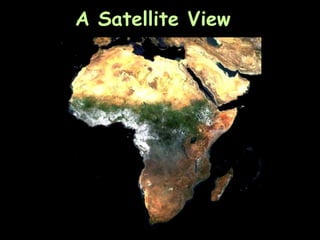
A Satellite View
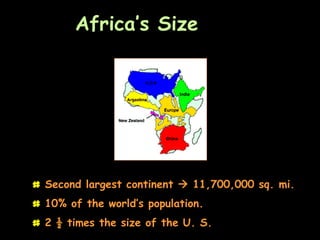
Africa’s Size
                 4600 MILES

          5
          0
          0
          0


          M
          I
          L
          E
          S


# Second largest continent  11,700,000 sq. mi.
# 10% of the world’s population.
# 2 ½ times the size of the U. S.
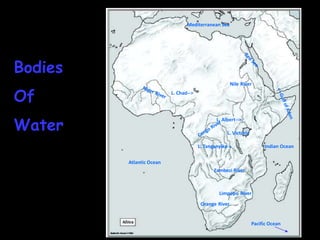
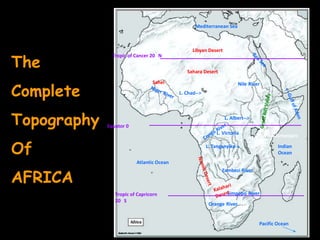
Mediterranean Sea


Bodies
                                                       Nile River

Of                        L. Chad-->


Water
                                               L. Albert-->

                                                    L. Victoria

                                       L. Tanganyika->                 Indian Ocean


         Atlantic Ocean
                                              Zambezi River


                                                Limpopo River
                                        Orange River


                                                                  Pacific Ocean
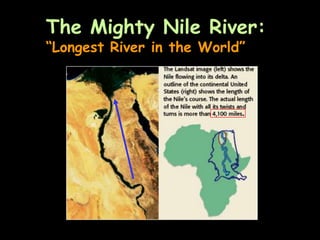
The Mighty Nile River:
“Longest River in the World”
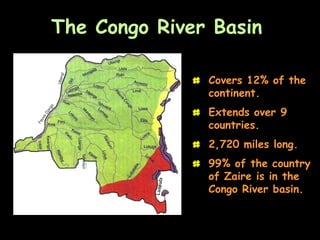
The Congo River Basin

              # Covers 12% of the
                continent.
              # Extends over 9
                countries.
              # 2,720 miles long.
              # 99% of the country
                of Zaire is in the
                Congo River basin.
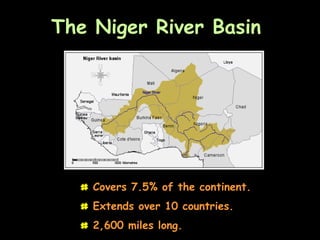
The Niger River Basin


  # Covers 7.5% of the continent.

  # Extends over 10 countries.
  # 2,600 miles long.
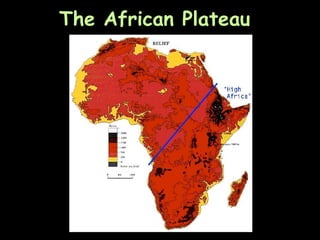
The African Plateau
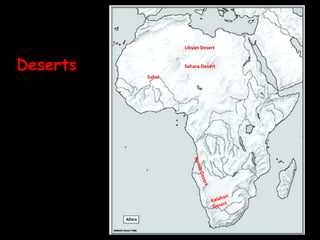
Libyan Desert


Deserts           Sahara Desert

          Sahel
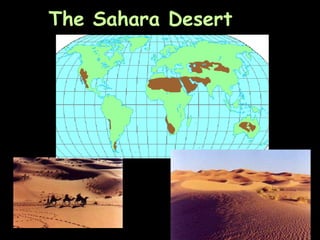
The Sahara Desert
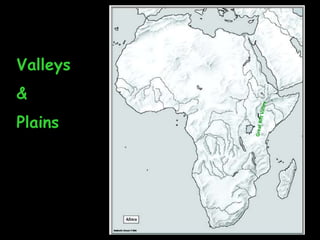
Valleys
&
Plains
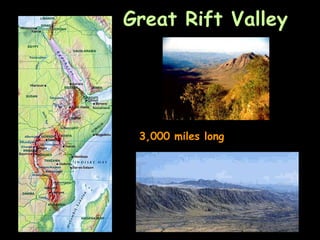
Great Rift Valley


 3,000 miles long
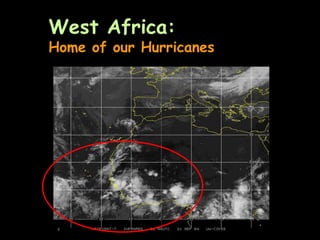
West Africa:
Home of our Hurricanes
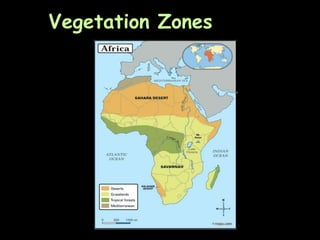
Vegetation Zones
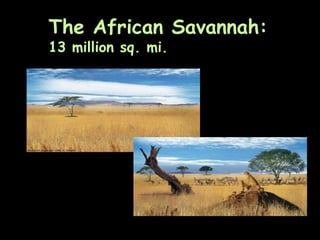
The African Savannah:
13 million sq. mi.
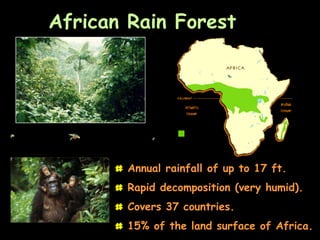
African Rain Forest


      # Annual rainfall of up to 17 ft.
      # Rapid decomposition (very humid).

      # Covers 37 countries.
      # 15% of the land surface of Africa.
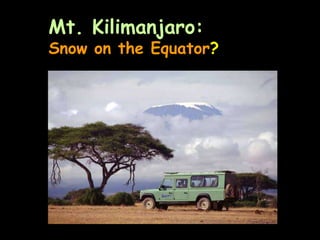
Mt. Kilimanjaro:
Snow on the Equator?
Mediterranean Sea


                                                Libyan Desert

The
               Tropic of Cancer 20 N


                                             Sahara Desert


Complete
                                Sahel                                  Nile River
                                          L. Chad-->


Topography   Equator 0
                                                               L. Albert-->
                                                                           Δ Mt. Kenya
                                                           L. Victoria
                                                                               Δ Mt. Kilimanjaro


Of                                                     L. Tanganyika->                  Indian
                                                                                        Ocean
                         Atlantic Ocean


AFRICA
                                                              Zambezi River


                Tropic of Capricorn                             Limpopo River
                20 S
                                                        Orange River


                                                                                Pacific Ocean
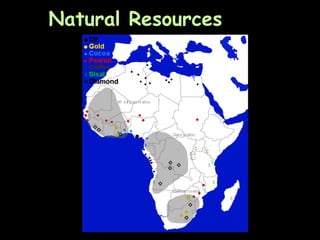
Natural Resources
Controversy Over Egypt:


   Traditionalists
       Versus
   Afrocentricists
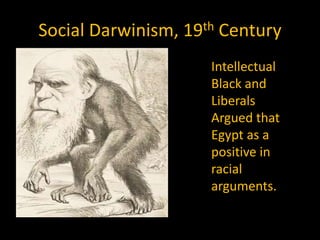
Social Darwinism, 19th Century
                     Intellectual
                     Black and
                     Liberals
                     Argued that
                     Egypt as a
                     positive in
                     racial
                     arguments.
Afrocentricists
• The Egypt was a black civilization
• Linked to other African Civilizations In the
  South
• Important Impact on the Mediterranean Sea,
  especially Greek and Rome
• Thus, promoted philosophy and science which
  is the basis for Western Civilization.
Traditionalists
• Modern racial categories has no
  relevance to the ancient Egypt
• Ancient Greece is the father of
  empirical science and ideas about
  individual freedom
• Egypt did make huge contributions in
  religion, commerce and art.
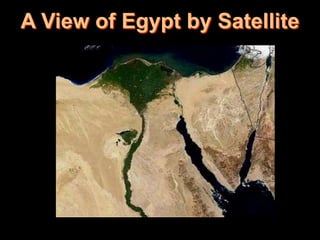
A View of Egypt by Satellite
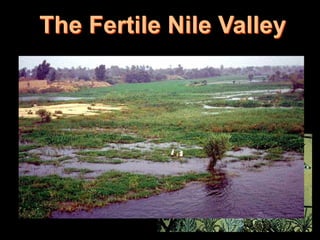
The Fertile Nile Valley
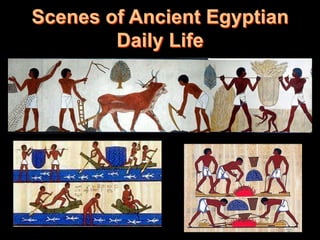
Scenes of Ancient Egyptian
        Daily Life
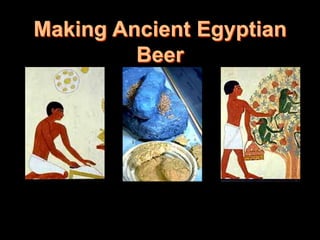
Making Ancient Egyptian
         Beer
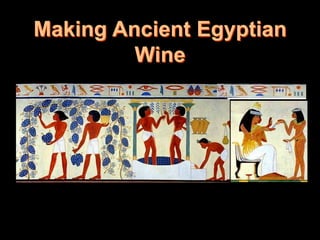
Making Ancient Egyptian
         Wine
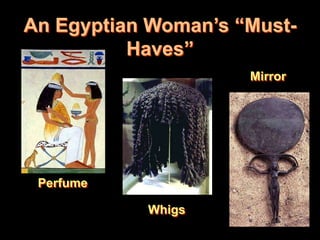
An Egyptian Woman’s “Must-
          Haves”
                     Mirror


 Perfume

           Whigs
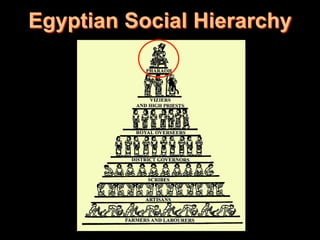
Egyptian Social Hierarchy
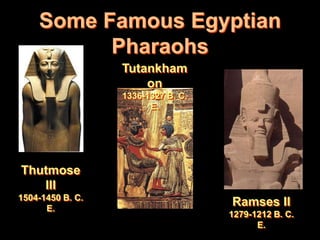
Some Famous Egyptian
          Pharaohs
                  Tutankham
                      on
                  1336-1327 B. C.
                        E.


Thutmose
   III
1504-1450 B. C.
      E.
                                    Ramses II
                                    1279-1212 B. C.
                                          E.
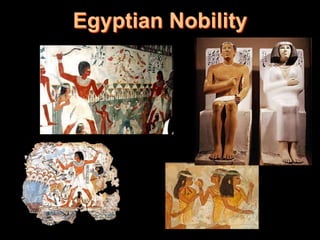
Egyptian Nobility
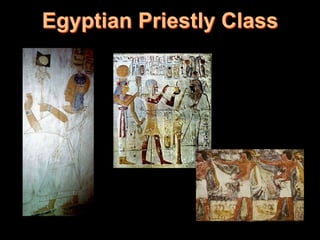
Egyptian Priestly Class
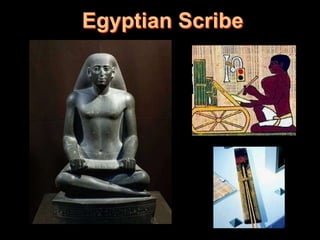
Egyptian Scribe
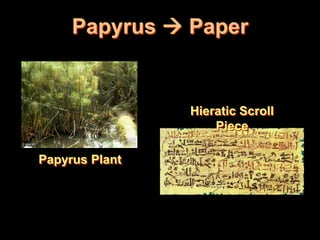
Papyrus  Paper


                Hieratic Scroll
                    Piece

Papyrus Plant
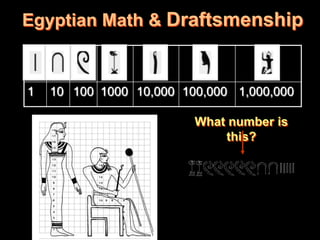
Egyptian Math & Draftsmenship


1   10 100 1000 10,000 100,000 1,000,000

                         What number is
                             this?
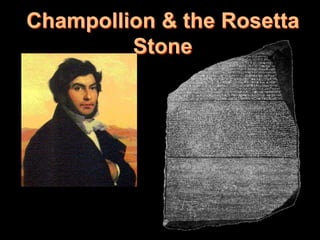
Champollion & the Rosetta
         Stone
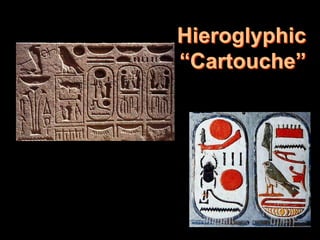
Hieroglyphic
“Cartouche”
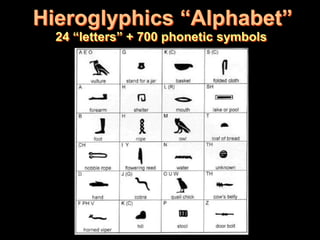
Hieroglyphics “Alphabet”
  24 “letters” + 700 phonetic symbols
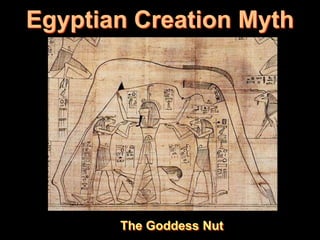
Egyptian Creation Myth


       The Goddess Nut
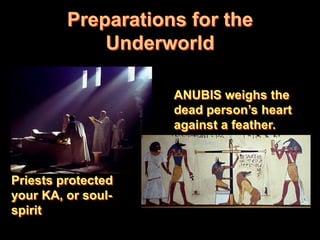
Preparations for the
             Underworld

                    ANUBIS weighs the
                    dead person’s heart
                    against a feather.


Priests protected
your KA, or soul-
spirit
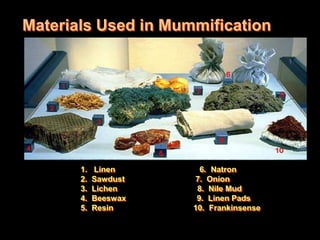
Materials Used in Mummification


       1.   Linen       6. Natron
       2.   Sawdust   7. Onion
       3.   Lichen     8. Nile Mud
       4.   Beeswax    9. Linen Pads
       5.   Resin     10. Frankinsense
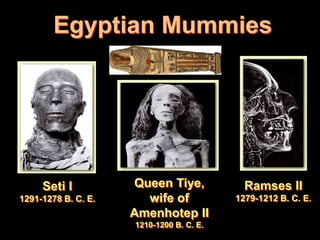
Egyptian Mummies


     Seti I          Queen Tiye,            Ramses II
1291-1278 B. C. E.     wife of            1279-1212 B. C. E.
                     Amenhotep II
                     1210-1200 B. C. E.
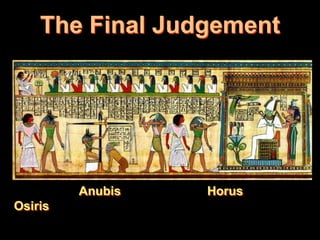
The Final Judgement


         Anubis   Horus
Osiris
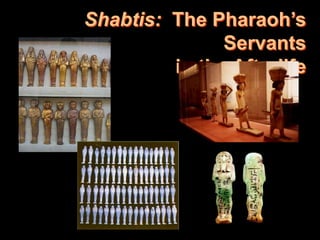
Shabtis: The Pharaoh’s
               Servants
         in the Afterlife
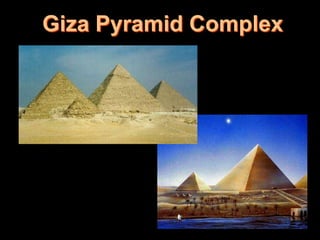
Giza Pyramid Complex
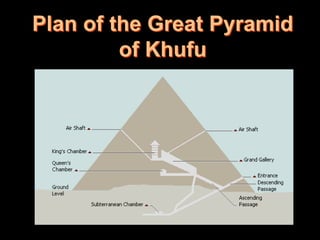
Plan of the Great Pyramid
         of Khufu
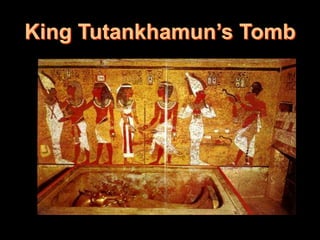
King Tutankhamun’s Tomb
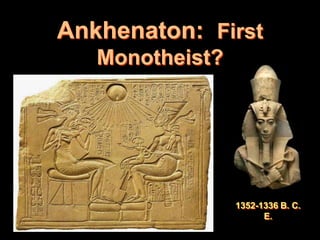
Ankhenaton: First
   Monotheist?


                 1352-1336 B. C.
                       E.
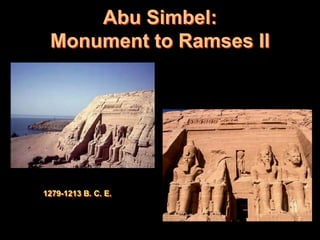
Abu Simbel:
 Monument to Ramses II


1279-1213 B. C. E.
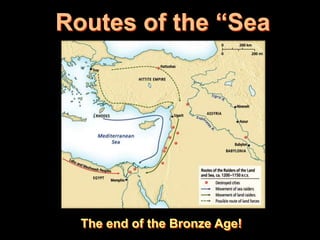
Routes of the “Sea
    Peoples”


  The end of the Bronze Age!
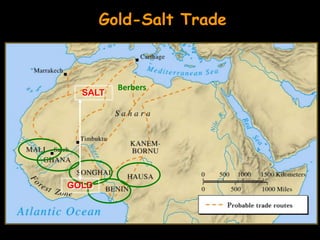
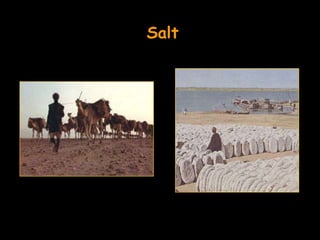
Gold-Salt Trade


         Berbers
  SALT


GOLD
Ghana Empire       [4c-11c]


Gold “Money”, Ghana/Ivory Coast
Salt
Mali Empire   [13c-15c]


  SALT


GOLD
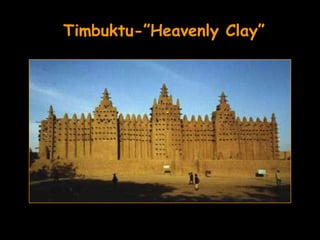
Timbuktu-”Heavenly Clay”
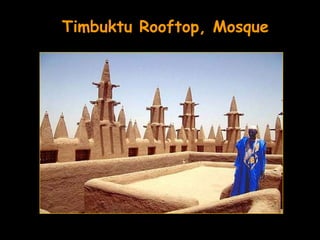
Timbuktu Rooftop, Mosque
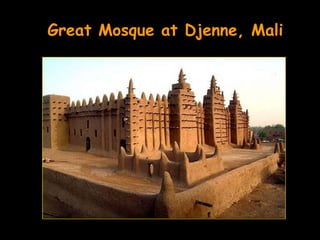
Great Mosque at Djenne, Mali
Sundiata   [1210-1260]


     “Lion Prince”
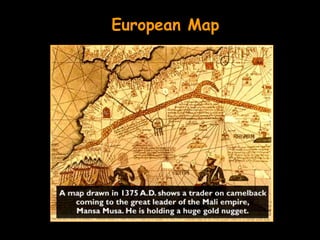
Mansa Musa   [r. 1312-1337]
European Map
Songhai Empire   [15c-16c]


SALT


GOLD
Sunni Ali   [r.1464-1492]
Askia Mohammed   [r.1493-1529]
Askia Mohammed’s Tomb   [1443-1538]


            Gao, Mali
Benin Empire   [15c-19c]
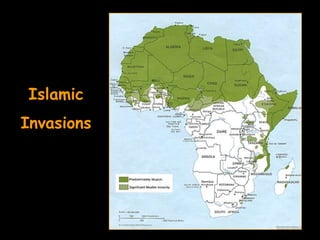
Islamic
Invasions
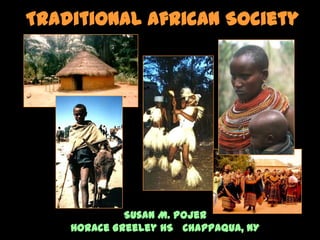
Traditional African Society


             Susan M. Pojer
    Horace Greeley HS Chappaqua, NY
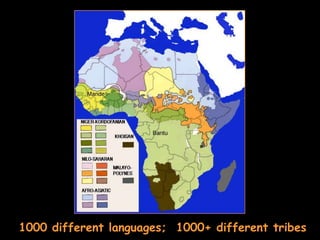
1000 different languages; 1000+ different tribes
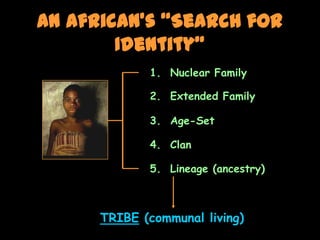
An African’s “Search for
        Identity”
             1. Nuclear Family

             2. Extended Family

             3. Age-Set

             4. Clan

             5. Lineage (ancestry)


      TRIBE (communal living)
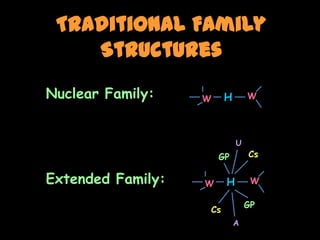
Traditional Family
    Structures
                           C                     C
Nuclear Family:    C       W        H       W
                       C                         C


                                        U
                                   GP       Cs
                           C                     C
Extended Family:   C           W    H        W
                       C                         C
                                            GP
                               Cs
                                        A
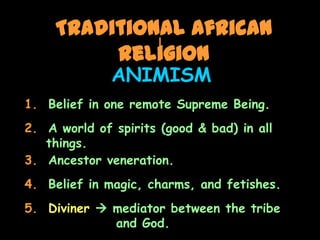
Traditional African
          Religion
              ANIMISM
1. Belief in one remote Supreme Being.
2. A world of spirits (good & bad) in all
   things.
3. Ancestor veneration.
4. Belief in magic, charms, and fetishes.
5. Diviner  mediator between the tribe
             and God.
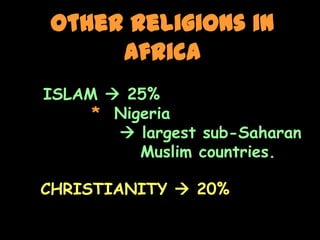
Other Religions in
     Africa
ISLAM  25%
     * Nigeria
        largest sub-Saharan
          Muslim countries.

CHRISTIANITY  20%
Common Traits or Characteristics
of Traditional African Tribal Life
 1. The good of the group comes ahead of the good
    of the individual.
 2. All land is owned by the group.
 3. Strong feeling of loyalty to the group.

 4. Important ceremonies at different parts of a
    person’s life.
 5. Special age and work associations.
 6. Deep respect for ancestors.

 7. Religion is an important part of everyday life.
 8. Government is in the hands of the chiefs [kings].
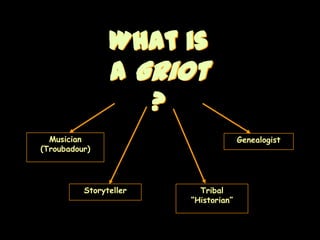
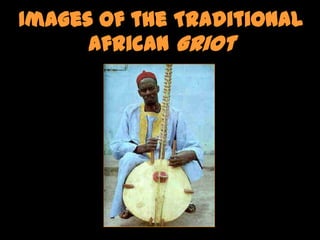
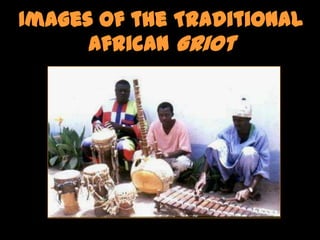
What is
                a Griot
                   ?
  Musician                            Genealogist
(Troubadour)


          Storyteller     Tribal
                        “Historian”
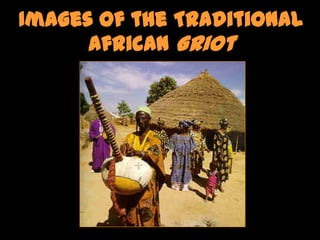
Images of the Traditional
      African Griot
Images of the Traditional
      African Griot
Images of the Traditional
      African Griot
Africa: Week 2
Africa: Week 2
Africa: Week 2

Africa: Week 2