Transforming Institutions:
the Case of IS Innovation for
Agriculture Advisory Services in
Ghana
Mira Slavova
11 January 2014
AFAM 2014, Gaborone, Botswana
Agriculture Background
• In Ghana, productivity gap remains considerable (Gollin
et al., 2012; Nin-Pratt et al., 2009).
• Foundation for economic growth
• Policies geared towards strengthening demand-drive,
markets
• Agriculture advisory services (Christoplos, 2009): aim
to provide understanding of improved practice and
equitable inclusion in value chains
• Traditionally: low-skill, labor intensive
• Increasingly: information and knowledge intensive
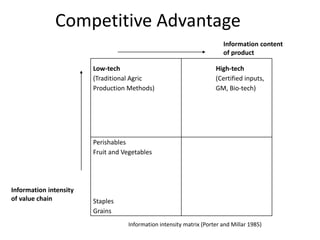
Low-tech
(Traditional Agric
Production Methods)
High-tech
(Certified inputs,
GM, Bio-tech)
Perishables
Fruit and Vegetables
Staples
Grains
Information intensity matrix (Porter and Millar 1985)
Information intensity
of value chain
Information content
of product
Competitive Advantage
IS Innovation
“Throughout this paper I use the term ‘IS innovation’ to refer to the
development and implementation of ICT systems and
concomitant organizational change. That IS implementation
comprises technology development and organizational change
does not require explanation for the readers of an IS journal. But
it is, perhaps, somewhat unusual in the IS literature to see such
socio-technical change as ‘innovation’. I chose this term to
convey the notion of novelty and open-endedness of the effort
and experience of IS implementation and of the associated
changes in the hosting organization and beyond it. Even if the
technologies implemented in an IS project are common and
widespread, the local IS implementation experience constitutes
an innovation for the organization undertaking it and may
well constitute innovation for its socio-economic context.”
(Avgerou 2008)
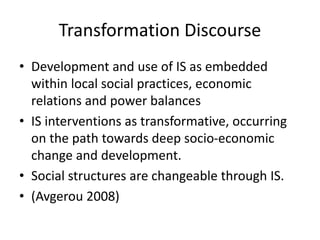
Transformation Discourse
• Development and use of IS as embedded
within local social practices, economic
relations and power balances
• IS interventions as transformative, occurring
on the path towards deep socio-economic
change and development.
• Social structures are changeable through IS.
• (Avgerou 2008)
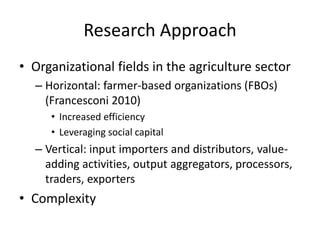
Research Approach
• Organizational fields in the agriculture sector
– Horizontal: farmer-based organizations (FBOs)
(Francesconi 2010)
• Increased efficiency
• Leveraging social capital
– Vertical: input importers and distributors, value-
adding activities, output aggregators, processors,
traders, exporters
• Complexity
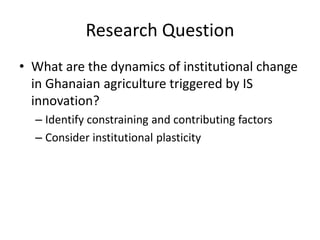
Research Question
• What are the dynamics of institutional change
in Ghanaian agriculture triggered by IS
innovation?
– Identify constraining and contributing factors
– Consider institutional plasticity
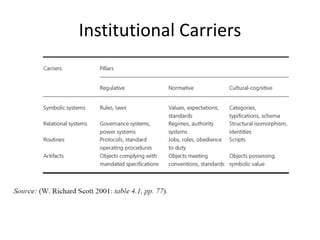
Institutional Carriers
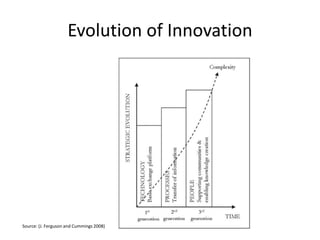
Evolution of Innovation
Source: (J. Ferguson and Cummings 2008)
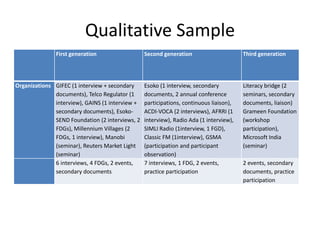
Qualitative Sample
First generation Second generation Third generation
Organizations GIFEC (1 interview + secondary
documents), Telco Regulator (1
interview), GAINS (1 interview +
secondary documents), Esoko-
SEND Foundation (2 interviews, 2
FDGs), Millennium Villages (2
FDGs, 1 interview), Manobi
(seminar), Reuters Market Light
(seminar)
Esoko (1 interview, secondary
documents, 2 annual conference
participations, continuous liaison),
ACDI-VOCA (2 interviews), AFRRI (1
interview), Radio Ada (1 interview),
SIMLI Radio (1interview, 1 FGD),
Classic FM (1interview), GSMA
(participation and participant
observation)
Literacy bridge (2
seminars, secondary
documents, liaison)
Grameen Foundation
(workshop
participation),
Microsoft India
(seminar)
6 interviews, 4 FDGs, 2 events,
secondary documents
7 interviews, 1 FDG, 2 events,
practice participation
2 events, secondary
documents, practice
participation
Findings
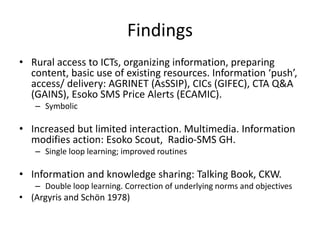
• Rural access to ICTs, organizing information, preparing
content, basic use of existing resources. Information ‘push’,
access/ delivery: AGRINET (AsSSIP), CICs (GIFEC), CTA Q&A
(GAINS), Esoko SMS Price Alerts (ECAMIC).
– Symbolic
• Increased but limited interaction. Multimedia. Information
modifies action: Esoko Scout, Radio-SMS GH.
– Single loop learning; improved routines
• Information and knowledge sharing: Talking Book, CKW.
– Double loop learning. Correction of underlying norms and objectives
• (Argyris and Schön 1978)
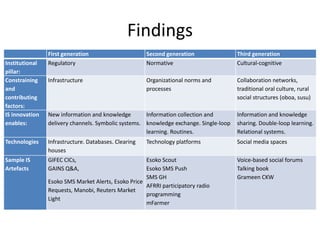
First generation Second generation Third generation
Institutional
pillar:
Regulatory Normative Cultural-cognitive
Constraining
and
contributing
factors:
Infrastructure Organizational norms and
processes
Collaboration networks,
traditional oral culture, rural
social structures (oboa, susu)
IS innovation
enables:
New information and knowledge
delivery channels. Symbolic systems.
Information collection and
knowledge exchange. Single-loop
learning. Routines.
Information and knowledge
sharing. Double-loop learning.
Relational systems.
Technologies Infrastructure. Databases. Clearing
houses
Technology platforms Social media spaces
Sample IS
Artefacts
GIFEC CICs,
GAINS Q&A,
Esoko SMS Market Alerts, Esoko Price
Requests, Manobi, Reuters Market
Light
Esoko Scout
Esoko SMS Push
SMS GH
AFRRI participatory radio
programming
mFarmer
Voice-based social forums
Talking book
Grameen CKW
Findings
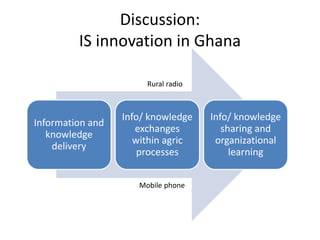
Discussion:
IS innovation in Ghana
Information and
knowledge
delivery
Info/ knowledge
exchanges
within agric
processes
Info/ knowledge
sharing and
organizational
learning
Rural radio
Mobile phone

Transforming institutions: the case of IS innovation for agriculture advisory serrvices in Ghana

  • 1.
    Transforming Institutions: the Caseof IS Innovation for Agriculture Advisory Services in Ghana Mira Slavova 11 January 2014 AFAM 2014, Gaborone, Botswana
  • 2.
    Agriculture Background • InGhana, productivity gap remains considerable (Gollin et al., 2012; Nin-Pratt et al., 2009). • Foundation for economic growth • Policies geared towards strengthening demand-drive, markets • Agriculture advisory services (Christoplos, 2009): aim to provide understanding of improved practice and equitable inclusion in value chains • Traditionally: low-skill, labor intensive • Increasingly: information and knowledge intensive
  • 3.
    Low-tech (Traditional Agric Production Methods) High-tech (Certifiedinputs, GM, Bio-tech) Perishables Fruit and Vegetables Staples Grains Information intensity matrix (Porter and Millar 1985) Information intensity of value chain Information content of product Competitive Advantage
  • 4.
    IS Innovation “Throughout thispaper I use the term ‘IS innovation’ to refer to the development and implementation of ICT systems and concomitant organizational change. That IS implementation comprises technology development and organizational change does not require explanation for the readers of an IS journal. But it is, perhaps, somewhat unusual in the IS literature to see such socio-technical change as ‘innovation’. I chose this term to convey the notion of novelty and open-endedness of the effort and experience of IS implementation and of the associated changes in the hosting organization and beyond it. Even if the technologies implemented in an IS project are common and widespread, the local IS implementation experience constitutes an innovation for the organization undertaking it and may well constitute innovation for its socio-economic context.” (Avgerou 2008)
  • 5.
    Transformation Discourse • Developmentand use of IS as embedded within local social practices, economic relations and power balances • IS interventions as transformative, occurring on the path towards deep socio-economic change and development. • Social structures are changeable through IS. • (Avgerou 2008)
  • 6.
    Research Approach • Organizationalfields in the agriculture sector – Horizontal: farmer-based organizations (FBOs) (Francesconi 2010) • Increased efficiency • Leveraging social capital – Vertical: input importers and distributors, value- adding activities, output aggregators, processors, traders, exporters • Complexity
  • 7.
    Research Question • Whatare the dynamics of institutional change in Ghanaian agriculture triggered by IS innovation? – Identify constraining and contributing factors – Consider institutional plasticity
  • 8.
  • 9.
    Evolution of Innovation Source:(J. Ferguson and Cummings 2008)
  • 10.
    Qualitative Sample First generationSecond generation Third generation Organizations GIFEC (1 interview + secondary documents), Telco Regulator (1 interview), GAINS (1 interview + secondary documents), Esoko- SEND Foundation (2 interviews, 2 FDGs), Millennium Villages (2 FDGs, 1 interview), Manobi (seminar), Reuters Market Light (seminar) Esoko (1 interview, secondary documents, 2 annual conference participations, continuous liaison), ACDI-VOCA (2 interviews), AFRRI (1 interview), Radio Ada (1 interview), SIMLI Radio (1interview, 1 FGD), Classic FM (1interview), GSMA (participation and participant observation) Literacy bridge (2 seminars, secondary documents, liaison) Grameen Foundation (workshop participation), Microsoft India (seminar) 6 interviews, 4 FDGs, 2 events, secondary documents 7 interviews, 1 FDG, 2 events, practice participation 2 events, secondary documents, practice participation
  • 11.
    Findings • Rural accessto ICTs, organizing information, preparing content, basic use of existing resources. Information ‘push’, access/ delivery: AGRINET (AsSSIP), CICs (GIFEC), CTA Q&A (GAINS), Esoko SMS Price Alerts (ECAMIC). – Symbolic • Increased but limited interaction. Multimedia. Information modifies action: Esoko Scout, Radio-SMS GH. – Single loop learning; improved routines • Information and knowledge sharing: Talking Book, CKW. – Double loop learning. Correction of underlying norms and objectives • (Argyris and Schön 1978)
  • 12.
    First generation Secondgeneration Third generation Institutional pillar: Regulatory Normative Cultural-cognitive Constraining and contributing factors: Infrastructure Organizational norms and processes Collaboration networks, traditional oral culture, rural social structures (oboa, susu) IS innovation enables: New information and knowledge delivery channels. Symbolic systems. Information collection and knowledge exchange. Single-loop learning. Routines. Information and knowledge sharing. Double-loop learning. Relational systems. Technologies Infrastructure. Databases. Clearing houses Technology platforms Social media spaces Sample IS Artefacts GIFEC CICs, GAINS Q&A, Esoko SMS Market Alerts, Esoko Price Requests, Manobi, Reuters Market Light Esoko Scout Esoko SMS Push SMS GH AFRRI participatory radio programming mFarmer Voice-based social forums Talking book Grameen CKW Findings
  • 13.
    Discussion: IS innovation inGhana Information and knowledge delivery Info/ knowledge exchanges within agric processes Info/ knowledge sharing and organizational learning Rural radio Mobile phone