Pathways by Which Improved
Information Can Affect Market
Performance: Implications for
  Evaluation of MIS Impacts

                     John Staatz
               Michigan State University

  Workshop on Agricultural Market Information Systems
             in Africa: Renewal & Impact
        Montpellier, France, 29 31 March 2010
                             29-31

                                                        1
Key messages
Complementarity between public and
private activities to improve market
information
MIS can improve market performance both
through
  Direct impacts on decisions of private actors:
     Spatial and temporal arbitrage
     Production decisions
     P d ti d i i
  Indirect effects via:
     Complementarity with other hard and soft
     infrastructure (
       f            (e.g., roads, credit programs),
                              d      d           )
     Impacts on improving government policies
                                                      2
Key messages
 Yet as one moves towards these more round-
 about impacts of MIS, it becomes increasingly
 difficult to
 diffi lt t quantify th i
                tif the impact of MIS d t
                              t f     due to:
   Problems of attribution of impacts to the MIS
   actions vis a vis other complementary and often
                               p         y
   contemporaneous actions (e.g., market reforms)
   The difficulty of specifying the counterfactual (in
   terms of the policy environment) for the without-
                                              without
   MIS situation.


                                                         3
Why try to estimate impacts?
 Conceptual links between better information and
 improved market performance
 Reasons why private investment may lead to
              yp                       y
 insufficient provision of market information
    Indivisibility
    Non-excludabilityy
    Uncertainty
    Lack of effective demand among the very poor
 New ICT may change some of these reasons (e.g.,
 non-excludabiltity), increasing role for private info.
 provision
 Q
 Question remains: At margin, how much to invest
                            g ,
 in public provision of market information relative to
 other programs?
                                                          4
Pathways from better
information to better market
performance: implications for
evaluation


                                5
Potential Direct Impacts of Better Market
  Information & Ways of Evaluating Them


Rent redistribution in short run– e.g.,
reduction in intra-market margins
following introduction of MIS
  E.g., early work on Malian MIS
  Value consumer savings per kg times market
  volumes
  Does not examine longer-run growth
  implications of such redistribution
                                               6
Potential Direct Impacts of Better Market
  Information & Ways of Evaluating Them

Improved spatial arbitrage of existing
production more stable and possibly higher
average prices
  Examples:
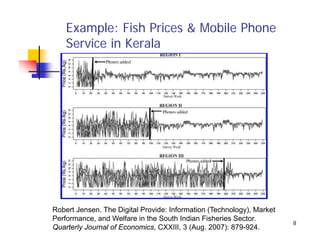
    Jensen’s (2007) analysis of introduction of cell phones on
    J      ’            l i f i t d ti        f ll h
    Kerala fishermen’s prices
    Jenny Aker’s (2009) analysis of impact of cell phones on
    marketing ma gins Nige
    ma keting margins in Niger
  Need good data; this approach captures 1st-round
  effects only—not longer-term growth or supply
             y        g        g           pp y
  response
                                                                 7
Example: Fish Prices & Mobile Phone
    Service in Kerala


Robert Jensen. The Digital Provide: Information (Technology), Market
Performance, and Welfare in the South Indian Fisheries Sector.
                                                                       8
Quarterly Journal of Economics, CXXIII, 3 (Aug. 2007): 879-924.
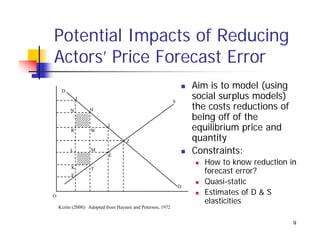
Potential Impacts of Reducing
Actors’ Price Forecast Error
     D
                                                                    Aim is to model (using
              J
                                                            S
                                                                    social surplus models)
         N        H                                                 the costs reductions of
                                                                    being off of the
         R         W
                           I
                                                                    equilibrium price and
                                    Z                               quantity
         L         M
                           E
                                                                    Constraints:
                                                                       How to know reduction in
                                                                       forecast error?
          K        T
          F

                                                                D
                                                                       Quasi-static
O
                                                                       Estimates of D & S
                                                                       elasticities
    Kizito (2008): Adopted from Hayami and Peterson, 1972


                                                                                              9
Estimates of with/without
                 /
improved information over time
 Problems of attribution given the
 complementarity of information with other
 market improvements
 Better information as an input into better
 policies, which then improves payoffs to
 market information (both public and private)
   Example of OMA in Mali
   E     l f        i M li
   Problem for estimation of impacts everything is
   endogenous!

                                                     10
So how to measure impacts of
more dynamic effects?
 User satisfaction surveys? Identifying
 what information comes from MIS vs
 other sources, including the market
 itself?
 Contingent valuation? Problems of
 stated preference vs revealed
                    vs.
 preference?

                                          11
So how to measure impacts of
more dynamic effects?
 Revealed preference of funding by public sector or
 through a users’ organization?
   May be the most reliable indicator but does this help you
                            indicator,
   ex-ante?
   Can you duplicate successful models from elsewhere?
      Donor funding crowding out national funding?
      Need an explicit transition strategy to national funding
 Are we pursuing an impossible objective in trying to
 precisely quantify the payoffs to improve market
 information?
 Quantify what you can, but then build credible stories
 on more dynamic effects

                                                                 12
Your suggestions?
 Thanks for your attention and your
 help!


                                      13

Staatz MSU CIRAD 2010

  • 1.
    Pathways by WhichImproved Information Can Affect Market Performance: Implications for Evaluation of MIS Impacts John Staatz Michigan State University Workshop on Agricultural Market Information Systems in Africa: Renewal & Impact Montpellier, France, 29 31 March 2010 29-31 1
  • 2.
    Key messages Complementarity betweenpublic and private activities to improve market information MIS can improve market performance both through Direct impacts on decisions of private actors: Spatial and temporal arbitrage Production decisions P d ti d i i Indirect effects via: Complementarity with other hard and soft infrastructure ( f (e.g., roads, credit programs), d d ) Impacts on improving government policies 2
  • 3.
    Key messages Yetas one moves towards these more round- about impacts of MIS, it becomes increasingly difficult to diffi lt t quantify th i tif the impact of MIS d t t f due to: Problems of attribution of impacts to the MIS actions vis a vis other complementary and often p y contemporaneous actions (e.g., market reforms) The difficulty of specifying the counterfactual (in terms of the policy environment) for the without- without MIS situation. 3
  • 4.
    Why try toestimate impacts? Conceptual links between better information and improved market performance Reasons why private investment may lead to yp y insufficient provision of market information Indivisibility Non-excludabilityy Uncertainty Lack of effective demand among the very poor New ICT may change some of these reasons (e.g., non-excludabiltity), increasing role for private info. provision Q Question remains: At margin, how much to invest g , in public provision of market information relative to other programs? 4
  • 5.
    Pathways from better informationto better market performance: implications for evaluation 5
  • 6.
    Potential Direct Impactsof Better Market Information & Ways of Evaluating Them Rent redistribution in short run– e.g., reduction in intra-market margins following introduction of MIS E.g., early work on Malian MIS Value consumer savings per kg times market volumes Does not examine longer-run growth implications of such redistribution 6
  • 7.
    Potential Direct Impactsof Better Market Information & Ways of Evaluating Them Improved spatial arbitrage of existing production more stable and possibly higher average prices Examples: Jensen’s (2007) analysis of introduction of cell phones on J ’ l i f i t d ti f ll h Kerala fishermen’s prices Jenny Aker’s (2009) analysis of impact of cell phones on marketing ma gins Nige ma keting margins in Niger Need good data; this approach captures 1st-round effects only—not longer-term growth or supply y g g pp y response 7
  • 8.
    Example: Fish Prices& Mobile Phone Service in Kerala Robert Jensen. The Digital Provide: Information (Technology), Market Performance, and Welfare in the South Indian Fisheries Sector. 8 Quarterly Journal of Economics, CXXIII, 3 (Aug. 2007): 879-924.
  • 9.
    Potential Impacts ofReducing Actors’ Price Forecast Error D Aim is to model (using J S social surplus models) N H the costs reductions of being off of the R W I equilibrium price and Z quantity L M E Constraints: How to know reduction in forecast error? K T F D Quasi-static O Estimates of D & S elasticities Kizito (2008): Adopted from Hayami and Peterson, 1972 9
  • 10.
    Estimates of with/without / improved information over time Problems of attribution given the complementarity of information with other market improvements Better information as an input into better policies, which then improves payoffs to market information (both public and private) Example of OMA in Mali E l f i M li Problem for estimation of impacts everything is endogenous! 10
  • 11.
    So how tomeasure impacts of more dynamic effects? User satisfaction surveys? Identifying what information comes from MIS vs other sources, including the market itself? Contingent valuation? Problems of stated preference vs revealed vs. preference? 11
  • 12.
    So how tomeasure impacts of more dynamic effects? Revealed preference of funding by public sector or through a users’ organization? May be the most reliable indicator but does this help you indicator, ex-ante? Can you duplicate successful models from elsewhere? Donor funding crowding out national funding? Need an explicit transition strategy to national funding Are we pursuing an impossible objective in trying to precisely quantify the payoffs to improve market information? Quantify what you can, but then build credible stories on more dynamic effects 12
  • 13.
    Your suggestions? Thanksfor your attention and your help! 13