AES Encryption &
Decryption
AES parameters
• Nb – Number of columns in the State
• For AES, Nb = 4
• Nk – Number of 32-bit words in the Key
• For AES, Nk = 4, 6, or 8
• Nr – Number of rounds (function of Nb and Nk)
• For AES, Nr = 10, 12, or 14
AES methods
• Convert to state array
• Transformations (and their inverses)
• AddRoundKey
• SubBytes
• ShiftRows
• MixColumns
• Key Expansion
Convert to State Array
0 1 2 3 4 5 6 7 8 9 10 11 12 13 14 15
Input block:
0 4 8 12
1 5 9 13
2 6 10 14
3 7 11 15
S0,0 S0,1 S0,2 S0,3
S1,0 S1,1 S1,2 S1,3
S2,0 S2,1 S2,2 S2,3
S3,0 S3,1 S3,2 S3,3
=
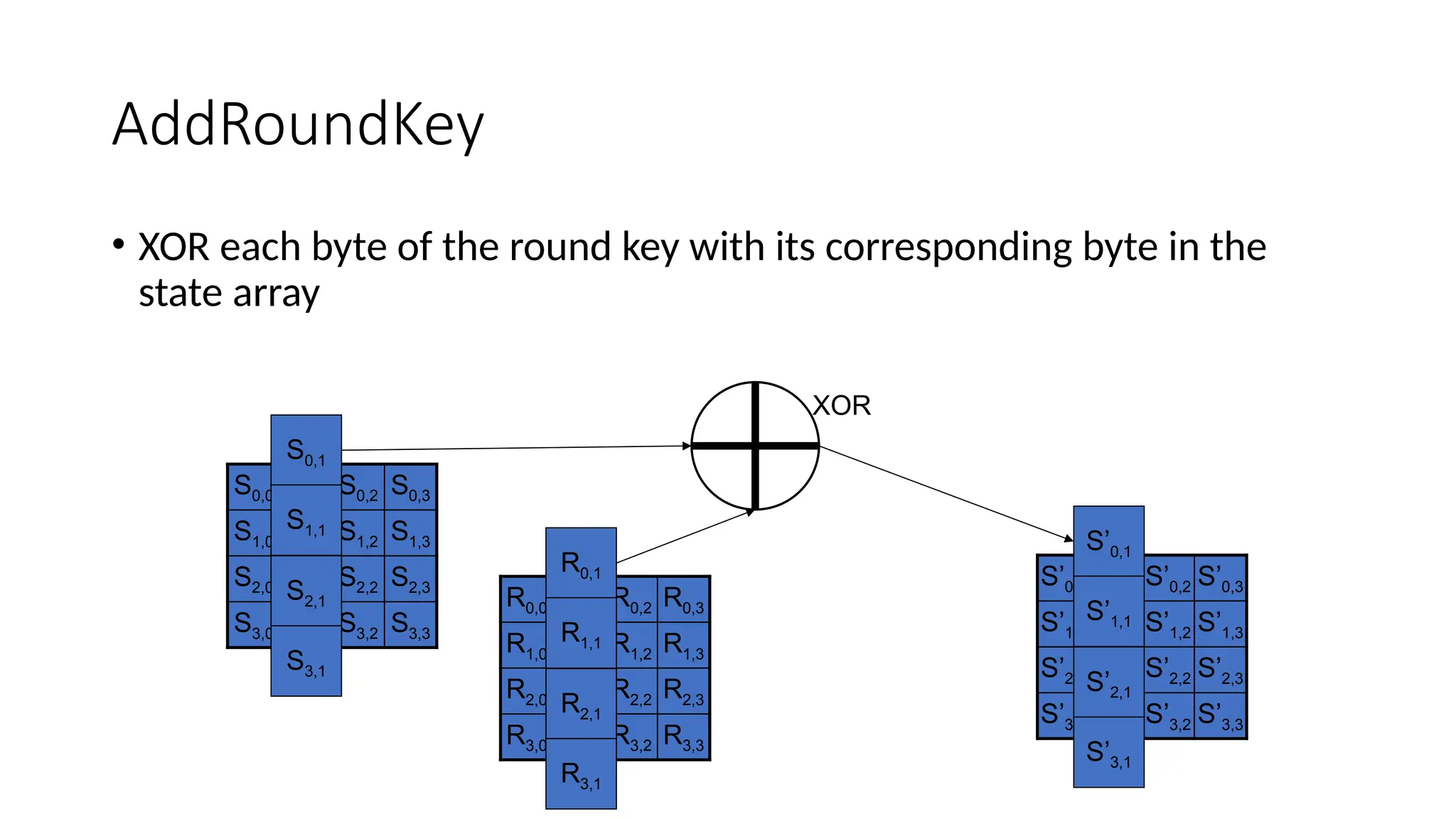
AddRoundKey
• XOR each byte of the round key with its corresponding byte in the
state array
S0,0 S0,1 S0,2 S0,3
S1,0 S1,1 S1,2 S1,3
S2,0 S2,1 S2,2 S2,3
S3,0 S3,1 S3,2 S3,3
S’0,0 S’0,1 S’0,2 S’0,3
S’1,0 S’1,1 S’1,2 S’1,3
S’2,0 S’2,1 S’2,2 S’2,3
S’3,0 S’3,1 S’3,2 S’3,3
S0,1
S1,1
S2,1
S3,1
S’0,1
S’1,1
S’2,1
S’3,1
R0,0 R0,1 R0,2 R0,3
R1,0 R1,1 R1,2 R1,3
R2,0 R2,1 R2,2 R2,3
R3,0 R3,1 R3,2 R3,3
R0,1
R1,1
R2,1
R3,1
XOR
SubBytes
• Replace each byte in the state array with its corresponding value from
the S-Box
00 44 88 CC
11 55 99 DD
22 66 AA EE
33 77 BB FF
55
ShiftRows
• Last three rows are cyclically shifted
S0,0 S0,1 S0,2 S0,3
S1,0 S1,1 S1,2 S1,3
S2,0 S2,1 S2,2 S2,3
S3,0 S3,1 S3,2 S3,3
S1,0
S3,0 S3,1 S3,2
S2,0 S2,1
MixColumns
• Apply MixColumn transformation to each column
S0,0 S0,1 S0,2 S0,3
S1,0 S1,1 S1,2 S1,3
S2,0 S2,1 S2,2 S2,3
S3,0 S3,1 S3,2 S3,3
S’0,0 S’0,1 S’0,2 S’0,3
S’1,0 S’1,1 S’1,2 S’1,3
S’2,0 S’2,1 S’2,2 S’2,3
S’3,0 S’3,1 S’3,2 S’3,3
S0,1
S1,1
S2,1
S3,1
S’0,1
S’1,1
S’2,1
S’3,1
MixColumns()
S’0,c = ({02}  S0,c)  ({03}  S1,c)  S2,c  S3,c
S’1,c = S0,c  ({02}  S1,c)  ({03}  S2,c)  S3,c
S’2,c = S0,c  S1,c  ({02}  S2,c )  ({03}  S3,c)
S’3,c = ({03}  S0,c)  S1,c  S2,c  ({02}  S3,c
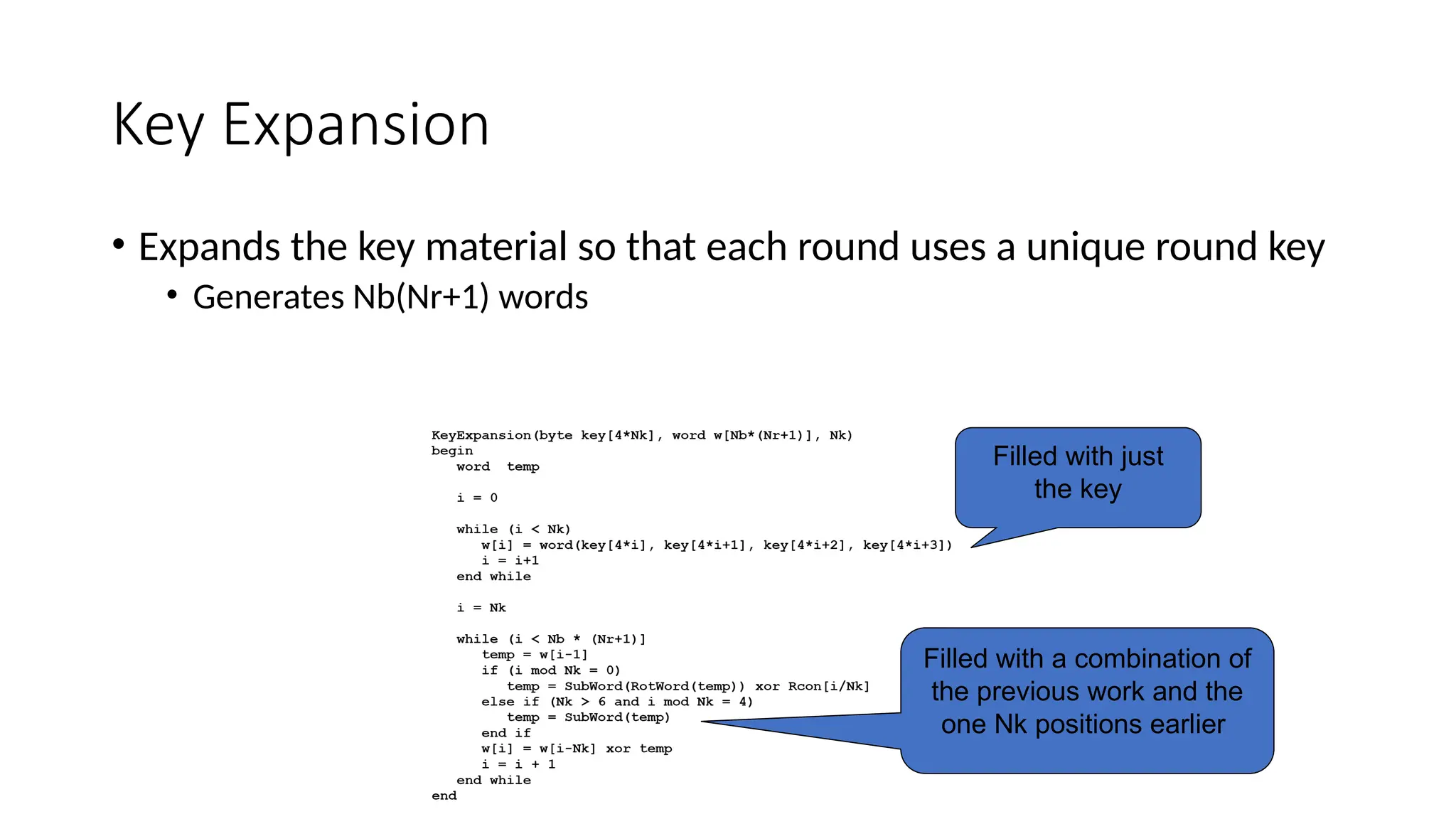
Key Expansion
• Expands the key material so that each round uses a unique round key
• Generates Nb(Nr+1) words
Filled with just
the key
Filled with a combination of
the previous work and the
one Nk positions earlier
Encryption
byte state[4,Nb]
state = in
AddRoundKey(state, keySchedule[0, Nb-1])
for round = 1 step 1 to Nr–1 {
SubBytes(state)
ShiftRows(state)
MixColumns(state)
AddRoundKey(state, keySchedule[round*Nb, (round+1)*Nb-1])
}
SubBytes(state)
ShiftRows(state)
AddRoundKey(state, keySchedule[Nr*Nb, (Nr+1)*Nb-1])
out = state
First and last operations
involve the key
Prevents an attacker from
even beginning to encrypt or
decrypt without the key
Decryption
byte state[4,Nb]
state = in
AddRoundKey(state, keySchedule[Nr*Nb, (Nr+1)*Nb-1])
for round = Nr-1 step -1 downto 1 {
InvShiftRows(state)
InvSubBytes(state)
AddRoundKey(state, keySchedule[round*Nb, (round+1)*Nb-1])
InvMixColumns(state)
}
InvShiftRows(state)
InvSubBytes(state)
AddRoundKey(state, keySchedule[0, Nb-1])
out = state
Encrypt and Decrypt
Encryption
AddRoundKey
SubBytes
ShiftRows
MixColumns
AddRoundKey
SubBytes
ShiftRows
AddRoundKey
Decryption
AddRoundKey
InvShiftRows
InvSubBytes
AddRoundKey
InvMixColumns
InvShiftRows
InvSubBytes
AddRoundKey

AES Encryption Decryption in Crptography.pptx

  • 1.
  • 2.
    AES parameters • Nb– Number of columns in the State • For AES, Nb = 4 • Nk – Number of 32-bit words in the Key • For AES, Nk = 4, 6, or 8 • Nr – Number of rounds (function of Nb and Nk) • For AES, Nr = 10, 12, or 14
  • 4.
    AES methods • Convertto state array • Transformations (and their inverses) • AddRoundKey • SubBytes • ShiftRows • MixColumns • Key Expansion
  • 5.
    Convert to StateArray 0 1 2 3 4 5 6 7 8 9 10 11 12 13 14 15 Input block: 0 4 8 12 1 5 9 13 2 6 10 14 3 7 11 15 S0,0 S0,1 S0,2 S0,3 S1,0 S1,1 S1,2 S1,3 S2,0 S2,1 S2,2 S2,3 S3,0 S3,1 S3,2 S3,3 =
  • 6.
    AddRoundKey • XOR eachbyte of the round key with its corresponding byte in the state array S0,0 S0,1 S0,2 S0,3 S1,0 S1,1 S1,2 S1,3 S2,0 S2,1 S2,2 S2,3 S3,0 S3,1 S3,2 S3,3 S’0,0 S’0,1 S’0,2 S’0,3 S’1,0 S’1,1 S’1,2 S’1,3 S’2,0 S’2,1 S’2,2 S’2,3 S’3,0 S’3,1 S’3,2 S’3,3 S0,1 S1,1 S2,1 S3,1 S’0,1 S’1,1 S’2,1 S’3,1 R0,0 R0,1 R0,2 R0,3 R1,0 R1,1 R1,2 R1,3 R2,0 R2,1 R2,2 R2,3 R3,0 R3,1 R3,2 R3,3 R0,1 R1,1 R2,1 R3,1 XOR
  • 7.
    SubBytes • Replace eachbyte in the state array with its corresponding value from the S-Box 00 44 88 CC 11 55 99 DD 22 66 AA EE 33 77 BB FF 55
  • 8.
    ShiftRows • Last threerows are cyclically shifted S0,0 S0,1 S0,2 S0,3 S1,0 S1,1 S1,2 S1,3 S2,0 S2,1 S2,2 S2,3 S3,0 S3,1 S3,2 S3,3 S1,0 S3,0 S3,1 S3,2 S2,0 S2,1
  • 9.
    MixColumns • Apply MixColumntransformation to each column S0,0 S0,1 S0,2 S0,3 S1,0 S1,1 S1,2 S1,3 S2,0 S2,1 S2,2 S2,3 S3,0 S3,1 S3,2 S3,3 S’0,0 S’0,1 S’0,2 S’0,3 S’1,0 S’1,1 S’1,2 S’1,3 S’2,0 S’2,1 S’2,2 S’2,3 S’3,0 S’3,1 S’3,2 S’3,3 S0,1 S1,1 S2,1 S3,1 S’0,1 S’1,1 S’2,1 S’3,1 MixColumns() S’0,c = ({02}  S0,c)  ({03}  S1,c)  S2,c  S3,c S’1,c = S0,c  ({02}  S1,c)  ({03}  S2,c)  S3,c S’2,c = S0,c  S1,c  ({02}  S2,c )  ({03}  S3,c) S’3,c = ({03}  S0,c)  S1,c  S2,c  ({02}  S3,c
  • 10.
    Key Expansion • Expandsthe key material so that each round uses a unique round key • Generates Nb(Nr+1) words Filled with just the key Filled with a combination of the previous work and the one Nk positions earlier
  • 11.
    Encryption byte state[4,Nb] state =in AddRoundKey(state, keySchedule[0, Nb-1]) for round = 1 step 1 to Nr–1 { SubBytes(state) ShiftRows(state) MixColumns(state) AddRoundKey(state, keySchedule[round*Nb, (round+1)*Nb-1]) } SubBytes(state) ShiftRows(state) AddRoundKey(state, keySchedule[Nr*Nb, (Nr+1)*Nb-1]) out = state First and last operations involve the key Prevents an attacker from even beginning to encrypt or decrypt without the key
  • 12.
    Decryption byte state[4,Nb] state =in AddRoundKey(state, keySchedule[Nr*Nb, (Nr+1)*Nb-1]) for round = Nr-1 step -1 downto 1 { InvShiftRows(state) InvSubBytes(state) AddRoundKey(state, keySchedule[round*Nb, (round+1)*Nb-1]) InvMixColumns(state) } InvShiftRows(state) InvSubBytes(state) AddRoundKey(state, keySchedule[0, Nb-1]) out = state
  • 13.

Editor's Notes

  • #2 Also known as block size