For More Papers Visit : www.TheOnlineMaterial.Blogspot.com
2011                                                                              AEROSPACE ENGINEERING – AE

                                AE: AEROSPACE ENGINEERING
                                             ONLINE Examination
Duration: Three Hours                                                                   Maximum Marks: 100

Read the following instructions carefully.
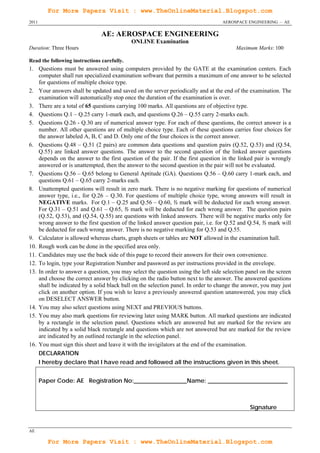
1. Questions must be answered using computers provided by the GATE at the examination centers. Each
    computer shall run specialized examination software that permits a maximum of one answer to be selected
    for questions of multiple choice type.
2. Your answers shall be updated and saved on the server periodically and at the end of the examination. The
    examination will automatically stop once the duration of the examination is over.
3. There are a total of 65 questions carrying 100 marks. All questions are of objective type.
4. Questions Q.1 – Q.25 carry 1-mark each, and questions Q.26 – Q.55 carry 2-marks each.
5. Questions Q.26 - Q.30 are of numerical answer type. For each of these questions, the correct answer is a
    number. All other questions are of multiple choice type. Each of these questions carries four choices for
    the answer labeled A, B, C and D. Only one of the four choices is the correct answer.
6. Questions Q.48 – Q.51 (2 pairs) are common data questions and question pairs (Q.52, Q.53) and (Q.54,
    Q.55) are linked answer questions. The answer to the second question of the linked answer questions
    depends on the answer to the first question of the pair. If the first question in the linked pair is wrongly
    answered or is unattempted, then the answer to the second question in the pair will not be evaluated.
7. Questions Q.56 – Q.65 belong to General Aptitude (GA). Questions Q.56 – Q.60 carry 1-mark each, and
    questions Q.61 – Q.65 carry 2-marks each.
8. Unattempted questions will result in zero mark. There is no negative marking for questions of numerical
    answer type, i.e., for Q.26 – Q.30. For questions of multiple choice type, wrong answers will result in
    NEGATIVE marks. For Q.1 – Q.25 and Q.56 – Q.60, ⅓ mark will be deducted for each wrong answer.
    For Q.31 – Q.51 and Q.61 – Q.65, ⅔ mark will be deducted for each wrong answer. The question pairs
    (Q.52, Q.53), and (Q.54, Q.55) are questions with linked answers. There will be negative marks only for
    wrong answer to the first question of the linked answer question pair, i.e. for Q.52 and Q.54, ⅔ mark will
    be deducted for each wrong answer. There is no negative marking for Q.53 and Q.55.
9. Calculator is allowed whereas charts, graph sheets or tables are NOT allowed in the examination hall.
10. Rough work can be done in the specified area only.
11. Candidates may use the back side of this page to record their answers for their own convenience.
12. To login, type your Registration Number and password as per instructions provided in the envelope.
13. In order to answer a question, you may select the question using the left side selection panel on the screen
    and choose the correct answer by clicking on the radio button next to the answer. The answered questions
    shall be indicated by a solid black ball on the selection panel. In order to change the answer, you may just
    click on another option. If you wish to leave a previously answered question unanswered, you may click
    on DESELECT ANSWER button.
14. You may also select questions using NEXT and PREVIOUS buttons.
15. You may also mark questions for reviewing later using MARK button. All marked questions are indicated
    by a rectangle in the selection panel. Questions which are answered but are marked for the review are
    indicated by a solid black rectangle and questions which are not answered but are marked for the review
    are indicated by an outlined rectangle in the selection panel.
16. You must sign this sheet and leave it with the invigilators at the end of the examination.
       DECLARATION
       I hereby declare that I have read and followed all the instructions given in this sheet.


       Paper Code: AE Registration No:__________________Name: ___________________________


                                                                                              Signature


AE

          For More Papers Visit : www.TheOnlineMaterial.Blogspot.com
For More Papers Visit : www.TheOnlineMaterial.Blogspot.com
2011                                                                                 AEROSPACE ENGINEERING – AE


Q. 1 – Q. 25 carry one mark each.

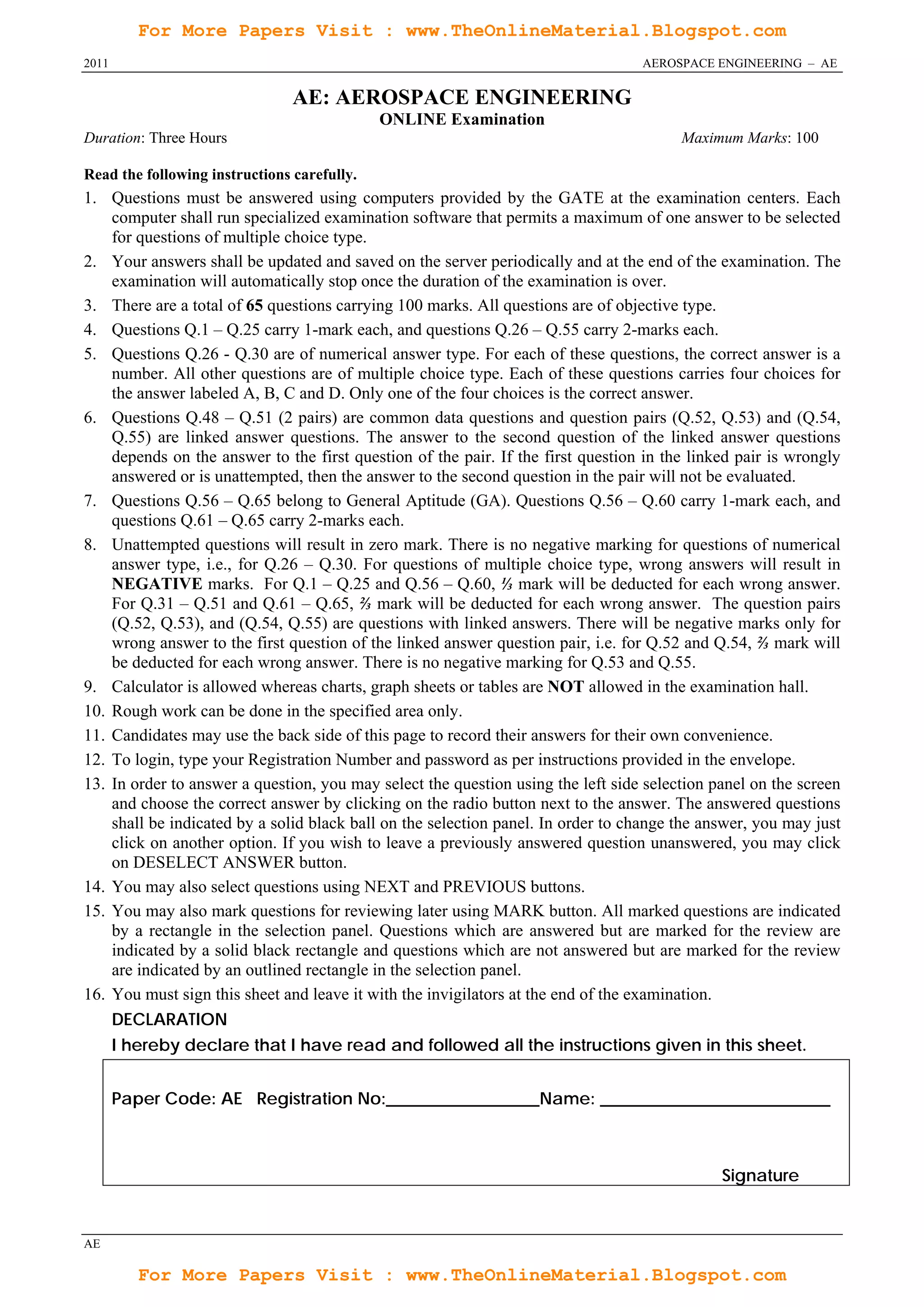
 Q.1   Consider x, y, z to be right-handed Cartesian coordinates. A vector function is defined in this
       coordinate system as v  3 xi  3 xyj  yz 2k , where i, j and k are the unit vectors along x, y and
       z axes, respectively. The curl of v is given by
       (A) z 2i  3 yk          (B) z 2 j  3 yk          (C) z 2i  3 yj           (D)  z 2 i  3 yk

 Q.2   Which of the following functions is periodic?

       (A) f ( x)  x 2         (B) f ( x)  log x        (C) f ( x)  e x          (D) f ( x)  const.

 Q.3   The function f ( x1 , x2 , x3 )  x12  x2  x3  2 x1  4 x2  6 x3  14 has its minimum value at
                                                2    2


       (A) (1, 2, 3)            (B) (0, 0, 0)             (C) (3, 2, 1)             (D) (1, 1, 3)

 Q.4                                                     x x
       Consider the function f ( x1 , x2 )  x12  2 x2  e 1 2 . The vector pointing in the direction of
                                                      2

       maximum increase of the function at the point (1, -1) is

              2                      1                         0.73                 2 
       (A) 
                 
                               (B) 
                                          
                                                         (C) 
                                                                         
                                                                                   (D) 
                                                                                              
                                                                                               
               5                     5                       6.73                  4

 Q.5   Two simultaneous equations given by y    x and y  x   have

       (A) a unique solution                              (B) infinitely many solutions
       (C) no solution                                    (D) a finite number of multiple solutions

 Q.6   In three-dimensional linear elastic solids, the number of non-trivial stress-strain relations, strain-
       displacement equations and equations of equilibrium are, respectively,
       (A) 3, 3 and 3           (B) 6, 3 and 3            (C) 6, 6 and 3            (D) 6, 3 and 6

 Q.7   An Euler-Bernoulli beam in bending is assumed to satisfy
       (A) both plane stress as well as plane strain conditions
       (B) plane strain condition but not plane stress condition
       (C) plane stress condition but not plane strain condition
       (D) neither plane strain condition nor plane stress condition

 Q.8   A statically indeterminate frame structure has
       (A) same number of joint degrees of freedom as the number of equilibrium equations
       (B) number of joint degrees of freedom greater than the number of equilibrium equations
       (C) number of joint degrees of freedom less than the number of equilibrium equations
       (D) unknown number of joint degrees of freedom, which cannot be solved using laws of mechanics

 Q.9   Consider a single degree of freedom spring-mass-damper system with mass, damping and stiffness
       of m , c and k , respectively. The logarithmic decrement of this system can be calculated using
                 2c                      c                        2c                            2c
       (A)                      (B)                       (C)                          (D)
               4mk  c    2
                                        4mk  c    2
                                                                  mk  c   2
                                                                                              mk  4c 2


AE

       For More Papers Visit : www.TheOnlineMaterial.Blogspot.com
For More Papers Visit : www.TheOnlineMaterial.Blogspot.com
2011                                                                                AEROSPACE ENGINEERING – AE

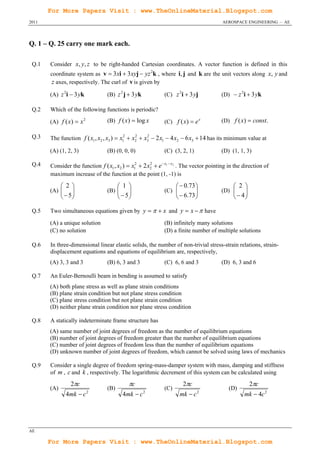
 Q.10   Consider a single degree of freedom spring-mass system of spring stiffness k1 and mass m which
        has a natural frequency of 10 rad/s. Consider another single degree of freedom spring-mass system
        of spring stiffness k 2 and mass m which has a natural frequency of 20 rad/s. The spring stiffness
        k 2 is equal to

        (A) k1                    (B) 2k1                       k1                  (D) 4k1
                                                          (C)
                                                                4

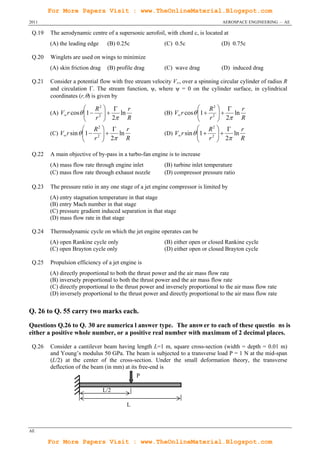
 Q.11   Consider a simply supported two-dimensional beam


        If the beam is converted into a fixed-fixed beam as


        then the degree of static indeterminacy will
        (A) increase by 3         (B) increase by 2       (C) decrease by 1         (D) decrease by 3

 Q.12   An impulsive launch of a rocket minimizes the loss of burn-out velocity due to
        (A) aerodynamic drag force only
        (B) gravitational force only
        (C) both aerodynamic drag and gravitational forces
        (D) reaction jet control force

 Q.13   Multi-staging in rockets improves the burn-out performance by increasing mainly stage-wise
        (A) payload mass ratios                           (B) structural mass efficiencies
        (C) propellant masses                             (D) control system masses

 Q.14   In an un-powered glide of an aircraft having weight W, lift L and drag D, the equilibrium glide
        angle is defined as

                  L                       D                      L                          W 
        (A) tan 1              (B) tan 1            (C) tan 1                  (D) tan 1  
                  D                       L                      W                          L

 Q.15   Lift on an aircraft climbing vertically up is
        (A) equal to its weight                           (B) zero
        (C) equal to the drag                             (D) equal to the thrust

 Q.16   If an aircraft is performing a positive yawing manoeuvre, the side slip angle
        (A) is always zero        (B) is never zero       (C) is always negative        (D) could be any value

 Q.17   For an airplane to be statically stable, its centre of gravity must always be
        (A) ahead of wing aerodynamic centre              (B) aft of the wing aerodynamic centre
        (C) ahead of neutral point                        (D) aft of neutral point

 Q.18   It is seen that the drag polar of a certain aerofoil is symmetric about the Cd axis. This drag polar
        could refer to
        (A) NACA 0012             (B) NACA 4415           (C) NACA 23012            (D) None of the above


AE

        For More Papers Visit : www.TheOnlineMaterial.Blogspot.com
For More Papers Visit : www.TheOnlineMaterial.Blogspot.com
2011                                                                               AEROSPACE ENGINEERING – AE

 Q.19   The aerodynamic centre of a supersonic aerofoil, with chord c, is located at
        (A) the leading edge      (B) 0.25c              (C) 0.5c                 (D) 0.75c

 Q.20   Winglets are used on wings to minimize
        (A) skin friction drag    (B) profile drag       (C) wave drag            (D) induced drag

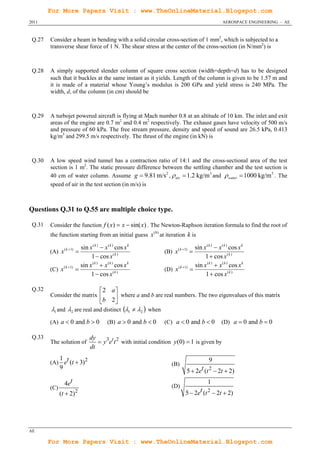
 Q.21   Consider a potential flow with free stream velocity V∞, over a spinning circular cylinder of radius R
        and circulation . The stream function, ψ, where ψ = 0 on the cylinder surface, in cylindrical
        coordinates (r,) is given by

                             R2      r                                     R2      r
        (A) V r cos  1 
                                
                               2 
                                     ln                  (B) V r cos  1 
                                                                                 
                                                                                2 
                                                                                      ln
                             r  2 R                                        r  2 R
                        R2         r                                  R2         r
        (C) V r sin  1  2  
                              2 ln R                  (D) V r sin  1  2  
                                                                               2 ln R
                          r                                              r 

 Q.22   A main objective of by-pass in a turbo-fan engine is to increase
        (A) mass flow rate through engine inlet          (B) turbine inlet temperature
        (C) mass flow rate through exhaust nozzle        (D) compressor pressure ratio

 Q.23   The pressure ratio in any one stage of a jet engine compressor is limited by
        (A) entry stagnation temperature in that stage
        (B) entry Mach number in that stage
        (C) pressure gradient induced separation in that stage
        (D) mass flow rate in that stage

 Q.24   Thermodynamic cycle on which the jet engine operates can be
        (A) open Rankine cycle only                      (B) either open or closed Rankine cycle
        (C) open Brayton cycle only                      (D) either open or closed Brayton cycle

 Q.25   Propulsion efficiency of a jet engine is
        (A) directly proportional to both the thrust power and the air mass flow rate
        (B) inversely proportional to both the thrust power and the air mass flow rate
        (C) directly proportional to the thrust power and inversely proportional to the air mass flow rate
        (D) inversely proportional to the thrust power and directly proportional to the air mass flow rate


Q. 26 to Q. 55 carry two marks each.
Questions Q.26 to Q. 30 are numerica l answer type. The answ er to each of these questio ns is
either a positive whole number, or a positive real number with maximum of 2 decimal places.

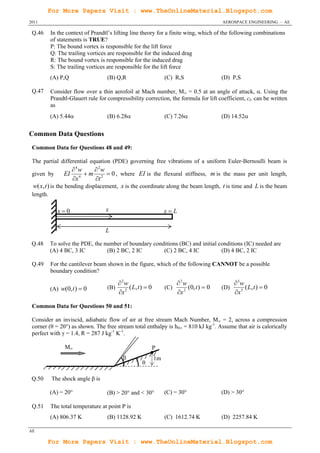
 Q.26   Consider a cantilever beam having length L=1 m, square cross-section (width = depth = 0.01 m)
        and Young’s modulus 50 GPa. The beam is subjected to a transverse load P = 1 N at the mid-span
        (L/2) at the center of the cross-section. Under the small deformation theory, the transverse
        deflection of the beam (in mm) at its free-end is
                                             P

                                 L/2

                                          L


AE

        For More Papers Visit : www.TheOnlineMaterial.Blogspot.com
For More Papers Visit : www.TheOnlineMaterial.Blogspot.com
2011                                                                                                AEROSPACE ENGINEERING – AE


 Q.27   Consider a beam in bending with a solid circular cross-section of 1 mm2, which is subjected to a
        transverse shear force of 1 N. The shear stress at the center of the cross-section (in N/mm2) is


 Q.28   A simply supported slender column of square cross section (width=depth=d) has to be designed
        such that it buckles at the same instant as it yields. Length of the column is given to be 1.57m and
        it is made of a material whose Young’s modulus is 200 GPa and yield stress is 240 MPa. The
        width, d, of the column (in cm) should be


 Q.29   A turbojet powered aircraft is flying at Mach number 0.8 at an altitude of 10 km. The inlet and exit
        areas of the engine are 0.7 m2 and 0.4 m2 respectively. The exhaust gases have velocity of 500 m/s
        and pressure of 60 kPa. The free stream pressure, density and speed of sound are 26.5 kPa, 0.413
        kg/m3 and 299.5 m/s respectively. The thrust of the engine (in kN) is


 Q.30   A low speed wind tunnel has a contraction ratio of 14:1 and the cross-sectional area of the test
        section is 1 m2. The static pressure difference between the settling chamber and the test section is
        40 cm of water column. Assume g  9.81 m/s 2 ,  air  1.2 kg/m 3 and  water  1000 kg/m 3 . The
        speed of air in the test section (in m/s) is


Questions Q.31 to Q.55 are multiple choice type.

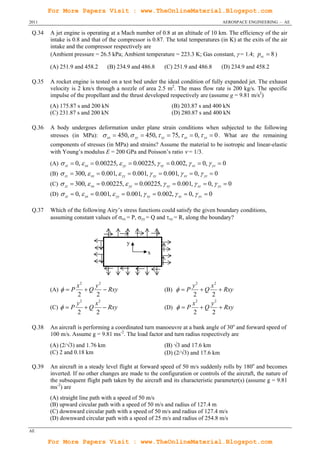
 Q.31   Consider the function f ( x)  x  sin( x) . The Newton-Raphson iteration formula to find the root of
        the function starting from an initial guess x ( 0 ) at iteration k is

                          sin x ( k )  x ( k ) cos x k                            sin x ( k )  x ( k ) cos x k
        (A) x ( k 1)                                           (B) x ( k 1) 
                               1  cos x ( k )                                          1  cos x ( k )
                          sin x ( k )  x ( k ) cos x k                            sin x ( k )  x ( k ) cos x k
        (C) x ( k 1)                                           (D) x ( k 1)   
                               1  cos x ( k )                                          1  cos x ( k )

 Q.32                        2 a 
        Consider the matrix           where a and b are real numbers. The two eigenvalues of this matrix
                              b 2  
        1 and 2 are real and distinct 1  2  when
        (A) a  0 and b  0               (B) a  0 and b  0    (C) a  0 and b  0               (D) a  0 and b  0

 Q.33                           dy
        The solution of             y 3et t 2 with initial condition y (0)  1 is given by
                                dt
              1                                                                         9
        (A) et (t  3) 2                                             (B)
              9                                                                    t (t 2  2t  2)
                                                                             5  2e
                  4et                                                                      1
        (C)                                                          (D)
              (t  2) 2                                                     5  2et (t 2  2t  2)


AE

        For More Papers Visit : www.TheOnlineMaterial.Blogspot.com
For More Papers Visit : www.TheOnlineMaterial.Blogspot.com
2011                                                                                   AEROSPACE ENGINEERING – AE

 Q.34   A jet engine is operating at a Mach number of 0.8 at an altitude of 10 km. The efficiency of the air
        intake is 0.8 and that of the compressor is 0.87. The total temperatures (in K) at the exits of the air
        intake and the compressor respectively are
        (Ambient pressure = 26.5 kPa; Ambient temperature = 223.3 K; Gas constant,  = 1.4; prc  8 )

        (A) 251.9 and 458.2       (B) 234.9 and 486.8       (C) 251.9 and 486.8        (D) 234.9 and 458.2

 Q.35   A rocket engine is tested on a test bed under the ideal condition of fully expanded jet. The exhaust
        velocity is 2 km/s through a nozzle of area 2.5 m2. The mass flow rate is 200 kg/s. The specific
        impulse of the propellant and the thrust developed respectively are (assume g = 9.81 m/s2)
        (A) 175.87 s and 200 kN                                (B) 203.87 s and 400 kN
        (C) 231.87 s and 200 kN                                (D) 280.87 s and 400 kN

 Q.36   A body undergoes deformation under plane strain conditions when subjected to the following
        stresses (in MPa):  xx  450,  yy  450,  xy  75,  xz  0,  yz  0 . What are the remaining
        components of stresses (in MPa) and strains? Assume the material to be isotropic and linear-elastic
        with Young’s modulus E = 200 GPa and Poisson’s ratio = 1/3.
        (A)  zz  0,  xx  0.00225,  yy  0.00225,  xy  0.002,  xz  0,  yz  0
        (B)  zz  300,  xx  0.001,  yy  0.001,  xy  0.001,  xz  0,  yz  0
        (C)  zz  300,  xx  0.00225,  yy  0.00225,  xy  0.001,  xz  0,  yz  0
        (D)  zz  0,  xx  0.001,  yy  0.001,  xy  0.002,  xz  0,  yz  0

 Q.37   Which of the following Airy’s stress functions could satisfy the given boundary conditions,
        assuming constant values of xx = P, yy = Q and xy = R, along the boundary?


                                          y
                                                    x


                  x2     y2                                           y2     x2
        (A)   P      Q  Rxy                             (B)   P      Q  Rxy
                  2      2                                            2      2
                    2
                  y      x2                                           x 2
                                                                             y2
        (C)   P      Q  Rxy                             (D)   P      Q  Rxy
                  2      2                                            2      2

 Q.38   An aircraft is performing a coordinated turn manoeuvre at a bank angle of 30o and forward speed of
        100 m/s. Assume g = 9.81 ms-2. The load factor and turn radius respectively are
        (A) (2/3) and 1.76 km                              (B) 3 and 17.6 km
        (C) 2 and 0.18 km                                   (D) (2/3) and 17.6 km

 Q.39   An aircraft in a steady level flight at forward speed of 50 m/s suddenly rolls by 180o and becomes
        inverted. If no other changes are made to the configuration or controls of the aircraft, the nature of
        the subsequent flight path taken by the aircraft and its characteristic parameter(s) (assume g = 9.81
        ms-2) are
        (A) straight line path with a speed of 50 m/s
        (B) upward circular path with a speed of 50 m/s and radius of 127.4 m
        (C) downward circular path with a speed of 50 m/s and radius of 127.4 m/s
        (D) downward circular path with a speed of 25 m/s and radius of 254.8 m/s

AE

        For More Papers Visit : www.TheOnlineMaterial.Blogspot.com
For More Papers Visit : www.TheOnlineMaterial.Blogspot.com
2011                                                                               AEROSPACE ENGINEERING – AE


 Q.40   An aircraft with a mass of 5000 kg takes off from sea level with a forward speed of 50 m/s and
        starts to climb with a climb angle of 15o. The rate of climb and excess thrust available at the start of
        the climb respectively (assume g = 9.81 ms-2) are
        (A) 13.40 m/s and 13146.0 N                       (B) 12.94 m/s and 12694.1 N
        (C) 13.40 m/s and 12694.1 N                       (D) 12.94 m/s and 13146.0 N

 Q.41   A glider having a mass of 500 kg is taken to an altitude of 1000 m with a jeep moving on ground at
        54 kmph. Upon reaching the required altitude in 50 s, the glider is released and starts its descent.
        Under the assumption of equilibrium glide, the range and endurance of the glider for a constant lift-
        to-drag ratio of 15 are
        (A) 15.0 km and 1002.2 s respectively             (B) 15.0 km and 601.3 s respectively
        (C) 1.0 km and 601.3 s respectively               (D) 1.0 km and 50 s respectively

 Q.42   An elliptic orbit has its perigee at 400 km above the Earth’s surface and apogee at 3400 km above
        the Earth’s surface. For this orbit, the eccentricity and semi-major axis respectively are (assume
        radius of Earth = 6400 km)
        (A) 0.18 and 8300 km                               (B) 0.18 and 1900 km
        (C) 0.22 and 8300 km                               (D) 0.22 and 1900 km

 Q.43   An aircraft in level flight encounters a vertical gust, which excites the phugoid mode. The phugoid
        motion completes 10 cycles in 50 s and its amplitude reduces to half of its maximum value in 25 s.
        The eigenvalues of the phugoid mode are
        (A) −0.05  0.02i       (B) −0.5  0.2i           (C) −0.028  1.26i       (D) 0.028  1.26i

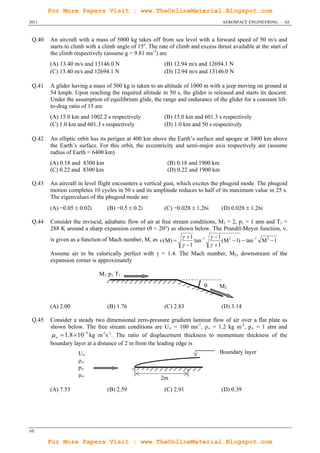
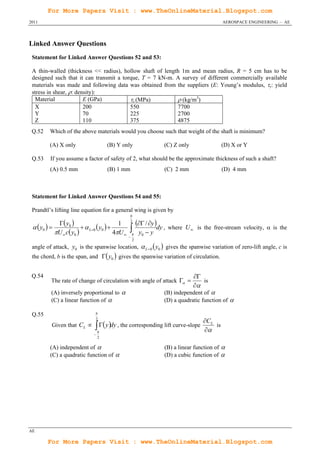
 Q.44   Consider the inviscid, adiabatic flow of air at free stream conditions, M1 = 2, p1 = 1 atm and T1 =
        288 K around a sharp expansion corner (θ = 20°) as shown below. The Prandtl-Meyer function, ν,
        is given as a function of Mach number, M, as  (M)    1 tan 1   1 (M 2  1)  tan 1 M 2  1
                                                                  1        1
        Assume air to be calorically perfect with  = 1.4. The Mach number, M2, downstream of the
        expansion corner is approximately

                             M1, p1, T1
                                                                                M2


        (A) 2.00                 (B) 1.76                 (C) 2.83                 (D) 3.14

 Q.45   Consider a steady two dimensional zero-pressure gradient laminar flow of air over a flat plate as
        shown below. The free stream conditions are U∞ = 100 ms-1, ρ∞ = 1.2 kg m-3, p∞ = 1 atm and
          1.8  105 kg m-1s-1. The ratio of displacement thickness to momentum thickness of the
        boundary layer at a distance of 2 m from the leading edge is
                   U∞                                                       Boundary layer
                   ∞
                   p∞
                   ∞
                                                       2m
        (A) 7.53                 (B) 2.59                 (C) 2.91                 (D) 0.39


AE

        For More Papers Visit : www.TheOnlineMaterial.Blogspot.com
For More Papers Visit : www.TheOnlineMaterial.Blogspot.com
2011                                                                                        AEROSPACE ENGINEERING – AE

 Q.46      In the context of Prandtl’s lifting line theory for a finite wing, which of the following combinations
           of statements is TRUE?
           P: The bound vortex is responsible for the lift force
           Q: The trailing vortices are responsible for the induced drag
           R: The bound vortex is responsible for the induced drag
           S: The trailing vortices are responsible for the lift force
           (A) P,Q                  (B) Q,R                        (C) R,S                  (D) P,S

 Q.47      Consider flow over a thin aerofoil at Mach number, M∞ = 0.5 at an angle of attack, . Using the
           Prandtl-Glauert rule for compressibility correction, the formula for lift coefficient, cl, can be written
           as
           (A) 5.44                (B) 6.28                      (C) 7.26                (D) 14.52


Common Data Questions
 Common Data for Questions 48 and 49:

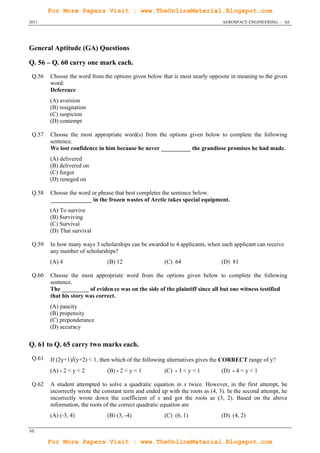
 The partial differential equation (PDE) governing free vibrations of a uniform Euler-Bernoulli beam is
                     4w      2w
 given by       EI         m 2  0 , where EI is the flexural stiffness, m is the mass per unit length,
                     x 4     t
 w( x, t ) is the bending displacement, x is the coordinate along the beam length, t is time and L is the beam
 length.

              x0                  x                               xL


                                   L

 Q.48      To solve the PDE, the number of boundary conditions (BC) and initial conditions (IC) needed are
           (A) 4 BC, 3 IC         (B) 2 BC, 2 IC        (C) 2 BC, 4 IC           (D) 4 BC, 2 IC

 Q.49      For the cantilever beam shown in the figure, which of the following CANNOT be a possible
           boundary condition?

                                          2w                            2w                       3w
           (A) w(0, t )  0         (B)        ( L, t )  0        (C)        (0, t )  0   (D)        ( L, t )  0
                                          x 2                           x 2                     x 3

 Common Data for Questions 50 and 51:

 Consider an inviscid, adiabatic flow of air at free stream Mach Number, M∞ = 2, across a compression
 corner (θ = 20°) as shown. The free stream total enthalpy is h0∞ = 810 kJ kg-1. Assume that air is calorically
 perfect with γ = 1.4, R = 287 J kg-1 K-1.

                 M∞                                           P
                                                            1m
                                                      

 Q.50      The shock angle β is

           (A) = 20°                (B) > 20° and< 30°            (C) = 30°               (D) > 30°

 Q.51      The total temperature at point P is
           (A) 806.37 K             (B) 1128.92 K                  (C) 1612.74 K            (D) 2257.84 K

AE

        For More Papers Visit : www.TheOnlineMaterial.Blogspot.com
For More Papers Visit : www.TheOnlineMaterial.Blogspot.com
2011                                                                                               AEROSPACE ENGINEERING – AE


Linked Answer Questions
 Statement for Linked Answer Questions 52 and 53:

 A thin-walled (thickness << radius), hollow shaft of length 1m and mean radius, R = 5 cm has to be
 designed such that it can transmit a torque, T = 7 kN-m. A survey of different commercially available
 materials was made and following data was obtained from the suppliers (E: Young’s modulus, y: yield
 stress in shear, : density):
  Material              E (GPa)          y (MPa)           (kg/m3)
  X                     200              550               7700
  Y                     70               225               2700
  Z                     110              375               4875
 Q.52    Which of the above materials would you choose such that weight of the shaft is minimum?

         (A) X only                      (B) Y only                     (C) Z only                 (D) X or Y

 Q.53     If you assume a factor of safety of 2, what should be the approximate thickness of such a shaft?
         (A) 0.5 mm                      (B) 1 mm                       (C) 2 mm                   (D) 4 mm


 Statement for Linked Answer Questions 54 and 55:

 Prandtl’s lifting line equation for a general wing is given by
                                                     b

                 y0                         1     2
                                                            / y dy ,
   y0                    L 0  y0                                 where U  is the free-stream velocity,  is the
              U  c y0                    4U      b    y0  y
                                                     
                                                       2

 angle of attack, y0 is the spanwise location,  L  0  y0  gives the spanwise variation of zero-lift angle, c is
 the chord, b is the span, and  y0  gives the spanwise variation of circulation.


 Q.54                                                                                
          The rate of change of circulation with angle of attack                     is
                                                                                     
          (A) inversely proportional to                                (B) independent of 
          (C) a linear function of                                     (D) a quadratic function of 

 Q.55                             b
                                  2
                                                                                         C L
          Given that C L           y dy , the corresponding lift curve-slope
                                     b                                                   
                                                                                              is
                                 
                                     2

         (A) independent of                                            (B) a linear function of 
         (C) a quadratic function of                                   (D) a cubic function of 


AE

        For More Papers Visit : www.TheOnlineMaterial.Blogspot.com
For More Papers Visit : www.TheOnlineMaterial.Blogspot.com
2011                                                                            AEROSPACE ENGINEERING – AE


General Aptitude (GA) Questions

Q. 56 – Q. 60 carry one mark each.
 Q.56   Choose the word from the options given below that is most nearly opposite in meaning to the given
        word:
        Deference
        (A) aversion
        (B) resignation
        (C) suspicion
        (D) contempt

 Q.57   Choose the most appropriate word(s) from the options given below to complete the following
        sentence.
        We lost confidence in him because he never __________ the grandiose promises he had made.
        (A) delivered
        (B) delivered on
        (C) forgot
        (D) reneged on

 Q.58   Choose the word or phrase that best completes the sentence below.
        ______________ in the frozen wastes of Arctic takes special equipment.
        (A) To survive
        (B) Surviving
        (C) Survival
        (D) That survival

 Q.59   In how many ways 3 scholarships can be awarded to 4 applicants, when each applicant can receive
        any number of scholarships?
        (A) 4                   (B) 12                  (C) 64                  (D) 81

 Q.60   Choose the most appropriate word from the options given below to complete the following
        sentence.
        The _________ of eviden ce was on the side of the plaintiff since all but one witness testified
        that his story was correct.
        (A) paucity
        (B) propensity
        (C) preponderance
        (D) accuracy


Q. 61 to Q. 65 carry two marks each.
 Q.61   If (2y+1)/(y+2) < 1, then which of the following alternatives gives the CORRECT range of y?
        (A) - 2 < y < 2         (B) - 2 < y < 1         (C) - 3 < y < 1         (D) - 4 < y < 1

 Q.62   A student attempted to solve a quadratic equation in x twice. However, in the first attempt, he
        incorrectly wrote the constant term and ended up with the roots as (4, 3). In the second attempt, he
        incorrectly wrote down the coefficient of x and got the roots as (3, 2). Based on the above
        information, the roots of the correct quadratic equation are
        (A) (-3, 4)             (B) (3, -4)             (C) (6, 1)              (D) (4, 2)

AE

        For More Papers Visit : www.TheOnlineMaterial.Blogspot.com
For More Papers Visit : www.TheOnlineMaterial.Blogspot.com
2011                                                                               AEROSPACE ENGINEERING – AE


 Q.63   L, M and N are waiting in a queue meant for children to enter the zoo. There are 5 children between
        L and M, and 8 children between M and N. If there are 3 children ahead of N and 21 children
        behind L, then what is the minimum number of children in the queue?
        (A) 28                  (B) 27                      (C) 41                 (D) 40

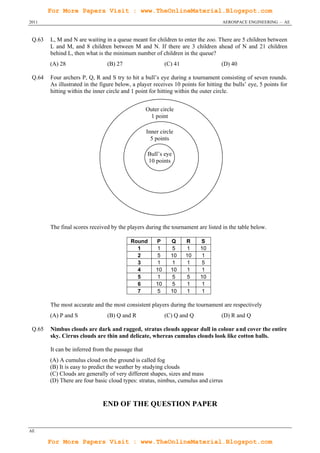
 Q.64   Four archers P, Q, R and S try to hit a bull’s eye during a tournament consisting of seven rounds.
        As illustrated in the figure below, a player receives 10 points for hitting the bulls’ eye, 5 points for
        hitting within the inner circle and 1 point for hitting within the outer circle.


                                                   Outer circle
                                                    1 point

                                                   Inner circle
                                                     5 points

                                                   Bull’s eye
                                                   10 points


        The final scores received by the players during the tournament are listed in the table below.

                                           Round       P      Q      R    S
                                             1         1      5      1    10
                                             2         5      10     10   1
                                             3         1      1      1    5
                                             4         10     10     1    1
                                             5         1      5      5    10
                                             6         10     5      1    1
                                             7         5      10     1    1

        The most accurate and the most consistent players during the tournament are respectively
        (A) P and S             (B) Q and R                 (C) Q and Q            (D) R and Q

 Q.65   Nimbus clouds are dark and ragged, stratus clouds appear dull in colour a nd cover the entire
        sky. Cirrus clouds are thin and delicate, whereas cumulus clouds look like cotton balls.

        It can be inferred from the passage that
        (A) A cumulus cloud on the ground is called fog
        (B) It is easy to predict the weather by studying clouds
        (C) Clouds are generally of very different shapes, sizes and mass
        (D) There are four basic cloud types: stratus, nimbus, cumulus and cirrus


                               END OF THE QUESTION PAPER


AE

        For More Papers Visit : www.TheOnlineMaterial.Blogspot.com
For More Papers Visit : www.TheOnlineMaterial.Blogspot.com


                       GATE 2011 - Answer Key - Paper : AE

Paper   Question no.        Key              Paper    Question no.     Key
 AE          1               D                AE          36             B
 AE          2               D                AE          37             C
 AE          3               A                AE          38             A
 AE          4               B                AE          39             C
 AE          5               C                AE          40             B
 AE          6               C                AE          41         MarkstoAll
 AE          7               D                AE          42             A
 AE          8          MarkstoAll            AE          43             C
 AE          9               A                AE          44             C
 AE         10               D                AE          45             B
 AE         11               A                AE          46             A
 AE         12               B                AE          47             C
 AE         13               A                AE          48             D
 AE         14               B                AE          49             C
 AE         15               B                AE          50             D
 AE         16               D                AE          51             A
 AE         17               C                AE          52             B
 AE         18               A                AE          53             D
 AE         19               C                AE          54             B
 AE         20               D                AE          55             A
 AE         21               C                AE          56             D
 AE         22              A/C               AE          57             B
 AE         23               C                AE          58             A
 AE         24               C                AE          59             C
 AE         25               C                AE          60             C
 AE         26          2.45to2.55            AE          61             B
 AE         27           1.3to1.35            AE          62             C
 AE         28          5.95to6.05            AE          63             A
 AE         29            29to32              AE          64             B
 AE         30            80to82              AE          65             D
 AE         31               A
 AE         32               C
 AE         33               D
 AE         34               C
 AE         35               B


    For More Papers Visit : www.TheOnlineMaterial.Blogspot.com

Aerospace Engineering (AE) - Gate Previous Question Paper 2011 Download

  • 1.
    For More PapersVisit : www.TheOnlineMaterial.Blogspot.com 2011 AEROSPACE ENGINEERING – AE AE: AEROSPACE ENGINEERING ONLINE Examination Duration: Three Hours Maximum Marks: 100 Read the following instructions carefully. 1. Questions must be answered using computers provided by the GATE at the examination centers. Each computer shall run specialized examination software that permits a maximum of one answer to be selected for questions of multiple choice type. 2. Your answers shall be updated and saved on the server periodically and at the end of the examination. The examination will automatically stop once the duration of the examination is over. 3. There are a total of 65 questions carrying 100 marks. All questions are of objective type. 4. Questions Q.1 – Q.25 carry 1-mark each, and questions Q.26 – Q.55 carry 2-marks each. 5. Questions Q.26 - Q.30 are of numerical answer type. For each of these questions, the correct answer is a number. All other questions are of multiple choice type. Each of these questions carries four choices for the answer labeled A, B, C and D. Only one of the four choices is the correct answer. 6. Questions Q.48 – Q.51 (2 pairs) are common data questions and question pairs (Q.52, Q.53) and (Q.54, Q.55) are linked answer questions. The answer to the second question of the linked answer questions depends on the answer to the first question of the pair. If the first question in the linked pair is wrongly answered or is unattempted, then the answer to the second question in the pair will not be evaluated. 7. Questions Q.56 – Q.65 belong to General Aptitude (GA). Questions Q.56 – Q.60 carry 1-mark each, and questions Q.61 – Q.65 carry 2-marks each. 8. Unattempted questions will result in zero mark. There is no negative marking for questions of numerical answer type, i.e., for Q.26 – Q.30. For questions of multiple choice type, wrong answers will result in NEGATIVE marks. For Q.1 – Q.25 and Q.56 – Q.60, ⅓ mark will be deducted for each wrong answer. For Q.31 – Q.51 and Q.61 – Q.65, ⅔ mark will be deducted for each wrong answer. The question pairs (Q.52, Q.53), and (Q.54, Q.55) are questions with linked answers. There will be negative marks only for wrong answer to the first question of the linked answer question pair, i.e. for Q.52 and Q.54, ⅔ mark will be deducted for each wrong answer. There is no negative marking for Q.53 and Q.55. 9. Calculator is allowed whereas charts, graph sheets or tables are NOT allowed in the examination hall. 10. Rough work can be done in the specified area only. 11. Candidates may use the back side of this page to record their answers for their own convenience. 12. To login, type your Registration Number and password as per instructions provided in the envelope. 13. In order to answer a question, you may select the question using the left side selection panel on the screen and choose the correct answer by clicking on the radio button next to the answer. The answered questions shall be indicated by a solid black ball on the selection panel. In order to change the answer, you may just click on another option. If you wish to leave a previously answered question unanswered, you may click on DESELECT ANSWER button. 14. You may also select questions using NEXT and PREVIOUS buttons. 15. You may also mark questions for reviewing later using MARK button. All marked questions are indicated by a rectangle in the selection panel. Questions which are answered but are marked for the review are indicated by a solid black rectangle and questions which are not answered but are marked for the review are indicated by an outlined rectangle in the selection panel. 16. You must sign this sheet and leave it with the invigilators at the end of the examination. DECLARATION I hereby declare that I have read and followed all the instructions given in this sheet. Paper Code: AE Registration No:__________________Name: ___________________________ Signature AE For More Papers Visit : www.TheOnlineMaterial.Blogspot.com
  • 2.
    For More PapersVisit : www.TheOnlineMaterial.Blogspot.com 2011 AEROSPACE ENGINEERING – AE Q. 1 – Q. 25 carry one mark each. Q.1 Consider x, y, z to be right-handed Cartesian coordinates. A vector function is defined in this coordinate system as v  3 xi  3 xyj  yz 2k , where i, j and k are the unit vectors along x, y and z axes, respectively. The curl of v is given by (A) z 2i  3 yk (B) z 2 j  3 yk (C) z 2i  3 yj (D)  z 2 i  3 yk Q.2 Which of the following functions is periodic? (A) f ( x)  x 2 (B) f ( x)  log x (C) f ( x)  e x (D) f ( x)  const. Q.3 The function f ( x1 , x2 , x3 )  x12  x2  x3  2 x1  4 x2  6 x3  14 has its minimum value at 2 2 (A) (1, 2, 3) (B) (0, 0, 0) (C) (3, 2, 1) (D) (1, 1, 3) Q.4 x x Consider the function f ( x1 , x2 )  x12  2 x2  e 1 2 . The vector pointing in the direction of 2 maximum increase of the function at the point (1, -1) is  2   1    0.73   2  (A)     (B)     (C)     (D)       5   5   6.73    4 Q.5 Two simultaneous equations given by y    x and y  x   have (A) a unique solution (B) infinitely many solutions (C) no solution (D) a finite number of multiple solutions Q.6 In three-dimensional linear elastic solids, the number of non-trivial stress-strain relations, strain- displacement equations and equations of equilibrium are, respectively, (A) 3, 3 and 3 (B) 6, 3 and 3 (C) 6, 6 and 3 (D) 6, 3 and 6 Q.7 An Euler-Bernoulli beam in bending is assumed to satisfy (A) both plane stress as well as plane strain conditions (B) plane strain condition but not plane stress condition (C) plane stress condition but not plane strain condition (D) neither plane strain condition nor plane stress condition Q.8 A statically indeterminate frame structure has (A) same number of joint degrees of freedom as the number of equilibrium equations (B) number of joint degrees of freedom greater than the number of equilibrium equations (C) number of joint degrees of freedom less than the number of equilibrium equations (D) unknown number of joint degrees of freedom, which cannot be solved using laws of mechanics Q.9 Consider a single degree of freedom spring-mass-damper system with mass, damping and stiffness of m , c and k , respectively. The logarithmic decrement of this system can be calculated using 2c c 2c 2c (A) (B) (C) (D) 4mk  c 2 4mk  c 2 mk  c 2 mk  4c 2 AE For More Papers Visit : www.TheOnlineMaterial.Blogspot.com
  • 3.
    For More PapersVisit : www.TheOnlineMaterial.Blogspot.com 2011 AEROSPACE ENGINEERING – AE Q.10 Consider a single degree of freedom spring-mass system of spring stiffness k1 and mass m which has a natural frequency of 10 rad/s. Consider another single degree of freedom spring-mass system of spring stiffness k 2 and mass m which has a natural frequency of 20 rad/s. The spring stiffness k 2 is equal to (A) k1 (B) 2k1 k1 (D) 4k1 (C) 4 Q.11 Consider a simply supported two-dimensional beam If the beam is converted into a fixed-fixed beam as then the degree of static indeterminacy will (A) increase by 3 (B) increase by 2 (C) decrease by 1 (D) decrease by 3 Q.12 An impulsive launch of a rocket minimizes the loss of burn-out velocity due to (A) aerodynamic drag force only (B) gravitational force only (C) both aerodynamic drag and gravitational forces (D) reaction jet control force Q.13 Multi-staging in rockets improves the burn-out performance by increasing mainly stage-wise (A) payload mass ratios (B) structural mass efficiencies (C) propellant masses (D) control system masses Q.14 In an un-powered glide of an aircraft having weight W, lift L and drag D, the equilibrium glide angle is defined as L D L W  (A) tan 1  (B) tan 1  (C) tan 1   (D) tan 1   D L W  L Q.15 Lift on an aircraft climbing vertically up is (A) equal to its weight (B) zero (C) equal to the drag (D) equal to the thrust Q.16 If an aircraft is performing a positive yawing manoeuvre, the side slip angle (A) is always zero (B) is never zero (C) is always negative (D) could be any value Q.17 For an airplane to be statically stable, its centre of gravity must always be (A) ahead of wing aerodynamic centre (B) aft of the wing aerodynamic centre (C) ahead of neutral point (D) aft of neutral point Q.18 It is seen that the drag polar of a certain aerofoil is symmetric about the Cd axis. This drag polar could refer to (A) NACA 0012 (B) NACA 4415 (C) NACA 23012 (D) None of the above AE For More Papers Visit : www.TheOnlineMaterial.Blogspot.com
  • 4.
    For More PapersVisit : www.TheOnlineMaterial.Blogspot.com 2011 AEROSPACE ENGINEERING – AE Q.19 The aerodynamic centre of a supersonic aerofoil, with chord c, is located at (A) the leading edge (B) 0.25c (C) 0.5c (D) 0.75c Q.20 Winglets are used on wings to minimize (A) skin friction drag (B) profile drag (C) wave drag (D) induced drag Q.21 Consider a potential flow with free stream velocity V∞, over a spinning circular cylinder of radius R and circulation . The stream function, ψ, where ψ = 0 on the cylinder surface, in cylindrical coordinates (r,) is given by  R2   r  R2   r (A) V r cos  1    2  ln (B) V r cos  1    2  ln  r  2 R  r  2 R  R2   r  R2   r (C) V r sin  1  2     2 ln R (D) V r sin  1  2     2 ln R  r   r  Q.22 A main objective of by-pass in a turbo-fan engine is to increase (A) mass flow rate through engine inlet (B) turbine inlet temperature (C) mass flow rate through exhaust nozzle (D) compressor pressure ratio Q.23 The pressure ratio in any one stage of a jet engine compressor is limited by (A) entry stagnation temperature in that stage (B) entry Mach number in that stage (C) pressure gradient induced separation in that stage (D) mass flow rate in that stage Q.24 Thermodynamic cycle on which the jet engine operates can be (A) open Rankine cycle only (B) either open or closed Rankine cycle (C) open Brayton cycle only (D) either open or closed Brayton cycle Q.25 Propulsion efficiency of a jet engine is (A) directly proportional to both the thrust power and the air mass flow rate (B) inversely proportional to both the thrust power and the air mass flow rate (C) directly proportional to the thrust power and inversely proportional to the air mass flow rate (D) inversely proportional to the thrust power and directly proportional to the air mass flow rate Q. 26 to Q. 55 carry two marks each. Questions Q.26 to Q. 30 are numerica l answer type. The answ er to each of these questio ns is either a positive whole number, or a positive real number with maximum of 2 decimal places. Q.26 Consider a cantilever beam having length L=1 m, square cross-section (width = depth = 0.01 m) and Young’s modulus 50 GPa. The beam is subjected to a transverse load P = 1 N at the mid-span (L/2) at the center of the cross-section. Under the small deformation theory, the transverse deflection of the beam (in mm) at its free-end is P L/2 L AE For More Papers Visit : www.TheOnlineMaterial.Blogspot.com
  • 5.
    For More PapersVisit : www.TheOnlineMaterial.Blogspot.com 2011 AEROSPACE ENGINEERING – AE Q.27 Consider a beam in bending with a solid circular cross-section of 1 mm2, which is subjected to a transverse shear force of 1 N. The shear stress at the center of the cross-section (in N/mm2) is Q.28 A simply supported slender column of square cross section (width=depth=d) has to be designed such that it buckles at the same instant as it yields. Length of the column is given to be 1.57m and it is made of a material whose Young’s modulus is 200 GPa and yield stress is 240 MPa. The width, d, of the column (in cm) should be Q.29 A turbojet powered aircraft is flying at Mach number 0.8 at an altitude of 10 km. The inlet and exit areas of the engine are 0.7 m2 and 0.4 m2 respectively. The exhaust gases have velocity of 500 m/s and pressure of 60 kPa. The free stream pressure, density and speed of sound are 26.5 kPa, 0.413 kg/m3 and 299.5 m/s respectively. The thrust of the engine (in kN) is Q.30 A low speed wind tunnel has a contraction ratio of 14:1 and the cross-sectional area of the test section is 1 m2. The static pressure difference between the settling chamber and the test section is 40 cm of water column. Assume g  9.81 m/s 2 ,  air  1.2 kg/m 3 and  water  1000 kg/m 3 . The speed of air in the test section (in m/s) is Questions Q.31 to Q.55 are multiple choice type. Q.31 Consider the function f ( x)  x  sin( x) . The Newton-Raphson iteration formula to find the root of the function starting from an initial guess x ( 0 ) at iteration k is sin x ( k )  x ( k ) cos x k sin x ( k )  x ( k ) cos x k (A) x ( k 1)  (B) x ( k 1)  1  cos x ( k ) 1  cos x ( k ) sin x ( k )  x ( k ) cos x k sin x ( k )  x ( k ) cos x k (C) x ( k 1)  (D) x ( k 1)  1  cos x ( k ) 1  cos x ( k ) Q.32 2 a  Consider the matrix  where a and b are real numbers. The two eigenvalues of this matrix  b 2  1 and 2 are real and distinct 1  2  when (A) a  0 and b  0 (B) a  0 and b  0 (C) a  0 and b  0 (D) a  0 and b  0 Q.33 dy The solution of  y 3et t 2 with initial condition y (0)  1 is given by dt 1 9 (A) et (t  3) 2 (B) 9 t (t 2  2t  2) 5  2e 4et 1 (C) (D) (t  2) 2 5  2et (t 2  2t  2) AE For More Papers Visit : www.TheOnlineMaterial.Blogspot.com
  • 6.
    For More PapersVisit : www.TheOnlineMaterial.Blogspot.com 2011 AEROSPACE ENGINEERING – AE Q.34 A jet engine is operating at a Mach number of 0.8 at an altitude of 10 km. The efficiency of the air intake is 0.8 and that of the compressor is 0.87. The total temperatures (in K) at the exits of the air intake and the compressor respectively are (Ambient pressure = 26.5 kPa; Ambient temperature = 223.3 K; Gas constant,  = 1.4; prc  8 ) (A) 251.9 and 458.2 (B) 234.9 and 486.8 (C) 251.9 and 486.8 (D) 234.9 and 458.2 Q.35 A rocket engine is tested on a test bed under the ideal condition of fully expanded jet. The exhaust velocity is 2 km/s through a nozzle of area 2.5 m2. The mass flow rate is 200 kg/s. The specific impulse of the propellant and the thrust developed respectively are (assume g = 9.81 m/s2) (A) 175.87 s and 200 kN (B) 203.87 s and 400 kN (C) 231.87 s and 200 kN (D) 280.87 s and 400 kN Q.36 A body undergoes deformation under plane strain conditions when subjected to the following stresses (in MPa):  xx  450,  yy  450,  xy  75,  xz  0,  yz  0 . What are the remaining components of stresses (in MPa) and strains? Assume the material to be isotropic and linear-elastic with Young’s modulus E = 200 GPa and Poisson’s ratio = 1/3. (A)  zz  0,  xx  0.00225,  yy  0.00225,  xy  0.002,  xz  0,  yz  0 (B)  zz  300,  xx  0.001,  yy  0.001,  xy  0.001,  xz  0,  yz  0 (C)  zz  300,  xx  0.00225,  yy  0.00225,  xy  0.001,  xz  0,  yz  0 (D)  zz  0,  xx  0.001,  yy  0.001,  xy  0.002,  xz  0,  yz  0 Q.37 Which of the following Airy’s stress functions could satisfy the given boundary conditions, assuming constant values of xx = P, yy = Q and xy = R, along the boundary? y x x2 y2 y2 x2 (A)   P  Q  Rxy (B)   P  Q  Rxy 2 2 2 2 2 y x2 x 2 y2 (C)   P  Q  Rxy (D)   P  Q  Rxy 2 2 2 2 Q.38 An aircraft is performing a coordinated turn manoeuvre at a bank angle of 30o and forward speed of 100 m/s. Assume g = 9.81 ms-2. The load factor and turn radius respectively are (A) (2/3) and 1.76 km (B) 3 and 17.6 km (C) 2 and 0.18 km (D) (2/3) and 17.6 km Q.39 An aircraft in a steady level flight at forward speed of 50 m/s suddenly rolls by 180o and becomes inverted. If no other changes are made to the configuration or controls of the aircraft, the nature of the subsequent flight path taken by the aircraft and its characteristic parameter(s) (assume g = 9.81 ms-2) are (A) straight line path with a speed of 50 m/s (B) upward circular path with a speed of 50 m/s and radius of 127.4 m (C) downward circular path with a speed of 50 m/s and radius of 127.4 m/s (D) downward circular path with a speed of 25 m/s and radius of 254.8 m/s AE For More Papers Visit : www.TheOnlineMaterial.Blogspot.com
  • 7.
    For More PapersVisit : www.TheOnlineMaterial.Blogspot.com 2011 AEROSPACE ENGINEERING – AE Q.40 An aircraft with a mass of 5000 kg takes off from sea level with a forward speed of 50 m/s and starts to climb with a climb angle of 15o. The rate of climb and excess thrust available at the start of the climb respectively (assume g = 9.81 ms-2) are (A) 13.40 m/s and 13146.0 N (B) 12.94 m/s and 12694.1 N (C) 13.40 m/s and 12694.1 N (D) 12.94 m/s and 13146.0 N Q.41 A glider having a mass of 500 kg is taken to an altitude of 1000 m with a jeep moving on ground at 54 kmph. Upon reaching the required altitude in 50 s, the glider is released and starts its descent. Under the assumption of equilibrium glide, the range and endurance of the glider for a constant lift- to-drag ratio of 15 are (A) 15.0 km and 1002.2 s respectively (B) 15.0 km and 601.3 s respectively (C) 1.0 km and 601.3 s respectively (D) 1.0 km and 50 s respectively Q.42 An elliptic orbit has its perigee at 400 km above the Earth’s surface and apogee at 3400 km above the Earth’s surface. For this orbit, the eccentricity and semi-major axis respectively are (assume radius of Earth = 6400 km) (A) 0.18 and 8300 km (B) 0.18 and 1900 km (C) 0.22 and 8300 km (D) 0.22 and 1900 km Q.43 An aircraft in level flight encounters a vertical gust, which excites the phugoid mode. The phugoid motion completes 10 cycles in 50 s and its amplitude reduces to half of its maximum value in 25 s. The eigenvalues of the phugoid mode are (A) −0.05  0.02i (B) −0.5  0.2i (C) −0.028  1.26i (D) 0.028  1.26i Q.44 Consider the inviscid, adiabatic flow of air at free stream conditions, M1 = 2, p1 = 1 atm and T1 = 288 K around a sharp expansion corner (θ = 20°) as shown below. The Prandtl-Meyer function, ν, is given as a function of Mach number, M, as  (M)    1 tan 1   1 (M 2  1)  tan 1 M 2  1  1  1 Assume air to be calorically perfect with  = 1.4. The Mach number, M2, downstream of the expansion corner is approximately M1, p1, T1  M2 (A) 2.00 (B) 1.76 (C) 2.83 (D) 3.14 Q.45 Consider a steady two dimensional zero-pressure gradient laminar flow of air over a flat plate as shown below. The free stream conditions are U∞ = 100 ms-1, ρ∞ = 1.2 kg m-3, p∞ = 1 atm and   1.8  105 kg m-1s-1. The ratio of displacement thickness to momentum thickness of the boundary layer at a distance of 2 m from the leading edge is U∞ Boundary layer ∞ p∞ ∞ 2m (A) 7.53 (B) 2.59 (C) 2.91 (D) 0.39 AE For More Papers Visit : www.TheOnlineMaterial.Blogspot.com
  • 8.
    For More PapersVisit : www.TheOnlineMaterial.Blogspot.com 2011 AEROSPACE ENGINEERING – AE Q.46 In the context of Prandtl’s lifting line theory for a finite wing, which of the following combinations of statements is TRUE? P: The bound vortex is responsible for the lift force Q: The trailing vortices are responsible for the induced drag R: The bound vortex is responsible for the induced drag S: The trailing vortices are responsible for the lift force (A) P,Q (B) Q,R (C) R,S (D) P,S Q.47 Consider flow over a thin aerofoil at Mach number, M∞ = 0.5 at an angle of attack, . Using the Prandtl-Glauert rule for compressibility correction, the formula for lift coefficient, cl, can be written as (A) 5.44 (B) 6.28 (C) 7.26 (D) 14.52 Common Data Questions Common Data for Questions 48 and 49: The partial differential equation (PDE) governing free vibrations of a uniform Euler-Bernoulli beam is 4w 2w given by EI  m 2  0 , where EI is the flexural stiffness, m is the mass per unit length, x 4 t w( x, t ) is the bending displacement, x is the coordinate along the beam length, t is time and L is the beam length. x0 x xL L Q.48 To solve the PDE, the number of boundary conditions (BC) and initial conditions (IC) needed are (A) 4 BC, 3 IC (B) 2 BC, 2 IC (C) 2 BC, 4 IC (D) 4 BC, 2 IC Q.49 For the cantilever beam shown in the figure, which of the following CANNOT be a possible boundary condition? 2w 2w  3w (A) w(0, t )  0 (B) ( L, t )  0 (C) (0, t )  0 (D) ( L, t )  0 x 2 x 2 x 3 Common Data for Questions 50 and 51: Consider an inviscid, adiabatic flow of air at free stream Mach Number, M∞ = 2, across a compression corner (θ = 20°) as shown. The free stream total enthalpy is h0∞ = 810 kJ kg-1. Assume that air is calorically perfect with γ = 1.4, R = 287 J kg-1 K-1. M∞ P  1m  Q.50 The shock angle β is (A) = 20° (B) > 20° and< 30° (C) = 30°  (D) > 30° Q.51 The total temperature at point P is (A) 806.37 K (B) 1128.92 K (C) 1612.74 K (D) 2257.84 K AE For More Papers Visit : www.TheOnlineMaterial.Blogspot.com
  • 9.
    For More PapersVisit : www.TheOnlineMaterial.Blogspot.com 2011 AEROSPACE ENGINEERING – AE Linked Answer Questions Statement for Linked Answer Questions 52 and 53: A thin-walled (thickness << radius), hollow shaft of length 1m and mean radius, R = 5 cm has to be designed such that it can transmit a torque, T = 7 kN-m. A survey of different commercially available materials was made and following data was obtained from the suppliers (E: Young’s modulus, y: yield stress in shear, : density): Material E (GPa) y (MPa)  (kg/m3) X 200 550 7700 Y 70 225 2700 Z 110 375 4875 Q.52 Which of the above materials would you choose such that weight of the shaft is minimum? (A) X only (B) Y only (C) Z only (D) X or Y Q.53 If you assume a factor of safety of 2, what should be the approximate thickness of such a shaft? (A) 0.5 mm (B) 1 mm (C) 2 mm (D) 4 mm Statement for Linked Answer Questions 54 and 55: Prandtl’s lifting line equation for a general wing is given by b   y0  1 2  / y dy ,   y0     L 0  y0    where U  is the free-stream velocity,  is the U  c y0  4U  b y0  y  2 angle of attack, y0 is the spanwise location,  L  0  y0  gives the spanwise variation of zero-lift angle, c is the chord, b is the span, and  y0  gives the spanwise variation of circulation. Q.54  The rate of change of circulation with angle of attack   is  (A) inversely proportional to  (B) independent of  (C) a linear function of  (D) a quadratic function of  Q.55 b 2 C L Given that C L    y dy , the corresponding lift curve-slope b  is  2 (A) independent of  (B) a linear function of  (C) a quadratic function of  (D) a cubic function of  AE For More Papers Visit : www.TheOnlineMaterial.Blogspot.com
  • 10.
    For More PapersVisit : www.TheOnlineMaterial.Blogspot.com 2011 AEROSPACE ENGINEERING – AE General Aptitude (GA) Questions Q. 56 – Q. 60 carry one mark each. Q.56 Choose the word from the options given below that is most nearly opposite in meaning to the given word: Deference (A) aversion (B) resignation (C) suspicion (D) contempt Q.57 Choose the most appropriate word(s) from the options given below to complete the following sentence. We lost confidence in him because he never __________ the grandiose promises he had made. (A) delivered (B) delivered on (C) forgot (D) reneged on Q.58 Choose the word or phrase that best completes the sentence below. ______________ in the frozen wastes of Arctic takes special equipment. (A) To survive (B) Surviving (C) Survival (D) That survival Q.59 In how many ways 3 scholarships can be awarded to 4 applicants, when each applicant can receive any number of scholarships? (A) 4 (B) 12 (C) 64 (D) 81 Q.60 Choose the most appropriate word from the options given below to complete the following sentence. The _________ of eviden ce was on the side of the plaintiff since all but one witness testified that his story was correct. (A) paucity (B) propensity (C) preponderance (D) accuracy Q. 61 to Q. 65 carry two marks each. Q.61 If (2y+1)/(y+2) < 1, then which of the following alternatives gives the CORRECT range of y? (A) - 2 < y < 2 (B) - 2 < y < 1 (C) - 3 < y < 1 (D) - 4 < y < 1 Q.62 A student attempted to solve a quadratic equation in x twice. However, in the first attempt, he incorrectly wrote the constant term and ended up with the roots as (4, 3). In the second attempt, he incorrectly wrote down the coefficient of x and got the roots as (3, 2). Based on the above information, the roots of the correct quadratic equation are (A) (-3, 4) (B) (3, -4) (C) (6, 1) (D) (4, 2) AE For More Papers Visit : www.TheOnlineMaterial.Blogspot.com
  • 11.
    For More PapersVisit : www.TheOnlineMaterial.Blogspot.com 2011 AEROSPACE ENGINEERING – AE Q.63 L, M and N are waiting in a queue meant for children to enter the zoo. There are 5 children between L and M, and 8 children between M and N. If there are 3 children ahead of N and 21 children behind L, then what is the minimum number of children in the queue? (A) 28 (B) 27 (C) 41 (D) 40 Q.64 Four archers P, Q, R and S try to hit a bull’s eye during a tournament consisting of seven rounds. As illustrated in the figure below, a player receives 10 points for hitting the bulls’ eye, 5 points for hitting within the inner circle and 1 point for hitting within the outer circle. Outer circle 1 point Inner circle 5 points Bull’s eye 10 points The final scores received by the players during the tournament are listed in the table below. Round P Q R S 1 1 5 1 10 2 5 10 10 1 3 1 1 1 5 4 10 10 1 1 5 1 5 5 10 6 10 5 1 1 7 5 10 1 1 The most accurate and the most consistent players during the tournament are respectively (A) P and S (B) Q and R (C) Q and Q (D) R and Q Q.65 Nimbus clouds are dark and ragged, stratus clouds appear dull in colour a nd cover the entire sky. Cirrus clouds are thin and delicate, whereas cumulus clouds look like cotton balls. It can be inferred from the passage that (A) A cumulus cloud on the ground is called fog (B) It is easy to predict the weather by studying clouds (C) Clouds are generally of very different shapes, sizes and mass (D) There are four basic cloud types: stratus, nimbus, cumulus and cirrus END OF THE QUESTION PAPER AE For More Papers Visit : www.TheOnlineMaterial.Blogspot.com
  • 12.
    For More PapersVisit : www.TheOnlineMaterial.Blogspot.com GATE 2011 - Answer Key - Paper : AE Paper Question no. Key Paper Question no. Key AE 1 D AE 36 B AE 2 D AE 37 C AE 3 A AE 38 A AE 4 B AE 39 C AE 5 C AE 40 B AE 6 C AE 41 MarkstoAll AE 7 D AE 42 A AE 8 MarkstoAll AE 43 C AE 9 A AE 44 C AE 10 D AE 45 B AE 11 A AE 46 A AE 12 B AE 47 C AE 13 A AE 48 D AE 14 B AE 49 C AE 15 B AE 50 D AE 16 D AE 51 A AE 17 C AE 52 B AE 18 A AE 53 D AE 19 C AE 54 B AE 20 D AE 55 A AE 21 C AE 56 D AE 22 A/C AE 57 B AE 23 C AE 58 A AE 24 C AE 59 C AE 25 C AE 60 C AE 26 2.45to2.55 AE 61 B AE 27 1.3to1.35 AE 62 C AE 28 5.95to6.05 AE 63 A AE 29 29to32 AE 64 B AE 30 80to82 AE 65 D AE 31 A AE 32 C AE 33 D AE 34 C AE 35 B For More Papers Visit : www.TheOnlineMaterial.Blogspot.com