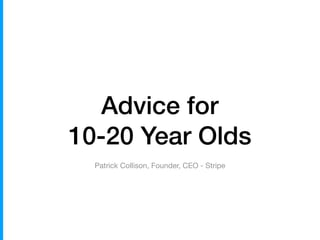
Advice for
10-20 Year Olds
Patrick Collison, Founder, CEO - Stripe
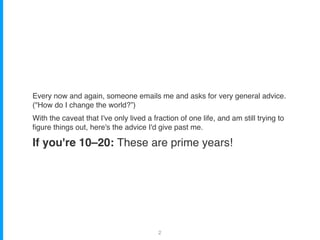
Every now and again, someone emails me and asks for very general advice.
("How do I change the world?”)
With the caveat that I've only lived a fraction of one life, and am still trying to
figure things out, here's the advice I'd give past me.
If you're 10–20: These are prime years!
2
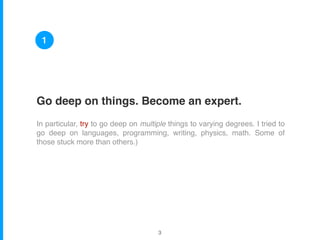
Go deep on things. Become an expert.
In particular, try to go deep on multiple things to varying degrees. I tried to
go deep on languages, programming, writing, physics, math. Some of
those stuck more than others.)
1
!3
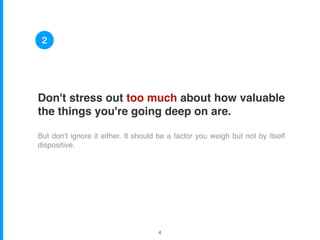
Don't stress out too much about how valuable
the things you're going deep on are.
But don't ignore it either. It should be a factor you weigh but not by itself
dispositive.
2
!4
One of the main things you should try to
achieve by age 20 is some sense for which
kinds of things you enjoy doing.
This probably won't change a lot throughout your life and so you should
try to discover the shape of that space as quickly as you can.
3
!5
To the extent that you enjoy working hard, do.
Subject to that constraint, it's not clear that the returns to effort ever
diminish substantially. If you're lucky enough to enjoy it a lot, be grateful
and take full advantage!
4
!6
Make friends over the internet with people
who are great at things you're interested in.
Internet is one of the biggest advantages you have over prior generations.
Leverage it.
5
!7
Aim to read a lot.
6
!8
If you think something is important but people
older than you don't hold it in high regard,
there's a reasonable chance that you're right
and they're wrong.
Status lags by a generation or more.
7
!9
Above all else, don't make the mistake of
judging your success based on your current
peer group.
By all means make friends but being weird as a teenager is generally
good.
8
!10
But having good social skills confers life-long
benefits. So, don't write them off.
Get good at making a good first impression, being funny (if possible... this
author still working on it...), speaking publicly.
9
!11
Make things.
Operating in a space with a lot of uncertainty is a very different experience
to learning something.
10
!12
More broadly, nobody is going to teach you to think for yourself.
A large fraction of what people around you
believe is mistaken. Internalize this and
practice coming up with your own worldview.
The correlation between it and those around you shouldn't be too strong
unless you think you were especially lucky in your initial conditions.
11
!13
If you're in US and go to a good school, there are a lot of forces that will
push you towards following train tracks laid by others rather than charting
a course yourself.
Make sure that the things you're pursuing are
weird things that you want to pursue, not
whatever the standard path is.
Heuristic: do your friends at school think your path is a bit strange? If not,
maybe it's too normal.
12
!14
Figure out a way to travel to San Francisco
and to meet other people who've moved there
to pursue their dreams.
Why San Francisco? San Francisco is the Schelling point for high-
openness, smart, energetic, optimistic people. Global Weird HQ. Take
advantage of opportunities to travel to other places too, of course.
13
!15
Find vivid examples of success in the domains you care about.
If you want to become a great scientist, try to
find ways to spend time with good (or,
ideally, great) scientists in person.
Watch YouTube videos of interviews. Follow some on Twitter.
15
!16
People who did great things often did so at
very surprisingly young ages.
(They were gray-haired when they became famous... not when they did
the work) So, hurry up! You can do great things.
16
!17
Adapted From - https://patrickcollison.com/advice
If you're 20–30: I'm not yet old enough to
write this section. Check back in some years.
If advice on this page helped you, I'd love to hear about it. And if
you're reading this page, Pioneer might be of interest.
My name is Piyush Gupta. I’ve had an ignorant childhood, one full of raw and pure fun, but now as a father of two adorable daughters, I’m
extremely curious about how to think. Patrick is an extraordinarily curious and social person, who’s advice touched me deeply. I created this
mini-book to consume these wonderful principles easily. If you’d like to deliberate any points with me, I’m reachable at gpiyush@gmail.com
!18

Advice for 10-20 from Patrick Collison

  • 1.
    Advice for 10-20 YearOlds Patrick Collison, Founder, CEO - Stripe
  • 2.
    Every now andagain, someone emails me and asks for very general advice. ("How do I change the world?”) With the caveat that I've only lived a fraction of one life, and am still trying to figure things out, here's the advice I'd give past me. If you're 10–20: These are prime years! 2
  • 3.
    Go deep onthings. Become an expert. In particular, try to go deep on multiple things to varying degrees. I tried to go deep on languages, programming, writing, physics, math. Some of those stuck more than others.) 1 !3
  • 4.
    Don't stress outtoo much about how valuable the things you're going deep on are. But don't ignore it either. It should be a factor you weigh but not by itself dispositive. 2 !4
  • 5.
    One of themain things you should try to achieve by age 20 is some sense for which kinds of things you enjoy doing. This probably won't change a lot throughout your life and so you should try to discover the shape of that space as quickly as you can. 3 !5
  • 6.
    To the extentthat you enjoy working hard, do. Subject to that constraint, it's not clear that the returns to effort ever diminish substantially. If you're lucky enough to enjoy it a lot, be grateful and take full advantage! 4 !6
  • 7.
    Make friends overthe internet with people who are great at things you're interested in. Internet is one of the biggest advantages you have over prior generations. Leverage it. 5 !7
  • 8.
    Aim to reada lot. 6 !8
  • 9.
    If you thinksomething is important but people older than you don't hold it in high regard, there's a reasonable chance that you're right and they're wrong. Status lags by a generation or more. 7 !9
  • 10.
    Above all else,don't make the mistake of judging your success based on your current peer group. By all means make friends but being weird as a teenager is generally good. 8 !10
  • 11.
    But having goodsocial skills confers life-long benefits. So, don't write them off. Get good at making a good first impression, being funny (if possible... this author still working on it...), speaking publicly. 9 !11
  • 12.
    Make things. Operating ina space with a lot of uncertainty is a very different experience to learning something. 10 !12
  • 13.
    More broadly, nobodyis going to teach you to think for yourself. A large fraction of what people around you believe is mistaken. Internalize this and practice coming up with your own worldview. The correlation between it and those around you shouldn't be too strong unless you think you were especially lucky in your initial conditions. 11 !13
  • 14.
    If you're inUS and go to a good school, there are a lot of forces that will push you towards following train tracks laid by others rather than charting a course yourself. Make sure that the things you're pursuing are weird things that you want to pursue, not whatever the standard path is. Heuristic: do your friends at school think your path is a bit strange? If not, maybe it's too normal. 12 !14
  • 15.
    Figure out away to travel to San Francisco and to meet other people who've moved there to pursue their dreams. Why San Francisco? San Francisco is the Schelling point for high- openness, smart, energetic, optimistic people. Global Weird HQ. Take advantage of opportunities to travel to other places too, of course. 13 !15
  • 16.
    Find vivid examplesof success in the domains you care about. If you want to become a great scientist, try to find ways to spend time with good (or, ideally, great) scientists in person. Watch YouTube videos of interviews. Follow some on Twitter. 15 !16
  • 17.
    People who didgreat things often did so at very surprisingly young ages. (They were gray-haired when they became famous... not when they did the work) So, hurry up! You can do great things. 16 !17
  • 18.
    Adapted From -https://patrickcollison.com/advice If you're 20–30: I'm not yet old enough to write this section. Check back in some years. If advice on this page helped you, I'd love to hear about it. And if you're reading this page, Pioneer might be of interest. My name is Piyush Gupta. I’ve had an ignorant childhood, one full of raw and pure fun, but now as a father of two adorable daughters, I’m extremely curious about how to think. Patrick is an extraordinarily curious and social person, who’s advice touched me deeply. I created this mini-book to consume these wonderful principles easily. If you’d like to deliberate any points with me, I’m reachable at gpiyush@gmail.com !18