KARAMWANT KAUR
ADVERTISING
Objectives, Functions & Advantages
KARAMWANT KAUR
Meaning of Advertising
• Advertising is a marketing communication that
employs an openly sponsored, non-personal
message to promote or sell a product, service
or idea.
• The process of spreading product information
among the potential buyers through a public
medium in order to maximize sales. Such a
public medium includes, among others,
newspapers, magazines, television and radio.
KARAMWANT KAUR
Objectives and Functions
• Promotion of sales: Advertising is done to
create demand for a product.
• Educate public about product: Advertising not
only promotes product but also make people
aware about their proper use.
• Introduction of new product: Whenever a new
product is launched in the market, it must be
brought to the notice of public through
advertisements.
KARAMWANT KAUR
• Overcome competition: In order to survive in
competition, the good features of the product
should be brought to the notice of public
through advertisements.
• Mass production: Large scale production will
be possible only if there is a market for it.
Mass production will reduce the overall cost
also.
KARAMWANT KAUR
Advertisement can do these things
• Introduce a new product.
• Create demand.
• Simulate the trade.
• Helps make a product competitive in market.
• To reach mass market.
• Give information about the product.
• Help determine buyer’s preference.
• Reduce selling expenses.
• Build customer relations.
• Test sales technique.
• Maintain prestige of the company.
KARAMWANT KAUR
Advertisement cannot do these things
• Sell a bad product twice.
• Sell an overpriced product.
• Sell a poorly distributed product.
• Sell a seasonal product out of season.
• Sell products to persons having no use for
them.
• Do the selling job alone.
KARAMWANT KAUR
Advantages
of
Advertising
KARAMWANT KAUR
ADVANTAGES TO MANUFACTURER
• It creates demand for new products by
informing people about the availability.
• It helps in expanding the market by attracting
more people to buy.
• It creates goodwill by making the name of the
manufacturer and his products famous.
• It facilitates quick turnover of goods by
promoting highly responsive markets.
• It reduces the cost of distribution by
popularising the products.
KARAMWANT KAUR
• It reduces the cost of production by making
large scale production possible through
creation of demand.
• It increases profit by increasing sales,
promoting large scale production, reducing
cost of production and cost of distribution.
• It increases labour productivity by
encouraging them to produce better quality
goods and achieve better performance.
KARAMWANT KAUR
ADVANTAGES TO CUSTOMERS
• It facilitate purchasing by educating consumer
to select correct brands of commodities.
• It paves the way for better standard of living
as consumers come to know about the new
products available in the market.
• It makes goods available at reduced prices.
• It increases the utility of commodities.
Consumers come to know about the proper
use of commodities through advertising.
KARAMWANT KAUR
• It saves consumer’s time as they have not to
waste their time in selecting commodities and
they can make up their mind about the brand
they have to purchase.
• Consumers get good quality products as it
encourages manufacturers to produce better
quality products.
• It reduces the possibility of being cheated as
through advertisement consumers come to
know about the price and composition of the
product.
KARAMWANT KAUR
KARAMWANT KAUR
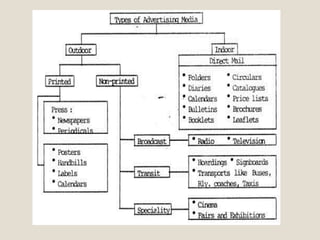
SELECTING A SUITABLE MEDIA
• Nature of the product: A product that is
needed by all will encourage mass media like
print, broadcast, telecast, etc.
• Nature of the market: The market may be
national or local or international. If a product
is sold nationally or internationally, then
magazines, television and cinemas may be
useful, if a product is local then cable and local
or regional newspapers may be a better
choice.
KARAMWANT KAUR
• Type of audience: if audience is uneducated then
radio, television can be used. If audience is
literate then magazines, newspapers can be used
for advertisement.
• Availability of funds: it also affects the type of
media used. For ex: in newspaper one has the
option of coloured or black & white printing,
which can be decided on the basis of available
funds.
• Media used by competitors: An advertiser should
carefully study the moves of competitors as to
media selected.

ADVERTISING (Objectives, Functions & Advantages)

  • 1.
  • 2.
    KARAMWANT KAUR Meaning ofAdvertising • Advertising is a marketing communication that employs an openly sponsored, non-personal message to promote or sell a product, service or idea. • The process of spreading product information among the potential buyers through a public medium in order to maximize sales. Such a public medium includes, among others, newspapers, magazines, television and radio.
  • 3.
    KARAMWANT KAUR Objectives andFunctions • Promotion of sales: Advertising is done to create demand for a product. • Educate public about product: Advertising not only promotes product but also make people aware about their proper use. • Introduction of new product: Whenever a new product is launched in the market, it must be brought to the notice of public through advertisements.
  • 4.
    KARAMWANT KAUR • Overcomecompetition: In order to survive in competition, the good features of the product should be brought to the notice of public through advertisements. • Mass production: Large scale production will be possible only if there is a market for it. Mass production will reduce the overall cost also.
  • 5.
    KARAMWANT KAUR Advertisement cando these things • Introduce a new product. • Create demand. • Simulate the trade. • Helps make a product competitive in market. • To reach mass market. • Give information about the product. • Help determine buyer’s preference. • Reduce selling expenses. • Build customer relations. • Test sales technique. • Maintain prestige of the company.
  • 6.
    KARAMWANT KAUR Advertisement cannotdo these things • Sell a bad product twice. • Sell an overpriced product. • Sell a poorly distributed product. • Sell a seasonal product out of season. • Sell products to persons having no use for them. • Do the selling job alone.
  • 7.
  • 8.
    KARAMWANT KAUR ADVANTAGES TOMANUFACTURER • It creates demand for new products by informing people about the availability. • It helps in expanding the market by attracting more people to buy. • It creates goodwill by making the name of the manufacturer and his products famous. • It facilitates quick turnover of goods by promoting highly responsive markets. • It reduces the cost of distribution by popularising the products.
  • 9.
    KARAMWANT KAUR • Itreduces the cost of production by making large scale production possible through creation of demand. • It increases profit by increasing sales, promoting large scale production, reducing cost of production and cost of distribution. • It increases labour productivity by encouraging them to produce better quality goods and achieve better performance.
  • 10.
    KARAMWANT KAUR ADVANTAGES TOCUSTOMERS • It facilitate purchasing by educating consumer to select correct brands of commodities. • It paves the way for better standard of living as consumers come to know about the new products available in the market. • It makes goods available at reduced prices. • It increases the utility of commodities. Consumers come to know about the proper use of commodities through advertising.
  • 11.
    KARAMWANT KAUR • Itsaves consumer’s time as they have not to waste their time in selecting commodities and they can make up their mind about the brand they have to purchase. • Consumers get good quality products as it encourages manufacturers to produce better quality products. • It reduces the possibility of being cheated as through advertisement consumers come to know about the price and composition of the product.
  • 12.
  • 13.
    KARAMWANT KAUR SELECTING ASUITABLE MEDIA • Nature of the product: A product that is needed by all will encourage mass media like print, broadcast, telecast, etc. • Nature of the market: The market may be national or local or international. If a product is sold nationally or internationally, then magazines, television and cinemas may be useful, if a product is local then cable and local or regional newspapers may be a better choice.
  • 14.
    KARAMWANT KAUR • Typeof audience: if audience is uneducated then radio, television can be used. If audience is literate then magazines, newspapers can be used for advertisement. • Availability of funds: it also affects the type of media used. For ex: in newspaper one has the option of coloured or black & white printing, which can be decided on the basis of available funds. • Media used by competitors: An advertiser should carefully study the moves of competitors as to media selected.