“Advertising Effectiveness”
Group 7
Shubham Gupta-2015304
Vandana Shivani-2015315
1
2
Arguments for Measuring
O Avoiding costly mistakes
O Evaluating alternative strategies
O Determining if objectives are achieved
3
Arguments for not
measuring
O Cost
O Research problem
O Disagreement on what to test
O Objectives of creative
O Time
4
Conducting research
What to Test
O Source Factor
O Message variable
O Media strategies
O Budgeting decisions
5
6
TESTING PROCESS
O Concept Generation and Testing-
O Rough art, Copy and Commercial Testing-
O Finished Art or Commercial Pretesting
O Market testing of ads or Commercials
O Essentials of Effective Testing
7
8
Testing
Concept testing
O Focus group
O Mall intercept
9
Rough art, Copy and Commercial Testing-
O Comprehension and Reaction Test
O Consumer Juries
O Halo Test
10
11
12
Finished Art or Commercial
Pretesting
1. Pretesting Finished Print-ads
O Portfolio test
O Readability test
O Dummy Advertising Vehicles
13
14
Pretesting
2. Pretesting Finished Broadcast ads
O Theatre test
O On-air test
O Physiological measures
O Brain waves
Alpha activity
Hemispheric Lateralization
15
16
Post-testing
of Print-ads
O Inquiry tests
O Recognition tests
O Recall tests
17
18
19
20
Post-testing
of Broadcast commercials
O Day after recall tests
O Persuasive measures-
O Diagnostics
O Comprehensive measures
O Test marketing
O Single-source tracking studies
O Tracking Print/Broadcast ads
21
22
Where to Test ?
O Laboratory test
O Field Test
23
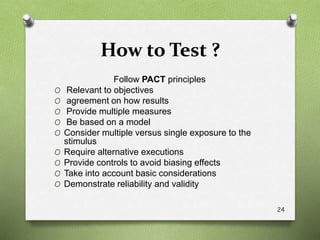
How to Test ?
Follow PACT principles
O Relevant to objectives
O agreement on how results
O Provide multiple measures
O Be based on a model
O Consider multiple versus single exposure to the
stimulus
O Require alternative executions
O Provide controls to avoid biasing effects
O Take into account basic considerations
O Demonstrate reliability and validity
24
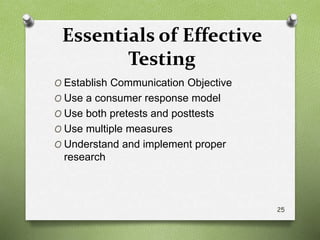
Essentials of Effective
Testing
O Establish Communication Objective
O Use a consumer response model
O Use both pretests and posttests
O Use multiple measures
O Understand and implement proper
research
25
26
27
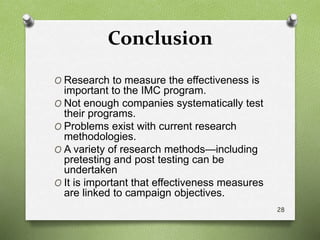
Conclusion
O Research to measure the effectiveness is
important to the IMC program.
O Not enough companies systematically test
their programs.
O Problems exist with current research
methodologies.
O A variety of research methods—including
pretesting and post testing can be
undertaken
O It is important that effectiveness measures
are linked to campaign objectives.
28
29

Advertising Effectiveness

  • 1.
    “Advertising Effectiveness” Group 7 ShubhamGupta-2015304 Vandana Shivani-2015315 1
  • 2.
  • 3.
    Arguments for Measuring OAvoiding costly mistakes O Evaluating alternative strategies O Determining if objectives are achieved 3
  • 4.
    Arguments for not measuring OCost O Research problem O Disagreement on what to test O Objectives of creative O Time 4
  • 5.
    Conducting research What toTest O Source Factor O Message variable O Media strategies O Budgeting decisions 5
  • 6.
  • 7.
    TESTING PROCESS O ConceptGeneration and Testing- O Rough art, Copy and Commercial Testing- O Finished Art or Commercial Pretesting O Market testing of ads or Commercials O Essentials of Effective Testing 7
  • 8.
  • 9.
    Testing Concept testing O Focusgroup O Mall intercept 9
  • 10.
    Rough art, Copyand Commercial Testing- O Comprehension and Reaction Test O Consumer Juries O Halo Test 10
  • 11.
  • 12.
  • 13.
    Finished Art orCommercial Pretesting 1. Pretesting Finished Print-ads O Portfolio test O Readability test O Dummy Advertising Vehicles 13
  • 14.
  • 15.
    Pretesting 2. Pretesting FinishedBroadcast ads O Theatre test O On-air test O Physiological measures O Brain waves Alpha activity Hemispheric Lateralization 15
  • 16.
  • 17.
    Post-testing of Print-ads O Inquirytests O Recognition tests O Recall tests 17
  • 18.
  • 19.
  • 20.
  • 21.
    Post-testing of Broadcast commercials ODay after recall tests O Persuasive measures- O Diagnostics O Comprehensive measures O Test marketing O Single-source tracking studies O Tracking Print/Broadcast ads 21
  • 22.
  • 23.
    Where to Test? O Laboratory test O Field Test 23
  • 24.
    How to Test? Follow PACT principles O Relevant to objectives O agreement on how results O Provide multiple measures O Be based on a model O Consider multiple versus single exposure to the stimulus O Require alternative executions O Provide controls to avoid biasing effects O Take into account basic considerations O Demonstrate reliability and validity 24
  • 25.
    Essentials of Effective Testing OEstablish Communication Objective O Use a consumer response model O Use both pretests and posttests O Use multiple measures O Understand and implement proper research 25
  • 26.
  • 27.
  • 28.
    Conclusion O Research tomeasure the effectiveness is important to the IMC program. O Not enough companies systematically test their programs. O Problems exist with current research methodologies. O A variety of research methods—including pretesting and post testing can be undertaken O It is important that effectiveness measures are linked to campaign objectives. 28
  • 29.

Editor's Notes

  • #2 This presentation is a part of Integrated Marketing communication course Book referred is Advertising & promotion by Belch , Belch , K Purani published by Mc Graw Hill
  • #4 Reasons to measure the effectiveness Avoiding costly mistakes-Advertising is a costly affair and the top 10 United States advertiser spend around $ 25 billion .Thus to maximize the return on investment the advertisement must be evaluated properly. Evaluating alternative strategies-using the traditional media to non-traditional media helps in reallocating the monies. In a study conducted by Anderson group, 63 % of the advertiser said they planned to spend more on social media. Determining if objectives are achieved-If objectives are attained then new ones needs to be established in the next planning period.  
  • #5 Reasons not to measure effectiveness Cost-Good research can be expensive in terms of both time and money. Many managers decide that time is critical and they must implement the program while the opportunity is available .Many believe monies spent on the research could be better spend on improved production of the ad ,additional media buys and the like. Research problem-arises because it is difficult to isolate the effects of promotional elements. Disagreement on what to test (impact of promotion on sales, impact on corporate image, assess recollect)-lack on agreement on what to test results in no test. Objectives of creative-sometimes creative department do not want their work to be tested and many agencies are reluctant to submit their work for testing. Time –Considering testing takes a lot of time so they might miss on the opportunity.
  • #6 Source Factor-includes the usage of an effective spokesperson for the target market in order to create a good impact. Message variable-Both message and means of communication are necessary for evaluation. Media strategies-consist of the decision as to which vehicle option source to be used and what would be its scheduling. Budgeting decisions- needs directly increases the sales.
  • #7 Red bull-After flying to an altitude of 39,045 meters (128,100 feet) in a helium-filled balloon, Felix Baumgartner completed a record breaking jump for the ages from the edge of space, exactly 65 years after Chuck Yeager first broke the sound barrier flying in an experimental rocket-powered airplane. Felix reached a maximum of speed of 1,357.6 km/h or 843.6 mph(Mach 1.25) through the near vacuum of the stratosphere before being slowed by the atmosphere later during his 4:20 minute long freefall. The 43-year-old Austrian skydiving expert also broke two other world records (highest freefall, highest manned balloon flight), leaving the one for the longest freefall to project mentor Col. Joe Kittinger.
  • #9 http://www.rediff.com/money/2005/feb/18spec.htm
  • #10 Concept Generation and Testing- As the amount of money spent in the ad campaign is huge, testing an idea at an early stage will prevent the organization from incurring losses by a failed campaign. The idea of the ad campaign is evaluated by showing rough sketch or design or the illustrations to the customers. Focus Groups are groups of 8 to 10 people in the target market for the product. This method is commonly followed by all the companies as it suggest the necessary changes required in the product at preliminary stages apart from being easily available, immediate and observable. Weakness of this method is that a small size is used to make generalization about the whole population which mayn’t prove to be correct always. Results obtained are not quantifiable. Mall Intercepts is another method of concept Testing in which the public opinion is collected about the ads idea from people in the malls. The method adopted is either through questionnaire, rating scales and/or rankings. Social media is also used to ask about the customer’s opinion as they are the cost efficient and time efficient way of collecting public opinion. Customer’s ideas/suggestions can also be used to modify the product. Levi's campaign to launch its Type 1 jeans earlier this year more than matched the company's reputation for avant garde advertising. The ad, by Bartle Bogle Hegarty, featured a group of hybrid mouse-humans personifying the ad's creative theme of 'a bold new breed' of denim. Levi's campaign to launch its Type 1 jeans earlier this year featured a group of hybrid mouse-humans, conceived to personify the ad's creative theme of 'a bold new breed' of denim. Before Bartle Bogle Hegarty shot the ad, qualitative groups discussed the plot where mouse-humans kidnap a cat and blackmail its owner. Research concluded that Levi's should tone down the aggression and superiority, and balance the female and male roles more equally from a script that was skewed toward the females. This can be classified into two- Pretests-measures taken before the campaign is implemented. The best reason to do pretesting is to identify winners, to enhance the goods ads and to eliminate the bad ones. Advantage-Feedback is relatively expensive so pretesting saves money on that. Disadvantage-are mock ups, storyboards, or animatic don’t communicate nearly as effective as the final product. Post-tests- occurs after the ad or commercial has been in the field. Post testing is common for both advertiser and ad agencies. It is designed to determine if the campaign is accomplishing the objectives sought and to serve as input into the next period’s situation analysis.
  • #11 A rough design or illustration of the ad is shown to the customer and their views are taken into consideration. It can be animatic, photographic, or live-action rough. It must indicate how the final output will be like. Otherwise it is of little value. Comprehension and Reaction Test- Whether the message conveyed through the ad is the same as that intended or not. It shouldn’t receive any negative reaction from the public like religious sentiments of a community getting hurt. Consumer Juries- In this representative of the target market evaluates the ad as they are more receptive to the consumer needs. The disadvantages of this method are that consumer may sometimes become over-critical and evaluate the ad from a personal perspective which can harm the concept of the ad-campaign. Number of ads considered also effect the result of this testing. In case of Paired Comparison Method, the number of evaluations required is calculated by the formula, = 𝑛(𝑛−1) 2 If six alternatives are considered, 15 evaluations must be made. Halo effect is a tendency in which participants overlook weaknesses of the product and give a positive approval to the product and vice-versa. In this way, there is no point in conducting the process of the test as they are not giving their true opinion about the product. People preferences about the ads also hampers the testing results. As some people prefer ads with emotional appeal over ads with factual information. Ads with details explaining about the product are more relevant but less preferred by people.
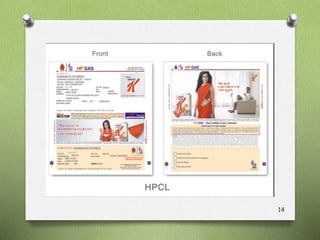
  • #14 Pretesting finished Print-ads- Portfolio test- After showing the ad to the respondents, they are asked how much they recall from the ad. Most effective ads are the ones with highest recall. Zoozoo ads are an example of the ads with high recall. The fact that respondents are participating in the research testing may hamper the creativity aspect of the ad. Readability test- Flesch Formula is used to assess the readability of the ads by determining the average number of syllables per 100 words. Human interest appeal of the material, length of sentences and familiarity of the words is also considered along with the educational background of the target audience. The disadvantage of this method is that it may become too mechanical and hamper the creativity of the respondent. Dummy Advertising Vehicles- Ads printed in the dummy magazines are distributed to the target audience and their response is evaluated. Its advantage is that a more real-life setting is offered to the respondent which makes it easier for him to give his true opinion. Disadvantage is that there may be biases associated with the response as it may get effected by other printed material available in the magazine and also this method is not reliable. Companies like Milward-Brown’s link copy test includes measures of emotional response to ads, assessing metrics such as enjoyment, engagement, likes and dislikes to address emotional response.  
  • #16 Theatre test- in this test, response of the audience to a standard TV program are compared with the response to the new TV program. These programs can be viewed either in theatre, malls, conference room or in home/office setting. These methods can sometime hamper the actual response by providing an artificial setting. On-air test- Ads are embedded in between the programmes and shown to the target audience. Response of the audience is judged on the basis of highest recall. This method is a strong indicator of the reliability and validity of the ad. Physiological measures- These measures include evaluating the physiological responses of the respondent. Methods like Pupil dilation, galvanic skin response and eye-tracking are used to check the involuntary response of the respondent. Brain waves- Electroencephalographic measures can be taken from the skull to determine electrical frequencies in the brain. These electrical impulses are used in two areas- Alpha activity- It is a state in which the person is inactive, resting or sleeping. The level upto which the person is moved from this alpha state measures the effectiveness of the ad. Hemispheric lateralization- It distinguishes between alpha activity between the right and the left side of the hemispheres.
  • #18 Post-testing of Print-ads- Inquiry tests- Advertising effectiveness measured on the basis of inquiries generated in the print media called as Bingo-cards. They are less common in today’s internet era where everything is available on the net. Other method used are- Running the ad in successive issues of the same medium, running split run tests, in which variation of the ad appear in different copies of the same newspaper or magazine or by running the same ad in different media. Recognition tests- The Starch ad readership Report provide certain measures for evaluating the effectiveness of an ad. According to starch the pulling power of the ad can be assessed through the control offered, competitor’s ad can be compared with the norms, alternative ad execution can be tested and readership scores are indicators of the customer involvement in the process. Recall tests- Ipsos-ASI Next Print test and the Gallup & Robinson Magazine
  • #22 Post-testing of Broadcast commercials- Day after recall tests- Burke Day –After Recall test. It is a method of measuring an Ad’s effectiveness in terms of consumer’s recall of an ad, a day after the exposure to the ad. It is conducted to make sure that the intended message of the ad is getting passed on to the consumers. HUL launched an ad for AXE Signature, in which a subtle form of seduction element is used along with the main message of its long lasting fragrance. If user after watching that ad can only recall the seduction part, then the ad has not done well on the recall test. Persuasive measures- In this the respondent is asked about the brand that he prefer to win in a drawing and then after showing an ad, he is again asked the same question. Diagnostics- These measures are designed to understand the viewer’s evaluation of the ad, as well as how clearly the creative idea is understood and how well the proposition is communicated. Comprehensive measures- Comprehensive approaches are used and all the above three measures can be obtained in one testing program. Test marketing- In specific test markets, tests of the ads are conducted. The market chosen are according to the product. The main advantage of test marketing is Realism. Single-source tracking studies- These methods track the behaviors of consumers from the television sets to the supermarket checkout counter. Participants give their demographics to the research company and the households are split into groups. One group is shown the ad while others were not shown the ad and then their purchasing behavior is related to the effect of ads. Tracking Print/Broadcast ads- These are used to measure the effects of advertising on awareness, recall, interest and attitudes towards the ad and/or brand as well as purchase intentions. They can be tailored for specific campaign and/or situation.  
  • #24 Where to Test Laboratory test is when the testers are either asked questions about them or their responses are measured through Pupil dilation, eye tracking or galvanic skin response. Since it is done in a controlled environment researcher can isolate the contribution of each factor. Disadvantage is lack of realism (it can’t duplicate the natural viewing situation) due to testing bias. Field Test-are tests of the ad or commercial under natural viewing situations, complete with the realism of noise, distractions and comfort of home. This test takes into account the effects of repetition, program content, even the presence of competitive messages. The disadvantage of this test is it lacks control.
  • #25 Provide measurements relevant to objectives of advertising Require agreement on how results will be used Provide multiple measures Be based on a model of human response to communications Consider multiple versus single exposure to the stimulus Require alternative executions to have same degree of finish Provide controls to avoid biasing effects of exposure context Take into account basic considerations of sample definition Demonstrate reliability and validity
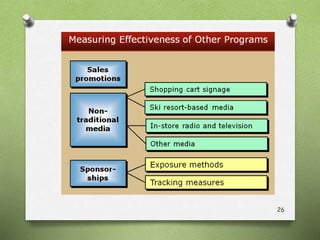
  • #27 Measuring the effectiveness of other program elements Sales promotion through the count of the number of inquiries, coupon redemption and sweepstakes entries.Eg-Shopper trak places sensors in the store that track whether a person is coming or going to calculate the shoppers height and gauge traffic patterns. Non –Traditional media- Effects of shopping cart signage-sales increase when shopping cart signage are used. Effectiveness of ski resort based media-Traffic audit bureau (TAB) is tracking the effectiveness of this form of advertising to give advertiser more reliable criteria on which to base purchase decisions. TAB data verify ad placements while the media vendors have employed Simmons market research bureau and Nielsen media research to collect ad impressions and advertising recall information. Effects of in store radio and television-Interactive market system (IMS) introduced software that enables clients to measure the effectiveness of in store ratio. Effectiveness of other media-measures like impact of package design, POP Displays, trade shows exhibits are helping in understanding the effectiveness. Measuring the effectiveness of sponsorship Exposure method-can is classified as those that monitor the quality and nature of the media coverage obtained for the sponsored event and those that estimate direct and indirect audiences. Tracking measures-designed to evaluate awareness, familiarity and preferences endangered by sponsorship based on the surveys.