Advanced Technology
Eyckle 2023
• 【樂齡科技博覽暨高峰會2020】精華片段及展品介紹
• https://www.youtube.com/watch?v=2fYrqySt5IU
• 樂齡科技 融入生活
• https://www.youtube.com/watch?v=mVcnudQT7lg
• 樂齡科技 租返屋企
https://www.youtube.com/watch?v=VkMHbK6H22Y
• 【樂齡科技 帶返屋企】
• https://www.youtube.com/watch?v=mlO-4k4SizA
• In the beginning, electronic products were designed by young
people to be used by young people.
• Video games
• Computers introduced into schools
• Few advertising efforts were made to interest older adults.
• Training opportunities were geared toward younger people.
What do you think?
1) Older adults are less interested in learning how to use these
technologies.
2) Older adults simply cannot learn how to use these
technologies.
3) Older adults are more anxious and have poorer attitudes
toward computer use relative to younger adults which ultimately
leads to nonuse.
Breakthrough
• Most older adults have positive attitudes toward the use of computers
and other types of electronic technology.
• Anxiety level did not seem to affect performance.
• Older adults did not seem to be more anxious than younger adults in
learning how to use electronic technology.
• We also found that attitudes could be modified under certain
circumstances.
• Longer training periods led to more positive attitudes and better
performance in the training sessions led to more positive attitudes.
• But the effects were small.
Breakthrough
• We also searched to find the optimal training method for
teaching computer skills to older adults.
• We looked at advanced organizers, modeling, manual, and
interactive techniques.
• We did not find an optimal training method. However, self-
pacing and peer interaction seemed to help.
• Research has shown that older adults can acquire memory
training techniques and software skills, and also glean
information on career development, pre-retirement, and/or
health issues using advanced technology, e.g. youtube,
facebook, instantgram......
• Nowadays, over 70% of elderly computers owners reported that
they have Internet access and 80% said they have accessed it
in the past month
• At present, it is estimated that about 22% of older adults are
surfing the Web.
• National Institute on Aging
• https://www.nia.nih.gov/health
• 醫療及老齡化
• https://www.ourhkfoundation.org.hk/zh-hant/research/aging-
society?tid=36
Why is it important?
• Scope
• 8.5 million seniors require some form of assistive care
• 80% of those over 65 are living with at least one chronic disease
• Every 69 seconds someone in America develops Alzheimer’s disease
• Costs
• Alzheimer’s Disease: $18,500-$36,000
• Nursing home care costs: $70,000-80,000 annually
• Annual loss to employers: $33 billion due to working family care givers
• Caregiver gap
• Nurses shortage: 120,000 and 159,300 doctors by 2025
• Understaffed nursing homes: 91%
• Family caregivers in US: 31% of households
• 70% of caregivers care for someone over age 50
• Data from http://www.hoaloharobotics.com/
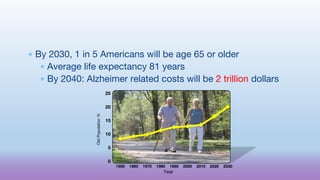
 By 2030, 1 in 5 Americans will be age 65 or older
 Average life expectancy 81 years
 By 2040: Alzheimer related costs will be 2 trillion dollars
Year
Old
Population
%
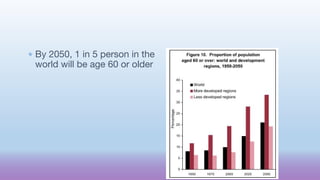
 By 2050, 1 in 5 person in the
world will be age 60 or older
• An increase in age-related disease
• Rising healthcare costs
• Shortage of professionals
• Increase in number of individuals unable to live independently
• Facilities cannot handle coming “age wave”
• Normal age related challenges
• Physical limitations
• Balance, reaching, etc.
• Perceptual
• Vision, hearing
• Cognitive
• Memory, parallel tasks
• Chronic age related diseases
• Alzheimer’s Disease (AD)
• Cancer, advanced disease
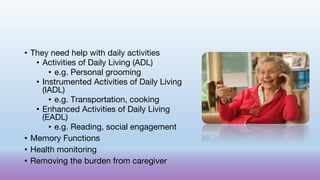
• They need help with daily activities
• Activities of Daily Living (ADL)
• e.g. Personal grooming
• Instrumented Activities of Daily Living
(IADL)
• e.g. Transportation, cooking
• Enhanced Activities of Daily Living
(EADL)
• e.g. Reading, social engagement
• Memory Functions
• Health monitoring
• Removing the burden from caregiver
Tools & Infrastructure
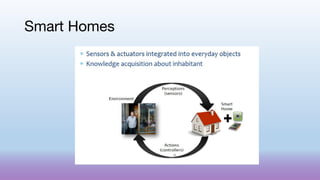
• Smart homes
• Mobile devices
• Wearable sensors
• Smart fabrics
• Assistive robotics
? ? ?
Smart Homes
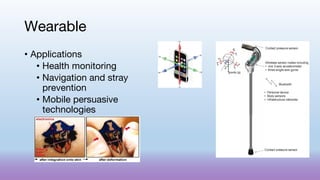
Wearable
• Applications
• Health monitoring
• Navigation and stray
prevention
• Mobile persuasive
technologies
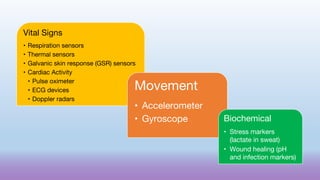
Vital Signs
• Respiration sensors
• Thermal sensors
• Galvanic skin response (GSR) sensors
• Cardiac Activity
• Pulse oximeter
• ECG devices
• Doppler radars
Movement
• Accelerometer
• Gyroscope Biochemical
• Stress markers
(lactate in sweat)
• Wound healing (pH
and infection markers)
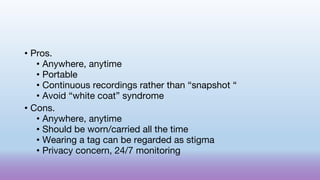
• Pros.
• Anywhere, anytime
• Portable
• Continuous recordings rather than “snapshot “
• Avoid “white coat” syndrome
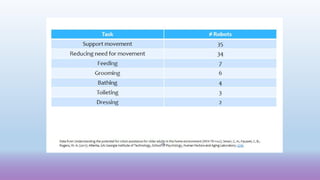
• Cons.
• Anywhere, anytime
• Should be worn/carried all the time
• Wearing a tag can be regarded as stigma
• Privacy concern, 24/7 monitoring
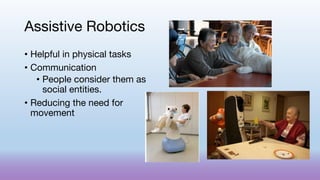
Assistive Robotics
• Helpful in physical tasks
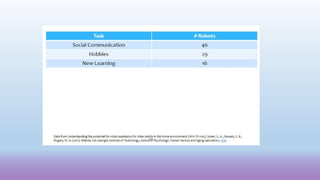
• Communication
• People consider them as
social entities.
• Reducing the need for
movement
Applications
Think
• Issues:
• Physical interference with movement
• Difficulty in removing and placing
• Weight
• Frequency and difficulty of maintenance
• Charging
• Cleaning
• Social and fashion concerns
• Suggestions:
• Use common devices to avoid stigmatization
• Lightweight
• Easy to maintain
Think
• Simple Interface
• Limit possibility of error
• Avoid cognitive overload
• Limit options
• keep dialogs linear
• Avoid parallel tasks
• Consider all stakeholders
• Patient, formal onsite/offsite caregivers, informal
onsite/offsite caregivers, technical personnel
Think: Ethics and Privacy
• Ethics
• Perfect transparency
• Control over the system
• Fight laziness
• Privacy
• Encrypt data
• Patient authentication (Owner aware)
Are they ready to adopt?
• Healthy older adults use technology more often*
• “Not being perceived as useful” *
• Better a known devil than an unknown god
• Privacy Concerns
• Big brother
• Stigmatization
Smart Home Challenges
• Smart homes
• Location detection
• Privacy/unobtrusiveness vs. accuracy
• Difficulty with multiple residents
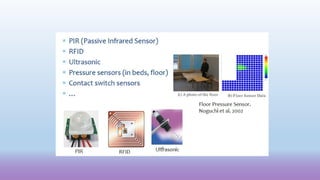
• PIR sensor proximity is important
• Reliability
• Distinguishing anomalies from normal changes
• Become more context aware
• Standard protocol
Wearable & Mobile Challenges
• Wearable & mobile
• Power harvesting
• Size
• Smart fabrics
• Limitations when skin is dry or during intense activity
• Still hybrid
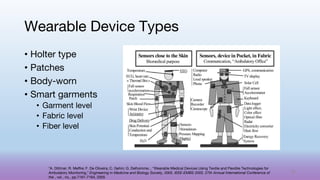
• Holter type
• Patches
• Body-worn
• Smart garments
• Garment level
• Fabric level
• Fiber level
Wearable Device Types
*A. Dittmar; R. Meffre; F. De Oliveira; C. Gehin; G. Delhomme; , "Wearable Medical Devices Using Textile and Flexible Technologies for
Ambulatory Monitoring," Engineering in Medicine and Biology Society, 2005. IEEE-EMBS 2005. 27th Annual International Conference of
the , vol., no., pp.7161-7164, 2005
36
Activity Recognition:
“Ambient Sensors”
Algorithms & Methods:
37
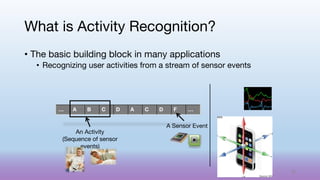
What is Activity Recognition?
• The basic building block in many applications
• Recognizing user activities from a stream of sensor events
… A B C D A C D F …
An Activity
(Sequence of sensor
events)
A Sensor Event
38
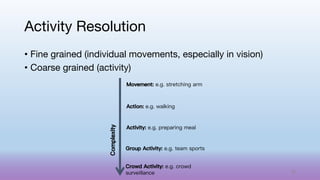
• Fine grained (individual movements, especially in vision)
• Coarse grained (activity)
Activity Resolution
Movement: e.g. stretching arm
Action: e.g. walking
Activity: e.g. preparing meal
Complexity
Group Activity: e.g. team sports
Crowd Activity: e.g. crowd
surveillance 39
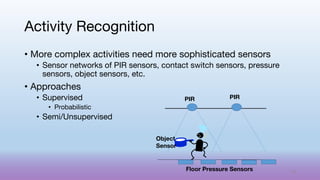
• More complex activities need more sophisticated sensors
• Sensor networks of PIR sensors, contact switch sensors, pressure
sensors, object sensors, etc.
• Approaches
• Supervised
• Probabilistic
• Semi/Unsupervised
Activity Recognition
PIR PIR
Floor Pressure Sensors
Object
Sensor
40
• Mostly in form of time series
• Accelerometer [& gyroscope]
• Most actions in form of distinct, periodic motion patterns
• Walking, running, sitting,..
• Usual features
• Average, standard deviation
• Time between peaks, FFT energy, Binned distribution
• Correlation between axes
• …
Activity Data from Wearable Sensors
41
Activity Recognition:
“Vision”
Algorithms & Methods:
42
• Used in many related application domains
• Video surveillance, sports analysis, …
• Advantages
• Rich information
• Disadvantages
• Highly varied activities in natural environment
• Privacy concerns
• Algorithm complexity
Vision Based Systems
[Cheng and Trivedi,2007]
43
• Background subtracted blobs and shapes
• isolate the moving parts of a scene by segmenting it into background
and foreground
• Optical flow
• Motion of individual pixels on the image plane
• Point Trajectories
• Velocity, curvature, etc.
• …
Vision: Low Level Feature Extraction
44
• Taxonomy of methods [Aggarwal & Ryoo 2011]
Algorithms
Human
Activity
Recognition
Single Layered
Approach
Space-time
Approaches
Space-time
Volume
Trajectories
Space-time
Features
Sequential
Approaches
Exemplar-based
State-based
Hierarchal
Approach
Statistical
Syntactic
Description-
based
45
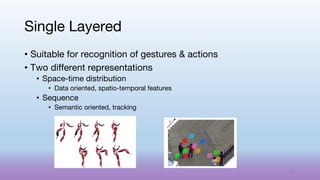
• Suitable for recognition of gestures & actions
• Two different representations
• Space-time distribution
• Data oriented, spatio-temporal features
• Sequence
• Semantic oriented, tracking
Single Layered
46
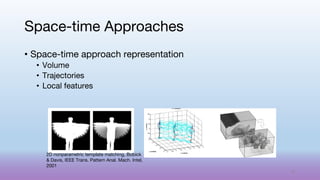
• Space-time approach representation
• Volume
• Trajectories
• Local features
Space-time Approaches
2D nonparametric template matching, Bobick
& Davis, IEEE Trans. Pattern Anal. Mach. Intel,
2001
47
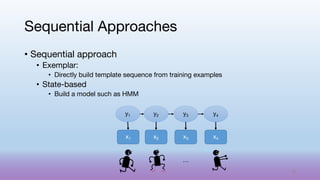
• Sequential approach
• Exemplar:
• Directly build template sequence from training examples
• State-based
• Build a model such as HMM
Sequential Approaches
y1 y2 y3 y4
x1 x2 x3 x4
…
48
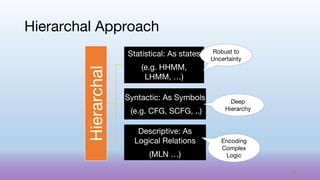
Hierarchal
Statistical: As states
(e.g. HHMM,
LHMM, …)
Syntactic: As Symbols
(e.g. CFG, SCFG, ..)
Descriptive: As
Logical Relations
(MLN …)
Hierarchal Approach
Robust to
Uncertainty
Encoding
Complex
Logic
Deep
Hierarchy
49
“…”
Algorithms & Methods:
50
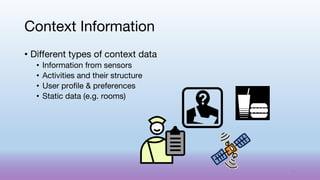
• Different types of context data
• Information from sensors
• Activities and their structure
• User profile & preferences
• Static data (e.g. rooms)
Context Information
51
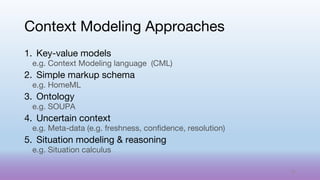
1. Key-value models
e.g. Context Modeling language (CML)
2. Simple markup schema
e.g. HomeML
3. Ontology
e.g. SOUPA
4. Uncertain context
e.g. Meta-data (e.g. freshness, confidence, resolution)
5. Situation modeling & reasoning
e.g. Situation calculus
Context Modeling Approaches
52
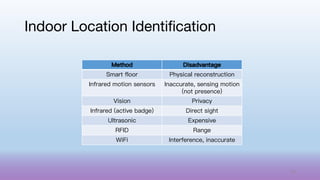
Indoor Location Identification
Method Disadvantage
Smart floor Physical reconstruction
Infrared motion sensors Inaccurate, sensing motion
(not presence)
Vision Privacy
Infrared (active badge) Direct sight
Ultrasonic Expensive
RFID Range
WiFi Interference, inaccurate
53
• Multiple residents
• Active Identification
• RFID Badges
• Anonymous
• Motion models (Wilson 2005, Crandall 2009)
Person Identification
54
• Problems [Pollack 2003 , Horvitz 2002, 2011]
• When to remind?
• What to remind?
• Avoiding activity conflicts
• Solutions
• Planning & scheduling
• Reinforcement learning
Reminders
55
Assistive Robotics Challenges
• Assistive robotics
• Marketing and price
• Lack of reliable technology
• A robot fully capable of helping with all ADLs
• Adaptive robots
• More user studies
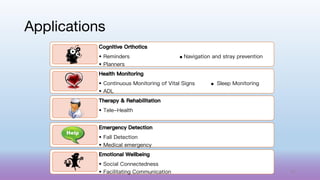
Applications
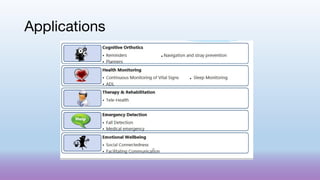
Cognitive Orthotics
• Reminders ● Navigation and stray prevention
• Planners
Health Monitoring
• Continuous Monitoring of Vital Signs ● Sleep Monitoring
• ADL
Therapy & Rehabilitation
• Tele-Health
Emergency Detection
• Fall Detection
• Medical emergency
Emotional Wellbeing
• Social Connectedness
• Facilitating Communication 57
• Simple reminders
• NeuroPager (1994), MAPS (2005), MemoJog (2005)
• AI-based
• PEAT (1997), Autominder (2003)
Reminders
[Davies 2009]
58
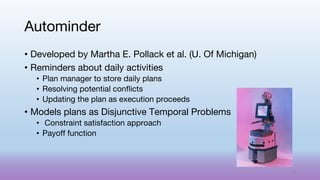
• Developed by Martha E. Pollack et al. (U. Of Michigan)
• Reminders about daily activities
• Plan manager to store daily plans
• Resolving potential conflicts
• Updating the plan as execution proceeds
• Models plans as Disjunctive Temporal Problems
• Constraint satisfaction approach
• Payoff function
Autominder
59
• COACH: Monitoring hand-washing activity and prompting
[Mihailidis 2007, U Toronto]
• Vision
• Detecting current state
• Markov Decision process (MDP)
• Prompting
COACH
60
• Opportunity Knocks (OK): public transit assistance [Patterson
2004]
• iRoute: Learns walking preference of dementia patients
[Hossain 2011]
• Commercial
• GPS shoes
• ComfortZone
Outdoor Stray Prevention
ComfortZone
GPS Shoes
Bracelet for
tracking
patients
61
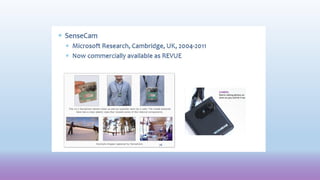
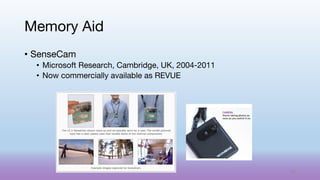
• SenseCam
• Microsoft Research, Cambridge, UK, 2004-2011
• Now commercially available as REVUE
Memory Aid
62
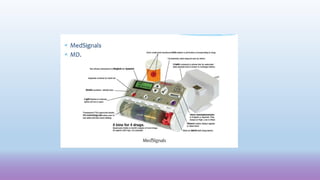
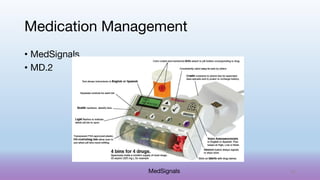
• MedSignals
• MD.2
Medication Management
MedSignals 63
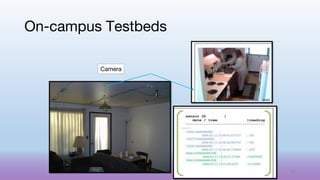
On-campus Testbeds
64
Camera
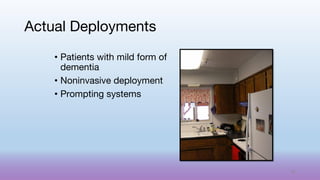
Actual Deployments
• Patients with mild form of
dementia
• Noninvasive deployment
• Prompting systems
65
Prompting Technology
• Context-based
• Prompt only if task
not initiated
• Prompt can be re-
issued
I’ve done
this task
I won’t do
this task
I will do it
now
I will do it
later 66
Design Issues
67
• Issues:
• Physical interference with movement
• Difficulty in removing and placing
• Weight
• Frequency and difficulty of maintenance
• Charging
• Cleaning
• Social and fashion concerns
• Suggestions:
• Use common devices to avoid stigmatization
• Lightweight
• Easy to maintain
Wearable & Mobile Design Issues
68
• Simple Interface
• Limit possibility of error
• Avoid cognitive overload
• Limit options
• keep dialogs linear
• Avoid parallel tasks
• Consider all stakeholders
• Patient, formal onsite/offsite caregivers, informal onsite/offsite
caregivers, technical personnel
User Interface Design Issues
69
Challenges & Future
70
• Healthy older adults use technology more often*
• “Not being perceived as useful” *
• Better a known devil than an unknown god
• Privacy Concerns
• Big brother
• Stigmatization
Are they ready to adopt?
*Heart and Kalderon, Older adults: Are they ready to adopt health-related ICT?, 2011 71
• Smart homes
• Location detection
• Privacy/unobtrusiveness vs. accuracy
• Difficulty with multiple residents
• PIR sensor proximity is important
• Reliability
• Distinguishing anomalies from normal changes
• Become more context aware
• Standard protocol
Smart Home Challenges
72
• Wearable & mobile
• Power harvesting
• Size
• Smart fabrics
• Limitations when skin is dry or during intense activity
• Still hybrid
Wearable & Mobile Challenges
73
• Assistive robotics
• Marketing and price
• Lack of reliable technology
• A robot fully capable of helping with all ADLs
• Adaptive robots
• More user studies
Assistive Robotics Challenges
74
• Legal, ethical
• Telemedicine
• Lack of regulations
• Which state regulations? Patient’s or Physician?
• Who is responsible for malpractice?
• Risk of fake physicians
• Physician out-of-state competition
• Insurance & reimbursement
• Patient confidentiality
Legal & Ethical Challenges
75
• Technology
• Device interoperability
• Legal issues
• Patient centric
• Integrate all
• Robots + smart home + wearable/mobile sensors + e-textile
• Technology transfer, go beyond prototype
Future
76
Reference:
• Lam Wai Man (2019). Palliative care in Hong Kong – past, present and future.
https://www.hkcfp.org.hk/Upload/HK_Practitioner/2019/hkp2019vol41Jun/discussion_p
aper.html
• Wong LY et al (2020). Quality of Palliative and End-Of-Life Care in Hong Kong:
Perspectives of Healthcare Providers.
https://www.ncbi.nlm.nih.gov/pmc/articles/PMC7400302/pdf/ijerph-17-05130.pdf
• Senthil P Kumar and Anand Jim (2010). Physical Therapy in Palliative Care: From
Symptom Control to Quality of Life: A Critical Review
https://www.ncbi.nlm.nih.gov/pmc/articles/PMC3012236/
• https://www.ourhkfoundation.org.hk/
• http://www.hoaloharobotics.com/
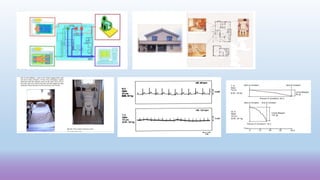
• Toshiyo Tamura etal (2007). E-Healthcare at an Experimental Welfare Techno House in
Japan. https://www.ncbi.nlm.nih.gov/pmc/articles/PMC2666468/

Advanced Technology

  • 1.
  • 2.
    • 【樂齡科技博覽暨高峰會2020】精華片段及展品介紹 • https://www.youtube.com/watch?v=2fYrqySt5IU •樂齡科技 融入生活 • https://www.youtube.com/watch?v=mVcnudQT7lg • 樂齡科技 租返屋企 https://www.youtube.com/watch?v=VkMHbK6H22Y • 【樂齡科技 帶返屋企】 • https://www.youtube.com/watch?v=mlO-4k4SizA
  • 3.
    • In thebeginning, electronic products were designed by young people to be used by young people. • Video games • Computers introduced into schools • Few advertising efforts were made to interest older adults. • Training opportunities were geared toward younger people.
  • 4.
    What do youthink? 1) Older adults are less interested in learning how to use these technologies. 2) Older adults simply cannot learn how to use these technologies. 3) Older adults are more anxious and have poorer attitudes toward computer use relative to younger adults which ultimately leads to nonuse.
  • 5.
    Breakthrough • Most olderadults have positive attitudes toward the use of computers and other types of electronic technology. • Anxiety level did not seem to affect performance. • Older adults did not seem to be more anxious than younger adults in learning how to use electronic technology. • We also found that attitudes could be modified under certain circumstances. • Longer training periods led to more positive attitudes and better performance in the training sessions led to more positive attitudes. • But the effects were small.
  • 6.
    Breakthrough • We alsosearched to find the optimal training method for teaching computer skills to older adults. • We looked at advanced organizers, modeling, manual, and interactive techniques. • We did not find an optimal training method. However, self- pacing and peer interaction seemed to help.
  • 7.
    • Research hasshown that older adults can acquire memory training techniques and software skills, and also glean information on career development, pre-retirement, and/or health issues using advanced technology, e.g. youtube, facebook, instantgram...... • Nowadays, over 70% of elderly computers owners reported that they have Internet access and 80% said they have accessed it in the past month • At present, it is estimated that about 22% of older adults are surfing the Web.
  • 8.
    • National Instituteon Aging • https://www.nia.nih.gov/health • 醫療及老齡化 • https://www.ourhkfoundation.org.hk/zh-hant/research/aging- society?tid=36
  • 9.
    Why is itimportant? • Scope • 8.5 million seniors require some form of assistive care • 80% of those over 65 are living with at least one chronic disease • Every 69 seconds someone in America develops Alzheimer’s disease • Costs • Alzheimer’s Disease: $18,500-$36,000 • Nursing home care costs: $70,000-80,000 annually • Annual loss to employers: $33 billion due to working family care givers • Caregiver gap • Nurses shortage: 120,000 and 159,300 doctors by 2025 • Understaffed nursing homes: 91% • Family caregivers in US: 31% of households • 70% of caregivers care for someone over age 50 • Data from http://www.hoaloharobotics.com/
  • 10.
     By 2030,1 in 5 Americans will be age 65 or older  Average life expectancy 81 years  By 2040: Alzheimer related costs will be 2 trillion dollars Year Old Population %
  • 11.
     By 2050,1 in 5 person in the world will be age 60 or older
  • 12.
    • An increasein age-related disease • Rising healthcare costs • Shortage of professionals • Increase in number of individuals unable to live independently • Facilities cannot handle coming “age wave”
  • 14.
    • Normal agerelated challenges • Physical limitations • Balance, reaching, etc. • Perceptual • Vision, hearing • Cognitive • Memory, parallel tasks • Chronic age related diseases • Alzheimer’s Disease (AD) • Cancer, advanced disease
  • 15.
    • They needhelp with daily activities • Activities of Daily Living (ADL) • e.g. Personal grooming • Instrumented Activities of Daily Living (IADL) • e.g. Transportation, cooking • Enhanced Activities of Daily Living (EADL) • e.g. Reading, social engagement • Memory Functions • Health monitoring • Removing the burden from caregiver
  • 16.
    Tools & Infrastructure •Smart homes • Mobile devices • Wearable sensors • Smart fabrics • Assistive robotics ? ? ?
  • 17.
  • 20.
    Wearable • Applications • Healthmonitoring • Navigation and stray prevention • Mobile persuasive technologies
  • 21.
    Vital Signs • Respirationsensors • Thermal sensors • Galvanic skin response (GSR) sensors • Cardiac Activity • Pulse oximeter • ECG devices • Doppler radars Movement • Accelerometer • Gyroscope Biochemical • Stress markers (lactate in sweat) • Wound healing (pH and infection markers)
  • 22.
    • Pros. • Anywhere,anytime • Portable • Continuous recordings rather than “snapshot “ • Avoid “white coat” syndrome • Cons. • Anywhere, anytime • Should be worn/carried all the time • Wearing a tag can be regarded as stigma • Privacy concern, 24/7 monitoring
  • 23.
    Assistive Robotics • Helpfulin physical tasks • Communication • People consider them as social entities. • Reducing the need for movement
  • 27.
  • 30.
    Think • Issues: • Physicalinterference with movement • Difficulty in removing and placing • Weight • Frequency and difficulty of maintenance • Charging • Cleaning • Social and fashion concerns • Suggestions: • Use common devices to avoid stigmatization • Lightweight • Easy to maintain
  • 31.
    Think • Simple Interface •Limit possibility of error • Avoid cognitive overload • Limit options • keep dialogs linear • Avoid parallel tasks • Consider all stakeholders • Patient, formal onsite/offsite caregivers, informal onsite/offsite caregivers, technical personnel
  • 32.
    Think: Ethics andPrivacy • Ethics • Perfect transparency • Control over the system • Fight laziness • Privacy • Encrypt data • Patient authentication (Owner aware)
  • 33.
    Are they readyto adopt? • Healthy older adults use technology more often* • “Not being perceived as useful” * • Better a known devil than an unknown god • Privacy Concerns • Big brother • Stigmatization
  • 34.
    Smart Home Challenges •Smart homes • Location detection • Privacy/unobtrusiveness vs. accuracy • Difficulty with multiple residents • PIR sensor proximity is important • Reliability • Distinguishing anomalies from normal changes • Become more context aware • Standard protocol
  • 35.
    Wearable & MobileChallenges • Wearable & mobile • Power harvesting • Size • Smart fabrics • Limitations when skin is dry or during intense activity • Still hybrid
  • 36.
    • Holter type •Patches • Body-worn • Smart garments • Garment level • Fabric level • Fiber level Wearable Device Types *A. Dittmar; R. Meffre; F. De Oliveira; C. Gehin; G. Delhomme; , "Wearable Medical Devices Using Textile and Flexible Technologies for Ambulatory Monitoring," Engineering in Medicine and Biology Society, 2005. IEEE-EMBS 2005. 27th Annual International Conference of the , vol., no., pp.7161-7164, 2005 36
  • 37.
  • 38.
    What is ActivityRecognition? • The basic building block in many applications • Recognizing user activities from a stream of sensor events … A B C D A C D F … An Activity (Sequence of sensor events) A Sensor Event 38
  • 39.
    • Fine grained(individual movements, especially in vision) • Coarse grained (activity) Activity Resolution Movement: e.g. stretching arm Action: e.g. walking Activity: e.g. preparing meal Complexity Group Activity: e.g. team sports Crowd Activity: e.g. crowd surveillance 39
  • 40.
    • More complexactivities need more sophisticated sensors • Sensor networks of PIR sensors, contact switch sensors, pressure sensors, object sensors, etc. • Approaches • Supervised • Probabilistic • Semi/Unsupervised Activity Recognition PIR PIR Floor Pressure Sensors Object Sensor 40
  • 41.
    • Mostly inform of time series • Accelerometer [& gyroscope] • Most actions in form of distinct, periodic motion patterns • Walking, running, sitting,.. • Usual features • Average, standard deviation • Time between peaks, FFT energy, Binned distribution • Correlation between axes • … Activity Data from Wearable Sensors 41
  • 42.
  • 43.
    • Used inmany related application domains • Video surveillance, sports analysis, … • Advantages • Rich information • Disadvantages • Highly varied activities in natural environment • Privacy concerns • Algorithm complexity Vision Based Systems [Cheng and Trivedi,2007] 43
  • 44.
    • Background subtractedblobs and shapes • isolate the moving parts of a scene by segmenting it into background and foreground • Optical flow • Motion of individual pixels on the image plane • Point Trajectories • Velocity, curvature, etc. • … Vision: Low Level Feature Extraction 44
  • 45.
    • Taxonomy ofmethods [Aggarwal & Ryoo 2011] Algorithms Human Activity Recognition Single Layered Approach Space-time Approaches Space-time Volume Trajectories Space-time Features Sequential Approaches Exemplar-based State-based Hierarchal Approach Statistical Syntactic Description- based 45
  • 46.
    • Suitable forrecognition of gestures & actions • Two different representations • Space-time distribution • Data oriented, spatio-temporal features • Sequence • Semantic oriented, tracking Single Layered 46
  • 47.
    • Space-time approachrepresentation • Volume • Trajectories • Local features Space-time Approaches 2D nonparametric template matching, Bobick & Davis, IEEE Trans. Pattern Anal. Mach. Intel, 2001 47
  • 48.
    • Sequential approach •Exemplar: • Directly build template sequence from training examples • State-based • Build a model such as HMM Sequential Approaches y1 y2 y3 y4 x1 x2 x3 x4 … 48
  • 49.
    Hierarchal Statistical: As states (e.g.HHMM, LHMM, …) Syntactic: As Symbols (e.g. CFG, SCFG, ..) Descriptive: As Logical Relations (MLN …) Hierarchal Approach Robust to Uncertainty Encoding Complex Logic Deep Hierarchy 49
  • 50.
  • 51.
    • Different typesof context data • Information from sensors • Activities and their structure • User profile & preferences • Static data (e.g. rooms) Context Information 51
  • 52.
    1. Key-value models e.g.Context Modeling language (CML) 2. Simple markup schema e.g. HomeML 3. Ontology e.g. SOUPA 4. Uncertain context e.g. Meta-data (e.g. freshness, confidence, resolution) 5. Situation modeling & reasoning e.g. Situation calculus Context Modeling Approaches 52
  • 53.
    Indoor Location Identification MethodDisadvantage Smart floor Physical reconstruction Infrared motion sensors Inaccurate, sensing motion (not presence) Vision Privacy Infrared (active badge) Direct sight Ultrasonic Expensive RFID Range WiFi Interference, inaccurate 53
  • 54.
    • Multiple residents •Active Identification • RFID Badges • Anonymous • Motion models (Wilson 2005, Crandall 2009) Person Identification 54
  • 55.
    • Problems [Pollack2003 , Horvitz 2002, 2011] • When to remind? • What to remind? • Avoiding activity conflicts • Solutions • Planning & scheduling • Reinforcement learning Reminders 55
  • 56.
    Assistive Robotics Challenges •Assistive robotics • Marketing and price • Lack of reliable technology • A robot fully capable of helping with all ADLs • Adaptive robots • More user studies
  • 57.
    Applications Cognitive Orthotics • Reminders● Navigation and stray prevention • Planners Health Monitoring • Continuous Monitoring of Vital Signs ● Sleep Monitoring • ADL Therapy & Rehabilitation • Tele-Health Emergency Detection • Fall Detection • Medical emergency Emotional Wellbeing • Social Connectedness • Facilitating Communication 57
  • 58.
    • Simple reminders •NeuroPager (1994), MAPS (2005), MemoJog (2005) • AI-based • PEAT (1997), Autominder (2003) Reminders [Davies 2009] 58
  • 59.
    • Developed byMartha E. Pollack et al. (U. Of Michigan) • Reminders about daily activities • Plan manager to store daily plans • Resolving potential conflicts • Updating the plan as execution proceeds • Models plans as Disjunctive Temporal Problems • Constraint satisfaction approach • Payoff function Autominder 59
  • 60.
    • COACH: Monitoringhand-washing activity and prompting [Mihailidis 2007, U Toronto] • Vision • Detecting current state • Markov Decision process (MDP) • Prompting COACH 60
  • 61.
    • Opportunity Knocks(OK): public transit assistance [Patterson 2004] • iRoute: Learns walking preference of dementia patients [Hossain 2011] • Commercial • GPS shoes • ComfortZone Outdoor Stray Prevention ComfortZone GPS Shoes Bracelet for tracking patients 61
  • 62.
    • SenseCam • MicrosoftResearch, Cambridge, UK, 2004-2011 • Now commercially available as REVUE Memory Aid 62
  • 63.
    • MedSignals • MD.2 MedicationManagement MedSignals 63
  • 64.
  • 65.
    Actual Deployments • Patientswith mild form of dementia • Noninvasive deployment • Prompting systems 65
  • 66.
    Prompting Technology • Context-based •Prompt only if task not initiated • Prompt can be re- issued I’ve done this task I won’t do this task I will do it now I will do it later 66
  • 67.
  • 68.
    • Issues: • Physicalinterference with movement • Difficulty in removing and placing • Weight • Frequency and difficulty of maintenance • Charging • Cleaning • Social and fashion concerns • Suggestions: • Use common devices to avoid stigmatization • Lightweight • Easy to maintain Wearable & Mobile Design Issues 68
  • 69.
    • Simple Interface •Limit possibility of error • Avoid cognitive overload • Limit options • keep dialogs linear • Avoid parallel tasks • Consider all stakeholders • Patient, formal onsite/offsite caregivers, informal onsite/offsite caregivers, technical personnel User Interface Design Issues 69
  • 70.
  • 71.
    • Healthy olderadults use technology more often* • “Not being perceived as useful” * • Better a known devil than an unknown god • Privacy Concerns • Big brother • Stigmatization Are they ready to adopt? *Heart and Kalderon, Older adults: Are they ready to adopt health-related ICT?, 2011 71
  • 72.
    • Smart homes •Location detection • Privacy/unobtrusiveness vs. accuracy • Difficulty with multiple residents • PIR sensor proximity is important • Reliability • Distinguishing anomalies from normal changes • Become more context aware • Standard protocol Smart Home Challenges 72
  • 73.
    • Wearable &mobile • Power harvesting • Size • Smart fabrics • Limitations when skin is dry or during intense activity • Still hybrid Wearable & Mobile Challenges 73
  • 74.
    • Assistive robotics •Marketing and price • Lack of reliable technology • A robot fully capable of helping with all ADLs • Adaptive robots • More user studies Assistive Robotics Challenges 74
  • 75.
    • Legal, ethical •Telemedicine • Lack of regulations • Which state regulations? Patient’s or Physician? • Who is responsible for malpractice? • Risk of fake physicians • Physician out-of-state competition • Insurance & reimbursement • Patient confidentiality Legal & Ethical Challenges 75
  • 76.
    • Technology • Deviceinteroperability • Legal issues • Patient centric • Integrate all • Robots + smart home + wearable/mobile sensors + e-textile • Technology transfer, go beyond prototype Future 76
  • 77.
    Reference: • Lam WaiMan (2019). Palliative care in Hong Kong – past, present and future. https://www.hkcfp.org.hk/Upload/HK_Practitioner/2019/hkp2019vol41Jun/discussion_p aper.html • Wong LY et al (2020). Quality of Palliative and End-Of-Life Care in Hong Kong: Perspectives of Healthcare Providers. https://www.ncbi.nlm.nih.gov/pmc/articles/PMC7400302/pdf/ijerph-17-05130.pdf • Senthil P Kumar and Anand Jim (2010). Physical Therapy in Palliative Care: From Symptom Control to Quality of Life: A Critical Review https://www.ncbi.nlm.nih.gov/pmc/articles/PMC3012236/ • https://www.ourhkfoundation.org.hk/ • http://www.hoaloharobotics.com/ • Toshiyo Tamura etal (2007). E-Healthcare at an Experimental Welfare Techno House in Japan. https://www.ncbi.nlm.nih.gov/pmc/articles/PMC2666468/