Elastic Search
Training Contents
☛ Description
☛ Intended Audience
☛ Key Skills
☛ Prerequisites
☛ Instructional Method
☛ course contents
Mobile:+91 7719882295/ 9730463630
Email:sales@anikatechnologies.com
Website:www.anikatechnologies.com
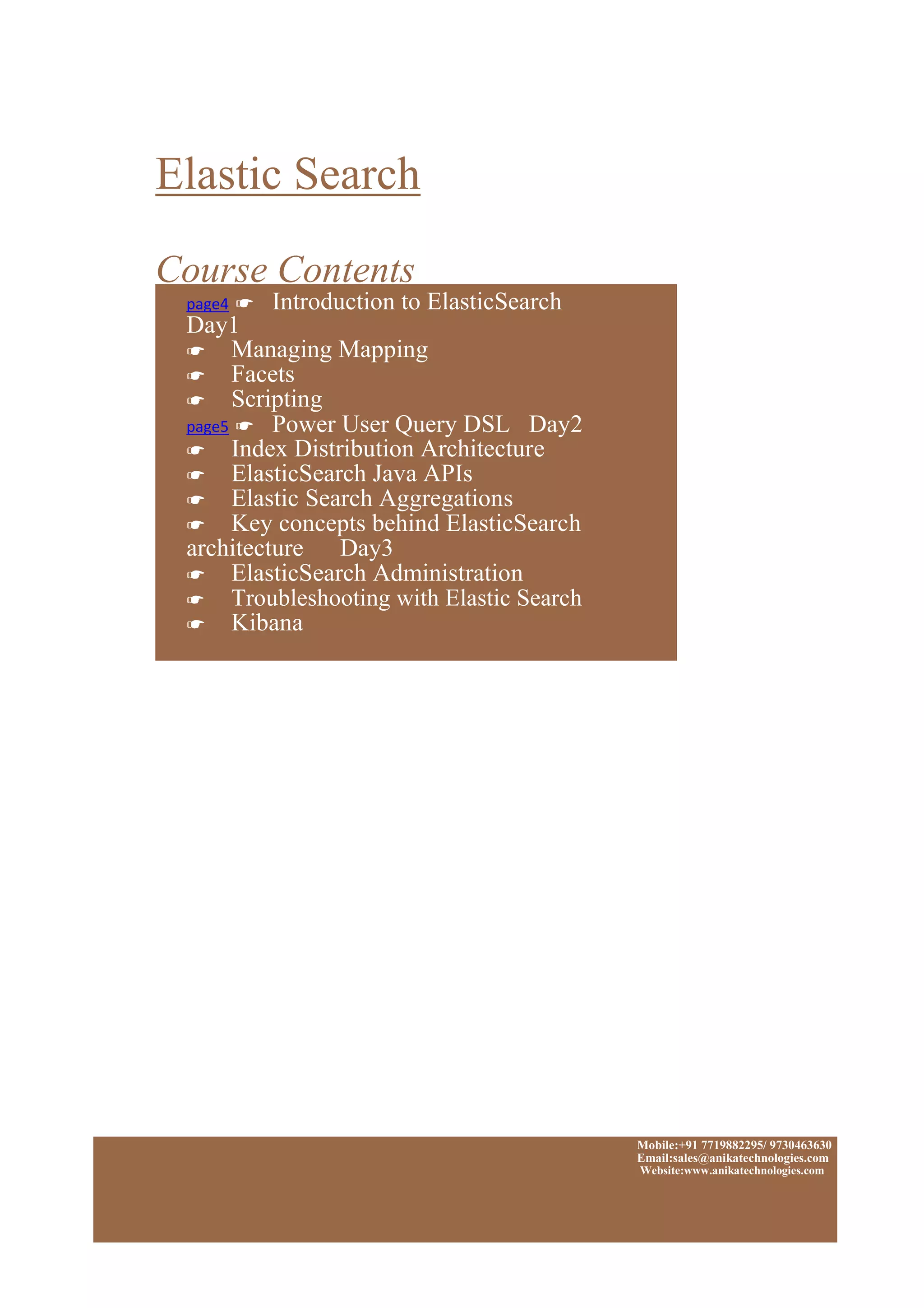
Elastic Search
Course Contents
page4 ☛ Introduction to ElasticSearch
Day1
☛ Managing Mapping
☛ Facets
☛ Scripting
page5 ☛ Power User Query DSL Day2
☛ Index Distribution Architecture
☛ ElasticSearch Java APIs
☛ Elastic Search Aggregations
☛ Key concepts behind ElasticSearch
architecture Day3
☛ ElasticSearch Administration
☛ Troubleshooting with Elastic Search
☛ Kibana
Mobile:+91 7719882295/ 9730463630
Email:sales@anikatechnologies.com
Website:www.anikatechnologies.com
Description:
■ The course aims to provide a solid foundation in search and information retrieval.
Starting with fundamental concepts and covers best practices, key features, and
distributed search application development with ElasticSearch. During the course
there will be time for discussion as well as attendee case studies. At the end of the
training you will have an in-depth understanding of how Elasticsearch works, you
will be able to reliably analyze, understand, and solve common problems, and be
ready to build state-of-the-art search applications.
Intended Audience:
■
■
■
Networking specialists
Programmers
Engineers
Key Skills:
■
■
■
■
■
■
■
■
■
■
■
■
Real Time Search Skills
Spinning up a Cluster in class
room. Lucene Internals
Fully immersive experience in managing and operating Elasticsearch clusters.
Best practices and examples for document design, testing, and other software
development design considerations are also covered
Real Time Case Study
Guidelines and tips on processing custom log formats
Creation of dashboards in Kibana
Choosing hardware Logstash
configuration Designing a
system to scale
Canaging the lifecycle of your logs
Prerequisites:
■ Working knowledge of Linux would help as it would be the platform used.
Instructional Method:
■ This is an instructor led course which provides lecture topics and the practical
application of Hadoop and the underlying technologies. It pictorially presents most
concepts and there is a detailed case study that strings together the technologies,
patterns and design.
Mobile:+91 7719882295/ 9730463630
Email:sales@anikatechnologies.com
Website:www.anikatechnologies.com
Elastic Search
■
■
Introduction to ElasticSearch
• Getting familiar with Lucene
• Index
• ntroducing Apache Lucene
• Introducing ElasticSearch
• Shard
• Gateway
• Cluster
• Node
• Mapping
• Understanding the basics
• Document
• Type
• Basic concepts
• Overall architecture
• Replica
Managing Mapping
• Mapping a GeoShape field
• Mapping different analyzers
• Mapping base types
• Mapping an attachment field
• Mapping an IP field
• Mapping a GeoPoint field
• Adding generic data to mapping
• Mapping arrays
• Managing a child document
• Using dynamic templates in document mapping
• Introduction
• Mapping a document
• Managing nested objects
Mobile:+91 7719882295/ 9730463630
Email:sales@anikatechnologies.com
Website:www.anikatechnologies.com
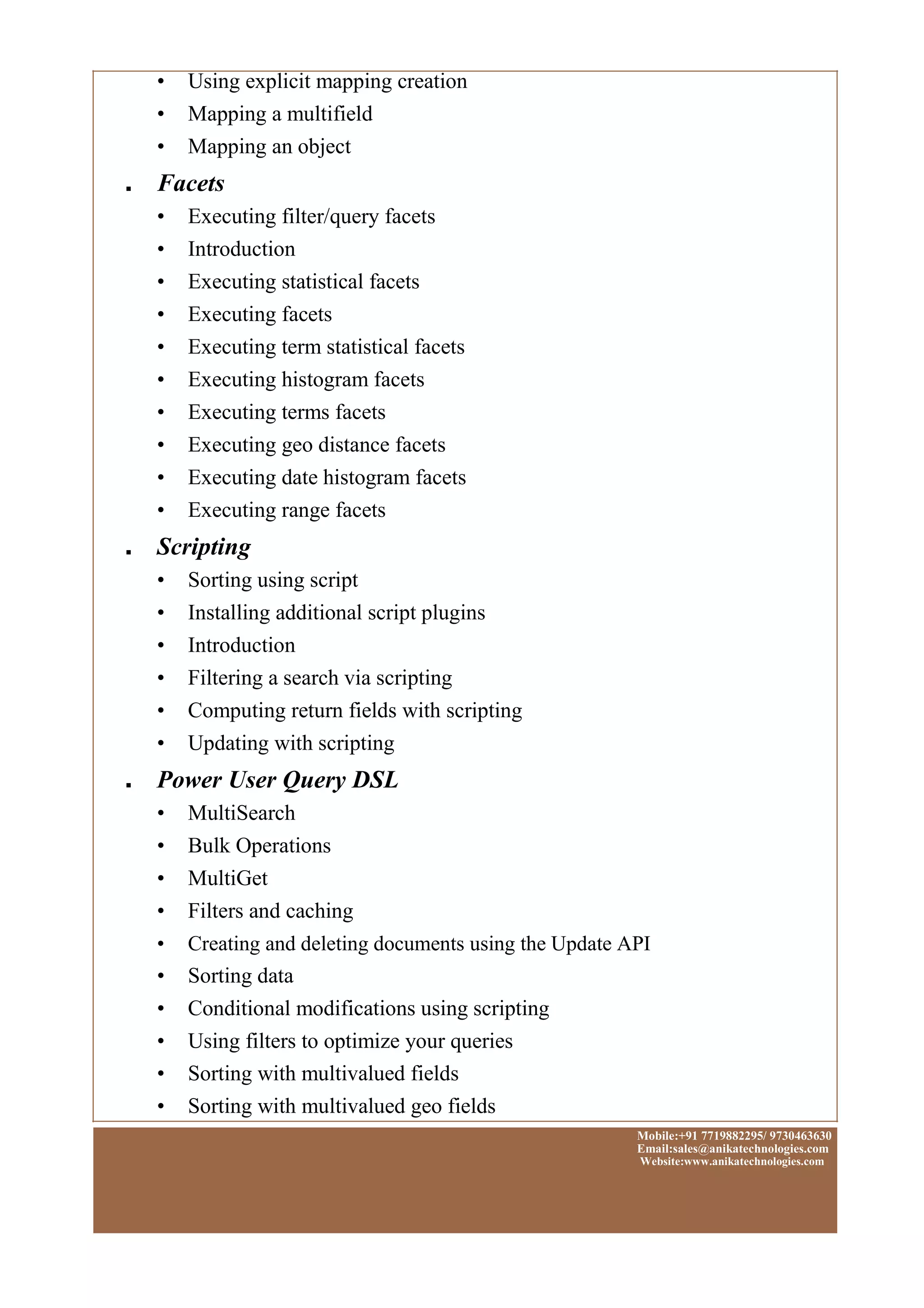
• Using explicit mapping creation
• Mapping a multifield
• Mapping an object
■ Facets
• Executing filter/query facets
• Introduction
• Executing statistical facets
• Executing facets
• Executing term statistical facets
• Executing histogram facets
• Executing terms facets
• Executing geo distance facets
• Executing date histogram facets
• Executing range facets
■ Scripting
• Sorting using script
• Installing additional script plugins
• Introduction
• Filtering a search via scripting
• Computing return fields with scripting
• Updating with scripting
■ Power User Query DSL
• MultiSearch
• Bulk Operations
• MultiGet
• Filters and caching
• Creating and deleting documents using the Update API
• Sorting data
• Conditional modifications using scripting
• Using filters to optimize your queries
• Sorting with multivalued fields
• Sorting with multivalued geo fields
Mobile:+91 7719882295/ 9730463630
Email:sales@anikatechnologies.com
Website:www.anikatechnologies.com
■
■
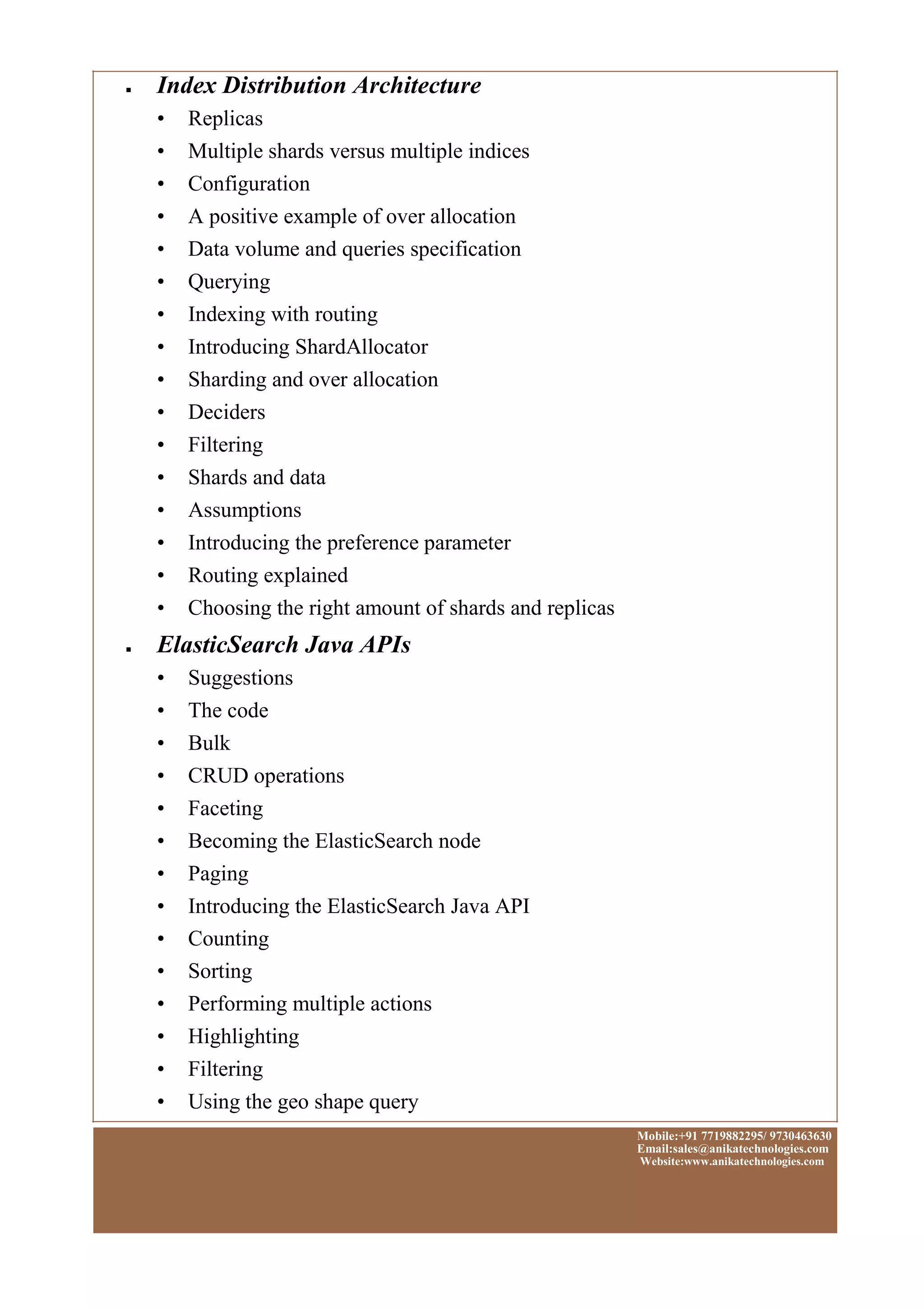
Index Distribution Architecture
• Replicas
• Multiple shards versus multiple indices
• Configuration
• A positive example of over allocation
• Data volume and queries specification
• Querying
• Indexing with routing
• Introducing ShardAllocator
• Sharding and over allocation
• Deciders
• Filtering
• Shards and data
• Assumptions
• Introducing the preference parameter
• Routing explained
• Choosing the right amount of shards and replicas
ElasticSearch Java APIs
• Suggestions
• The code
• Bulk
• CRUD operations
• Faceting
• Becoming the ElasticSearch node
• Paging
• Introducing the ElasticSearch Java API
• Counting
• Sorting
• Performing multiple actions
• Highlighting
• Filtering
• Using the geo shape query
Mobile:+91 7719882295/ 9730463630
Email:sales@anikatechnologies.com
Website:www.anikatechnologies.com
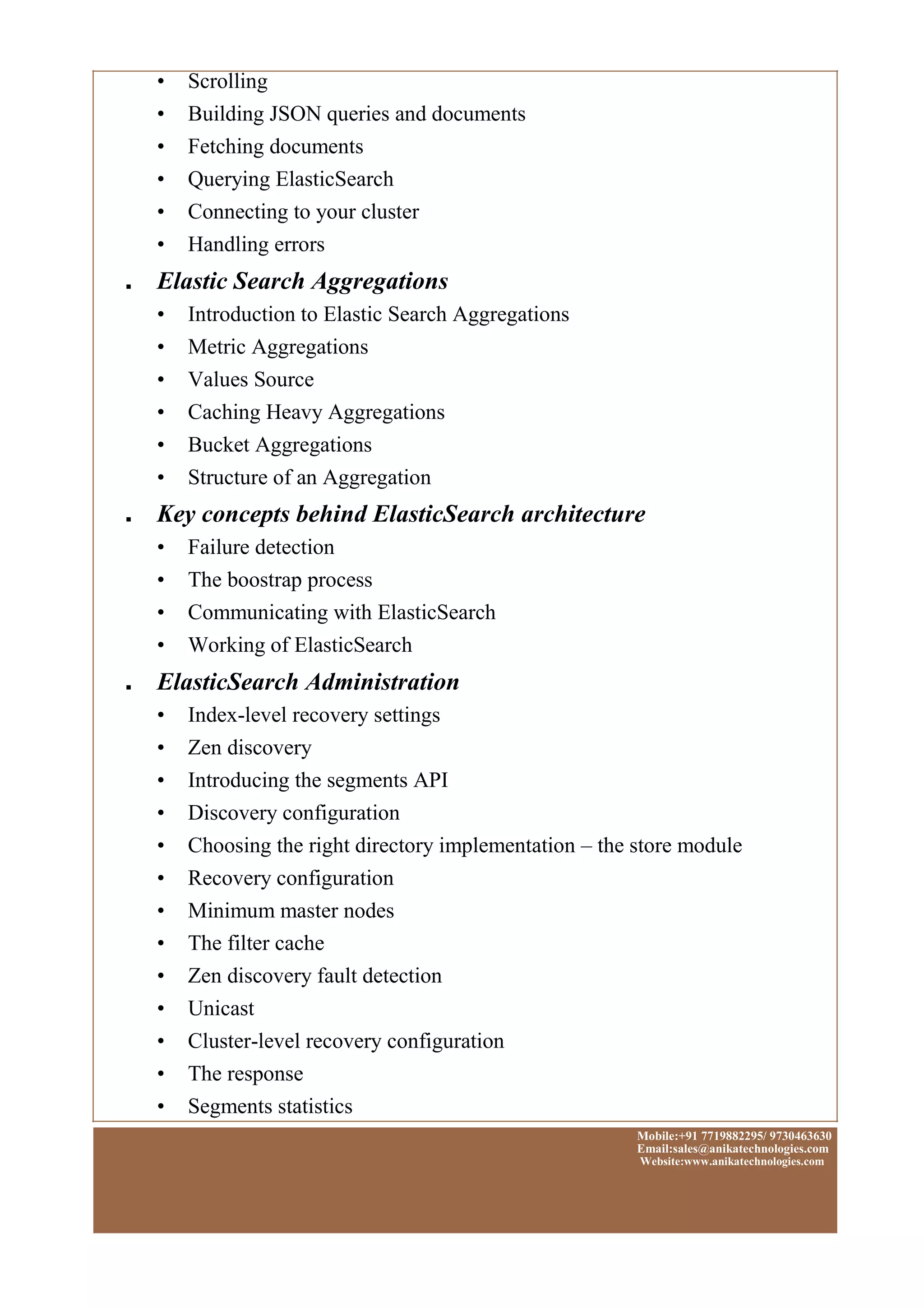
• Scrolling
• Building JSON queries and documents
• Fetching documents
• Querying ElasticSearch
• Connecting to your cluster
• Handling errors
■ Elastic Search Aggregations
• Introduction to Elastic Search Aggregations
• Metric Aggregations
• Values Source
• Caching Heavy Aggregations
• Bucket Aggregations
• Structure of an Aggregation
■ Key concepts behind ElasticSearch architecture
• Failure detection
• The boostrap process
• Communicating with ElasticSearch
• Working of ElasticSearch
■ ElasticSearch Administration
• Index-level recovery settings
• Zen discovery
• Introducing the segments API
• Discovery configuration
• Choosing the right directory implementation – the store module
• Recovery configuration
• Minimum master nodes
• The filter cache
• Zen discovery fault detection
• Unicast
• Cluster-level recovery configuration
• The response
• Segments statistics
Mobile:+91 7719882295/ 9730463630
Email:sales@anikatechnologies.com
Website:www.anikatechnologies.com
• Multicast
• Filter cache types
• Store type
■ Troubleshooting with Elastic Search
• Controlling I/O throttling
• Java memory
• Configuration example
• Knowing the garbage collector
• Querying with warmer present
• Adjusting garbage collector work in ElasticSearch
• Adding warmers to templates
• Creating memory dumps
• Querying without warmers present
• Adding warmers during index creation
• Turning on logging of garbage collection work
• Maximum throughput per second
• Very hot threads
• Using JStat
• Reason for using warmers
• Configuration
• Speeding up queries using warmers
■ Kibana
• Visualization and related features
• Security/Access control to elastic search
• Visualization using kibana
• using queries, single and multiquery
• Utilization of filters, logger tools
• Introduction
• Deployment strategies around indexing and searching high data
inflow (lacks of records per second)
• Search criteria and filters, JSON Input
Mobile:+91 7719882295/ 9730463630
Email:sales@anikatechnologies.com
Website:www.anikatechnologies.com

Advanced Elastic Search | Elastic Search | Kibana | Logstash

  • 1.
    Elastic Search Training Contents ☛Description ☛ Intended Audience ☛ Key Skills ☛ Prerequisites ☛ Instructional Method ☛ course contents Mobile:+91 7719882295/ 9730463630 Email:sales@anikatechnologies.com Website:www.anikatechnologies.com
  • 2.
    Elastic Search Course Contents page4☛ Introduction to ElasticSearch Day1 ☛ Managing Mapping ☛ Facets ☛ Scripting page5 ☛ Power User Query DSL Day2 ☛ Index Distribution Architecture ☛ ElasticSearch Java APIs ☛ Elastic Search Aggregations ☛ Key concepts behind ElasticSearch architecture Day3 ☛ ElasticSearch Administration ☛ Troubleshooting with Elastic Search ☛ Kibana Mobile:+91 7719882295/ 9730463630 Email:sales@anikatechnologies.com Website:www.anikatechnologies.com
  • 3.
    Description: ■ The courseaims to provide a solid foundation in search and information retrieval. Starting with fundamental concepts and covers best practices, key features, and distributed search application development with ElasticSearch. During the course there will be time for discussion as well as attendee case studies. At the end of the training you will have an in-depth understanding of how Elasticsearch works, you will be able to reliably analyze, understand, and solve common problems, and be ready to build state-of-the-art search applications. Intended Audience: ■ ■ ■ Networking specialists Programmers Engineers Key Skills: ■ ■ ■ ■ ■ ■ ■ ■ ■ ■ ■ ■ Real Time Search Skills Spinning up a Cluster in class room. Lucene Internals Fully immersive experience in managing and operating Elasticsearch clusters. Best practices and examples for document design, testing, and other software development design considerations are also covered Real Time Case Study Guidelines and tips on processing custom log formats Creation of dashboards in Kibana Choosing hardware Logstash configuration Designing a system to scale Canaging the lifecycle of your logs Prerequisites: ■ Working knowledge of Linux would help as it would be the platform used. Instructional Method: ■ This is an instructor led course which provides lecture topics and the practical application of Hadoop and the underlying technologies. It pictorially presents most concepts and there is a detailed case study that strings together the technologies, patterns and design. Mobile:+91 7719882295/ 9730463630 Email:sales@anikatechnologies.com Website:www.anikatechnologies.com
  • 4.
    Elastic Search ■ ■ Introduction toElasticSearch • Getting familiar with Lucene • Index • ntroducing Apache Lucene • Introducing ElasticSearch • Shard • Gateway • Cluster • Node • Mapping • Understanding the basics • Document • Type • Basic concepts • Overall architecture • Replica Managing Mapping • Mapping a GeoShape field • Mapping different analyzers • Mapping base types • Mapping an attachment field • Mapping an IP field • Mapping a GeoPoint field • Adding generic data to mapping • Mapping arrays • Managing a child document • Using dynamic templates in document mapping • Introduction • Mapping a document • Managing nested objects Mobile:+91 7719882295/ 9730463630 Email:sales@anikatechnologies.com Website:www.anikatechnologies.com
  • 5.
    • Using explicitmapping creation • Mapping a multifield • Mapping an object ■ Facets • Executing filter/query facets • Introduction • Executing statistical facets • Executing facets • Executing term statistical facets • Executing histogram facets • Executing terms facets • Executing geo distance facets • Executing date histogram facets • Executing range facets ■ Scripting • Sorting using script • Installing additional script plugins • Introduction • Filtering a search via scripting • Computing return fields with scripting • Updating with scripting ■ Power User Query DSL • MultiSearch • Bulk Operations • MultiGet • Filters and caching • Creating and deleting documents using the Update API • Sorting data • Conditional modifications using scripting • Using filters to optimize your queries • Sorting with multivalued fields • Sorting with multivalued geo fields Mobile:+91 7719882295/ 9730463630 Email:sales@anikatechnologies.com Website:www.anikatechnologies.com
  • 6.
    ■ ■ Index Distribution Architecture •Replicas • Multiple shards versus multiple indices • Configuration • A positive example of over allocation • Data volume and queries specification • Querying • Indexing with routing • Introducing ShardAllocator • Sharding and over allocation • Deciders • Filtering • Shards and data • Assumptions • Introducing the preference parameter • Routing explained • Choosing the right amount of shards and replicas ElasticSearch Java APIs • Suggestions • The code • Bulk • CRUD operations • Faceting • Becoming the ElasticSearch node • Paging • Introducing the ElasticSearch Java API • Counting • Sorting • Performing multiple actions • Highlighting • Filtering • Using the geo shape query Mobile:+91 7719882295/ 9730463630 Email:sales@anikatechnologies.com Website:www.anikatechnologies.com
  • 7.
    • Scrolling • BuildingJSON queries and documents • Fetching documents • Querying ElasticSearch • Connecting to your cluster • Handling errors ■ Elastic Search Aggregations • Introduction to Elastic Search Aggregations • Metric Aggregations • Values Source • Caching Heavy Aggregations • Bucket Aggregations • Structure of an Aggregation ■ Key concepts behind ElasticSearch architecture • Failure detection • The boostrap process • Communicating with ElasticSearch • Working of ElasticSearch ■ ElasticSearch Administration • Index-level recovery settings • Zen discovery • Introducing the segments API • Discovery configuration • Choosing the right directory implementation – the store module • Recovery configuration • Minimum master nodes • The filter cache • Zen discovery fault detection • Unicast • Cluster-level recovery configuration • The response • Segments statistics Mobile:+91 7719882295/ 9730463630 Email:sales@anikatechnologies.com Website:www.anikatechnologies.com
  • 8.
    • Multicast • Filtercache types • Store type ■ Troubleshooting with Elastic Search • Controlling I/O throttling • Java memory • Configuration example • Knowing the garbage collector • Querying with warmer present • Adjusting garbage collector work in ElasticSearch • Adding warmers to templates • Creating memory dumps • Querying without warmers present • Adding warmers during index creation • Turning on logging of garbage collection work • Maximum throughput per second • Very hot threads • Using JStat • Reason for using warmers • Configuration • Speeding up queries using warmers ■ Kibana • Visualization and related features • Security/Access control to elastic search • Visualization using kibana • using queries, single and multiquery • Utilization of filters, logger tools • Introduction • Deployment strategies around indexing and searching high data inflow (lacks of records per second) • Search criteria and filters, JSON Input Mobile:+91 7719882295/ 9730463630 Email:sales@anikatechnologies.com Website:www.anikatechnologies.com