Advanced Arduino Programming for Communications.pptx
1.
Advanced Arduino Programmingfor
Communications
1
PREPARED BY:
MD TASLIM ARIF
Lecturer, Dept. of CSE, DIU
Course Title: Embedded Systems & IoT
Course Code: CSE233
CSE233@DIU, SPRING 2025
2.
Table of contents
2
▶HC-05 Bluetooth Module Interfacing with Arduino
▶ SIM800L GSM/GPRS Module Interfacing with Arduino
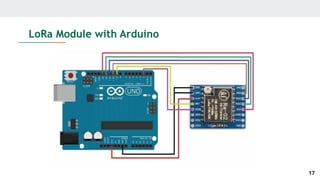
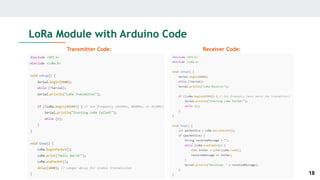
▶ LoRa RF Module Interfacing with Arduino
▶ Generic RF Module Interfacing with Arduino
▶ nRF24L01 RF Module Interfacing with Arduino
3.
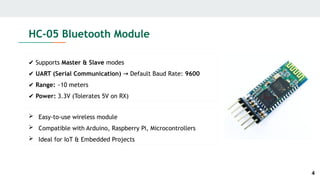
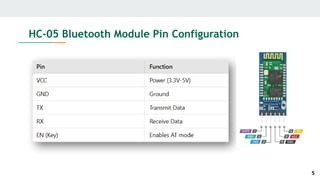
HC-05 Bluetooth Module
3
ABluetooth module is a device that allows wireless communication between electronic devices over
short distances using Bluetooth technology. It is commonly used in IoT, robotics, and home
automation applications to enable wireless data transfer between devices like smartphones,
computers, and microcontrollers.
Key Features:
Wireless Communication: Operates over short distances (typically 10m - 100m depending on
the module).
Low Power Consumption: Suitable for battery-operated devices.
Data Transfer: Supports serial communication (UART), allowing data transfer between a
microcontroller (e.g., Arduino) and other Bluetooth-enabled devices.
Bluetooth Versions: Common modules use Bluetooth 2.0, 3.0, 4.0 (Low Energy), or 5.0 (latest
version with increased range and speed).
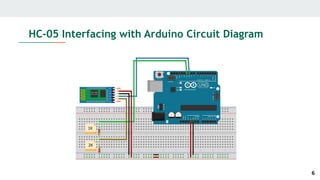
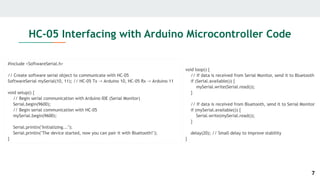
HC-05 Interfacing withArduino Microcontroller Code
7
void loop() {
// If data is received from Serial Monitor, send it to Bluetooth
if (Serial.available()) {
mySerial.write(Serial.read());
}
// If data is received from Bluetooth, send it to Serial Monitor
if (mySerial.available()) {
Serial.write(mySerial.read());
}
delay(20); // Small delay to improve stability
}
#include <SoftwareSerial.h>
// Create software serial object to communicate with HC-05
SoftwareSerial mySerial(10, 11); // HC-05 Tx -> Arduino 10, HC-05 Rx -> Arduino 11
void setup() {
// Begin serial communication with Arduino IDE (Serial Monitor)
Serial.begin(9600);
// Begin serial communication with HC-05
mySerial.begin(9600);
Serial.println("Initializing...");
Serial.println("The device started, now you can pair it with Bluetooth!");
}
8.
HC-05 Working Principle
8
•Pairing & Connection: The module discovers nearby devices and establishes a connection.
• Data Transfer: Uses serial communication (UART) to send/receive data via TX and RX pins.
• Bluetooth Profiles: Utilizes protocols like SPP (Serial Port Profile) for wireless serial communication.
• Wireless Range: Typically works within a range of up to 10 meters.
• Bidirectional Communication: Enables two-way data transfer between devices.
9.
HC-05 Bluetooth ModuleApplications
9
Industrial Automation: Enables remote monitoring and control of machines, improving
efficiency and reducing manual intervention.
IoT & Home Automation: Facilitates wireless control of smart home devices, allowing
automation of appliances via mobile apps.
Robotics & Remote Control: Supports wireless communication for robot navigation, making
remote operation and data exchange seamless.
Healthcare & Wearable Devices: Used in smart healthcare systems for wireless patient
monitoring and health tracking through Bluetooth-enabled devices.
Wireless Data Transfer: Replaces wired UART communication, enabling secure and efficient
data exchange between microcontrollers and smart devices.
10.
SIM800L Module
10
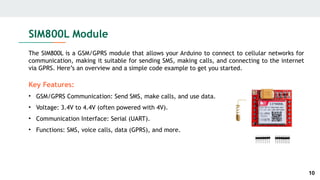
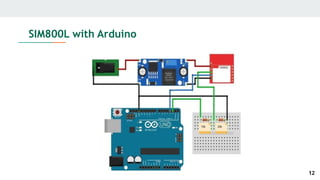
The SIM800Lis a GSM/GPRS module that allows your Arduino to connect to cellular networks for
communication, making it suitable for sending SMS, making calls, and connecting to the internet
via GPRS. Here’s an overview and a simple code example to get you started.
Key Features:
• GSM/GPRS Communication: Send SMS, make calls, and use data.
• Voltage: 3.4V to 4.4V (often powered with 4V).
• Communication Interface: Serial (UART).
• Functions: SMS, voice calls, data (GPRS), and more.
11.
SIM800L Pin Configuration
11
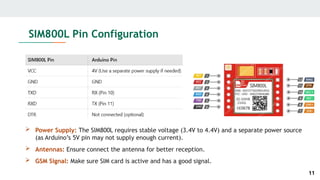
Power Supply: The SIM800L requires stable voltage (3.4V to 4.4V) and a separate power source
(as Arduino’s 5V pin may not supply enough current).
Antennas: Ensure connect the antenna for better reception.
GSM Signal: Make sure SIM card is active and has a good signal.
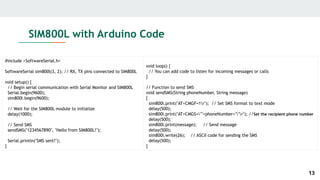
SIM800L with ArduinoCode
13
void loop() {
// You can add code to listen for incoming messages or calls
}
// Function to send SMS
void sendSMS(String phoneNumber, String message)
{
sim800l.print("AT+CMGF=1r"); // Set SMS format to text mode
delay(500);
sim800l.print("AT+CMGS=""+phoneNumber+""r"); //Set the recipient phone number
delay(500);
sim800l.print(message); // Send message
delay(500);
sim800l.write(26); // ASCII code for sending the SMS
delay(500);
}
#include <SoftwareSerial.h>
SoftwareSerial sim800l(3, 2); // RX, TX pins connected to SIM800L
void setup() {
// Begin serial communication with Serial Monitor and SIM800L
Serial.begin(9600);
sim800l.begin(9600);
// Wait for the SIM800L module to initialize
delay(1000);
// Send SMS
sendSMS("1234567890", "Hello from SIM800L!");
Serial.println("SMS sent!");
}
14.
SIM800L Working Principle
14
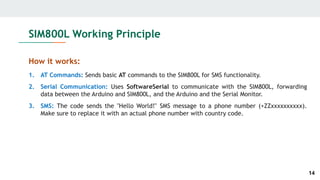
Howit works:
1. AT Commands: Sends basic AT commands to the SIM800L for SMS functionality.
2. Serial Communication: Uses SoftwareSerial to communicate with the SIM800L, forwarding
data between the Arduino and SIM800L, and the Arduino and the Serial Monitor.
3. SMS: The code sends the "Hello World!" SMS message to a phone number (+ZZxxxxxxxxxx).
Make sure to replace it with an actual phone number with country code.
15.
SIM800L Applications
15
The SIM800Lmodule has several applications, including:
SMS-based Communication: Send SMS alerts, control devices remotely, or create alert systems
for emergencies.
Voice Communication: Enable voice calls or intercom systems.
GPRS Data Communication: Provide internet access, send data from sensors, or enable GPS
tracking.
IoT Projects: Used in remote IoT devices for monitoring and automation, such as in agriculture or
smart home systems.
Home Automation & Security: Control appliances via SMS or phone calls and send alerts for
16.
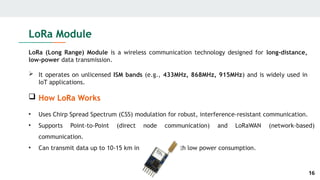
LoRa Module
16
LoRa (LongRange) Module is a wireless communication technology designed for long-distance,
low-power data transmission.
It operates on unlicensed ISM bands (e.g., 433MHz, 868MHz, 915MHz) and is widely used in
IoT applications.
How LoRa Works
• Uses Chirp Spread Spectrum (CSS) modulation for robust, interference-resistant communication.
• Supports Point-to-Point (direct node communication) and LoRaWAN (network-based)
communication.
• Can transmit data up to 10-15 km in open areas with low power consumption.
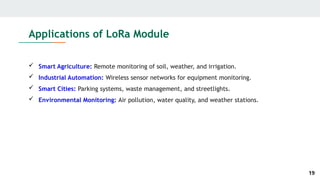
Applications of LoRaModule
19
Smart Agriculture: Remote monitoring of soil, weather, and irrigation.
Industrial Automation: Wireless sensor networks for equipment monitoring.
Smart Cities: Parking systems, waste management, and streetlights.
Environmental Monitoring: Air pollution, water quality, and weather stations.
20.
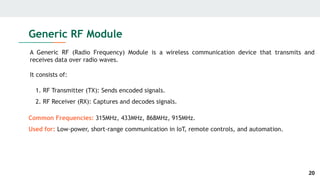
Generic RF Module
20
AGeneric RF (Radio Frequency) Module is a wireless communication device that transmits and
receives data over radio waves.
It consists of:
1. RF Transmitter (TX): Sends encoded signals.
2. RF Receiver (RX): Captures and decodes signals.
Common Frequencies: 315MHz, 433MHz, 868MHz, 915MHz.
Used for: Low-power, short-range communication in IoT, remote controls, and automation.
21.
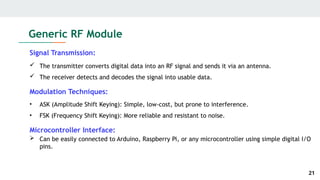
Generic RF Module
21
SignalTransmission:
The transmitter converts digital data into an RF signal and sends it via an antenna.
The receiver detects and decodes the signal into usable data.
Modulation Techniques:
• ASK (Amplitude Shift Keying): Simple, low-cost, but prone to interference.
• FSK (Frequency Shift Keying): More reliable and resistant to noise.
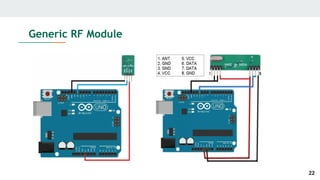
Microcontroller Interface:
Can be easily connected to Arduino, Raspberry Pi, or any microcontroller using simple digital I/O
pins.
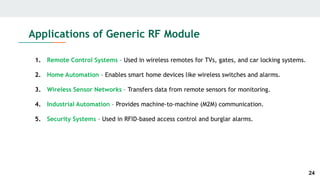
Applications of GenericRF Module
24
1. Remote Control Systems – Used in wireless remotes for TVs, gates, and car locking systems.
2. Home Automation – Enables smart home devices like wireless switches and alarms.
3. Wireless Sensor Networks – Transfers data from remote sensors for monitoring.
4. Industrial Automation – Provides machine-to-machine (M2M) communication.
5. Security Systems – Used in RFID-based access control and burglar alarms.
25.
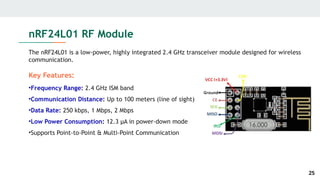
nRF24L01 RF Module
25
ThenRF24L01 is a low-power, highly integrated 2.4 GHz transceiver module designed for wireless
communication.
Key Features:
•Frequency Range: 2.4 GHz ISM band
•Communication Distance: Up to 100 meters (line of sight)
•Data Rate: 250 kbps, 1 Mbps, 2 Mbps
•Low Power Consumption: 12.3 µA in power-down mode
•Supports Point-to-Point & Multi-Point Communication
26.
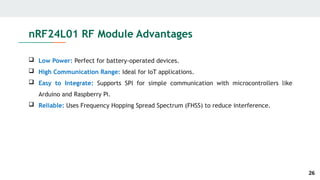
nRF24L01 RF ModuleAdvantages
26
Low Power: Perfect for battery-operated devices.
High Communication Range: Ideal for IoT applications.
Easy to Integrate: Supports SPI for simple communication with microcontrollers like
Arduino and Raspberry Pi.
Reliable: Uses Frequency Hopping Spread Spectrum (FHSS) to reduce interference.
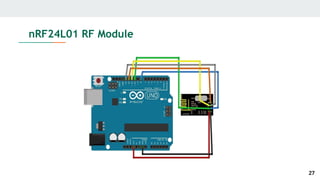
nRF24L01 RF Module
28
//Include Libraries
#include <SPI.h>
#include <nRF24L01.h>
#include <RF24.h>
// Create an RF24 object
RF24 radio(9, 8); // CE, CSN
// Address through which two modules communicate
const byte address[6] = "00001";
void setup() {
radio.begin();
// Set the address
radio.openWritingPipe(address);
// Set module as transmitter
radio.stopListening();
}
void loop() {
// Send message to receiver
const char text[] = "Hello World";
radio.write(&text, sizeof(text));
delay(1000);
}
// Include Libraries
#include <SPI.h>
#include <nRF24L01.h>
#include <RF24.h>
// Create an RF24 object
RF24 radio(9, 8); // CE, CSN
// Address through which two modules communicate
const byte address[6] = "00001";
void setup() {
while (!Serial);
Serial.begin(9600);
radio.begin();
// Set the address
radio.openReadingPipe(0, address);
// Set module as receiver
radio.startListening();
}
void loop() {
// Read the data if available in buffer
if (radio.available()) {
char text[32] = {0};
radio.read(&text, sizeof(text));
Serial.println(text);
}
}
Transmitter Code:
Receiver Code:
29.
nRF24L01 RF ModuleApplications
29
Wireless Sensor Networks – Remote data collection from environmental or industrial sensors.
Home Automation – Wireless control of smart devices like lights, fans, and door locks.
IoT Applications – Seamless communication between IoT devices for real-time monitoring and control.
Robotics and Automation – Wireless control and coordination of robots and automated systems.
Remote Control Systems – Stable, long-range control for RC cars, drones, and robotic projects.
![nRF24L01 RF Module
28
// Include Libraries
#include <SPI.h>
#include <nRF24L01.h>
#include <RF24.h>
// Create an RF24 object
RF24 radio(9, 8); // CE, CSN
// Address through which two modules communicate
const byte address[6] = "00001";
void setup() {
radio.begin();
// Set the address
radio.openWritingPipe(address);
// Set module as transmitter
radio.stopListening();
}
void loop() {
// Send message to receiver
const char text[] = "Hello World";
radio.write(&text, sizeof(text));
delay(1000);
}
// Include Libraries
#include <SPI.h>
#include <nRF24L01.h>
#include <RF24.h>
// Create an RF24 object
RF24 radio(9, 8); // CE, CSN
// Address through which two modules communicate
const byte address[6] = "00001";
void setup() {
while (!Serial);
Serial.begin(9600);
radio.begin();
// Set the address
radio.openReadingPipe(0, address);
// Set module as receiver
radio.startListening();
}
void loop() {
// Read the data if available in buffer
if (radio.available()) {
char text[32] = {0};
radio.read(&text, sizeof(text));
Serial.println(text);
}
}
Transmitter Code:
Receiver Code:](https://image.slidesharecdn.com/advancedarduinoprogrammingforcommunications-250321041524-faa0f07a/85/Advanced-Arduino-Programming-for-Communications-pptx-28-320.jpg)



![20260201 [FOSDEM] gomodjail - library sandboxing for Go modules.pdf](https://cdn.slidesharecdn.com/ss_thumbnails/20260201fosdemgomodjail-librarysandboxingforgomodules-260201225659-76609ec4-thumbnail.jpg?width=640&height=640&fit=bounds)


![谷歌留痕技术教程[ 𝙩𝙤𝙥 𝟮𝟯𝟯. 𝙘 𝙤𝙢 ]](https://cdn.slidesharecdn.com/ss_thumbnails/top233-260130173900-2eb784f9-thumbnail.jpg?width=640&height=640&fit=bounds)


