Copyright © 2007, Oracle. All rights reserved.6 - 1 Copyright © 2007, Oracle. All rights reserved.6 - 1
SCALAR &
CORRELATED
SUBQUERIES,
WITH CLAUSE
B.Sc.IT
325
ANKIT SURATI
Copyright © 2007, Oracle. All rights reserved.6 - 2 Copyright © 2007, Oracle. All rights reserved.6 - 2
Scalar Subquery Expressions
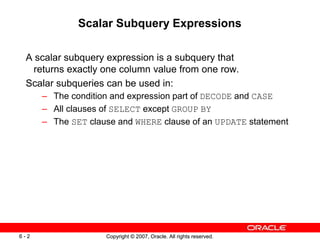
A scalar subquery expression is a subquery that
returns exactly one column value from one row.
Scalar subqueries can be used in:
– The condition and expression part of DECODE and CASE
– All clauses of SELECT except GROUP BY
– The SET clause and WHERE clause of an UPDATE statement
Copyright © 2007, Oracle. All rights reserved.6 - 3 Copyright © 2007, Oracle. All rights reserved.6 - 3
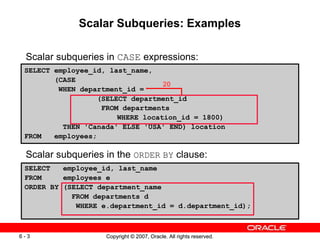
Scalar Subqueries: Examples
Scalar subqueries in CASE expressions:
Scalar subqueries in the ORDER BY clause:
SELECT employee_id, last_name,
(CASE
WHEN department_id =
(SELECT department_id
FROM departments
WHERE location_id = 1800)
THEN 'Canada' ELSE 'USA' END) location
FROM employees;
SELECT employee_id, last_name
FROM employees e
ORDER BY (SELECT department_name
FROM departments d
WHERE e.department_id = d.department_id);
20
Copyright © 2007, Oracle. All rights reserved.6 - 4 Copyright © 2007, Oracle. All rights reserved.6 - 4
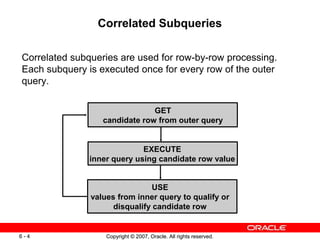
Correlated Subqueries
Correlated subqueries are used for row-by-row processing.
Each subquery is executed once for every row of the outer
query.
GET
candidate row from outer query
EXECUTE
inner query using candidate row value
USE
values from inner query to qualify or
disqualify candidate row
Copyright © 2007, Oracle. All rights reserved.6 - 5 Copyright © 2007, Oracle. All rights reserved.6 - 5
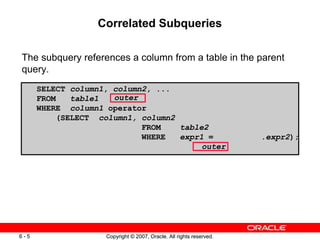
Correlated Subqueries
The subquery references a column from a table in the parent
query.
SELECT column1, column2, ...
FROM table1
WHERE column1 operator
(SELECT column1, column2
FROM table2
WHERE expr1 = .expr2);
outer
outer
Copyright © 2007, Oracle. All rights reserved.6 - 6 Copyright © 2007, Oracle. All rights reserved.6 - 6
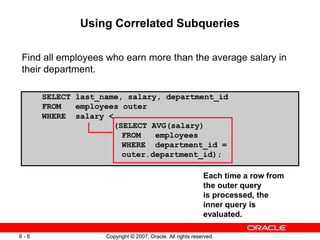
SELECT last_name, salary, department_id
FROM employees outer
WHERE salary <
(SELECT AVG(salary)
FROM employees
WHERE department_id =
outer.department_id);
Using Correlated Subqueries
Find all employees who earn more than the average salary in
their department.
Each time a row from
the outer query
is processed, the
inner query is
evaluated.
Copyright © 2007, Oracle. All rights reserved.6 - 7 Copyright © 2007, Oracle. All rights reserved.6 - 7
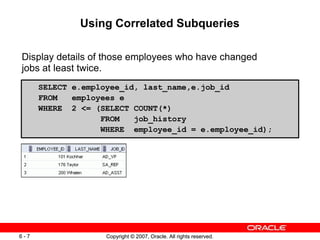
Using Correlated Subqueries
Display details of those employees who have changed
jobs at least twice.
SELECT e.employee_id, last_name,e.job_id
FROM employees e
WHERE 2 <= (SELECT COUNT(*)
FROM job_history
WHERE employee_id = e.employee_id);
Copyright © 2007, Oracle. All rights reserved.6 - 8 Copyright © 2007, Oracle. All rights reserved.6 - 8
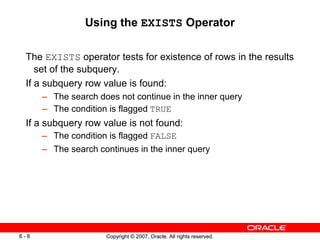
Using the EXISTS Operator
The EXISTS operator tests for existence of rows in the results
set of the subquery.
If a subquery row value is found:
– The search does not continue in the inner query
– The condition is flagged TRUE
If a subquery row value is not found:
– The condition is flagged FALSE
– The search continues in the inner query
Copyright © 2007, Oracle. All rights reserved.6 - 9 Copyright © 2007, Oracle. All rights reserved.6 - 9
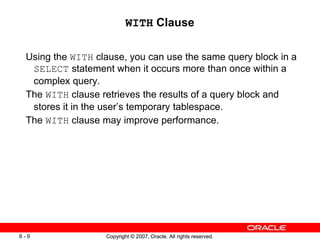
WITH Clause
Using the WITH clause, you can use the same query block in a
SELECT statement when it occurs more than once within a
complex query.
The WITH clause retrieves the results of a query block and
stores it in the user’s temporary tablespace.
The WITH clause may improve performance.
Copyright © 2007, Oracle. All rights reserved.6 - 10 Copyright © 2007, Oracle. All rights reserved.6 - 10
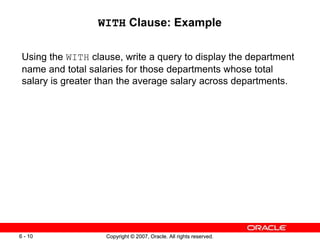
WITH Clause: Example
Using the WITH clause, write a query to display the department
name and total salaries for those departments whose total
salary is greater than the average salary across departments.
Copyright © 2007, Oracle. All rights reserved.6 - 11 Copyright © 2007, Oracle. All rights reserved.6 - 11
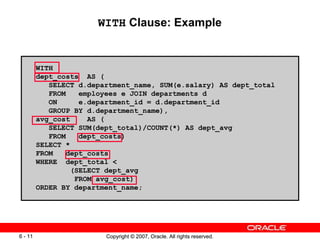
WITH Clause: Example
WITH
dept_costs AS (
SELECT d.department_name, SUM(e.salary) AS dept_total
FROM employees e JOIN departments d
ON e.department_id = d.department_id
GROUP BY d.department_name),
avg_cost AS (
SELECT SUM(dept_total)/COUNT(*) AS dept_avg
FROM dept_costs)
SELECT *
FROM dept_costs
WHERE dept_total <
(SELECT dept_avg
FROM avg_cost)
ORDER BY department_name;
Copyright © 2007, Oracle. All rights reserved.6 - 12 Copyright © 2007, Oracle. All rights reserved.6 - 12
Thank you

ADVANCE SQL-"Sub queries"

  • 1.
    Copyright © 2007,Oracle. All rights reserved.6 - 1 Copyright © 2007, Oracle. All rights reserved.6 - 1 SCALAR & CORRELATED SUBQUERIES, WITH CLAUSE B.Sc.IT 325 ANKIT SURATI
  • 2.
    Copyright © 2007,Oracle. All rights reserved.6 - 2 Copyright © 2007, Oracle. All rights reserved.6 - 2 Scalar Subquery Expressions A scalar subquery expression is a subquery that returns exactly one column value from one row. Scalar subqueries can be used in: – The condition and expression part of DECODE and CASE – All clauses of SELECT except GROUP BY – The SET clause and WHERE clause of an UPDATE statement
  • 3.
    Copyright © 2007,Oracle. All rights reserved.6 - 3 Copyright © 2007, Oracle. All rights reserved.6 - 3 Scalar Subqueries: Examples Scalar subqueries in CASE expressions: Scalar subqueries in the ORDER BY clause: SELECT employee_id, last_name, (CASE WHEN department_id = (SELECT department_id FROM departments WHERE location_id = 1800) THEN 'Canada' ELSE 'USA' END) location FROM employees; SELECT employee_id, last_name FROM employees e ORDER BY (SELECT department_name FROM departments d WHERE e.department_id = d.department_id); 20
  • 4.
    Copyright © 2007,Oracle. All rights reserved.6 - 4 Copyright © 2007, Oracle. All rights reserved.6 - 4 Correlated Subqueries Correlated subqueries are used for row-by-row processing. Each subquery is executed once for every row of the outer query. GET candidate row from outer query EXECUTE inner query using candidate row value USE values from inner query to qualify or disqualify candidate row
  • 5.
    Copyright © 2007,Oracle. All rights reserved.6 - 5 Copyright © 2007, Oracle. All rights reserved.6 - 5 Correlated Subqueries The subquery references a column from a table in the parent query. SELECT column1, column2, ... FROM table1 WHERE column1 operator (SELECT column1, column2 FROM table2 WHERE expr1 = .expr2); outer outer
  • 6.
    Copyright © 2007,Oracle. All rights reserved.6 - 6 Copyright © 2007, Oracle. All rights reserved.6 - 6 SELECT last_name, salary, department_id FROM employees outer WHERE salary < (SELECT AVG(salary) FROM employees WHERE department_id = outer.department_id); Using Correlated Subqueries Find all employees who earn more than the average salary in their department. Each time a row from the outer query is processed, the inner query is evaluated.
  • 7.
    Copyright © 2007,Oracle. All rights reserved.6 - 7 Copyright © 2007, Oracle. All rights reserved.6 - 7 Using Correlated Subqueries Display details of those employees who have changed jobs at least twice. SELECT e.employee_id, last_name,e.job_id FROM employees e WHERE 2 <= (SELECT COUNT(*) FROM job_history WHERE employee_id = e.employee_id);
  • 8.
    Copyright © 2007,Oracle. All rights reserved.6 - 8 Copyright © 2007, Oracle. All rights reserved.6 - 8 Using the EXISTS Operator The EXISTS operator tests for existence of rows in the results set of the subquery. If a subquery row value is found: – The search does not continue in the inner query – The condition is flagged TRUE If a subquery row value is not found: – The condition is flagged FALSE – The search continues in the inner query
  • 9.
    Copyright © 2007,Oracle. All rights reserved.6 - 9 Copyright © 2007, Oracle. All rights reserved.6 - 9 WITH Clause Using the WITH clause, you can use the same query block in a SELECT statement when it occurs more than once within a complex query. The WITH clause retrieves the results of a query block and stores it in the user’s temporary tablespace. The WITH clause may improve performance.
  • 10.
    Copyright © 2007,Oracle. All rights reserved.6 - 10 Copyright © 2007, Oracle. All rights reserved.6 - 10 WITH Clause: Example Using the WITH clause, write a query to display the department name and total salaries for those departments whose total salary is greater than the average salary across departments.
  • 11.
    Copyright © 2007,Oracle. All rights reserved.6 - 11 Copyright © 2007, Oracle. All rights reserved.6 - 11 WITH Clause: Example WITH dept_costs AS ( SELECT d.department_name, SUM(e.salary) AS dept_total FROM employees e JOIN departments d ON e.department_id = d.department_id GROUP BY d.department_name), avg_cost AS ( SELECT SUM(dept_total)/COUNT(*) AS dept_avg FROM dept_costs) SELECT * FROM dept_costs WHERE dept_total < (SELECT dept_avg FROM avg_cost) ORDER BY department_name;
  • 12.
    Copyright © 2007,Oracle. All rights reserved.6 - 12 Copyright © 2007, Oracle. All rights reserved.6 - 12 Thank you