Adult Day Program
Kyle Holcomb, Dave Carr, Jerry Stark | A&R Case Management
Adult Day Program
We are excited to announce that we will be restructuring the Adult Day
Program.We will now have a team that includes the hourly supported
living participants, the participants attending our day program, and
team members!Welcome to ourTeam!The hourly supported living
participants and team members are coming over from the umbrella of
Supported Living.
Itinerary
 Introductions (15 min.)
 History (5 min.)
 Mission (5 min.)
 Vision (5 min.)
 Leaders (15 min.)
 Top Down (15 min.)
 Program Hierarchy (5 min.)
 CSRTraining (15 min.)
 Attendance Policy (20 min.)
 Break (10 min.)
 Project Scope (5 min.)
 Milestones (10 min.)
 Cost Analysis (5 min.)
 Profit Margins (5 min.)
 Conclusion (10 min.)
History
 A&R Case Management was established on May 30, 1995 as a Sub
Chapter S Corporation and is owned and operated by Joanne Anderson
and Lori Rainboth-Owen for profit.
 We started in the JoanneAnderson’s residence, progressed to Lori
Rainboth-Owen’s residence, and just a few years later A&R moved into
the Hasbrouck House.After the Hasbrouck House was not suitable we
moved on over to the previous location off of Holly street.The company
then decided to upgrade to a newer building in the year of 2012.We
remain in this location off of 12th Ave. in Nampa, ID
 During the past 20 years of business A&R has expanded from just a
handful of participants to serving a couple of hundred of participants
and employing nearly two hundred team members.
History Continued…
 Also, during that time we have been apart of positive and negative
experiences.We have learned that the most important part of running a
successful business is utilizing The Golden Rule.
 Some of the most positive include serving individuals during Special
Olympics and getting to know each participant for who they are and not
by their disability.
 Some of the negative include state-laws that gave us the opportunity to
adapt and continue in a different direction. Even negative happening
have allowed us to become stronger and better suited for future
endeavors.
Mission Statement
 A&R Case Management believes that every individual can achieve
greater independence with the right support, encouragement, and
positive environment.
 The mission of A&R Case Management is to provide Service
Coordination, Habilitative Intervention, Habilitative Support, Age and
Disabled Waiver Services, Residential Habilitation, Supported Living,
and Personal Care Services.
 The Adult Program has printed out personal mission statements for
each one of our team members.We have also provided a web address
that will grant access to a free online copy as well for future use.
 http://www.daveramsey.com/entreleadership/mission/
A&R Adult Day ProgramVision
 Our vision is to expand at a rate that we can continue to serve our
participants very well in regards to therapy, dignity, and respect.
 Slow and steady expansion wins the race
 Our vision is to expand into multiple therapy rooms and accommodate
ample resources for all participants and team members
 This also includes developing future leaders in the Adult Program to
help facilitate activities, events, training, and other business endeavors.
A&R Adult Day ProgramVision continued…
 Have a program that has less than 15% of downtime
 Has a waiting list for admission
 Action Items
 Objectives that enhance learning to the full potential
 Daily activities that encourage learning to the full potential
A&R Leaders
 A Leader Defined:
 A person that can be;
 Passionately serving
 Mavericks (independent minded person) who have integrity
 Disciplined risk takers
 Courageous while humble
 MotivatedVisionaries
 Driven while loyal
 Influential learners
A&R Leaders continued…
 An A&R Leader needs to have a servant mentality by leading our team
members.
 Teaching and mentoring
 Protecting team members from inappropriateness (sexual harassment, etc.)
 Digging the trenches
 Reprimanding a team member or even allowing him to work somewhere
else.
 Passion
 You cannot lead without passion and passion is a force multiplier.
 Passion is simply caring deeply!
 The byproducts of this are quality, excellence, impressed customers,
employees who become team members, and ultimately a higher
likelihood of profit.
A&R Leaders continued…
 There is more energy in an organization with a passionate leader and team.
 People are naturally more productive when they care deeply about the outcomes and
company
 If I am a customer and I believe you deeply care about delivering to me, I am more
forgiving when there is a mistake.
 Unity only comes when a group of people truly believe each member cares.
 If people are merely looking for a J-O-B we will allow them to work somewhere else
 Passion is so key in leading and creating excellence that our team will hire passion
over education or talent every time.
From theTop Down
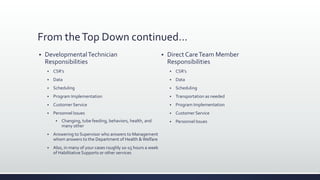
 Developmental Specialists Responsibilities
 Developmental Application
 H/C
 Developmental Evaluation
 Medical Notes
 Mental Healthy Diagnosis
 PSR
 ISP/PIP
 6MR and AR
 Med. Social, IEP, Sib-r, etc.
 Program Coordinator Responsibilities
 Program Implementation
 DevelopmentalAssessment
 Implementation Program Plans
 6MR & 12MR
 ISP Meetings
 Safety Plans & Behavioral Plans
 Assist team members
 Incident Reports
 QualityAssurance
From theTop Down continued…
 Developmental Specialists and Program CoordinatorAdditional Responsibilities
 Activities and Events Coordination
 Marketing & Selling
 Program
 Therapy
 A&R Brand
 Observations
 Customer Service
 Personnel Issues
 Answering to Management whom answer to the Department of Health &Welfare
 Also, in my case roughly 10-15 hours a week of Habilitative Intervention
From theTop Down continued…
 DevelopmentalTechnician
Responsibilities
 CSR’s
 Data
 Scheduling
 Program Implementation
 Customer Service
 Personnel Issues
 Changing, tube feeding, behaviors, health, and
many other
 Answering to Supervisor who answers to Management
whom answers to the Department of Health &Welfare
 Also, in many of your cases roughly 10-15 hours a week
of Habilitative Supports or other services
 Direct CareTeam Member
Responsibilities
 CSR’s
 Data
 Scheduling
 Transportation as needed
 Program Implementation
 Customer Service
 Personnel Issues
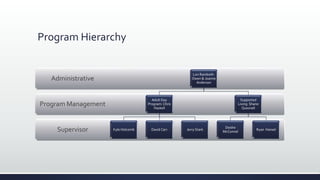
Program Hierarchy
Supervisor
Program Management
Administrative
Lori Rainboth-
Owen & Joanne
Anderson
Adult Day
Program: Chris
Haskell
Kyle Holcomb David Carr Jerry Stark
Supported
Living: Shane
Quesnell
Deidre
McConnel
Ryan Hansel
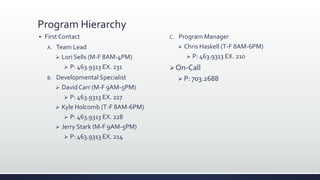
Program Hierarchy
 First Contact
A. Team Lead
 Lori Sells (M-F 8AM-4PM)
 P: 463.9313 EX. 231
B. Developmental Specialist
 David Carr (M-F 9AM-5PM)
 P: 463.9313 EX. 227
 Kyle Holcomb (T-F 8AM-6PM)
 P: 463.9313 EX. 228
 Jerry Stark (M-F 9AM-5PM)
 P: 463.9313 EX. 214
C. Program Manager
 Chris Haskell (T-F 8AM-6PM)
 P: 463.9313 EX. 210
On-Call
 P: 703.2688
CSRTraining
 Reference Document
Attendance Policy
 Attendance PolicyGuidelines and;
 Implementation
 We need all team members printed name, signature, and date
 Staffing Coordinator
 P: 208.703.4133
Break!
 10 min.
Project Scope
 Work to be accomplished
 Program Expectations
 Program Implementation
 What’s the purpose or business need for this project?
 The purpose of this project is the expansion of the Adult Day Program, increase participant
interaction, increased profit margins, and customer satisfaction.
Objectives
 Identify overall project objectives:
 Team Member Responsibilities and
Expectations
 ProfessionalismTraining
 Prompt HierarchyTraining
 HierarchyVerbal Intervention
 Screen Usage Guidelines
 6STraining
 DTTM
 Monthly
 Positives
 Goals
 Action Items
 Conclusion (Questions or
concerns)
 Time Management and
Organization
 SMART Goals
 Weekly Activity Planner
 Prioritized Action Items
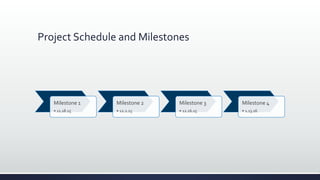
Project Schedule and Milestones
Milestone 1
• 11.18.15
Milestone 2
• 12.2.15
Milestone 3
• 12.16.15
Milestone 4
• 1.13.16
Milestone Schedule
 HSLTeam Members:
 Will receive all four of the milestone trainings
 Adult RoomTeam Members:
 Will attend the monthly DTTM meetings only unless they need a refresher on any of the
trainings.
Milestone 1
 Team Member ResponsibilitiesTraining
 Team Member ExpectationsTraining
 ProfessionalismTraining
Milestone 2
 DevelopmentalTechnicianTraining Meeting (DTTM)
 *Direct CareTeam Members are expected to attend
 Monthly
 Positives
 Goals
 Action Items
 Conclusion (Questions or concerns)
 Time Management & Organization
 SMART Goals
 Weekly Activity Planner
 PrioritizedAction Items
Milestone 3
 Outlook CalendarTraining
 Identify places that participants would like to attend quarterly
 Scheduling Protocol
Milestone 4
 HierarchicalVerbal InterventionTraining
 Prompt HierarchyTraining
 6STraining onWorkplace Organization
 Screen Usage Guidelines
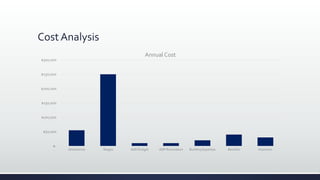
Cost Analysis
$-
$50,000
$100,000
$150,000
$200,000
$250,000
$300,000
Attendance Wages ADP Budget ADP Renovation Building Expenses Benefits Insurance
Annual Cost
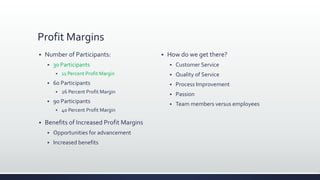
Profit Margins
 Number of Participants:
 30 Participants
 11 Percent Profit Margin
 60 Participants
 26 Percent Profit Margin
 90 Participants
 40 Percent Profit Margin
 Benefits of Increased Profit Margins
 Opportunities for advancement
 Increased benefits
 How do we get there?
 Customer Service
 Quality of Service
 Process Improvement
 Passion
 Team members versus employees
Success Factors
 Satisfied clients
 Meet project objectives
Conclusion
 Question andAnswer
 Please provide an email address and phone number for business purposes
 If a team member does not have an email to provide please stay seated.We will conduct a
quick email creation training and expect an email address from each team member by our
next meeting. Our next meeting will be sent out on checks when applicable.
 Please submit personal Mission Statement by our next meeting if you have not
already. If less than 80% are submitted by our next meeting we will take time to
complete our Mission Statements during our next meeting.The Mission Statements
can be submitted early via email: kyleh@arcasemanagement.com
 Thank you for your time!!
Adult Day Program
DTTM
Itinerary
 Mission Statements
 Professionalism
 DTTM
 Time Management Expectations and;
 Organization
 Outlook CalendarTraining and;
 Scheduling protocol
Mission Statements
 15-30 minutes to complete Mission Statements if less than 80% of HSL team members
have completed the document.
ProfessionalismTraining
 Professionalism LearningObjectives:
 Define professionalism
 Describe key professional attributes
 Describing methods for teaching and assessment of professionalism
 Describe the most common examples of unprofessional behavior
ProfessionalismTraining
 Professionalism:
 Without questions…the most important career competencies
 Most common reason for “failure” in a career is a lack thereof professionalism
ProfessionalTraining
 Distractions that interfere with professional behavior:
 Financial worries
 Time constraints
 Fatigue
 Physical illness and;
 Family stress
ProfessionalismTraining
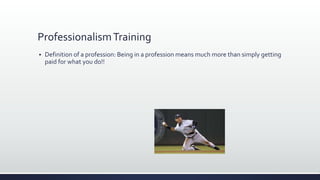
 Definition of a profession: Being in a profession means much more than simply getting
paid for what you do!!
ProfessionalismTraining
 Definition of a Profession:
 Distinct body of knowledge
 Responsibility for advancing knowledge
 Responsibility for transmitting knowledge to the next generation
 Special code of behavior- A true higher standard, a calling!!
 Moral Imperative
 Put the people you serve above your own self interest
ProfessionalismTraining
 Definition of a Profession:
 “The great use of a life is to spend it on something that will outlast it.”
-William James
ProfessionalismTraining
 Desirable ProfessionalAttributes:
 Humility
 Participants needs are put first
 Honesty
 Truthfulness
 Integrity
 Responsible
 Reliable
 Accountable
ProfessionalismTraining
 Desirable ProfessionalAttributes:
 Consistency
 Persistence
 “When you learn to quit it, it becomes a habit.”
 Vince Lombardi
 Balance
 Home Life and working life
 Attention to personal health
 Physical and;
 Psychological
ProfessionalismTraining
 Desirable ProfessionalAttributes:
 Respectful
 Loyal
 Commitment to Excellence
 Developing daily
 Commitment to self-directed learning
 Reading, education, developing goals and achieving
 Compassion and sensitivity
 Appropriate hygiene and personal appearance
ProfessionalismTraining
 Desirable ProfessionalAttributes:
 Intellectual curiosity
 Look at what we need to improve
 Insight into personal strengths and weaknesses
 Maturity
 “You don’t make your character in a crisis, you exhibit it.”
-MarkTwain
ProfessionalismTraining
 Characteristics of Effective Feedback:
 Timely
 Specific
 Suggestions for improvement and;
 Timeline for improvement
 Privacy
 Focused on the specific behavior not personality
 “Sandwiched” with praise for work well done
ProfessionalismTraining
 Teaching Professionalism
 Lectures
 Seminars
 Role-playing exercises
 Directed reading
 Modeling of proper behavior
 One-on-one counseling
Professionalism (Milestone 1)
 View Activity 20-30 minutes
ProfessionalismTraining
 Top 10 Examples of Unprofessional Behavior:
 Dishonesty
 Arrogance- too great a sense of entitlement
 In the work place and;
 Social situations
 Prejudice
 Disrespectfulness
 Lack of Accountability
 Fiscal Irresponsibility
 Lack of sustained commitment to self learning
 Lack of due diligence
 Carelessness or;
 Laziness
 Personal Excesses- substance abuse or gambling
 Sexual Misconduct
ProfessionalismTraining
 Assessment of Professionalism:
 Focus on modifying undesirable behaviors, not changing an individuals personality
ProfessionalismTraining
 Take a look at ourselves:
 Punctuality
 Consistency in attendance
 Dress
 Respectfulness in interacting with others
 Respect for diversity
 Ethnicity
 Lifestyle
 Willingness to accept personal responsibility for outcomes
ProfessionalismTraining
 Willingness to seek help when needed
 Communication
 Family Members
 Team Members
 Participants
 Dependability
 Work Ethic
 Attitude
 Be part of the solution not part of the problem
ProfessionalismTraining
 “Just do it!”
ProfessionalismTraining
 Conclusions:
 Be nice!
 Be virtuous!
 Strive for excellence but accept imperfection!
 Do the right thing!
DTTM (Milestone 2)
 DevelopmentalTechnicianTraining Meeting (DTTM)
 *Direct CareTeam Members are expected to attend
 Monthly
 Positives
 Goals
 Action Items
 Conclusion (Questions or concerns)
 Time Management & Organization
 SMART Goals
 Weekly Activity Planner
 PrioritizedAction Items
Positives
 Lets take a minute and state some positives from the last month!
S.M.A.R.T. Goals
 S.M.A.R.T.Goals
 Specific
 What, where, how?
 Measurable
 From and to (when the goal is complete)
 Assignable
 Group or individual
 Realistic
 Challenging, yet achievable within the time frame
 Time-based
 When?
Goals
 PersonalGoals:
 Develop the A&R Case Management Professionalism training document by 1.13.16.
 Work-out
 I want to start my Master’s in BusinessAdministration program through NNU by January 15,
2016 and graduate by June 1, 2018.
 Team Goals:
 Please take 10 minutes and develop two goals for the upcoming month.The goals can be
work related or for personal advancement. Our next meeting will be January 13.16 which
would be a good due date for the goals.
Stephen Curry
 https://www.youtube.com/watch?v=rxsdiusm1NQ
Action Items
Time Management and Organization
 Making a schedule
 Creating aTo-Do-List
 Utilize the first twenty minutes of each day to write out Action Items
 Number the list in order of most important to least important
 Re-write the list in the correct order and complete sequentially
Time Management and Organization
 Four Quadrants
 Quadrant 1: Important and urgent
 Examples: production deadlines, payroll, completing data, running programs, and being two steps ahead of
our group
 Quadrant 2: Important but not urgent
 Examples: Exercise, strategic planning, goal setting, reading non-fiction literature, taking a class or three,
relationship building, prayer, date nights with significant others, a day off devoting to brainstorming, and
having the oil changed in your car.
 Quadrant 3: Not important but urgent
 Example: Checking email while writing a report.The email creates an inbox alert and you are distracted like
a moth with a light.You check the email and loose your train of thought on the important document. Other
examples include, but are not limited to…
 Quadrant 4: Not important and not urgent
 Example:Television, Facebook, andTwitter. These are activities that people fall into and almost never
intentionally set out to waste that time.
Time Management and Organization
 When problems arise (unless it is a safety issue)
 1) If something arises: I would like to analyze and give some ideas for resolution and then
challengeTeam Members to come back with 3 good ways to solve the problem.
 2)Team Members will find three or more possible solutions to a problem and a suggested
course of action before bringing to the Supervisor’s attention.
 3)Team Members are sending Supervisor’s emails, texts, etc. telling what the problem or
opportunity was, what the possible solutions were, and how they already solved it.
Outlook CalendarTraining
 Teach how to log-in and view calendar.
 Adult Room team members create the calendar and HSL team members are welcome
to attend community events and activities with participants. Please encourage
participants that you are working with to attend these activities.
 For instance, If I wanted Kai to attend the bowling activity I would present the information to
Kai with two choices. Providing the two choices gives Kai a since of involvement and control.
When I present the two choices I will be very careful of what I say. If I say, “Do you want to go
bowling or not go bowling today?”There is a chance that Kai will choose not to go bowling.
However, if I state, “Kai would you like to go bowling in a half an hour or bowling in fifteen
minutes?” Kai will most likely choose one of the two options. If she does not I would redirect
her by stating, “That was not one of our choices and present the choices again.”
 Please do not make any changes to the calendar at this time.This will change in the
future but will be clearly defined by management.
Closing
 Any questions or concerns?
 CSR’s
 Please ensure to fill out a daily response and;
 If you have a client from 2:30PM-5:30PM please stop filling out data at the box that states
5:15-5:30 instead of 5:30-5:45
 In conclusion, I would like to thank you for your time, and wish you a Merry Christmas
and a Happy NewYear!
Adult Day Program
DTTM
Itinerary
 Positives
 Goals
 HierarchalVerbal Intervention
 Prompt Hierarchy
 6STraining
 Screen Usage Guidelines
 Conclusion
Positives
 Lets take a minute and state some positives from the last month!
Goals
 PersonalGoals:
 Finished the professionalism training
 Make five contacts a week for bundledblessingsfertility.com for the next four weeks.
 Work out three times a week for one hour each session for the entire year of 2016.
 Team Goals:
 Please take 10 minutes and develop two goals for the upcoming month.The goals can be
work related or for personal advancement. Please ensure that the time frame is obtainable.
 Our team goal will be to have 100% accuracy on our CSR’s for two consecutive weeks by our
next meeting. If we have 100% accuracy for two consecutive weeks two pairs of movie
tickets will be raffled off to the HSL team members.
Intervention Hierarchy (Student Centered)
 Non-Verbal Intervention
 Planned Ignoring
 Signal Interference
 Proximity Interference
 Touch Interference
HierarchyVerbal Intervention
 Hints
 Name dropping
 Humor
 Question awareness of effect
 Do we understand that by hitting Charlie it would hurt him?
HierarchyVerbal Intervention
 I message…
 I like it when Chelsey completes her money program
 Direct Appeal:
 Whisper to participant and ask for him/her to complete task for you
 Positive Phrasing:
 As soon as you do X, we will doY
 Are not for:
 Centers are not for throwing items
HierarchyVerbal Intervention Continued…
 Reminder of rules
 GlassersTriplets
 What are you doing?
 What rule are we breaking?
 What should we do?
 Explicit Redirection:
 Stop ________ , instead do ________
 Close with broken record
 Example: Stop.That’s not the point (Repeat like a broken record)
Consequences (Teacher Centered)
 You have a choice:
 Stop_____ and begin______ or; _____ And then you and I will discuss privately later, you
decide
 I see you have chosen to _____ . Please do it now. Follow the broken record if
necessary. Do it now. Do it now or you will be removed by our Developmental
Specialist, (walk away and then come back with time limit). I can see you have chosen
to be removed by the DS-Must follow through
Rules forVerbal Intervention
 Whenever possible use non-verbal first
 Keep as private as possible
 Keep as brief as possible
 Speak to the situation, not the person (Ginnot, 1972) ***
 Set limits on behavior, not on feelings
 Avoid sarcasm or anything that belittles
 Fit the student, situation, and is closer to a student-control then a teacher-influence
 If the first verbal control does not work, then use a different control which is closer to the teacher-influence end of hierarchy
 When considering where to start on the hierarchy, teacher-centered works better with younger, developmentally immature children while
student-centered works better with older, more mature students
 If more than one or two, verbal interventions have been unsuccessful, move to Logical Consequences
IneffectiveVerbal Intervention
Encourage inappropriate behavior
 “I dare you to do that again”
 “aren’t you sorry for what you did?”
 “Why don’t you just admit you have a problem?”
 “grow up!”
 “You’ll never amount to anything”
Positive Comments
 Positive:
 Please walk with me
 Nice hands please
 Sand is for the ground
 Please come inside with me
 Negative:
 Don’t run
 Stop pulling on that
 Don’t throw sand
 Get back in here
Prompt Hierarchy
 Please refer to Prompt Hierarchy document
 C:UsersKyle & Shauni HolcomDesktopPrompt Hierarchy.docx
6STraining
 6S is workplace organization
 Sort Out
 Set in Order
 Shine
 Standardize
 Sustain
 Safety
6STraining
 Training IntroductionVideo -YouTube
6STraining
 Form a team
 6S team should include:
 Leader/facilitator
 Members from designated area
 Using the 6S approach
 Implementing the 6S process
 Mentoring others and encouraging 100% participation
 Create a map
 Select an area
 Take before and after pictures
6STraining
 Notify affected personnel
 An important part of initiating a 6S event is to notify the affected personnel before starting
the event.
 What is happening?
 When will it happen?
 How will it affect them?
6STraining Key Points
 Sort out
 We have sorted out the majority of items that we need and do not need. We can continue
this process by looking at the items that we use daily and the items that we rarely or never
use. If we feel like there are items that need removed we can red tag them. If the red tag
remains on the item for an additional week and does not get used we can remove that item
either temporarily or permanently
 Set in order
 We have also completed this process but could continue to look at room organization. Are
the items in an area that is ergonomic for the participant and staff. Can we improve this?
 Are items labeled?
 Easily identifiable
 Easy to find needed tools and organized
6STraining Key Points
 Shine
 This has been completed.We can continue to upgrade items in the Adult Room such as new tables when
necessary, etc.
 Standardize
 We are working on labeling items appropriately.
 A couple of the following action items we could incorporate to standardization of room organization:
 Cleaning microwave should be conducted daily. One group can be responsible for this task throughout the week. It is best to
clean the microwave immediately versus waiting until food residue has dried onto the surface
 New items that enter the adult room must be approved by myself and this will require an appropriate bin and label before
being granted
 When crafts are created a picture can be saved on the tablet within a created folder and then all products of the craft must be
sent home
 When a group or individual uses an item it must be returned to the appropriately labelled area once item is no longer needed
6STraining Key Points
 Sustaining
 Every 6M we will go through the entire room in order to sustain organization duringADH. Having the participants take
ownership of this room will improve our likely hood of successful 6S integration
 Regularly scheduled audits
 Teamwork
 React immediately to issues
 Safety
 The part that I have decided to add to the 5S model is safety. If there are ever any concerns in regards to safety we will
address them immediately. Such as, if a client needs a chair to reduce the likely hood of pinching fingers, etc.
 Knowing where the following items are vital to a safe environment within the adult room:
 Fires Escape route
 FirstAid
 Employee Documentation
 Community and;
 Center based documents
 Keeping up on training
 Etc.
Screen Usage Guidelines
 Please refer to document
 C:UsersKyle & Shauni HolcomDesktopAdult Program Screen Usage Guidelines.dotx
Closing
 Any questions or concerns?
 CSR’s
 Please remember that 100% accuracy will result in a movie ticket raffle!!!
 In conclusion, I would like to thank you for your time, and have a great week!
Adult Day Program

Adult Day Program

  • 1.
    Adult Day Program KyleHolcomb, Dave Carr, Jerry Stark | A&R Case Management
  • 2.
    Adult Day Program Weare excited to announce that we will be restructuring the Adult Day Program.We will now have a team that includes the hourly supported living participants, the participants attending our day program, and team members!Welcome to ourTeam!The hourly supported living participants and team members are coming over from the umbrella of Supported Living.
  • 3.
    Itinerary  Introductions (15min.)  History (5 min.)  Mission (5 min.)  Vision (5 min.)  Leaders (15 min.)  Top Down (15 min.)  Program Hierarchy (5 min.)  CSRTraining (15 min.)  Attendance Policy (20 min.)  Break (10 min.)  Project Scope (5 min.)  Milestones (10 min.)  Cost Analysis (5 min.)  Profit Margins (5 min.)  Conclusion (10 min.)
  • 4.
    History  A&R CaseManagement was established on May 30, 1995 as a Sub Chapter S Corporation and is owned and operated by Joanne Anderson and Lori Rainboth-Owen for profit.  We started in the JoanneAnderson’s residence, progressed to Lori Rainboth-Owen’s residence, and just a few years later A&R moved into the Hasbrouck House.After the Hasbrouck House was not suitable we moved on over to the previous location off of Holly street.The company then decided to upgrade to a newer building in the year of 2012.We remain in this location off of 12th Ave. in Nampa, ID  During the past 20 years of business A&R has expanded from just a handful of participants to serving a couple of hundred of participants and employing nearly two hundred team members.
  • 5.
    History Continued…  Also,during that time we have been apart of positive and negative experiences.We have learned that the most important part of running a successful business is utilizing The Golden Rule.  Some of the most positive include serving individuals during Special Olympics and getting to know each participant for who they are and not by their disability.  Some of the negative include state-laws that gave us the opportunity to adapt and continue in a different direction. Even negative happening have allowed us to become stronger and better suited for future endeavors.
  • 6.
    Mission Statement  A&RCase Management believes that every individual can achieve greater independence with the right support, encouragement, and positive environment.  The mission of A&R Case Management is to provide Service Coordination, Habilitative Intervention, Habilitative Support, Age and Disabled Waiver Services, Residential Habilitation, Supported Living, and Personal Care Services.  The Adult Program has printed out personal mission statements for each one of our team members.We have also provided a web address that will grant access to a free online copy as well for future use.  http://www.daveramsey.com/entreleadership/mission/
  • 7.
    A&R Adult DayProgramVision  Our vision is to expand at a rate that we can continue to serve our participants very well in regards to therapy, dignity, and respect.  Slow and steady expansion wins the race  Our vision is to expand into multiple therapy rooms and accommodate ample resources for all participants and team members  This also includes developing future leaders in the Adult Program to help facilitate activities, events, training, and other business endeavors.
  • 8.
    A&R Adult DayProgramVision continued…  Have a program that has less than 15% of downtime  Has a waiting list for admission  Action Items  Objectives that enhance learning to the full potential  Daily activities that encourage learning to the full potential
  • 9.
    A&R Leaders  ALeader Defined:  A person that can be;  Passionately serving  Mavericks (independent minded person) who have integrity  Disciplined risk takers  Courageous while humble  MotivatedVisionaries  Driven while loyal  Influential learners
  • 10.
    A&R Leaders continued… An A&R Leader needs to have a servant mentality by leading our team members.  Teaching and mentoring  Protecting team members from inappropriateness (sexual harassment, etc.)  Digging the trenches  Reprimanding a team member or even allowing him to work somewhere else.  Passion  You cannot lead without passion and passion is a force multiplier.  Passion is simply caring deeply!  The byproducts of this are quality, excellence, impressed customers, employees who become team members, and ultimately a higher likelihood of profit.
  • 11.
    A&R Leaders continued… There is more energy in an organization with a passionate leader and team.  People are naturally more productive when they care deeply about the outcomes and company  If I am a customer and I believe you deeply care about delivering to me, I am more forgiving when there is a mistake.  Unity only comes when a group of people truly believe each member cares.  If people are merely looking for a J-O-B we will allow them to work somewhere else  Passion is so key in leading and creating excellence that our team will hire passion over education or talent every time.
  • 12.
    From theTop Down Developmental Specialists Responsibilities  Developmental Application  H/C  Developmental Evaluation  Medical Notes  Mental Healthy Diagnosis  PSR  ISP/PIP  6MR and AR  Med. Social, IEP, Sib-r, etc.  Program Coordinator Responsibilities  Program Implementation  DevelopmentalAssessment  Implementation Program Plans  6MR & 12MR  ISP Meetings  Safety Plans & Behavioral Plans  Assist team members  Incident Reports  QualityAssurance
  • 13.
    From theTop Downcontinued…  Developmental Specialists and Program CoordinatorAdditional Responsibilities  Activities and Events Coordination  Marketing & Selling  Program  Therapy  A&R Brand  Observations  Customer Service  Personnel Issues  Answering to Management whom answer to the Department of Health &Welfare  Also, in my case roughly 10-15 hours a week of Habilitative Intervention
  • 14.
    From theTop Downcontinued…  DevelopmentalTechnician Responsibilities  CSR’s  Data  Scheduling  Program Implementation  Customer Service  Personnel Issues  Changing, tube feeding, behaviors, health, and many other  Answering to Supervisor who answers to Management whom answers to the Department of Health &Welfare  Also, in many of your cases roughly 10-15 hours a week of Habilitative Supports or other services  Direct CareTeam Member Responsibilities  CSR’s  Data  Scheduling  Transportation as needed  Program Implementation  Customer Service  Personnel Issues
  • 15.
    Program Hierarchy Supervisor Program Management Administrative LoriRainboth- Owen & Joanne Anderson Adult Day Program: Chris Haskell Kyle Holcomb David Carr Jerry Stark Supported Living: Shane Quesnell Deidre McConnel Ryan Hansel
  • 16.
    Program Hierarchy  FirstContact A. Team Lead  Lori Sells (M-F 8AM-4PM)  P: 463.9313 EX. 231 B. Developmental Specialist  David Carr (M-F 9AM-5PM)  P: 463.9313 EX. 227  Kyle Holcomb (T-F 8AM-6PM)  P: 463.9313 EX. 228  Jerry Stark (M-F 9AM-5PM)  P: 463.9313 EX. 214 C. Program Manager  Chris Haskell (T-F 8AM-6PM)  P: 463.9313 EX. 210 On-Call  P: 703.2688
  • 17.
  • 18.
    Attendance Policy  AttendancePolicyGuidelines and;  Implementation  We need all team members printed name, signature, and date  Staffing Coordinator  P: 208.703.4133
  • 19.
  • 20.
    Project Scope  Workto be accomplished  Program Expectations  Program Implementation  What’s the purpose or business need for this project?  The purpose of this project is the expansion of the Adult Day Program, increase participant interaction, increased profit margins, and customer satisfaction.
  • 21.
    Objectives  Identify overallproject objectives:  Team Member Responsibilities and Expectations  ProfessionalismTraining  Prompt HierarchyTraining  HierarchyVerbal Intervention  Screen Usage Guidelines  6STraining  DTTM  Monthly  Positives  Goals  Action Items  Conclusion (Questions or concerns)  Time Management and Organization  SMART Goals  Weekly Activity Planner  Prioritized Action Items
  • 22.
    Project Schedule andMilestones Milestone 1 • 11.18.15 Milestone 2 • 12.2.15 Milestone 3 • 12.16.15 Milestone 4 • 1.13.16
  • 23.
    Milestone Schedule  HSLTeamMembers:  Will receive all four of the milestone trainings  Adult RoomTeam Members:  Will attend the monthly DTTM meetings only unless they need a refresher on any of the trainings.
  • 24.
    Milestone 1  TeamMember ResponsibilitiesTraining  Team Member ExpectationsTraining  ProfessionalismTraining
  • 25.
    Milestone 2  DevelopmentalTechnicianTrainingMeeting (DTTM)  *Direct CareTeam Members are expected to attend  Monthly  Positives  Goals  Action Items  Conclusion (Questions or concerns)  Time Management & Organization  SMART Goals  Weekly Activity Planner  PrioritizedAction Items
  • 26.
    Milestone 3  OutlookCalendarTraining  Identify places that participants would like to attend quarterly  Scheduling Protocol
  • 27.
    Milestone 4  HierarchicalVerbalInterventionTraining  Prompt HierarchyTraining  6STraining onWorkplace Organization  Screen Usage Guidelines
  • 28.
    Cost Analysis $- $50,000 $100,000 $150,000 $200,000 $250,000 $300,000 Attendance WagesADP Budget ADP Renovation Building Expenses Benefits Insurance Annual Cost
  • 29.
    Profit Margins  Numberof Participants:  30 Participants  11 Percent Profit Margin  60 Participants  26 Percent Profit Margin  90 Participants  40 Percent Profit Margin  Benefits of Increased Profit Margins  Opportunities for advancement  Increased benefits  How do we get there?  Customer Service  Quality of Service  Process Improvement  Passion  Team members versus employees
  • 30.
    Success Factors  Satisfiedclients  Meet project objectives
  • 31.
    Conclusion  Question andAnswer Please provide an email address and phone number for business purposes  If a team member does not have an email to provide please stay seated.We will conduct a quick email creation training and expect an email address from each team member by our next meeting. Our next meeting will be sent out on checks when applicable.  Please submit personal Mission Statement by our next meeting if you have not already. If less than 80% are submitted by our next meeting we will take time to complete our Mission Statements during our next meeting.The Mission Statements can be submitted early via email: kyleh@arcasemanagement.com  Thank you for your time!!
  • 32.
  • 33.
    Itinerary  Mission Statements Professionalism  DTTM  Time Management Expectations and;  Organization  Outlook CalendarTraining and;  Scheduling protocol
  • 34.
    Mission Statements  15-30minutes to complete Mission Statements if less than 80% of HSL team members have completed the document.
  • 35.
    ProfessionalismTraining  Professionalism LearningObjectives: Define professionalism  Describe key professional attributes  Describing methods for teaching and assessment of professionalism  Describe the most common examples of unprofessional behavior
  • 36.
    ProfessionalismTraining  Professionalism:  Withoutquestions…the most important career competencies  Most common reason for “failure” in a career is a lack thereof professionalism
  • 37.
    ProfessionalTraining  Distractions thatinterfere with professional behavior:  Financial worries  Time constraints  Fatigue  Physical illness and;  Family stress
  • 38.
    ProfessionalismTraining  Definition ofa profession: Being in a profession means much more than simply getting paid for what you do!!
  • 39.
    ProfessionalismTraining  Definition ofa Profession:  Distinct body of knowledge  Responsibility for advancing knowledge  Responsibility for transmitting knowledge to the next generation  Special code of behavior- A true higher standard, a calling!!  Moral Imperative  Put the people you serve above your own self interest
  • 40.
    ProfessionalismTraining  Definition ofa Profession:  “The great use of a life is to spend it on something that will outlast it.” -William James
  • 41.
    ProfessionalismTraining  Desirable ProfessionalAttributes: Humility  Participants needs are put first  Honesty  Truthfulness  Integrity  Responsible  Reliable  Accountable
  • 42.
    ProfessionalismTraining  Desirable ProfessionalAttributes: Consistency  Persistence  “When you learn to quit it, it becomes a habit.”  Vince Lombardi  Balance  Home Life and working life  Attention to personal health  Physical and;  Psychological
  • 43.
    ProfessionalismTraining  Desirable ProfessionalAttributes: Respectful  Loyal  Commitment to Excellence  Developing daily  Commitment to self-directed learning  Reading, education, developing goals and achieving  Compassion and sensitivity  Appropriate hygiene and personal appearance
  • 44.
    ProfessionalismTraining  Desirable ProfessionalAttributes: Intellectual curiosity  Look at what we need to improve  Insight into personal strengths and weaknesses  Maturity  “You don’t make your character in a crisis, you exhibit it.” -MarkTwain
  • 45.
    ProfessionalismTraining  Characteristics ofEffective Feedback:  Timely  Specific  Suggestions for improvement and;  Timeline for improvement  Privacy  Focused on the specific behavior not personality  “Sandwiched” with praise for work well done
  • 46.
    ProfessionalismTraining  Teaching Professionalism Lectures  Seminars  Role-playing exercises  Directed reading  Modeling of proper behavior  One-on-one counseling
  • 47.
    Professionalism (Milestone 1) View Activity 20-30 minutes
  • 48.
    ProfessionalismTraining  Top 10Examples of Unprofessional Behavior:  Dishonesty  Arrogance- too great a sense of entitlement  In the work place and;  Social situations  Prejudice  Disrespectfulness  Lack of Accountability  Fiscal Irresponsibility  Lack of sustained commitment to self learning  Lack of due diligence  Carelessness or;  Laziness  Personal Excesses- substance abuse or gambling  Sexual Misconduct
  • 49.
    ProfessionalismTraining  Assessment ofProfessionalism:  Focus on modifying undesirable behaviors, not changing an individuals personality
  • 50.
    ProfessionalismTraining  Take alook at ourselves:  Punctuality  Consistency in attendance  Dress  Respectfulness in interacting with others  Respect for diversity  Ethnicity  Lifestyle  Willingness to accept personal responsibility for outcomes
  • 51.
    ProfessionalismTraining  Willingness toseek help when needed  Communication  Family Members  Team Members  Participants  Dependability  Work Ethic  Attitude  Be part of the solution not part of the problem
  • 52.
  • 53.
    ProfessionalismTraining  Conclusions:  Benice!  Be virtuous!  Strive for excellence but accept imperfection!  Do the right thing!
  • 54.
    DTTM (Milestone 2) DevelopmentalTechnicianTraining Meeting (DTTM)  *Direct CareTeam Members are expected to attend  Monthly  Positives  Goals  Action Items  Conclusion (Questions or concerns)  Time Management & Organization  SMART Goals  Weekly Activity Planner  PrioritizedAction Items
  • 55.
    Positives  Lets takea minute and state some positives from the last month!
  • 56.
    S.M.A.R.T. Goals  S.M.A.R.T.Goals Specific  What, where, how?  Measurable  From and to (when the goal is complete)  Assignable  Group or individual  Realistic  Challenging, yet achievable within the time frame  Time-based  When?
  • 57.
    Goals  PersonalGoals:  Developthe A&R Case Management Professionalism training document by 1.13.16.  Work-out  I want to start my Master’s in BusinessAdministration program through NNU by January 15, 2016 and graduate by June 1, 2018.  Team Goals:  Please take 10 minutes and develop two goals for the upcoming month.The goals can be work related or for personal advancement. Our next meeting will be January 13.16 which would be a good due date for the goals.
  • 58.
  • 59.
  • 60.
    Time Management andOrganization  Making a schedule  Creating aTo-Do-List  Utilize the first twenty minutes of each day to write out Action Items  Number the list in order of most important to least important  Re-write the list in the correct order and complete sequentially
  • 61.
    Time Management andOrganization  Four Quadrants  Quadrant 1: Important and urgent  Examples: production deadlines, payroll, completing data, running programs, and being two steps ahead of our group  Quadrant 2: Important but not urgent  Examples: Exercise, strategic planning, goal setting, reading non-fiction literature, taking a class or three, relationship building, prayer, date nights with significant others, a day off devoting to brainstorming, and having the oil changed in your car.  Quadrant 3: Not important but urgent  Example: Checking email while writing a report.The email creates an inbox alert and you are distracted like a moth with a light.You check the email and loose your train of thought on the important document. Other examples include, but are not limited to…  Quadrant 4: Not important and not urgent  Example:Television, Facebook, andTwitter. These are activities that people fall into and almost never intentionally set out to waste that time.
  • 62.
    Time Management andOrganization  When problems arise (unless it is a safety issue)  1) If something arises: I would like to analyze and give some ideas for resolution and then challengeTeam Members to come back with 3 good ways to solve the problem.  2)Team Members will find three or more possible solutions to a problem and a suggested course of action before bringing to the Supervisor’s attention.  3)Team Members are sending Supervisor’s emails, texts, etc. telling what the problem or opportunity was, what the possible solutions were, and how they already solved it.
  • 63.
    Outlook CalendarTraining  Teachhow to log-in and view calendar.  Adult Room team members create the calendar and HSL team members are welcome to attend community events and activities with participants. Please encourage participants that you are working with to attend these activities.  For instance, If I wanted Kai to attend the bowling activity I would present the information to Kai with two choices. Providing the two choices gives Kai a since of involvement and control. When I present the two choices I will be very careful of what I say. If I say, “Do you want to go bowling or not go bowling today?”There is a chance that Kai will choose not to go bowling. However, if I state, “Kai would you like to go bowling in a half an hour or bowling in fifteen minutes?” Kai will most likely choose one of the two options. If she does not I would redirect her by stating, “That was not one of our choices and present the choices again.”  Please do not make any changes to the calendar at this time.This will change in the future but will be clearly defined by management.
  • 64.
    Closing  Any questionsor concerns?  CSR’s  Please ensure to fill out a daily response and;  If you have a client from 2:30PM-5:30PM please stop filling out data at the box that states 5:15-5:30 instead of 5:30-5:45  In conclusion, I would like to thank you for your time, and wish you a Merry Christmas and a Happy NewYear!
  • 65.
  • 66.
    Itinerary  Positives  Goals HierarchalVerbal Intervention  Prompt Hierarchy  6STraining  Screen Usage Guidelines  Conclusion
  • 67.
    Positives  Lets takea minute and state some positives from the last month!
  • 68.
    Goals  PersonalGoals:  Finishedthe professionalism training  Make five contacts a week for bundledblessingsfertility.com for the next four weeks.  Work out three times a week for one hour each session for the entire year of 2016.  Team Goals:  Please take 10 minutes and develop two goals for the upcoming month.The goals can be work related or for personal advancement. Please ensure that the time frame is obtainable.  Our team goal will be to have 100% accuracy on our CSR’s for two consecutive weeks by our next meeting. If we have 100% accuracy for two consecutive weeks two pairs of movie tickets will be raffled off to the HSL team members.
  • 69.
    Intervention Hierarchy (StudentCentered)  Non-Verbal Intervention  Planned Ignoring  Signal Interference  Proximity Interference  Touch Interference
  • 70.
    HierarchyVerbal Intervention  Hints Name dropping  Humor  Question awareness of effect  Do we understand that by hitting Charlie it would hurt him?
  • 71.
    HierarchyVerbal Intervention  Imessage…  I like it when Chelsey completes her money program  Direct Appeal:  Whisper to participant and ask for him/her to complete task for you  Positive Phrasing:  As soon as you do X, we will doY  Are not for:  Centers are not for throwing items
  • 72.
    HierarchyVerbal Intervention Continued… Reminder of rules  GlassersTriplets  What are you doing?  What rule are we breaking?  What should we do?  Explicit Redirection:  Stop ________ , instead do ________  Close with broken record  Example: Stop.That’s not the point (Repeat like a broken record)
  • 73.
    Consequences (Teacher Centered) You have a choice:  Stop_____ and begin______ or; _____ And then you and I will discuss privately later, you decide  I see you have chosen to _____ . Please do it now. Follow the broken record if necessary. Do it now. Do it now or you will be removed by our Developmental Specialist, (walk away and then come back with time limit). I can see you have chosen to be removed by the DS-Must follow through
  • 74.
    Rules forVerbal Intervention Whenever possible use non-verbal first  Keep as private as possible  Keep as brief as possible  Speak to the situation, not the person (Ginnot, 1972) ***  Set limits on behavior, not on feelings  Avoid sarcasm or anything that belittles  Fit the student, situation, and is closer to a student-control then a teacher-influence  If the first verbal control does not work, then use a different control which is closer to the teacher-influence end of hierarchy  When considering where to start on the hierarchy, teacher-centered works better with younger, developmentally immature children while student-centered works better with older, more mature students  If more than one or two, verbal interventions have been unsuccessful, move to Logical Consequences
  • 75.
    IneffectiveVerbal Intervention Encourage inappropriatebehavior  “I dare you to do that again”  “aren’t you sorry for what you did?”  “Why don’t you just admit you have a problem?”  “grow up!”  “You’ll never amount to anything”
  • 76.
    Positive Comments  Positive: Please walk with me  Nice hands please  Sand is for the ground  Please come inside with me  Negative:  Don’t run  Stop pulling on that  Don’t throw sand  Get back in here
  • 77.
    Prompt Hierarchy  Pleaserefer to Prompt Hierarchy document  C:UsersKyle & Shauni HolcomDesktopPrompt Hierarchy.docx
  • 78.
    6STraining  6S isworkplace organization  Sort Out  Set in Order  Shine  Standardize  Sustain  Safety
  • 79.
  • 80.
    6STraining  Form ateam  6S team should include:  Leader/facilitator  Members from designated area  Using the 6S approach  Implementing the 6S process  Mentoring others and encouraging 100% participation  Create a map  Select an area  Take before and after pictures
  • 81.
    6STraining  Notify affectedpersonnel  An important part of initiating a 6S event is to notify the affected personnel before starting the event.  What is happening?  When will it happen?  How will it affect them?
  • 82.
    6STraining Key Points Sort out  We have sorted out the majority of items that we need and do not need. We can continue this process by looking at the items that we use daily and the items that we rarely or never use. If we feel like there are items that need removed we can red tag them. If the red tag remains on the item for an additional week and does not get used we can remove that item either temporarily or permanently  Set in order  We have also completed this process but could continue to look at room organization. Are the items in an area that is ergonomic for the participant and staff. Can we improve this?  Are items labeled?  Easily identifiable  Easy to find needed tools and organized
  • 83.
    6STraining Key Points Shine  This has been completed.We can continue to upgrade items in the Adult Room such as new tables when necessary, etc.  Standardize  We are working on labeling items appropriately.  A couple of the following action items we could incorporate to standardization of room organization:  Cleaning microwave should be conducted daily. One group can be responsible for this task throughout the week. It is best to clean the microwave immediately versus waiting until food residue has dried onto the surface  New items that enter the adult room must be approved by myself and this will require an appropriate bin and label before being granted  When crafts are created a picture can be saved on the tablet within a created folder and then all products of the craft must be sent home  When a group or individual uses an item it must be returned to the appropriately labelled area once item is no longer needed
  • 84.
    6STraining Key Points Sustaining  Every 6M we will go through the entire room in order to sustain organization duringADH. Having the participants take ownership of this room will improve our likely hood of successful 6S integration  Regularly scheduled audits  Teamwork  React immediately to issues  Safety  The part that I have decided to add to the 5S model is safety. If there are ever any concerns in regards to safety we will address them immediately. Such as, if a client needs a chair to reduce the likely hood of pinching fingers, etc.  Knowing where the following items are vital to a safe environment within the adult room:  Fires Escape route  FirstAid  Employee Documentation  Community and;  Center based documents  Keeping up on training  Etc.
  • 85.
    Screen Usage Guidelines Please refer to document  C:UsersKyle & Shauni HolcomDesktopAdult Program Screen Usage Guidelines.dotx
  • 86.
    Closing  Any questionsor concerns?  CSR’s  Please remember that 100% accuracy will result in a movie ticket raffle!!!  In conclusion, I would like to thank you for your time, and have a great week!

Editor's Notes

  • #16 Introductions: Chris Haskell, Kyle Holcomb, David Carr, Jerry Stark, All Developmental Technicians. Each team member will need to include a little bit about themselves including, special interests, how long you have been at A&R, what inspired you to work in this field?
  • #21 May require more than one slide
  • #35 Check and see if most Mission Statements are submitted and complete.
  • #37 Without professionalism a team member will not be successful
  • #38 Read above and then the following: For instance, if you and your significant other were arguing about how much to spend on the gifts for the Holidays before your shift it could effect your attitude at work. It is pivotal to hang up your coat on the way into work. In other words, ensure that all your problems outside of work are left at the door. Shift the attitude and be the best we can be. If someone dear to us has cancer it would definitely effect our attitude and performance at work. A team member could handle this appropriately by addressing this concern with their supervisor and creating a plan to manage emotions. All of these distractions are legitimate and can be difficult but we must think of handling these situations professionally.
  • #39 Derek Jeter took this to heart. He decided at an early age that he was going to master his craft. Just so happens, his craft happened to be baseball. Others crafts might be finance or nursing. Whatever it might be, take it to the extreme and be the best you can be!
  • #42 Integrity: if you don’t stand for something you will fall for anything…We need to have integrity and make the right decision even in a difficult situation. Responsibility: Keeping our appointments, personal hygiene, driving safely, and being a good neighbor, father, son, or daughter, etc. Accountability: If you say you are going to do something you do it!
  • #46 This slide is for expectations on how Supervisors at A&R need to handle professionalism issues. It needs to be conducted in a timely manner, right after or during the event, we must be specific with suggestions for improvement and create a timeline for improvement with a paper trail, conduct the meeting in a private area, focus on the behavior, and sandwich the improvement with praise!
  • #47 This slide gives ideas to supervisors and managers on how to implement professionalism training. Today, we will be completing the first of four activities on professionalism!
  • #49 The following slides go over what not to do so we have a clear understanding of what is acceptable and what is not.
  • #50 The following slides ask us to take a look at ourselves….
  • #51 Where can we improve? Should we take initiative to drive to work 30 minutes before shift to ensure that if something comes up we will still be on time? Should we dress in a more professional manner not because of lack of expression but because it can lead to great success. Great success leads to taking care of our family and ourselves which should trump our expression anytime. Should we respect others to treat others how we want to be treated? If we have nothing nice to say should we say it or respect a lifestyle decision? Should we worry about ourselves and understand that we cannot control what others do but we can control what we do?
  • #52 Lets ask those same tough questions to the list on this slide. What can we do better and how can we seek that improvement? What steps do we need to take?
  • #55 The following section will be going over Developmental Technician Training Meeting protocol by going over our first round of positives, goals, action items, and conclusion. We will also discuss time management and organization
  • #57 A SMART goal is specific, measurable, assignable and attainable, realistic, and time based.
  • #58 Of my personal goals, are any of them SMART goals? Please take some time and develop goals of your own. We will be leaving them at the back of the room on way out tonight.
  • #59 Attached is an inspirational video about maintaining our passion and setting goals to get somewhere!!!!
  • #62 We must prioritize our action items based on the four quadrants.
  • #69 Of my personal goals, are any of them SMART goals? Please take some time and develop goals of your own. We will be leaving them at the back of the room on way out tonight.