Adreno-cortical carcinoma in
a nutshell
Dr. Shinjan Patra
Basics
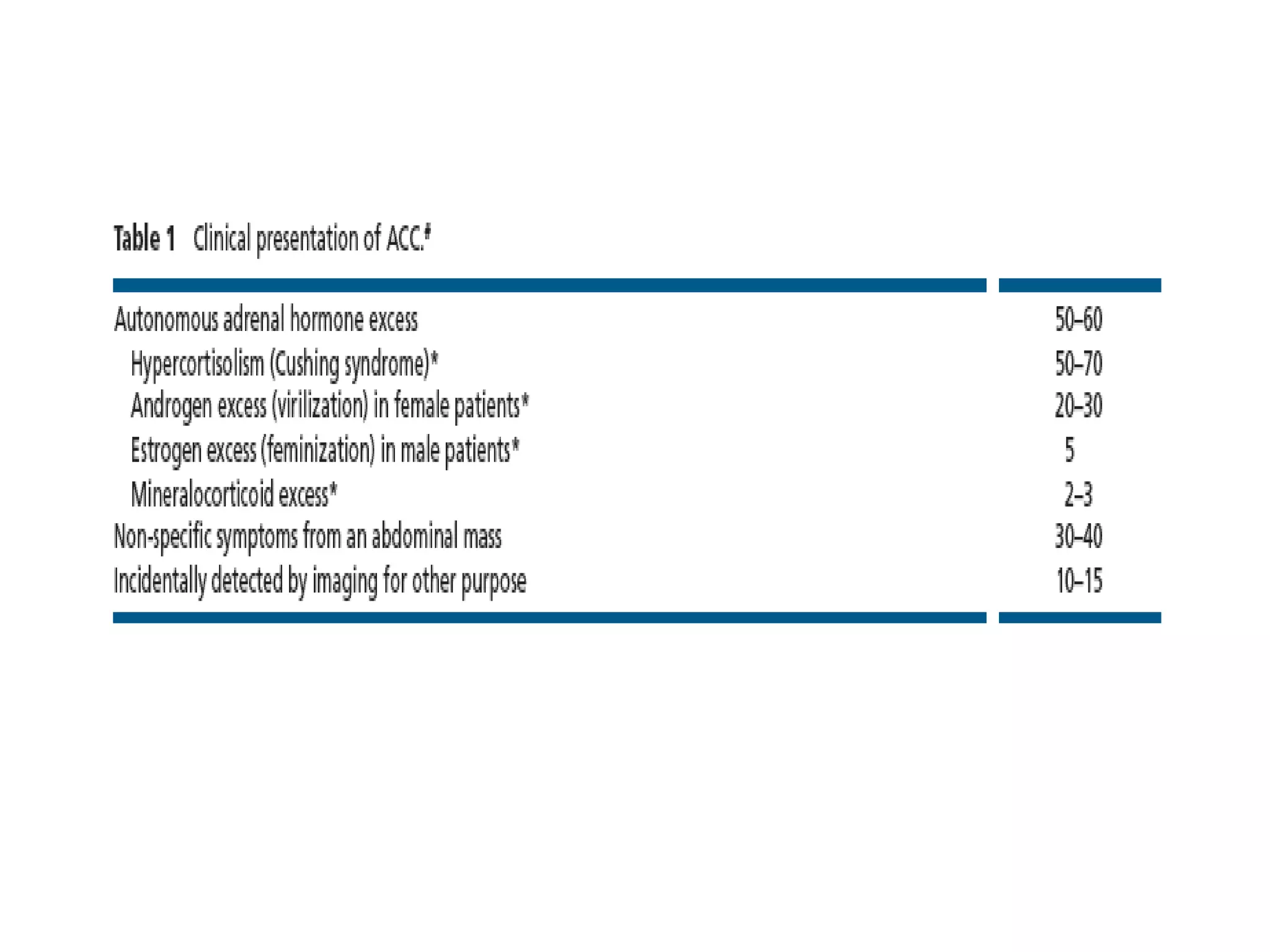
• Incidence of 0.7 to 2 per million population per year
• Unusually high in southern brazil
• LI-fraumeni syndrome TP53 mutation
• Beckwith-wiedemann syndrome
• Increased IGF-2 expression
• Mass > 6 cm increases the chance of ACC
• < 10 HU cut-off useful
• Delayed attenuation > 35 HU & a wash out < 50%
suggests malignancy
• Ki-67 labeling index > 10% poor survival
Surgery
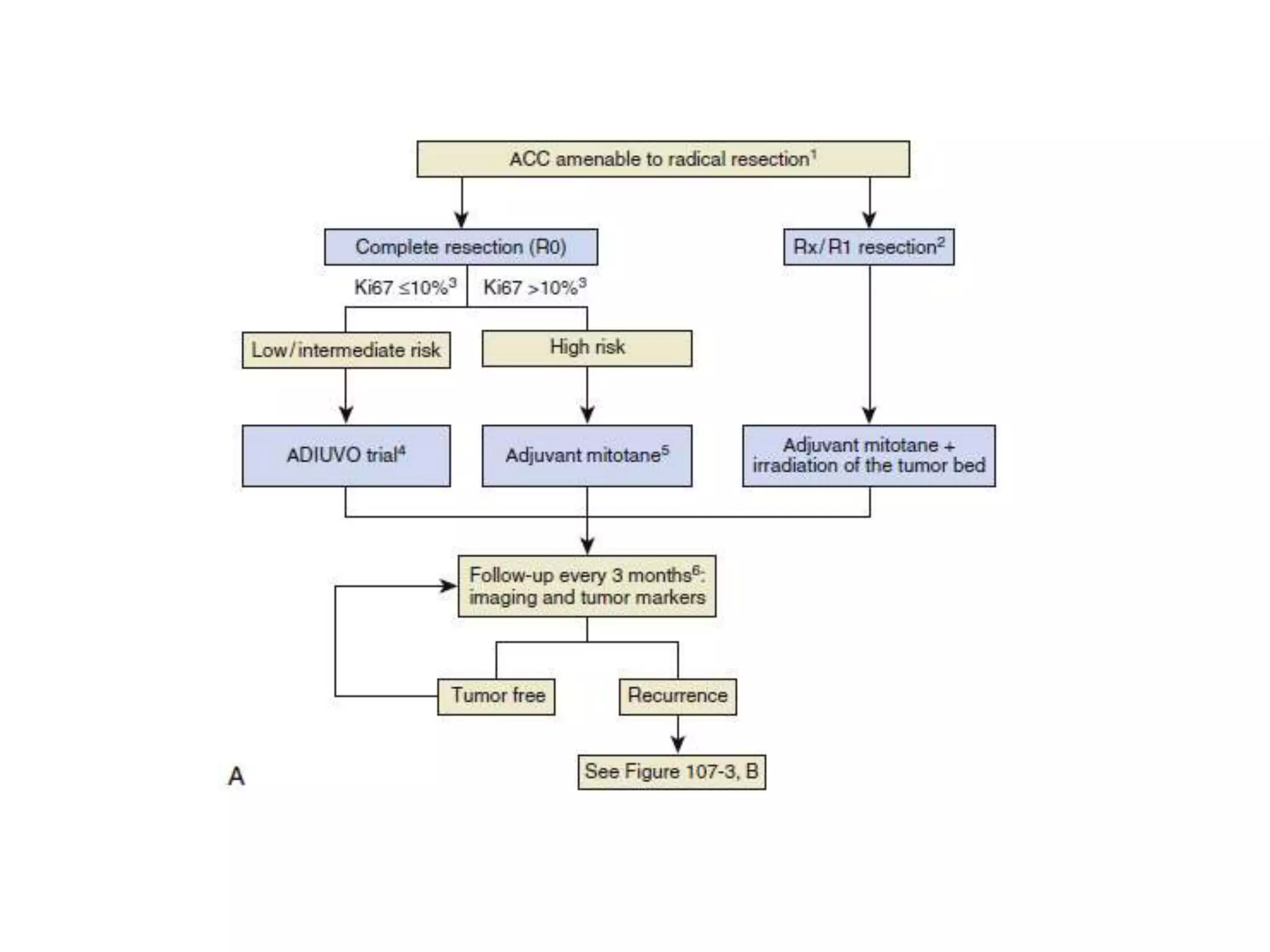
• Complete tumour removal single most important
measure
• An R0 resection (resection margins
microscopically tumor-free) utmost importance
for long-term prognosis
• Surgery for recurrent ACC should be performed in
patients with a disease-free interval of more than
12 months, in whom a complete resection is
feasible
Radiation therapy
• Studies failed to demonstrate a survival benefit
for patients who underwent radiation therapy
• Palliative radiotherapy in symptomatic metastatic
lesions is a well-established treatment option for
patients with ACC, in particular for bone
metastases
• Also be effective in unresectable abdominal
recurrences causing pain and vascular or
intestinal obstruction
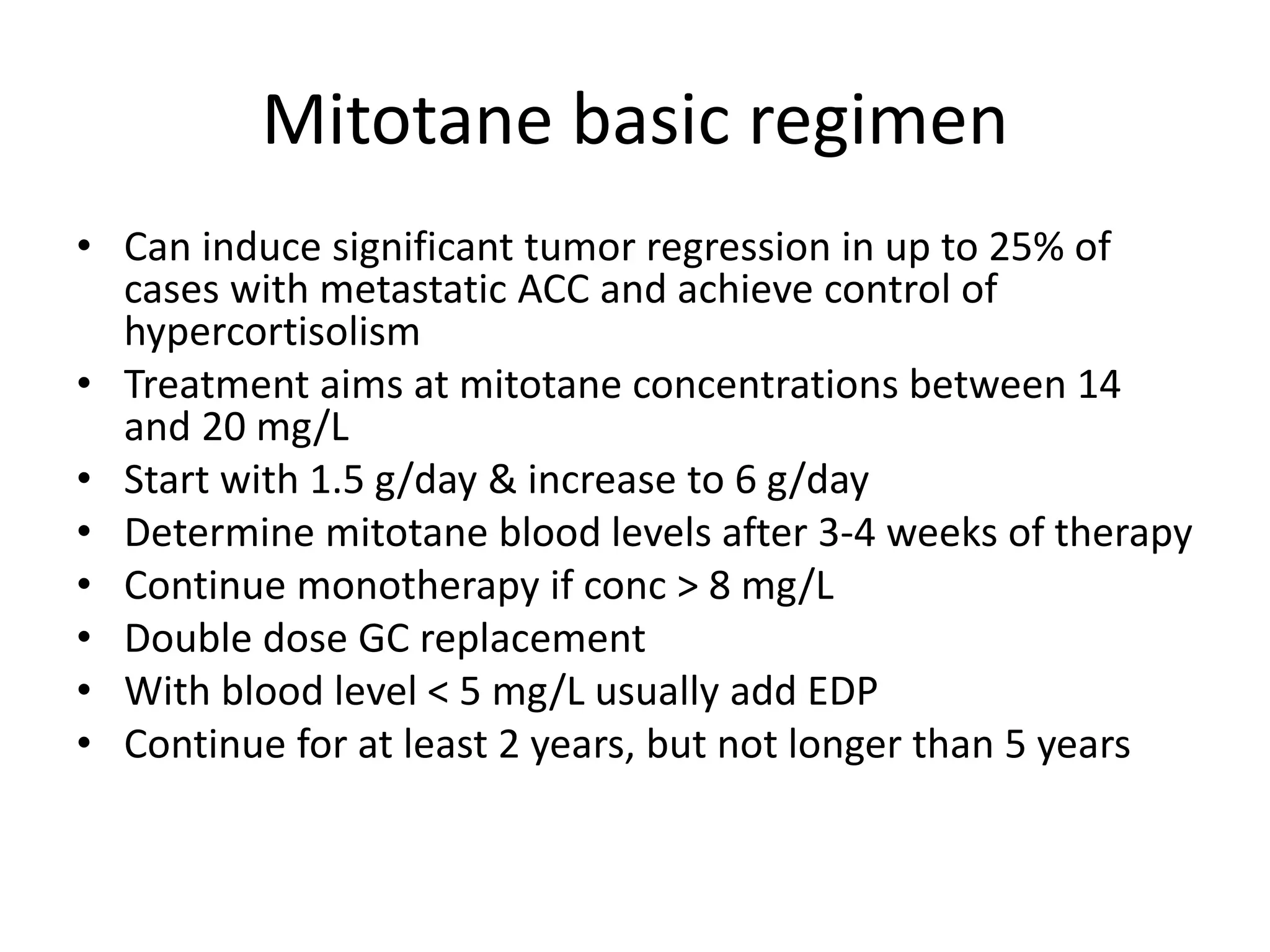
Mitotane basic regimen
• Can induce significant tumor regression in up to 25% of
cases with metastatic ACC and achieve control of
hypercortisolism
• Treatment aims at mitotane concentrations between 14
and 20 mg/L
• Start with 1.5 g/day & increase to 6 g/day
• Determine mitotane blood levels after 3-4 weeks of therapy
• Continue monotherapy if conc > 8 mg/L
• Double dose GC replacement
• With blood level < 5 mg/L usually add EDP
• Continue for at least 2 years, but not longer than 5 years
Cytotoxic chemotherapy
• Etoposide/Doxorubicin/Cisplatin & Mitotane
(EDP-M) proved better than
Streptozotocin/Mitotane (Sz-M)
• Both as first-line & second line therapy
Targeted therapies
• Not satisfactory with cytotoxic chemotherapy
<50% responding to treatment
• Erlotinib + Gemcitabine exhibited limited efficacy
• Blockade of the IGF-1 has been studied
• Combination of IGF-1 receptor ab + temsirolimus
• Sunitinib shown modest activity in clinical trials
• Dovitinib showed efficacy
• Sorafenib & paclitaxel showed no efficacy
• Mitotane targeted therapies lead to CYP3A4
induction
Follow up
• Staging repeated every 3 months ( CT of
abdomen + chest ) for a minimum of 2 years
• Then every 3–6 months for a further 3 years
• Even after 2 years without recurrence, there
remains a high risk for relapse
• Steroid metabolomics currently investigated
for detecting tumour recurrence
• Regular surveillance for minimum 5 years
Additional recommendations
• Routine loco-regional lymphadenectomy
should be performed with adrenalectomy for
highly suspected or proven ACC
• Peri-operative hydrocortisone replacement in
all patients with hypercortisolism that
undergo surgery for ACC
• For advanced ACC, surveillance based on
prognostic factors
Thank you……………….

Adreno Cortical Carcinoma in a Nut Shell

  • 1.
    Adreno-cortical carcinoma in anutshell Dr. Shinjan Patra
  • 2.
    Basics • Incidence of0.7 to 2 per million population per year • Unusually high in southern brazil • LI-fraumeni syndrome TP53 mutation • Beckwith-wiedemann syndrome • Increased IGF-2 expression • Mass > 6 cm increases the chance of ACC • < 10 HU cut-off useful • Delayed attenuation > 35 HU & a wash out < 50% suggests malignancy • Ki-67 labeling index > 10% poor survival
  • 7.
    Surgery • Complete tumourremoval single most important measure • An R0 resection (resection margins microscopically tumor-free) utmost importance for long-term prognosis • Surgery for recurrent ACC should be performed in patients with a disease-free interval of more than 12 months, in whom a complete resection is feasible
  • 8.
    Radiation therapy • Studiesfailed to demonstrate a survival benefit for patients who underwent radiation therapy • Palliative radiotherapy in symptomatic metastatic lesions is a well-established treatment option for patients with ACC, in particular for bone metastases • Also be effective in unresectable abdominal recurrences causing pain and vascular or intestinal obstruction
  • 9.
    Mitotane basic regimen •Can induce significant tumor regression in up to 25% of cases with metastatic ACC and achieve control of hypercortisolism • Treatment aims at mitotane concentrations between 14 and 20 mg/L • Start with 1.5 g/day & increase to 6 g/day • Determine mitotane blood levels after 3-4 weeks of therapy • Continue monotherapy if conc > 8 mg/L • Double dose GC replacement • With blood level < 5 mg/L usually add EDP • Continue for at least 2 years, but not longer than 5 years
  • 10.
    Cytotoxic chemotherapy • Etoposide/Doxorubicin/Cisplatin& Mitotane (EDP-M) proved better than Streptozotocin/Mitotane (Sz-M) • Both as first-line & second line therapy
  • 11.
    Targeted therapies • Notsatisfactory with cytotoxic chemotherapy <50% responding to treatment • Erlotinib + Gemcitabine exhibited limited efficacy • Blockade of the IGF-1 has been studied • Combination of IGF-1 receptor ab + temsirolimus • Sunitinib shown modest activity in clinical trials • Dovitinib showed efficacy • Sorafenib & paclitaxel showed no efficacy • Mitotane targeted therapies lead to CYP3A4 induction
  • 12.
    Follow up • Stagingrepeated every 3 months ( CT of abdomen + chest ) for a minimum of 2 years • Then every 3–6 months for a further 3 years • Even after 2 years without recurrence, there remains a high risk for relapse • Steroid metabolomics currently investigated for detecting tumour recurrence • Regular surveillance for minimum 5 years
  • 13.
    Additional recommendations • Routineloco-regional lymphadenectomy should be performed with adrenalectomy for highly suspected or proven ACC • Peri-operative hydrocortisone replacement in all patients with hypercortisolism that undergo surgery for ACC • For advanced ACC, surveillance based on prognostic factors
  • 14.