Name : 
……………………………………………………… 
Id :…………………………. 
Module : English 1 
[Session] August, 2014 
Question Number : ……………..
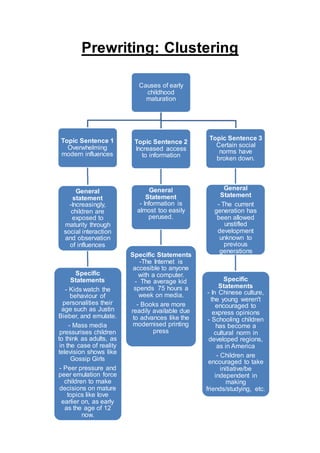
Prewriting: Clustering 
Causes of early 
childhood 
maturation 
Topic Sentence 2 
Increased access 
to information 
General 
Statement 
- Information is 
almost too easily 
perused. 
Specific Statements 
-The Internet is 
accesible to anyone 
with a computer. 
- The average kid 
spends 75 hours a 
week on media. 
- Books are more 
readily available due 
to advances like the 
modernised printing 
press 
Topic Sentence 1 
Overwhelming 
modern influences 
General 
statement 
-Increasingly, 
children are 
exposed to 
maturity through 
social interaction 
and observation 
of influences 
Specific 
Statements 
- Kids watch the 
behaviour of 
personalities their 
age such as Justin 
Bieber, and emulate. 
- Mass media 
pressurises children 
to think as adults, as 
in the case of reality 
television shows like 
Gossip Girls 
- Peer pressure and 
peer emulation force 
children to make 
decisions on mature 
topics like love 
earlier on, as early 
as the age of 12 
now. 
Topic Sentence 3 
Certain social 
norms have 
broken down. 
General 
Statement 
- The current 
generation has 
been allowed 
unstifled 
development 
unknown to 
previous 
generations 
Specific 
Statements 
- In Chinese culture, 
the young weren't 
encouraged to 
express opinions 
- Schooling children 
has become a 
cultural norm in 
developed regions, 
as in America 
- Children are 
encouraged to take 
initiative/be 
independent in 
making 
friends/studying, etc.
The Premature Child 
In the year 1939, newspapers were abuzz with news that a girl, Lina Medina 
had given birth to a baby boy, at the age of seven. Although until today no case of 
pubescent precocity compares to the aforementioned case, the equally extraordinary 
condition of mental precocity is something prevailing in the younger generation 
(Abbs et al., 2011). You see children the age of 10, seeming to wield the mind of a 
17 year old, and pre-teenagers making decisions one only made at the age of 20 in 
decades past. As strange as it is, this phenomenon must be understood so that we 
may approach it the best we can. This essay postulates that the causes of early 
mental maturation in children includes the overwhelming modern influences upon 
children, the increased access to information modern children have, and the 
differences in socio-cultural norms in present times. 
Firstly, we see that overwhelming modern influences are causing children to 
mature earlier than previously seen. These modern influences can be interpreted as 
many things, be it mass media, social interaction, or anything of the like. Mass media 
is inescapable these days, and is unquestionably a huge influence upon children, as 
it is seen that children consume an average of 8 hours of media a day (Gutnick, 
Robb, Takeuchi, & Kotler, 2011). As examples, you see teenagers aged 15 
emulating young personalities seen on TV, like Justin Bieber. Social interaction also 
plays its role, as teens as young as 15 are forced to make decisions which require 
good measures of maturity. This phenomena is known as peer pressure, and 
manifests itself in many ways, such as in puppy love, abstinence, drug consumption, 
and the like. These forced decisions do require for children and teenagers to mature 
earlier (Oswalt, 2008).
A second factor which contributes to this, is the increased access to 
information modern children have. Information is almost too easily perused in this 
day and age. As children become more susceptible to this information, they become 
more and more molded by information. This is exemplified in how easy it is for 
children and teenagers to surf the Internet. Statistics from a study conducted in the 
year 2013 show that mobile internet access is seen at an alarming 74% among 
teens aged 12-17 (Madden, Lenhart, Duggan, Cortesi, & Urs, 2013). This means that 
3 out of 4 teens can access any kind of information on the go, using their mobile 
devices, like their Iphones, Ipads, laptops, etc. This kind of exposure is bound to 
shape and mold a child in a manner unprecedented (Williams, 2014). As a child is 
exposed to concepts and information only accessible to adults in previous 
generations, it is expected, that he matures in an accelerated manner. 
Finally, differences in socio-cultural norms as compared to the past can be 
regarded as a major factor in early child maturation. In some ways, certain barriers 
have been broken down that has allowed this generation to mature faster than 
previous generations. Those barriers existed before, some for good; but now, 
upholding those barriers are not seen as an accepted norm. Take for instance, the 
norm held in Chinese culture, where children and teenagers were not able to voice 
opinions or thoughts publicly (The Economic and Commercial Counsellor's Office of 
the Embassy of the People's Republic of China in The United States of America, 
2004). In modern days, this norm does not stand, which does bring repercussions to 
maturation rates in children, namely, the accelerated maturation of children. 
Nowadays, education is seen as a cultural norm, whereas in the past it was not. For 
instance, secondary education was not seen as a norm until 1910 in the USA, 
because it just was not seen as a necessity (Goldin, 1999). Education is indeed 
something which accelerates maturation, and, contributes to the maturity of a child.
Another social norm we see in difference with the past, is the independence of 
children nowadays. Parents allow, and encourage children to make decisions on 
matters like choosing between the Boy Scouts, and the Red Cross Society these 
days. Changes like these matter in affecting the rate of maturity in children. 
In conclusion, it is ratified that early childhood maturation these days is 
caused by factors like the overwhelming modern influences upon children, the 
increased access to information modern children have, and the differences in socio-cultural 
norms in present times. It cannot be decided, whether this change is 
something which should be embraced, or resisted, as it is too early to tell. The only 
measure we can take is to ensure that all influences/factors can be monitored and 
controlled, in order that the maturation of children is guided towards the right 
direction.
References 
Goldin, C. (1999). 'Human Capital and Social Capital: The Rise of Secondary 
Schooling in America, 1910 to 1940.”. Journal of Interdisciplinary History XXIX , 
Spring. 
Gutnick, A. L., Robb, M., Takeuchi, L., & Kotler, J. (2011). Always Connected: The 
new digital media habits of young children. The Joan Ganz Cooney Center. 
Madden, M., Lenhart, A., Duggan, M., Cortesi, S., & Urs, G. (2013, March 13). Teens 
and Technology 2013. Retrieved September 18, 2014, from Pew Research Internet 
Project: http://www.pewinternet.org/2013/03/13/teens-and-technology-2013/ 
Oswalt, A. (2008, Aug 10). Teens and Peer Relationships. Retrieved September 18, 
2014, from Seven Counties Services, Inc: 
http://www.sevencounties.org/poc/view_doc.php?type=doc&id=41168&cn=1310 
The Economic and Commercial Counsellor's Office of the Embassy of the People's 
Republic of China in The United States of America. (2004, Nov 9). Chinese customs, 
superstitions and traditions. Retrieved September 18, 2014, from The Economic and 
Commercial Counsellor's Office of the Embassy of the People's Republic of China in 
The United States of America: 
http://us2.mofcom.gov.cn/article/aboutchina/custom/200411/20041100004548.shtml 
Williams, R. (2014, February 6th). Children using social networks underage 'exposes 
them to danger'. Retrieved September 19, 2014, from The Telegraph: 
http://www.telegraph.co.uk/technology/news/10619007/Children-using-social-networks- 
underage-exposes-them-to-danger.html

adPrewriting

  • 1.
    Name : ……………………………………………………… Id :…………………………. Module : English 1 [Session] August, 2014 Question Number : ……………..
  • 2.
    Prewriting: Clustering Causesof early childhood maturation Topic Sentence 2 Increased access to information General Statement - Information is almost too easily perused. Specific Statements -The Internet is accesible to anyone with a computer. - The average kid spends 75 hours a week on media. - Books are more readily available due to advances like the modernised printing press Topic Sentence 1 Overwhelming modern influences General statement -Increasingly, children are exposed to maturity through social interaction and observation of influences Specific Statements - Kids watch the behaviour of personalities their age such as Justin Bieber, and emulate. - Mass media pressurises children to think as adults, as in the case of reality television shows like Gossip Girls - Peer pressure and peer emulation force children to make decisions on mature topics like love earlier on, as early as the age of 12 now. Topic Sentence 3 Certain social norms have broken down. General Statement - The current generation has been allowed unstifled development unknown to previous generations Specific Statements - In Chinese culture, the young weren't encouraged to express opinions - Schooling children has become a cultural norm in developed regions, as in America - Children are encouraged to take initiative/be independent in making friends/studying, etc.
  • 3.
    The Premature Child In the year 1939, newspapers were abuzz with news that a girl, Lina Medina had given birth to a baby boy, at the age of seven. Although until today no case of pubescent precocity compares to the aforementioned case, the equally extraordinary condition of mental precocity is something prevailing in the younger generation (Abbs et al., 2011). You see children the age of 10, seeming to wield the mind of a 17 year old, and pre-teenagers making decisions one only made at the age of 20 in decades past. As strange as it is, this phenomenon must be understood so that we may approach it the best we can. This essay postulates that the causes of early mental maturation in children includes the overwhelming modern influences upon children, the increased access to information modern children have, and the differences in socio-cultural norms in present times. Firstly, we see that overwhelming modern influences are causing children to mature earlier than previously seen. These modern influences can be interpreted as many things, be it mass media, social interaction, or anything of the like. Mass media is inescapable these days, and is unquestionably a huge influence upon children, as it is seen that children consume an average of 8 hours of media a day (Gutnick, Robb, Takeuchi, & Kotler, 2011). As examples, you see teenagers aged 15 emulating young personalities seen on TV, like Justin Bieber. Social interaction also plays its role, as teens as young as 15 are forced to make decisions which require good measures of maturity. This phenomena is known as peer pressure, and manifests itself in many ways, such as in puppy love, abstinence, drug consumption, and the like. These forced decisions do require for children and teenagers to mature earlier (Oswalt, 2008).
  • 4.
    A second factorwhich contributes to this, is the increased access to information modern children have. Information is almost too easily perused in this day and age. As children become more susceptible to this information, they become more and more molded by information. This is exemplified in how easy it is for children and teenagers to surf the Internet. Statistics from a study conducted in the year 2013 show that mobile internet access is seen at an alarming 74% among teens aged 12-17 (Madden, Lenhart, Duggan, Cortesi, & Urs, 2013). This means that 3 out of 4 teens can access any kind of information on the go, using their mobile devices, like their Iphones, Ipads, laptops, etc. This kind of exposure is bound to shape and mold a child in a manner unprecedented (Williams, 2014). As a child is exposed to concepts and information only accessible to adults in previous generations, it is expected, that he matures in an accelerated manner. Finally, differences in socio-cultural norms as compared to the past can be regarded as a major factor in early child maturation. In some ways, certain barriers have been broken down that has allowed this generation to mature faster than previous generations. Those barriers existed before, some for good; but now, upholding those barriers are not seen as an accepted norm. Take for instance, the norm held in Chinese culture, where children and teenagers were not able to voice opinions or thoughts publicly (The Economic and Commercial Counsellor's Office of the Embassy of the People's Republic of China in The United States of America, 2004). In modern days, this norm does not stand, which does bring repercussions to maturation rates in children, namely, the accelerated maturation of children. Nowadays, education is seen as a cultural norm, whereas in the past it was not. For instance, secondary education was not seen as a norm until 1910 in the USA, because it just was not seen as a necessity (Goldin, 1999). Education is indeed something which accelerates maturation, and, contributes to the maturity of a child.
  • 5.
    Another social normwe see in difference with the past, is the independence of children nowadays. Parents allow, and encourage children to make decisions on matters like choosing between the Boy Scouts, and the Red Cross Society these days. Changes like these matter in affecting the rate of maturity in children. In conclusion, it is ratified that early childhood maturation these days is caused by factors like the overwhelming modern influences upon children, the increased access to information modern children have, and the differences in socio-cultural norms in present times. It cannot be decided, whether this change is something which should be embraced, or resisted, as it is too early to tell. The only measure we can take is to ensure that all influences/factors can be monitored and controlled, in order that the maturation of children is guided towards the right direction.
  • 6.
    References Goldin, C.(1999). 'Human Capital and Social Capital: The Rise of Secondary Schooling in America, 1910 to 1940.”. Journal of Interdisciplinary History XXIX , Spring. Gutnick, A. L., Robb, M., Takeuchi, L., & Kotler, J. (2011). Always Connected: The new digital media habits of young children. The Joan Ganz Cooney Center. Madden, M., Lenhart, A., Duggan, M., Cortesi, S., & Urs, G. (2013, March 13). Teens and Technology 2013. Retrieved September 18, 2014, from Pew Research Internet Project: http://www.pewinternet.org/2013/03/13/teens-and-technology-2013/ Oswalt, A. (2008, Aug 10). Teens and Peer Relationships. Retrieved September 18, 2014, from Seven Counties Services, Inc: http://www.sevencounties.org/poc/view_doc.php?type=doc&id=41168&cn=1310 The Economic and Commercial Counsellor's Office of the Embassy of the People's Republic of China in The United States of America. (2004, Nov 9). Chinese customs, superstitions and traditions. Retrieved September 18, 2014, from The Economic and Commercial Counsellor's Office of the Embassy of the People's Republic of China in The United States of America: http://us2.mofcom.gov.cn/article/aboutchina/custom/200411/20041100004548.shtml Williams, R. (2014, February 6th). Children using social networks underage 'exposes them to danger'. Retrieved September 19, 2014, from The Telegraph: http://www.telegraph.co.uk/technology/news/10619007/Children-using-social-networks- underage-exposes-them-to-danger.html