Developed by Irene Tan
2009
1
dependent clauses that must be joined to
independent clauses
describe nouns and pronouns
 often placed in a sentence right after the
noun they describe
add details to sentences by functioning as
adjectives
2
ADJECTIVE CLAUSES
ADJECTIVE (RELATIVE) CLAUSES
Adjective clauses begin with one of the
relative pronouns such as who, whom,
whose, where , that, which,
Also called relative clauses.
3
Relative Pronouns & Relative Clauses
Who
Refers to people,
used as subject in
the clause
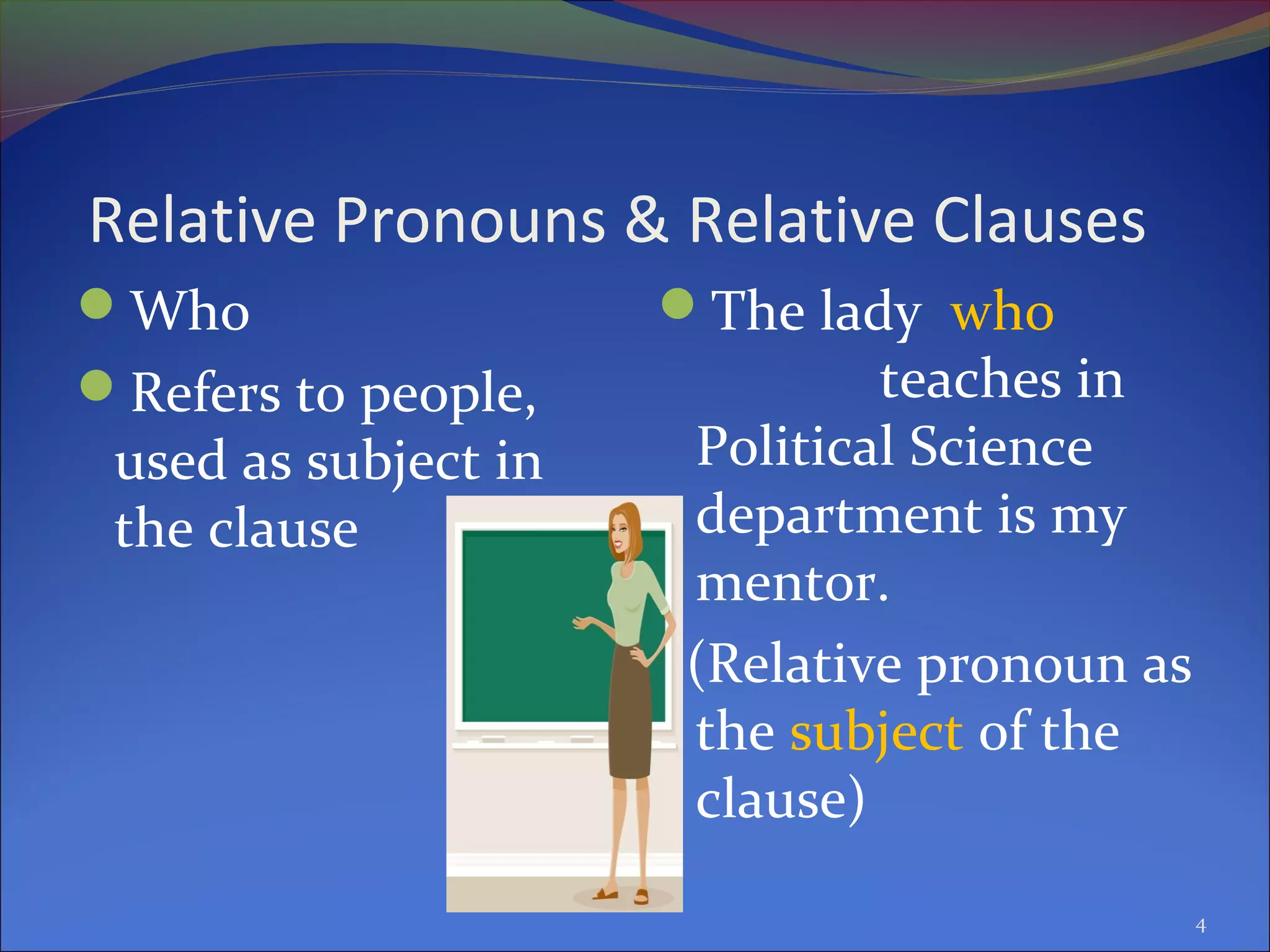
The lady who
teaches in
Political Science
department is my
mentor.
(Relative pronoun as
the subject of the
clause)
4
Relative Pronouns & Relative Clauses
Whom
Refers to people, used
as object or object of
preposition
(Formal grammar
recommends whom,
not who, in the object
position)
Sally, who(m) he knew,
arrived yesterday.
(Relative pronoun as
the object of the clause)
The student of whom
he spoke was a
foreigner.
(Relative pronoun as
the object of a
preposition)
5
Relative Pronouns & Relative Clauses
Which or that
Refers to things, animals
The watch which Ken bought
was expensive.
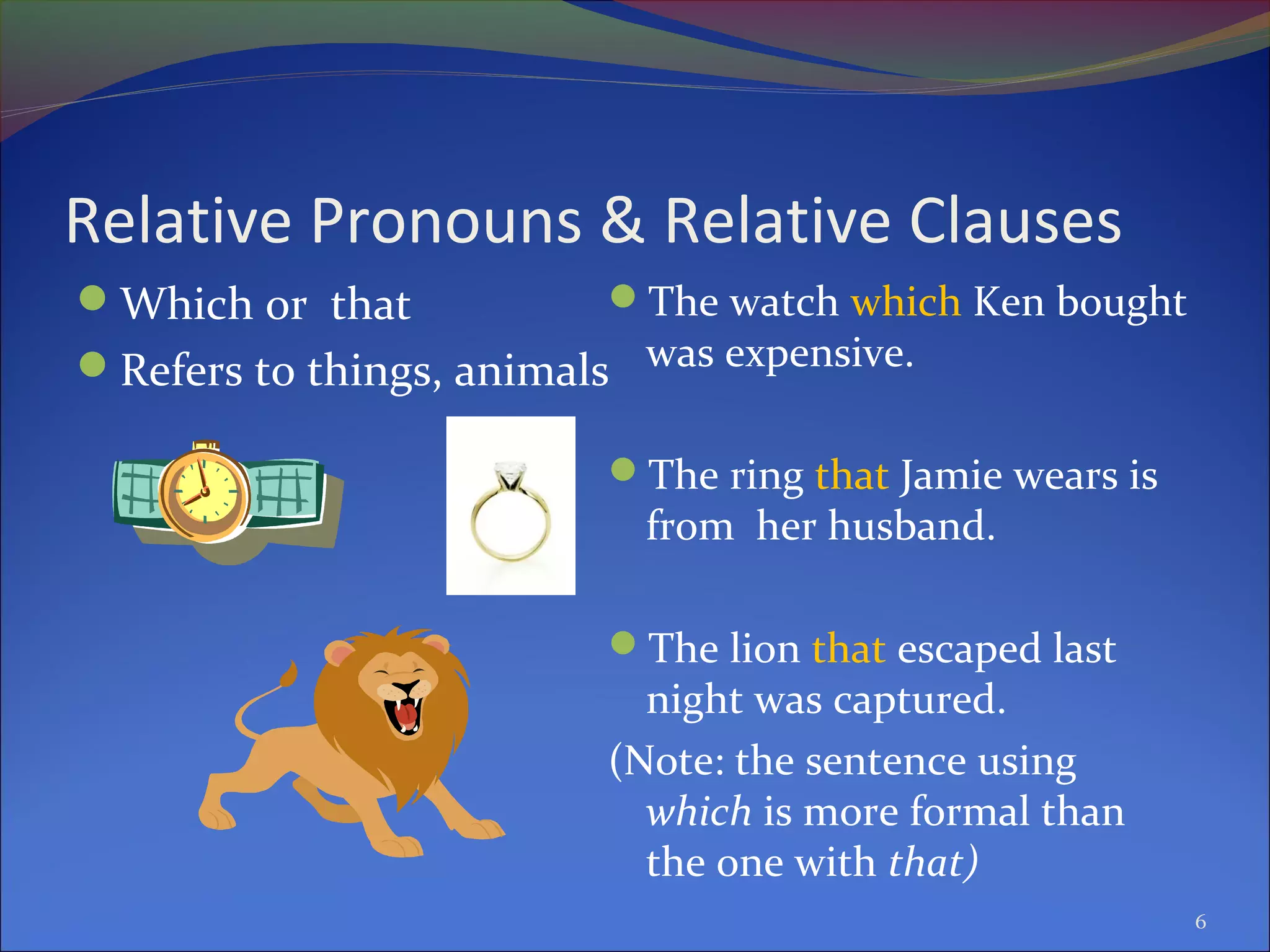
The ring that Jamie wears is
from her husband.
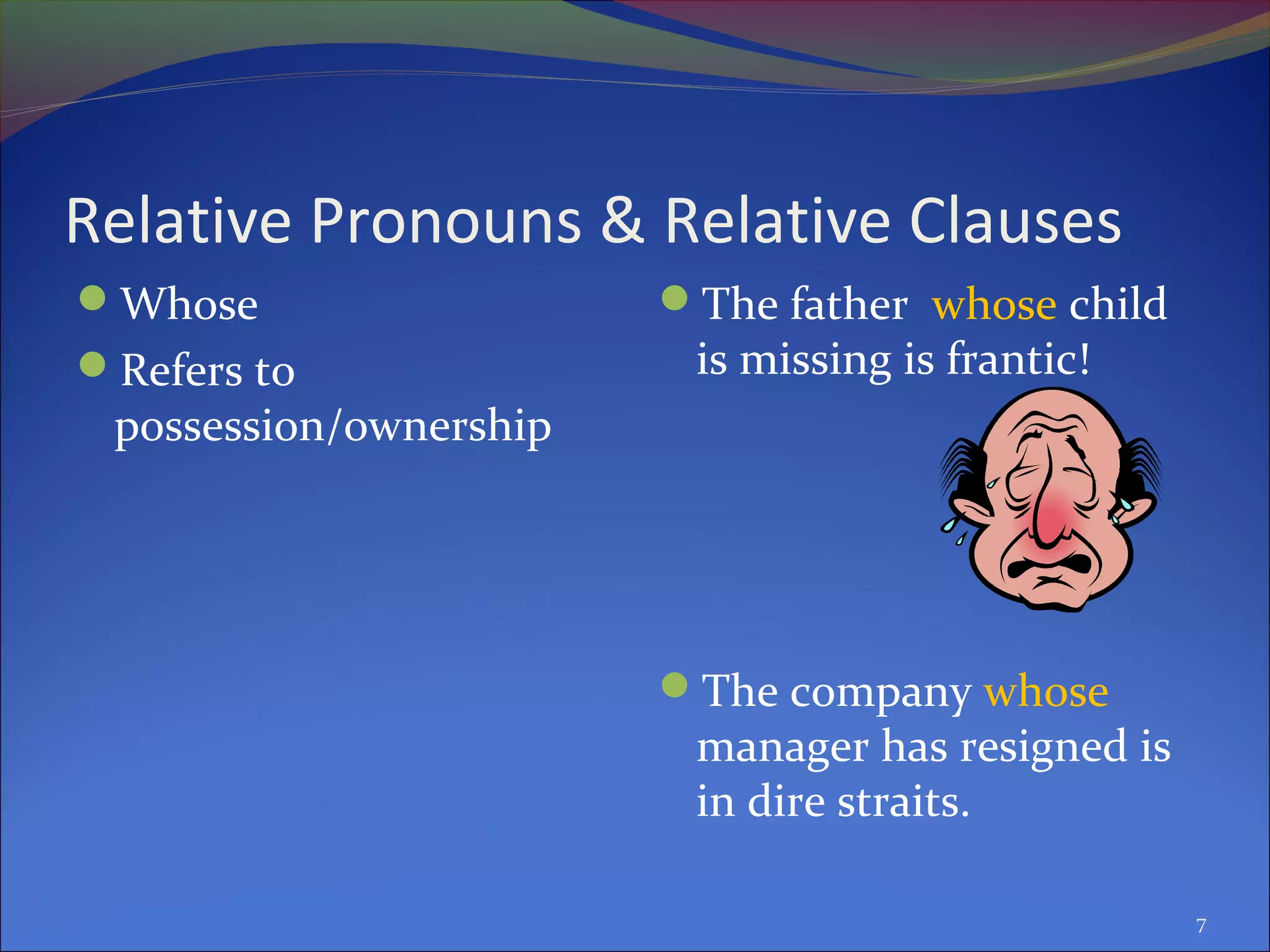
The lion that escaped last
night was captured.
(Note: the sentence using
which is more formal than
the one with that)
6
Relative Pronouns & Relative Clauses
Whose
Refers to
possession/ownership
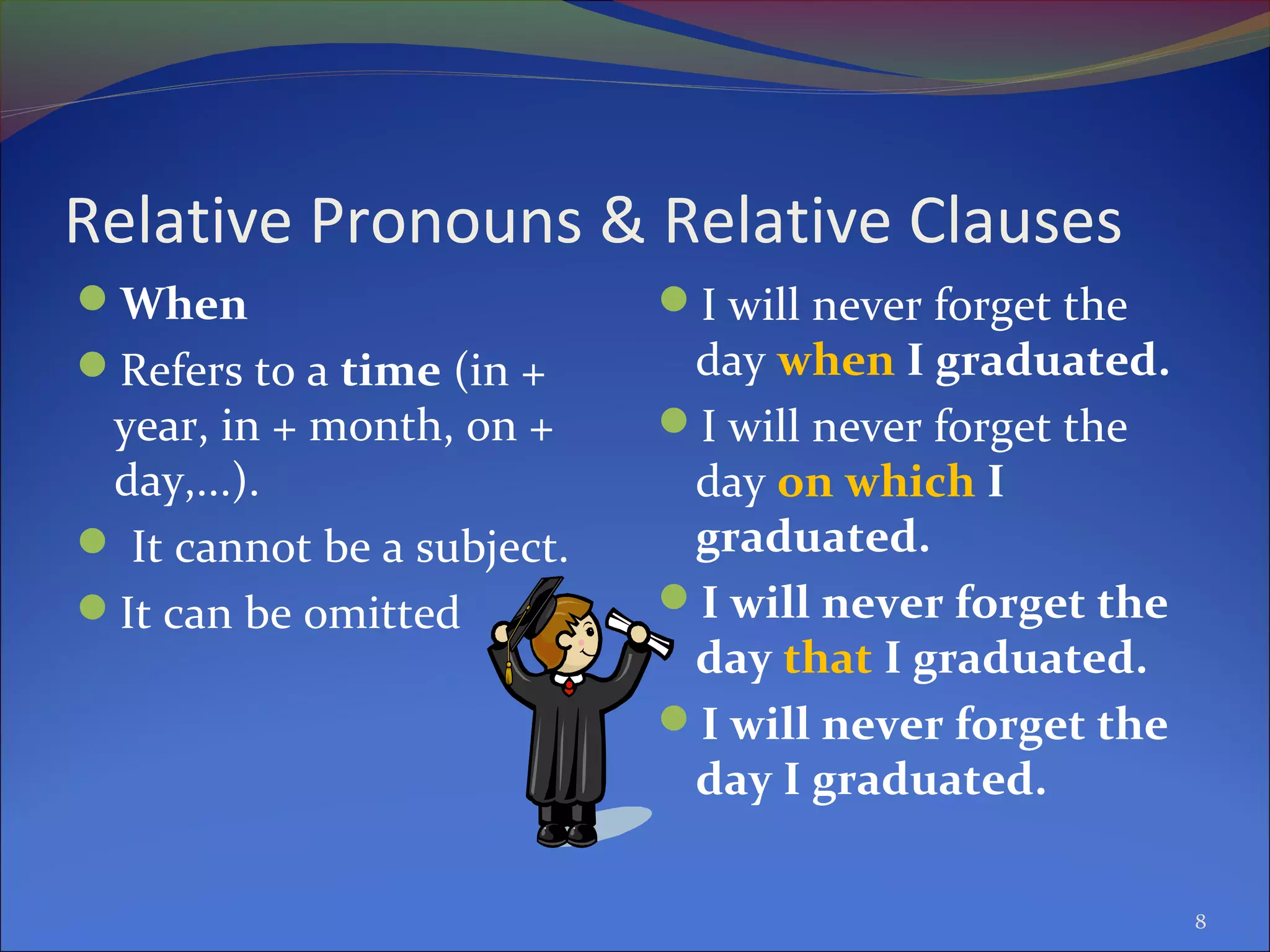
The father whose child
is missing is frantic!
The company whose
manager has resigned is
in dire straits.
7
Relative Pronouns & Relative Clauses
When
Refers to a time (in +
year, in + month, on +
day,...).
 It cannot be a subject.
It can be omitted
I will never forget the
day when I graduated.
I will never forget the
day on which I
graduated.
I will never forget the
day that I graduated.
I will never forget the
day I graduated.
8
Relative Pronouns & Relative Clauses
Where
Refers to a place (in
+ country, in + city,
at + school,...).
It cannot be a
subject.
 It can be omitted
but a preposition
(at, in, to) usually
must be added.
The house where he
stays is old .
The house in which
he stays is old.
The house which he
stays in is old.
The house that he
stays in is old.
The house he stays in
is old. 9
Relative Pronouns & Relative Clauses
Why
Refers to reason
It can be omitted
I don’t know why
he winked.
I don’t know the
reason why he
winked.
I don’t know the
reason he winked.
10
11
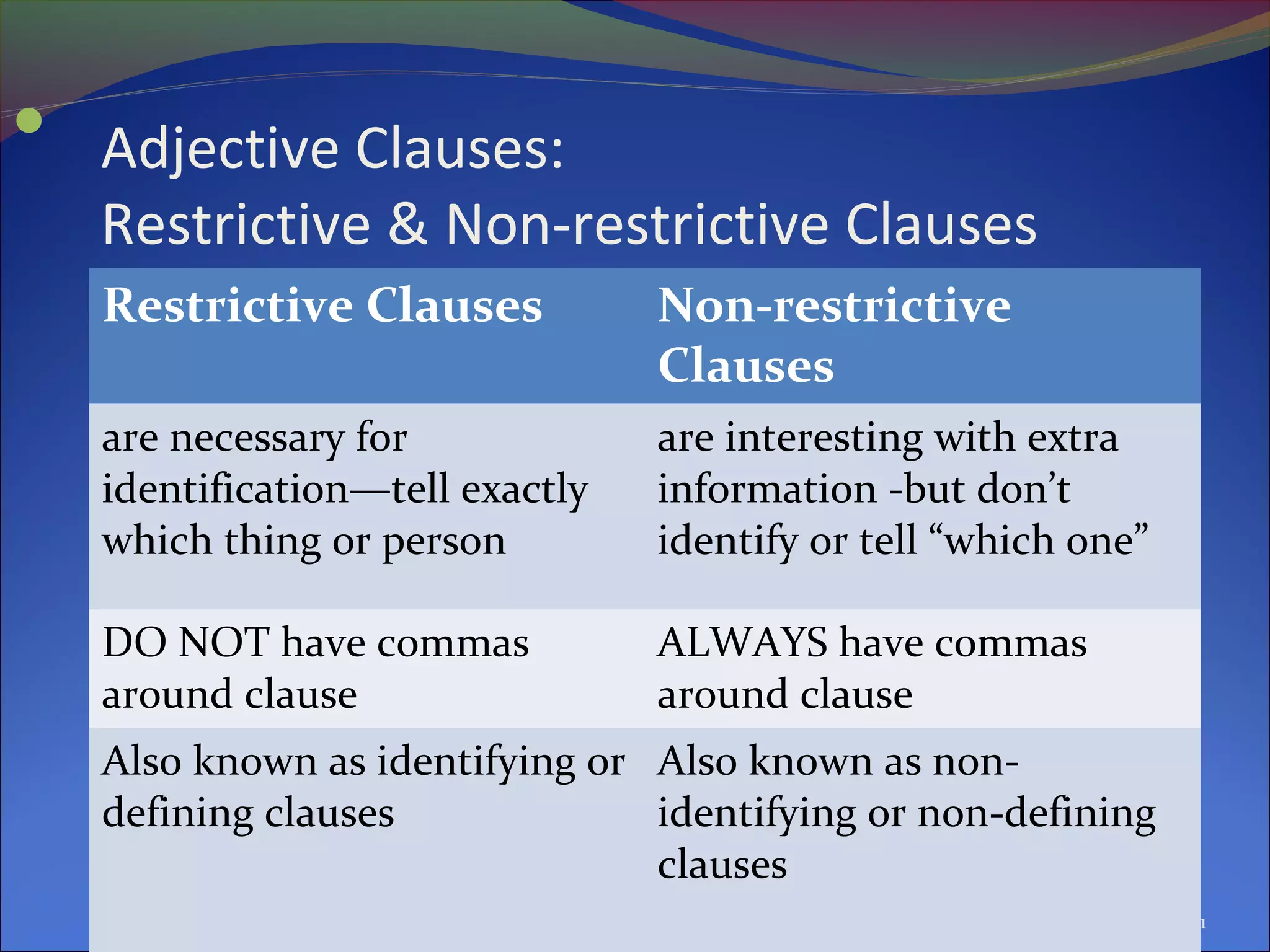
Adjective Clauses:
Restrictive & Non-restrictive Clauses

Restrictive Clauses Non-restrictive
Clauses
are necessary for
identification—tell exactly
which thing or person
are interesting with extra
information -but don’t
identify or tell “which one”
DO NOT have commas
around clause
ALWAYS have commas
around clause
Also known as identifying or
defining clauses
Also known as non-
identifying or non-defining
clauses
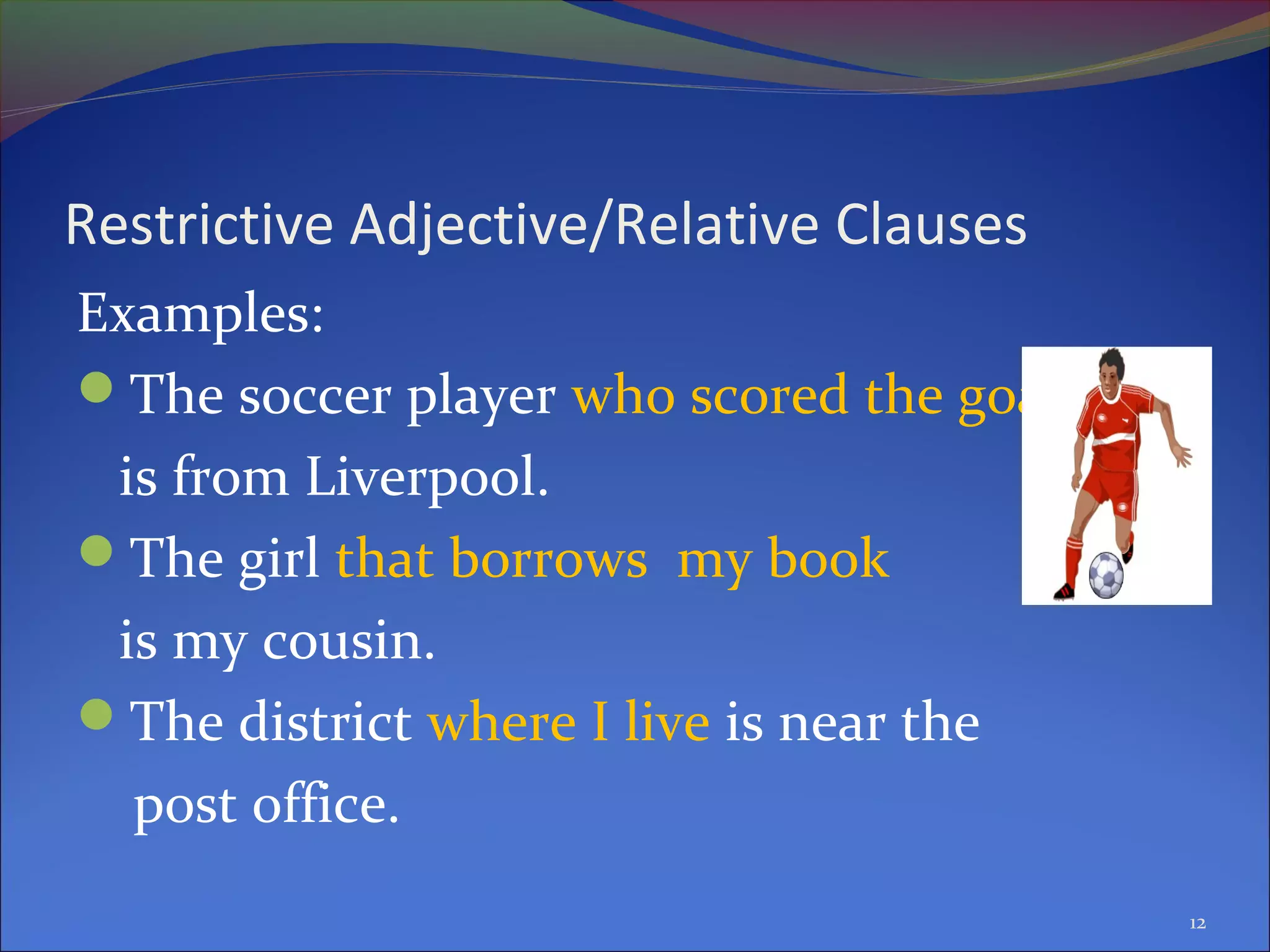
Restrictive Adjective/Relative Clauses
Examples:
The soccer player who scored the goal
is from Liverpool.
The girl that borrows my book
is my cousin.
The district where I live is near the
post office.
12
Non- Restrictive Adjective/Relative Clauses
Examples:
Ms. Tan, who is my English tutor, went to Korea last
winter.
My dog, which is barking, is in the backyard.
William decided to reject the offer, which upset his
manager.
13
Compare Restrictive & Non-restrictive
Clauses
1. My brother who lives in Bukit Timah is an accountant.
This sentence suggests that I have more than
one brother. “Who lives in Bukit Timah” identifies
this brother, not the one who lives in Clementi.
2. My brother, who lives in Bukit Timah, is an accountant.
This sentence suggests that I only have one brother,
“who lives in Bukit Timah”.
14
Which is logically correct?
1. My father, who is a taxi driver, doesn’t like to exercise.
2. My father who is a taxi driver doesn’t like to exercise.
15
Answer
1. My father, who is a taxi driver, doesn’t like to exercise.
(Correct!)
2. My father who is a taxi driver doesn’t like to exercise.
(This suggests you have more than one father!)
16
Which is logically correct?
Situation: You have 3 sisters and you have already
made that clear in preceding sentences. One is a
doctor, one an air stewardess, and one a model.
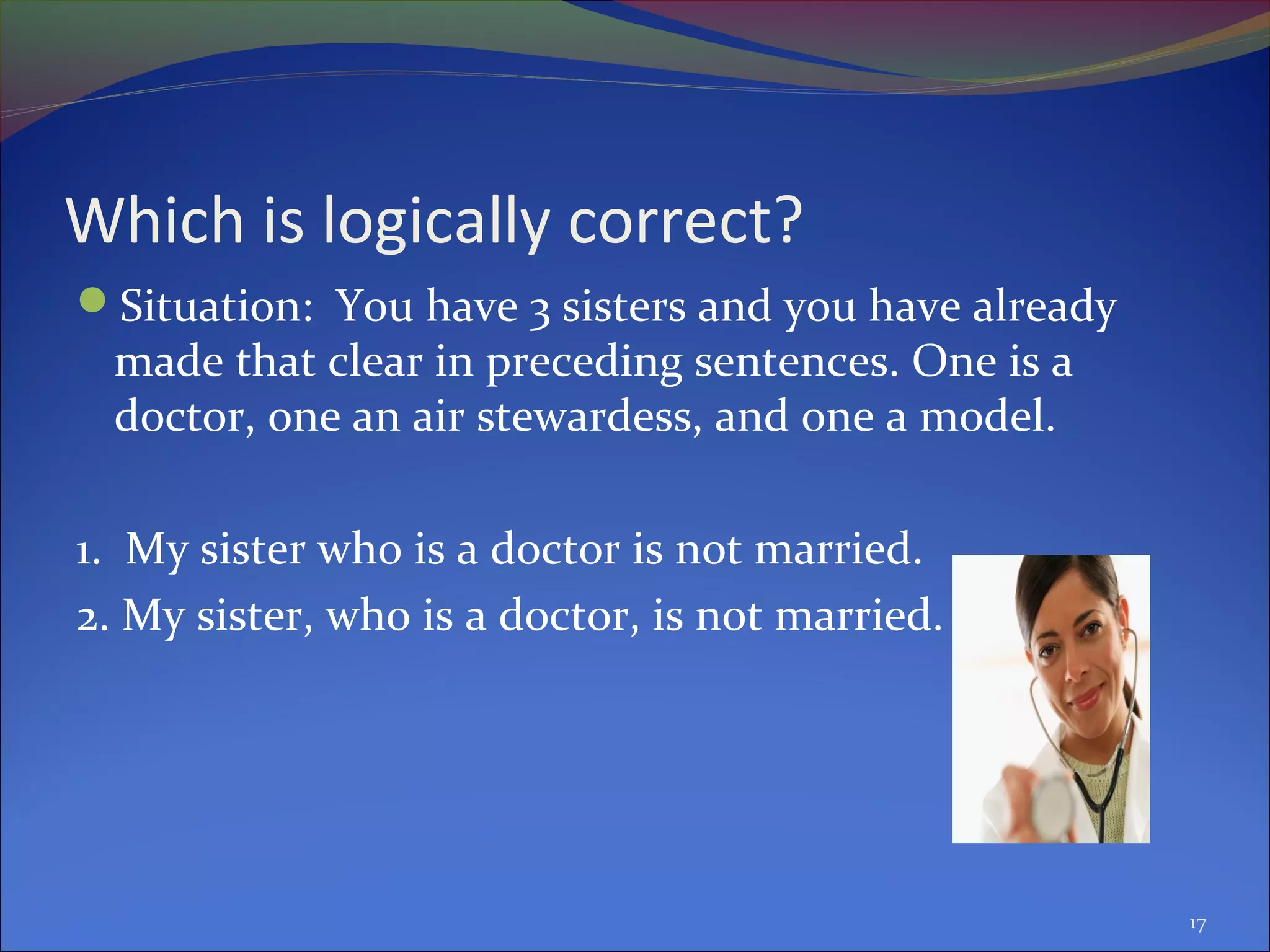
1. My sister who is a doctor is not married.
2. My sister, who is a doctor, is not married.
17
Answer
1. My sister who is a doctor is not married.
(Correct! This tells which sister , so it’s identifying.)
2. My sister, who is a doctor, is not married.
(Identifying information should not have commas
around it.)
18
Which is correct?
1. Paul Smith who is an excellent researcher is from
England.
2. Paul Smith, who is an excellent researcher , is from
England.
19
Answer
1. Paul Smith who is an excellent researcher is from
England.
(Note that proper nouns are considered already
identified, so the adjective clause needs commas.)
2. Paul Smith, who is an excellent researcher , is from
England. (Correct!)
20
Which is correct?
1. The wind, that is howling, is making me nervous.
2. The wind, which is howling, is making me nervous.
21
Answer
1. The wind, that is howling, is making me nervous.
(Never use commas with a “that” clause.)
2. The wind, which is howling, is making me nervous.
(Correct!)
22

Adjective clauses

  • 1.
  • 2.
    dependent clauses thatmust be joined to independent clauses describe nouns and pronouns  often placed in a sentence right after the noun they describe add details to sentences by functioning as adjectives 2 ADJECTIVE CLAUSES
  • 3.
    ADJECTIVE (RELATIVE) CLAUSES Adjectiveclauses begin with one of the relative pronouns such as who, whom, whose, where , that, which, Also called relative clauses. 3
  • 4.
    Relative Pronouns &Relative Clauses Who Refers to people, used as subject in the clause The lady who teaches in Political Science department is my mentor. (Relative pronoun as the subject of the clause) 4
  • 5.
    Relative Pronouns &Relative Clauses Whom Refers to people, used as object or object of preposition (Formal grammar recommends whom, not who, in the object position) Sally, who(m) he knew, arrived yesterday. (Relative pronoun as the object of the clause) The student of whom he spoke was a foreigner. (Relative pronoun as the object of a preposition) 5
  • 6.
    Relative Pronouns &Relative Clauses Which or that Refers to things, animals The watch which Ken bought was expensive. The ring that Jamie wears is from her husband. The lion that escaped last night was captured. (Note: the sentence using which is more formal than the one with that) 6
  • 7.
    Relative Pronouns &Relative Clauses Whose Refers to possession/ownership The father whose child is missing is frantic! The company whose manager has resigned is in dire straits. 7
  • 8.
    Relative Pronouns &Relative Clauses When Refers to a time (in + year, in + month, on + day,...).  It cannot be a subject. It can be omitted I will never forget the day when I graduated. I will never forget the day on which I graduated. I will never forget the day that I graduated. I will never forget the day I graduated. 8
  • 9.
    Relative Pronouns &Relative Clauses Where Refers to a place (in + country, in + city, at + school,...). It cannot be a subject.  It can be omitted but a preposition (at, in, to) usually must be added. The house where he stays is old . The house in which he stays is old. The house which he stays in is old. The house that he stays in is old. The house he stays in is old. 9
  • 10.
    Relative Pronouns &Relative Clauses Why Refers to reason It can be omitted I don’t know why he winked. I don’t know the reason why he winked. I don’t know the reason he winked. 10
  • 11.
    11 Adjective Clauses: Restrictive &Non-restrictive Clauses  Restrictive Clauses Non-restrictive Clauses are necessary for identification—tell exactly which thing or person are interesting with extra information -but don’t identify or tell “which one” DO NOT have commas around clause ALWAYS have commas around clause Also known as identifying or defining clauses Also known as non- identifying or non-defining clauses
  • 12.
    Restrictive Adjective/Relative Clauses Examples: Thesoccer player who scored the goal is from Liverpool. The girl that borrows my book is my cousin. The district where I live is near the post office. 12
  • 13.
    Non- Restrictive Adjective/RelativeClauses Examples: Ms. Tan, who is my English tutor, went to Korea last winter. My dog, which is barking, is in the backyard. William decided to reject the offer, which upset his manager. 13
  • 14.
    Compare Restrictive &Non-restrictive Clauses 1. My brother who lives in Bukit Timah is an accountant. This sentence suggests that I have more than one brother. “Who lives in Bukit Timah” identifies this brother, not the one who lives in Clementi. 2. My brother, who lives in Bukit Timah, is an accountant. This sentence suggests that I only have one brother, “who lives in Bukit Timah”. 14
  • 15.
    Which is logicallycorrect? 1. My father, who is a taxi driver, doesn’t like to exercise. 2. My father who is a taxi driver doesn’t like to exercise. 15
  • 16.
    Answer 1. My father,who is a taxi driver, doesn’t like to exercise. (Correct!) 2. My father who is a taxi driver doesn’t like to exercise. (This suggests you have more than one father!) 16
  • 17.
    Which is logicallycorrect? Situation: You have 3 sisters and you have already made that clear in preceding sentences. One is a doctor, one an air stewardess, and one a model. 1. My sister who is a doctor is not married. 2. My sister, who is a doctor, is not married. 17
  • 18.
    Answer 1. My sisterwho is a doctor is not married. (Correct! This tells which sister , so it’s identifying.) 2. My sister, who is a doctor, is not married. (Identifying information should not have commas around it.) 18
  • 19.
    Which is correct? 1.Paul Smith who is an excellent researcher is from England. 2. Paul Smith, who is an excellent researcher , is from England. 19
  • 20.
    Answer 1. Paul Smithwho is an excellent researcher is from England. (Note that proper nouns are considered already identified, so the adjective clause needs commas.) 2. Paul Smith, who is an excellent researcher , is from England. (Correct!) 20
  • 21.
    Which is correct? 1.The wind, that is howling, is making me nervous. 2. The wind, which is howling, is making me nervous. 21
  • 22.
    Answer 1. The wind,that is howling, is making me nervous. (Never use commas with a “that” clause.) 2. The wind, which is howling, is making me nervous. (Correct!) 22