Adjective Clauses
Making Your Sentences More Complex
Rush University Center for Academic Excellence
Review
Q: What’s an adjective clause?
A: An adjective clause functions like an
adjective—it gives more information about a
noun.
Q: Which words does it begin with?
A: A relative clause always begins with a “relative
pronoun,” which substitutes for a noun or a
pronoun.
Q: What are the relative pronouns?
who for people can substitute for subject nouns/pronouns (he, she, we,
they)
whom for people can substitute for object nouns/pronouns (him, her, us,
them)
whose for people can substitute for possessive nouns/pronouns (his, hers,
our, their)
that for people or
things
can be either subject or object
can only be used in restrictive relative clauses (see below)
which for things can be either subject or object
can be used in non-restrictive relative clauses
can also be used in restrictive relative clauses, though
some people don’t like this use
A: The relative pronouns are:
Now, let’s practice and review!
 If you have the same cards, you are partners.
 Get into partner pairs.
 Each pair will receive relative pronoun cards.
 Read each sentence, and decide among yourselves which
pronoun you should use.
 Ask yourselves this: “Is it a subject or an object?”
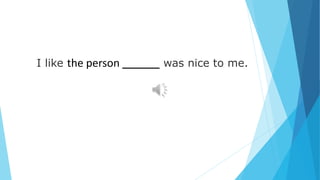
I like the person _______ was nice to me.
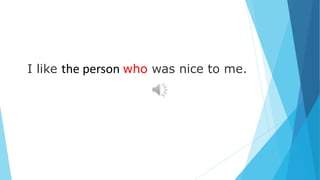
I like the person who was nice to me.
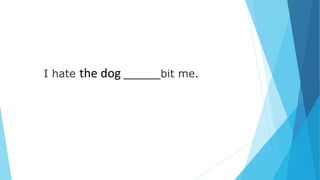
I hate the dog _______bit me.
I hate the dog that bit me.
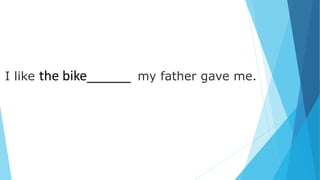
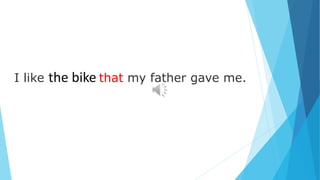
I like the bike______ my father gave me.
I like the bike that my father gave me.
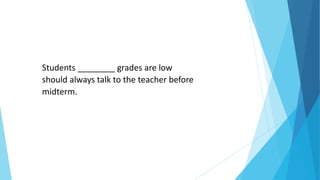
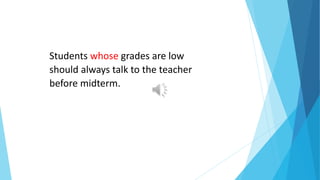
Students ________ grades are low
should always talk to the teacher before
midterm.
Students whose grades are low
should always talk to the teacher
before midterm.
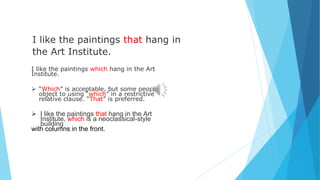
I like the paintings ________
hang in the Art Institute.
I like the paintings that hang in
the Art Institute.
I like the paintings which hang in the Art
Institute.
 “Which” is acceptable, but some people
object to using “which” in a restrictive
relative clause. “That” is preferred.
 I like the paintings that hang in the Art
Institute, which is a neoclassical-style
building
with columns in the front.
I hope I hear from the
person with ________ I
spent hours talking last
night.
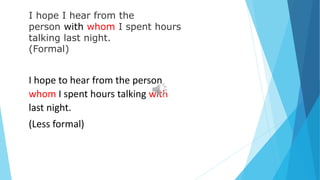
I hope I hear from the
person with whom I spent hours
talking last night.
(Formal)
I hope to hear from the person
whom I spent hours talking with
last night.
(Less formal)
I hope to hear from the person who
I spent hours talking with/to last
night.
(Conversational speech)
Group 1 (Restrictive Clauses - No Commas)
These include necessary/essential information after the
pronouns.
All students who do their work should pass easily.
The car that I want is out of my price range.
Students who study hard will do well in my class.
The person whom you kissed was Lionel Messi.
Group 2 (Non-Restrictive Clause - With
Commas)
These include extra, non-essential pieces of information.
I am moving to Louisville, KY,which is home to the
Muhammad Ali Museum.
Edgar Allan Poe, who wrote "The Raven," is a great
American poet.
Puerto Rico was a Spanish colony until 1898, when
it was made part of the United States.
My mother, who is an excellent cook, is thinking of
opening a restaurant.
Group 2, cont.
I’m planning to grow roses,which I find quite
beautiful.
I’m driving across the country with three small
children, which is going to be stressful.
France, which is located in Western Europe,
has a long cultural history.
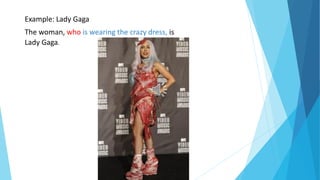
Example: Lady Gaga
The woman, who is wearing the crazy dress, is
Lady Gaga.
Adjective Clauses.pdf

Adjective Clauses.pdf

  • 1.
    Adjective Clauses Making YourSentences More Complex Rush University Center for Academic Excellence
  • 2.
    Review Q: What’s anadjective clause? A: An adjective clause functions like an adjective—it gives more information about a noun. Q: Which words does it begin with? A: A relative clause always begins with a “relative pronoun,” which substitutes for a noun or a pronoun. Q: What are the relative pronouns?
  • 3.
    who for peoplecan substitute for subject nouns/pronouns (he, she, we, they) whom for people can substitute for object nouns/pronouns (him, her, us, them) whose for people can substitute for possessive nouns/pronouns (his, hers, our, their) that for people or things can be either subject or object can only be used in restrictive relative clauses (see below) which for things can be either subject or object can be used in non-restrictive relative clauses can also be used in restrictive relative clauses, though some people don’t like this use A: The relative pronouns are:
  • 4.
    Now, let’s practiceand review!  If you have the same cards, you are partners.  Get into partner pairs.  Each pair will receive relative pronoun cards.  Read each sentence, and decide among yourselves which pronoun you should use.  Ask yourselves this: “Is it a subject or an object?”
  • 5.
    I like theperson _______ was nice to me.
  • 6.
    I like theperson who was nice to me.
  • 7.
    I hate thedog _______bit me.
  • 8.
    I hate thedog that bit me.
  • 9.
    I like thebike______ my father gave me.
  • 10.
    I like thebike that my father gave me.
  • 11.
    Students ________ gradesare low should always talk to the teacher before midterm.
  • 12.
    Students whose gradesare low should always talk to the teacher before midterm.
  • 13.
    I like thepaintings ________ hang in the Art Institute.
  • 14.
    I like thepaintings that hang in the Art Institute. I like the paintings which hang in the Art Institute.  “Which” is acceptable, but some people object to using “which” in a restrictive relative clause. “That” is preferred.  I like the paintings that hang in the Art Institute, which is a neoclassical-style building with columns in the front.
  • 15.
    I hope Ihear from the person with ________ I spent hours talking last night.
  • 16.
    I hope Ihear from the person with whom I spent hours talking last night. (Formal) I hope to hear from the person whom I spent hours talking with last night. (Less formal)
  • 17.
    I hope tohear from the person who I spent hours talking with/to last night. (Conversational speech)
  • 18.
    Group 1 (RestrictiveClauses - No Commas) These include necessary/essential information after the pronouns. All students who do their work should pass easily. The car that I want is out of my price range. Students who study hard will do well in my class. The person whom you kissed was Lionel Messi.
  • 19.
    Group 2 (Non-RestrictiveClause - With Commas) These include extra, non-essential pieces of information. I am moving to Louisville, KY,which is home to the Muhammad Ali Museum. Edgar Allan Poe, who wrote "The Raven," is a great American poet. Puerto Rico was a Spanish colony until 1898, when it was made part of the United States. My mother, who is an excellent cook, is thinking of opening a restaurant.
  • 20.
    Group 2, cont. I’mplanning to grow roses,which I find quite beautiful. I’m driving across the country with three small children, which is going to be stressful. France, which is located in Western Europe, has a long cultural history.
  • 21.
    Example: Lady Gaga Thewoman, who is wearing the crazy dress, is Lady Gaga.