Adidas strategy
on the current
context
Javier G. Recuenco
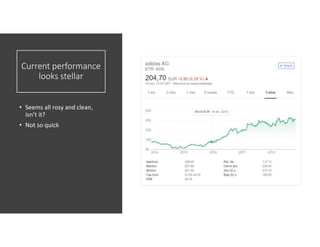
Current performance
looks stellar
• Seems all rosy and clean,
isn’t it?
• Not so quick
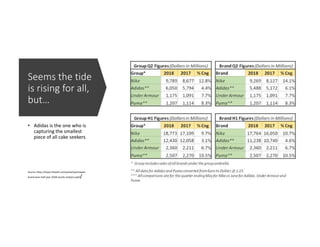
Seems the tide
is rising for all,
but…
• Adidas is the one who is
capturing the smallest
piece of all cake seekers
Source: https://www.linkedin.com/pulse/sportswear-
brand-wars-half-year-2018-results-analysis-patil/
Let’s get a closer look
• Adidas (on the other hand compared to Nike) seems to have finally slowed a bit
and fallen into a similar product trap that Nike was in only 12-18 months ago.
Overall Adidas did extremely well on financials concentrating on profitability
(+20%) and improving everything non-product.
• Slow down on the Courts was as per expectation, as was the trend around the
plateaued hype and overreach on the NMD and Ultraboosts. Adidas needed some
real excitement. They found some in Deerupt and continued volume sales in
styles like the X-plr, but overall these could not to make a mortal difference.
• The reception to the attempt to breathe some life in the Gazelles and older styles,
and to create new platforms on the Boost base was lukewarm at best, and
somewhere the brand seemed to miss out on creating a new working platform
that will resonate with the customer in the long run and got wrapped up in their
own hype and internal marketing that does not always translate into sales – An
easy trap to fall into, but one that keeps repeating across brands and businesses,
not constrained to the sporting goods industry.
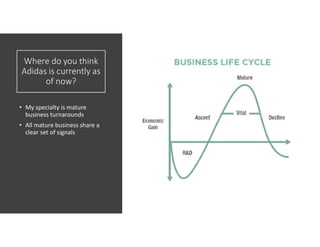
Where do you think
Adidas is currently as
of now?
• My specialty is mature
business turnarounds
• All mature business share a
clear set of signals
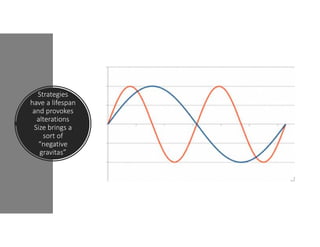
Strategies
have a lifespan
and provokes
alterations
Size brings a
sort of
“negative
gravitas”
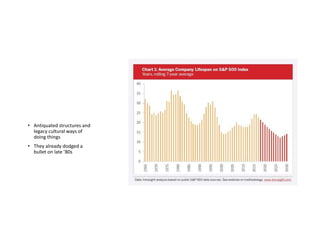
Its own lifespan
is playing against
it
• Antiquated structures and
legacy cultural ways of
doing things
• They already dodged a
bullet on late ’80s
Adidas has a
strong legacy
with good and
bad points
In 1989, with the company at a
crossroads, then CEO René Jäggi
decided to invite two ex-Nike
managers, Peter Moore and Rob
Strasser, to visit Adidas. Moore had
been creative director of Nike and the
designer of the Air Jordan brand, and
Strasser had been Nike’s marketing
director. As the guardians of Nike’s
image, they promoted the
importance of a clear and consistent
approach to building a brand. They
had left Nike a couple of years before
to set up a business to help create
and develop other sports brands.
Adidas has a
strong legacy
with good and
bad points
• In looking to Adidas’s past, Moore and Strasser recognized two
unique capabilities. First, they saw that the core of the
company had been Adi Dassler’s hands-on approach to
innovation — his philosophy of industrialized craftsmanship.
Dassler’s closeness to athletes and his intimate understanding
of their needs had created a stream of innovative products that
enhanced athletic performance. When the company lost its
connection to athletes, quality suffered.
• Moore and Strasser recommended renewing Dassler’s
approach, and developed a new product line called Adidas
Equipment. For Equipment, which was launched in 1991 and
later evolved into Adidas Performance, Moore and Strasser
created branding rules that emphasized product quality. For
example, they placed restrictions on the color, sizing, and
placement of the logo, and initially even on the colors of the
shoes themselves. They wanted consumers to focus on the
quality of the shoe, and not be distracted by other features.
They wanted to make the product the hero, just as Dassler
would have done. “The idea of Equipment was that it was a
model that you could build the whole company around,”
Moore told us. “The model was to go back to what Dassler had
tried to do all his life, which was to make the best products for
the athlete to compete in.” Reconnecting in this way was
emotionally uplifting — especially for those who had worked
with Dassler — and helped restore employees’ confidence.
Today, Performance represents the core of the Adidas brand
and accounts for more than 75 percent of its sales.
Adidas has a
strong legacy
with good and
bad points
• Second, Moore and Strasser understood that Adi
Dassler’s approach to design, which emphasized
functionality over style, had created a portfolio of
timeless, authentic shoe designs. The shoes were no
longer cutting-edge in terms of their athletic
performance (the technology had moved on), but
they had a strong emotional appeal, especially in
the burgeoning street-wear market epitomized by
the Adidas-wearing hip-hop group Run DMC and its
fans.
• Adidas had struggled to create a leisurewear line,
but it seemed the company unknowingly already
had one. In a brief memo to the Adidas board,
Moore set out the idea for a new brand of street-
wear shoes. The suggestion was to take some key
models from the past and modernize the quality,
comfort, and fit. Rather than blurring the clarity of
Equipment, Adidas recognized that this new line
should have a separate name, “Originals,” and a
distinctive presentation. As a testament to the
success of the approach, Originals is now a $2.8
billion business. All of the shoes selected for
updating at the launch of the initiative are still
produced today, including the Stan Smith tennis
shoe, 60 million pairs of which have been sold.
Adidas has a
strong legacy
with good and
bad points
It can be difficult for managers to see the truth
about their own organization. Accepting “the way
we do things around here” can create a form of
groupthink. Often, outsiders who come into
companies, unencumbered by the existing
culture, reinstitute strategies firmly rooted in the
firm’s capabilities. Some examples are Jørgen Vig
Knudstorp, the first non–family member to be
named CEO of Lego; Angela Ahrendts, the
American who turned around British fashion icon
Burberry; and Steve Jobs, who had a second,
triumphant tenure at Apple, the company he had
founded and from which he had been ousted. Of
course, it may not always be practical to have
outsiders challenging the status quo. But at a
minimum, insiders should be questioning and
self-critical.
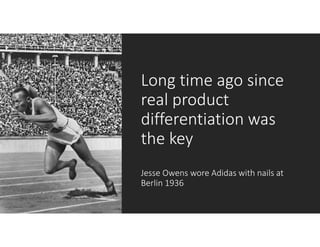
Long time ago since
real product
differentiation was
the key
Jesse Owens wore Adidas with nails at
Berlin 1936
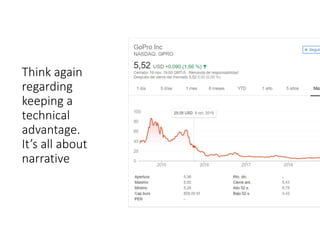
Think again
regarding
keeping a
technical
advantage.
It’s all about
narrative
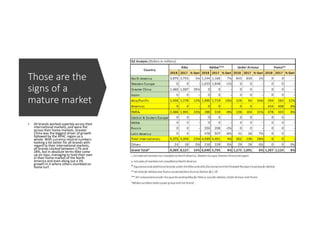
Those are the
signs of a
mature market
• All brands worked superbly across their
international markets, and were flat
across their home markets. Greater
China was the biggest driver of growth
followed by the APAC region as a
whole. With currency neutral numbers
looking a lot better for all brands with
regard to their international markets,
all brands clocked between 17% and
28%, but in absolute terms Nike came
up on tops, managing to hold their own
in their home market of the North
America and even eking out a 3%
growth in it where others stumbled on
home turf.
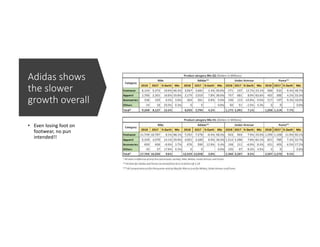
Adidas shows
the slower
growth overall
• Even losing foot on
footwear, no pun
intended!!
But they are
excelling on
nailing the
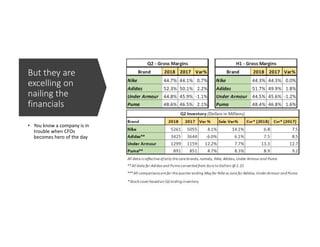
financials
• You know a company is in
trouble when CFOs
becomes hero of the day
What is Adidas doing
right?
On its own words
Source: https://www.ispo.com/en/companies/adidas-goes-after-nike-digital-strategy
1. Adidas1. Adidas1. Adidas1. Adidas seesseesseessees itselfitselfitselfitself
as a digitalas a digitalas a digitalas a digital
companycompanycompanycompany
• “We’ve become a digital company,” says Kasper Rorsted. Part
of this, for example, is the fact that (according to Rorsted) 90
percent of the marketing budget will already be given over to
digital campaigns and social media. “We can thus interact
with consumer and be where they are.” At the same time,
they are a very young company. For the employees, there is
no “digital transformation,” as they “already are digital” and
have a high affinity for digital topics.
• Furthermore, according to Rorsted, Adidas is now gaining lots
of insight from Big Data and digital analyses. With 3D printing
and in the Speedfactory, the production processes are as
digitized as much as possible.
• When it comes to revenue growth, e-commerce far
outstripped all distribution channels last year at a growth of
57 percent.
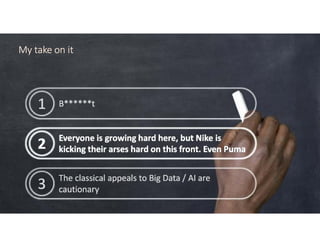
B******t1 B******t1
Everyone is growing hard here, but Nike is
kicking their arses hard on this front. Even Puma2 Everyone is growing hard here, but Nike is
kicking their arses hard on this front. Even Puma2
The classical appeals to Big Data / AI are
cautionary3 The classical appeals to Big Data / AI are
cautionary3
My take on itMy take on itMy take on itMy take on it
Let’s get a closer look
Moving to non Brick and Mortar spaces, we saw
some stellar movement here as well, with Nike
growing at 41%, Adidas at 26% and one may derive
over 20% growth each on Puma and UA as well.
With extremely tangible steps being outlined in the
conference calls for Nike on the build up on their
Digital expansion plans, the 3 other brands
remained a bit shy in terms of tangible steps -
perhaps a space they want to double down on -
with Ecom and Omni the future - only - the future is
now, and I am confident no one wants to be caught
in the Nokia trap.
Let’s make a
deeper head to
head
comparison
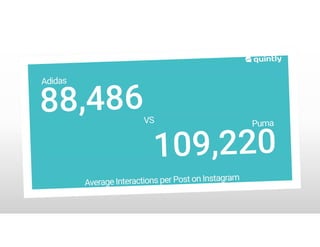
• Adidas: 20,8 million fans - 88,486 avg. interactions per post
(month July 2018)
• Puma: 8,1 million fans - 109,220 avg. interactions per post
(month July 2018)
• Although Adidas has more than double the fan count, Puma
manages to even outperform Adidas in terms of average
interactions per post in July 2018.
• Facebook is the least used social network - Adidas has zero
posts in the analyzed 30 days, even though their fan count is
greater there than among all other social media channels (34,5
million).
• Comparing the content both post, Adidas seems to be far more
creative and diverse.
• Adidas is the more popular brand but still, Puma cannot be
underestimated. They seem to take care of their social
channels and also show a lot of content with a high production
value.
• The analysis contains data for the timeframe of June 17 to July
17 of 2018.
2. Adidas’ increased2. Adidas’ increased2. Adidas’ increased2. Adidas’ increased
focus on the USfocus on the USfocus on the USfocus on the US
• They now understand the USA better, the Adidas CEO said. A
27 percent growth for North America proves him right.
Besides e-commerce and the business in China, North
America is a strategic growth area for Adidas and one of the
“main drivers for success,” says Rorsted. In the US it’s
important to service the key businesses of football, baseball,
and basketball, not soccer like in Europe. In addition there
are, of course, several global trends coming out of the US.
• Music stars Kanye West and Pharrell Williams would have
been an enormous help for Adidas’ lifestyle division here. The
CEO is cautious about the positive development compared to
competitors Nike and Under Armour: Adidas also started from
a weaker foundation, and expectations in the competition are
made much higher with the positive headlines of recent
years.
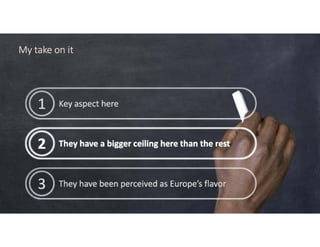
Key aspect here1 Key aspect here1
They have a bigger ceiling here than the rest2 They have a bigger ceiling here than the rest2
They have been perceived as Europe’s flavor3 They have been perceived as Europe’s flavor3
My take on itMy take on itMy take on itMy take on it
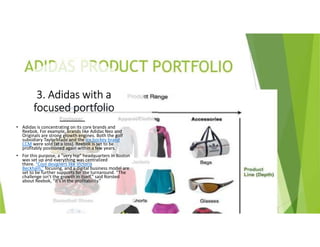
3. Adidas with a3. Adidas with a3. Adidas with a3. Adidas with a
focused portfoliofocused portfoliofocused portfoliofocused portfolio
• Adidas is concentrating on its core brands and
Reebok. For example, brands like Adidas Neo and
Originals are strong growth engines. Both the golf
subsidiary TaylorMade and the ice hockey brand
CCM were sold (at a loss). Reebok is set to be
profitably positioned again within a few years.
• For this purpose, a “very hip” headquarters in Boston
was set up and everything was centralized
there. “Cool designers like Victoria
Beckham,” focusing, and a digital business model are
set to be further supports for the turnaround. “The
challenge isn’t the growth in itself,” said Rorsted
about Reebok, “it’s in the profitability.”
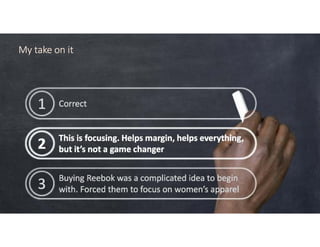
Correct1 Correct1
This is focusing. Helps margin, helps everything,
but it’s not a game changer2 This is focusing. Helps margin, helps everything,
but it’s not a game changer2
Buying Reebok was a complicated idea to begin
with. Forced them to focus on women’s apparel3 Buying Reebok was a complicated idea to begin
with. Forced them to focus on women’s apparel3
My take on itMy take on itMy take on itMy take on it
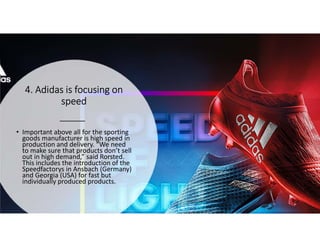
4. Adidas is focusing on4. Adidas is focusing on4. Adidas is focusing on4. Adidas is focusing on
speedspeedspeedspeed
• Important above all for the sporting
goods manufacturer is high speed in
production and delivery. “We need
to make sure that products don’t sell
out in high demand,” said Rorsted.
This includes the introduction of the
Speedfactorys in Ansbach (Germany)
and Georgia (USA) for fast but
individually produced products.
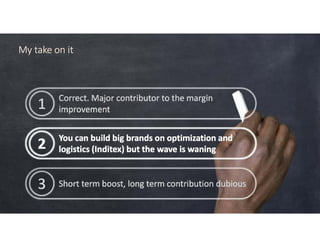
Correct. Major contributor to the margin
improvement1 Correct. Major contributor to the margin
improvement1
You can build big brands on optimization and
logistics (Inditex) but the wave is waning2 You can build big brands on optimization and
logistics (Inditex) but the wave is waning2
Short term boost, long term contribution dubious3 Short term boost, long term contribution dubious3
My take on itMy take on itMy take on itMy take on it
5. Adidas is putting its5. Adidas is putting its5. Adidas is putting its5. Adidas is putting its
marketing focus on sixmarketing focus on sixmarketing focus on sixmarketing focus on six
key citieskey citieskey citieskey cities
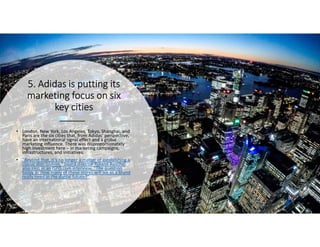
• London, New York, Los Angeles, Tokyo, Shanghai, and
Paris are the six cities that, from Adidas’ perspective,
have an international signal effect and a global
marketing influence. There was disproportionately
high investment here – in marketing campaigns,
infrastructures, and initiatives.
• "Beyond that, it’s no longer a matter of establishing a
classic distribution," board director Roland Auschel
also says in an ISPO.com interview, “The question
today is: How many of these stores will we as a brand
really need in the digital future?”
11
Any global brand worth its salt must address it2 Any global brand worth its salt must address it2
So again, does not look like a game changer3 So again, does not look like a game changer3
My take on itMy take on itMy take on itMy take on it
A blinding flash of the obvious
6. Adidas supporting its6. Adidas supporting its6. Adidas supporting its6. Adidas supporting its
own innovations withown innovations withown innovations withown innovations with
open sourceopen sourceopen sourceopen source
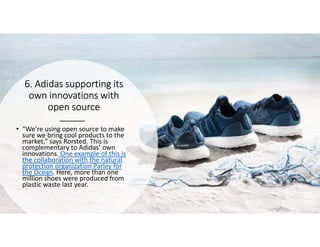
• “We’re using open source to make
sure we bring cool products to the
market,” says Rorsted. This is
complementary to Adidas’ own
innovations. One example of this is
the collaboration with the natural
protection organization Parley for
the Ocean. Here, more than one
million shoes were produced from
plastic waste last year.
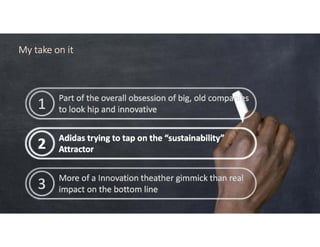
Part of the overall obsession of big, old companies
to look hip and innovative1 Part of the overall obsession of big, old companies
to look hip and innovative1
Adidas trying to tap on the “sustainability”
Attractor2 Adidas trying to tap on the “sustainability”
Attractor2
More of a Innovation theather gimmick than real
impact on the bottom line3 More of a Innovation theather gimmick than real
impact on the bottom line3
My take on itMy take on itMy take on itMy take on it
Overall
Market
wrapup
All brands were firmly positive in outlook this first half despite troubles at home. The overall
macro economic conditions with trade, oil and overall strife will keep things interesting, but the
IMF projections for 2018 and 2019 stay at a firm 3.9%. With the sportswear industry growing
7.2%, almost twice the overall projections, things still look good.
In the developed economies, North America will be key at (2.7% vs 2.2% avg) with a stronger
dollar by 5%, this will be the difference for the brands. And within this market the buildup of
Basketball will continue to be key. As Nike doubles down on ensuring it stays on top, Puma
recognizes it and is trying out a new fashion angle to it. Adidas and Under Amour continue to
wander a little aimlessly here.
In developing markets, China and India will be key (6.6% and 7.3% respectively vs 5.5% avg).
And given the massive potential and growth seen here, the brand that captures the market first
will see the biggest upside.
Brands will need to ensure they tap into real customer excitement and demand vs internal
marketing excitement. (Or alternatively, find a way to translate their excitement in the real
world). It is a fine line to tread and the Achilles heel we notice time and time again. Then again,
in hindsight it is all 20-20.
The DTC and Digital revenue channel will be a key indicator of growth over the next 2-6
seasons, as brands transition, and find the new right balance between revenue streams, and as
we have seen with Amazon, only the strongest and quickest will survive.
Overall a very positive first half across the sportswear industry clocking almost 2 times the
forecasted world economy growth, with all brands taking both, reactive and proactive steps to
evolve and ensure their sustained growth and survival in a time where we have seen
businesses struggle in the retail industry. The second half looks to be just as strong and
potentially even stronger given positive early signs of individual brands in the first half.
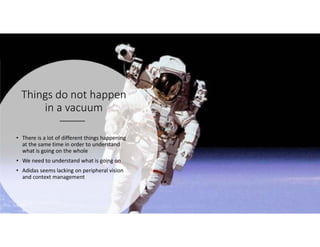
Things do not happen
in a vacuum
• There is a lot of different things happening
at the same time in order to understand
what is going on the whole
• We need to understand what is going on
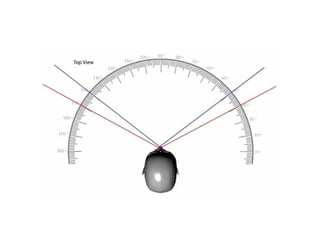
• Adidas seems lacking on peripheral vision
and context management
Strategy Expert speaking
May be a bit picky
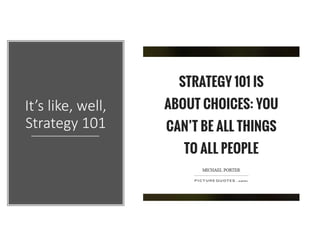
It’s like, well,
Strategy 101
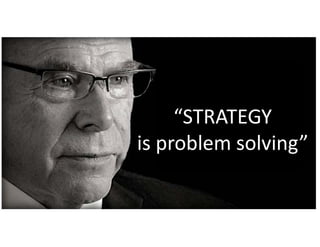
“STRATEGY
is problem solving”
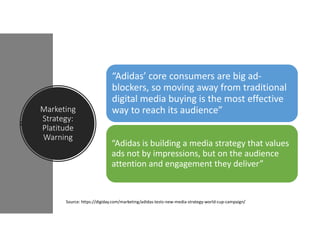
Marketing
Strategy:
Platitude
Warning
“Adidas’ core consumers are big ad-
blockers, so moving away from traditional
digital media buying is the most effective
way to reach its audience”
“Adidas is building a media strategy that values
ads not by impressions, but on the audience
attention and engagement they deliver”
Source: https://digiday.com/marketing/adidas-tests-new-media-strategy-world-cup-campaign/
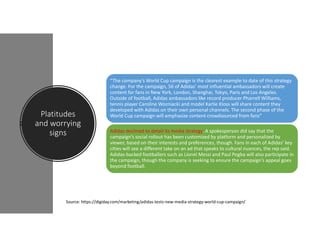
Platitudes
and worrying
signs
“The company’s World Cup campaign is the clearest example to date of this strategy
change. For the campaign, 56 of Adidas’ most influential ambassadors will create
content for fans in New York, London, Shanghai, Tokyo, Paris and Los Angeles.
Outside of football, Adidas ambassadors like record producer Pharrell Williams,
tennis player Caroline Wozniacki and model Karlie Kloss will share content they
developed with Adidas on their own personal channels. The second phase of the
World Cup campaign will emphasize content crowdsourced from fans”
Adidas declined to detail its media strategy. A spokesperson did say that the
campaign’s social rollout has been customized by platform and personalized by
viewer, based on their interests and preferences, though. Fans in each of Adidas’ key
cities will see a different take on an ad that speaks to cultural nuances, the rep said.
Adidas-backed footballers such as Lionel Messi and Paul Pogba will also participate in
the campaign, though the company is seeking to ensure the campaign’s appeal goes
beyond football.
Source: https://digiday.com/marketing/adidas-tests-new-media-strategy-world-cup-campaign/
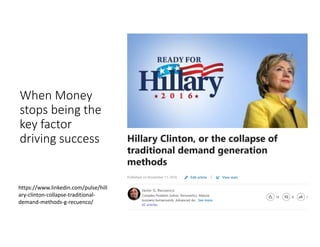
When Money
stops being the
key factor
driving success
https://www.linkedin.com/pulse/hill
ary-clinton-collapse-traditional-
demand-methods-g-recuenco/
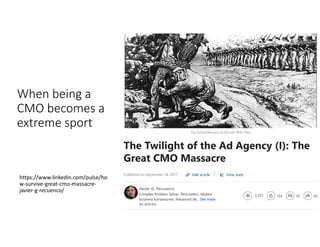
When being a
CMO becomes a
extreme sport
https://www.linkedin.com/pulse/ho
w-survive-great-cmo-massacre-
javier-g-recuenco/
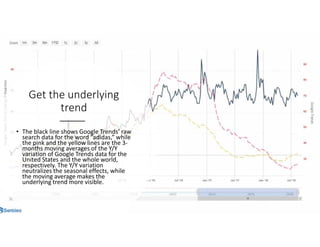
Get the underlying
trend
• The black line shows Google Trends’ raw
search data for the word “adidas,” while
the pink and the yellow lines are the 3-
months moving averages of the Y/Y
variation of Google Trends data for the
United States and the whole world,
respectively. The Y/Y variation
neutralizes the seasonal effects, while
the moving average makes the
underlying trend more visible.
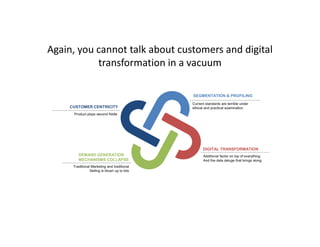
Again, you cannot talk about customers and digital
transformation in a vacuum
CUSTOMER CENTRICITY
DEMAND GENERATION
MECHANISMS COLLAPSE
DIGITAL TRANSFORMATION
SEGMENTATION & PROFILING
Product plays second fiddle
Traditional Marketing and traditional
Selling is blown up to bits
Current standards are terrible under
ethical and practical examination
Additional factor on top of everything.
And the data deluge that brings along
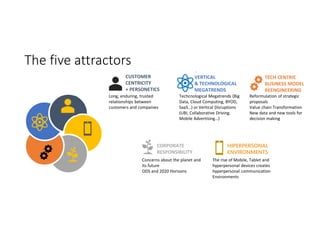
The five attractors
CUSTOMER
CENTRICITY
+ PERSONETICS
Long, enduring, trusted
relationships between
customers and companies
VERTICAL
& TECHNOLOGICAL
MEGATRENDS
Techcnological Megatrends (Big
Data, Cloud Computing, BYOD,
SaaS…) or Vertical Disruptions
(UBI, Collaborative Driving,
Mobile Advertising…)
TECH CENTRIC
BUSINESS MODEL
REENGINEERING
Reformulation of strategic
proposals
Value chain Transformation
New data and new tools for
decision making
HIPERPERSONAL
ENVIRONMENTS
The rise of Mobile, Tablet and
hyperpersonal devices creates
hyperpersonal communication
Environments
Concerns about the planet and
its future
ODS and 2020 Horizons
CORPORATE
RESPONSIBILITY
Double Whammy:
Sales process & Demand Generation
Double Whammy:
Sales process & Demand Generation
Protoproblems:
Strategy & Complex Problem Solving
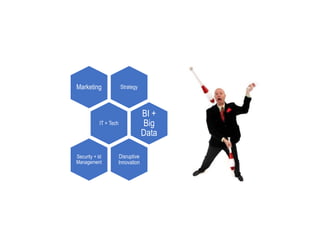
StrategyMarketing
IT + Tech
BI +
Big
Data
Disruptive
Innovation
Security + Id
Management
And what about the
celebrities?
• Mixed nuts
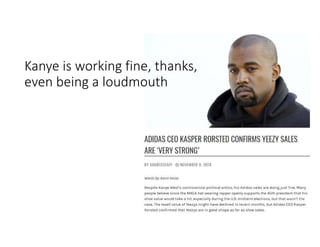
Kanye is working fine, thanks,
even being a loudmouth
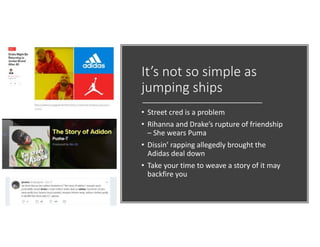
It’s not so simple as
jumping ships
• Street cred is a problem
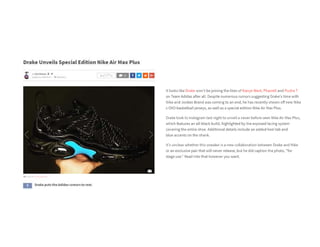
• Rihanna and Drake’s rupture of friendship
– She wears Puma
• Dissin’ rapping allegedly brought the
Adidas deal down
• Take your time to weave a story of it may
backfire you
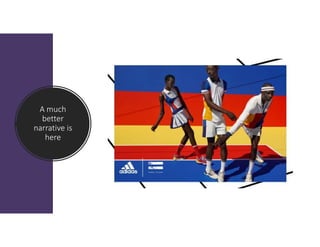
A much
better
narrative is
here
It’s about
coolness.
It’s about
culture.
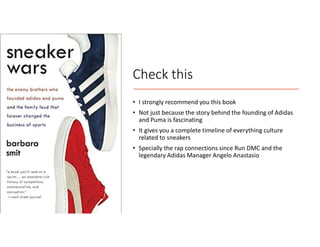
Check this
• I strongly recommend you this book
• Not just because the story behind the founding of Adidas
and Puma is fascinating
• It gives you a complete timeline of everything culture
related to sneakers
• Specially the rap connections since Run DMC and the
legendary Adidas Manager Angelo Anastasio
At the
end of
the day
it’s about
WHO ARE
YOU
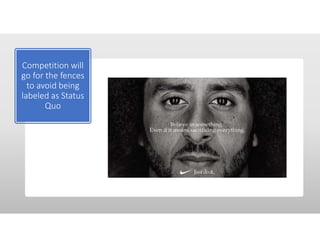
Competition will
go for the fences
to avoid being
labeled as Status
Quo
So, my final take:
• Adidas is the slowest grower in a growing
market
• For how long? Global recession looms
• Key strategic issues are not being addressed
properly – Bar needs to be raised
• It’s still a powerhouse, so nothing that
cannot be corrected
• But beware the “Too big to fail” syndrome
that preyed companies like Kodak or Nokia
Thanks for your
attention!
Javier.recuenco@singularsolving.com
Twitter: @recuenco

Adidas strategy on the current context

  • 1.
    Adidas strategy on thecurrent context Javier G. Recuenco
  • 3.
    Current performance looks stellar •Seems all rosy and clean, isn’t it? • Not so quick
  • 4.
    Seems the tide isrising for all, but… • Adidas is the one who is capturing the smallest piece of all cake seekers Source: https://www.linkedin.com/pulse/sportswear- brand-wars-half-year-2018-results-analysis-patil/
  • 5.
    Let’s get acloser look • Adidas (on the other hand compared to Nike) seems to have finally slowed a bit and fallen into a similar product trap that Nike was in only 12-18 months ago. Overall Adidas did extremely well on financials concentrating on profitability (+20%) and improving everything non-product. • Slow down on the Courts was as per expectation, as was the trend around the plateaued hype and overreach on the NMD and Ultraboosts. Adidas needed some real excitement. They found some in Deerupt and continued volume sales in styles like the X-plr, but overall these could not to make a mortal difference. • The reception to the attempt to breathe some life in the Gazelles and older styles, and to create new platforms on the Boost base was lukewarm at best, and somewhere the brand seemed to miss out on creating a new working platform that will resonate with the customer in the long run and got wrapped up in their own hype and internal marketing that does not always translate into sales – An easy trap to fall into, but one that keeps repeating across brands and businesses, not constrained to the sporting goods industry.
  • 6.
    Where do youthink Adidas is currently as of now? • My specialty is mature business turnarounds • All mature business share a clear set of signals
  • 7.
    Strategies have a lifespan andprovokes alterations Size brings a sort of “negative gravitas”
  • 8.
    Its own lifespan isplaying against it • Antiquated structures and legacy cultural ways of doing things • They already dodged a bullet on late ’80s
  • 9.
    Adidas has a stronglegacy with good and bad points In 1989, with the company at a crossroads, then CEO René Jäggi decided to invite two ex-Nike managers, Peter Moore and Rob Strasser, to visit Adidas. Moore had been creative director of Nike and the designer of the Air Jordan brand, and Strasser had been Nike’s marketing director. As the guardians of Nike’s image, they promoted the importance of a clear and consistent approach to building a brand. They had left Nike a couple of years before to set up a business to help create and develop other sports brands.
  • 10.
    Adidas has a stronglegacy with good and bad points • In looking to Adidas’s past, Moore and Strasser recognized two unique capabilities. First, they saw that the core of the company had been Adi Dassler’s hands-on approach to innovation — his philosophy of industrialized craftsmanship. Dassler’s closeness to athletes and his intimate understanding of their needs had created a stream of innovative products that enhanced athletic performance. When the company lost its connection to athletes, quality suffered. • Moore and Strasser recommended renewing Dassler’s approach, and developed a new product line called Adidas Equipment. For Equipment, which was launched in 1991 and later evolved into Adidas Performance, Moore and Strasser created branding rules that emphasized product quality. For example, they placed restrictions on the color, sizing, and placement of the logo, and initially even on the colors of the shoes themselves. They wanted consumers to focus on the quality of the shoe, and not be distracted by other features. They wanted to make the product the hero, just as Dassler would have done. “The idea of Equipment was that it was a model that you could build the whole company around,” Moore told us. “The model was to go back to what Dassler had tried to do all his life, which was to make the best products for the athlete to compete in.” Reconnecting in this way was emotionally uplifting — especially for those who had worked with Dassler — and helped restore employees’ confidence. Today, Performance represents the core of the Adidas brand and accounts for more than 75 percent of its sales.
  • 11.
    Adidas has a stronglegacy with good and bad points • Second, Moore and Strasser understood that Adi Dassler’s approach to design, which emphasized functionality over style, had created a portfolio of timeless, authentic shoe designs. The shoes were no longer cutting-edge in terms of their athletic performance (the technology had moved on), but they had a strong emotional appeal, especially in the burgeoning street-wear market epitomized by the Adidas-wearing hip-hop group Run DMC and its fans. • Adidas had struggled to create a leisurewear line, but it seemed the company unknowingly already had one. In a brief memo to the Adidas board, Moore set out the idea for a new brand of street- wear shoes. The suggestion was to take some key models from the past and modernize the quality, comfort, and fit. Rather than blurring the clarity of Equipment, Adidas recognized that this new line should have a separate name, “Originals,” and a distinctive presentation. As a testament to the success of the approach, Originals is now a $2.8 billion business. All of the shoes selected for updating at the launch of the initiative are still produced today, including the Stan Smith tennis shoe, 60 million pairs of which have been sold.
  • 12.
    Adidas has a stronglegacy with good and bad points It can be difficult for managers to see the truth about their own organization. Accepting “the way we do things around here” can create a form of groupthink. Often, outsiders who come into companies, unencumbered by the existing culture, reinstitute strategies firmly rooted in the firm’s capabilities. Some examples are Jørgen Vig Knudstorp, the first non–family member to be named CEO of Lego; Angela Ahrendts, the American who turned around British fashion icon Burberry; and Steve Jobs, who had a second, triumphant tenure at Apple, the company he had founded and from which he had been ousted. Of course, it may not always be practical to have outsiders challenging the status quo. But at a minimum, insiders should be questioning and self-critical.
  • 13.
    Long time agosince real product differentiation was the key Jesse Owens wore Adidas with nails at Berlin 1936
  • 14.
  • 15.
    Those are the signsof a mature market • All brands worked superbly across their international markets, and were flat across their home markets. Greater China was the biggest driver of growth followed by the APAC region as a whole. With currency neutral numbers looking a lot better for all brands with regard to their international markets, all brands clocked between 17% and 28%, but in absolute terms Nike came up on tops, managing to hold their own in their home market of the North America and even eking out a 3% growth in it where others stumbled on home turf.
  • 16.
    Adidas shows the slower growthoverall • Even losing foot on footwear, no pun intended!!
  • 17.
    But they are excellingon nailing the financials • You know a company is in trouble when CFOs becomes hero of the day
  • 18.
    What is Adidasdoing right? On its own words Source: https://www.ispo.com/en/companies/adidas-goes-after-nike-digital-strategy
  • 19.
    1. Adidas1. Adidas1.Adidas1. Adidas seesseesseessees itselfitselfitselfitself as a digitalas a digitalas a digitalas a digital companycompanycompanycompany • “We’ve become a digital company,” says Kasper Rorsted. Part of this, for example, is the fact that (according to Rorsted) 90 percent of the marketing budget will already be given over to digital campaigns and social media. “We can thus interact with consumer and be where they are.” At the same time, they are a very young company. For the employees, there is no “digital transformation,” as they “already are digital” and have a high affinity for digital topics. • Furthermore, according to Rorsted, Adidas is now gaining lots of insight from Big Data and digital analyses. With 3D printing and in the Speedfactory, the production processes are as digitized as much as possible. • When it comes to revenue growth, e-commerce far outstripped all distribution channels last year at a growth of 57 percent.
  • 20.
    B******t1 B******t1 Everyone isgrowing hard here, but Nike is kicking their arses hard on this front. Even Puma2 Everyone is growing hard here, but Nike is kicking their arses hard on this front. Even Puma2 The classical appeals to Big Data / AI are cautionary3 The classical appeals to Big Data / AI are cautionary3 My take on itMy take on itMy take on itMy take on it
  • 21.
    Let’s get acloser look Moving to non Brick and Mortar spaces, we saw some stellar movement here as well, with Nike growing at 41%, Adidas at 26% and one may derive over 20% growth each on Puma and UA as well. With extremely tangible steps being outlined in the conference calls for Nike on the build up on their Digital expansion plans, the 3 other brands remained a bit shy in terms of tangible steps - perhaps a space they want to double down on - with Ecom and Omni the future - only - the future is now, and I am confident no one wants to be caught in the Nokia trap.
  • 23.
    Let’s make a deeperhead to head comparison • Adidas: 20,8 million fans - 88,486 avg. interactions per post (month July 2018) • Puma: 8,1 million fans - 109,220 avg. interactions per post (month July 2018) • Although Adidas has more than double the fan count, Puma manages to even outperform Adidas in terms of average interactions per post in July 2018. • Facebook is the least used social network - Adidas has zero posts in the analyzed 30 days, even though their fan count is greater there than among all other social media channels (34,5 million). • Comparing the content both post, Adidas seems to be far more creative and diverse. • Adidas is the more popular brand but still, Puma cannot be underestimated. They seem to take care of their social channels and also show a lot of content with a high production value. • The analysis contains data for the timeframe of June 17 to July 17 of 2018.
  • 24.
    2. Adidas’ increased2.Adidas’ increased2. Adidas’ increased2. Adidas’ increased focus on the USfocus on the USfocus on the USfocus on the US • They now understand the USA better, the Adidas CEO said. A 27 percent growth for North America proves him right. Besides e-commerce and the business in China, North America is a strategic growth area for Adidas and one of the “main drivers for success,” says Rorsted. In the US it’s important to service the key businesses of football, baseball, and basketball, not soccer like in Europe. In addition there are, of course, several global trends coming out of the US. • Music stars Kanye West and Pharrell Williams would have been an enormous help for Adidas’ lifestyle division here. The CEO is cautious about the positive development compared to competitors Nike and Under Armour: Adidas also started from a weaker foundation, and expectations in the competition are made much higher with the positive headlines of recent years.
  • 25.
    Key aspect here1Key aspect here1 They have a bigger ceiling here than the rest2 They have a bigger ceiling here than the rest2 They have been perceived as Europe’s flavor3 They have been perceived as Europe’s flavor3 My take on itMy take on itMy take on itMy take on it
  • 26.
    3. Adidas witha3. Adidas with a3. Adidas with a3. Adidas with a focused portfoliofocused portfoliofocused portfoliofocused portfolio • Adidas is concentrating on its core brands and Reebok. For example, brands like Adidas Neo and Originals are strong growth engines. Both the golf subsidiary TaylorMade and the ice hockey brand CCM were sold (at a loss). Reebok is set to be profitably positioned again within a few years. • For this purpose, a “very hip” headquarters in Boston was set up and everything was centralized there. “Cool designers like Victoria Beckham,” focusing, and a digital business model are set to be further supports for the turnaround. “The challenge isn’t the growth in itself,” said Rorsted about Reebok, “it’s in the profitability.”
  • 27.
    Correct1 Correct1 This isfocusing. Helps margin, helps everything, but it’s not a game changer2 This is focusing. Helps margin, helps everything, but it’s not a game changer2 Buying Reebok was a complicated idea to begin with. Forced them to focus on women’s apparel3 Buying Reebok was a complicated idea to begin with. Forced them to focus on women’s apparel3 My take on itMy take on itMy take on itMy take on it
  • 28.
    4. Adidas isfocusing on4. Adidas is focusing on4. Adidas is focusing on4. Adidas is focusing on speedspeedspeedspeed • Important above all for the sporting goods manufacturer is high speed in production and delivery. “We need to make sure that products don’t sell out in high demand,” said Rorsted. This includes the introduction of the Speedfactorys in Ansbach (Germany) and Georgia (USA) for fast but individually produced products.
  • 29.
    Correct. Major contributorto the margin improvement1 Correct. Major contributor to the margin improvement1 You can build big brands on optimization and logistics (Inditex) but the wave is waning2 You can build big brands on optimization and logistics (Inditex) but the wave is waning2 Short term boost, long term contribution dubious3 Short term boost, long term contribution dubious3 My take on itMy take on itMy take on itMy take on it
  • 30.
    5. Adidas isputting its5. Adidas is putting its5. Adidas is putting its5. Adidas is putting its marketing focus on sixmarketing focus on sixmarketing focus on sixmarketing focus on six key citieskey citieskey citieskey cities • London, New York, Los Angeles, Tokyo, Shanghai, and Paris are the six cities that, from Adidas’ perspective, have an international signal effect and a global marketing influence. There was disproportionately high investment here – in marketing campaigns, infrastructures, and initiatives. • "Beyond that, it’s no longer a matter of establishing a classic distribution," board director Roland Auschel also says in an ISPO.com interview, “The question today is: How many of these stores will we as a brand really need in the digital future?”
  • 31.
    11 Any global brandworth its salt must address it2 Any global brand worth its salt must address it2 So again, does not look like a game changer3 So again, does not look like a game changer3 My take on itMy take on itMy take on itMy take on it A blinding flash of the obvious
  • 32.
    6. Adidas supportingits6. Adidas supporting its6. Adidas supporting its6. Adidas supporting its own innovations withown innovations withown innovations withown innovations with open sourceopen sourceopen sourceopen source • “We’re using open source to make sure we bring cool products to the market,” says Rorsted. This is complementary to Adidas’ own innovations. One example of this is the collaboration with the natural protection organization Parley for the Ocean. Here, more than one million shoes were produced from plastic waste last year.
  • 33.
    Part of theoverall obsession of big, old companies to look hip and innovative1 Part of the overall obsession of big, old companies to look hip and innovative1 Adidas trying to tap on the “sustainability” Attractor2 Adidas trying to tap on the “sustainability” Attractor2 More of a Innovation theather gimmick than real impact on the bottom line3 More of a Innovation theather gimmick than real impact on the bottom line3 My take on itMy take on itMy take on itMy take on it
  • 34.
    Overall Market wrapup All brands werefirmly positive in outlook this first half despite troubles at home. The overall macro economic conditions with trade, oil and overall strife will keep things interesting, but the IMF projections for 2018 and 2019 stay at a firm 3.9%. With the sportswear industry growing 7.2%, almost twice the overall projections, things still look good. In the developed economies, North America will be key at (2.7% vs 2.2% avg) with a stronger dollar by 5%, this will be the difference for the brands. And within this market the buildup of Basketball will continue to be key. As Nike doubles down on ensuring it stays on top, Puma recognizes it and is trying out a new fashion angle to it. Adidas and Under Amour continue to wander a little aimlessly here. In developing markets, China and India will be key (6.6% and 7.3% respectively vs 5.5% avg). And given the massive potential and growth seen here, the brand that captures the market first will see the biggest upside. Brands will need to ensure they tap into real customer excitement and demand vs internal marketing excitement. (Or alternatively, find a way to translate their excitement in the real world). It is a fine line to tread and the Achilles heel we notice time and time again. Then again, in hindsight it is all 20-20. The DTC and Digital revenue channel will be a key indicator of growth over the next 2-6 seasons, as brands transition, and find the new right balance between revenue streams, and as we have seen with Amazon, only the strongest and quickest will survive. Overall a very positive first half across the sportswear industry clocking almost 2 times the forecasted world economy growth, with all brands taking both, reactive and proactive steps to evolve and ensure their sustained growth and survival in a time where we have seen businesses struggle in the retail industry. The second half looks to be just as strong and potentially even stronger given positive early signs of individual brands in the first half.
  • 35.
    Things do nothappen in a vacuum • There is a lot of different things happening at the same time in order to understand what is going on the whole • We need to understand what is going on • Adidas seems lacking on peripheral vision and context management
  • 37.
  • 40.
  • 41.
  • 42.
    Marketing Strategy: Platitude Warning “Adidas’ core consumersare big ad- blockers, so moving away from traditional digital media buying is the most effective way to reach its audience” “Adidas is building a media strategy that values ads not by impressions, but on the audience attention and engagement they deliver” Source: https://digiday.com/marketing/adidas-tests-new-media-strategy-world-cup-campaign/
  • 43.
    Platitudes and worrying signs “The company’sWorld Cup campaign is the clearest example to date of this strategy change. For the campaign, 56 of Adidas’ most influential ambassadors will create content for fans in New York, London, Shanghai, Tokyo, Paris and Los Angeles. Outside of football, Adidas ambassadors like record producer Pharrell Williams, tennis player Caroline Wozniacki and model Karlie Kloss will share content they developed with Adidas on their own personal channels. The second phase of the World Cup campaign will emphasize content crowdsourced from fans” Adidas declined to detail its media strategy. A spokesperson did say that the campaign’s social rollout has been customized by platform and personalized by viewer, based on their interests and preferences, though. Fans in each of Adidas’ key cities will see a different take on an ad that speaks to cultural nuances, the rep said. Adidas-backed footballers such as Lionel Messi and Paul Pogba will also participate in the campaign, though the company is seeking to ensure the campaign’s appeal goes beyond football. Source: https://digiday.com/marketing/adidas-tests-new-media-strategy-world-cup-campaign/
  • 45.
    When Money stops beingthe key factor driving success https://www.linkedin.com/pulse/hill ary-clinton-collapse-traditional- demand-methods-g-recuenco/
  • 46.
    When being a CMObecomes a extreme sport https://www.linkedin.com/pulse/ho w-survive-great-cmo-massacre- javier-g-recuenco/
  • 47.
    Get the underlying trend •The black line shows Google Trends’ raw search data for the word “adidas,” while the pink and the yellow lines are the 3- months moving averages of the Y/Y variation of Google Trends data for the United States and the whole world, respectively. The Y/Y variation neutralizes the seasonal effects, while the moving average makes the underlying trend more visible.
  • 48.
    Again, you cannottalk about customers and digital transformation in a vacuum CUSTOMER CENTRICITY DEMAND GENERATION MECHANISMS COLLAPSE DIGITAL TRANSFORMATION SEGMENTATION & PROFILING Product plays second fiddle Traditional Marketing and traditional Selling is blown up to bits Current standards are terrible under ethical and practical examination Additional factor on top of everything. And the data deluge that brings along
  • 49.
    The five attractors CUSTOMER CENTRICITY +PERSONETICS Long, enduring, trusted relationships between customers and companies VERTICAL & TECHNOLOGICAL MEGATRENDS Techcnological Megatrends (Big Data, Cloud Computing, BYOD, SaaS…) or Vertical Disruptions (UBI, Collaborative Driving, Mobile Advertising…) TECH CENTRIC BUSINESS MODEL REENGINEERING Reformulation of strategic proposals Value chain Transformation New data and new tools for decision making HIPERPERSONAL ENVIRONMENTS The rise of Mobile, Tablet and hyperpersonal devices creates hyperpersonal communication Environments Concerns about the planet and its future ODS and 2020 Horizons CORPORATE RESPONSIBILITY
  • 51.
    Double Whammy: Sales process& Demand Generation Double Whammy: Sales process & Demand Generation
  • 52.
  • 53.
    StrategyMarketing IT + Tech BI+ Big Data Disruptive Innovation Security + Id Management
  • 56.
    And what aboutthe celebrities? • Mixed nuts
  • 57.
    Kanye is workingfine, thanks, even being a loudmouth
  • 58.
    It’s not sosimple as jumping ships • Street cred is a problem • Rihanna and Drake’s rupture of friendship – She wears Puma • Dissin’ rapping allegedly brought the Adidas deal down • Take your time to weave a story of it may backfire you
  • 60.
  • 61.
  • 62.
    Check this • Istrongly recommend you this book • Not just because the story behind the founding of Adidas and Puma is fascinating • It gives you a complete timeline of everything culture related to sneakers • Specially the rap connections since Run DMC and the legendary Adidas Manager Angelo Anastasio
  • 63.
    At the end of theday it’s about WHO ARE YOU
  • 64.
    Competition will go forthe fences to avoid being labeled as Status Quo
  • 65.
    So, my finaltake: • Adidas is the slowest grower in a growing market • For how long? Global recession looms • Key strategic issues are not being addressed properly – Bar needs to be raised • It’s still a powerhouse, so nothing that cannot be corrected • But beware the “Too big to fail” syndrome that preyed companies like Kodak or Nokia
  • 66.