Safeguarding
Student Services
• When travelling to work /
college
• Walking home late at night
• In the Learning Centre
• In unsupervised areas of the
college
• In your workplace
Do you feel safe?
Safeguarding means to protect people from risk or
harm. This includes a wide range of things such as:
• Bullying
• Abuse
• Sexual Exploitation
• E-safety
• Peer on peer abuse
• Female Genital Mutilation
• Domestic/relationship abuse
• Self harm
• Forced Marriage
• Radicalisation and Extremism
What is
Safeguarding?
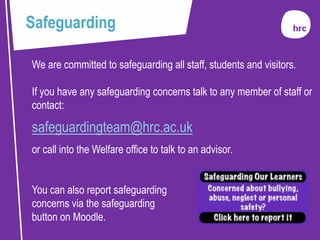
We are committed to safeguarding all staff, students and visitors.
If you have any safeguarding concerns talk to any member of staff or
contact:
safeguardingteam@hrc.ac.uk
or call into the Welfare office to talk to an advisor.
You can also report safeguarding
concerns via the safeguarding
button on Moodle.
Safeguarding
Young people are capable of abusing their peers.
Peer on peer abuse can take the form of:
• bullying (including cyber-bullying)
• sexting and any other form of
• sexual or physical abuse.
• Gender based issues can also occur e.g.
• girls being sexually touched/assaulted
• boys being subject to initiation/hazing type
violence.
Peer on Peer
Abuse
Extremism
• Everyone has the right to hold differing
views, however…
• If these view are hateful, dangerous or
against the law these views may be
extremist
• Extremism comes in many forms,
environmental, political, religious
• If you are concerned that someone is
showing extremist views report it
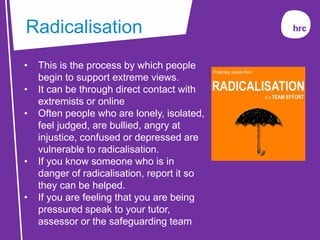
Radicalisation
• This is the process by which people
begin to support extreme views.
• It can be through direct contact with
extremists or online
• Often people who are lonely, isolated,
feel judged, are bullied, angry at
injustice, confused or depressed are
vulnerable to radicalisation.
• If you know someone who is in
danger of radicalisation, report it so
they can be helped.
• If you are feeling that you are being
pressured speak to your tutor,
assessor or the safeguarding team
• This is the government’s programme to
help prevent extremism and terrorism.
• The college plays an active role in the
strategy to safeguard our learners.
• It is not about picking on any particular
community or group, but helping to stop
extremist and violent behaviour.
Prevent
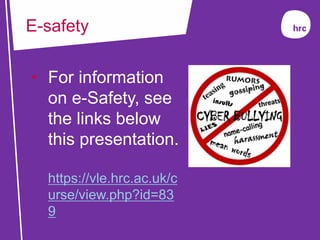
• For information
on e-Safety, see
the links below
this presentation.
https://vle.hrc.ac.uk/c
urse/view.php?id=83
9
E-safety
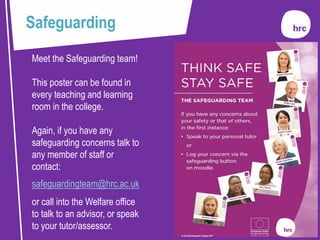
Meet the Safeguarding team!
This poster can be found in
every teaching and learning
room in the college.
Again, if you have any
safeguarding concerns talk to
any member of staff or
contact:
safeguardingteam@hrc.ac.uk
or call into the Welfare office
to talk to an advisor, or speak
to your tutor/assessor.
Safeguarding

Add to xerte safeguarding session 17-18

  • 1.
  • 2.
    • When travellingto work / college • Walking home late at night • In the Learning Centre • In unsupervised areas of the college • In your workplace Do you feel safe?
  • 3.
    Safeguarding means toprotect people from risk or harm. This includes a wide range of things such as: • Bullying • Abuse • Sexual Exploitation • E-safety • Peer on peer abuse • Female Genital Mutilation • Domestic/relationship abuse • Self harm • Forced Marriage • Radicalisation and Extremism What is Safeguarding?
  • 4.
    We are committedto safeguarding all staff, students and visitors. If you have any safeguarding concerns talk to any member of staff or contact: safeguardingteam@hrc.ac.uk or call into the Welfare office to talk to an advisor. You can also report safeguarding concerns via the safeguarding button on Moodle. Safeguarding
  • 5.
    Young people arecapable of abusing their peers. Peer on peer abuse can take the form of: • bullying (including cyber-bullying) • sexting and any other form of • sexual or physical abuse. • Gender based issues can also occur e.g. • girls being sexually touched/assaulted • boys being subject to initiation/hazing type violence. Peer on Peer Abuse
  • 6.
    Extremism • Everyone hasthe right to hold differing views, however… • If these view are hateful, dangerous or against the law these views may be extremist • Extremism comes in many forms, environmental, political, religious • If you are concerned that someone is showing extremist views report it
  • 7.
    Radicalisation • This isthe process by which people begin to support extreme views. • It can be through direct contact with extremists or online • Often people who are lonely, isolated, feel judged, are bullied, angry at injustice, confused or depressed are vulnerable to radicalisation. • If you know someone who is in danger of radicalisation, report it so they can be helped. • If you are feeling that you are being pressured speak to your tutor, assessor or the safeguarding team
  • 8.
    • This isthe government’s programme to help prevent extremism and terrorism. • The college plays an active role in the strategy to safeguard our learners. • It is not about picking on any particular community or group, but helping to stop extremist and violent behaviour. Prevent
  • 9.
    • For information one-Safety, see the links below this presentation. https://vle.hrc.ac.uk/c urse/view.php?id=83 9 E-safety
  • 10.
    Meet the Safeguardingteam! This poster can be found in every teaching and learning room in the college. Again, if you have any safeguarding concerns talk to any member of staff or contact: safeguardingteam@hrc.ac.uk or call into the Welfare office to talk to an advisor, or speak to your tutor/assessor. Safeguarding