ADAPTIVE OPTICS IN GROUND
BASED TELESCOPE
Guided by: Presented by:
V P Vinturaj Ajeesh . K. V
Lecturer in Electronics S5 EL, ROLL NO:03
Dept . of EL,GPTC. kasaragod 1
CONTENTS
 INTRODUCTION
 TELESCOPES
 DIFFERENTTYPES OFTELESCOPES
 OPTICALTELESCOPE
 REFLECTINGTELESCOPE
 RADIOTELESCOPE
 ADAPTIVE OPTICS
 BASIC PRINCIPLES
 SEEING INFRARED
 OTHER STARS AND OTHER EARTH
 CONCLUSION
INTRODUCTION
 Adaptive optics is new technology which in effect
removes the atmosphere tremor and helps the
astronomer see the image through earth based
telescopes more brightly.
 Without using this system the image obtained in
telescope on earth are seen to be blurred, which is
caused by the turbulent mixing of air at different
temperatures .
 It brings together the latest in computers, materials
science, electronic detectors and digital control in a
system that warps and bends a mirror in a telescope to
counteract in real time the atmospheric distortion.
Dep . Of EL, GPTC. Kasaragod 2
TELESCOPES
 Telescopes are instruments used to study the
electromagnetic radiations from the universe.
 The word telescope is derived from the Greek
words “tele” (from afar)and “skopos” (viewer).
 The underlying principle of all telescopes is to
gather radiation from distant objects and focus it.
This increases the intensity of the radiations thereby
allowing the objects to be magnified.
Dept . of EL, GPTC. Kasaragod 3
THREE DIFFERENT TYPES OF
TELESCOPES
 Optical telescope
 Reflecting telescope
 Radio telescope
Dept . Of EL, GPTC. Kasaragod 4
Optical Telescopes
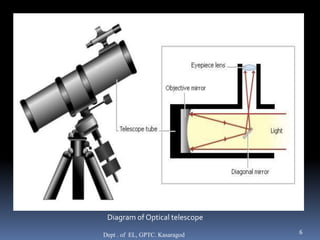
 An optical telescope is a telescope that gathers
and focuses light, mainly from the visible part of the
electromagnetic spectrum, to create
a magnified image for direct view, or to make
a photograph, or to collect data through
electronic image sensors.
 Optical telescopes have been used in astronomical
research since the time of their invention in the early
17th century.
 Many types have been constructed over the years
depending on the optical technology, such as
refracting and reflecting etc.
Dept . Of EL, GPTC. Kasaragod 5
Diagram of Optical telescope
Dept . of EL, GPTC. Kasaragod 6
Reflecting Telescopes
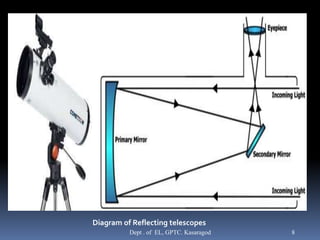
 A reflecting telescope (also called a reflector) is
a telescope that uses a single or a combination
of curved mirrors that reflect light and form an image.
 The reflecting telescope was invented in the 17th
century, by Isaac Newton, as an alternative to
the refracting telescope which, at that time, was a
design that suffered from severe chromatic aberration.
 Reflecting telescopes come in many design variations
and may employ extra optical elements to improve
image quality or place the image in a mechanically
advantageous position.
Dept . of EL, GPTC. kasaragod 7
Diagram of Reflecting telescopes
Dept . of EL, GPTC. Kasaragod 8
Radio Telescopes
 A radio telescope is a specialized antenna and radio receiver used
to receive radio waves from astronomical radio sources in the sky
in radio astronomy.
 Radio telescopes are the main observing instrument used in radio
astronomy, which studies the radio frequency portion of
the electromagnetic spectrum emitted by astronomical objects, just
as optical telescopes are the main observing instrument used in
traditional optical astronomy which studies the light wave portion
of the spectrum coming from astronomical objects.
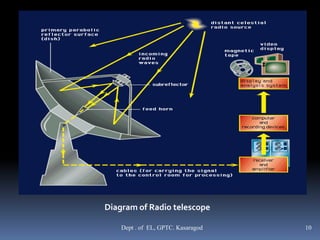
 Radio telescopes are typically large parabolic ("dish")
antennas similar to those employed in tracking and communicating
with satellites and space probes. They may be used singly or
linked together electronically in an array.
 Unlike optical telescopes, radio telescopes can be used in the
daytime as well as at night.
Dept. of EL, GPTC. Kasaragod 9
Diagram of Radio telescope
Dept . of EL, GPTC. Kasaragod 10
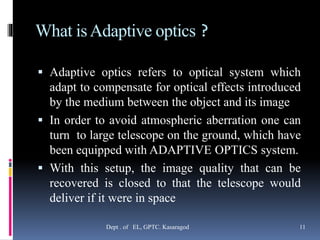
What isAdaptive optics ?
 Adaptive optics refers to optical system which
adapt to compensate for optical effects introduced
by the medium between the object and its image
 In order to avoid atmospheric aberration one can
turn to large telescope on the ground, which have
been equipped with ADAPTIVE OPTICS system.
 With this setup, the image quality that can be
recovered is closed to that the telescope would
deliver if it were in space
Dept . of EL, GPTC. Kasaragod 11
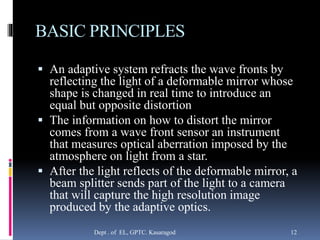
BASIC PRINCIPLES
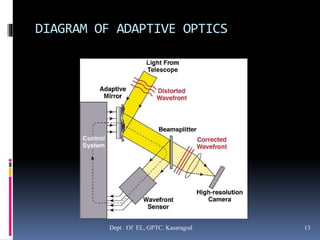
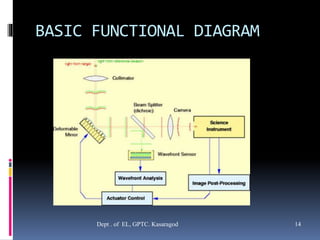
 An adaptive system refracts the wave fronts by
reflecting the light of a deformable mirror whose
shape is changed in real time to introduce an
equal but opposite distortion
 The information on how to distort the mirror
comes from a wave front sensor an instrument
that measures optical aberration imposed by the
atmosphere on light from a star.
 After the light reflects of the deformable mirror, a
beam splitter sends part of the light to a camera
that will capture the high resolution image
produced by the adaptive optics.
Dept . of EL, GPTC. Kasaragod 12
DIAGRAM OF ADAPTIVE OPTICS
Dept . Of EL, GPTC. Kasaragod 13
BASIC FUNCTIONAL DIAGRAM
Dept . of EL, GPTC. Kasaragod 14
SEEING INFRARED
 In the infrared, the hardware of adaptive optics
consists of an existing telescope, complete with
its primary and secondary mirrors, and adds a
separate box of optics, including the deformable
mirror, to perform the atmospheric compensation.
 One is that each additional optical surface beam
train absorbs some of the light from the target
object in the sky, making the object appear fainter.
 Also it emits light by virtue of its warmth ,
introducing thermal noise, further degrading the
astronomers, ability to detect faint objects
Dept . of EL, GPTC. Kasaragod 15
OTHER STARS, OTHER EARTHS
 Per haps the most exciting scientific program to
benefit from the new approach to adaptive optics
will be to look at Jupiter like planets orbiting
other stars.
 Roughly 100 such stars have been found out
through observation of the effects on the motion
of there parent stars, but none has ever be seen by
direct imaging.
 It happens because they are extraordinary faint
and to compound the problem, they are right next
to something that is enormously brighter
Dept . of EL, GPTC. Kasaragod 16
CONCLUSION
 There are many substantial technological challenges
in AO.
 Among them are the development of fast, very low-
noise detectors in order to be able to correct with
fainter reference stars; high-power reliable & easy to
operate sodium lasers, very fast processors exceeding
109 to 1010 operations per second; deformable
mirror with bandwidths of actuators and large
secondary adaptive mirror.
 The latter are especially interesting at thermal wave
lengths, where any additional mirror raises the
already huge thermal background seen by the
instruments
Dept . of EL, GPTC. Kasaragod 17
THANK YOU

Adaptive optics on ground based telescope

  • 1.
    ADAPTIVE OPTICS INGROUND BASED TELESCOPE Guided by: Presented by: V P Vinturaj Ajeesh . K. V Lecturer in Electronics S5 EL, ROLL NO:03 Dept . of EL,GPTC. kasaragod 1
  • 2.
    CONTENTS  INTRODUCTION  TELESCOPES DIFFERENTTYPES OFTELESCOPES  OPTICALTELESCOPE  REFLECTINGTELESCOPE  RADIOTELESCOPE  ADAPTIVE OPTICS  BASIC PRINCIPLES  SEEING INFRARED  OTHER STARS AND OTHER EARTH  CONCLUSION
  • 3.
    INTRODUCTION  Adaptive opticsis new technology which in effect removes the atmosphere tremor and helps the astronomer see the image through earth based telescopes more brightly.  Without using this system the image obtained in telescope on earth are seen to be blurred, which is caused by the turbulent mixing of air at different temperatures .  It brings together the latest in computers, materials science, electronic detectors and digital control in a system that warps and bends a mirror in a telescope to counteract in real time the atmospheric distortion. Dep . Of EL, GPTC. Kasaragod 2
  • 4.
    TELESCOPES  Telescopes areinstruments used to study the electromagnetic radiations from the universe.  The word telescope is derived from the Greek words “tele” (from afar)and “skopos” (viewer).  The underlying principle of all telescopes is to gather radiation from distant objects and focus it. This increases the intensity of the radiations thereby allowing the objects to be magnified. Dept . of EL, GPTC. Kasaragod 3
  • 5.
    THREE DIFFERENT TYPESOF TELESCOPES  Optical telescope  Reflecting telescope  Radio telescope Dept . Of EL, GPTC. Kasaragod 4
  • 6.
    Optical Telescopes  Anoptical telescope is a telescope that gathers and focuses light, mainly from the visible part of the electromagnetic spectrum, to create a magnified image for direct view, or to make a photograph, or to collect data through electronic image sensors.  Optical telescopes have been used in astronomical research since the time of their invention in the early 17th century.  Many types have been constructed over the years depending on the optical technology, such as refracting and reflecting etc. Dept . Of EL, GPTC. Kasaragod 5
  • 7.
    Diagram of Opticaltelescope Dept . of EL, GPTC. Kasaragod 6
  • 8.
    Reflecting Telescopes  Areflecting telescope (also called a reflector) is a telescope that uses a single or a combination of curved mirrors that reflect light and form an image.  The reflecting telescope was invented in the 17th century, by Isaac Newton, as an alternative to the refracting telescope which, at that time, was a design that suffered from severe chromatic aberration.  Reflecting telescopes come in many design variations and may employ extra optical elements to improve image quality or place the image in a mechanically advantageous position. Dept . of EL, GPTC. kasaragod 7
  • 9.
    Diagram of Reflectingtelescopes Dept . of EL, GPTC. Kasaragod 8
  • 10.
    Radio Telescopes  Aradio telescope is a specialized antenna and radio receiver used to receive radio waves from astronomical radio sources in the sky in radio astronomy.  Radio telescopes are the main observing instrument used in radio astronomy, which studies the radio frequency portion of the electromagnetic spectrum emitted by astronomical objects, just as optical telescopes are the main observing instrument used in traditional optical astronomy which studies the light wave portion of the spectrum coming from astronomical objects.  Radio telescopes are typically large parabolic ("dish") antennas similar to those employed in tracking and communicating with satellites and space probes. They may be used singly or linked together electronically in an array.  Unlike optical telescopes, radio telescopes can be used in the daytime as well as at night. Dept. of EL, GPTC. Kasaragod 9
  • 11.
    Diagram of Radiotelescope Dept . of EL, GPTC. Kasaragod 10
  • 12.
    What isAdaptive optics?  Adaptive optics refers to optical system which adapt to compensate for optical effects introduced by the medium between the object and its image  In order to avoid atmospheric aberration one can turn to large telescope on the ground, which have been equipped with ADAPTIVE OPTICS system.  With this setup, the image quality that can be recovered is closed to that the telescope would deliver if it were in space Dept . of EL, GPTC. Kasaragod 11
  • 13.
    BASIC PRINCIPLES  Anadaptive system refracts the wave fronts by reflecting the light of a deformable mirror whose shape is changed in real time to introduce an equal but opposite distortion  The information on how to distort the mirror comes from a wave front sensor an instrument that measures optical aberration imposed by the atmosphere on light from a star.  After the light reflects of the deformable mirror, a beam splitter sends part of the light to a camera that will capture the high resolution image produced by the adaptive optics. Dept . of EL, GPTC. Kasaragod 12
  • 14.
    DIAGRAM OF ADAPTIVEOPTICS Dept . Of EL, GPTC. Kasaragod 13
  • 15.
    BASIC FUNCTIONAL DIAGRAM Dept. of EL, GPTC. Kasaragod 14
  • 16.
    SEEING INFRARED  Inthe infrared, the hardware of adaptive optics consists of an existing telescope, complete with its primary and secondary mirrors, and adds a separate box of optics, including the deformable mirror, to perform the atmospheric compensation.  One is that each additional optical surface beam train absorbs some of the light from the target object in the sky, making the object appear fainter.  Also it emits light by virtue of its warmth , introducing thermal noise, further degrading the astronomers, ability to detect faint objects Dept . of EL, GPTC. Kasaragod 15
  • 17.
    OTHER STARS, OTHEREARTHS  Per haps the most exciting scientific program to benefit from the new approach to adaptive optics will be to look at Jupiter like planets orbiting other stars.  Roughly 100 such stars have been found out through observation of the effects on the motion of there parent stars, but none has ever be seen by direct imaging.  It happens because they are extraordinary faint and to compound the problem, they are right next to something that is enormously brighter Dept . of EL, GPTC. Kasaragod 16
  • 18.
    CONCLUSION  There aremany substantial technological challenges in AO.  Among them are the development of fast, very low- noise detectors in order to be able to correct with fainter reference stars; high-power reliable & easy to operate sodium lasers, very fast processors exceeding 109 to 1010 operations per second; deformable mirror with bandwidths of actuators and large secondary adaptive mirror.  The latter are especially interesting at thermal wave lengths, where any additional mirror raises the already huge thermal background seen by the instruments Dept . of EL, GPTC. Kasaragod 17
  • 19.