ADVANCE TRAFFIC ENGINEERING PRSENTATION
TOPIC: REVIEW OF FUZZY MICROSCOPIC TRAFFIC MODELS
BY
ADAMU, MUHAMMAD ISAH
SPS/17/MCE/00074
COURSE FACILITATOR: ENGR. PROF. H.M.ALHASSAN
FACULTY OF ENGINEERING, CIVIL ENGINEERING PROGRAM
BAYERO UNIVERSITY KANO
15TH MAY, 2018.
INTRODUCTION
 Traffic congestion and increased number of accidents have become one of the most
prior problem of populated areas. Because the existing road networks cannot satisfy
the current demand and construction of new roads is usually not a solution and often
not economical and socially desired. Therefore the need for new traffic management
and information systems.
 Traffic models are thus fundamental resources in the management of road network.
Microscopic models appears to be promising among the models for its ability to
describe the dynamics of traffic flow at the level of each individual vehicle.
 However, microscopic models assumed that vehicular behavior can be described base
on precise and approximated values. But this have its limitations as Human decisions
imply uncertainties since most of our behaviors have fuzzy nature rather than crisp,
and the application of fuzzy set theory is a useful tool to handle uncertainties.
AIM
The aim of this review is to integrate fuzzy logic with
microscopic traffic models
OBJECTIVES
 To review microscopic model assumptions
 To highlight the limitations of microscopic model
 To give the processes involved in considering fuzzy logic
 To highlight the benefits of fuzzy logic in microscopic traffic models.
JUSTIFICATION
Due to increasing number of private car ownership, the share
of public transport has reduced and therefore an increase in
traffic volume. Especially in the medium sized cities, people
have a strong perception that car is the most suitable mode
when compared to existing public transport system and
continuously thinking of owning and using a car. These
perception of people will not do justice to the traffic
management policies. Therefore the need to review these
policies from time to time.
REVIEW OF MICROSCOPIC CAR-FOLLOWING MODEL
 Car-following models have been developed since 1950s (Pipes,
1953). These models describe the accelerative behavior of a
driver as a function of distance headway and relative speed.
The following are representative car-following models
 Safe Distance models
 Optimal Speed models (OSM)
 General motors model (stimulus response model)
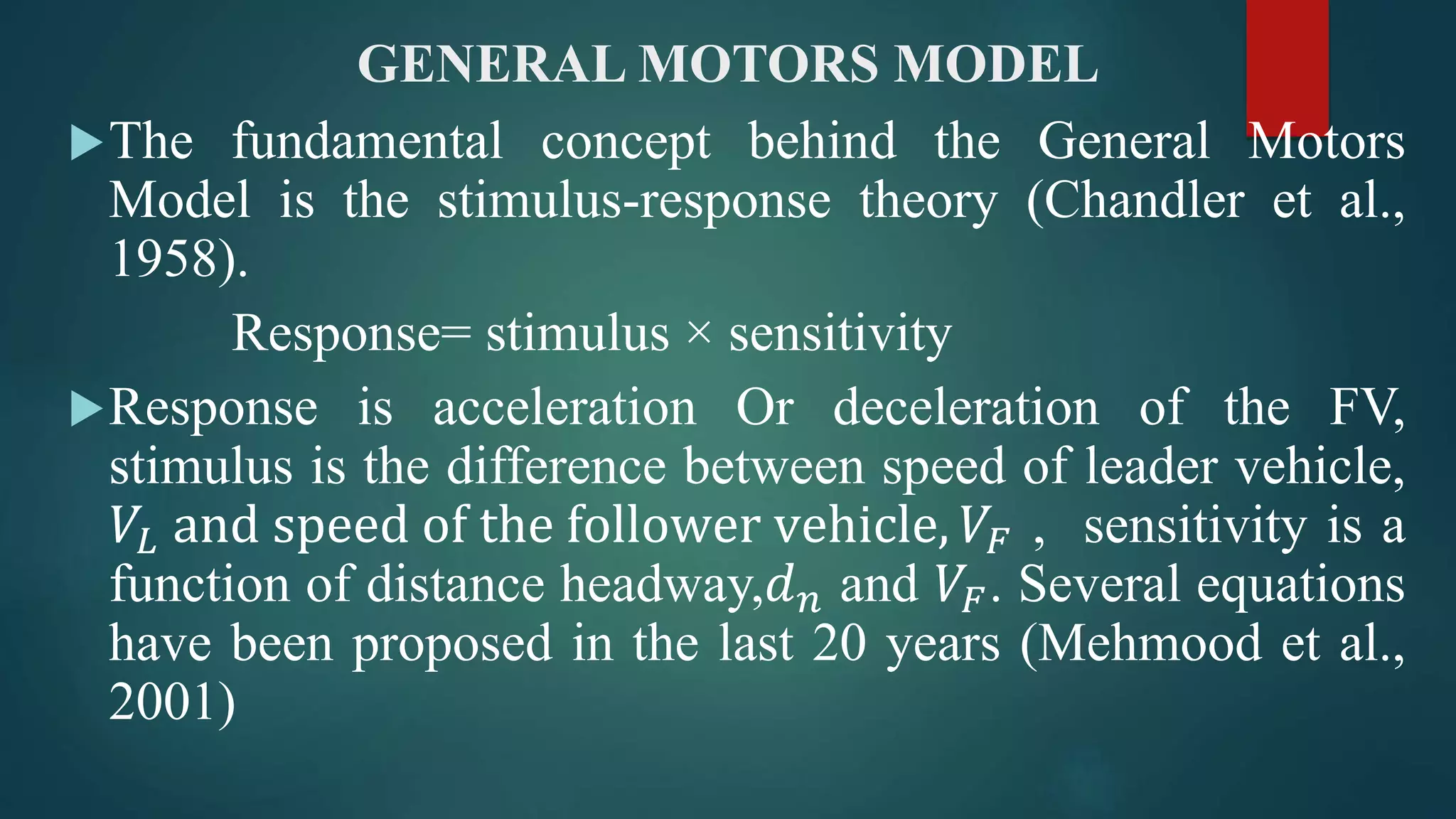
GENERAL MOTORS MODEL
The fundamental concept behind the General Motors
Model is the stimulus-response theory (Chandler et al.,
1958).
Response= stimulus × sensitivity
Response is acceleration Or deceleration of the FV,
stimulus is the difference between speed of leader vehicle,
𝑉𝐿 and speed of the follower vehicle, 𝑉𝐹 , sensitivity is a
function of distance headway,𝑑 𝑛 and 𝑉𝐹. Several equations
have been proposed in the last 20 years (Mehmood et al.,
2001)
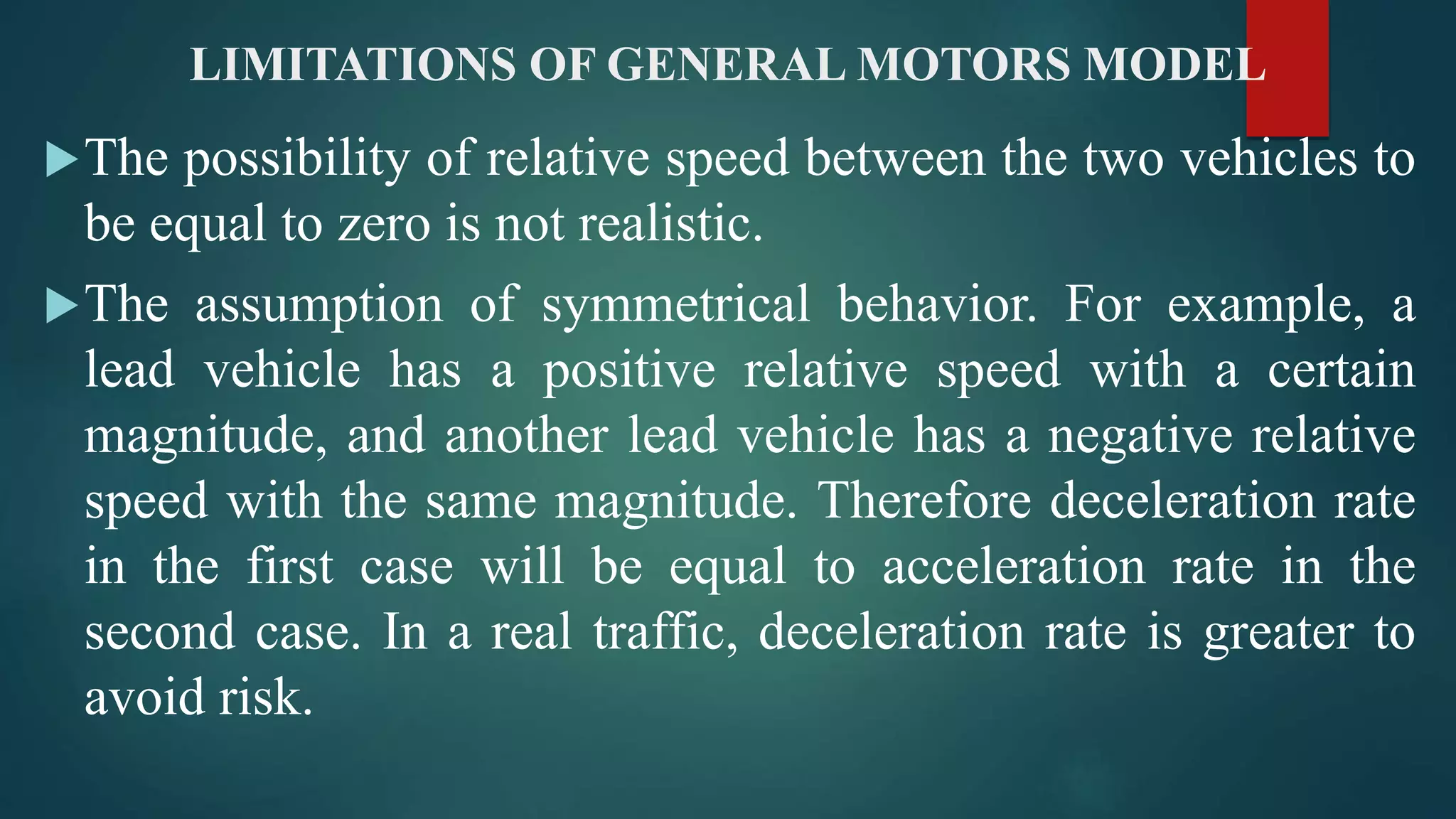
LIMITATIONS OF GENERAL MOTORS MODEL
The possibility of relative speed between the two vehicles to
be equal to zero is not realistic.
The assumption of symmetrical behavior. For example, a
lead vehicle has a positive relative speed with a certain
magnitude, and another lead vehicle has a negative relative
speed with the same magnitude. Therefore deceleration rate
in the first case will be equal to acceleration rate in the
second case. In a real traffic, deceleration rate is greater to
avoid risk.
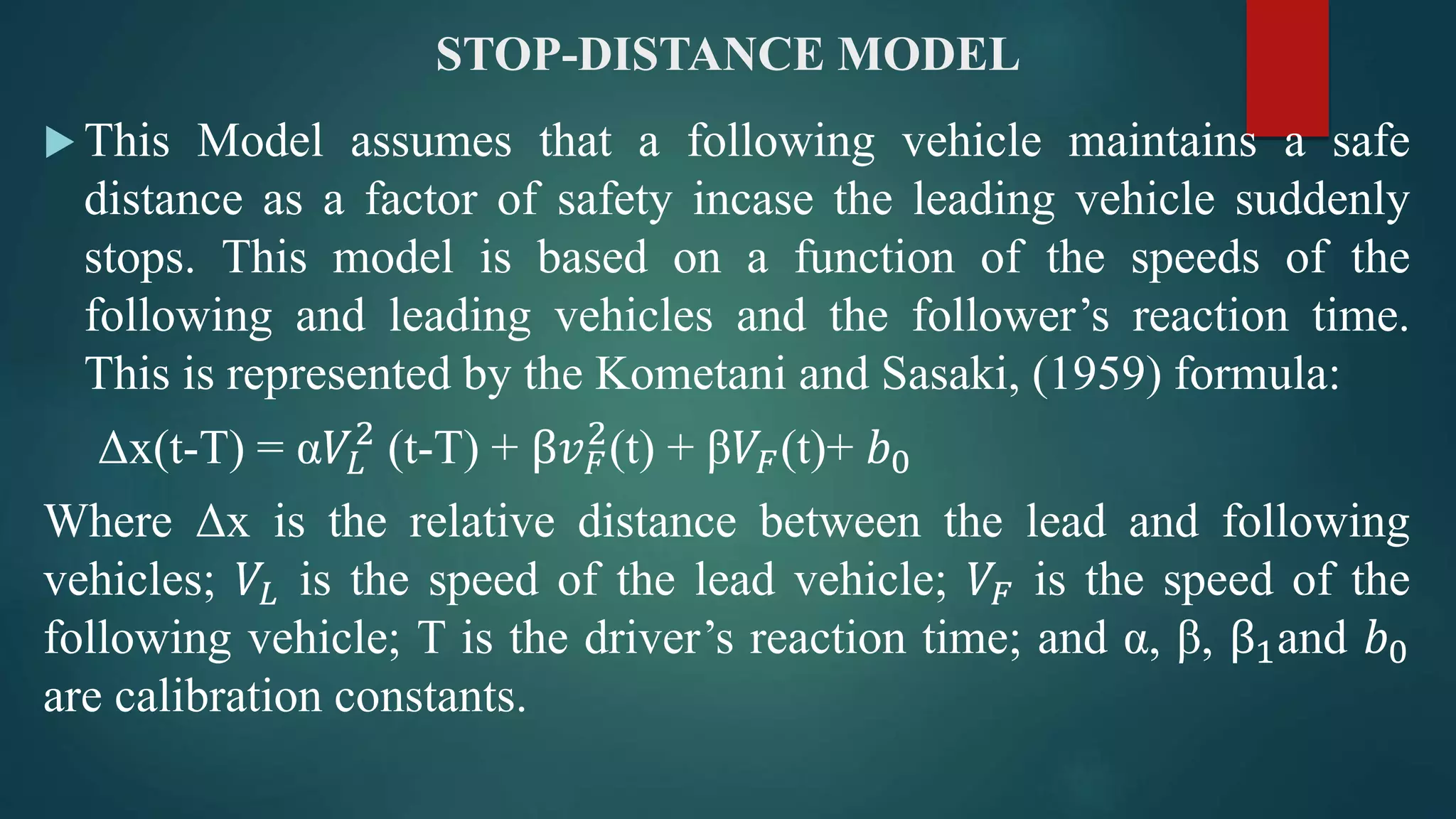
STOP-DISTANCE MODEL
 This Model assumes that a following vehicle maintains a safe
distance as a factor of safety incase the leading vehicle suddenly
stops. This model is based on a function of the speeds of the
following and leading vehicles and the follower’s reaction time.
This is represented by the Kometani and Sasaki, (1959) formula:
Δx(t-T) = α𝑉𝐿
2
(t-T) + β𝑣 𝐹
2
(t) + β𝑉𝐹(t)+ 𝑏0
Where Δx is the relative distance between the lead and following
vehicles; 𝑉𝐿 is the speed of the lead vehicle; 𝑉𝐹 is the speed of the
following vehicle; T is the driver’s reaction time; and α, β, β1and 𝑏0
are calibration constants.
LIMITATIONS OF STOP DISTANCE MODEL
The Stop Distance Model is widely used in microscopic
traffic simulations (Gipps, 1981), because of its easy
calibration based on a realistic driving behavior, requiring
only the maximal deceleration of the following vehicle.
However, the “safe headway” concept is not a totally valid
starting point, and this assumption is not consistent with
empirical observations.
OPTIMAL SPEED MODELS (OSM)
 The Optimal Speed Model (OSM) is a microscopic “car following
type” model first proposed by Bando et al.,(1994).
It is based on the principle that for each situation, there is an Optimal
Speed (OS) to adopt by the driver. Any deviation from this OS
causes the vehicle to adopt an acceleration proportional to the
difference between the optimum and actual speed (Six,etal.,2012).
LIMITATIONS OF OSM
 The sensitivity and the OS function are assumed to be common to
all cars.
 The OS model predicts that a homogenous flow becomes unstable
and transits to a jammed flow if the density exceeds a critical
value (Akihiro et al. (2016)
 Linear OS Functions do not describe realistic microscopic
behaviours (Antoine and Armin, 2014)
 Optimal Speed Model has difficulty to avoid collision in urgent
braking cases (Doudouet al., 2016)
FUZZY LOGIC
In the recent past, many microscopic simulation models have
been developed (Algers et al, 1997) based on probabilistic or
mechanistic approach in capturing drivers’ decisions (Hidas,
2002). However, these approaches do not incorporate the
uncertainties of driver perception and decisions (Wu et al,
2000).
The reactions of a driver perhaps is not based on a
deterministic one-to-one relationship, but on a set of vague
driving rules developed through experience (Chakraborty and
Kikuchi, 1999).
CONTINUETION
• Fuzzy logic provides the opportunity to introduce a
quantifiable degree of uncertainty into the modelling
procedure to reflect the natural or subjective perception of
the real variables (Wu et al. 2000).
• McDonald et al (1997).; Brackstone et al (1998) and Wu et
al. (2000) developed a fuzzy logic model based on fuzzy
sets and systems. To model the lane changing decision, they
classified the lane changing manoeuvres into two categories
lane changes to the near-side lane and lane changes to the
off-side lane.
CONTNUATION
• The fuzzy logic model uses relative velocity and distance divergence
(DD) (ratio of headway distance to desired headway) as input variables.
The output variable is the acceleration or deceleration rate. The DD is the
average of the headway distance that is observed when the relative speeds
between vehicles are close to zero. This model adopts fuzzy functions
(fuzzy sets described by membership functions) as the formula for the
input-output relationship
• The fuzzy logic car-following model was developed by the Transportation
Research Group (TRG) at the University of Southampton (Wu et al.,
2000). McDonald et al. collected car following behavior data on real
roads. Then developed and validated the proposed fuzzy logic car-
following model based on the real-world data
FUZZY LOGIC CAR-FOLLOWING MODEL
The car-following models listed above have established a unique
interpretation of drivers in a car following behaviors;
• General Motors Model described the driver in a car following
situation as a stimuli responder
• Stop Distance Model describe the driver as a safe distance keeper
and
• Optimal speed model describe the driver as a state monitor who
wants to maintain optimal speed below the threshold
However, these models include non-realistic constraints to describe
car-following behavior in real road-traffic environments: symmetry
between acceleration and deceleration, the “safe headway” concept,
and constant acceleration or deceleration above the threshold.
The fuzzy logic car-following model describes driving operations
under car-following conditions using linguistic terms and associated
rules, instead of deterministic mathematical functions.
Car-following behavior can be described in a natural manner that
reflects the imprecise and uncertain human sensory modalities
The fuzzy logic car-following model treats a driver as a decision-
maker who decides the controls based on the current information,
experience and situation as inputs using a fuzzy reasoning.
CONTINUATION
FUTURE RESEARCH
However, the details of the inbuilt mechanism of underlying models are
not been accessible in the available literature. The further refinements
are still going on to improve fuzzy microscopic simulation models in
terms of computational performance, accuracy of the underlying
models in representing realistic traffic flow, analyze various policies
related to ITS applications etc.
1. Chandler, R. E., Herman, R. and Montroll, E. W. (1958) ‘Traffic dynamics: studies
in car following’, Operations Research, 6, pp. 165-184.
2. Chakroborty, P. and Kikuchi, S. (1999) ‘Evaluation of general motors based car-
following models and proposed fuzzy inference model’, Transportation Research C,
7, pp 209-235.
3. McDonald, M., Wu, J., Brackstone, M., 1997. Development of a Fuzzy Logic Based
Microscopic Motorway Simulation Mode. Proceedings of the IEEE Conference on
Intelligent Transportation Systems, Boston, U.S.A.
4. Wu, J., Brackstone, M., McDonald, M., 2000. Fuzzy Sets and Systems for a
Motorway Microscopic Simulation Model. Fuzzy Sets and Systems, special issue on
fuzzy sets in traffic and transport systems 116 (1), 65-76.
5. Gazis, D. C., Herman, R. and Potts, R. B. (1959) ‘Car following theory of steady
state traffic flow’, Operations Research, 7, pp. 499-505.
6. Gipps, P. G. (1981) ‘A behavioral car-following model for computer simulation’,
Transportation Research B, 15, pp. 105-111.
REFERENCE
7. Kometani, E. & Sasaki, T.; (1959). Dynamic behavior of traffic with a nonlinear
spacing speed relationship. Proceedings of the Symposium of Theory of Traffic Flow, pp. 105-
119, New York, USA, 1959
8. Akiyama, T. (2000) ‘Extended traffic assignment models with fuzzy travel time’, Proc. 4th
AFSS, Japan, 1, May-Jun 2000, pp. 587-592.
9. Akiyama, T. and Nomura, T. (1999) ‘The proposal of fuzzy traffic assignment models’,
Journal of EASTS, 3(6), pp. 263-277.
10. Hidas, P. (1998) ‘A car-following model for urban traffic simulation’, Traffic Engineering
Control, 39(5), pp. 300-305.
11. Hidas, P. (2002) ‘Modelling lane changing and merging in microscopic traffic
simulation’, Transportation Research C, 10, pp. 351-371.
12. Mehmood, A., Saccomanno, F., & Hellinga, B.; (2001). Evaluation of a car-following
model using systems dynamics. Proceedings of the 19th International Conference of the
System Dynamics Society, Atlanta, Georgia, USA, July 23-27, 2001
REFERENCE

Adamu muhammad isah

  • 1.
    ADVANCE TRAFFIC ENGINEERINGPRSENTATION TOPIC: REVIEW OF FUZZY MICROSCOPIC TRAFFIC MODELS BY ADAMU, MUHAMMAD ISAH SPS/17/MCE/00074 COURSE FACILITATOR: ENGR. PROF. H.M.ALHASSAN FACULTY OF ENGINEERING, CIVIL ENGINEERING PROGRAM BAYERO UNIVERSITY KANO 15TH MAY, 2018.
  • 2.
    INTRODUCTION  Traffic congestionand increased number of accidents have become one of the most prior problem of populated areas. Because the existing road networks cannot satisfy the current demand and construction of new roads is usually not a solution and often not economical and socially desired. Therefore the need for new traffic management and information systems.  Traffic models are thus fundamental resources in the management of road network. Microscopic models appears to be promising among the models for its ability to describe the dynamics of traffic flow at the level of each individual vehicle.  However, microscopic models assumed that vehicular behavior can be described base on precise and approximated values. But this have its limitations as Human decisions imply uncertainties since most of our behaviors have fuzzy nature rather than crisp, and the application of fuzzy set theory is a useful tool to handle uncertainties.
  • 3.
    AIM The aim ofthis review is to integrate fuzzy logic with microscopic traffic models
  • 4.
    OBJECTIVES  To reviewmicroscopic model assumptions  To highlight the limitations of microscopic model  To give the processes involved in considering fuzzy logic  To highlight the benefits of fuzzy logic in microscopic traffic models.
  • 5.
    JUSTIFICATION Due to increasingnumber of private car ownership, the share of public transport has reduced and therefore an increase in traffic volume. Especially in the medium sized cities, people have a strong perception that car is the most suitable mode when compared to existing public transport system and continuously thinking of owning and using a car. These perception of people will not do justice to the traffic management policies. Therefore the need to review these policies from time to time.
  • 6.
    REVIEW OF MICROSCOPICCAR-FOLLOWING MODEL  Car-following models have been developed since 1950s (Pipes, 1953). These models describe the accelerative behavior of a driver as a function of distance headway and relative speed. The following are representative car-following models  Safe Distance models  Optimal Speed models (OSM)  General motors model (stimulus response model)
  • 7.
    GENERAL MOTORS MODEL Thefundamental concept behind the General Motors Model is the stimulus-response theory (Chandler et al., 1958). Response= stimulus × sensitivity Response is acceleration Or deceleration of the FV, stimulus is the difference between speed of leader vehicle, 𝑉𝐿 and speed of the follower vehicle, 𝑉𝐹 , sensitivity is a function of distance headway,𝑑 𝑛 and 𝑉𝐹. Several equations have been proposed in the last 20 years (Mehmood et al., 2001)
  • 8.
    LIMITATIONS OF GENERALMOTORS MODEL The possibility of relative speed between the two vehicles to be equal to zero is not realistic. The assumption of symmetrical behavior. For example, a lead vehicle has a positive relative speed with a certain magnitude, and another lead vehicle has a negative relative speed with the same magnitude. Therefore deceleration rate in the first case will be equal to acceleration rate in the second case. In a real traffic, deceleration rate is greater to avoid risk.
  • 9.
    STOP-DISTANCE MODEL  ThisModel assumes that a following vehicle maintains a safe distance as a factor of safety incase the leading vehicle suddenly stops. This model is based on a function of the speeds of the following and leading vehicles and the follower’s reaction time. This is represented by the Kometani and Sasaki, (1959) formula: Δx(t-T) = α𝑉𝐿 2 (t-T) + β𝑣 𝐹 2 (t) + β𝑉𝐹(t)+ 𝑏0 Where Δx is the relative distance between the lead and following vehicles; 𝑉𝐿 is the speed of the lead vehicle; 𝑉𝐹 is the speed of the following vehicle; T is the driver’s reaction time; and α, β, β1and 𝑏0 are calibration constants.
  • 10.
    LIMITATIONS OF STOPDISTANCE MODEL The Stop Distance Model is widely used in microscopic traffic simulations (Gipps, 1981), because of its easy calibration based on a realistic driving behavior, requiring only the maximal deceleration of the following vehicle. However, the “safe headway” concept is not a totally valid starting point, and this assumption is not consistent with empirical observations.
  • 11.
    OPTIMAL SPEED MODELS(OSM)  The Optimal Speed Model (OSM) is a microscopic “car following type” model first proposed by Bando et al.,(1994). It is based on the principle that for each situation, there is an Optimal Speed (OS) to adopt by the driver. Any deviation from this OS causes the vehicle to adopt an acceleration proportional to the difference between the optimum and actual speed (Six,etal.,2012).
  • 12.
    LIMITATIONS OF OSM The sensitivity and the OS function are assumed to be common to all cars.  The OS model predicts that a homogenous flow becomes unstable and transits to a jammed flow if the density exceeds a critical value (Akihiro et al. (2016)  Linear OS Functions do not describe realistic microscopic behaviours (Antoine and Armin, 2014)  Optimal Speed Model has difficulty to avoid collision in urgent braking cases (Doudouet al., 2016)
  • 13.
    FUZZY LOGIC In therecent past, many microscopic simulation models have been developed (Algers et al, 1997) based on probabilistic or mechanistic approach in capturing drivers’ decisions (Hidas, 2002). However, these approaches do not incorporate the uncertainties of driver perception and decisions (Wu et al, 2000). The reactions of a driver perhaps is not based on a deterministic one-to-one relationship, but on a set of vague driving rules developed through experience (Chakraborty and Kikuchi, 1999).
  • 14.
    CONTINUETION • Fuzzy logicprovides the opportunity to introduce a quantifiable degree of uncertainty into the modelling procedure to reflect the natural or subjective perception of the real variables (Wu et al. 2000). • McDonald et al (1997).; Brackstone et al (1998) and Wu et al. (2000) developed a fuzzy logic model based on fuzzy sets and systems. To model the lane changing decision, they classified the lane changing manoeuvres into two categories lane changes to the near-side lane and lane changes to the off-side lane.
  • 15.
    CONTNUATION • The fuzzylogic model uses relative velocity and distance divergence (DD) (ratio of headway distance to desired headway) as input variables. The output variable is the acceleration or deceleration rate. The DD is the average of the headway distance that is observed when the relative speeds between vehicles are close to zero. This model adopts fuzzy functions (fuzzy sets described by membership functions) as the formula for the input-output relationship • The fuzzy logic car-following model was developed by the Transportation Research Group (TRG) at the University of Southampton (Wu et al., 2000). McDonald et al. collected car following behavior data on real roads. Then developed and validated the proposed fuzzy logic car- following model based on the real-world data
  • 16.
    FUZZY LOGIC CAR-FOLLOWINGMODEL The car-following models listed above have established a unique interpretation of drivers in a car following behaviors; • General Motors Model described the driver in a car following situation as a stimuli responder • Stop Distance Model describe the driver as a safe distance keeper and • Optimal speed model describe the driver as a state monitor who wants to maintain optimal speed below the threshold However, these models include non-realistic constraints to describe car-following behavior in real road-traffic environments: symmetry between acceleration and deceleration, the “safe headway” concept, and constant acceleration or deceleration above the threshold.
  • 17.
    The fuzzy logiccar-following model describes driving operations under car-following conditions using linguistic terms and associated rules, instead of deterministic mathematical functions. Car-following behavior can be described in a natural manner that reflects the imprecise and uncertain human sensory modalities The fuzzy logic car-following model treats a driver as a decision- maker who decides the controls based on the current information, experience and situation as inputs using a fuzzy reasoning. CONTINUATION
  • 18.
    FUTURE RESEARCH However, thedetails of the inbuilt mechanism of underlying models are not been accessible in the available literature. The further refinements are still going on to improve fuzzy microscopic simulation models in terms of computational performance, accuracy of the underlying models in representing realistic traffic flow, analyze various policies related to ITS applications etc.
  • 19.
    1. Chandler, R.E., Herman, R. and Montroll, E. W. (1958) ‘Traffic dynamics: studies in car following’, Operations Research, 6, pp. 165-184. 2. Chakroborty, P. and Kikuchi, S. (1999) ‘Evaluation of general motors based car- following models and proposed fuzzy inference model’, Transportation Research C, 7, pp 209-235. 3. McDonald, M., Wu, J., Brackstone, M., 1997. Development of a Fuzzy Logic Based Microscopic Motorway Simulation Mode. Proceedings of the IEEE Conference on Intelligent Transportation Systems, Boston, U.S.A. 4. Wu, J., Brackstone, M., McDonald, M., 2000. Fuzzy Sets and Systems for a Motorway Microscopic Simulation Model. Fuzzy Sets and Systems, special issue on fuzzy sets in traffic and transport systems 116 (1), 65-76. 5. Gazis, D. C., Herman, R. and Potts, R. B. (1959) ‘Car following theory of steady state traffic flow’, Operations Research, 7, pp. 499-505. 6. Gipps, P. G. (1981) ‘A behavioral car-following model for computer simulation’, Transportation Research B, 15, pp. 105-111. REFERENCE
  • 20.
    7. Kometani, E.& Sasaki, T.; (1959). Dynamic behavior of traffic with a nonlinear spacing speed relationship. Proceedings of the Symposium of Theory of Traffic Flow, pp. 105- 119, New York, USA, 1959 8. Akiyama, T. (2000) ‘Extended traffic assignment models with fuzzy travel time’, Proc. 4th AFSS, Japan, 1, May-Jun 2000, pp. 587-592. 9. Akiyama, T. and Nomura, T. (1999) ‘The proposal of fuzzy traffic assignment models’, Journal of EASTS, 3(6), pp. 263-277. 10. Hidas, P. (1998) ‘A car-following model for urban traffic simulation’, Traffic Engineering Control, 39(5), pp. 300-305. 11. Hidas, P. (2002) ‘Modelling lane changing and merging in microscopic traffic simulation’, Transportation Research C, 10, pp. 351-371. 12. Mehmood, A., Saccomanno, F., & Hellinga, B.; (2001). Evaluation of a car-following model using systems dynamics. Proceedings of the 19th International Conference of the System Dynamics Society, Atlanta, Georgia, USA, July 23-27, 2001 REFERENCE